
Reflections on the Public Procurement Act Namibia Frederico
Reflections on the Public Procurement Act Namibia Frederico Links, Research Associate, Institute for Public Policy Research @ Workshop on Public Procurement and Human Rights in Africa Monday, November 13, 2017 Pretoria, South Africa
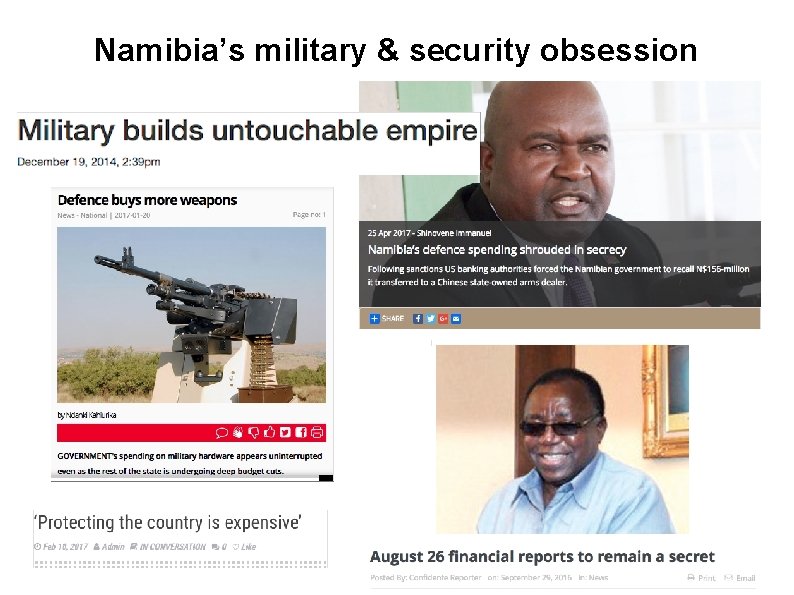
Namibia’s military & security obsession Namibia continues to be a world leader in military spending – a fact that is as baffling as it is damaging for national development. In 2015 Namibia spent 11. 3 percent of its government expenditure on defence – a figure only eclipsed by Angola (11. 5), Algeria (14. 3) and South Sudan (28) in Africa.
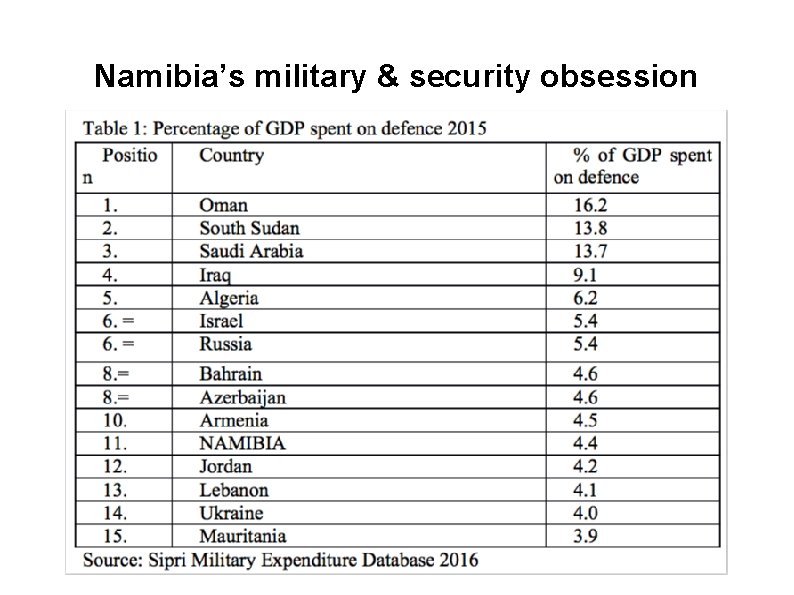
Namibia’s military & security obsession In 2015 Namibia was 11 th in the world rankings of defence expenditure in terms of Gross Domestic Product – having splurged 4. 4 percent of GDP on military spending. This made Namibia the second highestspending country in sub-Saharan Africa after the virtual failed state of South Sudan.
Namibia’s military & security obsession
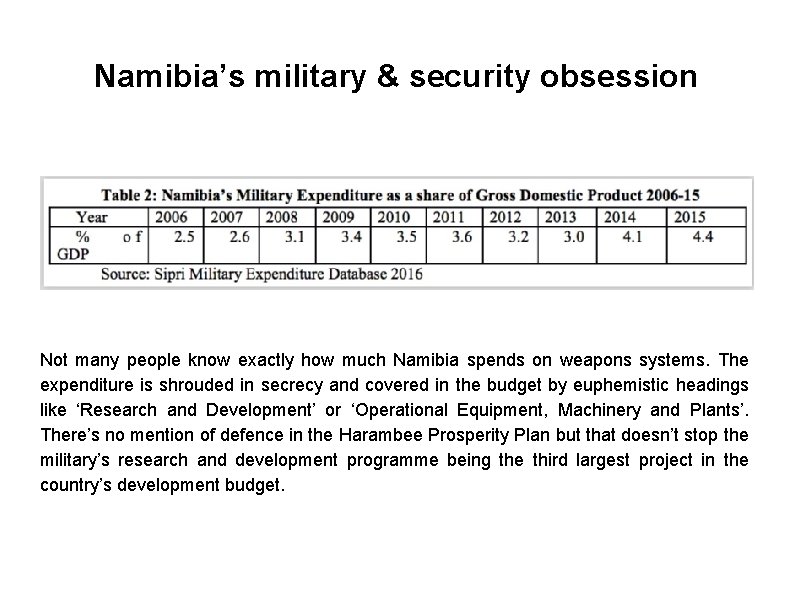
Namibia’s military & security obsession Not many people know exactly how much Namibia spends on weapons systems. The expenditure is shrouded in secrecy and covered in the budget by euphemistic headings like ‘Research and Development’ or ‘Operational Equipment, Machinery and Plants’. There’s no mention of defence in the Harambee Prosperity Plan but that doesn’t stop the military’s research and development programme being the third largest project in the country’s development budget.
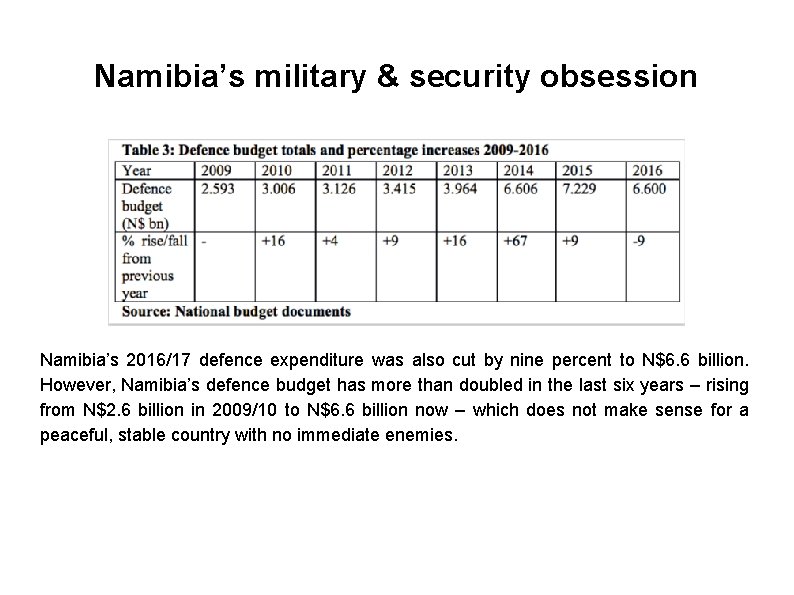
Namibia’s military & security obsession Namibia’s 2016/17 defence expenditure was also cut by nine percent to N$6. 6 billion. However, Namibia’s defence budget has more than doubled in the last six years – rising from N$2. 6 billion in 2009/10 to N$6. 6 billion now – which does not make sense for a peaceful, stable country with no immediate enemies.

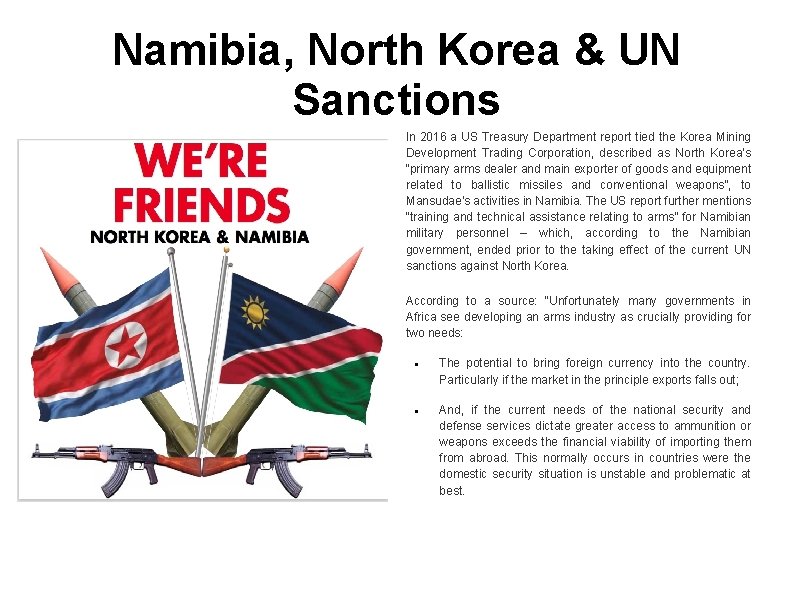
Namibia, North Korea & UN Sanctions In 2016 a US Treasury Department report tied the Korea Mining Development Trading Corporation, described as North Korea’s “primary arms dealer and main exporter of goods and equipment related to ballistic missiles and conventional weapons”, to Mansudae’s activities in Namibia. The US report further mentions “training and technical assistance relating to arms” for Namibian military personnel – which, according to the Namibian government, ended prior to the taking effect of the current UN sanctions against North Korea. According to a source: “Unfortunately many governments in Africa see developing an arms industry as crucially providing for two needs: The potential to bring foreign currency into the country. Particularly if the market in the principle exports falls out; And, if the current needs of the national security and defense services dictate greater access to ammunition or weapons exceeds the financial viability of importing them from abroad. This normally occurs in countries were the domestic security situation is unstable and problematic at best.
Namibia’s military & security obsession
Namibia’s military & security obsession
“Tender business in Namibia, is good business”
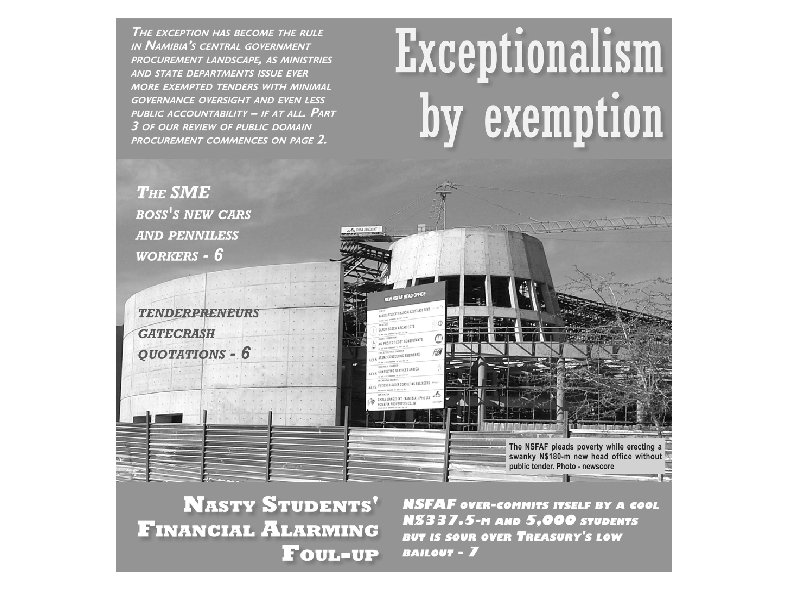
The 'grey' practice The award of government contracts became increasingly less transparent and the dealings of the Tender Board more opaque, as tender exemptions – an unquestionably ‘grey’ practice – appeared to become the norm in public contracting.
The 'grey' practice “In the 2005 -06 financial year the Tender Board approved tenders worth N$619 million and tender exemptions worth N$170. 4 million. In the 200607 financial year, exemptions spiralled to N$1. 6 billion in value while awarded tenders amounted to N$868. 3 million. This trend continued through the 2007 -08 financial year, when the value of government procurement soared to over N$4 billion, and the value of tender awards amounted to N$624. 3 million, compared to N$3. 4 billion spent on tender exempted procurement. If this trend is followed through to the present and beyond, then a disturbing picture becomes starkly clear, in that tender exemptions appear to have become the rule and have long since ceased to be the exception. ” - Links, F and C. Daniels (2011) The Tender Board – Need for root and branch reform, IPPR Anti-Corruption Research Programme.
The 'grey' practice In 2010 -11 central government procurement amounted to about N$6. 2 billion, with exemptions hitting N$4. 3 billion, and in 2012 -13 government procurement spiked to an astronomical N$14 billion, with a staggering N$9. 2 billion exempted from competitive tendering. It is probably reasonable to suggest that 2015 -16 public sector procurement, budgeted at over N$13 billion, will see this trend continuing.
The 'grey' practice The state’s procurement needs have dramatically surged in volume, complexity and sophistication over the last two decades; The Tender Board Act of 1996 became out-dated; Systemic weaknesses have led to “loss of public and stakeholder confidence in the integrity of public procurement processes, which in turn has led to a negative corporate image for the Tender Board, and by extension diminished its credibility”; Corruption and mismanagement are present at all state levels and in structures; “The Public Procurement process is fraught with conflict of interest, delays, favouritism, abuse of office and outright corruption”.

Has anything changed with the coming of the Public Procurement Act of 2015?
Public Procurement Act (2015) Key considerations: The Namibian Public Procurement Act (2015) is a consequence of the United Nations Commission on International Trade Law (UNCITRAL) Model Law on Procurement of Goods, Construction and Services and the UN Convention Against Corruption (UNCAC). Article 9 of chapter II explicitly encourages Namibia to “take the necessary steps to establish appropriate systems of procurement, based on transparency, competition and objective criteria in decision-making, that are effective, inter alia, in preventing corruption”.
Public Procurement Act (2015) The six broad requirements of UNCAC's article 9 are: (a) the establishment of a sound procurement system; (b) transparency in procurement; (c) objective decision-making in procurement; (d) domestic review (or bid challenge) systems; (e) integrity of public officials; and (f) soundness of public records and finance
Public Procurement Act (2015) The Public Procurement Act from the get-go seems to speak to the intent to meet these requirements. Right up front the law states: “ 2. The objects of this Act are (a) to promote integrity, accountability, transparency, competitive supply, effectiveness, efficiency, fair-dealing, responsiveness, informed decision-making, consistency, legality and integration in the procurement of assets, works and services [. . . ]. ”
Public Procurement Act (2015) The following provisions of Part 1 (Introductory Provisions) of the law need to be flagged: “Exemptions 4. (1) The Minister may for a specified or unspecified period issue a general or specific exemption from the application of certain provisions that are not practical or appropriate for the procurement, letting, hiring or disposal of security related goods, works, services and property by the (a) Namibian Defence Force; (b) Namibian Police Force; (c) Namibia Correctional Services; and (d) Namibia Central Intelligence Service.
Public Procurement Act (2015) (2) The Minister may, with or without condition, as the Minister may determine, grant a general or specific exemption by way of a directive for specific types of procurement or disposal from the application of certain provisions of this Act that are not practical or appropriate for the purpose for which such goods are let, hired or disposed of, including goods, works and services being procured. (3) Any information, document or record relating to the procurement or disposal of security related goods, works, services or property contemplated in subsection (1) are strictly confidential and secret. ”
Public Procurement Act (2015) Also worthy of flagging is the allowance for emergency procurement, which like exemptions, creates an avenue for undermining, sidestepping or abusing procurement practices and for corruption to infiltrate what in law and on paper comes across as an otherwise “sound procurement system”.
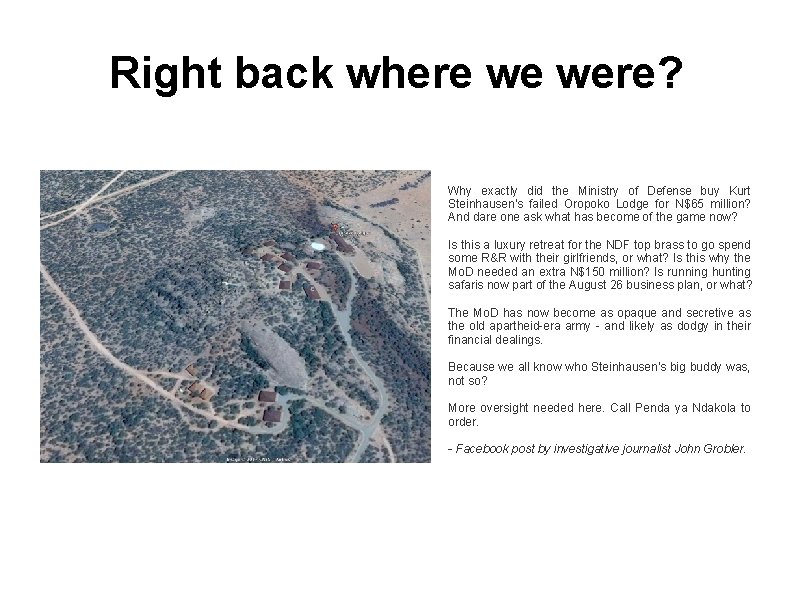
Right back where we were? Why exactly did the Ministry of Defense buy Kurt Steinhausen's failed Oropoko Lodge for N$65 million? And dare one ask what has become of the game now? Is this a luxury retreat for the NDF top brass to go spend some R&R with their girlfriends, or what? Is this why the Mo. D needed an extra N$150 million? Is running hunting safaris now part of the August 26 business plan, or what? The Mo. D has now become as opaque and secretive as the old apartheid-era army - and likely as dodgy in their financial dealings. Because we all know who Steinhausen's big buddy was, not so? More oversight needed here. Call Penda ya Ndakola to order. - Facebook post by investigative journalist John Grobler.

That's that, folks! Thanks
- Slides: 26