
Reflections on my career and why it has

- Slides: 13
Reflections on my career and why it has developed as it has Susan Michie Professor of Health Psychology, UCL, June 2017
Zigzagging • • Education/training – 8 years NHS Hospital – about 10 years – had 3 children Kings College London + 1 day at NHS Hospital – 9 years University College London – 15 years 2
Education/training • Undergraduate – Experimental Psychology • Clinical Psychology training • Ph. D in Developmental Psychology 3
Royal Free Hospital • Worked as clinical psychologist for children and families • Began to do research into antenatal care • Clinical/academic post – clinical post in Occupational Health Unit – organisational consultancy – research into organisational interventions and staff stress 4
University posts • Kings College London – Research programme investigating psychological aspects of genetic testing – One day a week at Royal Free Hospital – Chair of the British Psychological Society Division of Health Psychology • University College London – Behaviour change in relation to health • Prevention, adaptation to illness, implementation (professional practice) – President of the European Health Psychology Society – Consultancy with the Department of Health; with NICE (National Institute for Health and Clinical Excellence – Set up UCL Centre for Behaviour Change 5
UCL Centre for Behaviour Change @UCLBehave. Change www. ucl. ac. uk/behaviour-change
What has influenced what I have done? • In my inaugural talk when I was made a professor, I thanked my parents who taught me to – Question everything – Respect evidence – Value social justice 7
The work that I have done … • Intellectually interesting • Socially useful • Working with people who I like 8
This has led to working with … • Many disciplines across a broad range – E. g. Human Behaviour Change Project • Policy-makers – E. g. Dept Health, Public Health England … both require listening and understanding agendas, incentives, concepts, language … this takes time 9
Some tensions • Work vs Rest of life – Work is only one part of one’s life – but an important part! • Academic vs applied – Clinical, policy • Breadth vs depth – Be curious and open to opportunities vs be focused • Ploughing one’s own furrow vs helping others/being collegiate – Altruism is reciprocated 10
Some Top Tips • Follow your energy and enthusiasm • Make things fun • Be organised – That way you can lead at least two lives in one • Persistence pays – If you believe in something or want something, don’t give up & don’t put practicalities before possibilities • Never be afraid to say you don’t know or ask for help – Seek and use mentorship/ support/ help – And offer it! 11
For research … • Know what’s gone before – Understand the history, what has been done, why, with what outcomes; what has been found and learnt? – Science is/should be a cumulative process • Be prepared to go out on a limb – don’t be constrained by current thinking/fashion • Communicate clearly – K. I. S. 12
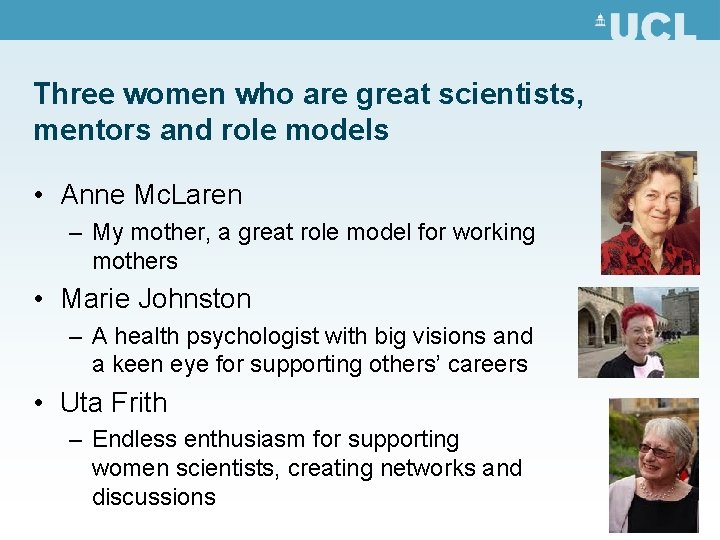
Three women who are great scientists, mentors and role models • Anne Mc. Laren – My mother, a great role model for working mothers • Marie Johnston – A health psychologist with big visions and a keen eye for supporting others’ careers • Uta Frith – Endless enthusiasm for supporting women scientists, creating networks and discussions 13