
Reflections on Early AI and CS at Stanford

- Slides: 20
Reflections on Early AI and CS at Stanford 1963 – 1969 and Beyond Raj Reddy Carnegie Mellon University March 21, 2006 Panel at CS 40 celebrations
1960 s: The Golden Age of SAIL • • • Robotics Computer Vision Knowledge Engineering Speech Language Understanding Computer Music • Chess, Symbolic Mathematics, Correctness of Programs, Theorem Proving, Logical AI, Common Sense • Time Sharing • LISP • DEC Clones: Foonly, Graphical Editors, Pieces of Glass, Theory of Computation
The Hand Eye Project • Interaction with the Physical World • Early work by • Karl Pingle, Bill Wichman, Don Pieper • Main Project Team • Jerry Feldman, R. Lou Paul, Marty Tenenbaum, Gerry Agin, Irwin Sobel, etc. • Robotic Hands • Bernie Roth and Vic Scheinman • Started in 1965 • Using the PDP 1 and later the PDP 6 • Led Machine Vision and Robotics Industry
Image Analysis and Understanding • Image Analysis • Manfred Hueckel, Ruzena Bajcsy, and Tom Binford • Led to Vision and Robotics at UPenn • Image Understanding • Natural Scenes and Face Recognition • Mike Kelly and Raj Reddy • Led to Vision and Robotics at CMU
Mobile Robotics • Mars Rover and Stanford Cart • Marvin Minsky (visiting) • Mars Explorer project 1964 • • • Les Earnest Bruce Baumgart Lynn Quam Hans Moravec Rod Brooks (later in the seventies) • Influenced direction of programs at SRI and MIT
Capturing Expertise • Heuristic Dendral: Representation, acquisition and use of knowledge in chemical inference • Project Team • Ed Feigenbaum, Josh Lederberg, Bruce Buchanan, Georgia Sutherland et al. • Started in 1965 • Led to • Expert Systems, Knowledge Engineering • Knowledge Based Systems Industry • Early Applications of AI
Speech • Speech Input to Computers • • Started in 1964 as a class project Using a PDP 1 with drum memory and a display By the end of 1964 we had a vowel recognizer running Project team in the sixties • Raj Reddy, Pierre Vicens, Lee Erman, Gary Goodman, Richard Neely • Led to the DARPA Speech Understanding Project during the years 1971 -76 • Most influential branch of Speech Recognition Industry: Dragon Systems, Apple, Microsoft • Indirectly IBM and Bell Labs
Language Understanding • Parsing and Understanding of Natural Language: Question Asking and Dialog Modeling • Computer Simulation of Belief systems • Ken Colby, Lawrence Tesler, Horace Enea et al • Parsing of Non-Grammatical Sentences • Colby, Enea et al • Conceptual Parsing • Roger Shank • Led to Language Processing Industry • via Shank and associates • Led to other Language Processing groups at Yale and UCLA • CMU, UMass, Berkeley, etc. • Influential strand of Language research
Computer Music • Computer Synthesis of Music • Started in 1964 on PDP 1 • John Chowning • Leland Smith • Andy Moorer • Impact • Led to Yamaha adopting digital synthesis for consumer products • Establishment of a Center in Computer Music in Paris
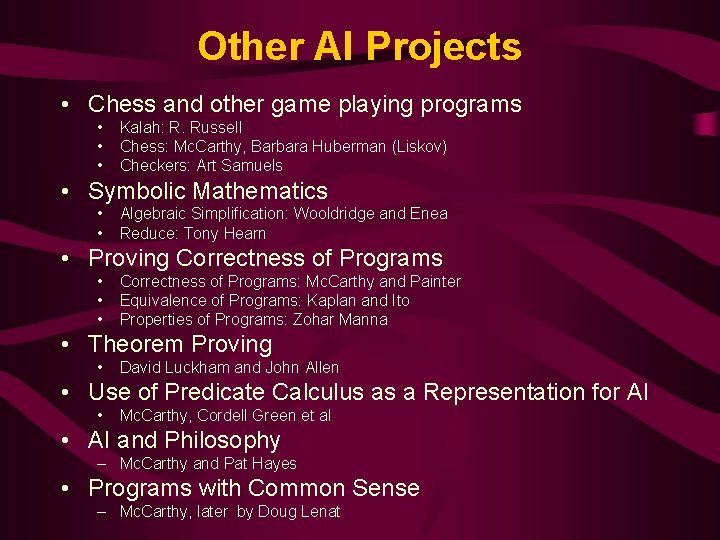
Other AI Projects • Chess and other game playing programs • • • Kalah: R. Russell Chess: Mc. Carthy, Barbara Huberman (Liskov) Checkers: Art Samuels • Symbolic Mathematics • • Algebraic Simplification: Wooldridge and Enea Reduce: Tony Hearn • Proving Correctness of Programs • • • Correctness of Programs: Mc. Carthy and Painter Equivalence of Programs: Kaplan and Ito Properties of Programs: Zohar Manna • Theorem Proving • David Luckham and John Allen • Use of Predicate Calculus as a Representation for AI • Mc. Carthy, Cordell Green et al • AI and Philosophy – Mc. Carthy and Pat Hayes • Programs with Common Sense – Mc. Carthy, later by Doug Lenat
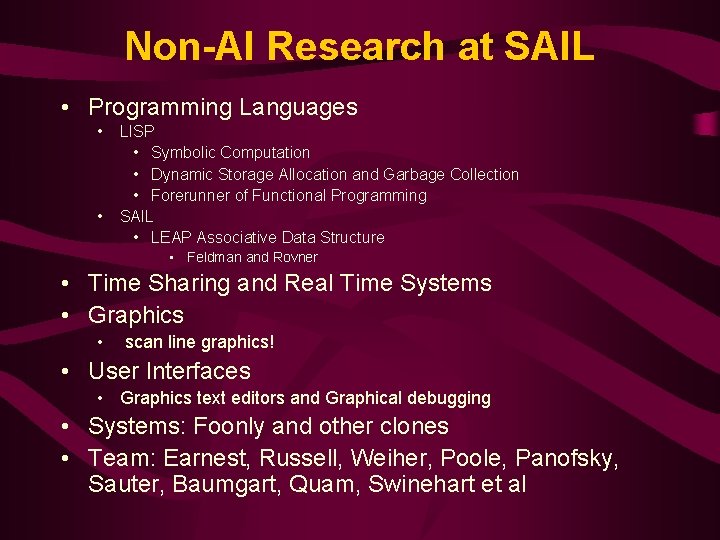
Non-AI Research at SAIL • Programming Languages • • LISP • Symbolic Computation • Dynamic Storage Allocation and Garbage Collection • Forerunner of Functional Programming SAIL • LEAP Associative Data Structure • Feldman and Rovner • Time Sharing and Real Time Systems • Graphics • scan line graphics! • User Interfaces • Graphics text editors and Graphical debugging • Systems: Foonly and other clones • Team: Earnest, Russell, Weiher, Poole, Panofsky, Sauter, Baumgart, Quam, Swinehart et al
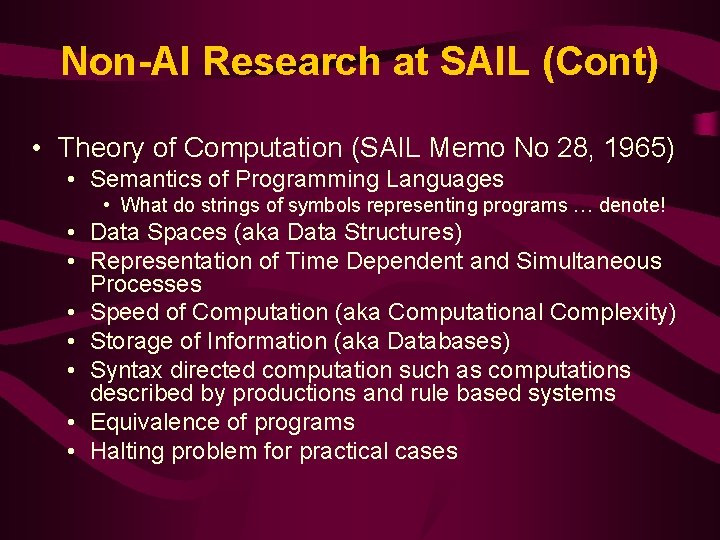
Non-AI Research at SAIL (Cont) • Theory of Computation (SAIL Memo No 28, 1965) • Semantics of Programming Languages • What do strings of symbols representing programs … denote! • Data Spaces (aka Data Structures) • Representation of Time Dependent and Simultaneous Processes • Speed of Computation (aka Computational Complexity) • Storage of Information (aka Databases) • Syntax directed computation such as computations described by productions and rule based systems • Equivalence of programs • Halting problem for practical cases
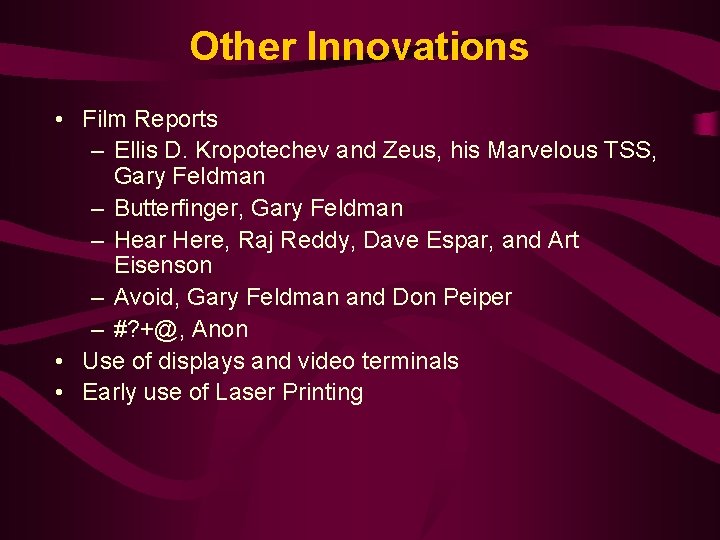
Other Innovations • Film Reports – Ellis D. Kropotechev and Zeus, his Marvelous TSS, Gary Feldman – Butterfinger, Gary Feldman – Hear Here, Raj Reddy, Dave Espar, and Art Eisenson – Avoid, Gary Feldman and Don Peiper – #? +@, Anon • Use of displays and video terminals • Early use of Laser Printing
Looking back: What we missed! • Personal Computers! • Alan Kay’s dynabook vs Apple and PCs • Internet and the WWW • ARPAnet in 1968 with Stanford as one of the initial nodes • Moore’s Law and VLSI • Graphics • Human Computer Interaction • UI design
Looking back: off in timing! • • Speech Vision Robotics Natural Language
Recent Trends in AI • Learning Systems • • Learn from examples Learn from experience Dynamic Learning from Sparse data • Architecture of Intelligence • Integrated Intelligence • • • Learn from Experience Use Knowledge Communicate using Speech and Language Operate in real time etc
Recent Trends in CS • • Lisp Timesharing Algorithm Design Systems Graphics UI Hardware → Functional Languages → Thin Clients → Scalable Dependable → beyond OS → 2 D to 3 D → Illiterate users? → Low power mobile
Whither AI? • Arthur Clarke’s The Songs of the Distant Earth • Ray Kurzweil’s Immortality
Whither CS? • Computers are for Entertainment and Communication • Not for Computing • “People are the Killer App” from Parc • Software as Service • Death of Software Product Market • Net 2. 0 and Web Services • Cell Phone as the Dominant Computing Platform • Embedded Body Computers
In Conclusion… • Much of what transpired in AI and CS in the last 40 years can be seen to have roots in the Stanford AI Labs activities of the 60 s! – We now have a million times more computing power! – May be we do need 1. 7 Einsteins, 3 Maxwells and 0. 7 Manhattan project (Mc. Carthy, 1980 s) to get there