
REFLECTIONS ON A MORAL TURING TEST Peter hrstrm
- Slides: 44
REFLECTIONS ON A MORAL TURING TEST Peter Øhrstrøm
Can ethics be implemented in a computer system? Can an ethical agent be constructed?
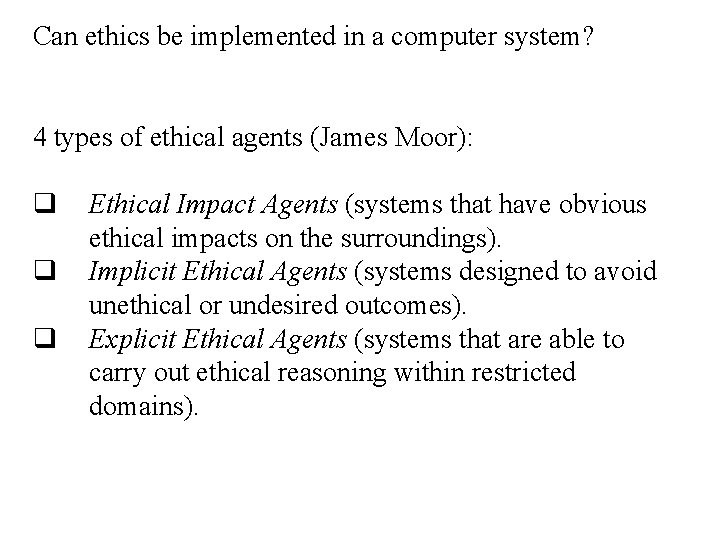
Can ethics be implemented in a computer system? 4 types of ethical agents (James Moor): q Ethical Impact Agents (systems that have obvious ethical impacts on the surroundings).
Can ethics be implemented in a computer system? 4 types of ethical agents (James Moor): q q Ethical Impact Agents (systems that have obvious ethical impacts on the surroundings). Implicit Ethical Agents (systems designed to avoid unethical or undesired outcomes).
Can ethics be implemented in a computer system? 4 types of ethical agents (James Moor): q q q Ethical Impact Agents (systems that have obvious ethical impacts on the surroundings). Implicit Ethical Agents (systems designed to avoid unethical or undesired outcomes). Explicit Ethical Agents (systems that are able to carry out ethical reasoning within restricted domains).
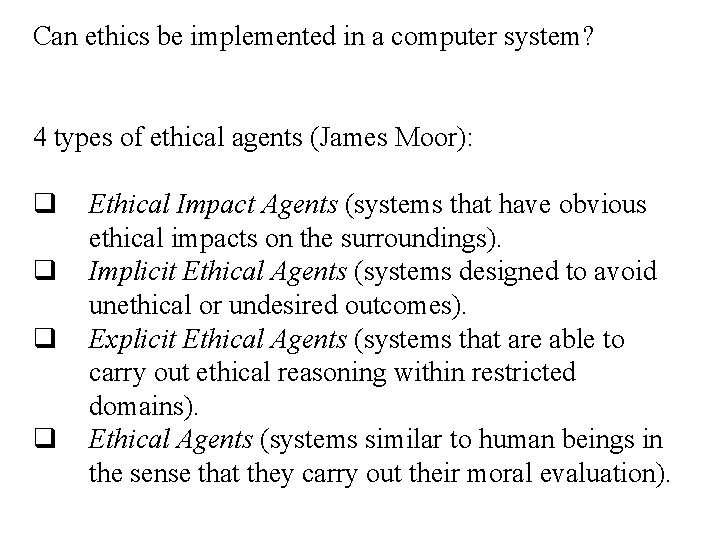
Can ethics be implemented in a computer system? 4 types of ethical agents (James Moor): q q Ethical Impact Agents (systems that have obvious ethical impacts on the surroundings). Implicit Ethical Agents (systems designed to avoid unethical or undesired outcomes). Explicit Ethical Agents (systems that are able to carry out ethical reasoning within restricted domains). Ethical Agents (systems similar to human beings in the sense that they carry out their moral evaluation).
q Ethical Agents (systems similar to human beings in the sense that they carry out their moral evaluation).
q Ethical Agents (systems similar to human beings in the sense that they carry out their moral evaluation). A necessary condition for being an ethical agent: It should pass the Moral Turing Test (MTT).
q Ethical Agents (systems similar to human beings in the sense that they carry out their moral evaluation). A necessary condition for being an ethical agent: It should pass the Moral Turing Test (MTT). A computer system passes the MTT if a human who interacts with the system is unable to distinguish between utterances on moral issues produced by the computer and those produced by a fellow human being.
q Ethical Agents (systems similar to human beings in the sense that they carry out their moral evaluation). A necessary condition for being an ethical agent: It should pass the Moral Turing Test (MTT). A computer system passes the MTT if a human who interacts with the system is unable to distinguish between utterances on moral issues produced by the computer and those produced by a fellow human being. Which sort of problems should a system which can pass the MTT be able to handle?
q Ethical Agents (systems similar to human beings in the sense that they carry out their moral evaluation). A necessary condition for being an ethical agent: It should pass the Moral Turing Test (MTT). A computer system passes the MTT if a human who interacts with the system is unable to distinguish between utterances on moral issues produced by the computer and those produced by a fellow human being. Which sort of problems should a system which can pass the MTT be able to handle? What would it mean for Robot to be able to handle ethical questions just as well as Frank?
An example borrowed from Linda Johansson (2012): Is it right to hit this annoying person with a baseball bat?
An example borrowed from Linda Johansson (2012): Is it right to hit this annoying person with a baseball bat? Does passing the MTT just mean that the system can handle such questions in a manner which is satisfactory from a human point of view?
An example borrowed from Linda Johansson (2012): Is it right to hit this annoying person with a baseball bat? Does passing the MTT just mean that the system can handle such questions in a manner which is satisfactory from a human point of view? A computer system passes the MTT if a human who interacts with the system is unable to distinguish between utterances (including reasoning) on moral issues produced by the computer and those produced by a fellow human being.
In order to pass the Moral Turing Test (MTT) the system should be able to: q reason taking alternative future possibilities into consideration
In order to pass the Moral Turing Test (MTT) the system should be able to: q q reason taking alternative future possibilities into consideration reason as if the action taken have been based on free choice (in the sense that the agent could have done otherwise)
In order to pass the Moral Turing Test (MTT) the system should be able to: q q q reason taking alternative future possibilities into consideration reason as if the action taken have been based on free choice (in the sense that the agent could have done otherwise) rationally evaluate the possible actions from a an ethical point of view
In order to pass the Moral Turing Test (MTT) the system should be able to: q q q reason taking alternative future possibilities into consideration reason as if the action taken have been based on free choice (in the sense that the agent could have done otherwise) rationally evaluate the possible actions from a an ethical point of view Is passing the MTT also a sufficient condition for being an ethical agent? – This is an open question!
In order to pass the Moral Turing Test (MTT) the system should be able to: q q q reason taking alternative future possibilities into consideration reason as if the action taken have been based on free choice (in the sense that the agent could have done otherwise) rationally evaluate the possible actions from a an ethical point of view Is there a formalization of human moral reasoning, which can give rise to an algorithm which can be implemented in a computer?
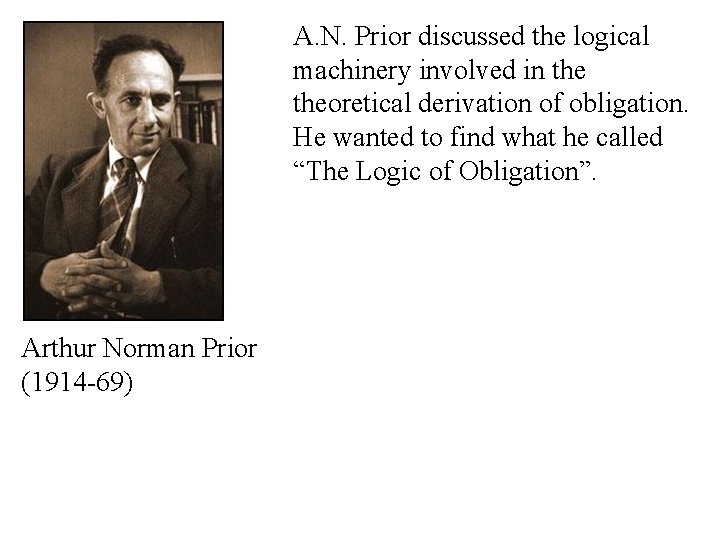
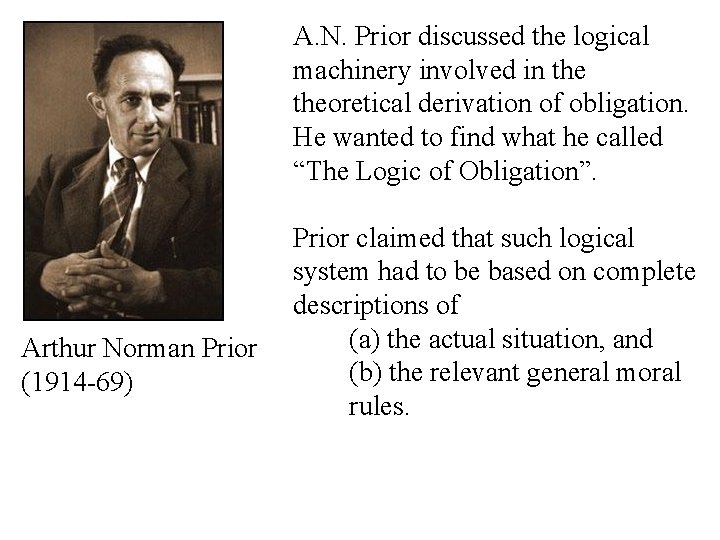
A. N. Prior discussed the logical machinery involved in theoretical derivation of obligation. He wanted to find what he called “The Logic of Obligation”. Arthur Norman Prior (1914 -69)
A. N. Prior discussed the logical machinery involved in theoretical derivation of obligation. He wanted to find what he called “The Logic of Obligation”. Arthur Norman Prior (1914 -69) Prior claimed that such logical system had to be based on complete descriptions of (a) the actual situation, and (b) the relevant general moral rules.
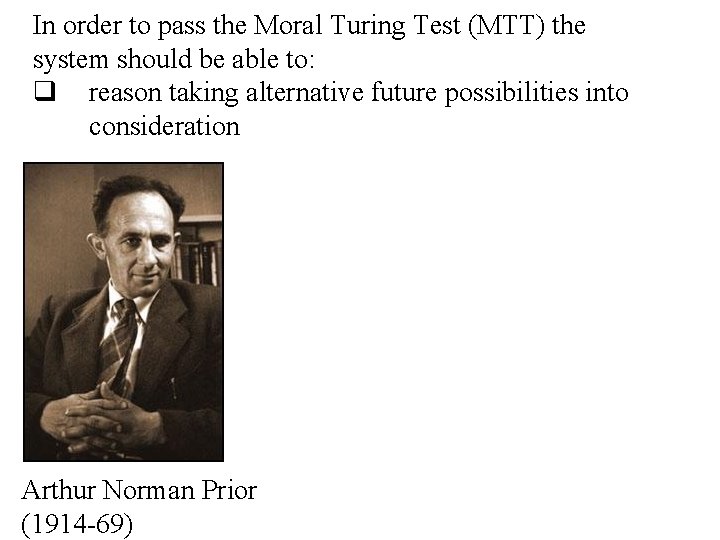
In order to pass the Moral Turing Test (MTT) the system should be able to: q reason taking alternative future possibilities into consideration Arthur Norman Prior (1914 -69)
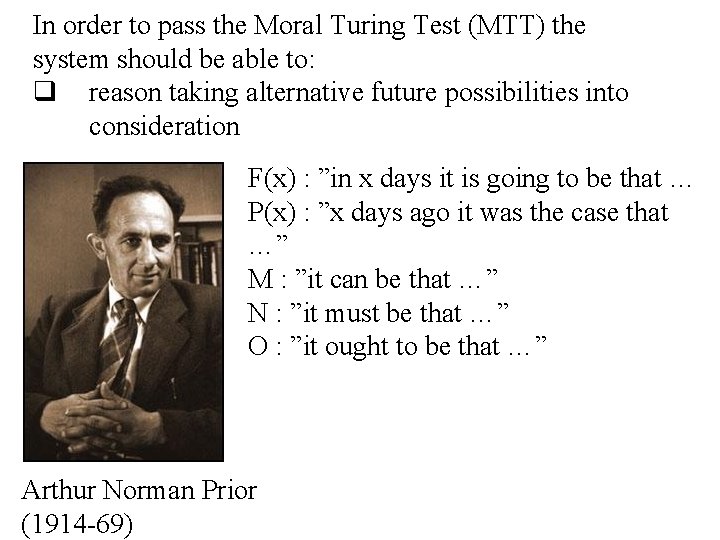
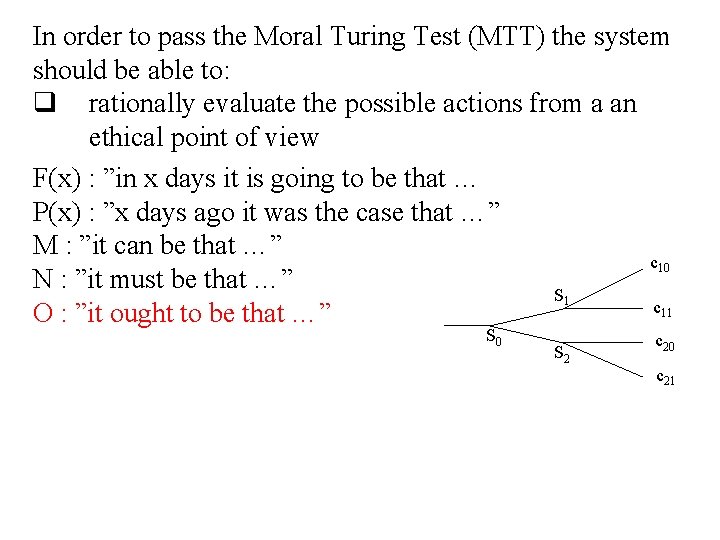
In order to pass the Moral Turing Test (MTT) the system should be able to: q reason taking alternative future possibilities into consideration F(x) : ”in x days it is going to be that … P(x) : ”x days ago it was the case that …” M : ”it can be that …” N : ”it must be that …” O : ”it ought to be that …” Arthur Norman Prior (1914 -69)
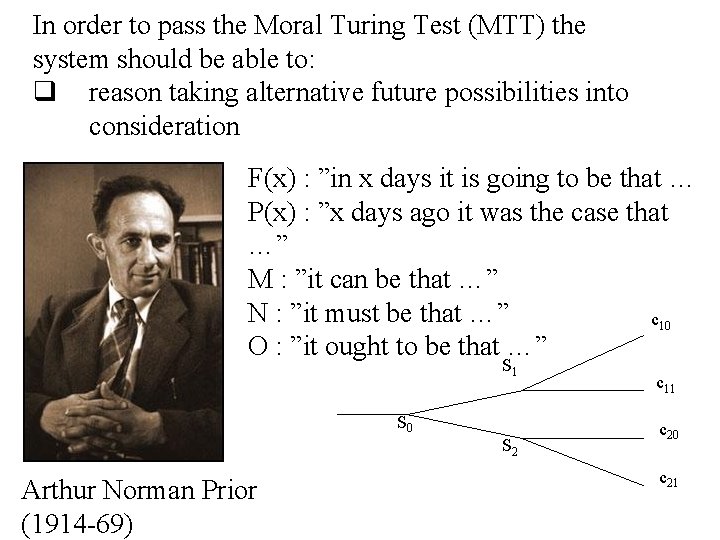
In order to pass the Moral Turing Test (MTT) the system should be able to: q reason taking alternative future possibilities into consideration F(x) : ”in x days it is going to be that … P(x) : ”x days ago it was the case that …” M : ”it can be that …” N : ”it must be that …” c 10 O : ”it ought to be that …” S 1 S 0 S 2 Arthur Norman Prior (1914 -69) c 11 c 20 c 21
In order to pass the Moral Turing Test (MTT) the system should be able to: q reason as if the action taken have been based on free choice (in the sense that the agent could have done otherwise)
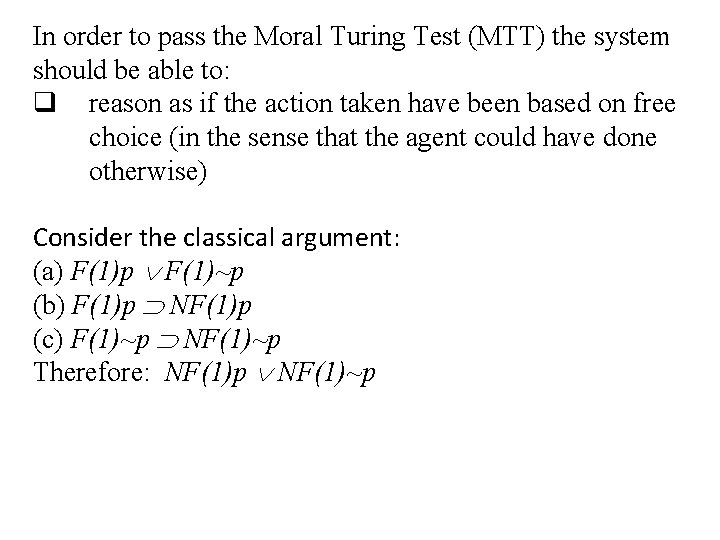
In order to pass the Moral Turing Test (MTT) the system should be able to: q reason as if the action taken have been based on free choice (in the sense that the agent could have done otherwise) Consider the classical argument: (a) F(1)p F(1)~p (b) F(1)p NF(1)p (c) F(1)~p NF(1)~p Therefore: NF(1)p NF(1)~p
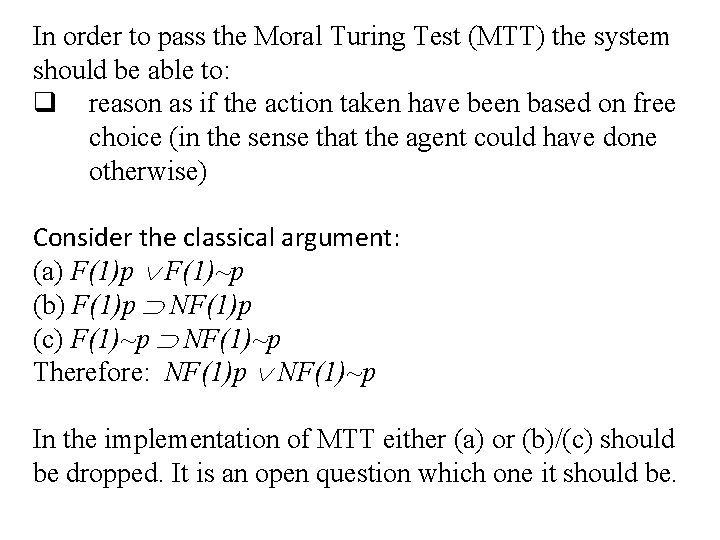
In order to pass the Moral Turing Test (MTT) the system should be able to: q reason as if the action taken have been based on free choice (in the sense that the agent could have done otherwise) Consider the classical argument: (a) F(1)p F(1)~p (b) F(1)p NF(1)p (c) F(1)~p NF(1)~p Therefore: NF(1)p NF(1)~p In the implementation of MTT either (a) or (b)/(c) should be dropped. It is an open question which one it should be.
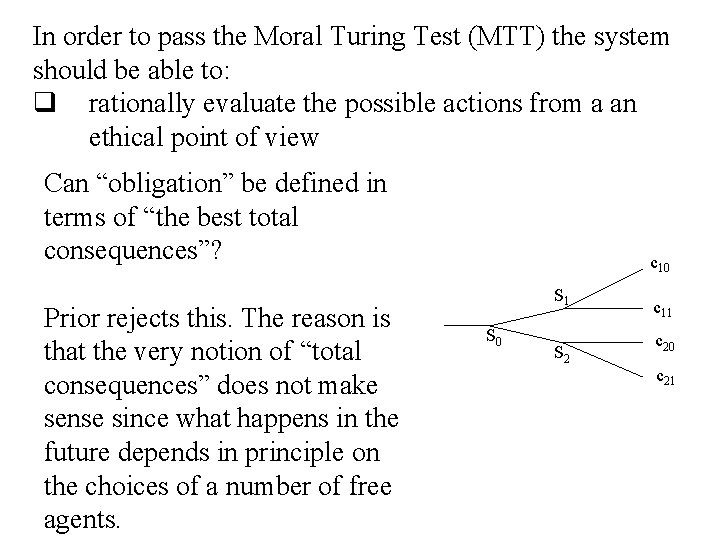
In order to pass the Moral Turing Test (MTT) the system should be able to: q rationally evaluate the possible actions from a an ethical point of view Can “obligation” be defined in terms of “the best total consequences”?
In order to pass the Moral Turing Test (MTT) the system should be able to: q rationally evaluate the possible actions from a an ethical point of view Can “obligation” be defined in terms of “the best total consequences”? Prior rejects this. The reason is that the very notion of “total consequences” does not make sense since what happens in the future depends in principle on the choices of a number of free agents. c 10 S 1 S 0 S 2 c 11 c 20 c 21
In order to pass the Moral Turing Test (MTT) the system should be able to: q rationally evaluate the possible actions from a an ethical point of view F(x) : ”in x days it is going to be that … P(x) : ”x days ago it was the case that …” M : ”it can be that …” c 10 N : ”it must be that …” S 1 c 11 O : ”it ought to be that …” S 0 S 2 c 20 c 21
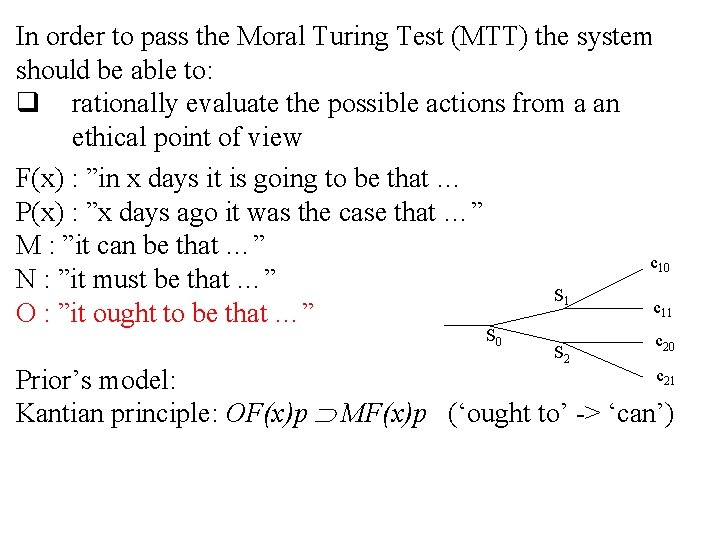
In order to pass the Moral Turing Test (MTT) the system should be able to: q rationally evaluate the possible actions from a an ethical point of view F(x) : ”in x days it is going to be that … P(x) : ”x days ago it was the case that …” M : ”it can be that …” c 10 N : ”it must be that …” S 1 c 11 O : ”it ought to be that …” S 0 S 2 c 20 c 21 Prior’s model: Kantian principle: OF(x)p MF(x)p (‘ought to’ -> ‘can’)
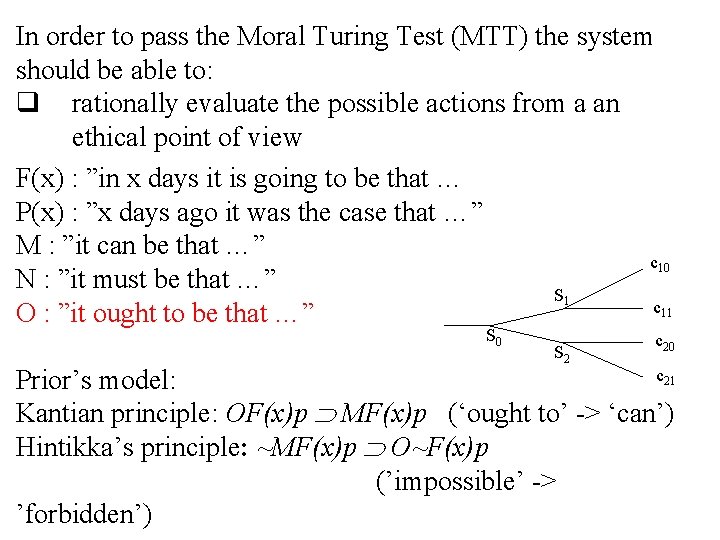
In order to pass the Moral Turing Test (MTT) the system should be able to: q rationally evaluate the possible actions from a an ethical point of view F(x) : ”in x days it is going to be that … P(x) : ”x days ago it was the case that …” M : ”it can be that …” c 10 N : ”it must be that …” S 1 c 11 O : ”it ought to be that …” S 0 S 2 c 20 c 21 Prior’s model: Kantian principle: OF(x)p MF(x)p (‘ought to’ -> ‘can’) Hintikka’s principle: ~MF(x)p O~F(x)p (’impossible’ -> ’forbidden’)
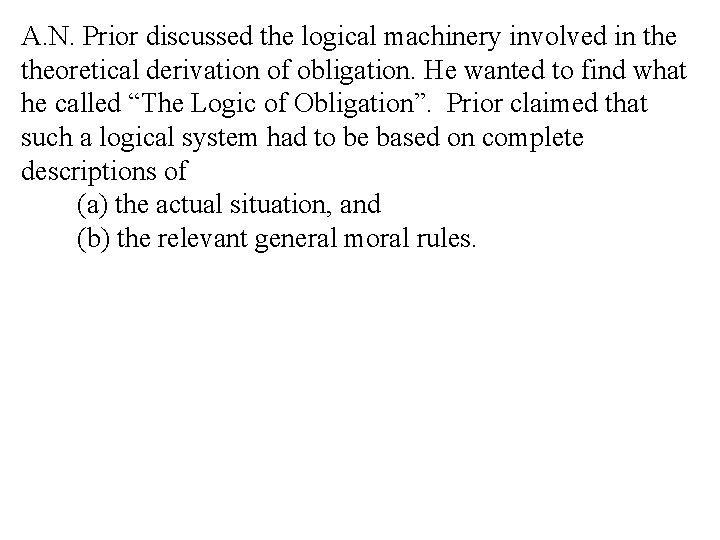
A. N. Prior discussed the logical machinery involved in theoretical derivation of obligation. He wanted to find what he called “The Logic of Obligation”. Prior claimed that such a logical system had to be based on complete descriptions of (a) the actual situation, and (b) the relevant general moral rules.
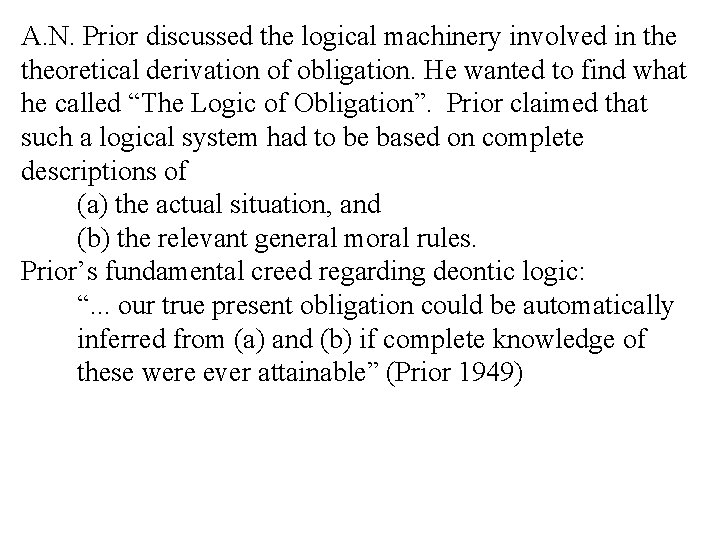
A. N. Prior discussed the logical machinery involved in theoretical derivation of obligation. He wanted to find what he called “The Logic of Obligation”. Prior claimed that such a logical system had to be based on complete descriptions of (a) the actual situation, and (b) the relevant general moral rules. Prior’s fundamental creed regarding deontic logic: “. . . our true present obligation could be automatically inferred from (a) and (b) if complete knowledge of these were ever attainable” (Prior 1949)
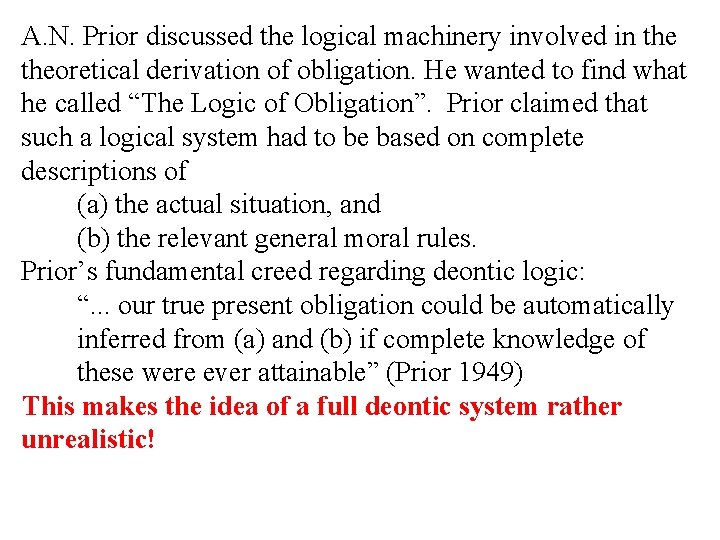
A. N. Prior discussed the logical machinery involved in theoretical derivation of obligation. He wanted to find what he called “The Logic of Obligation”. Prior claimed that such a logical system had to be based on complete descriptions of (a) the actual situation, and (b) the relevant general moral rules. Prior’s fundamental creed regarding deontic logic: “. . . our true present obligation could be automatically inferred from (a) and (b) if complete knowledge of these were ever attainable” (Prior 1949) This makes the idea of a full deontic system rather unrealistic!
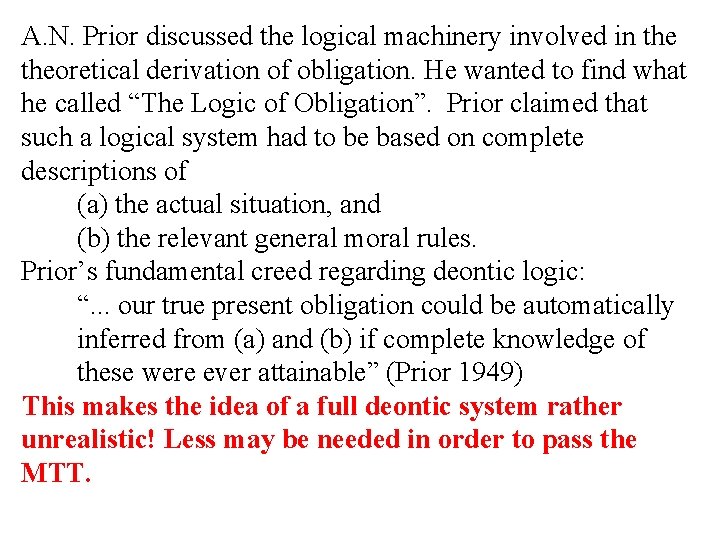
A. N. Prior discussed the logical machinery involved in theoretical derivation of obligation. He wanted to find what he called “The Logic of Obligation”. Prior claimed that such a logical system had to be based on complete descriptions of (a) the actual situation, and (b) the relevant general moral rules. Prior’s fundamental creed regarding deontic logic: “. . . our true present obligation could be automatically inferred from (a) and (b) if complete knowledge of these were ever attainable” (Prior 1949) This makes the idea of a full deontic system rather unrealistic! Less may be needed in order to pass the MTT.
A. N. Prior discussed the logical machinery involved in theoretical derivation of obligation. He wanted to find what he called “The Logic of Obligation”. Prior claimed that such a logical system had to be based on complete descriptions of (a) the actual situation, and (b) the relevant general moral rules. Prior’s fundamental creed regarding deontic logic: “. . . our true present obligation could be automatically inferred from (a) and (b) if complete knowledge of these were ever attainable” (Prior 1949) This makes the idea of a full deontic system rather unrealistic! Less may be needed in order to pass the MTT. - What happens if only incomplete descriptions are available?
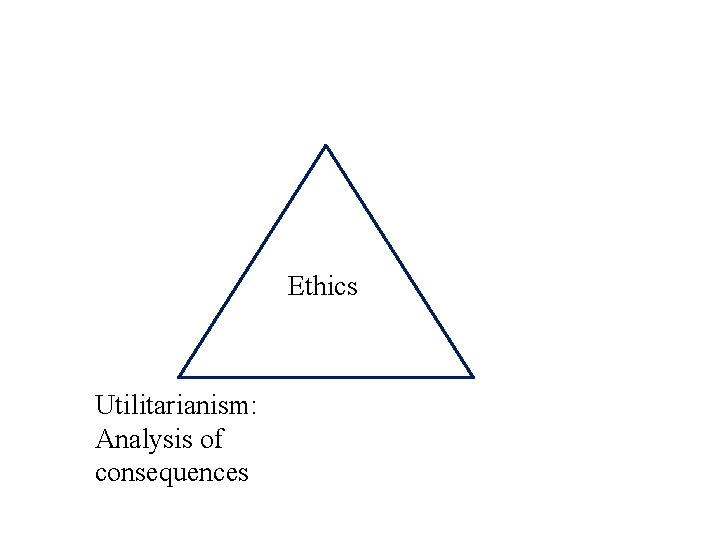
Ethics Utilitarianism: Analysis of consequences
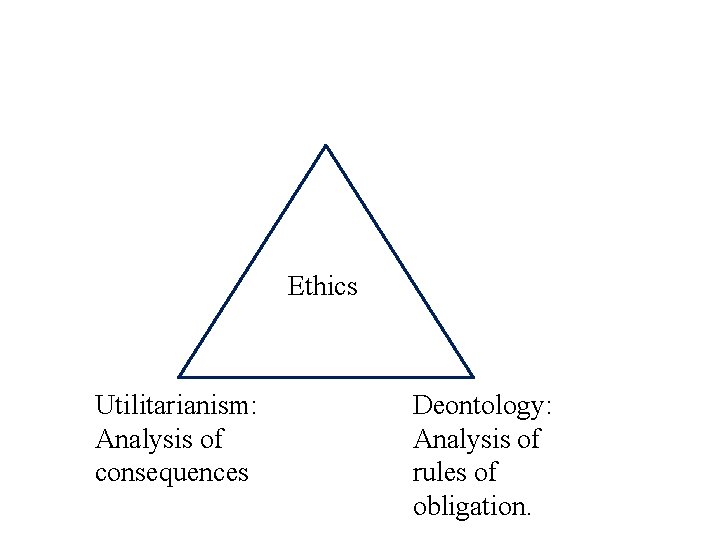
Ethics Utilitarianism: Analysis of consequences Deontology: Analysis of rules of obligation.
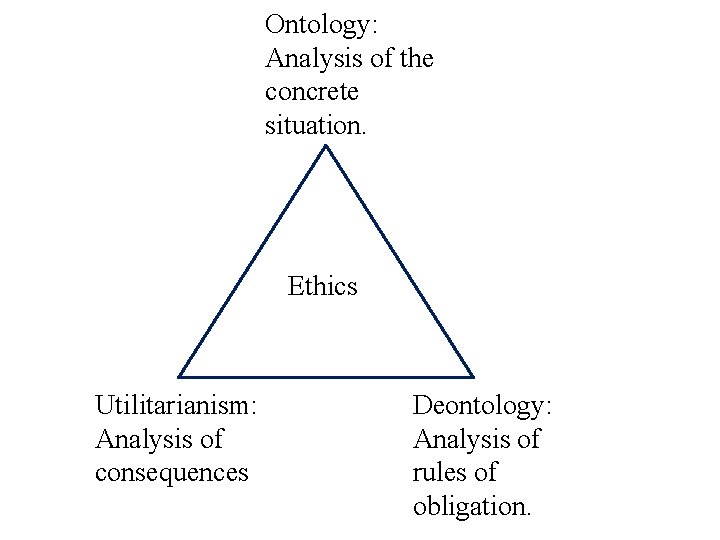
Ontology: Analysis of the concrete situation. Ethics Utilitarianism: Analysis of consequences Deontology: Analysis of rules of obligation.
Would systems which can pass the MTT be attractive? Would they be useful?
Would systems which can pass the MTT be attractive? Would they be useful? A possible simulation: A system which could take part in a conversation as if it could act just as a moral human being – including the human limitations.
Would systems which can pass the MTT be attractive? Would they be useful? A possible simulation: A system which could take part in a conversation as if it could act just as a moral human being – including the human limitations. In a certain sense we may want more than that, since we may want systems which can advice humans in practical situations i. e. systems without all the human limitations.
Would systems which can pass the MTT be attractive? Would they be useful? A possible simulation: A system which could take part in a conversation as if it could act just as a moral human being – including the human limitations. In a certain sense we may want more than that, since we may want systems which can advice humans in practical situations i. e. systems without all the human limitations. Still, a lot can be learned from the study and further discussion of what it means for a system to pass the MTT.