
REFLECTION ON THE WORK OF THE INTERIM MANAGEMENT
- Slides: 30
REFLECTION ON THE WORK OF THE INTERIM MANAGEMENT TEAM: EASTERN CAPE 11 August 2004
Background to the work of the IMT q The IMT has provided progress report to the Executive and Parliament at the beginning of 2004. q This presentation therefore only covers: – A brief overview of the mandate and nature of plans; – Key challenges for the continuation of implementation of the turnaround plans; – Institutional arrangements for sustainability, monitoring and evaluation; – Proposals on the Department of Education; and – Progress made by the four departments towards implementation
Mandate of the IMT q Overall goal of the IMT is to ensure that any service delivery backlogs are addressed and to establish sound management and leadership in the Education, Health, Roads and Public Works and Social Development departments q The IMT is specifically mandated to– establish turn around plans for the four target departments, including the elimination of service delivery backlogs – address cross cutting issues such as disciplinary matters, procurement reform and human resource management – establish appropriate management structures and back office support – monitor the implementation of the turn around plans and other interventions as well as the use of conditional grants q On the basis of its presentations to the Provincial EXCO and Cabinet, the IMT received additional mandates related to specific challenges
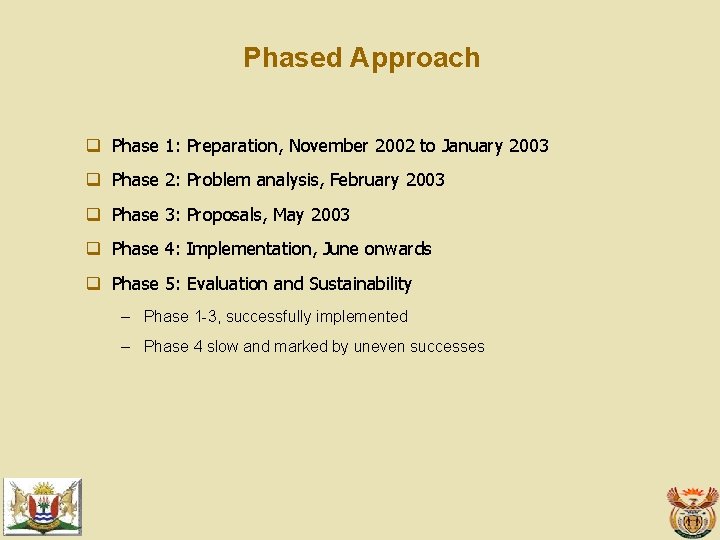
Phased Approach q Phase 1: Preparation, November 2002 to January 2003 q Phase 2: Problem analysis, February 2003 q Phase 3: Proposals, May 2003 q Phase 4: Implementation, June onwards q Phase 5: Evaluation and Sustainability – Phase 1 -3, successfully implemented – Phase 4 slow and marked by uneven successes
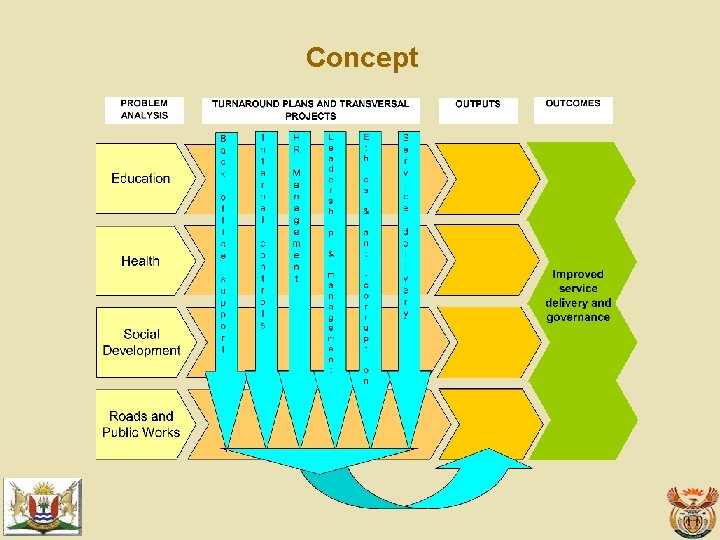
Concept
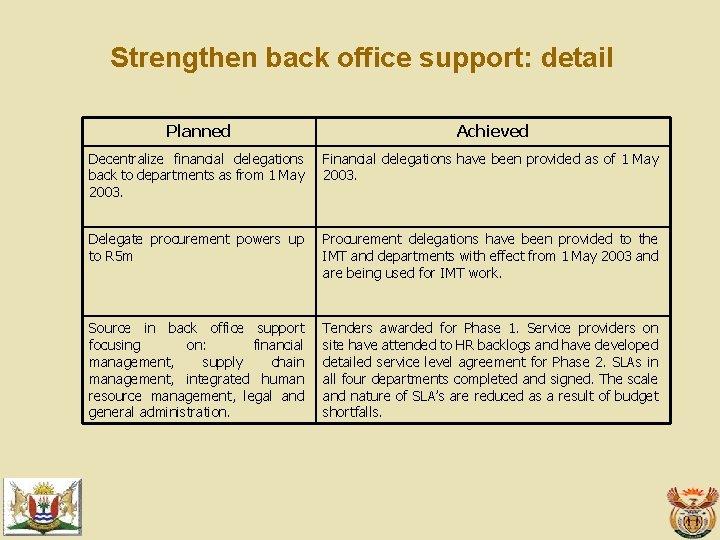
Strengthen back office support: detail Planned Achieved Decentralize financial delegations back to departments as from 1 May 2003. Financial delegations have been provided as of 1 May 2003. Delegate procurement powers up to R 5 m Procurement delegations have been provided to the IMT and departments with effect from 1 May 2003 and are being used for IMT work. Source in back office support focusing on: financial management, supply chain management, integrated human resource management, legal and general administration. Tenders awarded for Phase 1. Service providers on site have attended to HR backlogs and have developed detailed service level agreement for Phase 2. SLAs in all four departments completed and signed. The scale and nature of SLA’s are reduced as a result of budget shortfalls.
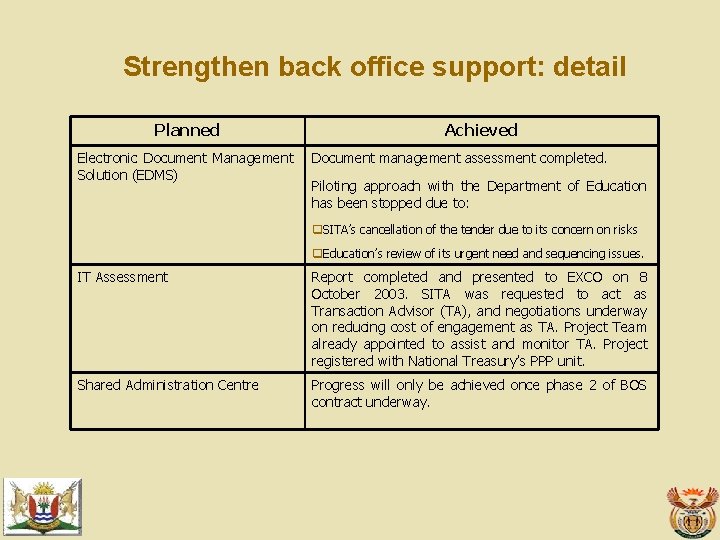
Strengthen back office support: detail Planned Electronic Document Management Solution (EDMS) Achieved Document management assessment completed. Piloting approach with the Department of Education has been stopped due to: q. SITA’s cancellation of the tender due to its concern on risks q. Education’s review of its urgent need and sequencing issues. IT Assessment Report completed and presented to EXCO on 8 October 2003. SITA was requested to act as Transaction Advisor (TA), and negotiations underway on reducing cost of engagement as TA. Project Team already appointed to assist and monitor TA. Project registered with National Treasury’s PPP unit. Shared Administration Centre Progress will only be achieved once phase 2 of BOS contract underway.
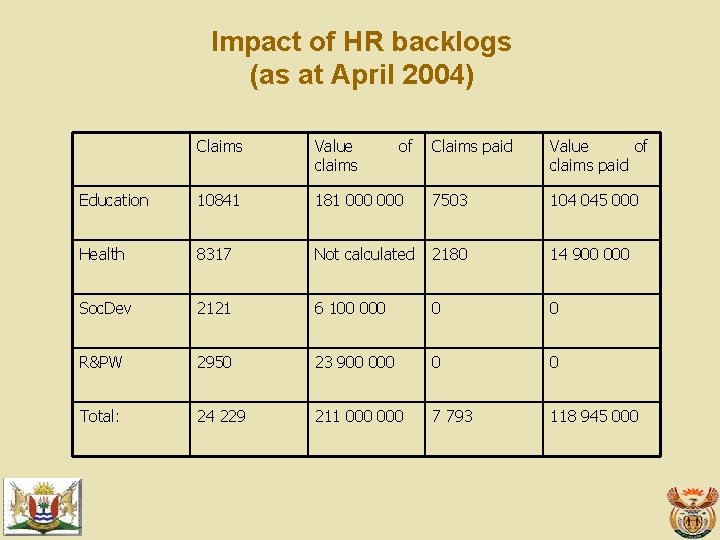
Impact of HR backlogs (as at April 2004) Claims Value claims Education 10841 Health of Claims paid Value of claims paid 181 000 7503 104 045 000 8317 Not calculated 2180 14 900 000 Soc. Dev 2121 6 100 0 0 R&PW 2950 23 900 0 0 Total: 24 229 211 000 7 793 118 945 000
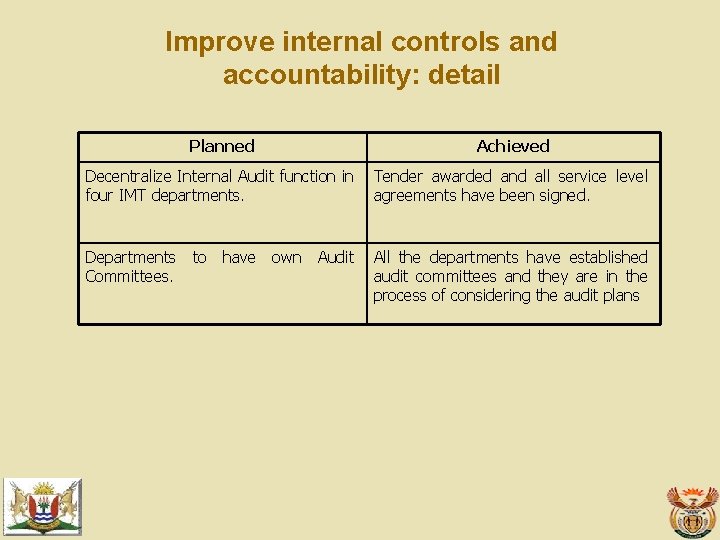
Improve internal controls and accountability: detail Planned Achieved Decentralize Internal Audit function in four IMT departments. Tender awarded and all service level agreements have been signed. Departments Committees. All the departments have established audit committees and they are in the process of considering the audit plans to have own Audit
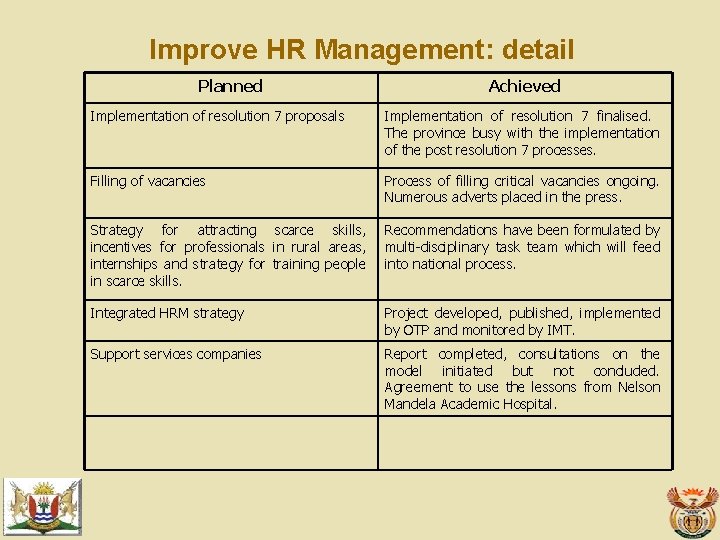
Improve HR Management: detail Planned Achieved Implementation of resolution 7 proposals Implementation of resolution 7 finalised. The province busy with the implementation of the post resolution 7 processes. Filling of vacancies Process of filling critical vacancies ongoing. Numerous adverts placed in the press. Strategy for attracting scarce skills, incentives for professionals in rural areas, internships and strategy for training people in scarce skills. Recommendations have been formulated by multi-disciplinary task team which will feed into national process. Integrated HRM strategy Project developed, published, implemented by OTP and monitored by IMT. Support services companies Report completed, consultations on the model initiated but not concluded. Agreement to use the lessons from Nelson Mandela Academic Hospital.
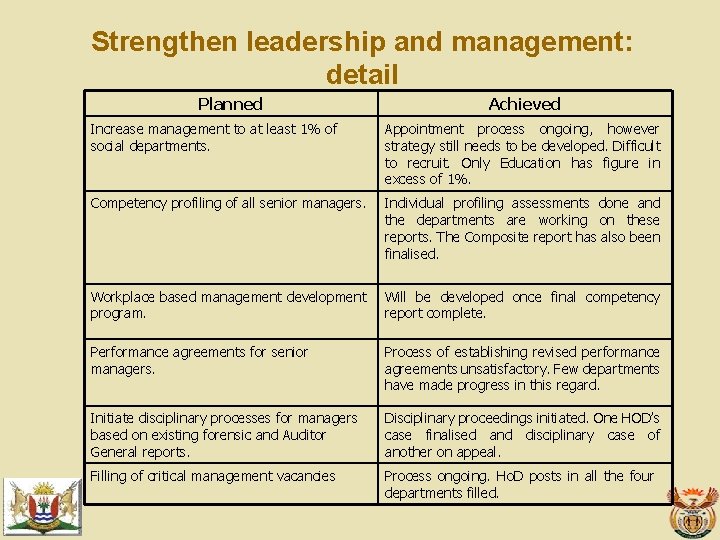
Strengthen leadership and management: detail Planned Achieved Increase management to at least 1% of social departments. Appointment process ongoing, however strategy still needs to be developed. Difficult to recruit. Only Education has figure in excess of 1%. Competency profiling of all senior managers. Individual profiling assessments done and the departments are working on these reports. The Composite report has also been finalised. Workplace based management development program. Will be developed once final competency report complete. Performance agreements for senior managers. Process of establishing revised performance agreements unsatisfactory. Few departments have made progress in this regard. Initiate disciplinary processes for managers based on existing forensic and Auditor General reports. Disciplinary proceedings initiated. One HOD’s case finalised and disciplinary case of another on appeal. Filling of critical management vacancies Process ongoing. Ho. D posts in all the four departments filled.
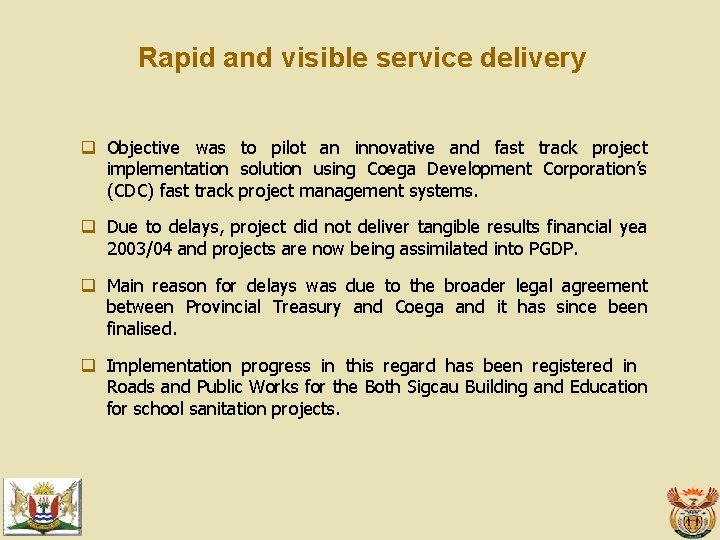
Rapid and visible service delivery q Objective was to pilot an innovative and fast track project implementation solution using Coega Development Corporation’s (CDC) fast track project management systems. q Due to delays, project did not deliver tangible results financial yea 2003/04 and projects are now being assimilated into PGDP. q Main reason for delays was due to the broader legal agreement between Provincial Treasury and Coega and it has since been finalised. q Implementation progress in this regard has been registered in Roads and Public Works for the Both Sigcau Building and Education for school sanitation projects.
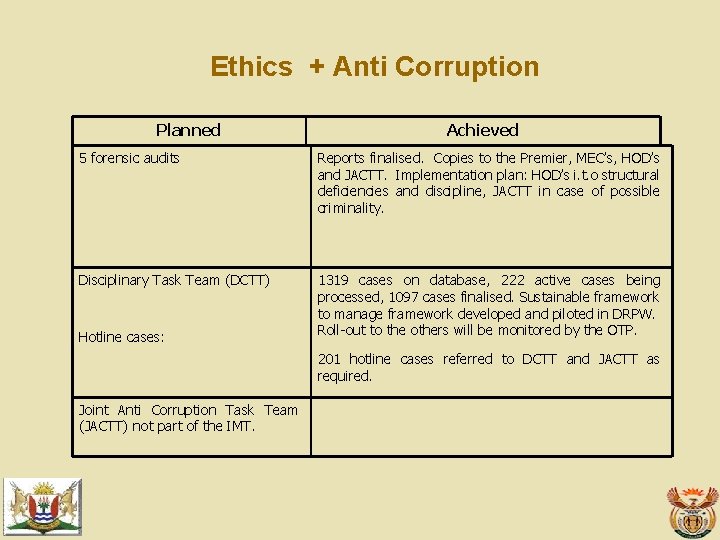
Ethics + Anti Corruption Planned Achieved 5 forensic audits Reports finalised. Copies to the Premier, MEC’s, HOD’s and JACTT. Implementation plan: HOD’s i. t. o structural deficiencies and discipline, JACTT in case of possible criminality. Disciplinary Task Team (DCTT) 1319 cases on database, 222 active cases being processed, 1097 cases finalised. Sustainable framework to manage framework developed and piloted in DRPW. Roll-out to the others will be monitored by the OTP. Hotline cases: 201 hotline cases referred to DCTT and JACTT as required. Joint Anti Corruption Task Team (JACTT) not part of the IMT.
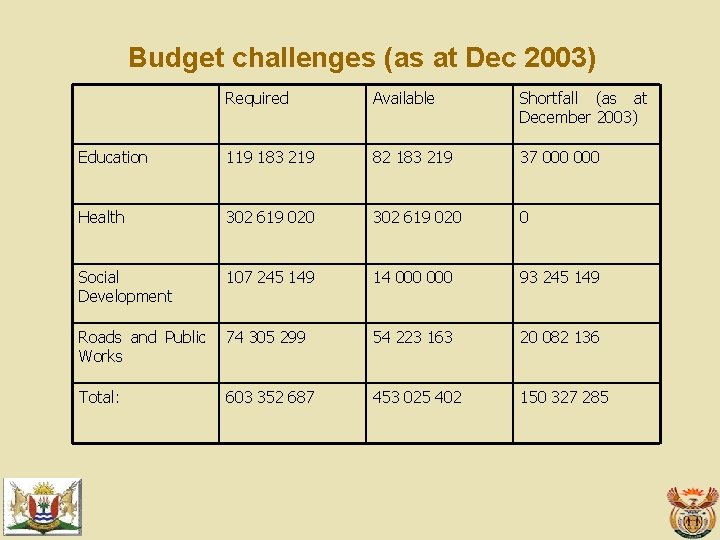
Budget challenges (as at Dec 2003) Required Available Shortfall (as at December 2003) Education 119 183 219 82 183 219 37 000 Health 302 619 020 0 Social Development 107 245 149 14 000 93 245 149 Roads and Public Works 74 305 299 54 223 163 20 082 136 Total: 603 352 687 453 025 402 150 327 285
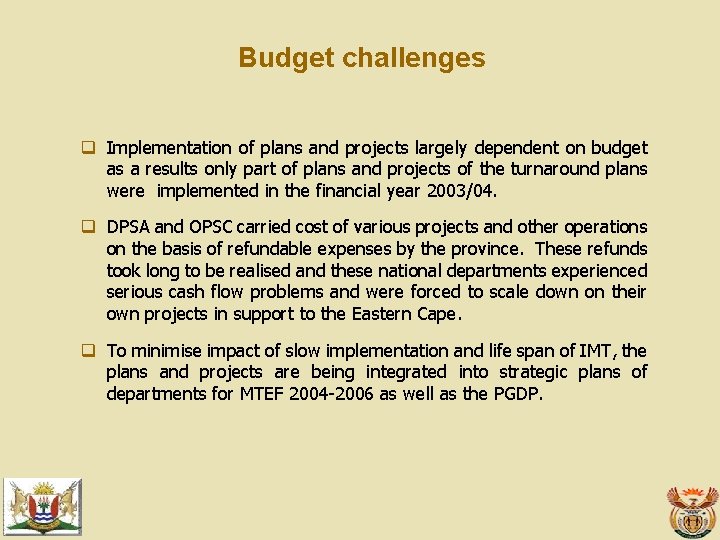
Budget challenges q Implementation of plans and projects largely dependent on budget as a results only part of plans and projects of the turnaround plans were implemented in the financial year 2003/04. q DPSA and OPSC carried cost of various projects and other operations on the basis of refundable expenses by the province. These refunds took long to be realised and these national departments experienced serious cash flow problems and were forced to scale down on their own projects in support to the Eastern Cape. q To minimise impact of slow implementation and life span of IMT, the plans and projects are being integrated into strategic plans of departments for MTEF 2004 -2006 as well as the PGDP.
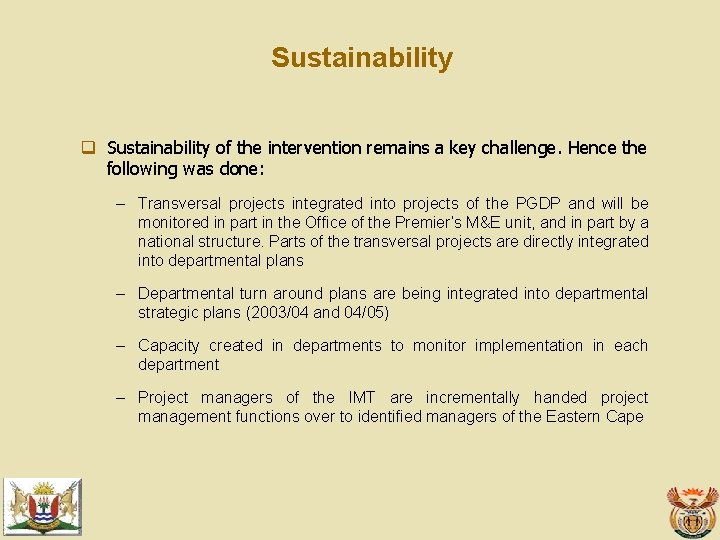
Sustainability q Sustainability of the intervention remains a key challenge. Hence the following was done: – Transversal projects integrated into projects of the PGDP and will be monitored in part in the Office of the Premier’s M&E unit, and in part by a national structure. Parts of the transversal projects are directly integrated into departmental plans – Departmental turn around plans are being integrated into departmental strategic plans (2003/04 and 04/05) – Capacity created in departments to monitor implementation in each department – Project managers of the IMT are incrementally handed project management functions over to identified managers of the Eastern Cape
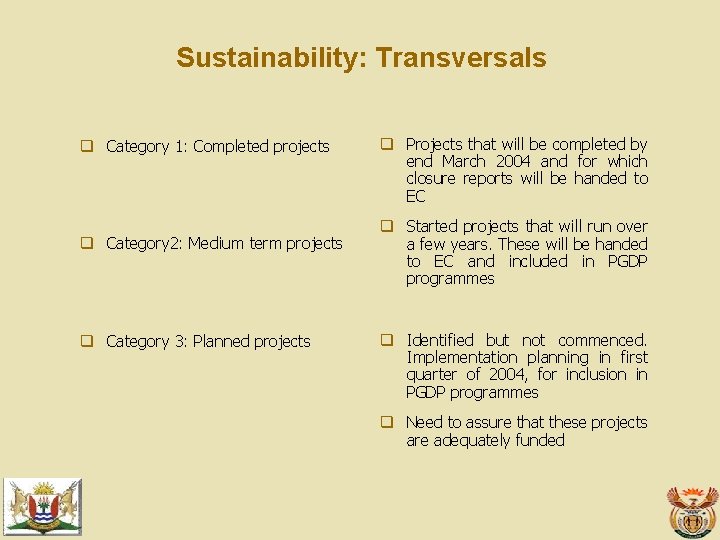
Sustainability: Transversals q Category 1: Completed projects q Category 2: Medium term projects q Category 3: Planned projects q Projects that will be completed by end March 2004 and for which closure reports will be handed to EC q Started projects that will run over a few years. These will be handed to EC and included in PGDP programmes q Identified but not commenced. Implementation planning in first quarter of 2004, for inclusion in PGDP programmes q Need to assure that these projects are adequately funded
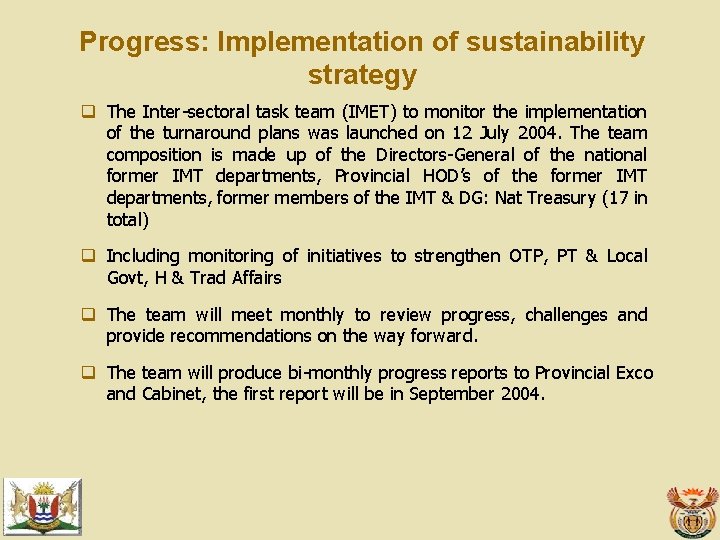
Progress: Implementation of sustainability strategy q The Inter-sectoral task team (IMET) to monitor the implementation of the turnaround plans was launched on 12 July 2004. The team composition is made up of the Directors-General of the national former IMT departments, Provincial HOD’s of the former IMT departments, former members of the IMT & DG: Nat Treasury (17 in total) q Including monitoring of initiatives to strengthen OTP, PT & Local Govt, H & Trad Affairs q The team will meet monthly to review progress, challenges and provide recommendations on the way forward. q The team will produce bi-monthly progress reports to Provincial Exco and Cabinet, the first report will be in September 2004.
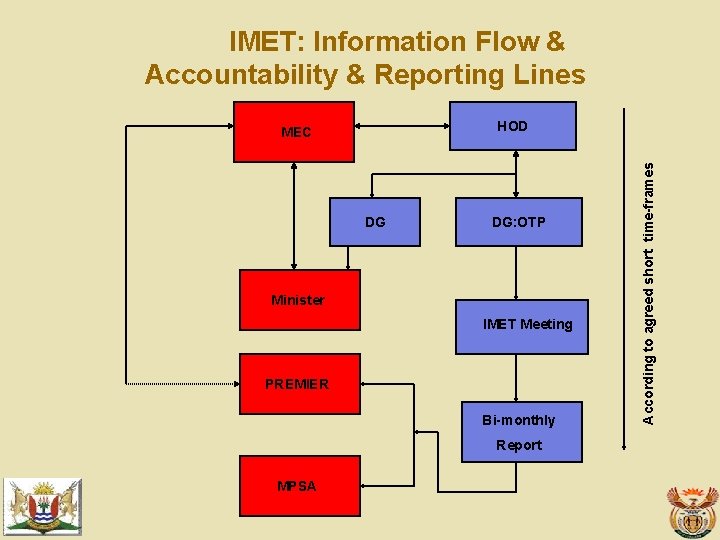
IMET: Information Flow & Accountability & Reporting Lines DG DG: OTP Minister IMET Meeting PREMIER Bi-monthly Report MPSA According to agreed short time-frames HOD MEC
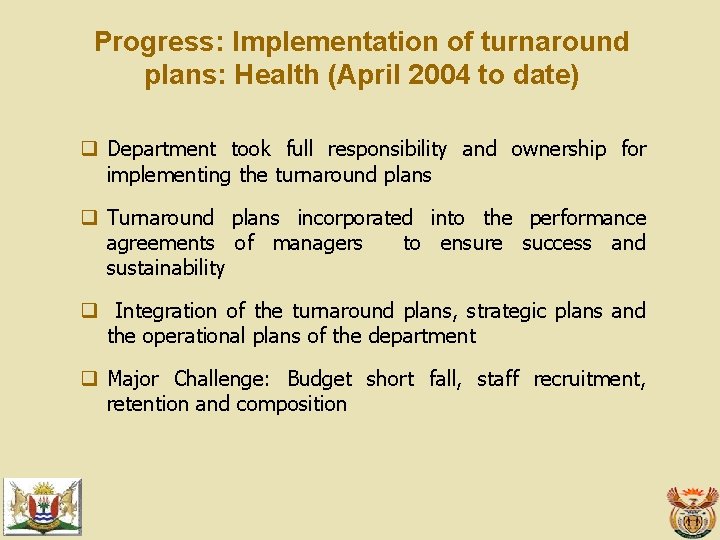
Progress: Implementation of turnaround plans: Health (April 2004 to date) q Department took full responsibility and ownership for implementing the turnaround plans q Turnaround plans incorporated into the performance agreements of managers to ensure success and sustainability q Integration of the turnaround plans, strategic plans and the operational plans of the department q Major Challenge: Budget short fall, staff recruitment, retention and composition
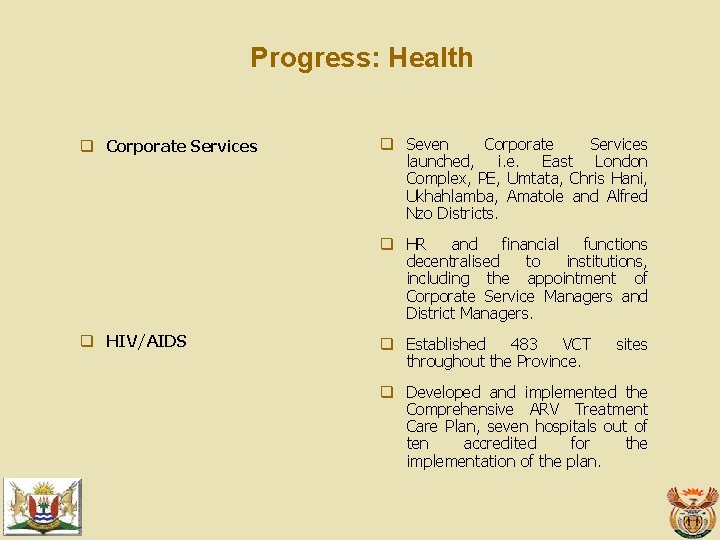
Progress: Health q Corporate Services q Seven Corporate Services launched, i. e. East London Complex, PE, Umtata, Chris Hani, Ukhahlamba, Amatole and Alfred Nzo Districts. q HR and financial functions decentralised to institutions, including the appointment of Corporate Service Managers and District Managers. q HIV/AIDS q Established 483 VCT throughout the Province. sites q Developed and implemented the Comprehensive ARV Treatment Care Plan, seven hospitals out of ten accredited for the implementation of the plan.
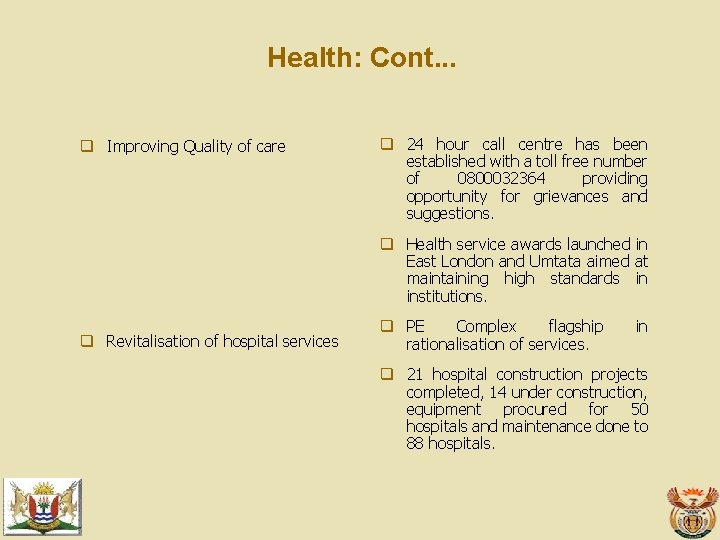
Health: Cont. . . q Improving Quality of care q 24 hour call centre has been established with a toll free number of 0800032364 providing opportunity for grievances and suggestions. q Health service awards launched in East London and Umtata aimed at maintaining high standards in institutions. q Revitalisation of hospital services q PE Complex flagship rationalisation of services. in q 21 hospital construction projects completed, 14 under construction, equipment procured for 50 hospitals and maintenance done to 88 hospitals.
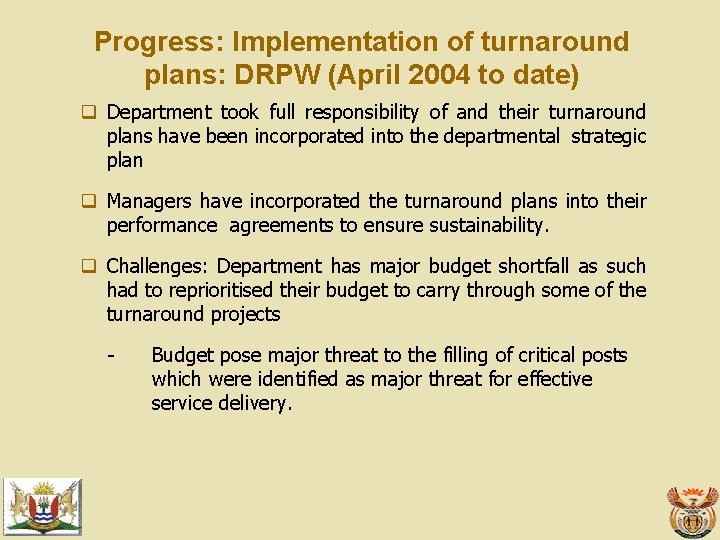
Progress: Implementation of turnaround plans: DRPW (April 2004 to date) q Department took full responsibility of and their turnaround plans have been incorporated into the departmental strategic plan q Managers have incorporated the turnaround plans into their performance agreements to ensure sustainability. q Challenges: Department has major budget shortfall as such had to reprioritised their budget to carry through some of the turnaround projects - Budget pose major threat to the filling of critical posts which were identified as major threat for effective service delivery.
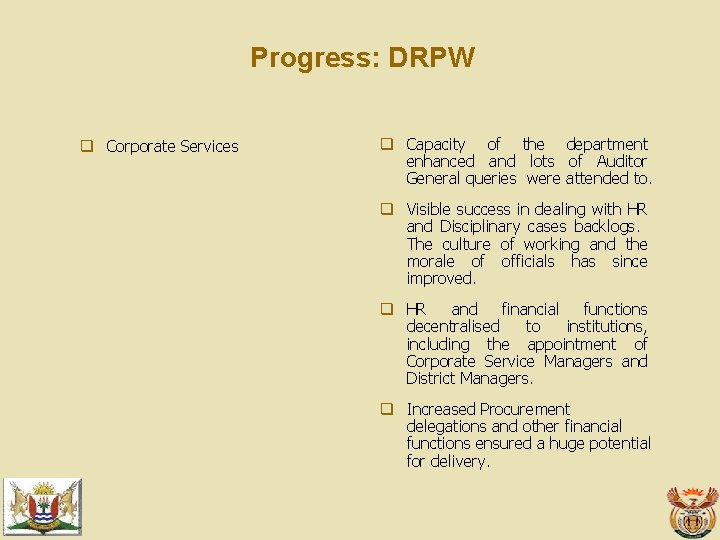
Progress: DRPW q Corporate Services q Capacity of the department enhanced and lots of Auditor General queries were attended to. q Visible success in dealing with HR and Disciplinary cases backlogs. The culture of working and the morale of officials has since improved. q HR and financial functions decentralised to institutions, including the appointment of Corporate Service Managers and District Managers. q Increased Procurement delegations and other financial functions ensured a huge potential for delivery.
Progress: Implementation of turnaround plans: Soc Dev (April 2004 to date) q Department took full responsibility of and their turnaround plans have been incorporated into the departmental strategic plan q Managers have incorporated the turnaround plans into their performance agreements to ensure sustainability. q Unqualified AG Report for 2003/04 q The project facilitation Unit has been developed to strengthen the implementation of the turnaround plans q Challenges: Department has major budget shortfall q The development and implementation of the Social Security Agency q Continued critical shortage of personnel including remuneration packages that are not competitive cause high turnover rate of professionals e. g. social workers.
Progress: Soc Dev q Corporate Services q Completion of 7 multimedia centres at front office service centres. q Registering of 52 566 Child Support Grant beneficiaries between ages 9 -11 q Construction of two Pay Points where Pension Beneficiaries can get their money in protected premises. q Rollout of Performance Management and development systems to all 24 area offices q Implementation of a Contract Management Centre functioning from East London.
Progress: Implementation of turnaround plans: Education (April 2004 to date) q Special arrangement: further intervention of one year-assess progress after six months. q Inter-sectoral intervention with the led by Minister of Education and the Director-General at national and the provincial MEC and Superintendent -General for Education. q The national department has made available resources on a full time basis to assist with the implementation. q The implementation strategy for the turnaround plan has been accepted and must be implemented. q Monthly reports will be submitted to the Minister of Education, the MEC, the Director-General and the Superintendent-General. q Three-monthly reports to be submitted to the Provincial Exco and Cabinet.
Emerging lessons/themes q Model of intervention – Model assumes cooperation, support, budget, preconditions that are not present in all respects – Management by committee does not work q Design of an intervention – Turn around of this nature requires more planning and fixed arrangements on issues such as accountability, budget, skills requirements and partners before the intervention is launched – Quick fixes rarely work and only for certain type of challenges – Sustainability and local responsibility need to be better defined
Emerging lessons/themes q Budget – Current budgetary system does not allow for quick response to challenges – Can a receiving institution realistically be expected to reprioritise to the extent where complete turnaround becomes possible q General skills requirements – Mismatch occurred in skills requirements and skills availability of deployees, and for receiving institutions – Need formal arrangement to deploy SMS cadres according to need q The role of managers, and other key stakeholders (e. g. unions) – Managers lacking in numbers and skills
Emerging lessons/themes q Logistics – Basic logistical support can make or break, causing delays and demoralisation q The effect of deployment – Long-term assignments and deployment of great number of staff impacts negatively on releasing departments, including emotional and financial strains. q Role of central departments – Organisationally, programmatically and in terms of skills, central departments are not geared for scope of IMT-type intervention – Need to relook role of central departments like DPSA, SAMDI, DPLG and National Treasury can and should play