
Reflection cards Cards to provoke discussion and reflection
- Slides: 36
Reflection cards Cards to provoke discussion and reflection around authentic assessment approaches in higher and further education Lydia Arnold (2021) Drawing on the work of Ashford-Rowe, Herrington and Brown (2014)
1. Triple jump Students are presented with an open problem from within a professional Challenge ����� area e. g. clinical case, or a farm business needing advice. The problem is Product/performance ���� often framed through a role play approach e. g. ‘mock clinic’ or 'a simulated Transfer of knowledge ���� Metacognition �� farm visit'. The ‘problem’ should be ‘open’ and have multiple possible ways Recognisable by stakeholders ��� forward rather than a single answer. The assessment requires the student Fidelity ����� to go through three steps. 1. Meet the client or patient to establish the Feedback/discussion ���� situation and ask any clarifying questions 2. Go away and do some Collaboration ��� research on the issue using any appropriate resources (2 -3 hours) 3. Come back to the client or patient and present recommendations. Much of the literature around the triple jump is clinically based but consider how this format translates to different context e. g. surveying, architecture, human resources. Read more about this recognised method in literature.
2. CPD Selfies Students plan a programme of personal and professional development to Challenge ��� Product/performance ��� Transfer of knowledge �� Metacognition ���� address their own skills in a specific area of practice e. g. teaching, digital skills. As they engage with their programme they keep a photographic record of what they did. This may include photographs of slides that made Recognisable by stakeholders �� them think, screenshots of notes taken at events or ‘selfies’ within different Fidelity �� CPD settings. A layer of fun can be added by having a just for fun Feedback/discussion ��� competition for the best CPD selfie! The pictures act as reflective triggers. Collaboration ��� Students then use the artefacts as an aide memoire to stimulate a piece of writing or a video narrative which identifies their learning from their own programme of activity and identifies new learning goals. The reflection on learning from the programme can be open for students to shape or it may be structured e. g. asking how the self-designed programme has developed beliefs, practice and knowledge.
3. Public Meeting Students research a controversial issue which has implications for Challenge ���� Product/performance ��� � Transfer of knowledge ���� communities. The ‘issue’ may be a new development (e. g. changes to road layout or a new housing development), a new medical treatment or a new Metacognition ��� way of voting in local elections. Students then undertake research and Recognisable by stakeholders ���� compile a presentation for a public meeting. They must use evidence- Fidelity ��� based arguments, be prepared to answer questions and must ensure that Feedback/discussion ��� complex issues are communicated in a way that is accessible. Making Collaboration ��� � presentations time limited means students must distil key information. Presentations could be recorded, with questions submitted asynchronously, or they may be given to the group with live questions. The pre-recorded approach may be kinder to students who struggle with live scenarios.
4. Video Analysis Challenge ���� Present students with some real-world video footage of a relevant Product/performance ��� � situation or, if appropriate, ask them to create their own video Transfer of knowledge ��� performance. Examples include filming a classroom teaching situation, or Metacognition �� a dance performance, or collating footage of traffic flows, protests in Recognisable by stakeholders ��� action or the movement of animals when grazing or running. Ask students Fidelity �� Feedback/discussion ��� Collaboration ��� � to analyse the footage and create a voice over to highlight key features in the scenario and analyse possible improvements or treatments. Through watching the footage and creating the narrative, students can observe, explain, discuss, predict, diagnose, evaluate and analyse. This task could be done by groups as well as individuals.
5. Video Creation Challenge ����� Product/performance ����� Transfer of knowledge ����� Metacognition ��� Students work with a local charity or organisation to produce videos to meet specific needs. The assessment focuses on process (team work and working with clients) as well as the product. The video could take Recognisable by stakeholders ���� many forms, for example to help educate local school children, to educate Fidelity ����� visitors to a specific place, to raise awareness of important issues with Feedback/discussion ����� Collaboration ����� scientific underpinnings. As well as supporting topic learning, students develop teamwork, digital skills, time management, and project management skills. To celebrate the assessments, students may also have a 'film premiere' evening to showcase their work. This example is credited to Emma Tappin, Claire Robertson-Bennett and Matt Cawte at Harper Adams University.
6. Design a quiz When there is a requirement for students to undertake calculations, such as Challenge ���� Product/performance ��� Transfer of knowledge ���� in engineering or accounting courses, a calculations quiz can be developed in place of a traditional exam. This may be more demanding than it sounds! Metacognition ���� Teaching students about question design, including what 'good distractors' Recognisable by stakeholders �� (i. e. wrong answers) look like will mean that students spend time Fidelity �� Feedback/discussion ��� Collaboration ��� researching common errors and misunderstandings to include in their quiz answers. These may even be explained in an annex to the quiz. This can be a demanding assessment which helps students recognise and appreciate where they could make mistakes. The quizzes can be used by future cohorts. Sharing outside of the cohort may be better after some peer review to ensure accuracy.
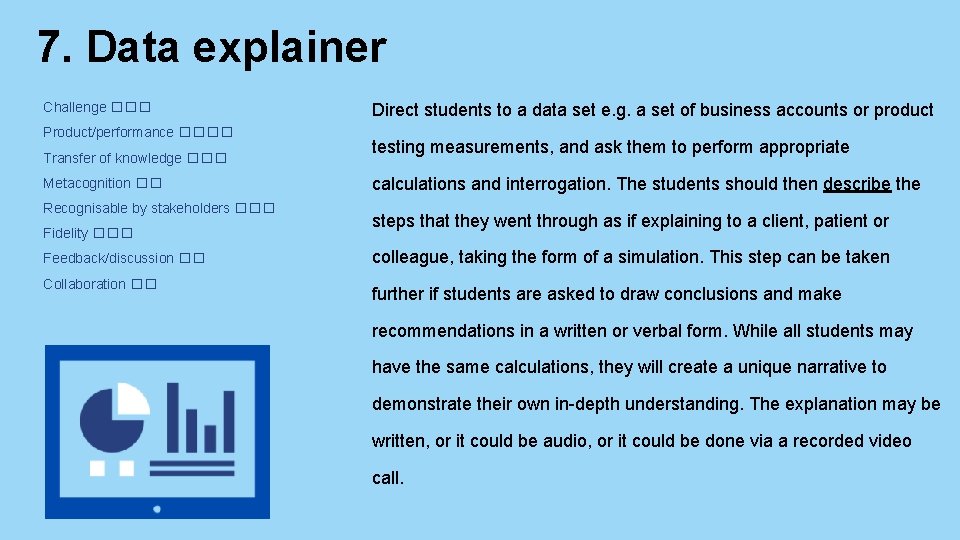
7. Data explainer Challenge ��� Product/performance ���� Transfer of knowledge ��� Metacognition �� Recognisable by stakeholders ��� Fidelity ��� Feedback/discussion �� Collaboration �� Direct students to a data set e. g. a set of business accounts or product testing measurements, and ask them to perform appropriate calculations and interrogation. The students should then describe the steps that they went through as if explaining to a client, patient or colleague, taking the form of a simulation. This step can be taken further if students are asked to draw conclusions and make recommendations in a written or verbal form. While all students may have the same calculations, they will create a unique narrative to demonstrate their own in-depth understanding. The explanation may be written, or it could be audio, or it could be done via a recorded video call.
8. Podcast Students can create a podcast to explain, discuss, analyse, and Challenge ����� disseminate. The format and style can be prescribed or students may Product/performance ����� research other podcasts or they may develop their own creative Transfer of knowledge ���� Metacognition��� approach. A key decision in developing the product is to define the Recognisable by stakeholders ���� audience (who is this for? ). To make marking manageable it is Fidelity ����� important to set a maximum duration. Students may create a number Feedback/discussion ����� of episodes and choose the best one to submit, perhaps with the Collaboration ����� help of peer feedback. Turn this in to a group project by getting the students to interview each other, discuss issues, or role play different perspectives within the podcast. Students may be encouraged to listen to podcasts around their topic to inspire their work. Topics may range from economic forecasting to crime scene investigation!
9. Create a Teaching Resource Ask students to create a resource to teach others about a specific Challenge ���� Product/performance ���� Transfer of knowledge ���� Metacognition��� topic. The resource could be designed so that it helps future students to avoid common errors or misconceptions, and so that it assists future students in key academic skills such as critical Recognisable by stakeholders ��� thinking. The assessment may help students see the importance of Fidelity ��� learning outcomes, and constructive alignment. In turn these Feedback/discussion ��� insights may enhance their meta-learning skills in addition to any Collaboration ���� gains in learning around the topic under consideration. Students may explore different technologies to assist, including screencast tools, quiz features, and recorded whiteboards. As students get creative any techniques may feedback to teaching staff too! Remember to ask students for permission to use their work with future cohorts.
10. Work-in Progress Exhibition Challenge ����� Product/performance ����� Students create a product or artefact (e. g. vegan food product, musical ident, interior design model, vehicle component prototype). Transfer of knowledge ���� They exhibit the product along with the story of its development at a Metacognition���� face-to-face or online cohort wide event. Professionals in the field, Recognisable by stakeholders ���� along with some willing past students, are invited to see the Fidelity ���� exhibition and offer constructive feedback. If different courses join Feedback/discussion ����� up on this assessment then related products can be exhibited for Collaboration ����� feedback e. g. new product development and related branding campaign. The feedback is considered and the product is refined before submission. Students can be marked on the product and their reflection on the process, including their use of feedback. Idea courtesy of Rachel Hilton, Harper Adams University.
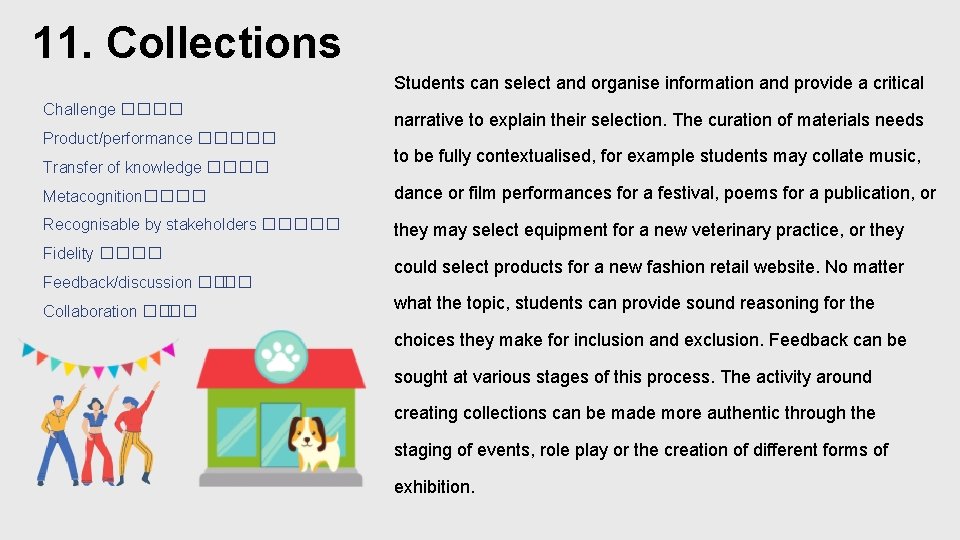
11. Collections Students can select and organise information and provide a critical Challenge ���� Product/performance ����� Transfer of knowledge ���� narrative to explain their selection. The curation of materials needs to be fully contextualised, for example students may collate music, Metacognition���� dance or film performances for a festival, poems for a publication, or Recognisable by stakeholders ����� they may select equipment for a new veterinary practice, or they Fidelity ���� Feedback/discussion ���� Collaboration ���� could select products for a new fashion retail website. No matter what the topic, students can provide sound reasoning for the choices they make for inclusion and exclusion. Feedback can be sought at various stages of this process. The activity around creating collections can be made more authentic through the staging of events, role play or the creation of different forms of exhibition.
12. Learning Journal Challenge ����� Learning journals provide an opportunity to record reflections on Product/performance ����� practice and learning. They provide a chance for students to Transfer of knowledge ���� highlight critical incidents, analyse their own goals and progress, Metacognition��� and to discuss their values. Reflection doesn't come naturally to Recognisable by stakeholders ���� everyone though, so making the benefits clear is very important. To Fidelity ����� assist with reflection, consider: Using media reflections (audio clips, Feedback/discussion ����� Collaboration ����� video diary); a pass/fail rather than a grade to lower the pressure and signal the intrinsic value; sharing examples of reflection to scaffold the process; and, discussing the professional value of reflection. To help with marking and to allow students to select what they want to have marked (e. g. choose three entries) while requiring the whole journal to be shared to demonstrate a sincere, or at least sustained, commitment to the learning process.
13. Analyse Public Data Challenge ���� Students locate open source data sets to help answer pressing Product/performance ��� questions associated with their discipline. They might engage with Transfer of knowledge ���� Metacognition�� Recognisable by stakeholders ���� Fidelity ��� live data from such sources as Google Trends, WHO, Earth Data and governments. For students of the arts, this may mean exploring and using open access repositories. Feedback/discussion �� Students may address questions which are set, or questions that Collaboration �� they themselves develop. It gives opportunity to work with big data sets and to critique data sources from a user perspective. It allows data to be selected, manipulated, and used to generate policy proposals, predictions, news documentaries or infographics (or other products associated with your discipline).
14. Make-away Create a model or product using 'ingredients' from everyday life. This Challenge ��� requires students to think about the fundamentals of the 'thing' that they Product/performance ���� are creating - be it an anatomical structure, a building, creating a Transfer of knowledge ���� campus soundscape only on a phone, or prototype child’s toy. It's Metacognition��� Recognisable by stakeholders �� Fidelity �� Feedback/discussion �� Collaboration ��� important to make sure students are not advantaged in the assessment criteria for their access to high grade materials; the emphasis should be on creativity, effective design ideas, and the associated explanations of the model. There is opportunity to hold peer feedback show and tell events as projects emerge. This could be a first stage assessment before ideas are brought to life further, or it could be a project in itself. As a variation, within specific settings such as labs or workshops, students may be given everyday items associated with that space to include in their design.
15. Write a Professional Press Article Challenge ��� Ask students to create an article for the professional press which Product/performance ���� may be associated with their discipline, or with allied professions. Transfer of knowledge ��� This gives opportunity to explore different professional writing Metacognition�� styles, beyond journals. It encourages students to engage with the Recognisable by stakeholders ���� professional press related to different career areas. It could result in Fidelity ��� Feedback/discussion ��� Collaboration ��� some actual submissions. A peer sharing element can be added to generate feedback or to promote co-authorship. The article could be generated by desk-research, primary research, or a literature search, or it could be an opinion piece. To further develop their work, students may also develop social media posts to accompany their article to encourage readership. This may help students develop the skills of clear messaging for their own work.
16. Research Project Challenge ����� Students (as individuals or as groups) can formulate a research Product/performance ���� question and conduct a project to answer their question. The extent Transfer of knowledge ���� to which choice is given may vary – students can be given a Metacognition��� question and design their own approach, they may be given a broad Recognisable by stakeholders ��� topic or a choice of titles, or they may design their own focus based Fidelity ���� Feedback/discussion ���� Collaboration ���� around some set parameters. This doesn't have to be on the scale of the traditional dissertation and the output could take many forms including a report in the style of a journal paper or a presentation or verbal report. Students can be directed to conduct micro-research projects or larger scale projects, depending on the circumstances.
17. Class publication Challenge ��� Develop a publication format to work with as a group and bring it Product/performance ���� fully to completion e. g. website, blog, newsletter or 'module special Transfer of knowledge ��� Metacognition��� issue'. Ask all students to contribute. Students can select topics Recognisable by stakeholders ��� from a list of options, or determine their own topic. This approach Fidelity �� works with a variety of written formats e. g. technical product reports Feedback/discussion ���� or opinion pieces. A two-stage submission process can be Collaboration ����� employed so that feedback comes before a final submission. Permission to publish can be managed. Students could be also encouraged to develop their own online professional presence and networks to share the publication and their contribution.
18. Personal Development Review Challenge ��� Product/performance ��� Transfer of knowledge �� Metacognition���� Where students have been on a development journey e. g. with a focus on practical skills, consider setting up a personal (and/or professional) development review style viva where students Recognisable by stakeholders ���� describe their progress, discuss strengths and challenges and Fidelity ��� where they make plans for the future. They can also bring along Feedback/discussion ���� evidence (e. g. practical certificates, micro credentials) of the skills Collaboration �� that they have accomplished as a record of their ongoing professional progress. This 'professional' format can give a structure to professional reflection; some may find this more natural than keeping a reflective journal.
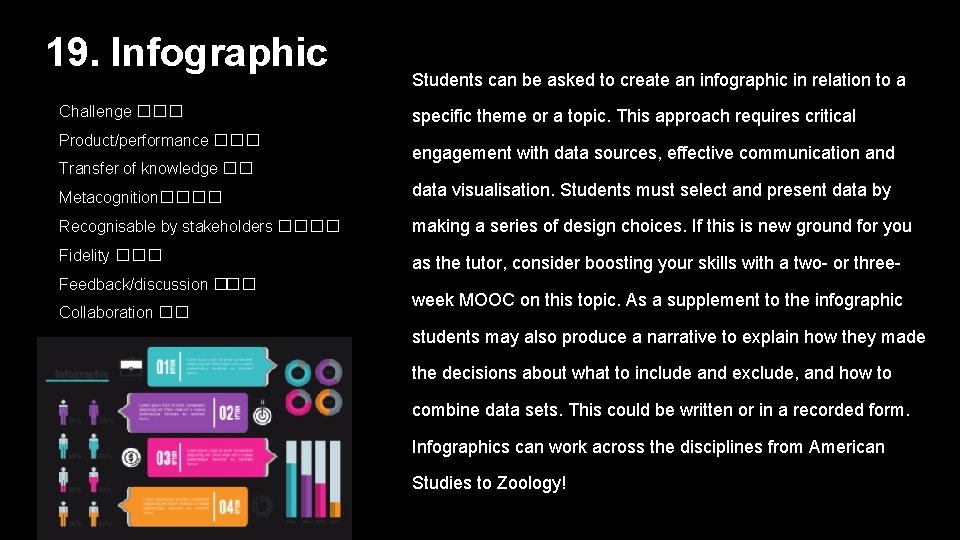
19. Infographic Challenge ��� Product/performance ��� Transfer of knowledge �� Students can be asked to create an infographic in relation to a specific theme or a topic. This approach requires critical engagement with data sources, effective communication and Metacognition���� data visualisation. Students must select and present data by Recognisable by stakeholders ���� making a series of design choices. If this is new ground for you Fidelity ��� as the tutor, consider boosting your skills with a two- or three- Feedback/discussion ��� Collaboration �� week MOOC on this topic. As a supplement to the infographic students may also produce a narrative to explain how they made the decisions about what to include and exclude, and how to combine data sets. This could be written or in a recorded form. Infographics can work across the disciplines from American Studies to Zoology!
20. Design your own assessment Challenge ����� Product/performance ���� Transfer of knowledge ���� Metacognition����� Take a learning outcome or two and ask students themselves to design a task to demonstrate the outcome(s). For example, an outcome such as 'Evaluate the applicability of different Recognisable by stakeholders ���� leadership theories' could be achieved by an interview project, a Fidelity ��� literature review or a review, an essay, or via a video diary of a Feedback/discussion ����� student in practice. Asking students to design their own can be Collaboration ��� motivational since it allows them to make choices that excite and inspire them, but it may also be daunting, so clear support and monitoring of the process is advisable. Students may need some low stakes practise and plenty of time for discussion and the formulation of their ideas.
21. Talk like TED Challenge ����� Ask students to 'offer a talk' along the lines of a Ted talk. Students Product/performance ���� can be supported to tell a valuable story about their subject that Transfer of knowledge ���� engages their audience, building a narrative. They should choose a Metacognition���� topic that inspires them. Recognising that not all students will thrive in Recognisable by stakeholders ���� Fidelity ��� front of camera – students can be offered a number of presentation Feedback/discussion ��� possibilities e. g. a live talk to peers, recorded talk using home-made Collaboration ��� green screening techniques or an alternative the use of a visual only side deck with a voice over. Students can be assessed on a range of TED aspects including technical content, communication (especially story structure), creativity, and presentation skills. There is an opportunity for students to undertake a critical reflection on their own performance after peer feedback has been gathered.
22. Interactive Topic Glossary Challenge �� Product/performance ��� Transfer of knowledge ��� When students need to know and learn terminology, consider asking them to create an interactive glossary; a terminology help sheet that Metacognition��� others can use to assist their learning. It might include definitions, Recognisable by stakeholders �� hyperlinks, mind-maps or sketch-notes, diagrams, mini-videos, Fidelity �� Feedback/discussion �� Collaboration �� examples, and some other quirky ways to help remember. Students will be able to grapple with terms and their meaning in their own way, whilst also creating resources for others. To add delight, students could hugely personalise their own glossaries in a playful way (explaining sociological terms with reference to their favourite film scenes for example!).
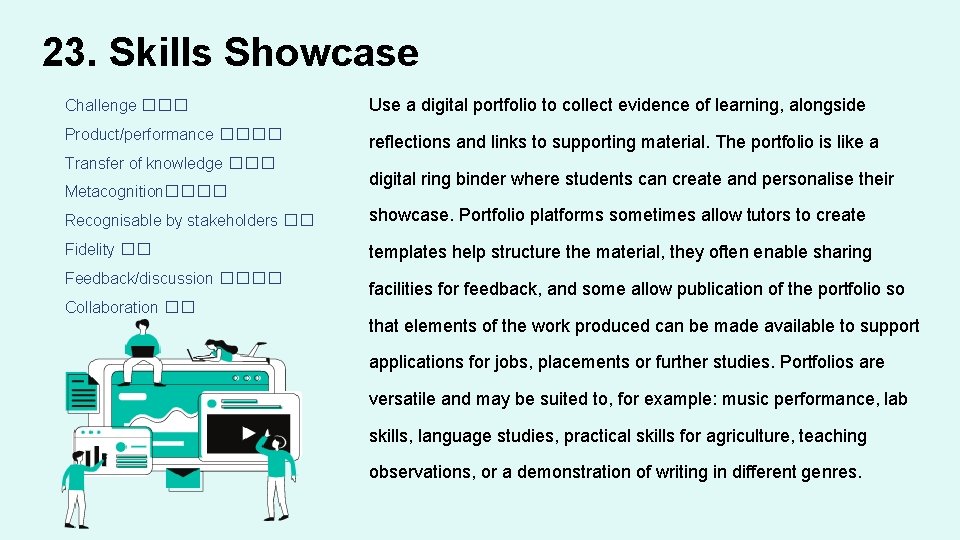
23. Skills Showcase Challenge ��� Use a digital portfolio to collect evidence of learning, alongside Product/performance ���� reflections and links to supporting material. The portfolio is like a Transfer of knowledge ��� Metacognition���� digital ring binder where students can create and personalise their Recognisable by stakeholders �� showcase. Portfolio platforms sometimes allow tutors to create Fidelity �� templates help structure the material, they often enable sharing Feedback/discussion ���� Collaboration �� facilities for feedback, and some allow publication of the portfolio so that elements of the work produced can be made available to support applications for jobs, placements or further studies. Portfolios are versatile and may be suited to, for example: music performance, lab skills, language studies, practical skills for agriculture, teaching observations, or a demonstration of writing in different genres.
24. Digital Field Guide Challenge ���� Students can use mobile phone technology to create virtual field guides, Product/performance ����� these are sources of information about specific sites. Through a Transfer of knowledge ��� combination of text, photographs, audio and video, students can present Metacognition���� an in-depth description or analysis of particular species, landscape Recognisable by stakeholders ��� Fidelity ��� feature or place. Students could choose or be allocated their focus. This Feedback/discussion ���� activity can be undertaken individually or as a group. If the completed Collaboration ����� resources are published online, then they can be paired with QR codes at the site so that others get to use the field guide to enhance their engagement with the environment. Whilst the example here is framed around the natural world, this approach could also be used to explore and explain history, musical heritage, tourist trails and more! Developed with Dr. Nicky Hunter at Harper Adams University
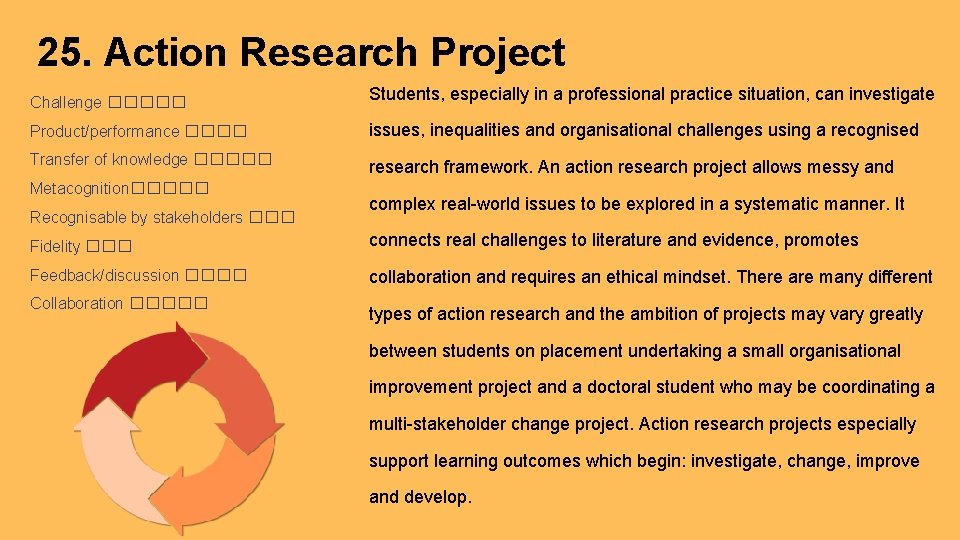
25. Action Research Project Challenge ����� Students, especially in a professional practice situation, can investigate Product/performance ���� issues, inequalities and organisational challenges using a recognised Transfer of knowledge ����� research framework. An action research project allows messy and Metacognition����� Recognisable by stakeholders ��� complex real-world issues to be explored in a systematic manner. It Fidelity ��� connects real challenges to literature and evidence, promotes Feedback/discussion ���� collaboration and requires an ethical mindset. There are many different Collaboration ����� types of action research and the ambition of projects may vary greatly between students on placement undertaking a small organisational improvement project and a doctoral student who may be coordinating a multi-stakeholder change project. Action research projects especially support learning outcomes which begin: investigate, change, improve and develop.
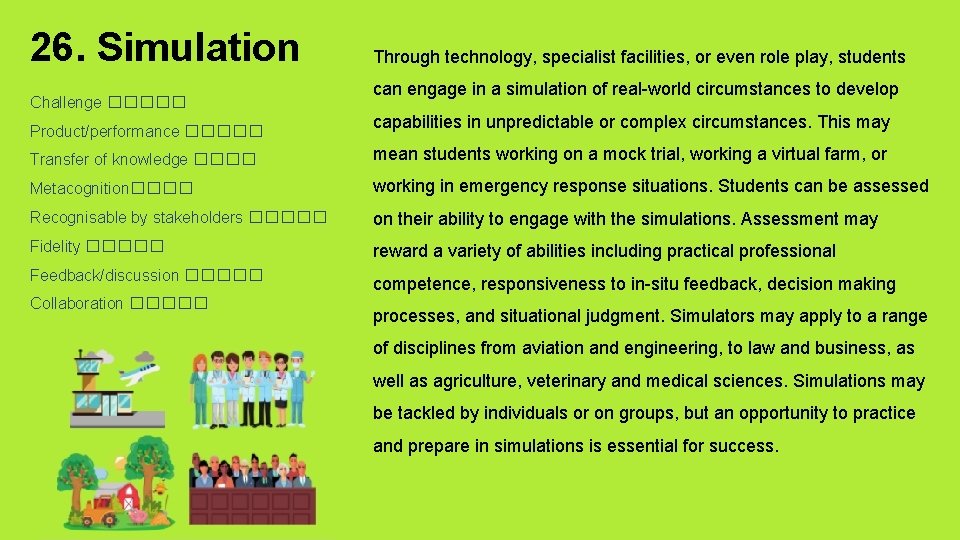
26. Simulation Challenge ����� Product/performance ����� Through technology, specialist facilities, or even role play, students can engage in a simulation of real-world circumstances to develop capabilities in unpredictable or complex circumstances. This may Transfer of knowledge ���� mean students working on a mock trial, working a virtual farm, or Metacognition���� working in emergency response situations. Students can be assessed Recognisable by stakeholders ����� on their ability to engage with the simulations. Assessment may Fidelity ����� reward a variety of abilities including practical professional Feedback/discussion ����� competence, responsiveness to in-situ feedback, decision making Collaboration ����� processes, and situational judgment. Simulators may apply to a range of disciplines from aviation and engineering, to law and business, as well as agriculture, veterinary and medical sciences. Simulations may be tackled by individuals or on groups, but an opportunity to practice and prepare in simulations is essential for success.
27. Design and Build Challenge ����� Students can be given a design brief to set out the need to address a Product/performance ����� ‘problem’. This may be easy to imagine in disciplines with a practical Transfer of knowledge ����� component, such as Engineering or Computing, but it may also be Metacognition��� applicable to other disciplines e. g. Designing a Professional Development Recognisable by stakeholders ����� Template for a business student, or a game to promote political Fidelity ���� engagement amongst the under 16 s to be used within county wide Feedback/discussion ���� schools. A reflective narrative (or exhibition) that goes with the product Collaboration ���� can detail the design process, the decisions made, the team work employed and even such things as stakeholder engagement. Design and build projects must result in the product actually being created so it is important to be realistic in the brief.
28. Case Study - Provided Challenge ����� Students are given case study material relating to a specific issue: e. g. Product/performance ��� product marketing strategies, dementia care, utilities location. At its Transfer of knowledge��� most simple students examine the cases presented and undertake an Metacognition��� evaluation by bringing their understanding to the case material. Recognisable by stakeholders ��� Students give responses based on the evidence provided – such as Fidelity �� where to locate pylons, or how to treat the patient cases. To increase Feedback/discussion ��� both the demand of the activity and its authenticity students may be Collaboration ��� asked to undertake additional research or investigate other cases to compare and contrast with the material provided. If the case is ‘live’ and in the public domain, then students may also seek out secondary supporting material beyond that presented by the tutor. Case studies may be one-off assessments or they may be built up over a sustained period acting as a site of deep-learning.
29. Case Study – Student Led Challenge ����� Product/performance ��� Students are given a 'brief' and they go on to select and build a Transfer of knowledge��� case study which may have decision making components. For Metacognition��� example, they may be asked to choose a major city and evaluate Recognisable by stakeholders ��� the energy supply options for the next 30 years, or they may be Fidelity ��� asked to select an international business and an analysis of the Feedback/discussion ��� social media strategy, and through comparisons with other Collaboration ��� businesses, make recommendations for enhancement. Student created case studies can allow students to engage deeply with a topic, and to explore a complex problem.
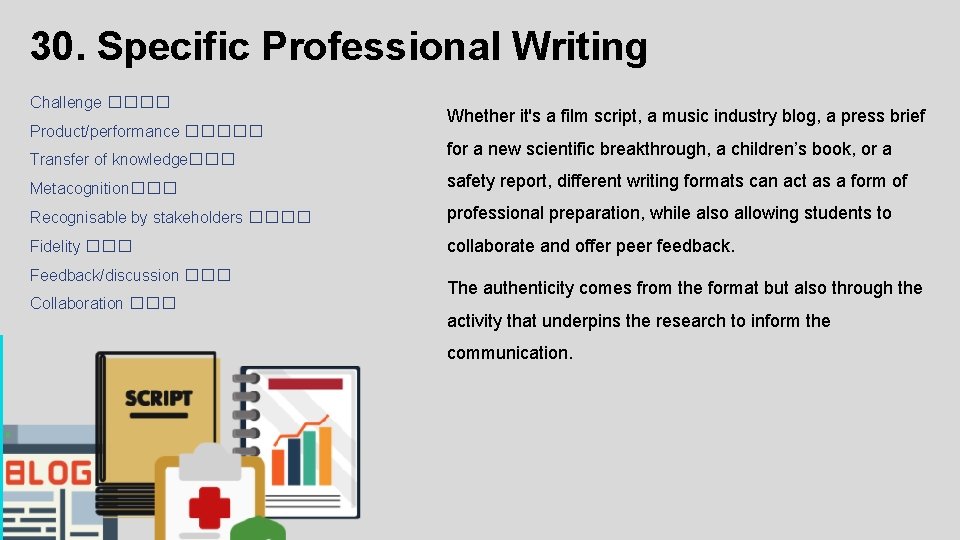
30. Specific Professional Writing Challenge ���� Product/performance ����� Transfer of knowledge��� Whether it's a film script, a music industry blog, a press brief for a new scientific breakthrough, a children’s book, or a Metacognition��� safety report, different writing formats can act as a form of Recognisable by stakeholders ���� professional preparation, while also allowing students to Fidelity ��� collaborate and offer peer feedback. Feedback/discussion ��� Collaboration ��� The authenticity comes from the format but also through the activity that underpins the research to inform the communication.
31. Online Talking Heads Challenge ���� Product/performance ���� Transfer of knowledge��� Metacognition��� Role play can be high pressure, and may not allow the time between interactions that is likely to be part of many realworld situations. A talking head role-play takes place in an Recognisable by stakeholders ���� online forum. Each member of a group is given a role – in a Fidelity ��� planning situation it may be Parish Councillor, County Feedback/discussion ��� Council Planning Officer, Environment Agency Officer and Collaboration ����� Housing Authority Representative. in an educational scenario it may be parent, teacher, student, governor. A scenario is provided and each member of the group makes contributions to resolve the issue using only their character’s position. Contributions can be researched inbetween responses. This can be used across disciplines from Talking Philosophers to Social Care.
Your examples Challenge Product/performance Transfer of knowledge Metacognition Recognisable by stakeholders Fidelity Feedback/discussion Collaboration Insert text:
Your examples Challenge Product/performance Transfer of knowledge Metacognition Recognisable by stakeholders Fidelity Feedback/discussion Collaboration Insert text:
Your examples Challenge Product/performance Transfer of knowledge Metacognition Recognisable by stakeholders Fidelity Feedback/discussion Collaboration Insert text:
Info This work is licensed under a Creative Commons Attribution-Non. Commercial-Share. Alike 4. 0 International License. Reference Ashford-Rowe, K. , Herrington, J. and Brown, C. (2014) ‘Establishing the critical elements that determine authentic assessment’, Assessment and Evaluation in Higher Education, 39(2), pp. 205– 222. doi: 10. 1080/02602938. 2013. 819566