
REFLECTING ON THE PAST LOOKING TO THE FUTURE

- Slides: 22
REFLECTING ON THE PAST, LOOKING TO THE FUTURE MODULE #1
Thinking About Audience Analysis Last week, we thought about the WHY of business communication. We came up with some features of business communication and explored what makes it different from other types of writing. We also got briefly introduced to a communication model as we reflected on our past writing experience. This week, we'll return to that communication model as we think more about audience analysis. We'll use the CMAPP model to think about a miscommunication and figure out what went wrong and why. At the end of last week, you did your first mind map. Before you begin this module, reflect on what themes emerged from Module #1. What unanswered questions do you have? Photo: Volodymyr Hryshchenko on Unsplash
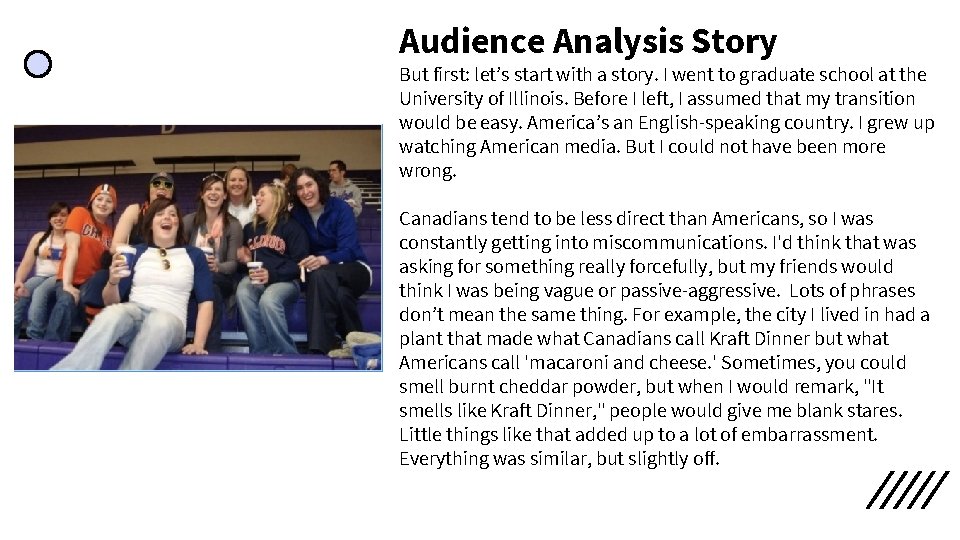
Audience Analysis Story But first: let’s start with a story. I went to graduate school at the University of Illinois. Before I left, I assumed that my transition would be easy. America’s an English-speaking country. I grew up watching American media. But I could not have been more wrong. Canadians tend to be less direct than Americans, so I was constantly getting into miscommunications. I'd think that was asking for something really forcefully, but my friends would think I was being vague or passive-aggressive. Lots of phrases don’t mean the same thing. For example, the city I lived in had a plant that made what Canadians call Kraft Dinner but what Americans call 'macaroni and cheese. ' Sometimes, you could smell burnt cheddar powder, but when I would remark, "It smells like Kraft Dinner, " people would give me blank stares. Little things like that added up to a lot of embarrassment. Everything was similar, but slightly off.
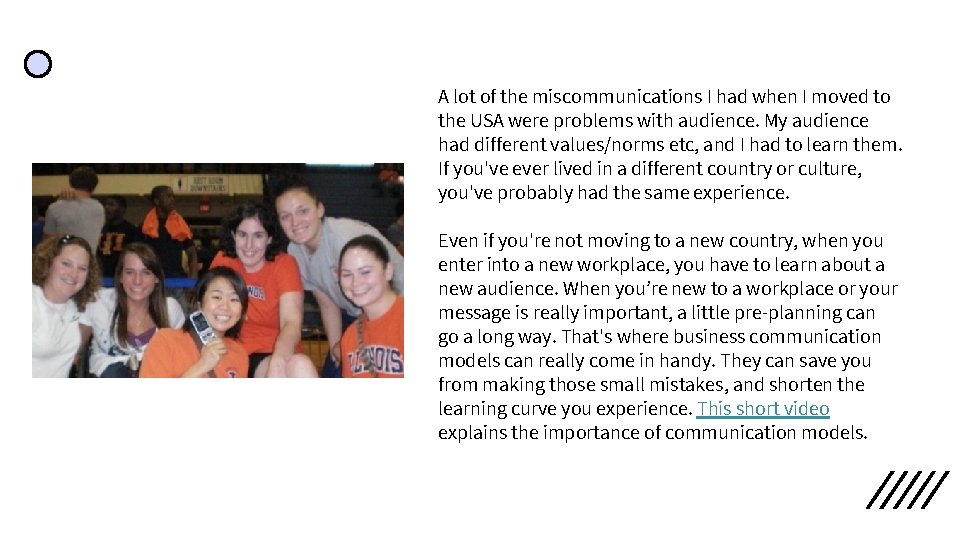
A lot of the miscommunications I had when I moved to the USA were problems with audience. My audience had different values/norms etc, and I had to learn them. If you've ever lived in a different country or culture, you've probably had the same experience. Even if you're not moving to a new country, when you enter into a new workplace, you have to learn about a new audience. When you’re new to a workplace or your message is really important, a little pre-planning can go a long way. That's where business communication models can really come in handy. They can save you from making those small mistakes, and shorten the learning curve you experience. This short video explains the importance of communication models.
Freewrite To understand communication models and how to analyze an audience, we're going to think back to a miscommunication. Think of a miscommunication you experienced. It could be big or small. Ideally, choose a situation where you were the sender of the message that caused the misunderstanding. Write for 5 minutes on the topic “Tell me about a time when you experienced a miscommunication with someone. ” As you write, try to go into as much detail as possible. How did you feel at the time? How did you react? Did the situation get resolved? If so, how?
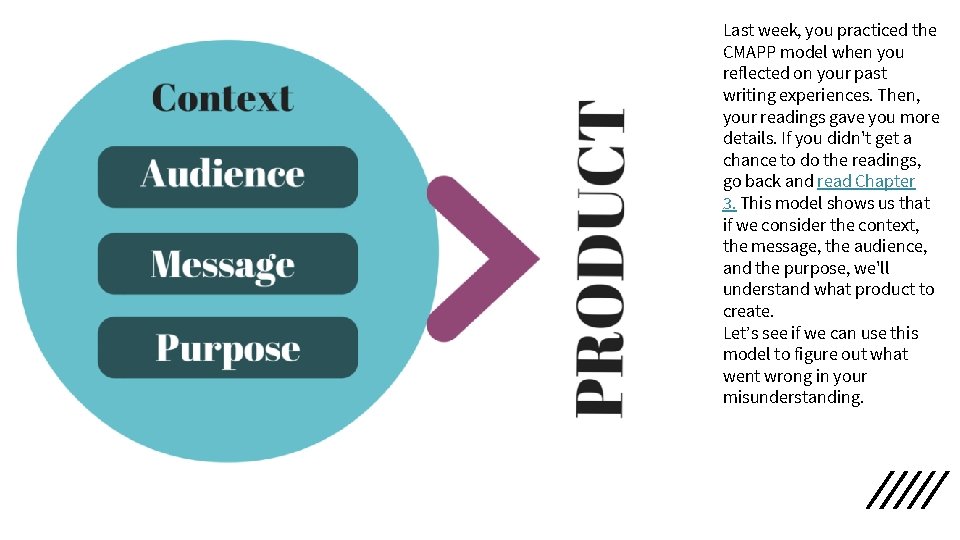
Last week, you practiced the CMAPP model when you reflected on your past writing experiences. Then, your readings gave you more details. If you didn't get a chance to do the readings, go back and read Chapter 3. This model shows us that if we consider the context, the message, the audience, and the purpose, we'll understand what product to create. Let’s see if we can use this model to figure out what went wrong in your misunderstanding.
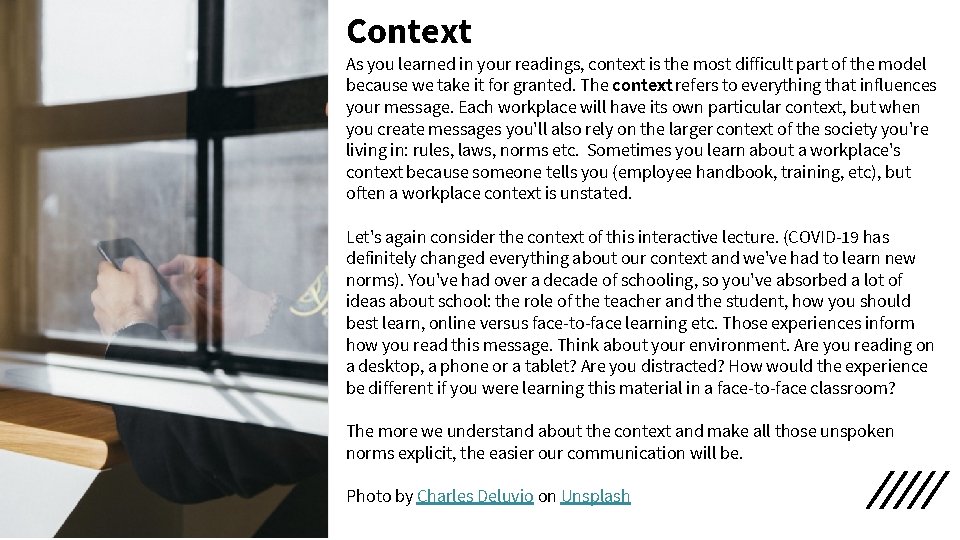
Context As you learned in your readings, context is the most difficult part of the model because we take it for granted. The context refers to everything that influences your message. Each workplace will have its own particular context, but when you create messages you'll also rely on the larger context of the society you're living in: rules, laws, norms etc. Sometimes you learn about a workplace's context because someone tells you (employee handbook, training, etc), but often a workplace context is unstated. Let's again consider the context of this interactive lecture. (COVID-19 has definitely changed everything about our context and we've had to learn new norms). You've had over a decade of schooling, so you've absorbed a lot of ideas about school: the role of the teacher and the student, how you should best learn, online versus face-to-face learning etc. Those experiences inform how you read this message. Think about your environment. Are you reading on a desktop, a phone or a tablet? Are you distracted? How would the experience be different if you were learning this material in a face-to-face classroom? The more we understand about the context and make all those unspoken norms explicit, the easier our communication will be. Photo by Charles Deluvio on Unsplash
Freewrite Set a timer for 2 minutes and make a list of everything you know about the context of your miscommunication. You might consider: • • What was your context when the miscommunication happened? What was your audience's context? Were they different? How much do you know about your audience's context when they received your message
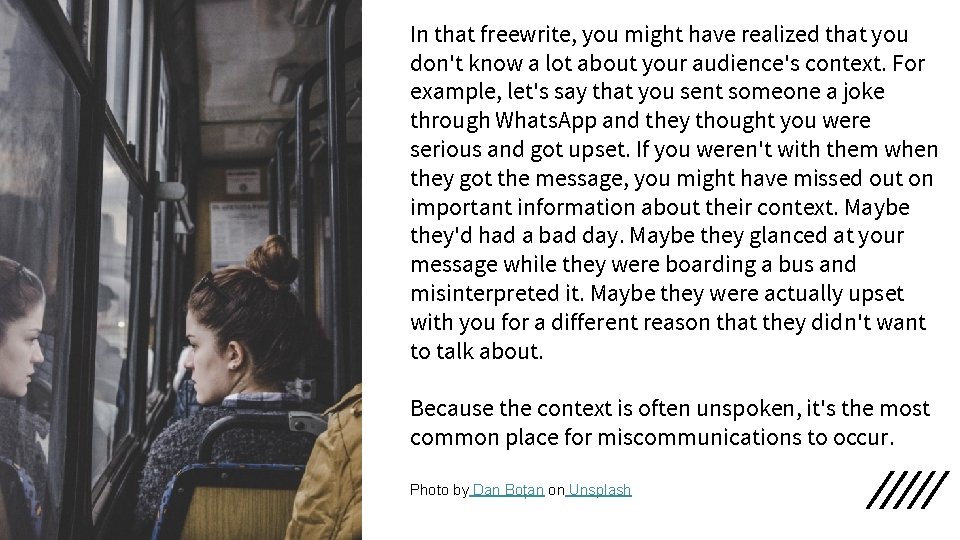
In that freewrite, you might have realized that you don't know a lot about your audience's context. For example, let's say that you sent someone a joke through Whats. App and they thought you were serious and got upset. If you weren't with them when they got the message, you might have missed out on important information about their context. Maybe they'd had a bad day. Maybe they glanced at your message while they were boarding a bus and misinterpreted it. Maybe they were actually upset with you for a different reason that they didn't want to talk about. Because the context is often unspoken, it's the most common place for miscommunications to occur. Photo by Dan Boțan on Unsplash
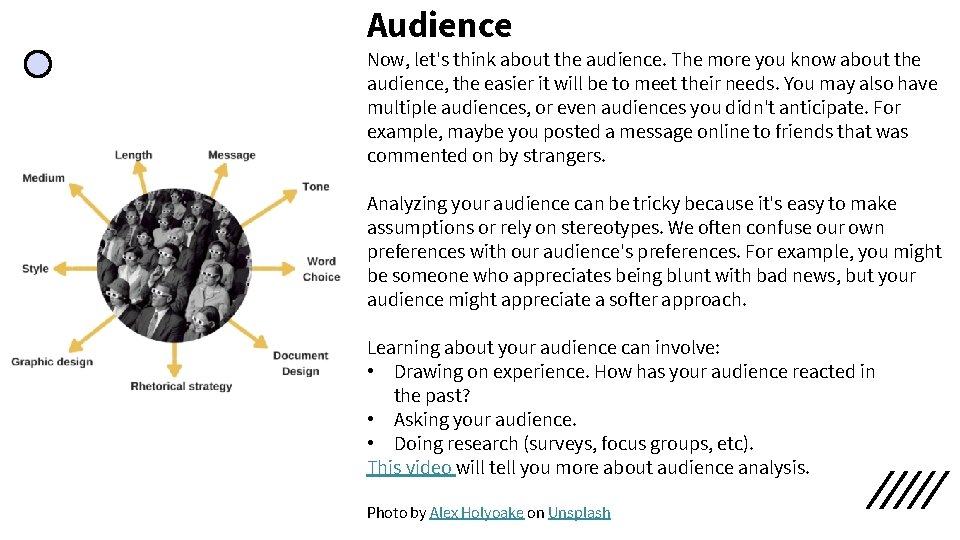
Audience Now, let's think about the audience. The more you know about the audience, the easier it will be to meet their needs. You may also have multiple audiences, or even audiences you didn't anticipate. For example, maybe you posted a message online to friends that was commented on by strangers. Analyzing your audience can be tricky because it's easy to make assumptions or rely on stereotypes. We often confuse our own preferences with our audience's preferences. For example, you might be someone who appreciates being blunt with bad news, but your audience might appreciate a softer approach. Learning about your audience can involve: • Drawing on experience. How has your audience reacted in the past? • Asking your audience. • Doing research (surveys, focus groups, etc). This video will tell you more about audience analysis. Photo by Alex Holyoake on Unsplash
Freewrite Set a timer for 2 minutes and write about how the audience impacted your miscommunication. You might consider: • How well did you think you understood your audience before you sent the message? Were you right? • Did you make any mistakes when analyzing your audience? • When you sent your message, how much did you think about your audience's needs?
Purpose In the workplace, you always have a reason to communicate. Your purpose could be small, like getting someone to answer your email, or it could be big, like convincing someone to give your company a big contract. Knowing why you're communicating will help you know what to include in your message. Often, miscommunications occur because either you don't have a clear purpose or your purpose isn't appropriate for your audience. For example, sometimes people struggle to write cover letters because they think the goal of a cover letter is to get you a job. In fact, the goal of a cover letter is much smaller; it’s just to get you an interview. You don't have to lay out every detail of your work experience at once. Understanding your purpose can help you craft a more successful message. Photo by oxana v on Unsplash
Freewrite Set a timer for 2 minutes and write about how the purpose impacted your miscommunication. You might consider: • What did you hope to achieve with your miscommunication? • What purpose did you actually achieve? • Did you think about your purpose beforehand? • Did the message you sent match your purpose?
Message Your message is what information you want to share with your audience. This includes the words you chose, your tone, your details and much more. Sometimes, you can have unspoken messages. For example, if you had a cooking blog, your messages might be "here's how to cook a delicious veggie burger" but your unspoken messages might be "this is easy and you can do it!" and "with the right flavours, eating healthy can be delicious. ” It's worth noting that what you learned about the context, audience and purpose will help you craft your message. For example, you might realize that your initial idea wouldn't meet your audience's needs, or you didn't have a clear purpose. That's why we consider the message towards the end of this model.
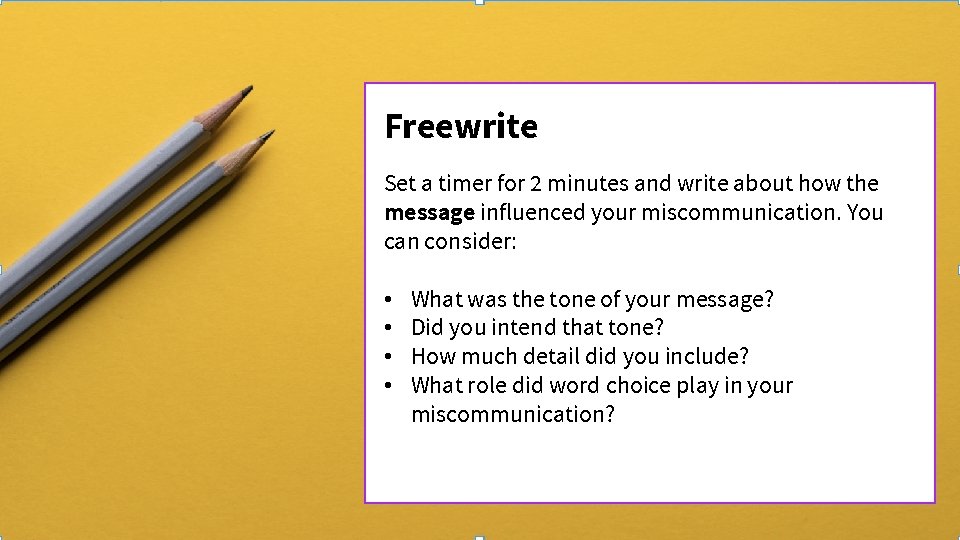
Freewrite Set a timer for 2 minutes and write about how the message influenced your miscommunication. You can consider: • • What was the tone of your message? Did you intend that tone? How much detail did you include? What role did word choice play in your miscommunication?
Product According to the model we've studied, analyzing your context, audience, message, and purpose will lead you to your product. Your product is what you create: a text message, an Instagram post, a phone call etc. If you leap too quickly to the product, you might get it wrong. Your audience analysis should help you choose an appropriate product for the situation. For example, you might be tempted to break up with someone you're casually dating over text message because it's quicker. However, after talking with friends and considering your date's needs, you might choose to do it in person or over the phone because it's more respectful.
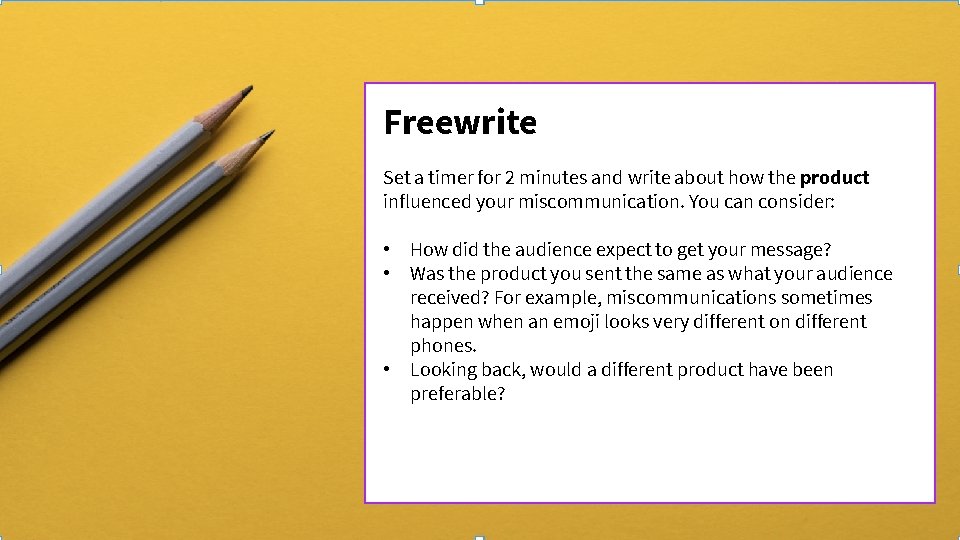
Freewrite Set a timer for 2 minutes and write about how the product influenced your miscommunication. You can consider: • • • How did the audience expect to get your message? Was the product you sent the same as what your audience received? For example, miscommunications sometimes happen when an emoji looks very different on different phones. Looking back, would a different product have been preferable?
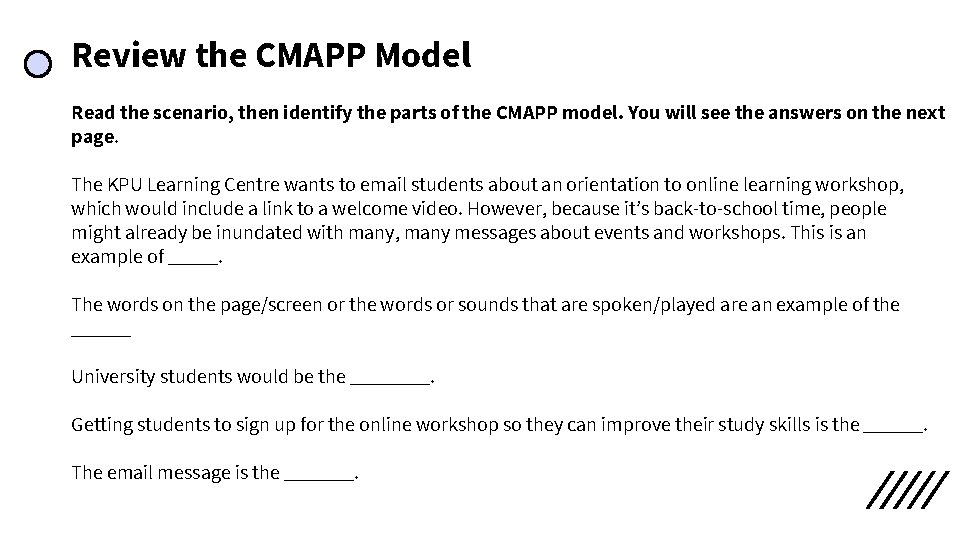
Review the CMAPP Model Read the scenario, then identify the parts of the CMAPP model. You will see the answers on the next page. The KPU Learning Centre wants to email students about an orientation to online learning workshop, which would include a link to a welcome video. However, because it’s back-to-school time, people might already be inundated with many, many messages about events and workshops. This is an example of _____. The words on the page/screen or the words or sounds that are spoken/played are an example of the ______ University students would be the ____. Getting students to sign up for the online workshop so they can improve their study skills is the ______. The email message is the _______.
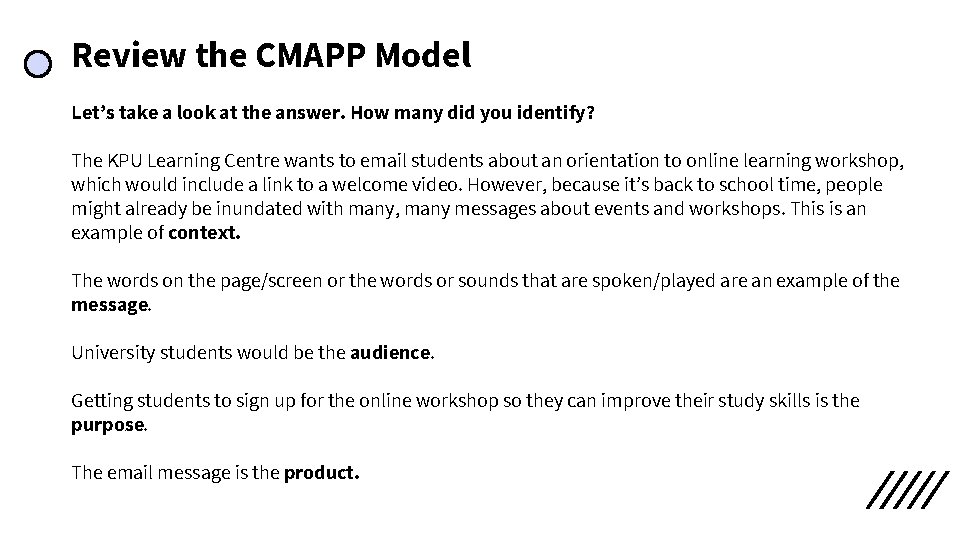
Review the CMAPP Model Let’s take a look at the answer. How many did you identify? The KPU Learning Centre wants to email students about an orientation to online learning workshop, which would include a link to a welcome video. However, because it’s back to school time, people might already be inundated with many, many messages about events and workshops. This is an example of context. The words on the page/screen or the words or sounds that are spoken/played are an example of the message. University students would be the audience. Getting students to sign up for the online workshop so they can improve their study skills is the purpose. The email message is the product.
Your Writing Foundation By the time you've reached this class, you've had decades of writing instruction. You've had even more time being exposed to messages about writing. You've also been communicating since you were born, even before you could speak. All of these beliefs, values and experiences inform our writing in ways we may not expect. If we don't reflect on these experiences, unhelpful beliefs might hold us back. Photo by Luke Stackpoole on Unsplash
Freewrite Let's try another freewrite. Set a timer for 3 minutes, then write on the following topic: What is "good writing? " Where did my ideas about good writing come from?
Putting It All Together In this lecture, we used the components of the CMAPP communication model to get some new insights into a miscommunication. Now, take a look at everything you've written. What did you learn? Was one part of the CMAPP model responsible for the miscommunication, or did multiple parts play a role? What could you have done differently? It's also worth noting that you don't need to conduct a thorough CMAPP analysis for every email you send. In the workplace, you might use this model before you tackle a big project, when you're sending a sensitive message or when you're just starting out. With practice, you'll probably go through the steps without even thinking about it. We'll build on what we learned in the next lecture when we think about the tone of a message.