
Reflectance Transformation Imaging RTI And PhotogrammetryStructure From Motion
- Slides: 42
Reflectance Transformation Imaging (RTI) And PhotogrammetryStructure From Motion (SFM) Methods of Documentation Dr. Timothy Urbaniak TRU Technologies Inc. turbaniak@bresnan. net
Definition of Reflectance Transformation Imaging (RTI) It assists in seeing things that you would not otherwise see. Or “RTI is a computational photographic method that captures a subject’s surface shape and color and enables the interactive re-lighting of the subject from any direction. RTI also permits the mathematical enhancement of the subject’s surface shape and color attributes. The enhancement functions of RTI reveal surface information that is not disclosed under direct empirical examination of the physical object. ” http: //culturalheritageimaging. org/Technologies/RTI/ Capture | Process | View
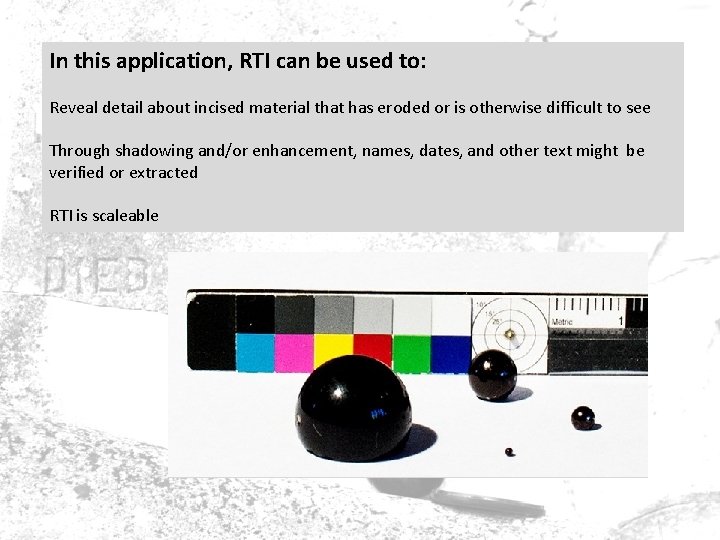
In this application, RTI can be used to: Reveal detail about incised material that has eroded or is otherwise difficult to see Through shadowing and/or enhancement, names, dates, and other text might be verified or extracted RTI is scaleable
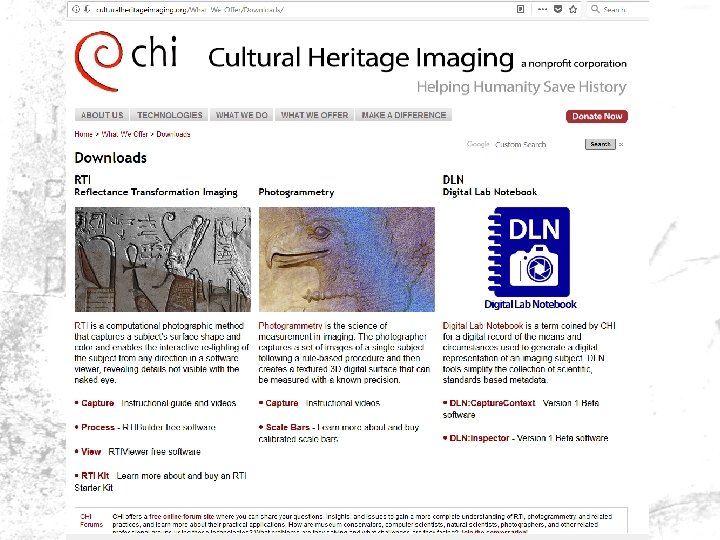
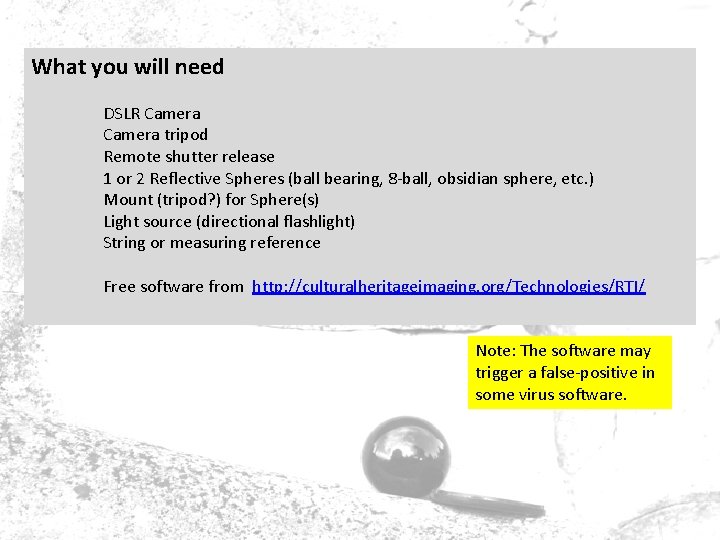
What you will need DSLR Camera tripod Remote shutter release 1 or 2 Reflective Spheres (ball bearing, 8 -ball, obsidian sphere, etc. ) Mount (tripod? ) for Sphere(s) Light source (directional flashlight) String or measuring reference Free software from http: //culturalheritageimaging. org/Technologies/RTI/ Note: The software may trigger a false-positive in some virus software.
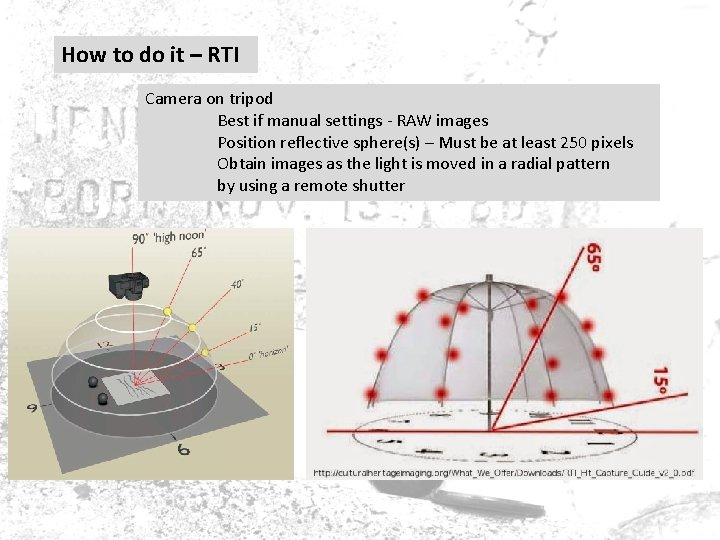
How to do it – RTI Camera on tripod Best if manual settings - RAW images Position reflective sphere(s) – Must be at least 250 pixels Obtain images as the light is moved in a radial pattern by using a remote shutter
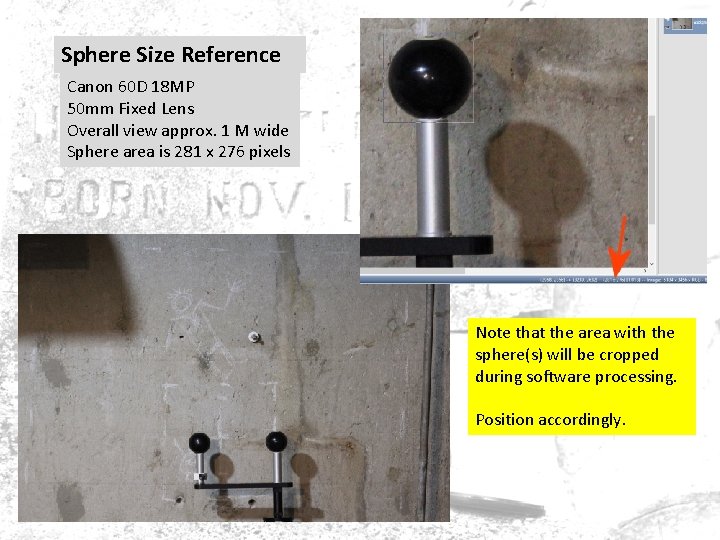
Sphere Size Reference Canon 60 D 18 MP 50 mm Fixed Lens Overall view approx. 1 M wide Sphere area is 281 x 276 pixels Note that the area with the sphere(s) will be cropped during software processing. Position accordingly.
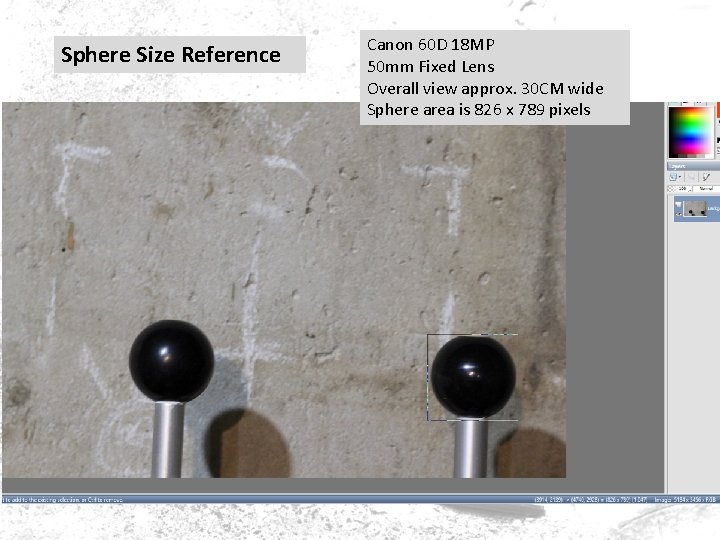
Sphere Size Reference Canon 60 D 18 MP 50 mm Fixed Lens Overall view approx. 30 CM wide Sphere area is 826 x 789 pixels
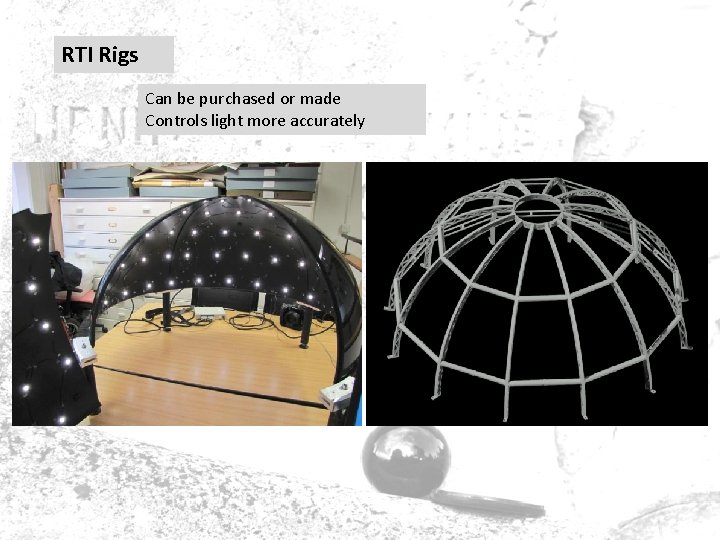
RTI Rigs Can be purchased or made Controls light more accurately
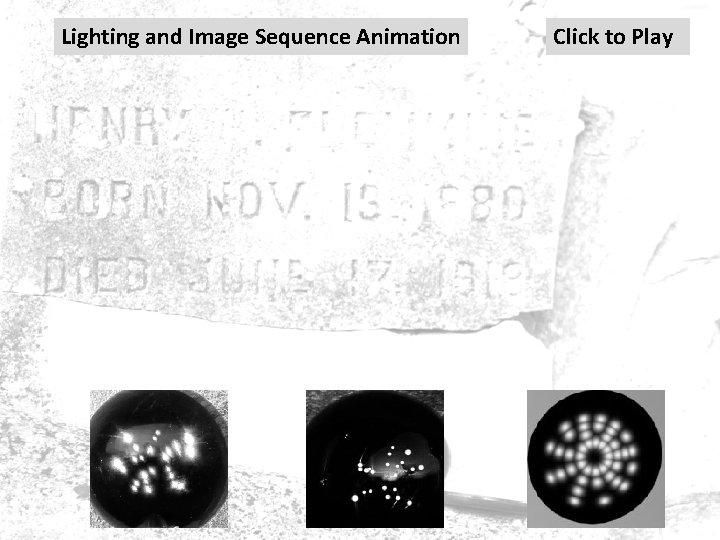
Lighting and Image Sequence Animation Click to Play
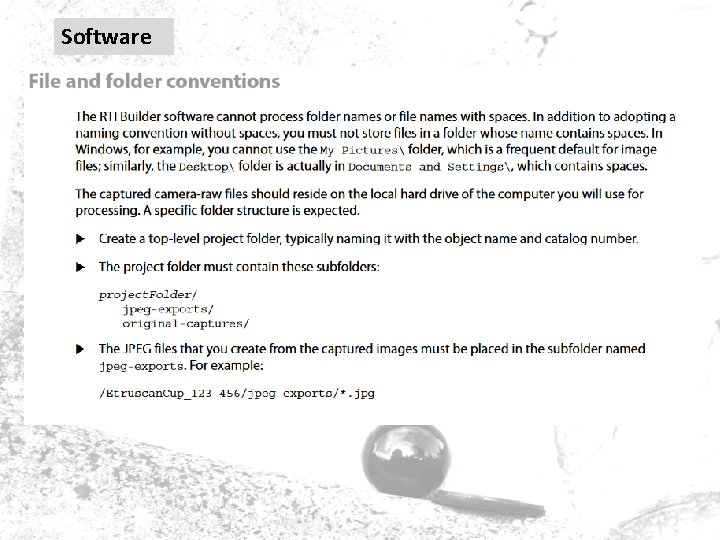
Software
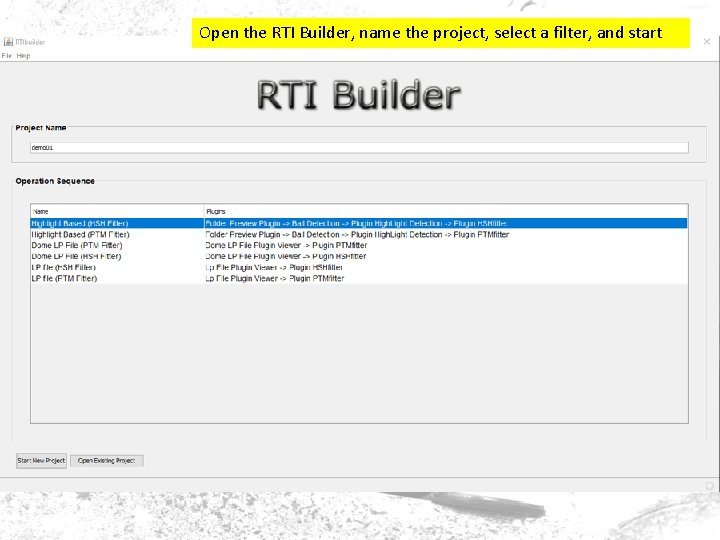
Open the RTI Builder, name the project, select a filter, and start
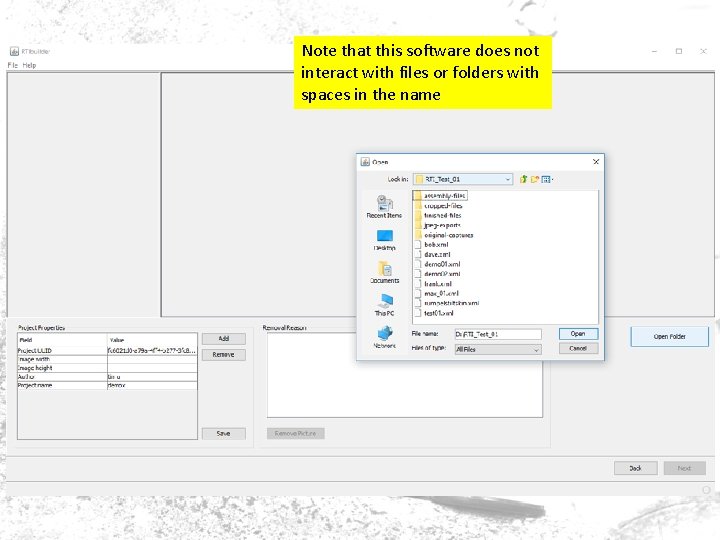
Note that this software does not interact with files or folders with spaces in the name
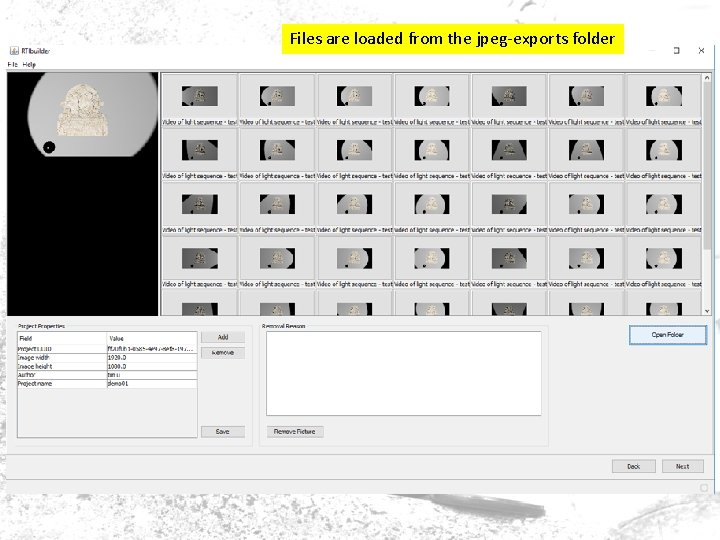
Files are loaded from the jpeg-exports folder
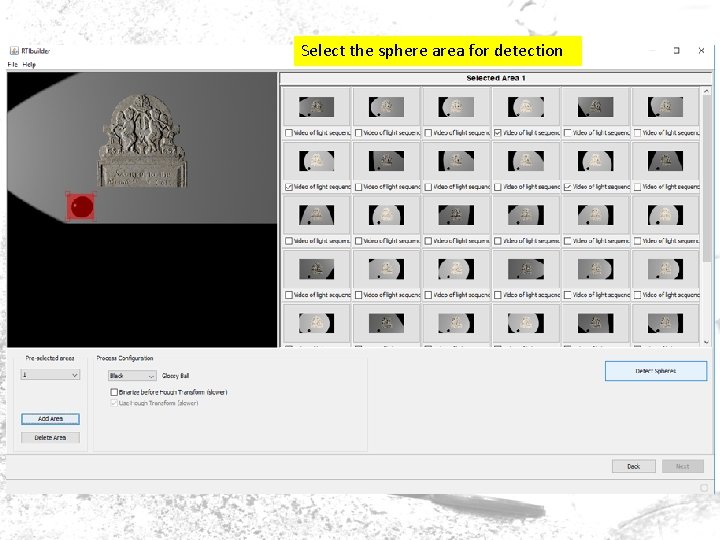
Select the sphere area for detection
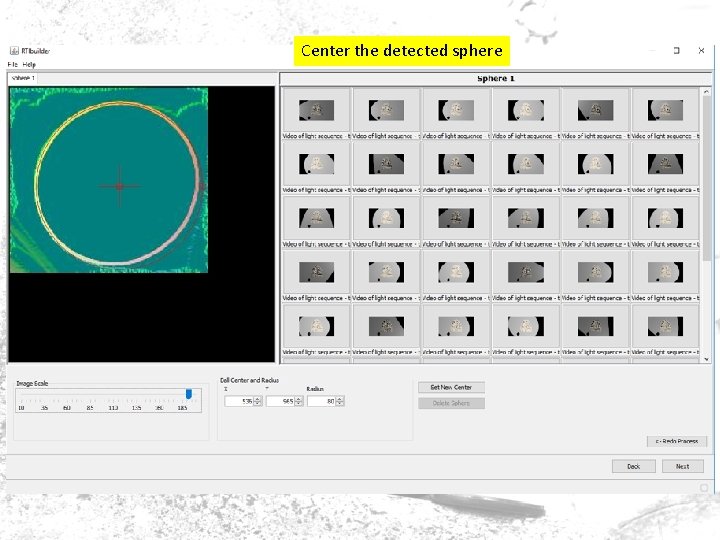
Center the detected sphere
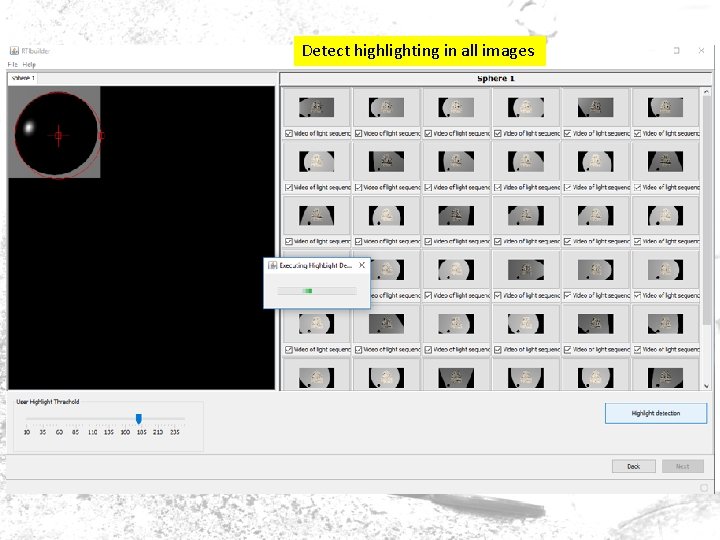
Detect highlighting in all images
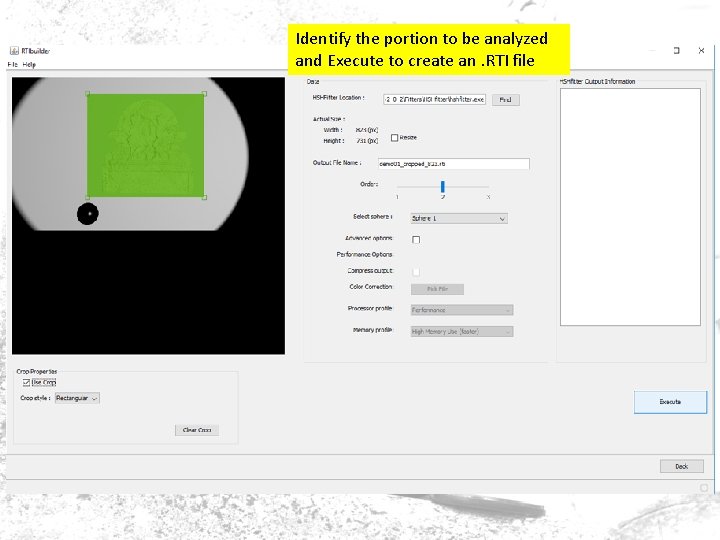
Identify the portion to be analyzed and Execute to create an. RTI file
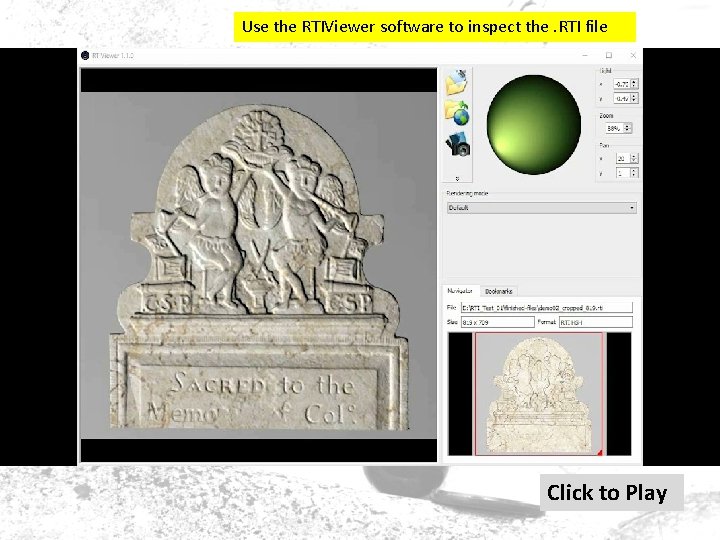
Use the RTIViewer software to inspect the. RTI file Click to Play
RTI Resources Best Source for Software and Techniques http: //culturalheritageimaging. org/Technologies/RTI/ Reflectance Transformation Imaging (RTI) https: //www. si. edu/MCIImaging. Studio/RTI Performing Reflectance Transformation Imaging https: //www. youtube. com/watch? v=zddxc. Sayxcg Reflectance Transformation Imaging (RTI): Capturing Gravestone Detail via Multiple Digital Images https: //livrepository. liverpool. ac. uk/3009787/1/E: %5 c. Work%20 HD%20 Jul y%202015%5 c. My%20 Passport%20 save%20(F)%5 c. Publications%20 Finishe d%20%20 Drafts%20&%20 Figs%5 c. Publication%20 pdfs%5 c. Mytum%20 et%2 0 al%202017%20 AGS%20 Newsl%20 RTI. pdf The Application of Reflectance Transformation Imaging (RTI) in Historical Archaeology https: //link. springer. com/article/10. 1007/s 41636 -018 -0107 -x
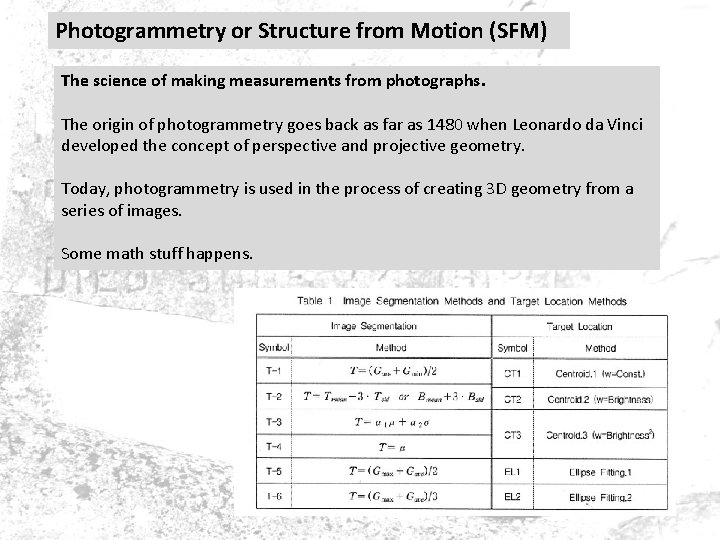
Photogrammetry or Structure from Motion (SFM) The science of making measurements from photographs. The origin of photogrammetry goes back as far as 1480 when Leonardo da Vinci developed the concept of perspective and projective geometry. Today, photogrammetry is used in the process of creating 3 D geometry from a series of images. Some math stuff happens.
What you will need for Photogrammetry Digital Camera Any camera – cel phone to DSLR Subject Matter Technique Obtain multiple images from varying elevations and vantage points Software Patience Commercial and Open Source There is a learning curve involved alongside processing time
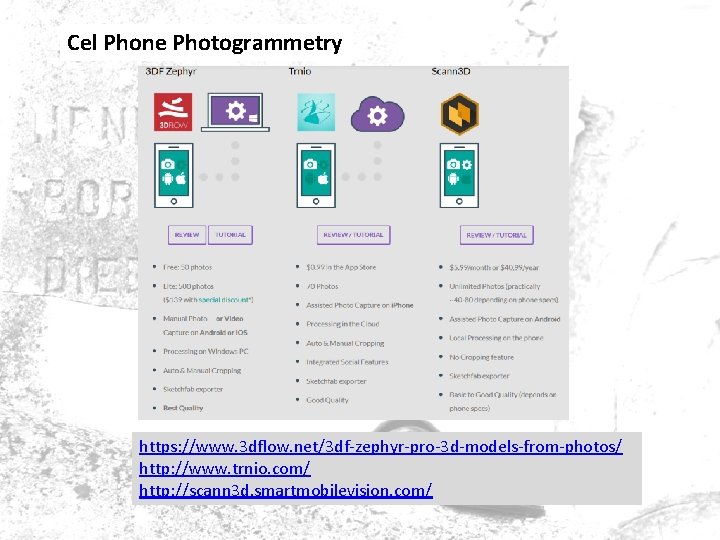
Cel Phone Photogrammetry https: //www. 3 dflow. net/3 df-zephyr-pro-3 d-models-from-photos/ http: //www. trnio. com/ http: //scann 3 d. smartmobilevision. com/
Onsite Workflow Evaluate scene for potential angles, lighting, and hazards (branches, holes) Is a scale needed? By placement, or any measured “known” Calibrated Scales Review camera settings Leave the lens at one magnification (tape the lens? ) Manual settings preferred for image uniformity Depth of field Manual or Automatic Focus Obtain a series of the subject by moving latterly at uniform intervals Obtain another series of the subject by moving latterly at uniform intervals at a different elevation (Repeat this step as needed) Regarding technique and accuracy – Today’s software is quite advanced in it’s ability to assimilate photos with a variety of settings, however – if greater accuracy is required, greater photographic control is needed.
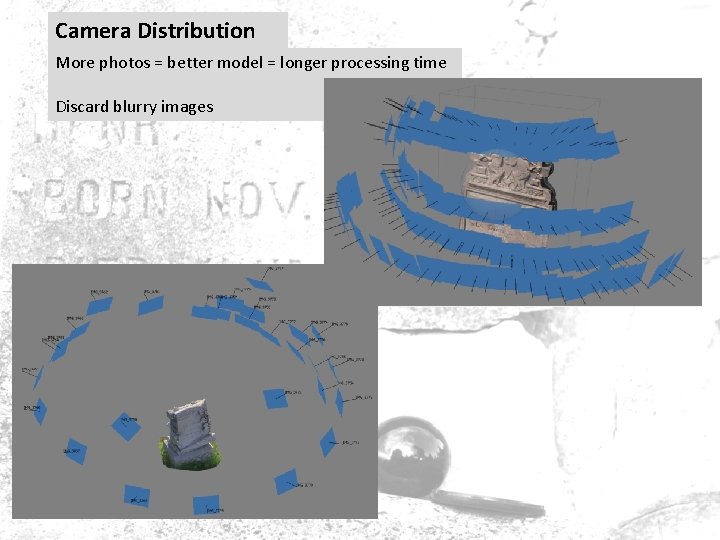
Camera Distribution More photos = better model = longer processing time Discard blurry images
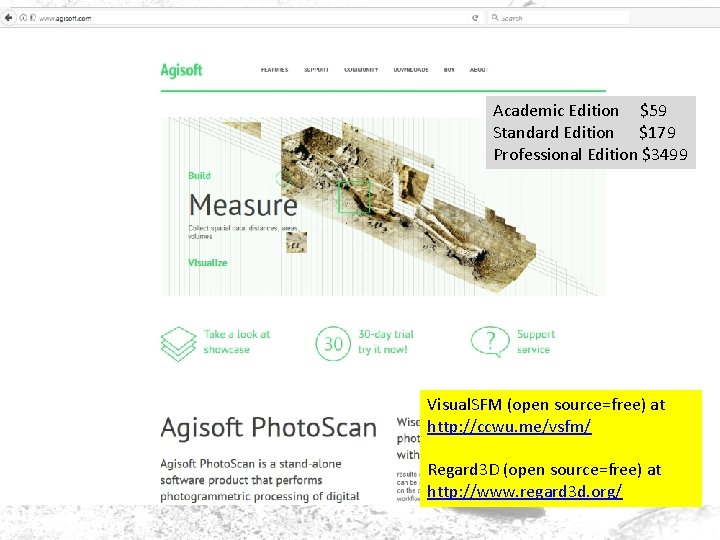
Academic Edition $59 Standard Edition $179 Professional Edition $3499 Visual. SFM (open source=free) at http: //ccwu. me/vsfm/ Regard 3 D (open source=free) at http: //www. regard 3 d. org/
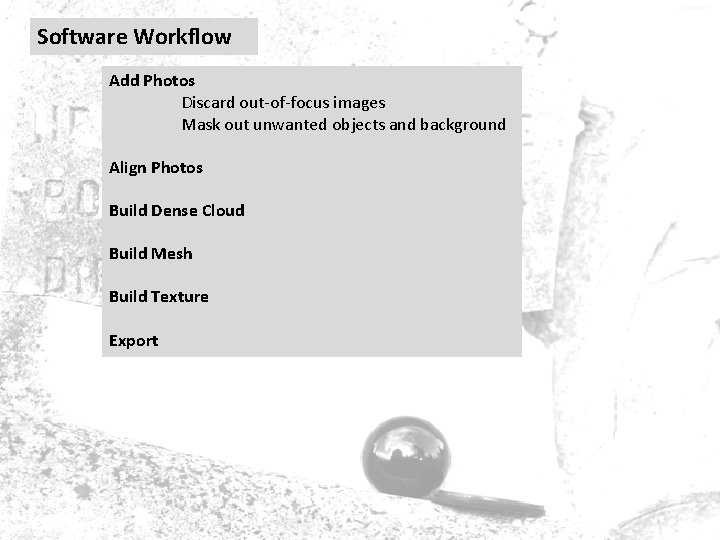
Software Workflow Add Photos Discard out-of-focus images Mask out unwanted objects and background Align Photos Build Dense Cloud Build Mesh Build Texture Export
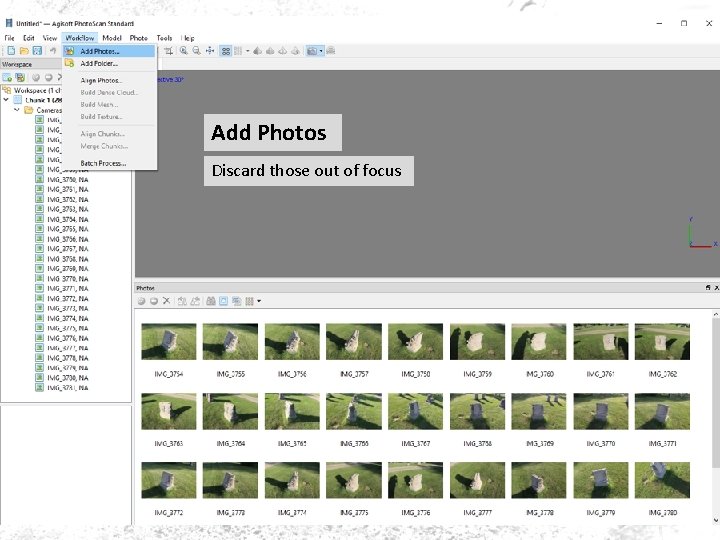
Add Photos Discard those out of focus
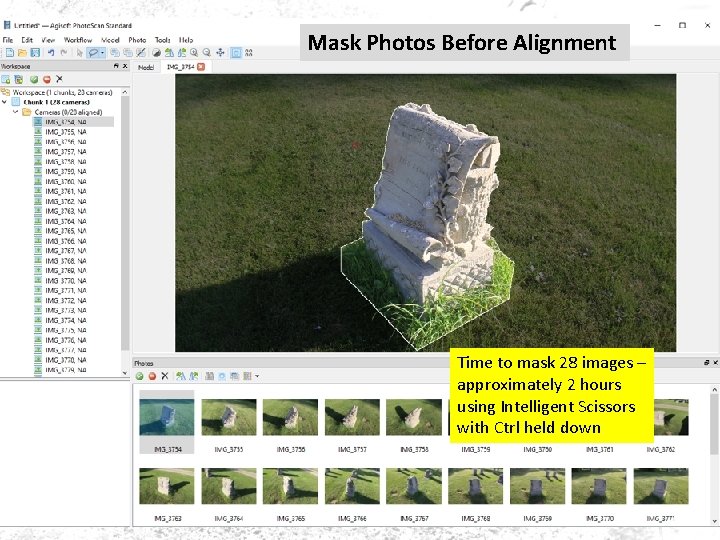
Mask Photos Before Alignment Time to mask 28 images – approximately 2 hours using Intelligent Scissors with Ctrl held down
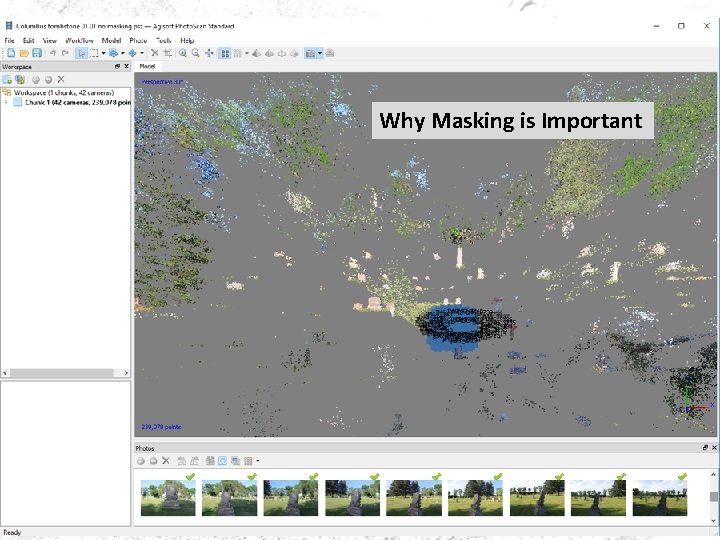
Why Masking is Important
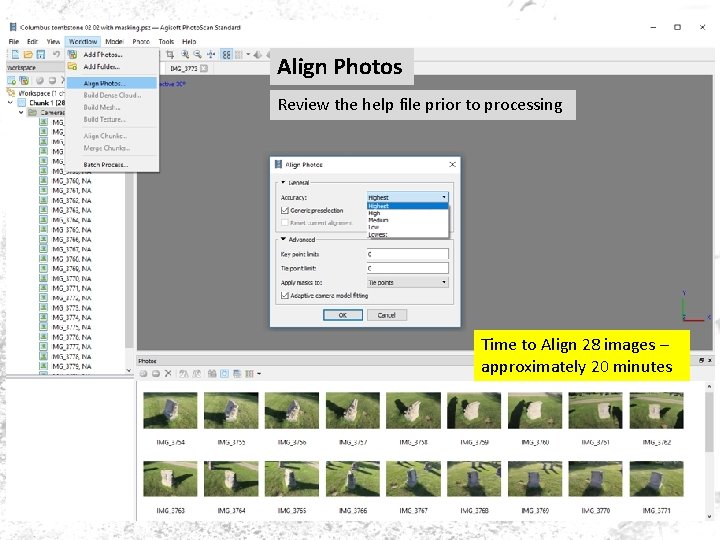
Align Photos Review the help file prior to processing Time to Align 28 images – approximately 20 minutes
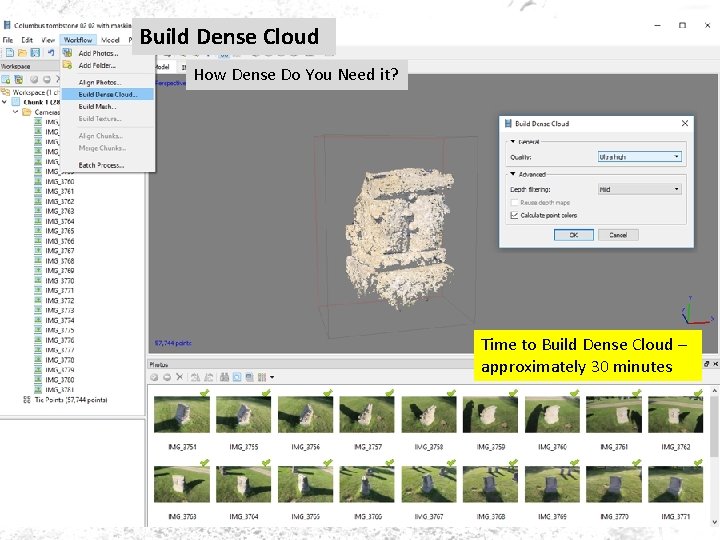
Build Dense Cloud How Dense Do You Need it? Time to Build Dense Cloud – approximately 30 minutes
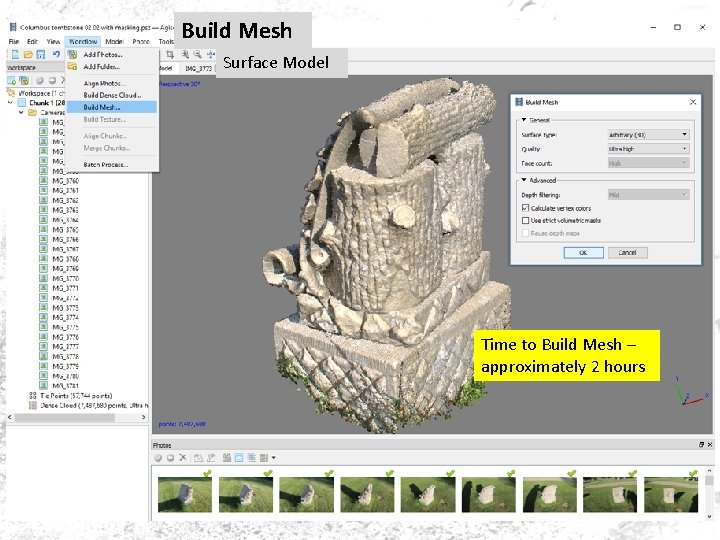
Build Mesh Surface Model Time to Build Mesh – approximately 2 hours
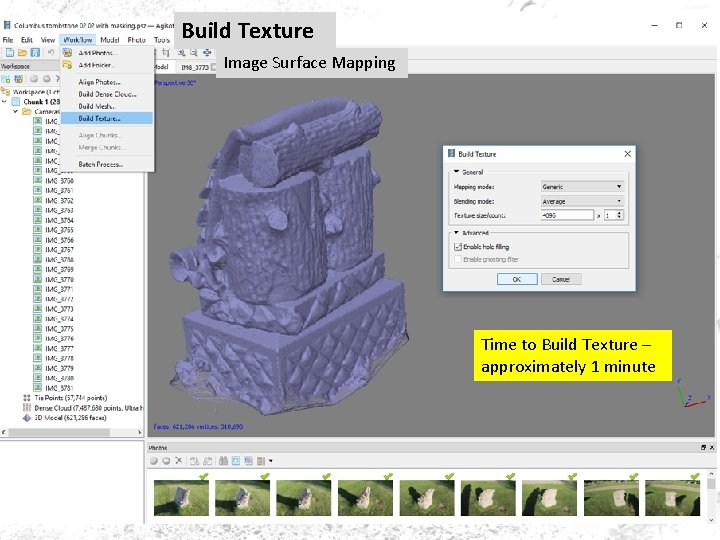
Build Texture Image Surface Mapping Time to Build Texture – approximately 1 minute
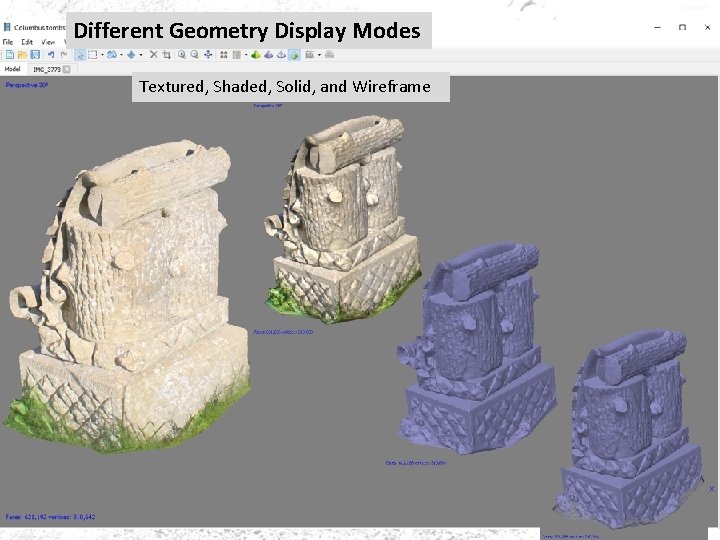
Different Geometry Display Modes Textured, Shaded, Solid, and Wireframe
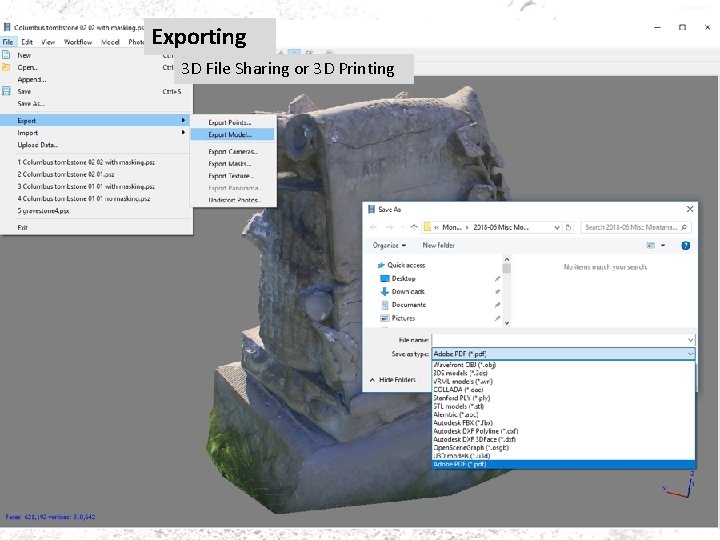
Exporting 3 D File Sharing or 3 D Printing
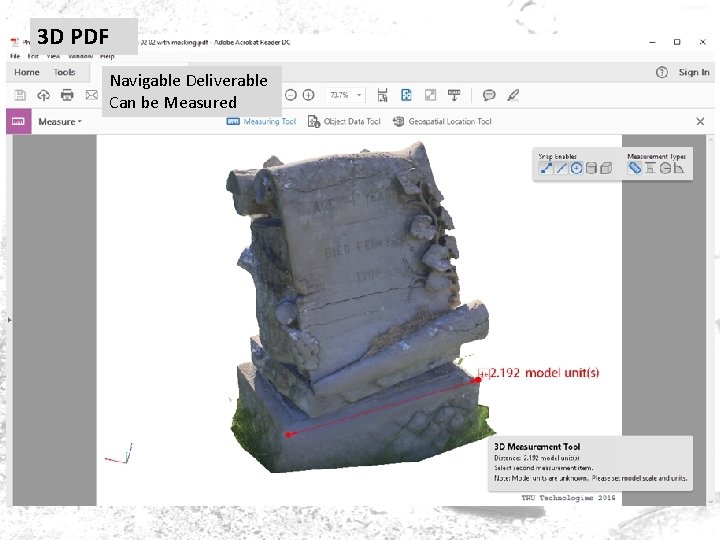
3 D PDF Navigable Deliverable Can be Measured
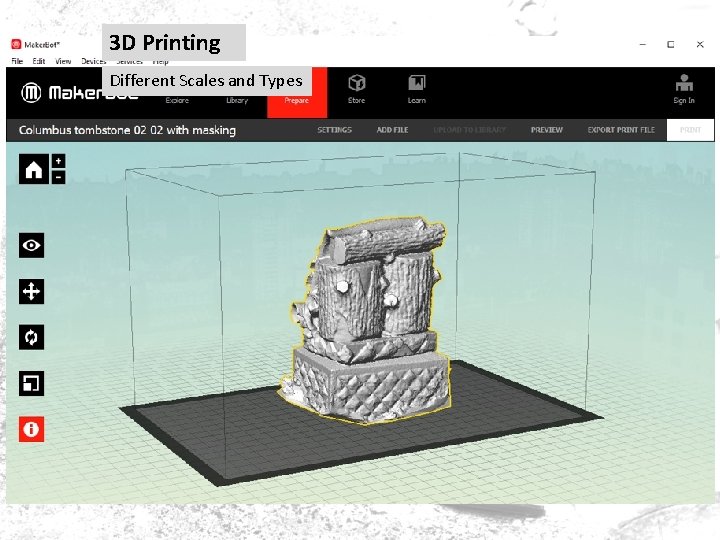
3 D Printing Different Scales and Types
Photogrammetry Notes Like RTI, Photogrammetry is Scalable Highly reflective and transparent objects are problematic Shadows, particularly moving shadows, can affect the outcome Consider a monopod for elevation control Cottonwood cotton It is possible to make models from old film photographs, but you need three or more angles More software sources
RTI and Photogrammetry Both methods begin with photography and minimal equipment Both methods can be successfully engaged by beginners, with results improving with experience Learning curves are how we learn There are many resources and tutorials available to help you Be safe and respect the subject matter and location
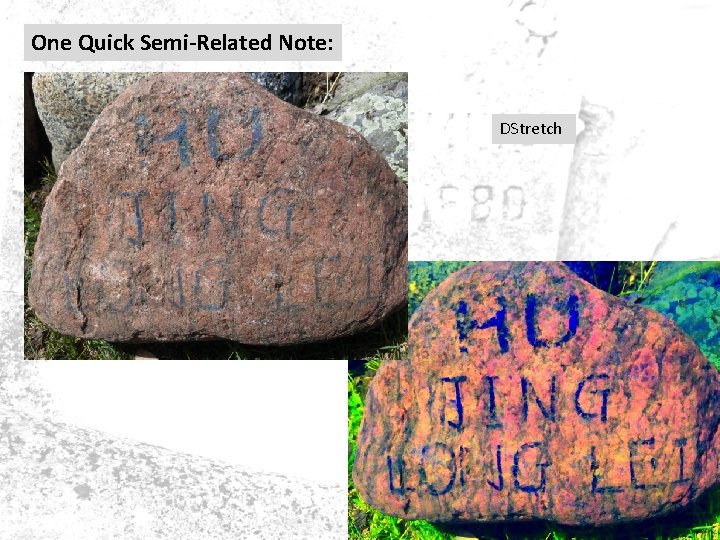
One Quick Semi-Related Note: DStretch
Thanks For Watching! turbaniak@bresnan. net Dr. Timothy Urbaniak TRU Technologies 1 -406 -259 -6595