
Reflectance Measurements of MultiLayer Insulation MLI in Support
- Slides: 10
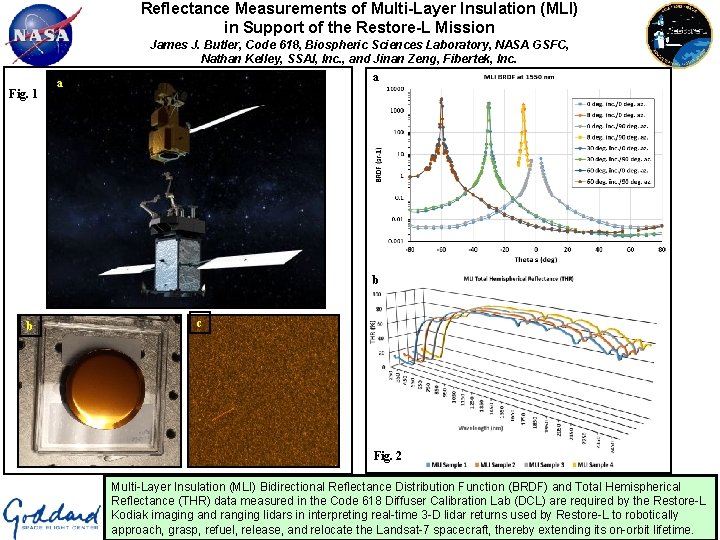
Reflectance Measurements of Multi-Layer Insulation (MLI) in Support of the Restore-L Mission Fig. 1 a James J. Butler, Code 618, Biospheric Sciences Laboratory, NASA GSFC, Nathan Kelley, SSAI, Inc. , and Jinan Zeng, Fibertek, Inc. a b b c Fig. 2 Figure 2 Multi-Layer Insulation (MLI) Bidirectional Reflectance Distribution Function (BRDF) and Total Hemispherical Reflectance (THR) data measured in the Code 618 Diffuser Calibration Lab (DCL) are required by the Restore-L Kodiak imaging and ranging lidars in interpreting real-time 3 -D lidar returns used by Restore-L to robotically approach, grasp, refuel, release, and relocate the Landsat-7 spacecraft, thereby extending its on-orbit lifetime.
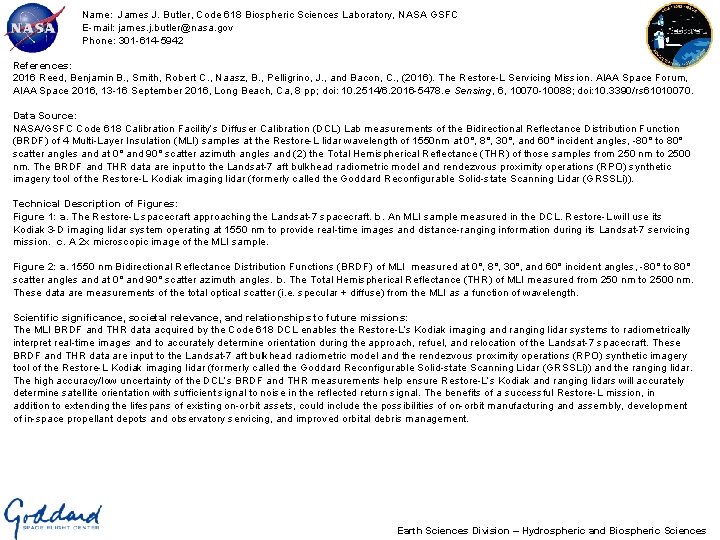
Name: James J. Butler, Code 618 Biospheric Sciences Laboratory, NASA GSFC E-mail: james. j. butler@nasa. gov Phone: 301 -614 -5942 References: 2016 Reed, Benjamin B. , Smith, Robert C. , Naasz, B. , Pelligrino, J. , and Bacon, C. , (2016). The Restore-L Servicing Mission. AIAA Space Forum, AIAA Space 2016, 13 -16 September 2016, Long Beach, Ca, 8 pp; doi: 10. 2514/6. 2016 -5478. e Sensing, 6, 10070 -10088; doi: 10. 3390/rs 61010070. Data Source: NASA/GSFC Code 618 Calibration Facility’s Diffuser Calibration (DCL) Lab measurements of the Bidirectional Reflectance Distribution Function (BRDF) of 4 Multi-Layer Insulation (MLI) samples at the Restore-L lidar wavelength of 1550 nm at 0°, 8°, 30°, and 60° incident angles, -80° to 80° scatter angles and at 0° and 90° scatter azimuth angles and (2) the Total Hemispherical Reflectance (THR) of those samples from 250 nm to 2500 nm. The BRDF and THR data are input to the Landsat-7 aft bulkhead radiometric model and rendezvous proximity operations (RPO) synthetic imagery tool of the Restore-L Kodiak imaging lidar (formerly called the Goddard Reconfigurable Solid-state Scanning Lidar (GRSSLi)). Technical Description of Figures: Figure 1: a. The Restore-L spacecraft approaching the Landsat-7 spacecraft. b. An MLI sample measured in the DCL. Restore-L will use its Kodiak 3 -D imaging lidar system operating at 1550 nm to provide real-time images and distance-ranging information during its Landsat-7 servicing mission. c. A 2 x microscopic image of the MLI sample. Figure 2: a. 1550 nm Bidirectional Reflectance Distribution Functions (BRDF) of MLI measured at 0°, 8°, 30°, and 60° incident angles, -80° to 80° scatter angles and at 0° and 90° scatter azimuth angles. b. The Total Hemispherical Reflectance (THR) of MLI measured from 250 nm to 2500 nm. These data are measurements of the total optical scatter (i. e. specular + diffuse) from the MLI as a function of wavelength. Scientific significance, societal relevance, and relationships to future missions: The MLI BRDF and THR data acquired by the Code 618 DCL enables the Restore-L’s Kodiak imaging and ranging lidar systems to radiometrically interpret real-time images and to accurately determine orientation during the approach, refuel, and relocation of the Landsat-7 spacecraft. These BRDF and THR data are input to the Landsat-7 aft bulkhead radiometric model and the rendezvous proximity operations (RPO) synthetic imagery tool of the Restore-L Kodiak imaging lidar (formerly called the Goddard Reconfigurable Solid-state Scanning Lidar (GRSSLi)) and the ranging lidar. The high accuracy/low uncertainty of the DCL’s BRDF and THR measurements help ensure Restore-L’s Kodiak and ranging lidars will accurately determine satellite orientation with sufficient signal to noise in the reflected return signal. The benefits of a successful Restore-L mission, in addition to extending the lifespans of existing on-orbit assets, could include the possibilities of on-orbit manufacturing and assembly, development of in-space propellant depots and observatory servicing, and improved orbital debris management. Earth Sciences Division – Hydrospheric and Biospheric Sciences
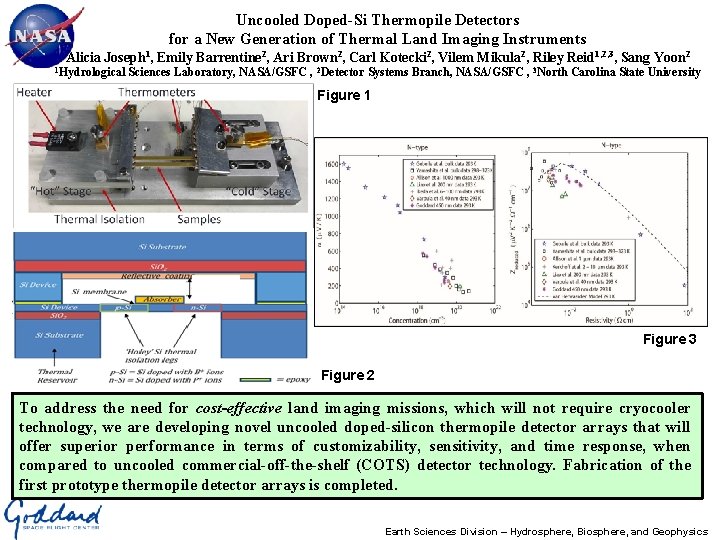
Uncooled Doped-Si Thermopile Detectors for a New Generation of Thermal Land Imaging Instruments Alicia Joseph 1, Emily Barrentine 2, Ari Brown 2, Carl Kotecki 2, Vilem Mikula 2, Riley Reid 1, 2, 3, Sang Yoon 2 1 Hydrological Sciences Laboratory, NASA/GSFC , 2 Detector Systems Branch, NASA/GSFC , 3 North Carolina State University Figure 1 Figure 3 Figure 2 To address the need for cost-effective land imaging missions, which will not require cryocooler technology, we are developing novel uncooled doped-silicon thermopile detector arrays that will offer superior performance in terms of customizability, sensitivity, and time response, when compared to uncooled commercial-off-the-shelf (COTS) detector technology. Fabrication of the first prototype thermopile detector arrays is completed. Earth Sciences Division – Hydrosphere, Biosphere, and Geophysics
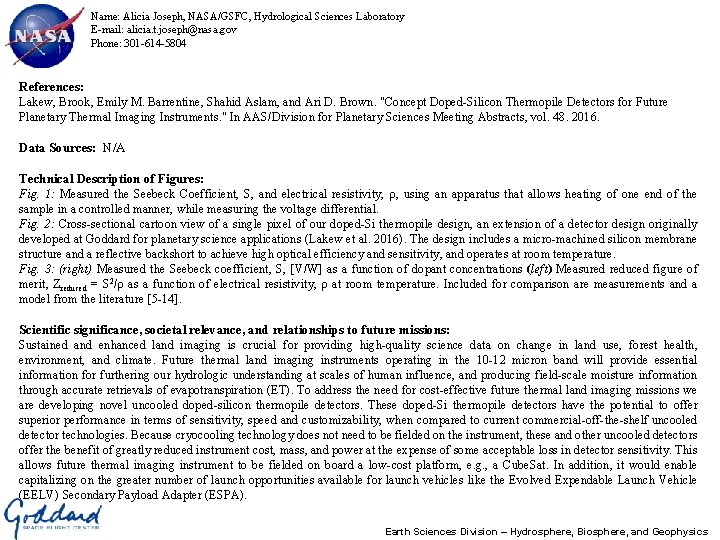
Name: Alicia Joseph, NASA/GSFC, Hydrological Sciences Laboratory E-mail: alicia. t. joseph@nasa. gov Phone: 301 -614 -5804 References: Lakew, Brook, Emily M. Barrentine, Shahid Aslam, and Ari D. Brown. "Concept Doped-Silicon Thermopile Detectors for Future Planetary Thermal Imaging Instruments. " In AAS/Division for Planetary Sciences Meeting Abstracts, vol. 48. 2016. Data Sources: N/A Technical Description of Figures: Fig. 1: Measured the Seebeck Coefficient, S, and electrical resistivity, ρ, using an apparatus that allows heating of one end of the sample in a controlled manner, while measuring the voltage differential. Fig. 2: Cross-sectional cartoon view of a single pixel of our doped-Si thermopile design, an extension of a detector design originally developed at Goddard for planetary science applications (Lakew et al. 2016). The design includes a micro-machined silicon membrane structure and a reflective backshort to achieve high optical efficiency and sensitivity, and operates at room temperature. Fig. 3: (right) Measured the Seebeck coefficient, S, [V/W] as a function of dopant concentrations (left) Measured reduced figure of merit, Zreduced = S 2/ρ as a function of electrical resistivity, ρ at room temperature. Included for comparison are measurements and a model from the literature [5 -14]. Scientific significance, societal relevance, and relationships to future missions: Sustained and enhanced land imaging is crucial for providing high-quality science data on change in land use, forest health, environment, and climate. Future thermal land imaging instruments operating in the 10 -12 micron band will provide essential information for furthering our hydrologic understanding at scales of human influence, and producing field-scale moisture information through accurate retrievals of evapotranspiration (ET). To address the need for cost-effective future thermal land imaging missions we are developing novel uncooled doped-silicon thermopile detectors. These doped-Si thermopile detectors have the potential to offer superior performance in terms of sensitivity, speed and customizability, when compared to current commercial-off-the-shelf uncooled detector technologies. Because cryocooling technology does not need to be fielded on the instrument, these and other uncooled detectors offer the benefit of greatly reduced instrument cost, mass, and power at the expense of some acceptable loss in detector sensitivity. This allows future thermal imaging instrument to be fielded on board a low-cost platform, e. g. , a Cube. Sat. In addition, it would enable capitalizing on the greater number of launch opportunities available for launch vehicles like the Evolved Expendable Launch Vehicle (EELV) Secondary Payload Adapter (ESPA). Earth Sciences Division – Hydrosphere, Biosphere, and Geophysics
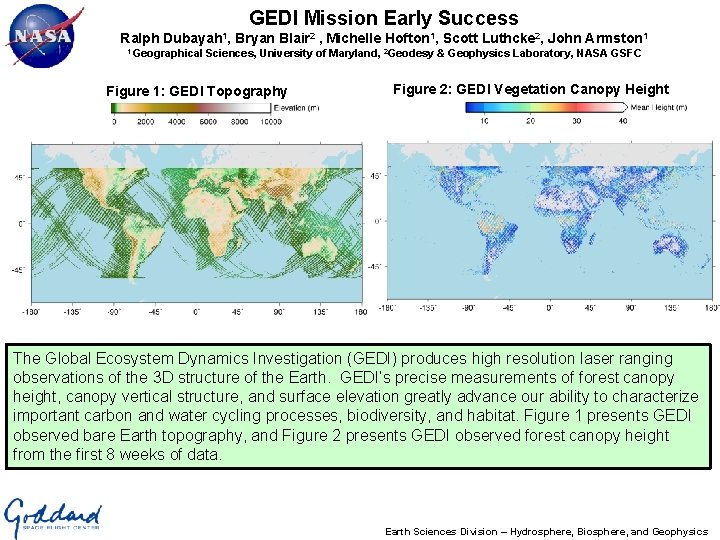
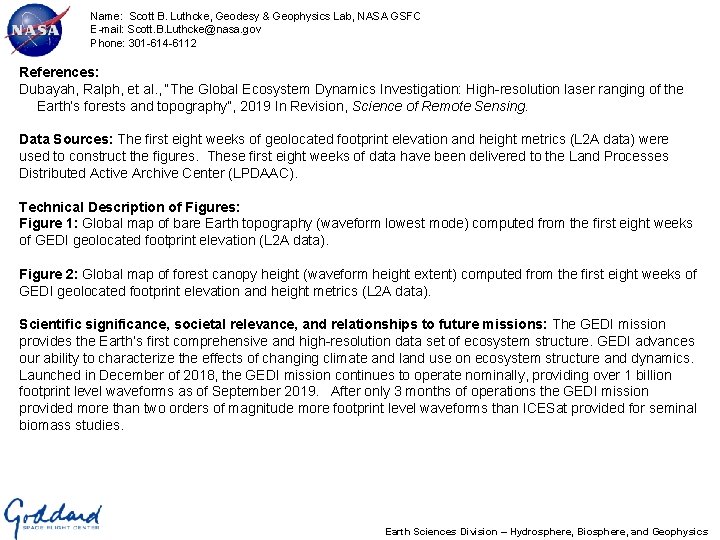
GEDI Mission Early Success Ralph Dubayah 1, 1 Geographical Bryan Blair 2 , Michelle Hofton 1, Scott Luthcke 2, John Armston 1 Sciences, University of Maryland, 2 Geodesy & Geophysics Laboratory, NASA GSFC Figure 1: GEDI Topography Figure 2: GEDI Vegetation Canopy Height The Global Ecosystem Dynamics Investigation (GEDI) produces high resolution laser ranging observations of the 3 D structure of the Earth. GEDI’s precise measurements of forest canopy height, canopy vertical structure, and surface elevation greatly advance our ability to characterize important carbon and water cycling processes, biodiversity, and habitat. Figure 1 presents GEDI observed bare Earth topography, and Figure 2 presents GEDI observed forest canopy height from the first 8 weeks of data. Earth Sciences Division – Hydrosphere, Biosphere, and Geophysics
Name: Scott B. Luthcke, Geodesy & Geophysics Lab, NASA GSFC E-mail: Scott. B. Luthcke@nasa. gov Phone: 301 -614 -6112 References: Dubayah, Ralph, et al. , “The Global Ecosystem Dynamics Investigation: High-resolution laser ranging of the Earth’s forests and topography”, 2019 In Revision, Science of Remote Sensing. Data Sources: The first eight weeks of geolocated footprint elevation and height metrics (L 2 A data) were used to construct the figures. These first eight weeks of data have been delivered to the Land Processes Distributed Active Archive Center (LPDAAC). Technical Description of Figures: Figure 1: Global map of bare Earth topography (waveform lowest mode) computed from the first eight weeks of GEDI geolocated footprint elevation (L 2 A data). Figure 2: Global map of forest canopy height (waveform height extent) computed from the first eight weeks of GEDI geolocated footprint elevation and height metrics (L 2 A data). Scientific significance, societal relevance, and relationships to future missions: The GEDI mission provides the Earth’s first comprehensive and high-resolution data set of ecosystem structure. GEDI advances our ability to characterize the effects of changing climate and land use on ecosystem structure and dynamics. Launched in December of 2018, the GEDI mission continues to operate nominally, providing over 1 billion footprint level waveforms as of September 2019. After only 3 months of operations the GEDI mission provided more than two orders of magnitude more footprint level waveforms than ICESat provided for seminal biomass studies. Earth Sciences Division – Hydrosphere, Biosphere, and Geophysics
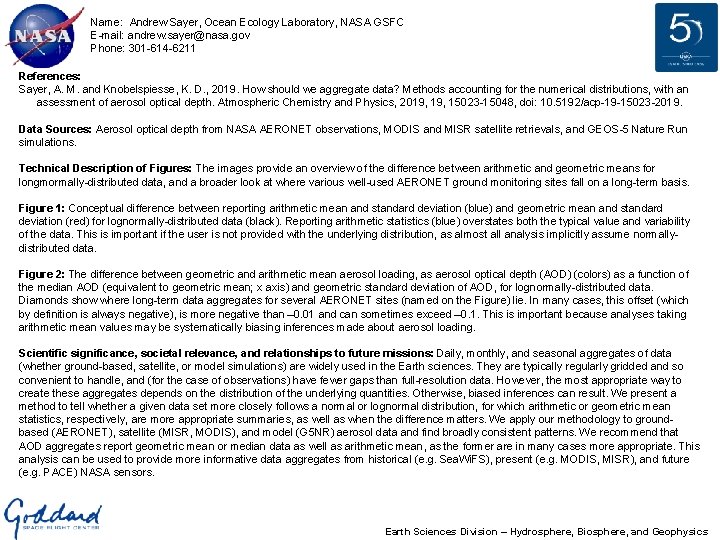
How we average data is important: an aerosol example Andrew M. Sayer 1, 2 and Kirk D. Knobelspiesse 1 1 Universities Space Research Association, Columbia, MD, 2 Ocean Ecology Laboratory, NASA GSFC Large means difference Small means difference Figure 1 Geometric mean AOD – Arithmetic mean AOD Figure 2 Daily and monthly aggregates of observations made at finer scales are used in many Earth system analyses. Typically, arithmetic means and standard deviations of these quantities are reported as summary statistics. One widely-used quantity is aerosol optical depth (AOD), a measure of the load of aerosol particles (e. g. dust, smoke) in the atmosphere. However, AOD generally follows lognormal distributions, for which geometric means are more appropriate. We provide a method to test whether arithmetic or geometric mean is more appropriate, and when the difference is important, which will help improve use of these data aggregates. Earth Sciences Division – Hydrosphere, Biosphere, and Geophysics
Name: Andrew Sayer, Ocean Ecology Laboratory, NASA GSFC E-mail: andrew. sayer@nasa. gov Phone: 301 -614 -6211 References: Sayer, A. M. and Knobelspiesse, K. D. , 2019. How should we aggregate data? Methods accounting for the numerical distributions, with an assessment of aerosol optical depth. Atmospheric Chemistry and Physics, 2019, 15023 -15048, doi: 10. 5192/acp-19 -15023 -2019. Data Sources: Aerosol optical depth from NASA AERONET observations, MODIS and MISR satellite retrievals, and GEOS-5 Nature Run simulations. Technical Description of Figures: The images provide an overview of the difference between arithmetic and geometric means for longmormally-distributed data, and a broader look at where various well-used AERONET ground monitoring sites fall on a long-term basis. Figure 1: Conceptual difference between reporting arithmetic mean and standard deviation (blue) and geometric mean and standard deviation (red) for lognormally-distributed data (black). Reporting arithmetic statistics (blue) overstates both the typical value and variability of the data. This is important if the user is not provided with the underlying distribution, as almost all analysis implicitly assume normallydistributed data. Figure 2: The difference between geometric and arithmetic mean aerosol loading, as aerosol optical depth (AOD) (colors) as a function of the median AOD (equivalent to geometric mean; x axis) and geometric standard deviation of AOD, for lognormally-distributed data. Diamonds show where long-term data aggregates for several AERONET sites (named on the Figure) lie. In many cases, this offset (which by definition is always negative), is more negative than – 0. 01 and can sometimes exceed – 0. 1. This is important because analyses taking arithmetic mean values may be systematically biasing inferences made about aerosol loading. Scientific significance, societal relevance, and relationships to future missions: Daily, monthly, and seasonal aggregates of data (whether ground-based, satellite, or model simulations) are widely used in the Earth sciences. They are typically regularly gridded and so convenient to handle, and (for the case of observations) have fewer gaps than full-resolution data. However, the most appropriate way to create these aggregates depends on the distribution of the underlying quantities. Otherwise, biased inferences can result. We present a method to tell whether a given data set more closely follows a normal or lognormal distribution, for which arithmetic or geometric mean statistics, respectively, are more appropriate summaries, as well as when the difference matters. We apply our methodology to groundbased (AERONET), satellite (MISR, MODIS), and model (G 5 NR) aerosol data and find broadly consistent patterns. We recommend that AOD aggregates report geometric mean or median data as well as arithmetic mean, as the former are in many cases more appropriate. This analysis can be used to provide more informative data aggregates from historical (e. g. Sea. Wi. FS), present (e. g. MODIS, MISR), and future (e. g. PACE) NASA sensors. Earth Sciences Division – Hydrosphere, Biosphere, and Geophysics
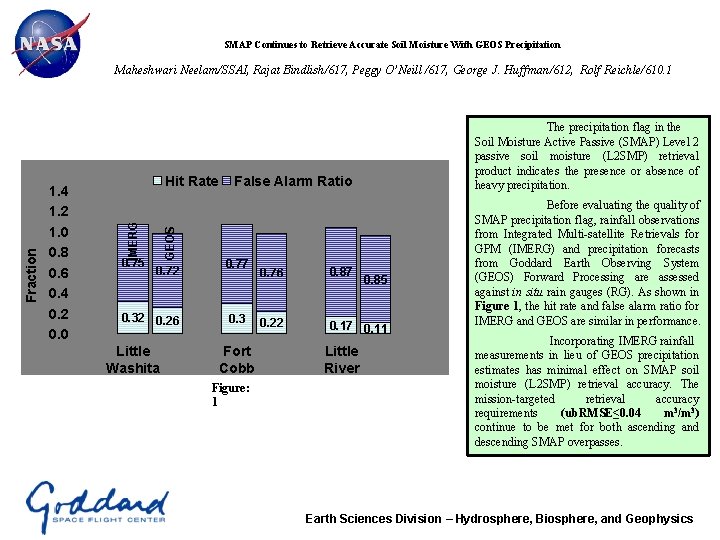
SMAP Continues to Retrieve Accurate Soil Moisture With GEOS Precipitation Hit Rate 0. 75 GEOS 1. 4 1. 2 1. 0 0. 8 0. 6 0. 4 0. 2 0. 0 IMERG Fraction Maheshwari Neelam/SSAI, Rajat 0. 72 0. 32 0. 26 Little Washita Bindlish/617, Peggy O’Neill /617, George J. Huffman/612, Rolf Reichle/610. 1 The precipitation flag in the Soil Moisture Active Passive (SMAP) Level 2 passive soil moisture (L 2 SMP) retrieval product indicates the presence or absence of heavy precipitation. False Alarm Ratio 0. 77 0. 3 Fort Cobb Figure: 1 0. 76 0. 87 0. 22 0. 17 0. 11 Little River 0. 85 Before evaluating the quality of SMAP precipitation flag, rainfall observations from Integrated Multi-satellite Retrievals for GPM (IMERG) and precipitation forecasts from Goddard Earth Observing System (GEOS) Forward Processing are assessed against in situ rain gauges (RG). As shown in Figure 1, the hit rate and false alarm ratio for IMERG and GEOS are similar in performance. Incorporating IMERG rainfall measurements in lieu of GEOS precipitation estimates has minimal effect on SMAP soil moisture (L 2 SMP) retrieval accuracy. The mission-targeted retrieval accuracy requirements (ub. RMSE≤ 0. 04 m 3/m 3) continue to be met for both ascending and descending SMAP overpasses. Earth Sciences Division – Hydrosphere, Biosphere, and Geophysics
Technical Point of Contact: Maheshwari Neelam (Maheshwari. Neelam@nasa. gov) NASA contact: SMAP Team (Peggy O’Neill /617, Peggy. E. ONeill@nasa. gov, 301 -614 -5773; Rajat Bindlish/617, Rajat. Bindlish@nasa. gov , Maheshwari Neelam/SSAI, Maheshwari. Neelam@nasa. gov , 301 -286 -0399) Reference: O’Neill, P. , R. Bindlish, S. Chan, M. J. Chaubell, E. Njoku, and T. Jackson, August 15, 2019, SMAP Algorithm Theoretical Basis Document: Level 2 & 3 Soil Moisture (Passive) Data Products, Rev. E, JPL-66480, Jet Propulsion Laboratory, California Institute of Technology, Pasadena CA USA. Data Sources: SMAP passive soil moisture retrieval product (L 2 SMP); Goddard Earth Observing System (GEOS) precipitation; Integrated Multi-satellite Retrievals for GPM (IMERG) Version 06 Early (latency of ~4 hours) calibrated precipitation product, rain gauge precipitation and in situ soil moisture from SMAP Core Validation Sites (CVS) during the period of 2015 - 2018. Technical Description of Figures: Figure 1: The precipitation flag used in SMAP L 2 SMP indicates a rain event if the precipitation rate P is greater than 1 mm h-1 within a 3 -hour window around the time of the SMAP overpass, and is not flagged if P ≤ 1 mm h-1. This threshold is used to flag SMAP retrievals as of uncertain retrieval quality due to the possible presence of precipitation. The hit rate (which determines the fraction of the observed precipitation events which are forecasted correctly) and false alarm ratio (the fraction of the forecasted precipitation events which did not occur) are determined for IMERG and GEOS using rain gauge data at a number of SMAP core validation sites. Results from three ARS locations (Little Washita (Oklahoma), Fort Cobb (Oklahoma), Little River (Georgia)) are shown in Figure 1 and indicate that both IMERG precipitation measurements and GEOS precipitation forecasts are performing similarly. Scientific significance and societal relevance: SMAP provides global soil moisture with a revisit time ~ 3 days or better to an ub. RMSE accuracy of 0. 04 m 3/m 3 or better. The Global Precipitation Mission (GPM) satellite-derived precipitation data provide a unique opportunity for direct grid-to-grid global comparison with GEOS precipitation estimates to evaluate SMAP precipitation flagging. The effect of incorporating IMERG rainfall measurements in lieu of GEOS precipitation estimates is minimal on the SMAP soil moisture (L 2 SMP) retrieval accuracy, which continues to meet SMAP mission accuracy requirements. This result remains true for both ascending and descending SMAP overpasses. Earth Sciences Division – Hydrosphere, Biosphere, and Geophysics