
Reflect a moment What were your experiences learning
- Slides: 22
Reflect a moment… What were your experiences learning to revise your writing? What tools were you given for improving your writing? As you progressed, how often did you really revise your writing? How did you measure your progression as a writer?
Re-Visioning Your Writing: The Best is Still Unwritten Tasha Thomas Spartanburg Writing Project Summer 2011
My Journey As a student, I was never given specific revision strategies, or even encouraged to revise my work. I had the natural gift of writing, so even in college, I could pretty much turn in my first draft and get an A. But as a senior, I received the first C I had ever seen on a formal paper, and then realized that revision is the REAL work of writing. As a participant in the 2002 SWP Summer Institute, I saw for the first time how revision truly can make your writing better when I was given the advice to change a piece I had written from prose to poetry.
I have come to realize… If we “ache with caring” about what we have written If we want to live a writer’s life If what we have written is worth sharing with others Then there is NO limit to the amount of time or energy we will put into REvisioning our writing
-Mark Twain The difference between the right word and the almost right word is the difference between the lightening and the lightening bug.
Revise This! Read the piece provided and discuss in your group ways to revise and improve it. What are the areas that need improvement? What specific changes and additions would you make?
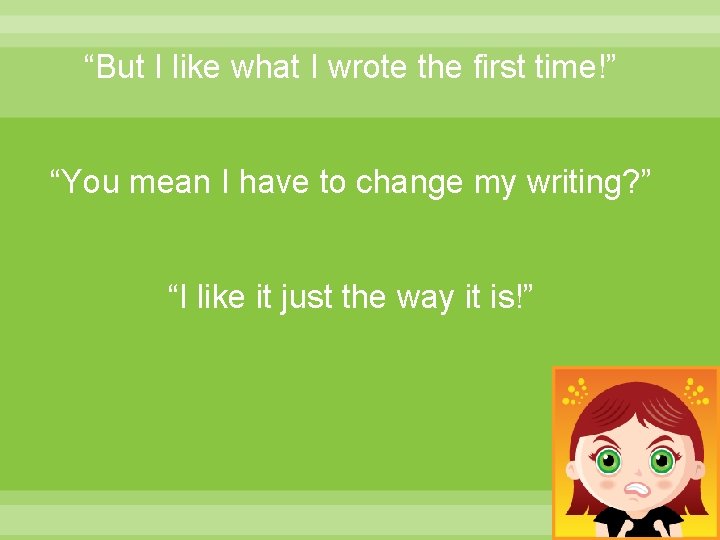
“But I like what I wrote the first time!” “You mean I have to change my writing? ” “I like it just the way it is!”
-E. B. White Remember, it is no sign of weakness or defeat that your manuscript ends up in need of major surgery. This is a common occurrence in all writing, and among the best writers.
What is Revision? How does revision differ from editing or proofreading? What does a clear understand of revision bring to our writing? How can we make revision a natural part of our process as writers? When? How?
According to Georgia Heard: “Revision involves changing the meaning, content, structure or style of a piece of writing rather than the more surface changes that editing demands. Revision doesn’t necessarily take place after the piece of writing is finished, but instead will most likely occur throughout the writing process. ”
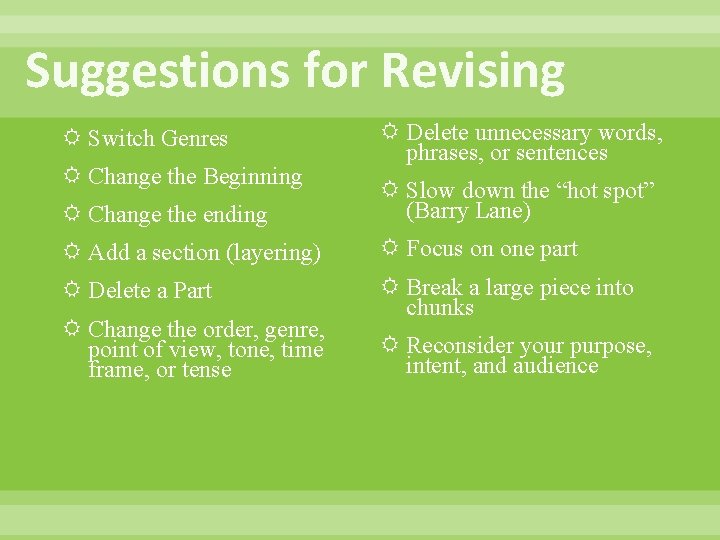
Suggestions for Revising Switch Genres Change the Beginning Delete unnecessary words, phrases, or sentences Change the ending Slow down the “hot spot” (Barry Lane) Add a section (layering) Focus on one part Delete a Part Break a large piece into chunks Change the order, genre, point of view, tone, time frame, or tense Reconsider your purpose, intent, and audience
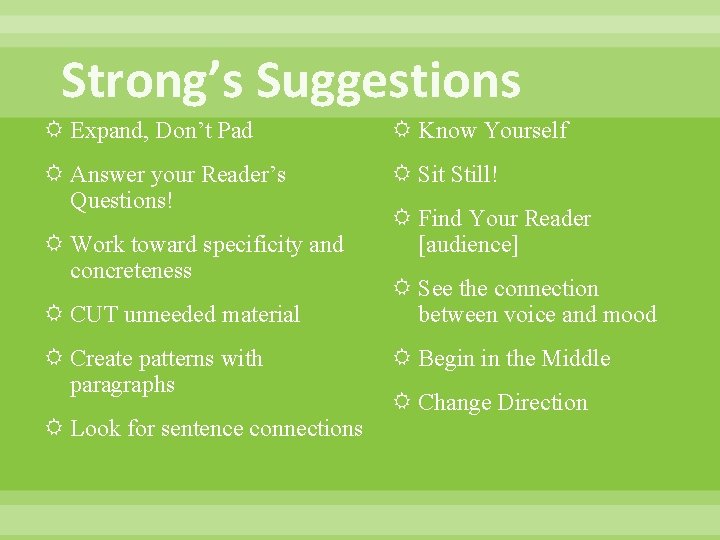
Strong’s Suggestions Expand, Don’t Pad Know Yourself Answer your Reader’s Questions! Sit Still! Work toward specificity and concreteness CUT unneeded material Create patterns with paragraphs Look for sentence connections Find Your Reader [audience] See the connection between voice and mood Begin in the Middle Change Direction
Revision in Action 1. Choose one draft you have been working on this week 2. Find an section or element of the draft that you are struggling with. 3. Choose one or more of the suggestions for revision and make a note to apply it to your piece during the revision time later this morning. 4. Feel free to confer with a member of your group and ask for feedback or suggestions to guide your revision.
As a Teacher… How do you illustrate the difference between revision and editing? Do you stress the recursive, cyclical, imperfect, never-ending nature of writing? Are you more concerned that student writing show marked improvement in content or conventions? Do you model your own revision processes?
The #1 Way to Improve Student Writing Create and conduct Mini-Lessons focused on revising specific elements of writing based on student needs, giving students the tools, desire, and know-how to “Re-en. Vision” their writing. Reviser’s Toolbox by Barry Lane
Suggestions for Teaching Revision Don’t expect to revise and publish everything Make sure students understand the difference between revision and editing Link revision to what you teach about craft Allow students to complete multiple drafts for credit Allow TIME for students to WALK AWAY from the writing and revision it with new perspective Encourage students to always read their work ALOUD (peer, self, you, parent, etc. —”whisper phones”) Encourage students to self-reflect and write about their writing and revision processes in their writer’s notebooks.
Suggestions for Teaching Revision Conduct weekly “process shares; ” talk about the “how-to” of revising Model revision in your own writing Help students build a “Toolbox” of revision strategies Create “Revision Centers” Have students use highlighters to check for sentence variety and length Work on organization by photocopying and cutting apart drafts into paragraphs or sentences Be patient. Check out these acronyms and make one a regular part of your WW: http: //www. angelfire. com/wi/writingprocess/revising. html
In my classroom… I have learned to focus more time and energy on the revision, identifying specific elements of my students’ writing that need improvement, then demonstrating HOW to improve these areas (ie. Content, clarity, conciseness, development, word choice, sentence structure and combining, etc. ) My students MUST turn in multiple drafts with each one counting a percentage of their final grade, and they MUST reflect on each piece, explaining which revision techniques they used.
My students say… “Allowing another individual to look over my work gave me the opportunity to see a reader’s point of view of my work. This specifically gave me an opportunity to see what revisions needed to be made. ” ~ Ashley “The reason why writing has become so lovely to me is because I have noticed that if I am passionate about the subject that my voice comes out in my writing and it makes my readers enjoy my writing. ” ~Roger “I’ve also learned that revision plays a MAJOR part in being an excellent writer. Usually, I don’t revise most of the papers I turn in, and if I do, I make very minor changes. One time, I decided to take a risk and revise my paper three times (haha!) It turned out to be one of the better papers that I’ve written since I’ve been in school. Now that I’ve seen how doing major revision can make a paper so much better, I’ll be doing a lot more of it!” ~Adrianna
Our Challenge: What will we do in the upcoming school year to ACTIVELY teach students to “revision” their writing? What tools and strategies will we employ?
“Revision is at the heart of the writing process and is fundamental to all good writing. Students can understand revision and the need for it when revision is demonstrated as a genuine part of what good writers do. ” - Reggie Routman (Invitations, 1994)
Resources Heard, Georgia. The Revision Toolbox: Teaching Techniques that Work. Heinemann, 2002. Jago, Carol. Cohesive Writing: When Concept is Not Enough. Heinemann, 2002. King, Stephen. On Writing. Scribner, 2000. Lane, Barry. Reviser’s Toolbox. Discover Writing Press, 1999. Noden, Harry. Image Grammar: Using Grammatical Structures to Teach Writing. Heinemann, 1999. Routman, Reggie. Invitations. Heinemann, 1994. Strong, William. Writing Incisively: Do-It-Yourself Prose Surgery. Mc. Graw-Hill, Inc. , 1991.