
Referred pain Functions of large intestine Defecation Dr
- Slides: 16
Referred pain Functions of large intestine Defecation Dr Mohammed Jeelani
Specific learning outcomes �Explain the basis of referred pain from GIT organs. �Describe the mechanism of defecations. �Explain the physiological basis of faeces and flatus formation. �Explain the role of fibres on the prevention of constipation. . �List the functions of the large intestine. �Indicate the causes of intestinal gas. �Explain the colonic motor activity and the role of haustral contraction.
Referred pain Pain from internal organ felt in an area of skin away from the site of its production Examples: �Pain due to stone in lower part of ureter is referred to testis and inner thigh. � Inflammation of diaphragm secondary to severe cholecystitis produces pain at the tip of shoulder.
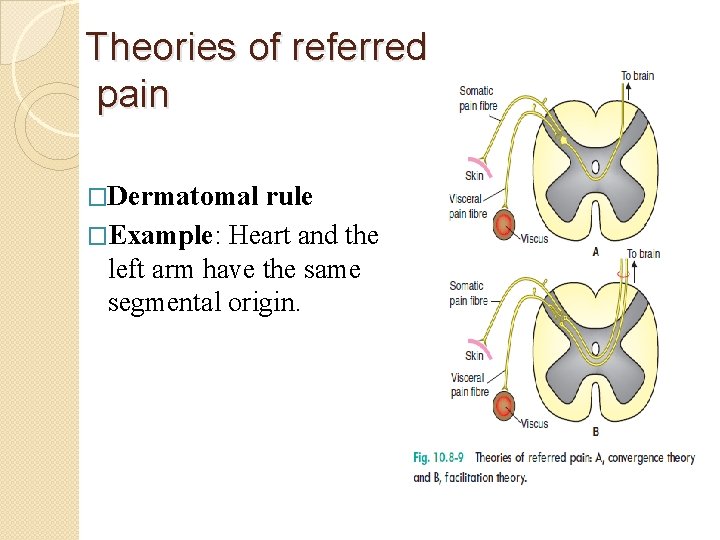
Theories of referred pain �Dermatomal rule �Example: Heart and the left arm have the same segmental origin.
Functions of large intestine �Secretory: q Mucin helps to lubricate the faecal matter. q Alkaline nature (p. H 8) neutralize the acids formed by the bacterial action on the faecal matter. • Synthesis: q. Synthesizes folic acid, vitamin B 12 and vitamin K.
�Absorptive: q. Absorption of water and electrolytes (proximal part of the colon). q. Organic substances like glucose, alcohol and some drugs like anaesthetic agents, sedatives and steroids. q. The vitamin K and a number of B-complex (by bacterial flora). �Excretory: q. Heavy metals like mercury, lead, bismuth and arsenic.
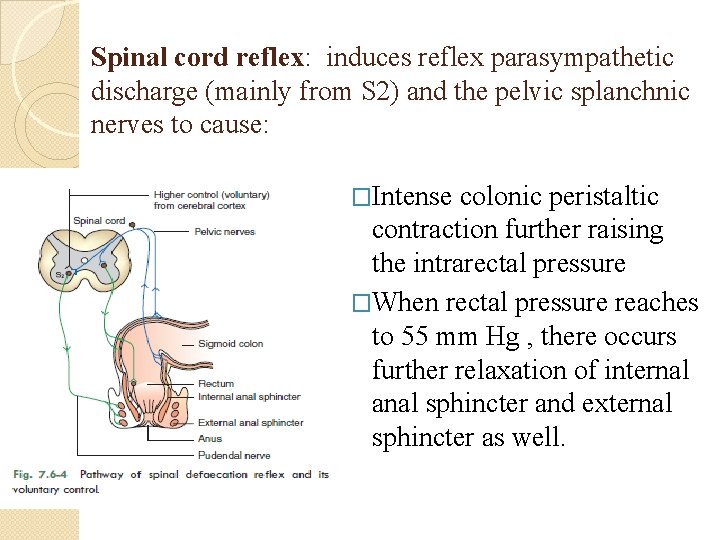
Defecation Desire for defecation is initiated when a mass movement forces the feces into rectum. �Dribbling of fecal matter is prevented by tonic contraction of internal anal sphincter (smooth muscles, ANS)and external anal sphincter (striated muscles, Pudendal nerve, voluntary control)
Defecation reflex v Intrinsic reflex �Afferent signals are initiated in the myenteric plexus, resulting in formation of peristaltic waves in descending colon, sigmoid colon and rectum, causing the active contraction of smooth muscles and further raising intrarectal pressure �Movement of feces towards anal canal relaxes internal sphincter(inhibitory signals from myenteric plexus)
Spinal cord reflex: induces reflex parasympathetic discharge (mainly from S 2) and the pelvic splanchnic nerves to cause: �Intense colonic peristaltic contraction further raising the intrarectal pressure �When rectal pressure reaches to 55 mm Hg , there occurs further relaxation of internal anal sphincter and external sphincter as well.
Intestinal gas (flatus) Due to Indifferent bacterial activities �Breakdown of undigested nutrients that reach the colon. �Colonic bacteria produce gas (7– 10 L/day) q Gases produced by bacteria: CO 2, H 2, hydrogen sulphide and methane. q Nitrogen gas from the swallowed air q Other gases diffuse readily through the intestinal mucosa (volume of flatus is reduced to about 600 m. L/day).
Faecus �Derived from intestinal secretion and undigested material � 75% water � 25% solids (inorganic material, calcium, phosphate, undigested plant fibers, epithelial cells, dead bacteria, bile pigments, fats and proteins) �Proteins in stools- not of dietary origin but from bacteria and cellular debries �Fats in stools- mostly from desquamated epithelial cells, bacterial synthesis
�p. H: 5 to 7 �Brown colour due to urobilin (formed from oxidation of urobilinogen) �Urobilinogen (colorless) is formed from bile pigments by intestinal bacteria �In obstructive jaundice stool becomes white (bile fails to enter intestine) �Odour of stool: indole, skatole, mercaptans, HS, due to action of colonic bacteria on food.
Role of fibers in prevention of constipation �Dietary fibers works as a bulk laxatives by providing a larger volume of indigestable material to colon
Colonic motor activity �These are types of movements of large intestine �Include q Haustral shuttling or contractions q Peristalsis q Mass movement
Haustral shuttling �Similar to segmental contraction of small intestine �Squeeze chyme �Contraction of circular muscle produces constriction rings at regular interval �Contraction of longitudinal muscle causes unstimulated portion of large intestine in between the constricted rings to bulge in bag like sac called haustration � Disappear within 60 sec and after few min initiated in nearby area
Reference �Medical Physiology for UG, Indu Khurana, 1 st Edition, Chapter 7. 2 Page 463, Chapter 7. 6 Pages 505 -509, Chapter 10. 8 Page 807.