
Referencing Federal State Regulations Objectives You will explain
Referencing Federal & State Regulations Objectives: You will explain how � federal and state laws are coded � how to site state and federal statutes �define and apply the Supremacy Clause �explain why Massachusetts is referenced as an “entitlement” state. �display a working knowledge of 603 CMR 28: 00
Questions? What is the difference, if any, between Statutes, Laws, Regulations, and policies? Massachusetts in referred to as an “entitlement state” What does that mean?

Federal Government The concept of federalism dates back to our founding father in the 1700 s. � The federal government has both express (laws)and implied powers (ex: discrimination claims, immigration challenges) broad powers to create, regulate, and enforce the laws of the United States. � � The federal government has certain express (or "enumerated") powers which are specifically spelled out in the U. S. Constitution, including the right to regulate commerce, declare war, levy taxes, establish immigration and bankruptcy laws, and so on. � Not only does the federal government have express powers under the U. S. Constitution, it also has implied powers, or powers not specifically mentioned in the Constitution. � This was the decision in the landmark Supreme Court case of Mc. Culloch v. Maryland. For example, the Constitution does not expressly mention the right to privacy, or the right of people to adopt, or seek an abortion, however, these rights can be inferred by the Constitution itself, or from the later amended Bill of Rights. � Find. LAW: http: //litigation. findlaw. com/legal-system/the-supremacy-clause-and-thedoctrine-of-preemption. html#sthash. HOwmf. Thk. dpuf

Code of Federal Regulations (CFR) The CFR is structured into 50 subject matter titles. The first codification of federal laws started in 1938. CFR Title 34 - Education is one of fifty titles comprising the United States Code of Federal Regulations (CFR). Title 34 is the principal set of rules and regulations issued by federal agencies of the United States regarding education. Regulatory Entity is Office of Special Education and Rehabilitative Services under the United States Department Of Education (USDOE) Federal Regulations IDEA 34 CFR 300. 00
Difference between MA Session Laws and General Laws � State laws (sometimes referred to as statutes) fall into two categories – session laws and general laws – and are proposed and passed by the Massachusetts Legislature, then signed into law by the Governor. � When the Legislature is proposing, debating, and voting on bills, they are “in session. ” Any law passed during a given session is called a session law and is assigned a number based on the order it is passed. Session laws can potentially impact all Massachusetts residents — such as a bill to ensure the care and education of children under five years of age — or may only affect a few — such as establishing a sick leave bank for state employees to donate unused sick time to a coworker suffering from a serious illness. � At the end of the legislative session, any enacted law that may impact all Massachusetts residents is organized and grouped with other related laws passed in previous years to make up the Massachusetts General Laws (MGLs).
� Under the authority granted to them by the Legislature, executive department agencies issue rules and regulations that further specify how a law will be interpreted and/or enforced. For example, EEC proposed a regulation in 2010 that requires children to brush their teeth pdf format of 606 CMR 7 � if they eat a meal or spend more than four hours of the day in a licensed home or group child care facility. � � Proposed regulations or changes to existing regulations must move through a public "rulemaking" process called the State Administrative Procedure (MGL Chapter 30 A, Sections 1 -8). This includes holding public hearings to discuss the proposed regulation with anyone who is interested in, or might be affected, by it. After this public comment period, the agency may choose to make changes to the regulation before it is enacted. � Once regulations are enacted, they have the force of law and are published every year in the Code of Massachusetts Regulations (CMR), the official record of Massachusetts state government regulations. New or existing regulations that are added or amended throughout the year are published through the bi-weekly Massachusetts Register and incorporated into the CMR at the end of the year.

Policies � After a statute is passed the State Department is authorized to enforce it and policies are made. � Example: After the toothbrushing regulation was enacted in 2010, EEC issued a detailed policy pdf format of Oral Health giving parents who preferred to brush their child’s teeth at home an opportunity to “opt-out” of the requirement. Individual policies can often be found on an agency’s website or by contacting the agency who issued the policy. � Local policies give local school districts opportunities to determine how they will enforce the regulation.
Special Education Regulations �Federal Regulations � 34 CFR 300 �Massachusetts's State Regulations � 603 CMR 28. 00 �Massachusetts's General Laws
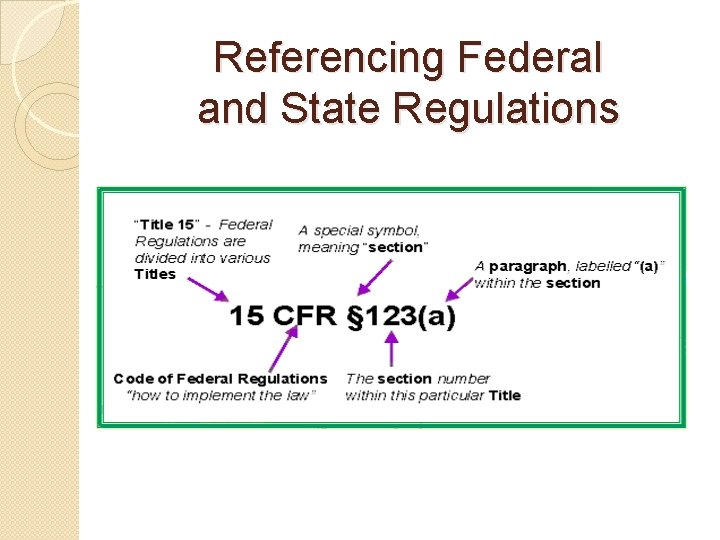
Referencing Federal and State Regulations
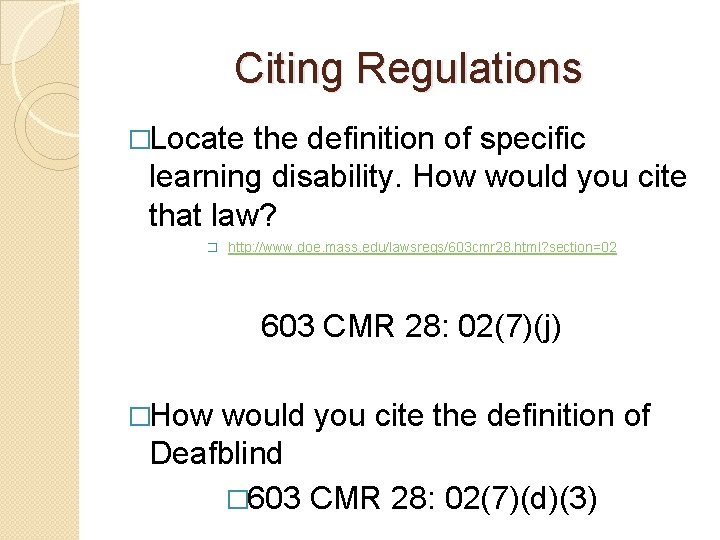
Citing Regulations �Locate the definition of specific learning disability. How would you cite that law? � http: //www. doe. mass. edu/lawsregs/603 cmr 28. html? section=02 603 CMR 28: 02(7)(j) �How would you cite the definition of Deafblind � 603 CMR 28: 02(7)(d)(3)
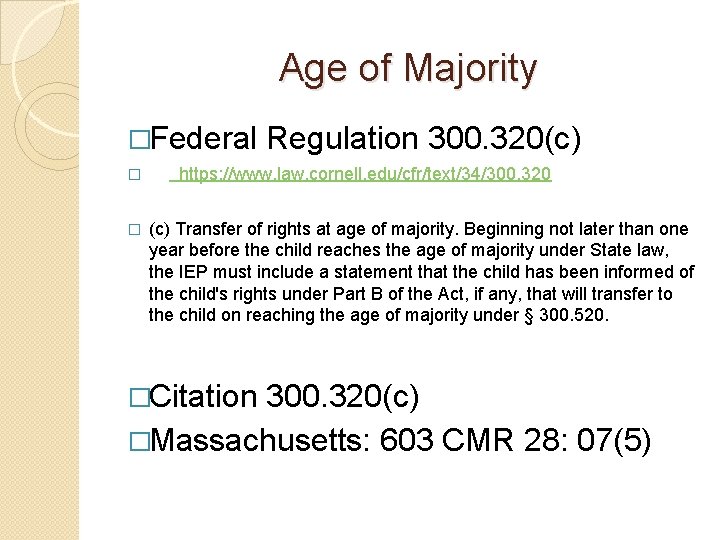
Age of Majority �Federal � � Regulation 300. 320(c) https: //www. law. cornell. edu/cfr/text/34/300. 320 (c) Transfer of rights at age of majority. Beginning not later than one year before the child reaches the age of majority under State law, the IEP must include a statement that the child has been informed of the child's rights under Part B of the Act, if any, that will transfer to the child on reaching the age of majority under § 300. 520. �Citation 300. 320(c) �Massachusetts: 603 CMR 28: 07(5)
Supremacy Clause and the Doctrine of Preemption � The Supremacy Clause is a clause within Article VI of the U. S. Constitution which dictates that federal law is the "supreme law of the land”. � This means that judges in every state must follow the Constitution, laws, and treatises of the federal government in matters which are directly or indirectly within the government's control. � Under the doctrine of preemption, which is based on the Supremacy Clause, federal law preempts state law, even when the laws conflict. Thus, a federal court may require a state to stop certain behavior it believes interferes with, or is in conflict with, federal law. � - See more at: http: //litigation. findlaw. com/legal-system/thesupremacy-clause-and-the-doctrine-ofpreemption. html#sthash. HOwmf. Thk. dpuf
Massachusetts Supremacy Clause Examples �Federal Regulation 300. 306 �Timelines for Eligibility Determination �Federal Regulation �Transition 300. 324(c)
Timelines for Eligibility Determination �Federal Regulation 300. 306(1)(i) �Must be conducted within 60 days of receiving parental consent for the evaluation; �Massachusetts 603 CMR 28: 06(2)(e).
Transition � Federal Regulation � Transition 300. 320(b) � (b) Transition services. Beginning not later than the first IEP to be in effect when the child turns 16, or younger if determined appropriate by the IEP Team, and updated annually, thereafter, the IEP must include � Massachusetts Regulations: 603 CMR 28. 05(4)(c) ◦ Mass General Law M. G. L. c. 71 B Sections 12 A-C � Determination of transition services � The Team discusses the student’s transition needs annually, beginning no later than when the student is 14 years old, and documents its discussion on the Transition Planning Form.
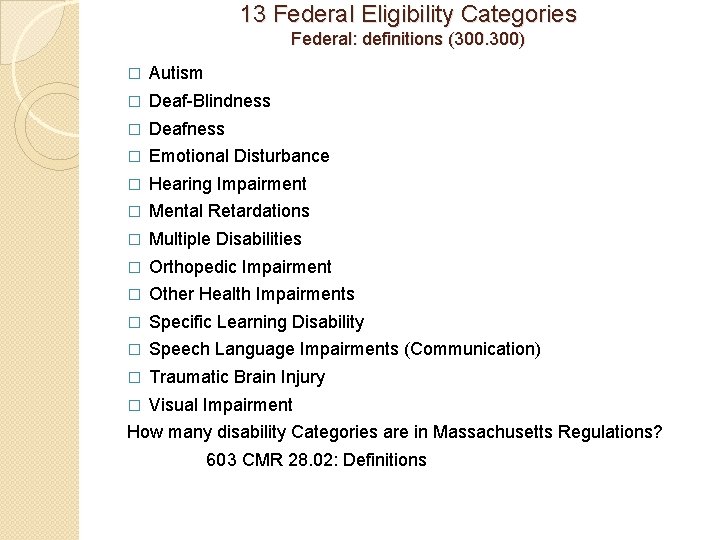
13 Federal Eligibility Categories Federal: definitions (300. 300) � Autism � Deaf-Blindness � Deafness � Emotional Disturbance � Hearing Impairment � Mental Retardations � Multiple Disabilities � Orthopedic Impairment � Other Health Impairments � Specific Learning Disability � Speech Language Impairments (Communication) � Traumatic Brain Injury � Visual Impairment How many disability Categories are in Massachusetts Regulations? 603 CMR 28. 02: Definitions
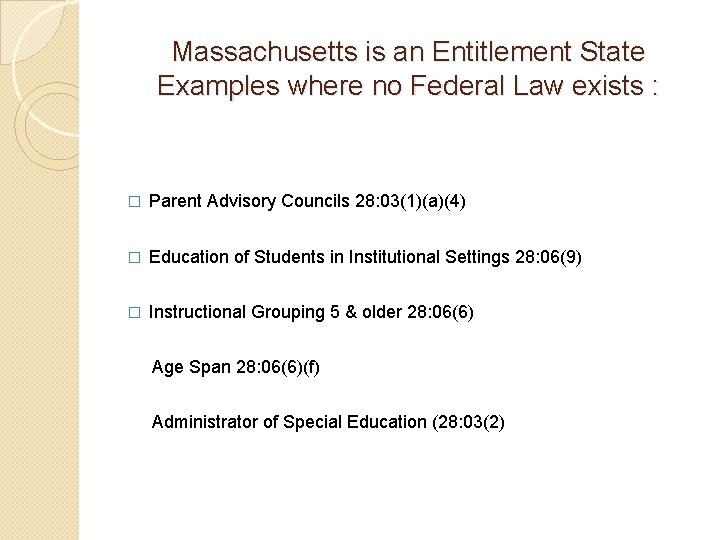
Massachusetts is an Entitlement State Examples where no Federal Law exists : � Parent Advisory Councils 28: 03(1)(a)(4) � Education of Students in Institutional Settings 28: 06(9) � Instructional Grouping 5 & older 28: 06(6) Age Span 28: 06(6)(f) Administrator of Special Education (28: 03(2)
- Slides: 17