
Reference System Issues in Binary Star Calculations Poster
Reference System Issues in Binary Star Calculations Poster for Division A Meeting DAp. 1. 05 George H. Kaplan Consultant to U. S. Naval Observatory Washington, D. C. , U. S. A. gk@gkaplan. us or george. kaplan@usno. navy. mil IAU General Assembly Honolulu, August 2015 1
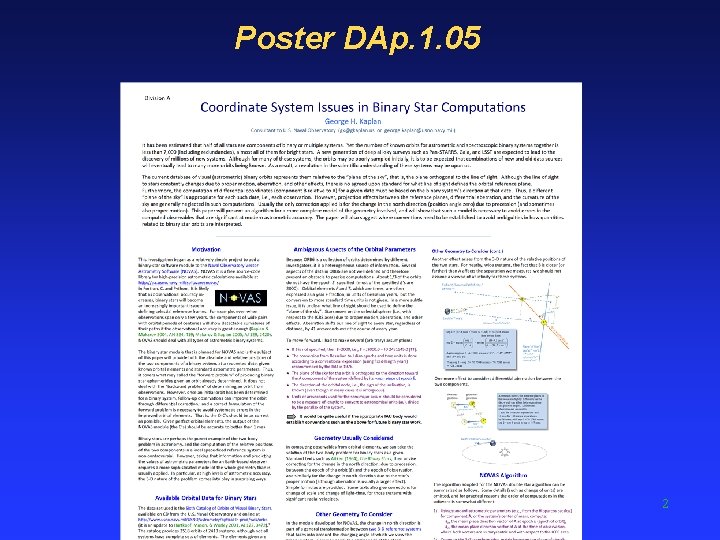
Poster DAp. 1. 05 2
What is this About? • Computing ephemerides of visual (astrometric) binary stars with known orbits • Ephemerides consist of values of astrometric observables for the pair of stars, for a specific time: 4 Position angle (θ) and separation (ρ) 4 Offsets in RA and Dec: Δα and Δδ 4 “Absolute” apparent RA and Dec: α and δ (in some standard reference system) • It’s not about computing orbits from observations • It assumes there is one set of astrometric parameters (α, δ, μα, μδ, π, v. R) for the pair, which might apply to either the A component or center of mass 3
Motivation • Add new software module Naval Observatory Vector Astrometry Software (NOVAS) • NOVAS it is a free source-code library for high-precision astrometric calculations available at http: //aa. usno. navy. mil/software/novas/ in Fortran, C, and Python. • It is likely that as observational accuracy increases, binary stars will become an increasingly important issue in defining celestial reference frames NOVAS has to accommodate them! 4
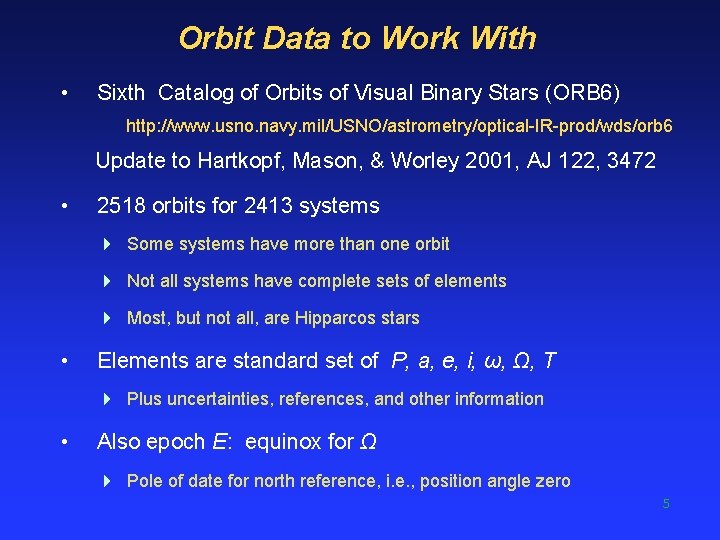
Orbit Data to Work With • Sixth Catalog of Orbits of Visual Binary Stars (ORB 6) http: //www. usno. navy. mil/USNO/astrometry/optical-IR-prod/wds/orb 6 Update to Hartkopf, Mason, & Worley 2001, AJ 122, 3472 • 2518 orbits for 2413 systems 4 Some systems have more than one orbit 4 Not all systems have complete sets of elements 4 Most, but not all, are Hipparcos stars • Elements are standard set of P, a, e, i, ω, Ω, T 4 Plus uncertainties, references, and other information • Also epoch E: equinox for Ω 4 Pole of date for north reference, i. e. , position angle zero 5
Some Things I Wish Were Specified • Epoch E not given for 33% of orbits • Besselian years are frequently used for periods and periastron date −− what conversion factor to “normal” time units was used? • What direction defines the “plane of the sky” −− the plane orthogonal to the line of sight? 6
Assumptions I Had to Make About the Orbits (whether valid or not) • If E is not specified, then E=2000, i. e. , E = J 2000. 0 = JD 2451545. 0 (TT). • The conversion from Besselian to Julian epochs and time units is done according to a conventional expression (using fixedlength years) recommended by the IAU in 1976. • The plane of the sky for the orbit is orthogonal to the direction toward the A component of the system defined by its mean place at epoch E. • The direction of the orbital node, i. e. , the sign of the inclination, is known (even though in many cases it is ambiguous). • Units of arcseconds used for the semimajor axis a should be considered to be a measure of length; to convert to astronomical units (au), divide by the parallax of the system. 7
Conventional Approach to Binary Star Ephemerides • Plane of sky doesn’t change • System is viewed from infinity • Standard 2 -body code works fine for the relative positions of the components in their local reference system • Once that is done, there are no geometric or lightpropagation effects that significantly shift the apparent position of one component relative to the other • Do need to adjust for the change in north direction between epoch E of the orbit and date of observation (i. e. , date of ephemerides) 8
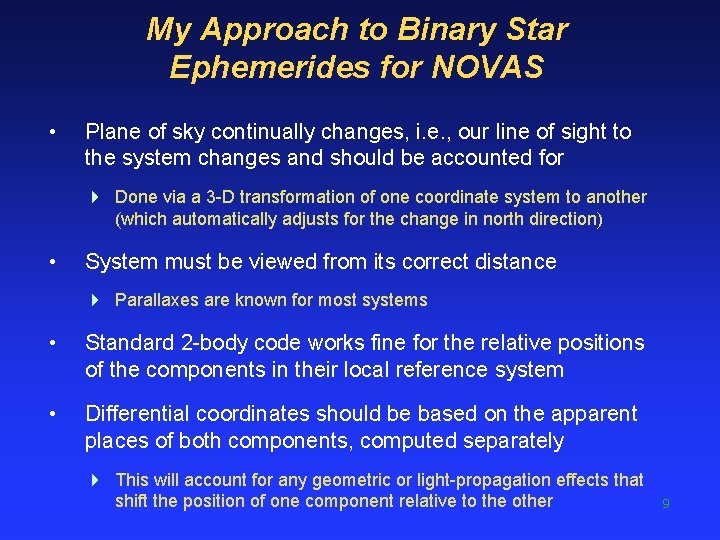
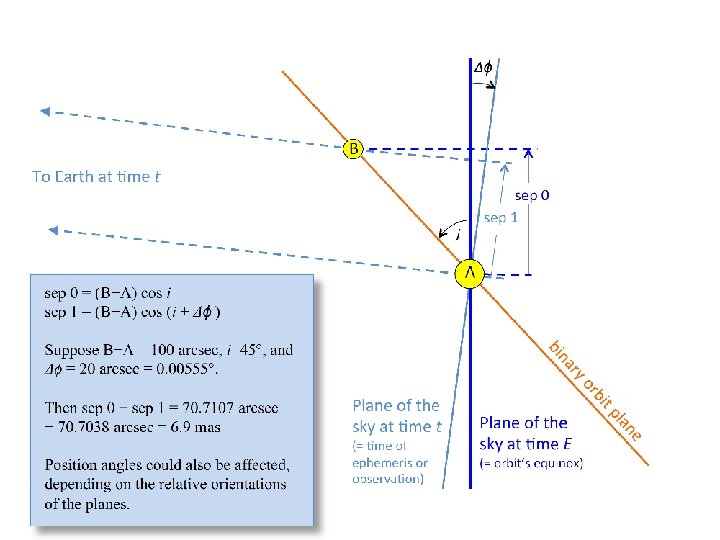
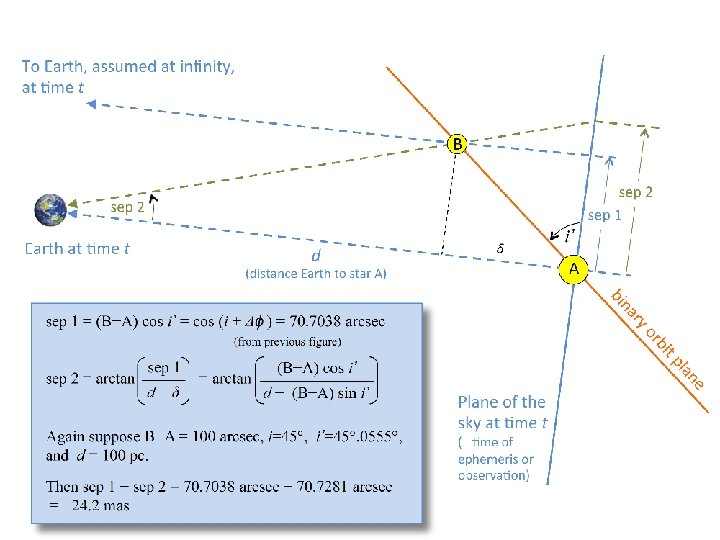
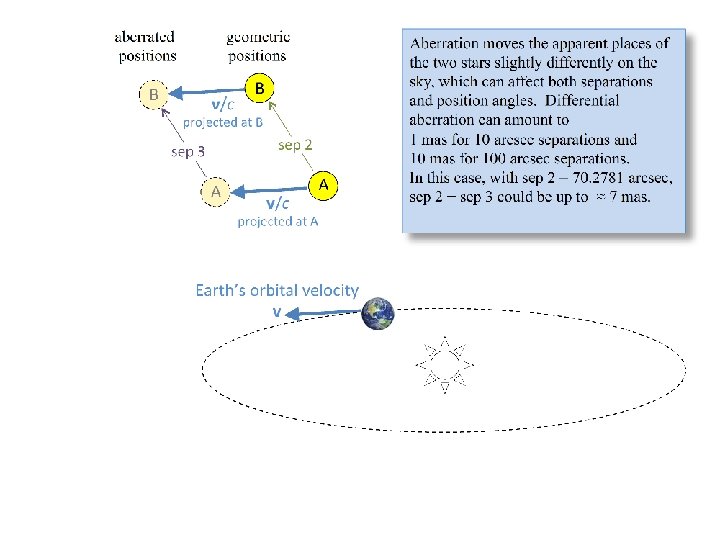
My Approach to Binary Star Ephemerides for NOVAS • Plane of sky continually changes, i. e. , our line of sight to the system changes and should be accounted for 4 Done via a 3 -D transformation of one coordinate system to another (which automatically adjusts for the change in north direction) • System must be viewed from its correct distance 4 Parallaxes are known for most systems • Standard 2 -body code works fine for the relative positions of the components in their local reference system • Differential coordinates should be based on the apparent places of both components, computed separately 4 This will account for any geometric or light-propagation effects that shift the position of one component relative to the other 9
10
11
12
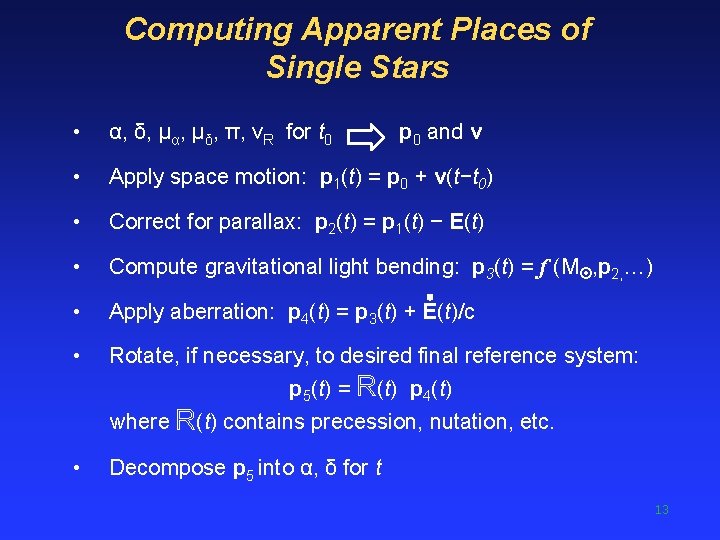
Computing Apparent Places of Single Stars • α, δ, μα, μδ, π, v. R for t 0 • Apply space motion: p 1(t) = p 0 + v(t−t 0) • Correct for parallax: p 2(t) = p 1(t) − E(t) • Compute gravitational light bending: p 3(t) = f (M , p 2, …) • Apply aberration: p 4(t) = p 3(t) + E(t)/c • Rotate, if necessary, to desired final reference system: p 5(t) = R(t) p 4(t) p 0 and v where R(t) contains precession, nutation, etc. • Decompose p 5 into α, δ for t 13
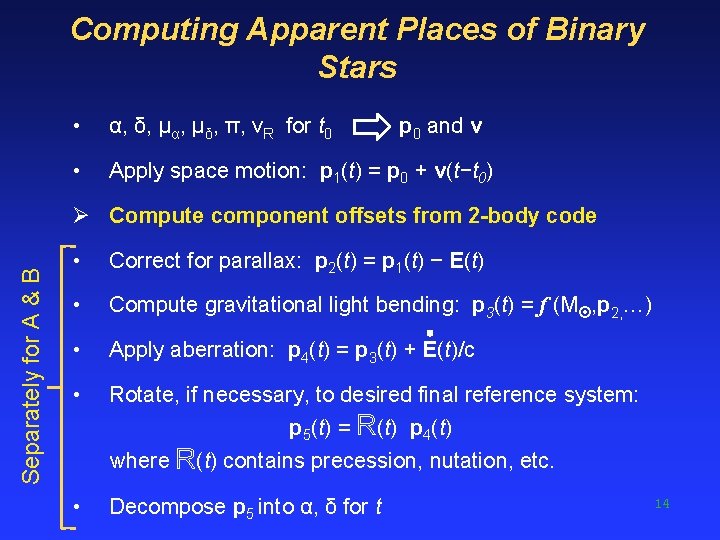
Computing Apparent Places of Binary Stars • α, δ, μα, μδ, π, v. R for t 0 • Apply space motion: p 1(t) = p 0 + v(t−t 0) p 0 and v Separately for A & B Ø Compute component offsets from 2 -body code • Correct for parallax: p 2(t) = p 1(t) − E(t) • Compute gravitational light bending: p 3(t) = f (M , p 2, …) • Apply aberration: p 4(t) = p 3(t) + E(t)/c • Rotate, if necessary, to desired final reference system: p 5(t) = R(t) p 4(t) where R(t) contains precession, nutation, etc. • Decompose p 5 into α, δ for t 14
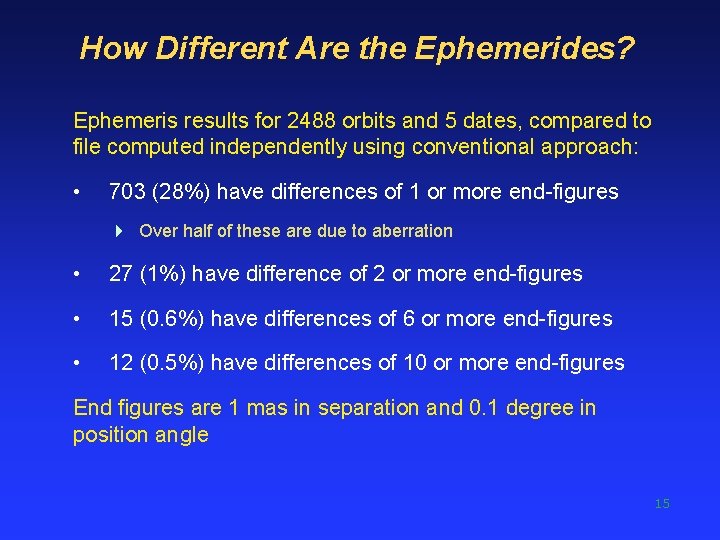
How Different Are the Ephemerides? Ephemeris results for 2488 orbits and 5 dates, compared to file computed independently using conventional approach: • 703 (28%) have differences of 1 or more end-figures 4 Over half of these are due to aberration • 27 (1%) have difference of 2 or more end-figures • 15 (0. 6%) have differences of 6 or more end-figures • 12 (0. 5%) have differences of 10 or more end-figures End figures are 1 mas in separation and 0. 1 degree in position angle 15
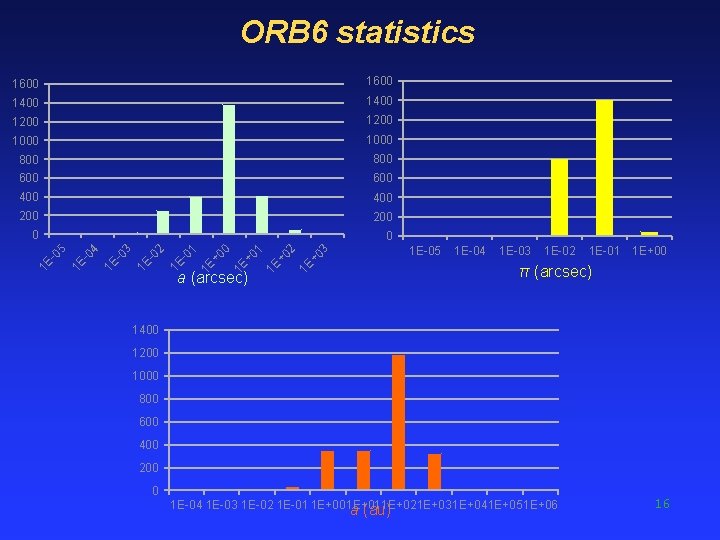
ORB 6 statistics 1000 800 600 400 200 0 0 1 E +0 1 E -0 1 E -0 1 1 E +0 2 1 E +0 3 1000 0 1200 1 1200 2 1400 3 1400 4 1600 5 1600 a (arcsec) 1 E-05 1 E-04 1 E-03 1 E-02 1 E-01 1 E+00 π (arcsec) 1400 1200 1000 800 600 400 200 0 1 E-04 1 E-03 1 E-02 1 E-01 1 E+001 E+011 E+021 E+031 E+041 E+051 E+06 a (au) 16
- Slides: 16