
Reference Model for an Open Archival Information System













- Slides: 50
Reference Model for an Open Archival Information System (OAIS) And Submission Agreements NOAA DSA TIM Donald Sawyer/NASA/GSFC 26 -October 2005
Topics (time permitting) • OAIS Reference Model • Producer-Archive Interface Methodology Abstract Standard • Submission Information Package (SIP) standardization (separate presentation)
OAIS Reference Model • Consultative Committee for Space Data Systems • International group of space agencies • Developed variety of science discipline- independent standards • Became working body for an ISO TC 20/ SC 13 about 1990 TC 20: Aircraft and Space Vehicles SC 13: Space Data and Information Transfer Systems – Ensured broad participation, including traditional archives (Not restricted to space communities; all participation was welcomed!)
What is a Reference Model? • A framework – for understanding significant relationships among the entities of some environment, and – for the development of consistent standards or specifications supporting that environment. • A reference model – is based on a small number of unifying concepts – is an abstraction of the key concepts, their relationships, and their interfaces both to each other and to the external environment – may be used as a basis for education and explaining standards to a non-specialist.
Organizational Approach • Organized US contribution under a framework with NASA lead – Established liaison with Federal Geographic Data Committee (FGDC) and National Archives and Records Administration (NARA) – Agency archives and users must be represented in this process • An “Open” process – Important to stimulate dialogue with broad archive/user communities – Results of US and International workshops put on WEB – Supported e-mail comments/critiques
Technical Approach: 1 • Investigate other Reference Models. – ISO “Seven Layer”Communications Reference Model – ISO Reference Model for Open Distributed Processing – ISO TC 211 Reference Model for Geomantics • Define what is meant by ‘archiving of data’ • Break ‘archiving’ into a few functional areas (e. g. , ingest, storage, access, and preservation planning)
Technical Approach: 2 • Define a set of interfaces between the functional areas • Define a set of data classes for use in Archiving • Choose formal specification techniques – Data flow diagrams for functional models and interfaces – Unified Modeling Language (UML) for data classes
Results: 1 • Reference Model targeted to several categories of reader – Archive designers – Archive users – Archive managers, to clarify digital preservation issues and assist in securing appropriate resources – Standards developers • Adopted terminology that crosses various disciplines – Traditional archivists – Scientific data centers – Digital libraries
Results: 2 • Widely adopted as starting point in digital preservation efforts – – Digital libraries (e. g. , Netherlands National Library) Traditional archives (e. g. , US National Archives) Scientific data centers (e. g. , National Space Science Data Center) Commercial Organizations (e. g. , Aerospace Industries Association preservation working team) • Published as final CCSDS standard (Blue Book) available from: http: //www. ccsds. org/documents/650 x 0 b 1. pdf • Published as a final ISO standard: ISO 14721: 2003
Purpose and Scope: 1 • Framework for understanding and applying concepts needed for long-term digital information preservation – Long-term is long enough to be concerned about changing technologies • Also can be starting point for model addressing non-digital information
Purpose and Scope: 2 • Provides set of minimal responsibilities to distinguish an OAIS from other uses of ‘archive’ • Framework for comparing architectures and operations of existing and future archives
Purpose and Scope: 3 • Basis for development of additional related standards • Addresses a full range of archival functions – Ingest, Archival Storage, Data Management, Access, Preservation Planning, Administration
Applicability • Applicable to all long-term archives and those organizations and individuals dealing with information that may need long-term preservation • Does NOT specify an implementation
Conformance • How does an archive conform? – It discharges the set of minimal responsibilities – It supports the basic information concepts that address a definition of information and types of information packages • How do other documents conform? – By using OAIS terms and concepts
Who wants to conform to OAIS? • All organizations that need to preserve digital information for extended periods – To demonstrate a level of awareness of digital preservation needs • Other standards and documents – For effective communication and integration
Open Archival Information System (OAIS) • Information – Any type of knowledge that can be exchanged – Data are the representation forms of information • Archival Information System – Hardware, software, and people who are responsible for the acquisition, preservation and dissemination of the information
View of an OAIS Environment • Producer provides the information to be preserved • Management sets overall OAIS policy • Consumer seeks and acquires preserved information of interest Producer OAIS (archive) Management Consumer
OAIS Responsibilities: 1 • Negotiates and accepts information from information producers • Obtains sufficient control to ensure long-term preservation • Determines which communities (designated) need to be able to understand the preserved information
OAIS Responsibilities: 2 • Ensures the information to be preserved is independently understandable to the Designated Communities • Follows documented policies and procedures that ensure the information is preserved against all reasonable contingencies • Makes the preserved information available to the Designated Communities in forms understandable to those communities
OAIS Information Definition • Information is always expressed (i. e. , represented) by some type of data • Data interpreted using its Representation Information yields Information Interpreted Yields Using its Data Representation Information Object
Information Package Definition Content Information Preservation Description Information • An Information Package is a conceptual container holding two types of information • Content Information • Preservation Description Information (PDI)
Content Information • The information that is the original target of preservation • Deciding what is the Content Information may not be obvious and may need to be negotiated with the Producer • The Content Data Object in the Content Information may be either a Digital Object or a Physical Object (e. g. , microfilm, a physical sample)
Preservation Description Information (PDI) : 1 • Reference Information – Provides one or more identifiers, or systems of identifiers, by which the Content Information may be uniquely identified • Provenance Information – Describes the source of Content Information, who has had custody of it, what is its history
Preservation Description Information (PDI) : 2 • Context Information – Describes how the Content Information relates to other information outside the Information Package • Fixity Information – Protects the Content Information from undocumented alteration
Examples of PDI • Reference – Bibliographic description; Persistent Ids • Provenance – Metadata on preservation process • Context – Pointers to related collections • Fixity – Digital signatures, checksums
Information Package Variants • Submission Information Package (SIP) – Negotiated between Producer and OAIS – Sent to OAIS by a Producer • Archival Information Package (AIP) – Information Package used for preservation – Holds complete set of Preservation Description Information for the Content Information • Dissemination Information Package (DIP) – Includes part or all of one or more Archival Information Packages – Sent to a Consumer by the OAIS
External Data Flow View Producer Submission Information Packages OAIS Archival Information Packages queries result sets Dissemination Information Packages orders Consumer
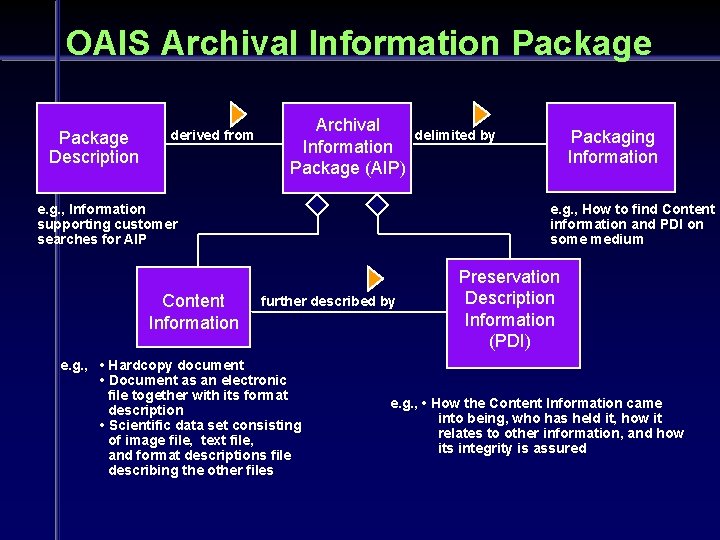
OAIS Archival Information Package Description derived from Archival Information Package (AIP) e. g. , Information supporting customer searches for AIP Content Information Packaging Information delimited by e. g. , How to find Content information and PDI on some medium further described by e. g. , • Hardcopy document • Document as an electronic file together with its format description • Scientific data set consisting of image file, text file, and format descriptions file describing the other files Preservation Description Information (PDI) e. g. , • How the Content Information came into being, who has held it, how it relates to other information, and how its integrity is assured
Packaging Information • Information which, either actually or logically, binds and relates the components of the package into an identifiable entity on specific media • Examples of typical Packaging Information include tar files, directory structures, filenames, and tape marks
Package Description • Contains the data that serves as the input to documents or applications called Access Aids. • Access Aids can be used by a Consumer to locate, analyze, retrieve, or order information from the OAIS.
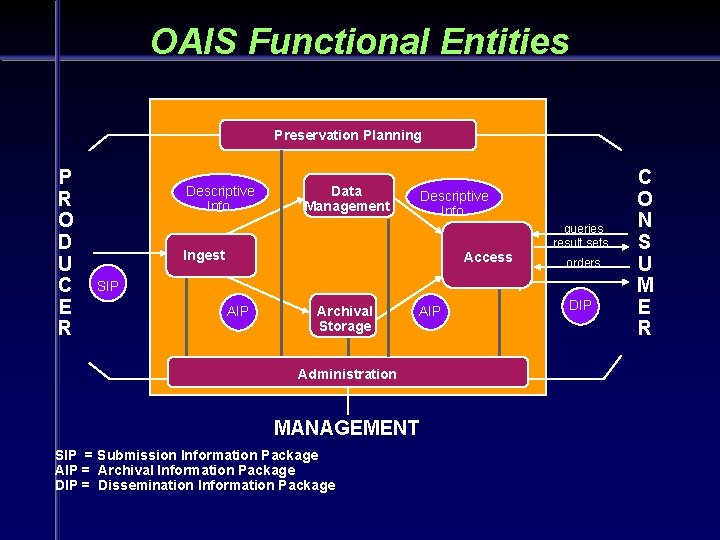
Functional Entities: 1 • Ingest: This entity provides the services and functions to accept Submission Information Packages (SIPs) from Producers and prepare the contents for storage and management within the archive • Archival Storage: This entity provides the services and functions for the storage, maintenance and retrieval of Archival Information Packages • Data Management: This entity provides the services and functions for populating, maintaining, and accessing both descriptive information that identifies and documents archive holdings and internal archive administrative data.
Functional Entities: 2 • Administration: This entity manages the overall operation of the archive system • Preservation Planning: This entity monitors the environment of the OAIS and provides recommendations to ensure that the information stored in the OAIS remain accessible to the Designated Community over the long term. • Access: This entity supports Consumers in determining the existence, description, location and availability of information stored in the OAIS and allows Consumers to request and receive information products
OAIS Functional Entities Preservation Planning P R O D U C E R Descriptive Info. Data Management Descriptive Info. Ingest Access queries result sets orders SIP Archival Storage AIP Administration MANAGEMENT SIP = Submission Information Package AIP = Archival Information Package DIP = Dissemination Information Package DIP C O N S U M E R
Submission Agreement • Negotiated between Producer and Archive • Identifies the SIPs to be submitted by the Producer • May include mandatory requirements • Not further expanded in the OAIS Reference Model
Reference Model Summary • Reference model is applicable to all digital archives, and their Producers and Consumers • Establishes common terms and concepts for comparing implementations, but does not specify an implementation • Identifies a minimum set of responsibilities for an archive to claim it is an OAIS • Provides detailed models of both archival functions and archival information • Also discusses OAIS information migration and interoperability among OAISs
Producer-Archive Interface Methodology Abstract Standard (PAIMAS) NOAA DSA TIM C. Huc/CNES, D. Boucon/CNES-SILOGIC, D. M. Sawyer/NASA/GSFC, J. G. Garrett/NASA-Raytheon RAYTHEON
Why a new standard? Needs for standardization: problems • The relations between archives and data Producers are rarely simple and easy: • nonconformity of received data • unclear and imprecise definition of the data to be delivered, • failure to meet delivery schedule, • late detection of errors in archived data, • non-management of modifications ==> Can be detrimental to archived information quality and the cost of the operation. • Ever increasing diversity of the producers • Data complexity • Each project develops its own methodology on the basis of a process that is roughly the same from one project to another ==> Work duplicated, no generality, excessively high costs, etc.
Methodology Context PAIMAS Focus Preservation Planning P R O D U C E R Data Management Descriptive Info. SIP Ingest Archival Storage AIP Administration MANAGEMENT SIP = Submission Information Package AIP = Archival Information Package DIP = Dissemination Information Package Access queries result sets orders DIP C O N S U M E R
Methodology Description
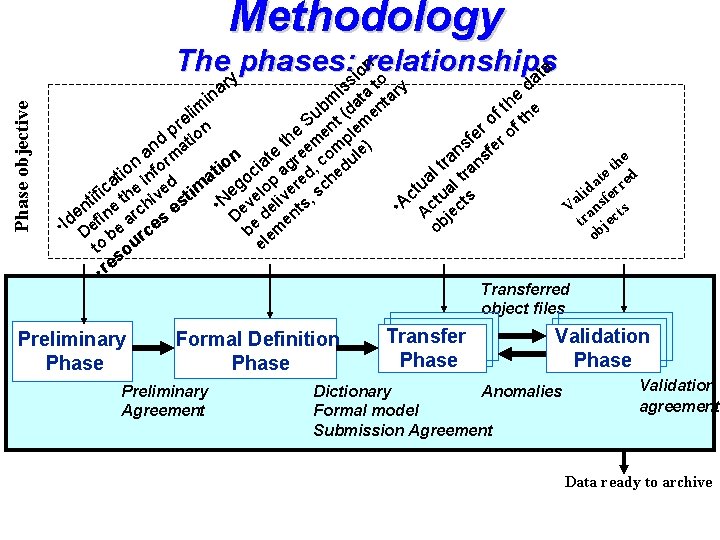
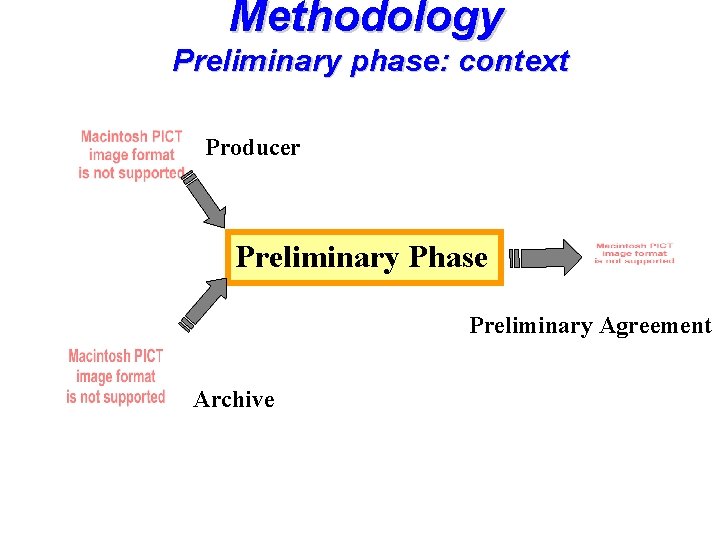
Methodology The yphases: iorelationships n a at s o Phase objective r a in lim e pr on i d t an a is ta t ary m a t b d n Su nt ( eme e e l th em mp e) e t e o l ia gr , c du n rm it o c a d e a go p re ch i d a o m c e e ifi th hiv sti • Ne vel live s, s t e de nt en fine arc s e D d e • I De be rce be lem e to ou n tio nfo he d f t the o er of f er s an sf he t te red a lid sfer a V an ts tr jec ob tr ran l a t tu ual s c • A Act ect j ob s • re Transferred object files Preliminary Phase Formal Definition Phase Preliminary Agreement Transfer Phase Validation Phase Dictionary Anomalies Formal model Submission Agreement Validation agreement Data ready to archive
Methodology Preliminary phase: context Producer Preliminary Phase Preliminary Agreement Archive
Methodology Preliminary phase: sub-phases Action table Description
Methodology Formal Definition Phase: context Preliminary Agreement Formal Definition Phase Dictionary Data Model Submission Agreement
Methodology Formal Definition Phase: sub-phases and action table Id Formal Definition Phase: Submission Agreement F-36 Draw up the Submission Agreement Involves Producer and/or Archive • information to be transferred (e. g. , SIP contents, SIP packaging, data models, Designated Community, legal and contractual aspects); • transfer definition (e. g. specification of the Data Submission Sessions); • validation definition; • change management (e. g. conditions for modification of the agreement, for breaking the agreement); • schedule (submission timetable).
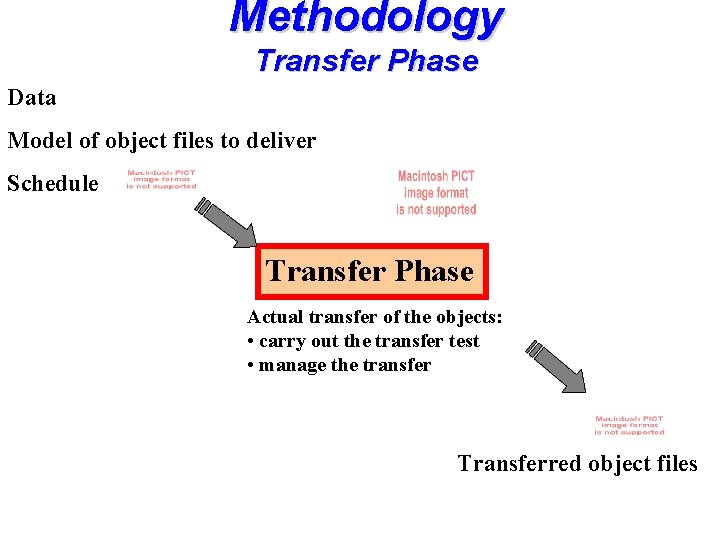
Methodology Transfer Phase Data Model of object files to deliver Schedule Transfer Phase Actual transfer of the objects: • carry out the transfer test • manage the transfer Transferred object files
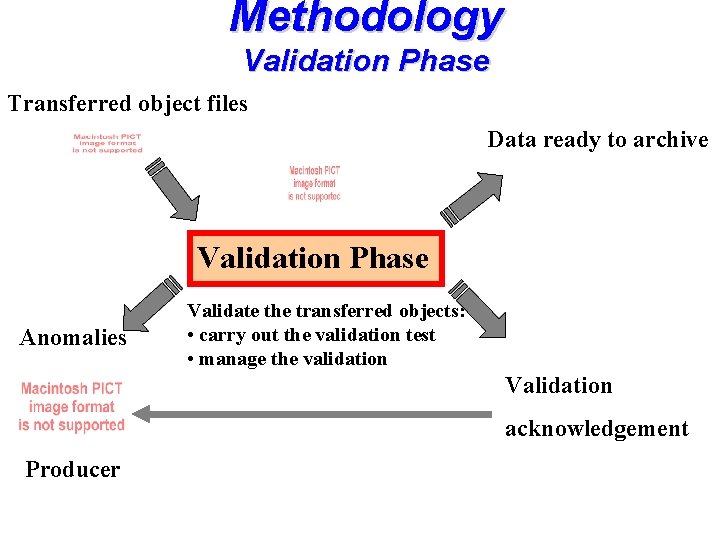
Methodology Validation Phase Transferred object files Data ready to archive Validation Phase Anomalies Validate the transferred objects: • carry out the validation test • manage the validation Validation acknowledgement Producer
Specialization • Adapt the generic standard to a particular community (which can range from an international organization to a simple archive service) • Steps involved to define a community standard • terminology, • data dictionary and information model, • standards, • common tools. • Analyze each action of the generic standard (add and delete actions as appropriate)
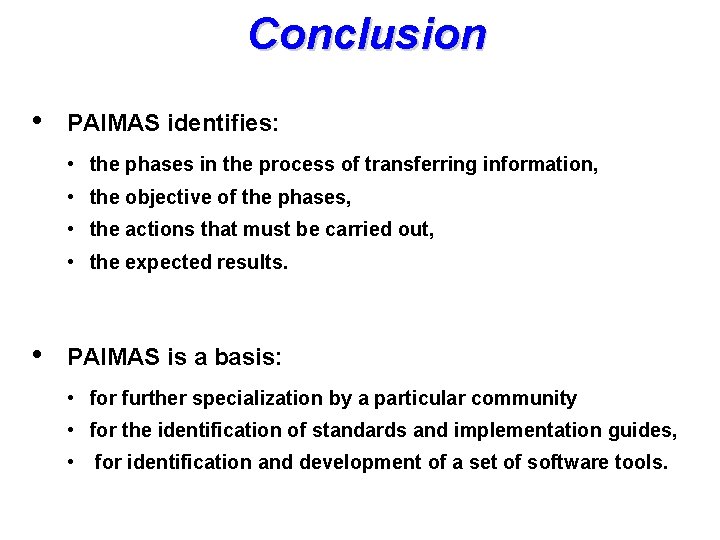
Conclusion • PAIMAS identifies: • the phases in the process of transferring information, • the objective of the phases, • the actions that must be carried out, • the expected results. • PAIMAS is a basis: • for further specialization by a particular community • for the identification of standards and implementation guides, • for identification and development of a set of software tools.
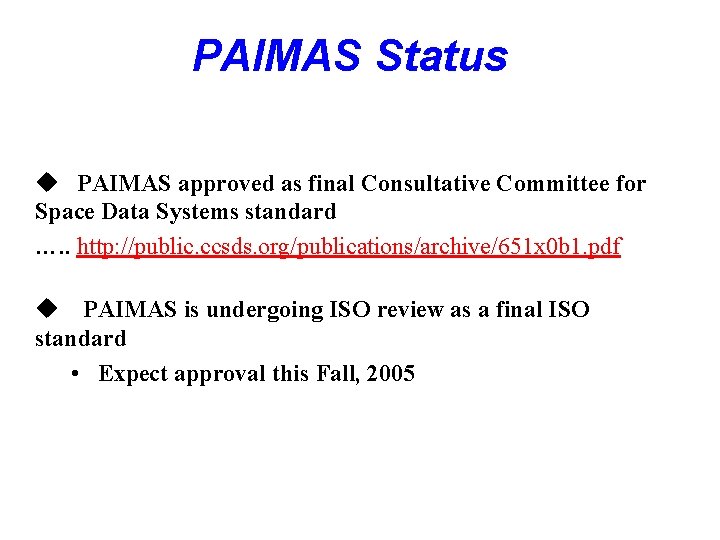
PAIMAS Status u PAIMAS approved as final Consultative Committee for Space Data Systems standard …. . http: //public. ccsds. org/publications/archive/651 x 0 b 1. pdf u PAIMAS is undergoing ISO review as a final ISO standard • Expect approval this Fall, 2005