
Reference genome assemblies and the technology behind them
Reference genome assemblies and the technology behind them Derek M Bickhart Animal Genomics and Improvement Laboratory Research Geneticist (Animal) derek. bickhart@ars. usda. gov Phone: (301) 504 -8679 Fax: (301) 504 -8092
USDA disclaimer Disclaimers: Mention of trade names, commercial products, or companies in this publication is solely for the purpose of providing specific information and does not imply recommendation or endorsement by the US Department of Agriculture over others not mentioned. The US Department of Agriculture (USDA) prohibits discrimination in all its programs and activities on the basis of race, color, national origin, age, disability, and where applicable, sex, marital status, familial status, parental status, religion, sexual orientation, genetic information, political beliefs, reprisal, or because all or part of an individual's income is derived from any public assistance program. (Not all prohibited bases apply to all programs. ) Persons with disabilities who require alternative means for communication of program information (Braille, large print, audiotape, etc. ) should contact USDA's TARGET Center at (202) 720 -2600 (voice and TDD). To file a complaint of discrimination, write to USDA, Director, Office of Civil Rights, 1400 Independence Avenue, S. W. , Washington, D. C. 20250 -9410, or call (800) 795 -3272 (voice) or (202) 720 -6382 (TDD). USDA is an equal opportunity provider and employer.
Outline • Alignment vs Assembly • Sequencing technologies that contribute to reference genomes • Scaffolding contigs into reference genomes
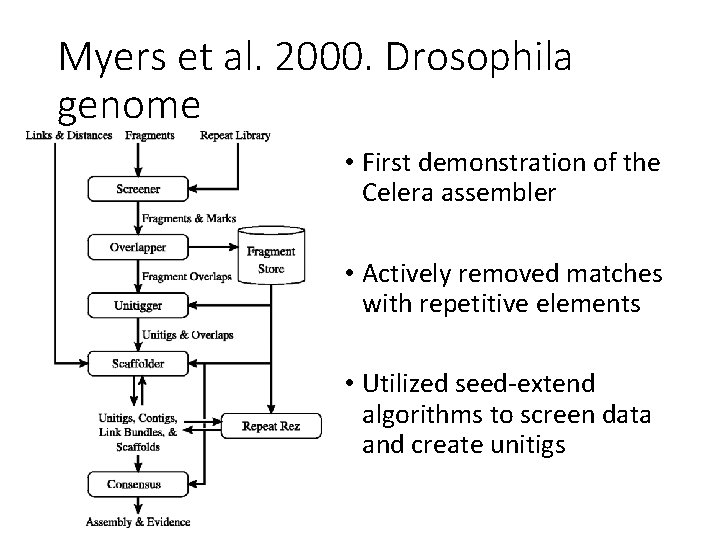
Myers et al. 2000. Drosophila genome • First demonstration of the Celera assembler • Actively removed matches with repetitive elements • Utilized seed-extend algorithms to screen data and create unitigs

Seed-extend: reduce computational complexity • Reduce reads into overlapping “K”mers • Hash the kmers for rapid retrieval ACGTAGAGGGATAAGATAGAG ACGTA AGGGATAAG CGTAG GGGATAAGA GTACGTAGA GGATAAGAT TACGTAGAG GATAAGATA for i in kmer_string: Hash long = (long << 5) + hash + int_value(i) Read 1 CTACTA • Select identical hash hits, and extend read to find best match TACGTAGAG Read 3 GGATAAG Read 2 TTTAT
The definition of alignment and its benefits • Alignment is a type of algorithm that returns the (probable) position of reads on a reference genome. • Benefits • Faster than de-novo assembly • Easy to reference between samples • Disadvantages • Does not easily give information on Insertions • Relies heavily on the reference assembly quality
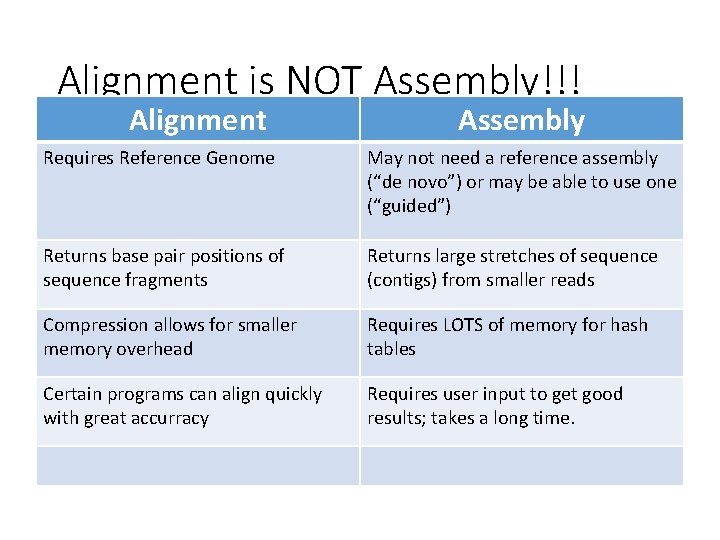
Alignment is NOT Assembly!!! Alignment Assembly Requires Reference Genome May not need a reference assembly (“de novo”) or may be able to use one (“guided”) Returns base pair positions of sequence fragments Returns large stretches of sequence (contigs) from smaller reads Compression allows for smaller memory overhead Requires LOTS of memory for hash tables Certain programs can align quickly with great accurracy Requires user input to get good results; takes a long time.

The algorithm behind Smith. Waterman-Gotoh alignment Matrix H • a = base from sequence 1 • b = base from sequence 2 • m = length(a) • n = length(b) • H(i, j) = Max similarity score of suffix of a[1. . i] and b[1. . j] • w(c, d) = penalty from the gap scoring scheme
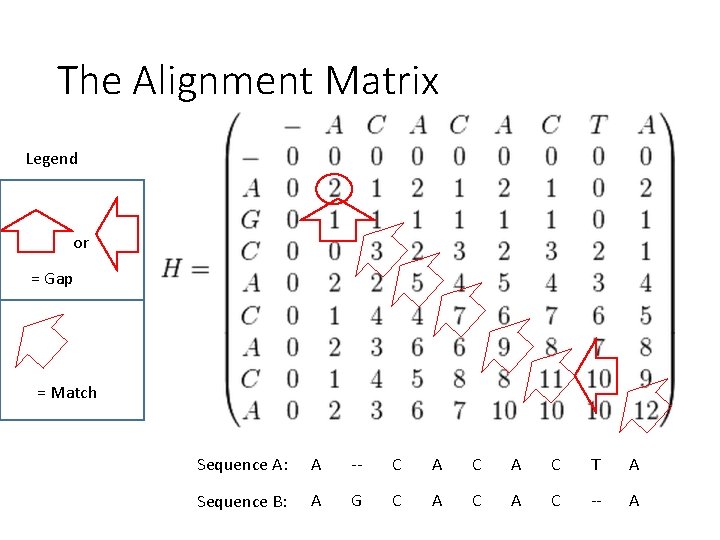
The Alignment Matrix Legend or = Gap = Match Sequence A: A -- C A C T A Sequence B: A G C A C -- A
Smith-Waterman-Gotoh is incredibly expensive to calculate! • Needs calculation of an X by Y matrix for query sequence of length X and target sequence of length Y. • Impossibly complex for use with excessively large target sequences (ie. A whole genome!). Hence it is called “local” alignment • We need strategies for finding suitable target sites
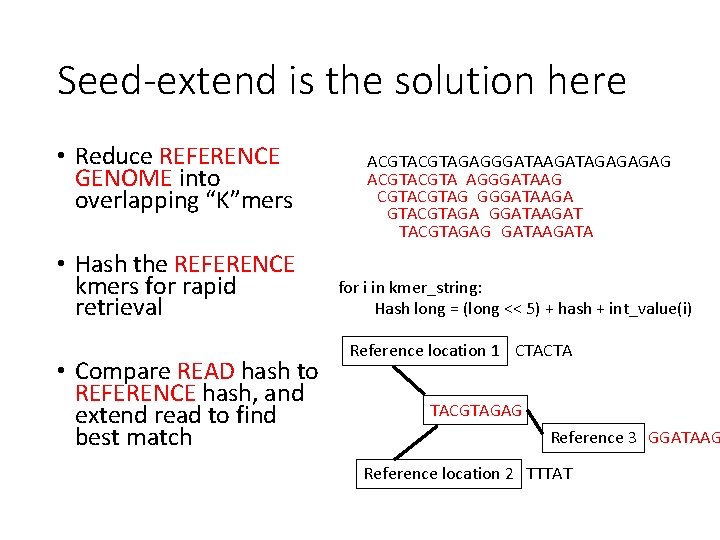
Seed-extend is the solution here • Reduce REFERENCE GENOME into overlapping “K”mers • Hash the REFERENCE kmers for rapid retrieval • Compare READ hash to REFERENCE hash, and extend read to find best match ACGTAGAGGGATAAGATAGAG ACGTA AGGGATAAG CGTAG GGGATAAGA GTACGTAGA GGATAAGAT TACGTAGAG GATAAGATA for i in kmer_string: Hash long = (long << 5) + hash + int_value(i) Reference location 1 CTACTA TACGTAGAG Reference 3 GGATAAG Reference location 2 TTTAT
Alignment requirements vs Assembly requirements for seed-extend • Alignment • Needs 3. 2 billion bases hashed into kmers for subsequent access • Completely ignores novel information that is not part of the reference • Assembly • Needs every single read (256+ billion bases) hashed into kmers for subsequent access • Can account for novel information
Improving de novo assembly: not the algorithm – the chemistry! • Major stumbling blocks for seed-extend: • Repeats • Heterochromatin • What is the best way to overcome repetitive DNA? • High fidelity sequencing – very accurate base calls • Longer reads – span repetitive elements with single reads
Who do we sequence? ? ? • If you had to make a new reference assembly, how would you do it? • A. Use a panel of individuals to maximize variants represented? • B. Use a single individual that has lots of heterozygosity? • C. Use a single individual that has very little heterozygosity? • D. Make a new reference assembly from each sample? • E. Use an individual with congenital diseases to get unique regions in the reference? • 70% of the draft HGP came from one anonymous donor
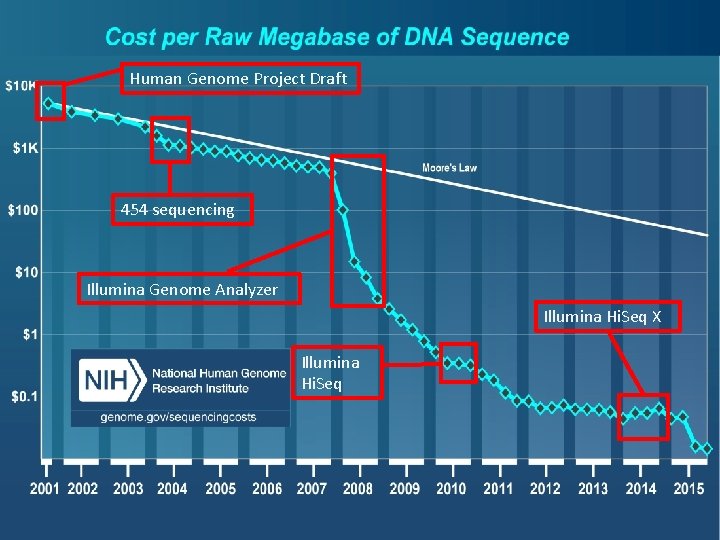
Human Genome Project Draft Sequencing read data sources 454 sequencing Illumina Genome Analyzer Illumina Hi. Seq X Illumina Hi. Seq
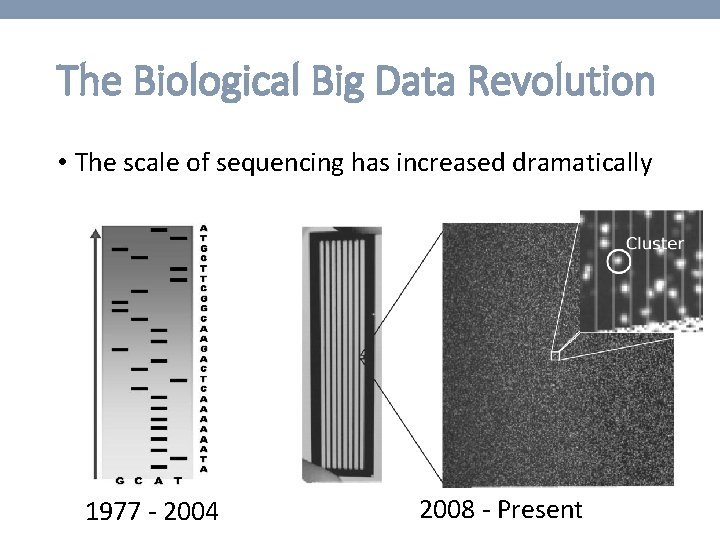
The Biological Big Data Revolution • The scale of sequencing has increased dramatically 1977 - 2004 2008 - Present
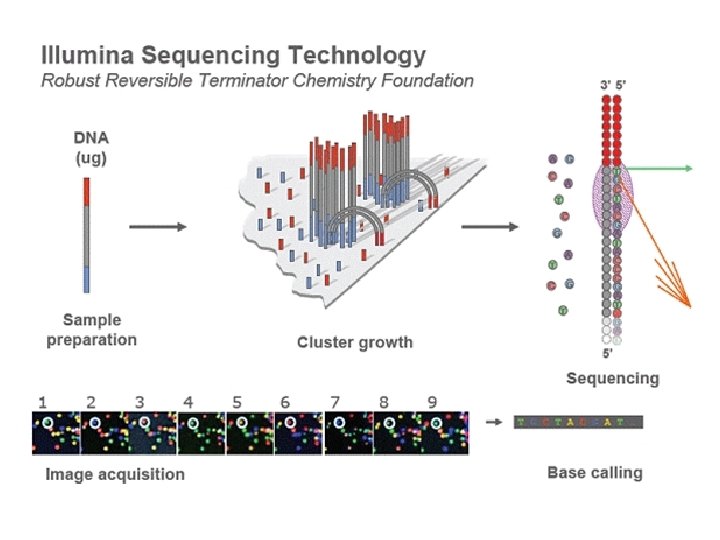
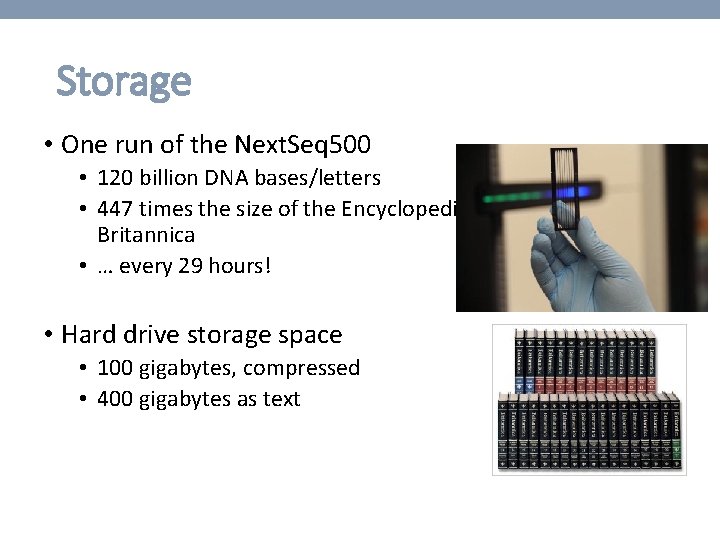
Storage • One run of the Next. Seq 500 • 120 billion DNA bases/letters • 447 times the size of the Encyclopedia Britannica • … every 29 hours! • Hard drive storage space • 100 gigabytes, compressed • 400 gigabytes as text
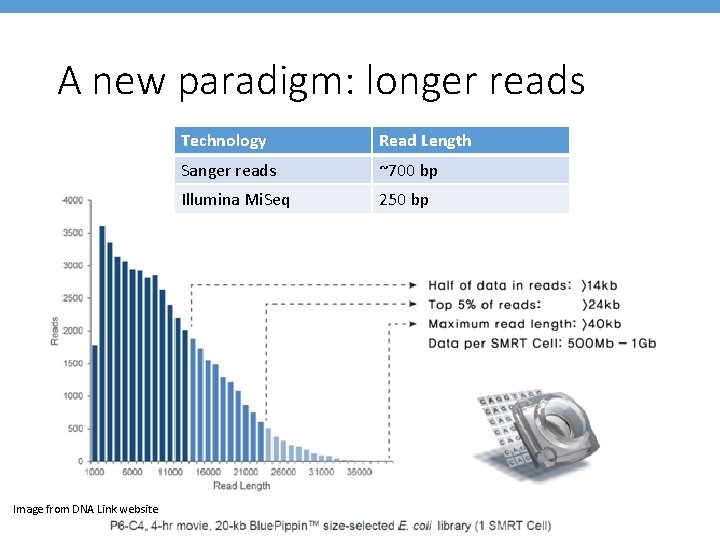
A new paradigm: longer reads Image from DNA Link website Technology Read Length Sanger reads ~700 bp Illumina Mi. Seq 250 bp
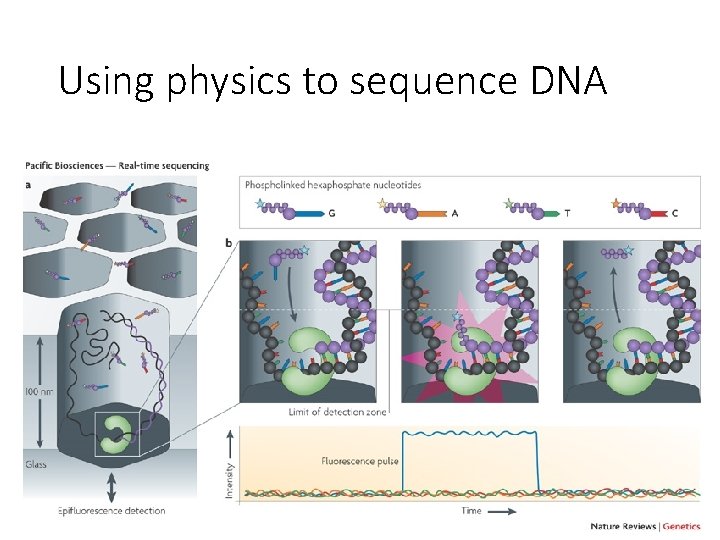
Using physics to sequence DNA
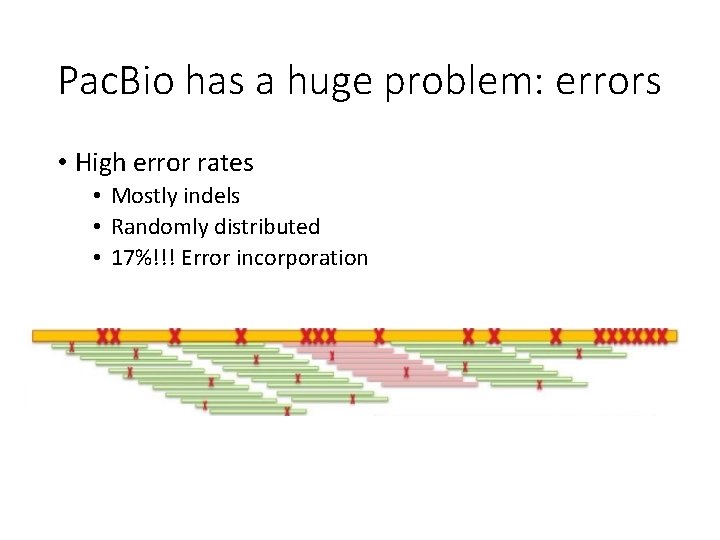
Pac. Bio has a huge problem: errors • High error rates • Mostly indels • Randomly distributed • 17%!!! Error incorporation
Contig definition • Contig: “Contiguous sequence. ” A single stretch of DNA sequence that is unbroken and represents one haplotype of the reference individual • A unitig is a type of contig that has no internal kmer references • How do we get around the incredibly high error rate?
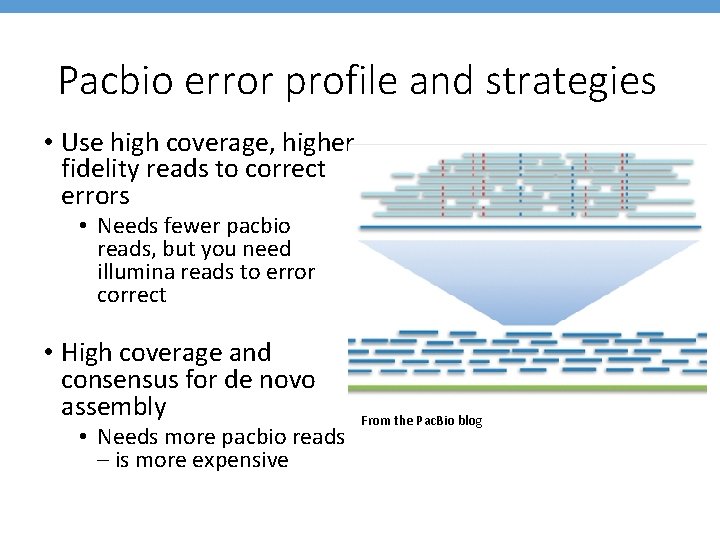
Pacbio error profile and strategies • Use high coverage, higher fidelity reads to correct errors • Needs fewer pacbio reads, but you need illumina reads to error correct • High coverage and consensus for de novo assembly • Needs more pacbio reads – is more expensive From the Pac. Bio blog
Can you get the whole genome into one Contig? • Bacterial genomes? • Vertebrate genomes?
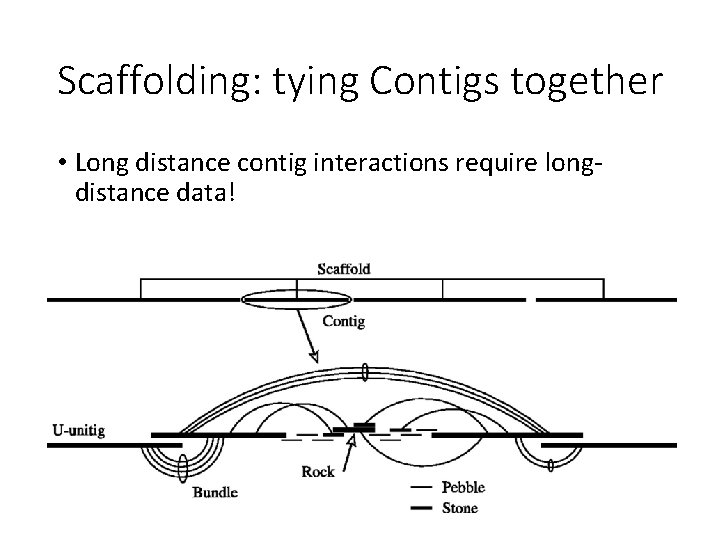
Scaffolding: tying Contigs together • Long distance contig interactions require longdistance data!
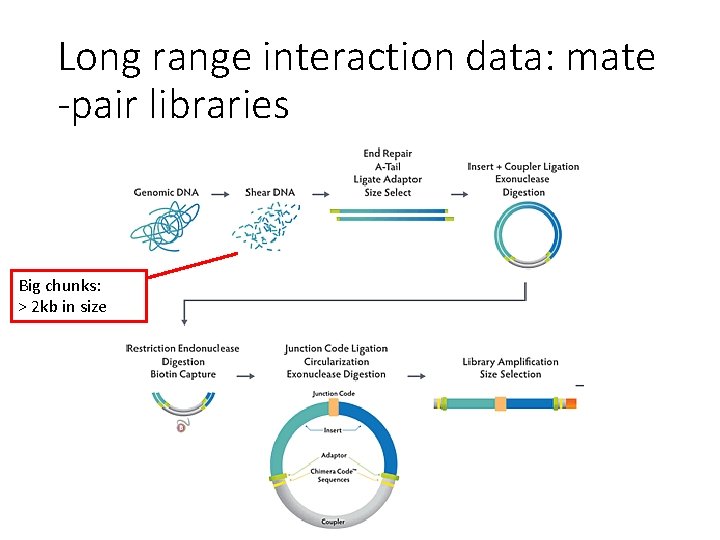
Long range interaction data: mate -pair libraries Big chunks: > 2 kb in size
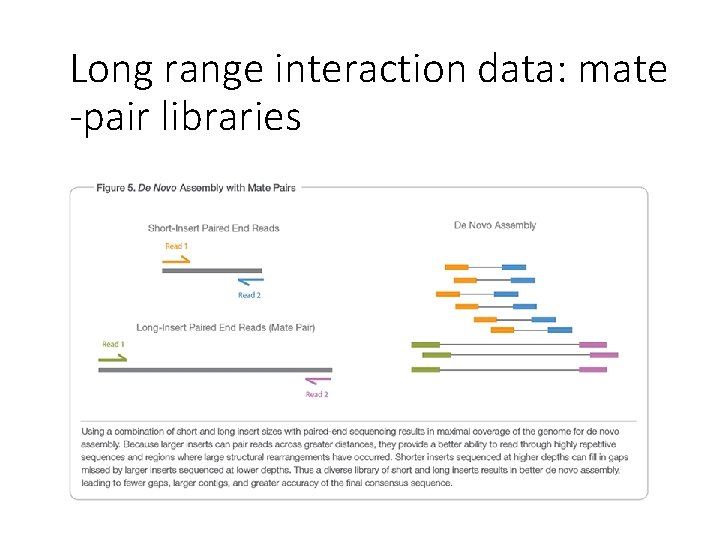
Long range interaction data: mate -pair libraries
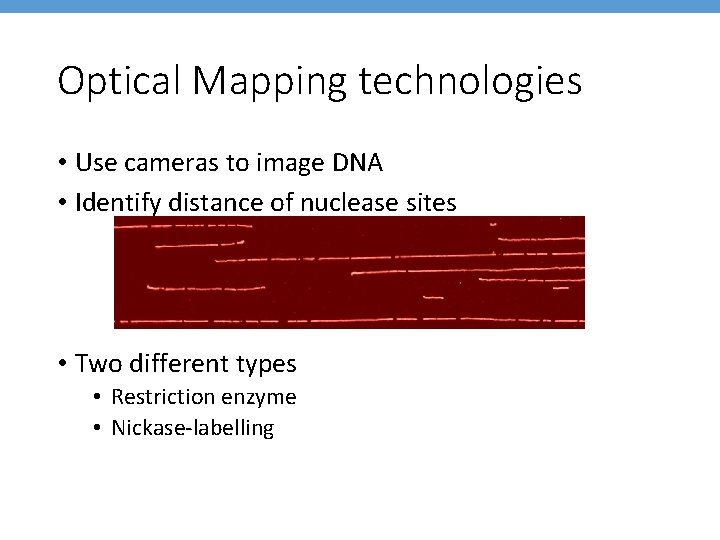
Optical Mapping technologies • Use cameras to image DNA • Identify distance of nuclease sites • Two different types • Restriction enzyme • Nickase-labelling
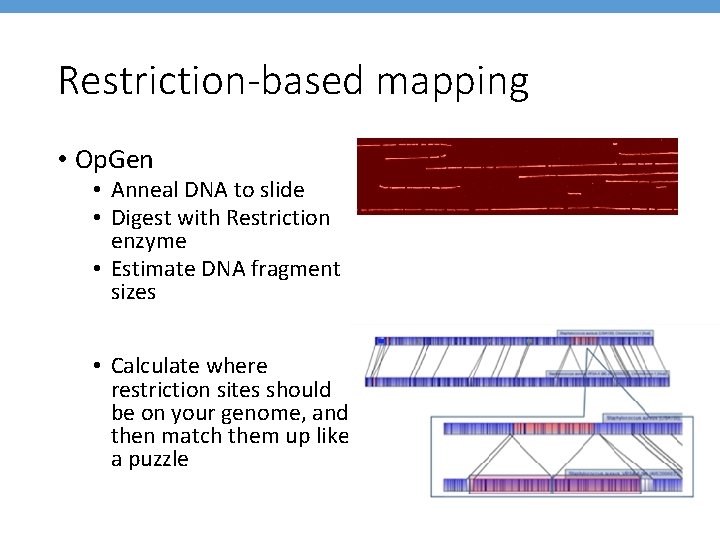
Restriction-based mapping • Op. Gen • Anneal DNA to slide • Digest with Restriction enzyme • Estimate DNA fragment sizes • Calculate where restriction sites should be on your genome, and then match them up like a puzzle
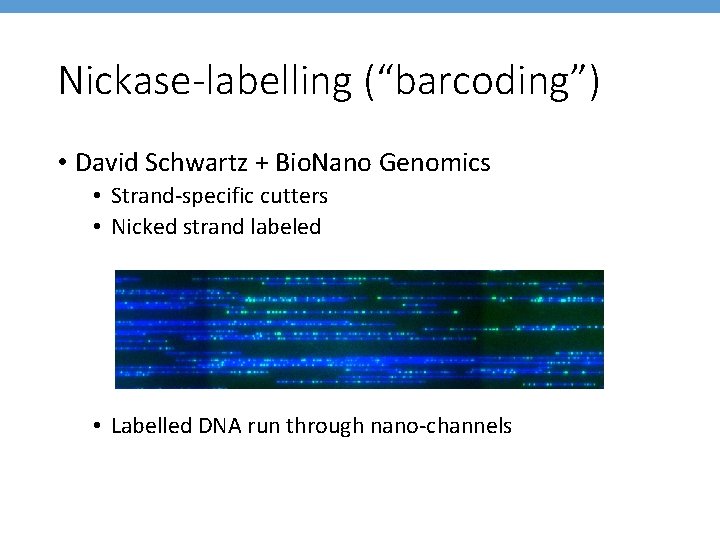
Nickase-labelling (“barcoding”) • David Schwartz + Bio. Nano Genomics • Strand-specific cutters • Nicked strand labeled • Labelled DNA run through nano-channels
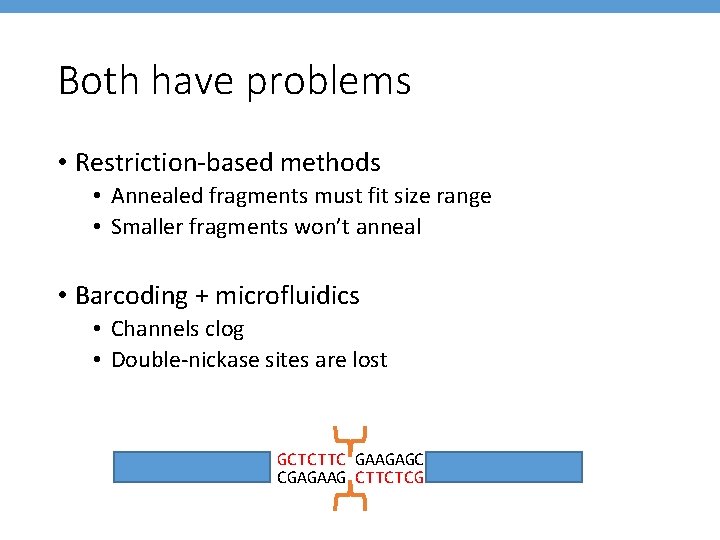
Both have problems • Restriction-based methods • Annealed fragments must fit size range • Smaller fragments won’t anneal • Barcoding + microfluidics • Channels clog • Double-nickase sites are lost GCTCTTC GAAGAGC CGAGAAG CTTCTCG
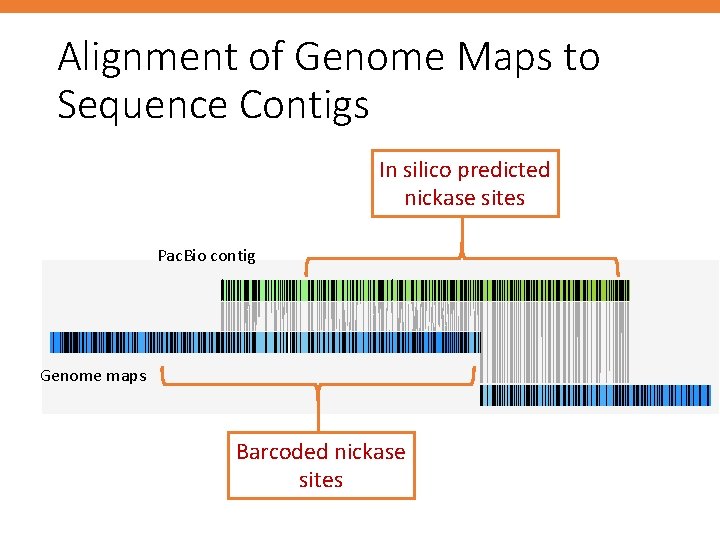
Alignment of Genome Maps to Sequence Contigs In silico predicted nickase sites Pac. Bio contig Genome maps Barcoded nickase sites
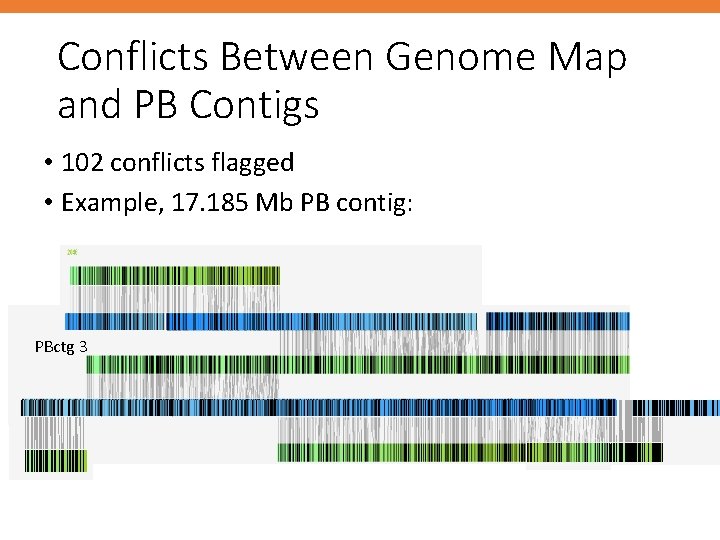
Conflicts Between Genome Map and PB Contigs • 102 conflicts flagged • Example, 17. 185 Mb PB contig: BNG 108 PBctg 3 BNG 1425
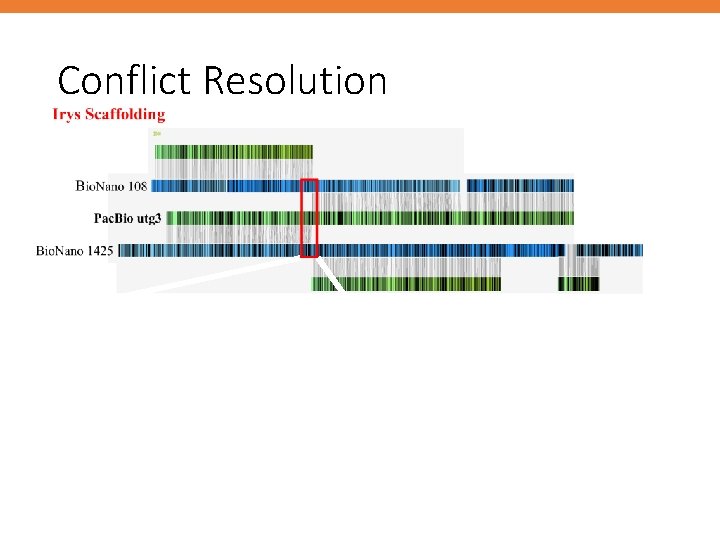
Conflict Resolution
Take-away points • Assembly vs Alignment • Alignment is NOT assembly, but they can share similar components! • Alignment is far faster because it takes advantage of the reference genome • Sequencing technologies • Trend is towards cheaper and longer read technologies! • Illumina makes the cheapest sequencing • Pac. Bio (currently) makes the longest reads
Take-away points • Scaffolding ties together contigs • Relies on long-distance associations of contigs to order them into a map • Different types of technologies are suitable here • Optical maps use visual DNA cues to tie together the contigs
Testing retention of knowledge 1. Describe how you would identify common repetitive elements from the data used in a seedextend alignment algorithm. Would you accomplish this differently if you were using a seed-extend assembly algorithm? 2. Reference genomes are extremely useful, but the data must be representative of the population. Can you ever truly finish a reference genome and make it perfectly representative? Why or how?
- Slides: 37