
Reference frames M A Floyd Massachusetts Institute of


- Slides: 29
Reference frames M. A. Floyd Massachusetts Institute of Technology, Cambridge, MA, USA GPS Data Processing and Analysis with GAMIT/GLOBK Earth Observatory of Singapore 17– 21 July 2017 http: //geoweb. mit. edu/~floyd/courses/gg/201707_EOS/ Material from R. W. King, T. A. Herring, M. A. Floyd (MIT) and S. C. Mc. Clusky (now at ANU)
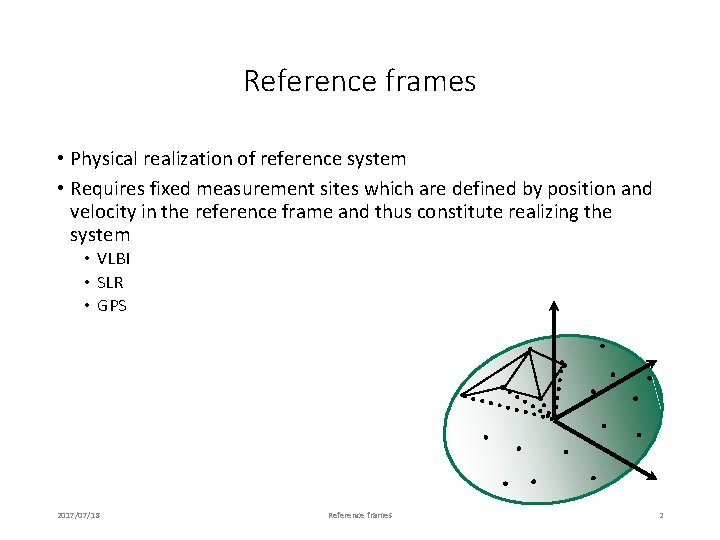
Reference frames • Physical realization of reference system • Requires fixed measurement sites which are defined by position and velocity in the reference frame and thus constitute realizing the system • VLBI • SLR • GPS 2017/07/18 Reference frames 2
Ultimately, everything is relative • Even “absolute positioning” is relative to some coordinate origin, orientation and scale • So what is “global positioning”? • The center and rotation pole of Earth define our coordinate axes • But how to we know where the center of the Earth is? • Do we really care? • It depends on your goals • No-net-rotation criterion (surface integral of angular velocity is zero) is usually used as the constraint on defining a terrestrial reference frame in the presence of surface motions (plate tectonics) 2017/07/18 Reference frames 3
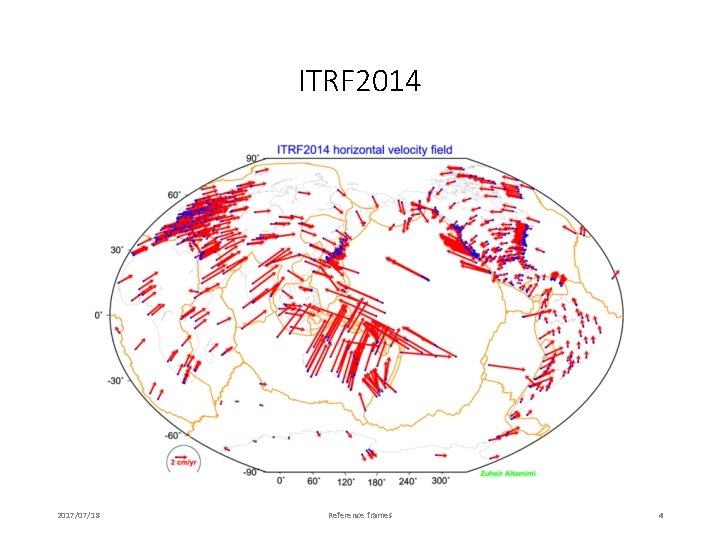
ITRF 2014 2017/07/18 Reference frames 4
ITRF 2014 What are some general features of plate motion that you can see? • North America rotates around a point in the Pacific off South America • Eurasia and Africa appear to have very similar motions • Antarctica is moving very little 2017/07/18 Reference frames 5
Choices of reference frame • Choose your reference frame based on your geophysical objectives • Velocities in ITRF are difficult to interpret visually from a geophysical perspective • Local surroundings of a volcano • One side of a fault • Upper plate of a subduction zone • Major plate reference frame • Major plates are often chosen to conform with conventional perspectives of velocity solutions • Relative to Eurasia, Nubia, North America, South America, etc. • But don’t feel restricted by this. Sometimes your geophysical discussion is best visualized relative to any stable boundary of a deforming region • Regional reference frame • Central Valley of California, non-deforming part of Anatolia, smaller coherent regions, etc. • Local reference frame • Sites near but outside the influence of a volcano, geothermal field, etc. 2017/07/18 Reference frames 6
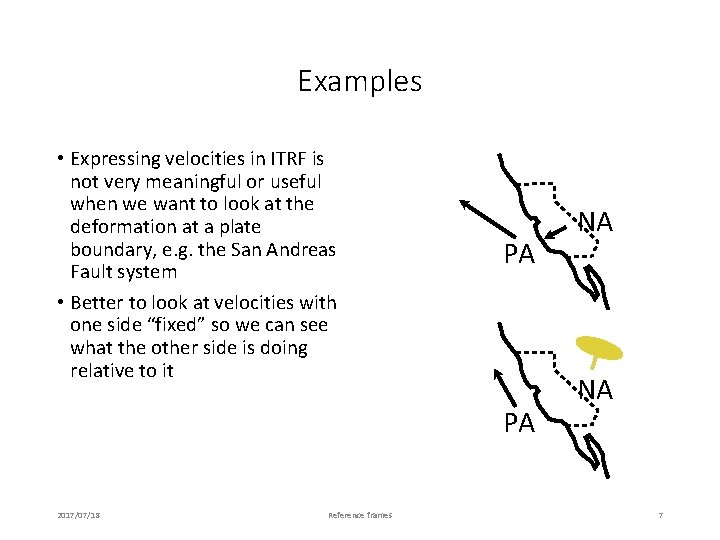
Examples • Expressing velocities in ITRF is not very meaningful or useful when we want to look at the deformation at a plate boundary, e. g. the San Andreas Fault system • Better to look at velocities with one side “fixed” so we can see what the other side is doing relative to it PA PA 2017/07/18 Reference frames NA NA 7
Basic issues in reference frame realization • Concept is to align the estimated site positions and possibly velocity to a set of well defined locations that have physical significance for the analysis being performed (e. g. , PBO aligns to a realization of the North America plate based on ITRF 2008) • glorg is the module which does this and computes the covariance matrix of the aligned solution in the reference frame chosen. • Transformation is often called an N-parameter Helmert transformation • N = 3: translation only (could also be just rotation) • N = 6: translation and rotation • N = 7: translation, rotation and scale • In GLOBK analyses, you need to decide • • How many parameters (3/6/7) Sites to use to determine the parameters (sh_gen_stats) Values of the positions/velocities of the reference frame sites Weight to be given to heights in computing the transformation parameters (“cnd_hgtv” command; first two arguments for position and velocity) 2017/07/18 Reference frames 8
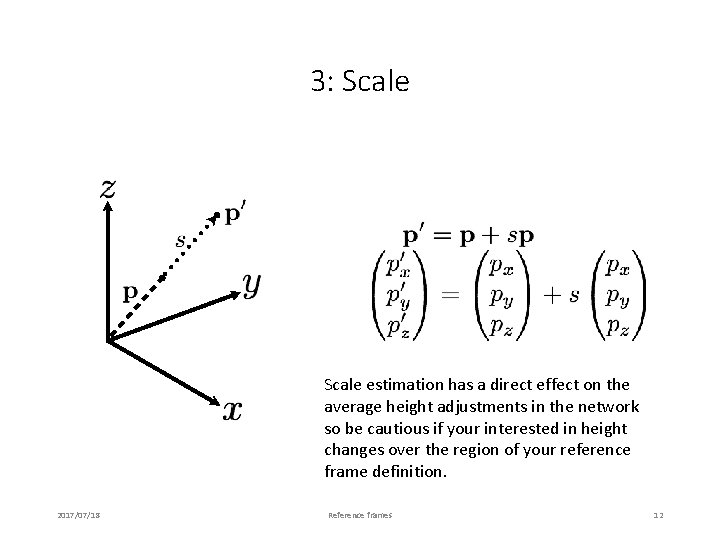
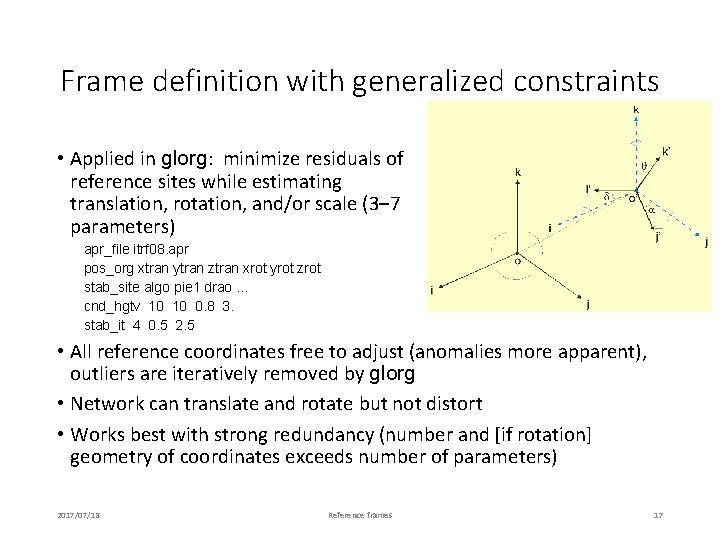
Reference frame implementation • Any vector may be mapped from one coordinate system to another by the application of • Translation (affects position of co-ordinate origin) • Rotation (affects orientation of co-ordinate axes) • Scale (affects length of co-ordinate axes and maps into heights in the network) 2017/07/18 Reference frames 9
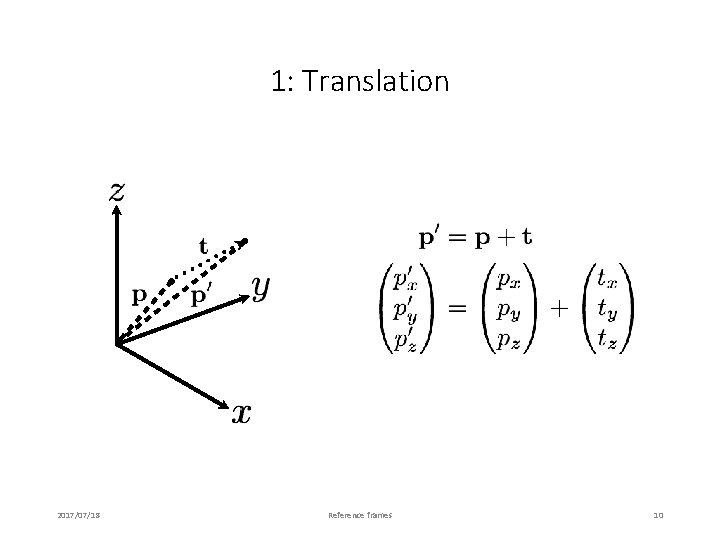
1: Translation 2017/07/18 Reference frames 10
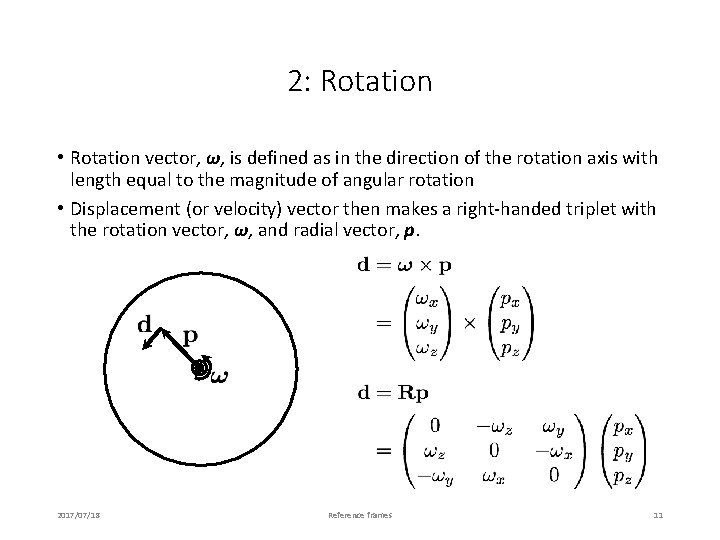
2: Rotation • Rotation vector, ω, is defined as in the direction of the rotation axis with length equal to the magnitude of angular rotation • Displacement (or velocity) vector then makes a right-handed triplet with the rotation vector, ω, and radial vector, p. 2017/07/18 Reference frames 11
3: Scale estimation has a direct effect on the average height adjustments in the network so be cautious if your interested in height changes over the region of your reference frame definition. 2017/07/18 Reference frames 12
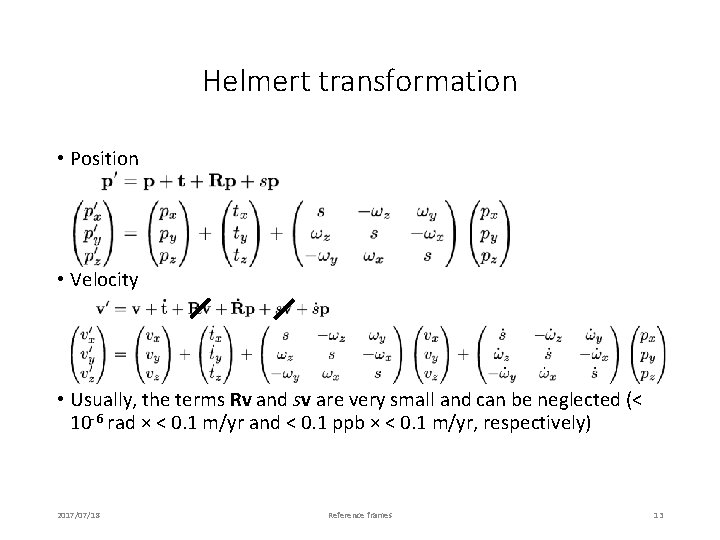
Helmert transformation • Position • Velocity • Usually, the terms Rv and sv are very small and can be neglected (< 10 -6 rad × < 0. 1 m/yr and < 0. 1 ppb × < 0. 1 m/yr, respectively) 2017/07/18 Reference frames 13
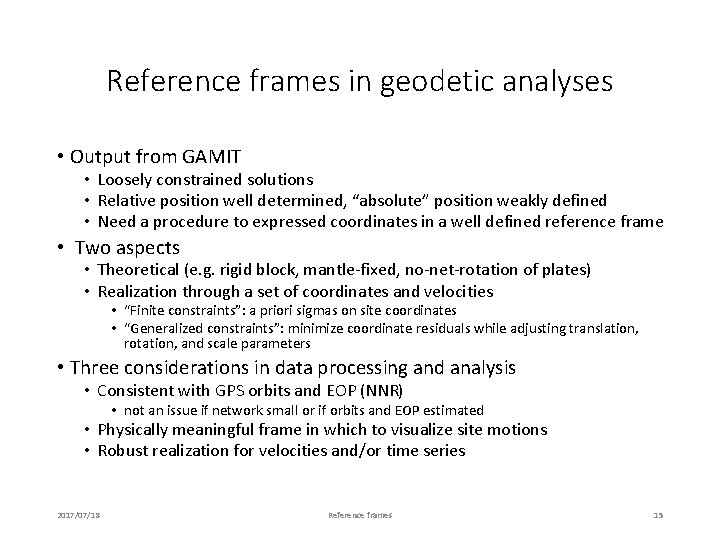
Reference frames in geodetic analyses • Output from GAMIT • Loosely constrained solutions • Relative position well determined, “absolute” position weakly defined • Need a procedure to expressed coordinates in a well defined reference frame • Two aspects • Theoretical (e. g. rigid block, mantle-fixed, no-net-rotation of plates) • Realization through a set of coordinates and velocities • “Finite constraints”: a priori sigmas on site coordinates • “Generalized constraints”: minimize coordinate residuals while adjusting translation, rotation, and scale parameters • Three considerations in data processing and analysis • Consistent with GPS orbits and EOP (NNR) • not an issue if network small or if orbits and EOP estimated • Physically meaningful frame in which to visualize site motions • Robust realization for velocities and/or time series 2017/07/18 Reference frames 15
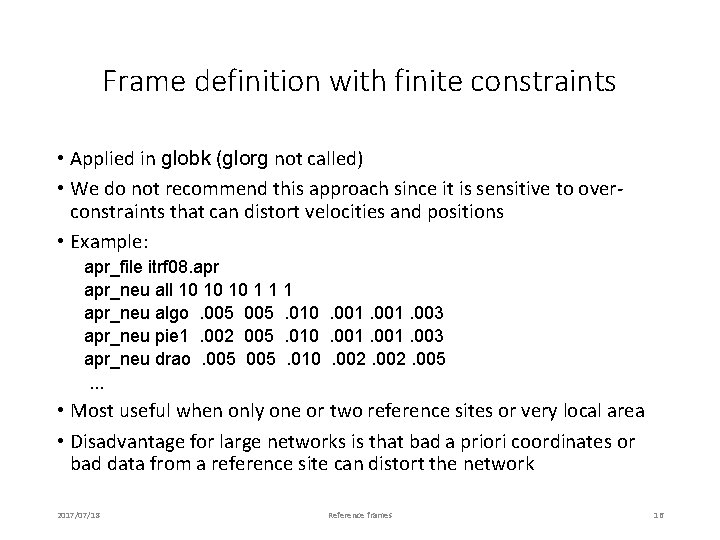
Frame definition with finite constraints • Applied in globk (glorg not called) • We do not recommend this approach since it is sensitive to overconstraints that can distort velocities and positions • Example: apr_file itrf 08. apr_neu all 10 10 10 1 1 1 apr_neu algo. 005. 010. 001. 003 apr_neu pie 1. 002 005. 010. 001. 003 apr_neu drao. 005. 010. 002. 005. . . • Most useful when only one or two reference sites or very local area • Disadvantage for large networks is that bad a priori coordinates or bad data from a reference site can distort the network 2017/07/18 Reference frames 16
Frame definition with generalized constraints • Applied in glorg: minimize residuals of reference sites while estimating translation, rotation, and/or scale (3– 7 parameters) apr_file itrf 08. apr pos_org xtran ytran ztran xrot yrot zrot stab_site algo pie 1 drao. . . cnd_hgtv 10 10 0. 8 3. stab_it 4 0. 5 2. 5 • All reference coordinates free to adjust (anomalies more apparent), outliers are iteratively removed by glorg • Network can translate and rotate but not distort • Works best with strong redundancy (number and [if rotation] geometry of coordinates exceeds number of parameters) 2017/07/18 Reference frames 17
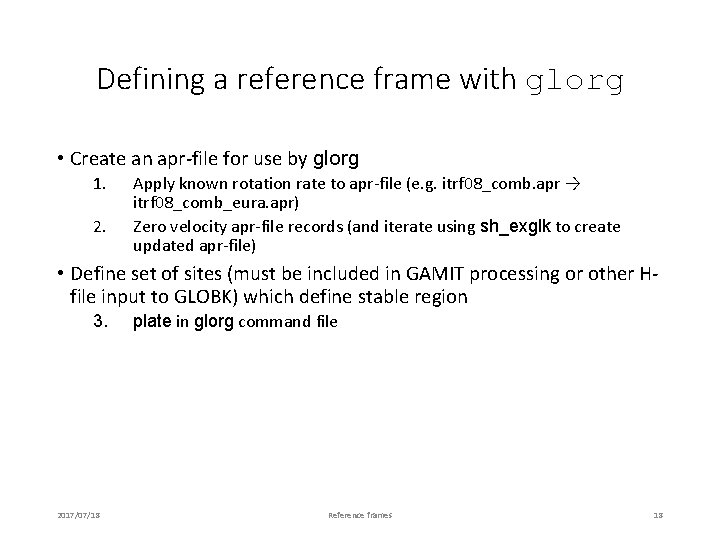
Defining a reference frame with glorg • Create an apr-file for use by glorg 1. 2. Apply known rotation rate to apr-file (e. g. itrf 08_comb. apr → itrf 08_comb_eura. apr) Zero velocity apr-file records (and iterate using sh_exglk to create updated apr-file) • Define set of sites (must be included in GAMIT processing or other Hfile input to GLOBK) which define stable region 3. 2017/07/18 plate in glorg command file Reference frames 18
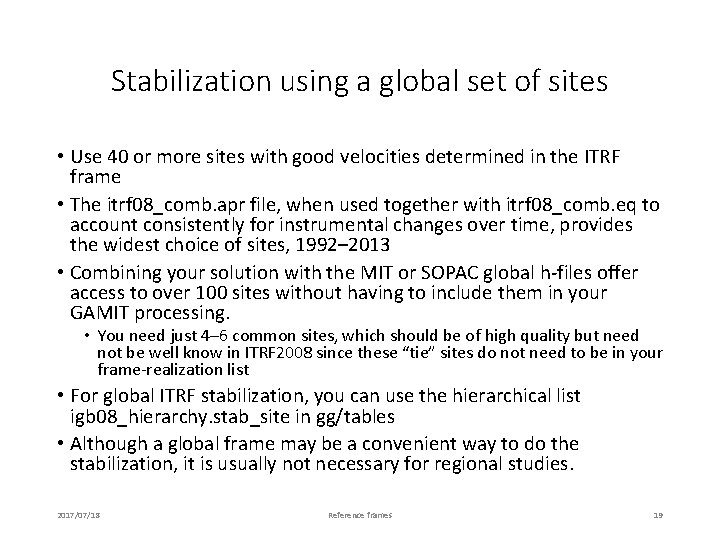
Stabilization using a global set of sites • Use 40 or more sites with good velocities determined in the ITRF frame • The itrf 08_comb. apr file, when used together with itrf 08_comb. eq to account consistently for instrumental changes over time, provides the widest choice of sites, 1992– 2013 • Combining your solution with the MIT or SOPAC global h-files offer access to over 100 sites without having to include them in your GAMIT processing. • You need just 4– 6 common sites, which should be of high quality but need not be well know in ITRF 2008 since these “tie” sites do not need to be in your frame-realization list • For global ITRF stabilization, you can use the hierarchical list igb 08_hierarchy. stab_site in gg/tables • Although a global frame may be a convenient way to do the stabilization, it is usually not necessary for regional studies. 2017/07/18 Reference frames 19
Use of global binary h-files • Include global h-files … or not? • For post-2000 data, not needed for orbits • Advantages • Access to a large number of sites for frame definition • Can (should) allow adjustment to orbits and EOP • Eases computational burden • Disadvantages • Must use (mostly) the same models as the global processing • Orbits implied by the global data worse than IGSF. Once-per-revolution radiation model parameters (loose in global h-files) should be treated carefully. • Some bad data may be included in global h-files (can remove) • Greater data storage burden • MIT hfiles available at ftp: //everest. mit. edu/pub/MIT_GLL/HYY When using MIT files, add “apr_svant all F F F” to globk command file to fix the satellite antenna offsets 2017/07/18 Reference frames 20
Stabilization using regional or local sites • If your area of study has a robust c. GPS network (10 or more welldistributed sites) with accurate a priori velocities, then glorg stabilization is robust and little thought is involved (glorg will automatically discard the one or two sites which may be weak or inconsistent) • If your region is short on c. GPS stations with well-known coordinates, you will need to think carefully about the choice of sites to include in your solution and use the initial stabilization. A stabilization site should have • High quality data over the full span of your study • Coordinates well-known in ITRF • Provide symmetric coverage around your study area (except that if the region is small enough, a translation-only stabilization may be possible and distribution is less important) 2017/07/18 Reference frames 21
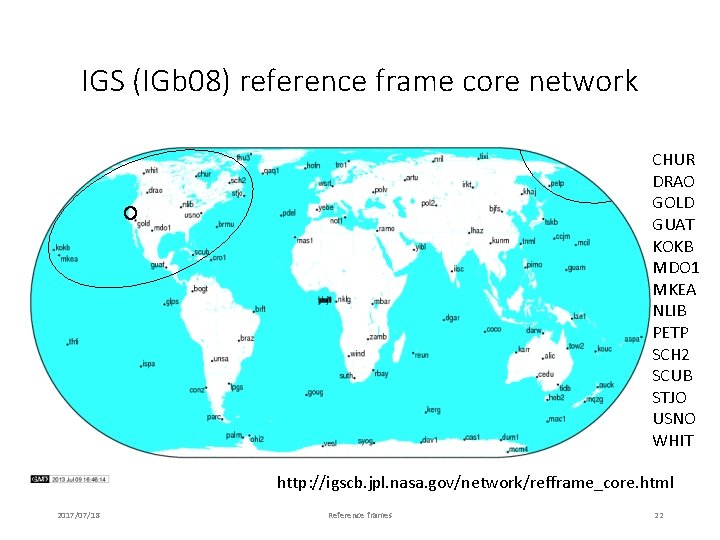
IGS (IGb 08) reference frame core network CHUR DRAO GOLD GUAT KOKB MDO 1 MKEA NLIB PETP SCH 2 SCUB STJO USNO WHIT http: //igscb. jpl. nasa. gov/network/refframe_core. html 2017/07/18 Reference frames 22
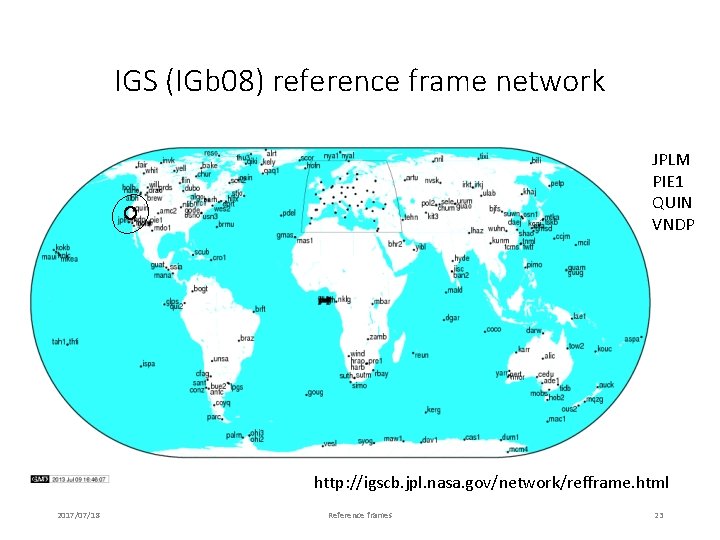
IGS (IGb 08) reference frame network JPLM PIE 1 QUIN VNDP http: //igscb. jpl. nasa. gov/network/refframe. html 2017/07/18 Reference frames 23
Reference frame implementation • The main point of reference frame definition is to use sites with well known coordinates to stabilize your processed network • If your processed network already contains sites with known accurate coordinates, e. g. in ~/gg/tables/itrf 08_comb. apr, then there is no need to additional sites to your processing • Your “stab_site” list in glorg command file should be guided by and closely associated with the contents of an accurate apr-file, e. g. itrf 08_comb. apr by default but could be any accurate apr-file you choose include in globk and glorg command files • ~/gg/tables/igb 08_hierarchy. stab_site relates to ~/gg/itrf 08_comb. apr • Decide early in your processing whether or not you will need to include additional, e. g. IGS, sites in your GAMIT processing to use ultimately to realize your preferred reference frame • The first decision you must make (choosing sites to process) is greatly influenced by the ultimate processing step (reference frame realization)! 2017/07/18 Reference frames 25
Rules for stabilization of time series • Small-extent network: translation-only in glorg, must constrain EOP in globk • Large-extent network: translation and rotation, must keep EOP loose in globk • If scale estimated in glorg, must estimate scale in globk • First pass for editing: • Adequate “stab_site” list of stations with accurate a priori coordinates and velocities and available most days • Keep in mind deficiencies in the list • Final pass for presentation / assessment / statistics • Robust “stab_site” list of all/most stations in network, with coordinates and velocities determined from the final velocity solution • System is often iterated (velocity field solution, generate time series, editing and statistics of time series; re-generate velocity field) • If you have time series, you can test options using tscon 2017/07/18 Reference frames 26
Issues with estimating scale • Many GPS analyses, automatically include scale when aligning reference frames • Since the Earth is almost spherical, scale changes are directly proportional to the average height difference between the reference site coordinates and their a priori values • When comparing and analyzing height changes, how scale is treated directly effects the results • Aspects of this issue are discussed in a white paper that is available from the GAGE analysis documentation at UNAVCO and in Herring et al. (2016) • Scale estimates are related the mean height differences over the reference sites • Should this be removed or not is an open question 2017/07/18 Reference frames 28
Velocities and time series • The criteria for stabilization are different for velocity solutions and time series • Velocity solutions: • Physical reference is important • Not so sensitive to station dropout (solution holds the frame together) • Time series: • Physical reference is not important • Sensitive to station dropout • Best representation of the statistics of the velocity solution is stabilization using ALL the well-determined sites from the velocity solution, now in a common frame 2017/07/18 Reference frames 30
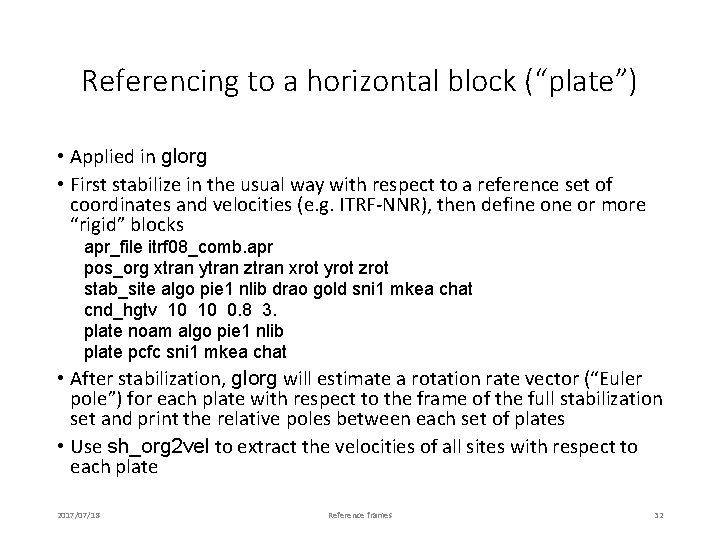
Referencing to a horizontal block (“plate”) • Applied in glorg • First stabilize in the usual way with respect to a reference set of coordinates and velocities (e. g. ITRF-NNR), then define or more “rigid” blocks apr_file itrf 08_comb. apr pos_org xtran ytran ztran xrot yrot zrot stab_site algo pie 1 nlib drao gold sni 1 mkea chat cnd_hgtv 10 10 0. 8 3. plate noam algo pie 1 nlib plate pcfc sni 1 mkea chat • After stabilization, glorg will estimate a rotation rate vector (“Euler pole”) for each plate with respect to the frame of the full stabilization set and print the relative poles between each set of plates • Use sh_org 2 vel to extract the velocities of all sites with respect to each plate 2017/07/18 Reference frames 32
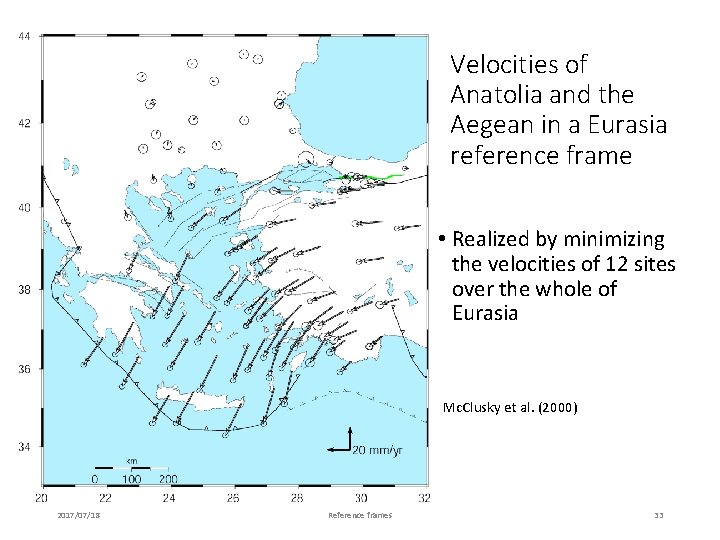
Velocities of Anatolia and the Aegean in a Eurasia reference frame • Realized by minimizing the velocities of 12 sites over the whole of Eurasia Mc. Clusky et al. (2000) 2017/07/18 Reference frames 33
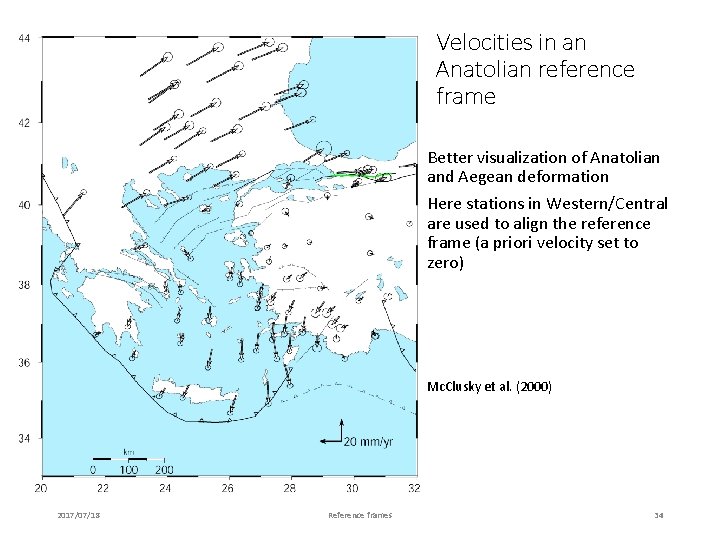
Velocities in an Anatolian reference frame • Better visualization of Anatolian and Aegean deformation • Here stations in Western/Central are used to align the reference frame (a priori velocity set to zero) • Mc. Clusky et al. (2000) 2017/07/18 Reference frames 34