
REF 2021 ECRs policy planning in an uncertain

- Slides: 18
REF 2021 & ECRs: policy & planning in an uncertain landscape Dr Charlotte Mathieson School of Literature and Languages, University of Surrey @cemathieson c. mathieson@surrey. ac. uk http: //charlottemathieson. wordpress. com S
Overview S What we know so far S What remains uncertain & implications S Some pointers and advice for ECR planning
REF 2021: key points Research Excellence Framework = the system for allocating research funding in UK HEIs S Research (60%); impact (25%); environment (15%) S Last run as REF 2014 S Stern Review in 2016; Consultation exercise held in March 2017 (summary of responses) S Initial decisions September 2017 S Draft guidance expected summer 2018; final guidance & criteria expected winter 2018
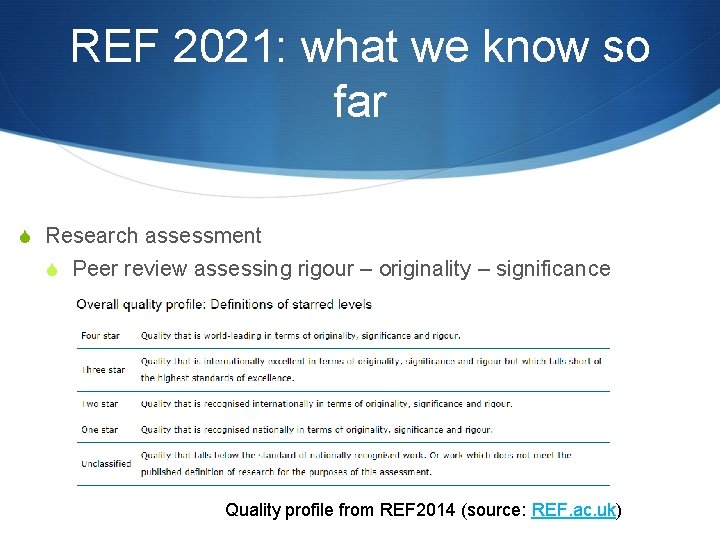
REF 2021: what we know so far S Research assessment S Peer review assessing rigour – originality – significance Quality profile from REF 2014 (source: REF. ac. uk)
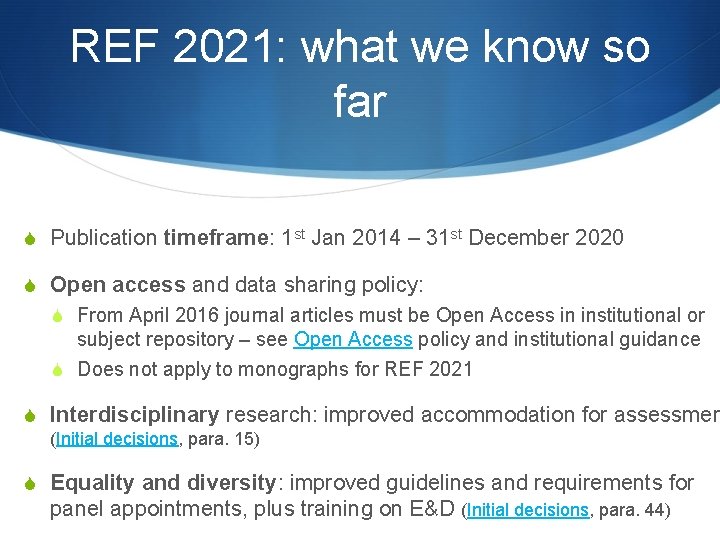
REF 2021: what we know so far S Publication timeframe: 1 st Jan 2014 – 31 st December 2020 S Open access and data sharing policy: S From April 2016 journal articles must be Open Access in institutional or subject repository – see Open Access policy and institutional guidance S Does not apply to monographs for REF 2021 S Interdisciplinary research: improved accommodation for assessmen (Initial decisions, para. 15) S Equality and diversity: improved guidelines and requirements for panel appointments, plus training on E&D (Initial decisions, para. 44)
REF 2021: what remains uncertain 3 key areas: S Staff submissions and eligibility S No. of outputs required S Portability of research
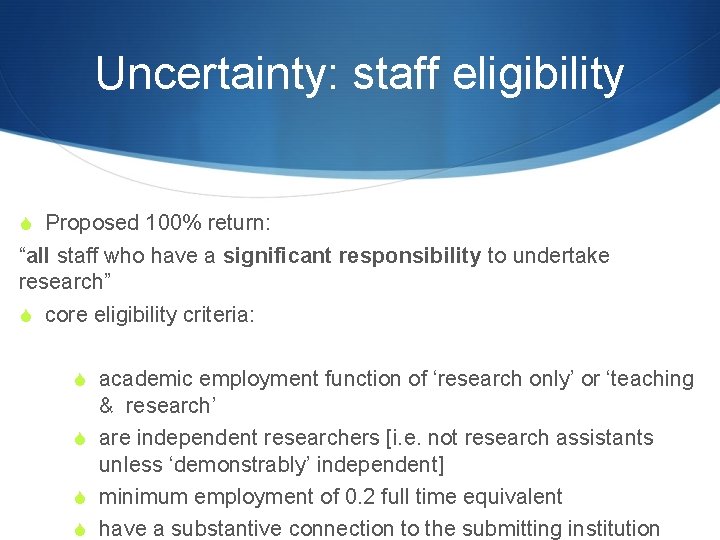
Uncertainty: staff eligibility S Proposed 100% return: “all staff who have a significant responsibility to undertake research” S core eligibility criteria: S academic employment function of ‘research only’ or ‘teaching & research’ S are independent researchers [i. e. not research assistants unless ‘demonstrably’ independent] S minimum employment of 0. 2 full time equivalent S have a substantive connection to the submitting institution
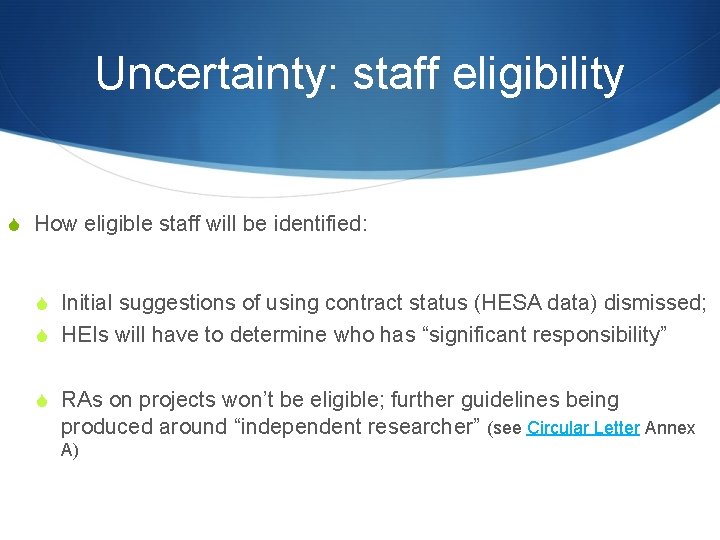
Uncertainty: staff eligibility S How eligible staff will be identified: S Initial suggestions of using contract status (HESA data) dismissed; S HEIs will have to determine who has “significant responsibility” S RAs on projects won’t be eligible; further guidelines being produced around “independent researcher” (see Circular Letter Annex A)
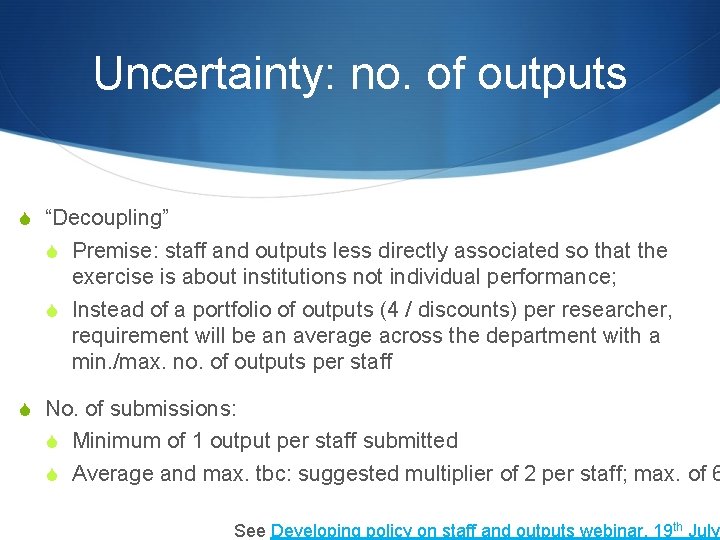
Uncertainty: no. of outputs S “Decoupling” S Premise: staff and outputs less directly associated so that the exercise is about institutions not individual performance; S Instead of a portfolio of outputs (4 / discounts) per researcher, requirement will be an average across the department with a min. /max. no. of outputs per staff S No. of submissions: S Minimum of 1 output per staff submitted S Average and max. tbc: suggested multiplier of 2 per staff; max. of 6 See Developing policy on staff and outputs webinar, 19 th July
Uncertainty: no. of outputs S E&D measures tbc, including : S codes of practice for applying criteria for identifying staff; approach to output selection; reductions for individual staff circumstances (ECRs? )
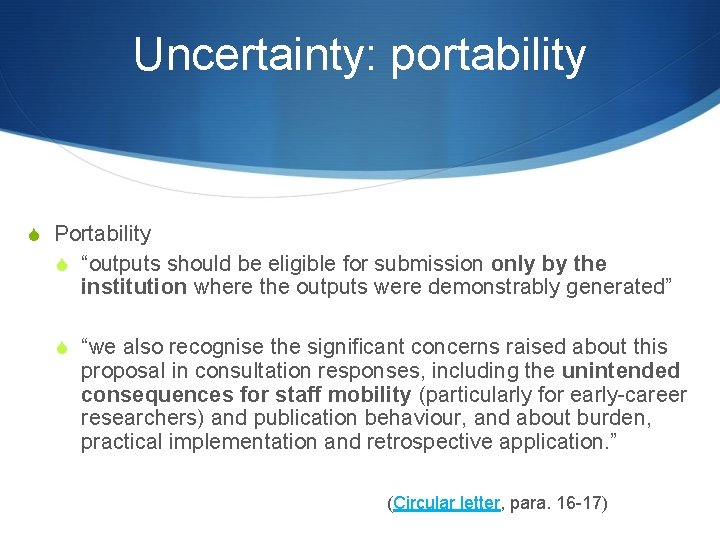
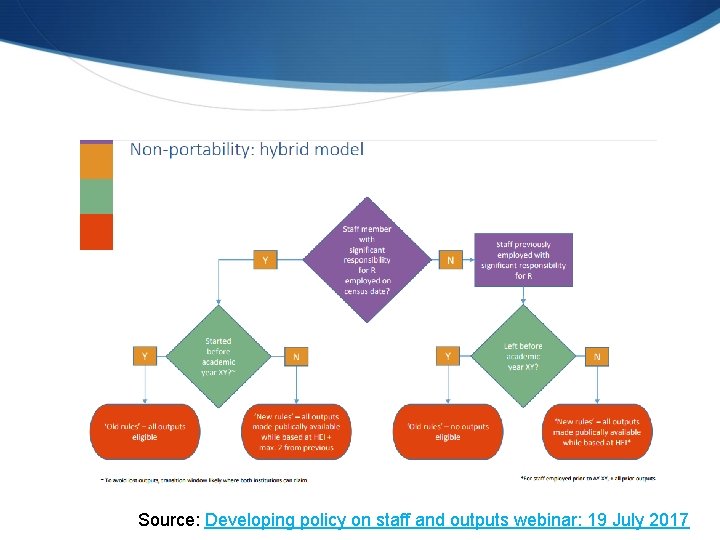
Uncertainty: portability S Portability S “outputs should be eligible for submission only by the institution where the outputs were demonstrably generated” S “we also recognise the significant concerns raised about this proposal in consultation responses, including the unintended consequences for staff mobility (particularly for early-career researchers) and publication behaviour, and about burden, practical implementation and retrospective application. ” (Circular letter, para. 16 -17)
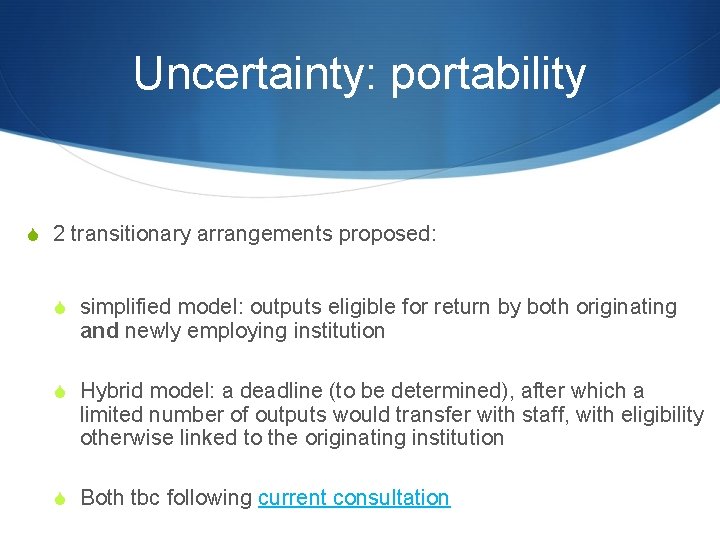
Uncertainty: portability S 2 transitionary arrangements proposed: S simplified model: outputs eligible for return by both originating and newly employing institution S Hybrid model: a deadline (to be determined), after which a limited number of outputs would transfer with staff, with eligibility otherwise linked to the originating institution S Both tbc following current consultation
Source: Developing policy on staff and outputs webinar: 19 July 2017
What can ECRs do? Some assumptions at this stage… S Assume: S for an academic T&R job, you will be in a REFable position S a minimum of 1 and ideally 2+ submissions will be required S portability will likely apply to current outputs; stay informed about further changes and especially cut-off date if hybrid model adopted
What can ECRs do? Some preliminary advice… S Stay informed: S HE news, blogs; events; institution information. S Publication strategy: S Quality not quantity; S Timing: S stay aware of changes around portability; S consider strategizing later in cycle (hold back) and/or; S have a “safety piece”
REF and mental health S Report on the impact of REF 2014 on ECRs: REF had a huge impact on ECR mental health and wellbeing; S many respondents experienced high levels of anxiety, insecurity and uncertainty, and mental health problems stemming from REF pressure; S also noted feeling isolated and unable to articulate concerns within highly pressurised and competitive workplace culture created by the REF; S Lack of/conflicting/mis- information from institutions cited as a contributing factor. (See the impact of the REF 2014 on ECRs)
Further reading S REF 2014 criteria S REF 2021 Open Access policy S Developing policy on staff and outputs webinar, 19 July 2017 S Initial decisions on the REF, including the Circular Letter, Sept. 2017 S Summary of responses to consultation on the Stern review, Sept. 2017 S Report on the Impact of the REF on ECRs; my related work here
Dr Charlotte Mathieson School of Literature and Languages, University of Surrey @cemathieson c. mathieson@surrey. ac. uk http: //charlottemathieson. wordpress. com