
REENERGISING THE LIFESAVING RULES Leaders Guide 17 September
RE-ENERGISING THE LIFE-SAVING RULES Leader’s Guide 17 September 2014
Instructions for supervisors This session should be run by the direct Supervisor or manager of a work group (not the HSE representative) Organise a suitable room for the engagement session, preferably with a projector or screen to show the video and presentation Print out a copy of the presentation and video reflection guide to use as your notes for the session You can print out the presentation to include the speaker notes by choosing the ‘notes pages’ option (Print “Print What” “Notes Pages”) We suggest you run both the video and the reflection video more than once prior to the session with your staff Remember telling people the answer stops them thinking for themselves, asking questions makes people think

Safety First! First and secondary Emergency Exits Emergency contact numbers Assembly Point Fire drills scheduled Alarm sirens/bell First aid kits and first aid number (do we have a first aider in the room? ) Location of toilets Location of coffee and tea, during break
Plan for today’s session • Intro (10 minutes) • Video (10 minutes) • Discussion (10 minutes) • Reflection Video (10 minutes) • Discussion (20 minutes) • Reality + Summary (10 minutes) • Consequences (10 minutes) • How to Intervene (inc. peer to peer) (20 minutes) • Close (10 mins)
CONTENTS §Why have this session ? §Session Overview? §Video & Discussion §Reality + Summary §Consequences §Intervention §Reporting §Close
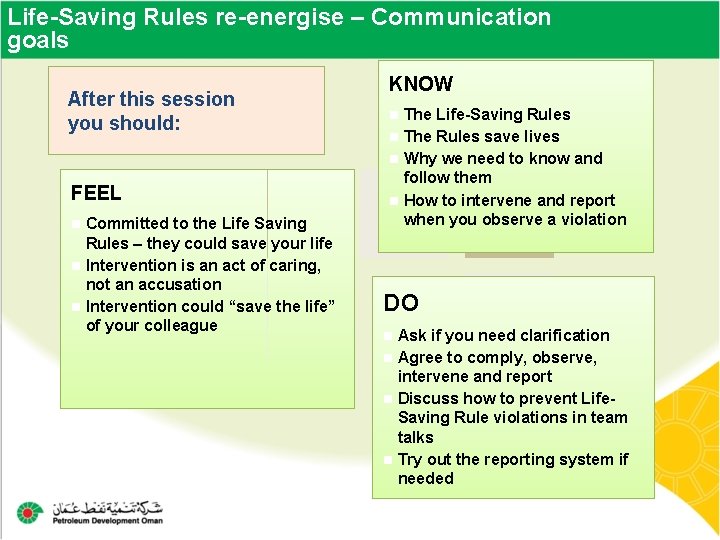
Life-Saving Rules re-energise – Communication goals After this session you should: FEEL Committed to the Life Saving Rules – they could save your life Intervention is an act of caring, not an accusation Intervention could “save the life” of your colleague KNOW The Life-Saving Rules The Rules save lives Why we need to know and follow them How to intervene and report when you observe a violation DO Ask if you need clarification Agree to comply, observe, intervene and report Discuss how to prevent Life. Saving Rule violations in team talks Try out the reporting system if needed
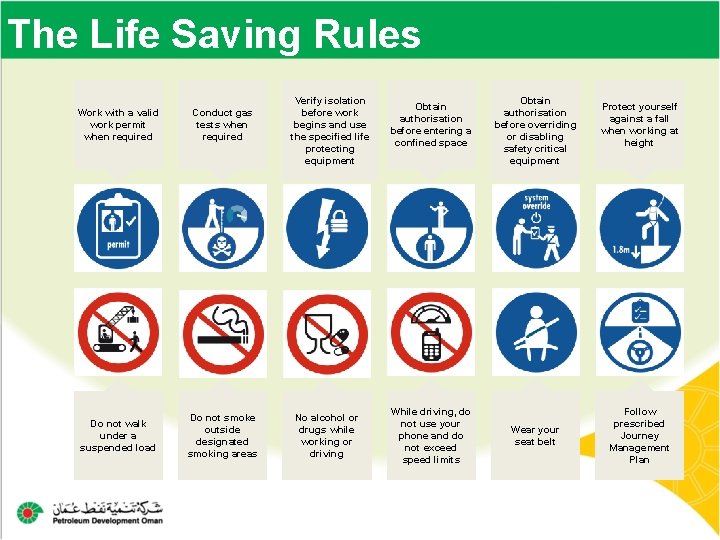
The Life Saving Rules Work with a valid work permit when required Conduct gas tests when required Do not walk under a suspended load Do not smoke outside designated smoking areas Verify isolation before work begins and use the specified life protecting equipment No alcohol or drugs while working or driving Obtain authorisation before entering a confined space While driving, do not use your phone and do not exceed speed limits Obtain authorisation before overriding or disabling safety critical equipment Wear your seat belt Protect yourself against a fall when working at height Follow prescribed Journey Management Plan
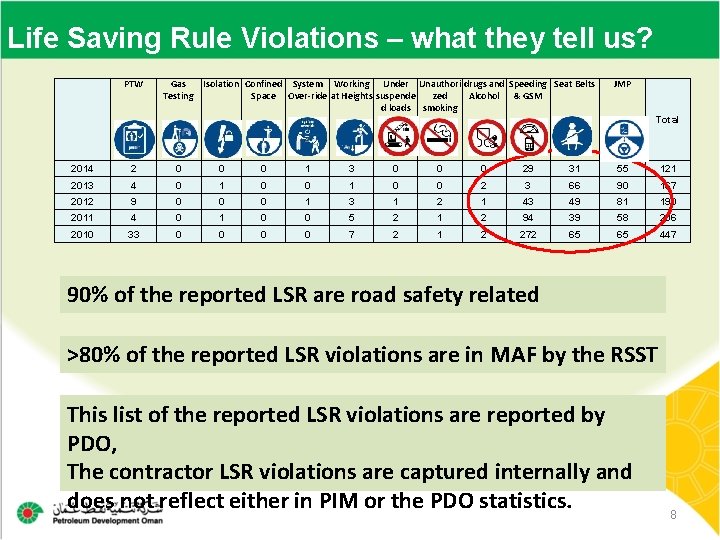
Life Saving Rule Violations – what they tell us? PTW Gas Isolation Confined System Working Under Unauthori drugs and Speeding Seat Belts Testing Space Over-ride at Heights suspende zed Alcohol & GSM d loads smoking JMP Total 2014 2 0 0 0 1 3 0 0 0 29 31 55 121 2013 4 0 1 0 0 2 3 66 90 167 2012 9 0 0 0 1 3 1 2 1 43 49 81 190 2011 4 0 1 0 0 5 2 1 2 94 39 58 206 2010 33 0 0 7 2 1 2 272 65 65 447 90% of the reported LSR are road safety related >80% of the reported LSR violations are in MAF by the RSST This list of the reported LSR violations are reported by PDO, The contractor LSR violations are captured internally and does not reflect either in PIM or the PDO statistics. 8
Video We will now watch a short video of a typical work scenario What we show here is a scenario from any Oil & Gas business Your task: Watch the video , Spot safe and unsafe! And take notes
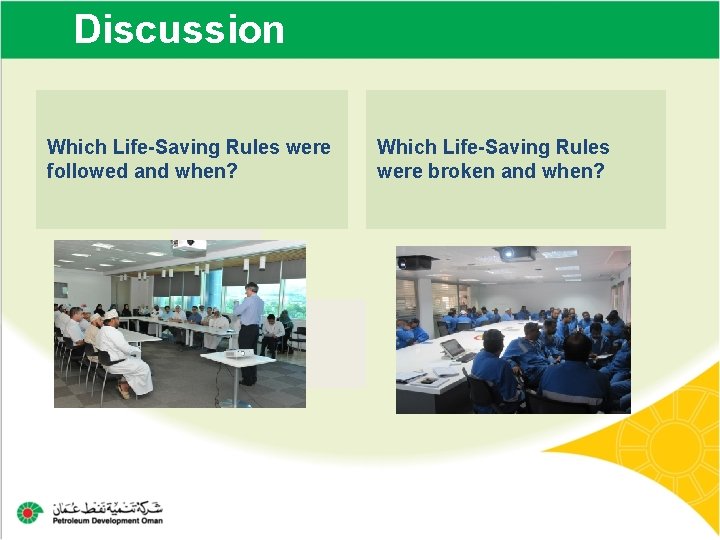
Discussion Which Life-Saving Rules were followed and when? Which Life-Saving Rules were broken and when?
Discussion Play Reflection Video Green traffic light: Why is this compliant to the Life-Saving Rules? Amber / Red traffic light: What has to change to make this compliant to the Life-Saving Rules?
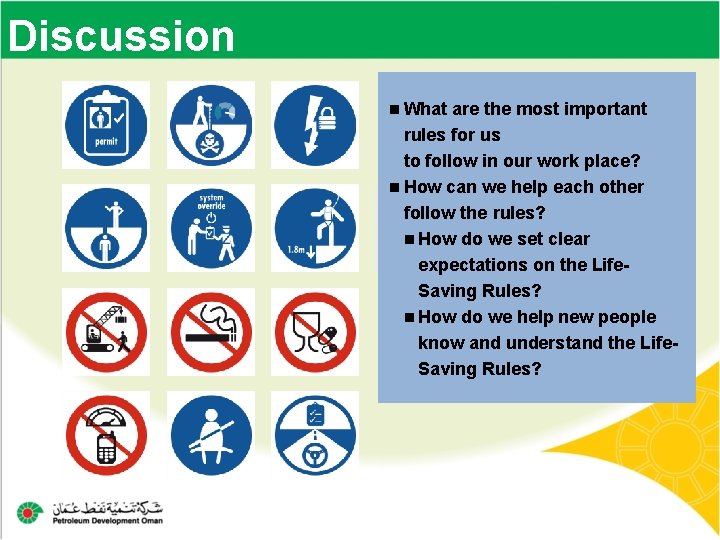
Discussion What are the most important rules for us to follow in our work place? How can we help each other follow the rules? How do we set clear expectations on the Life. Saving Rules? How do we help new people know and understand the Life. Saving Rules?
Reality + Summary We need to look after They are there to The Life-Saving each other and save Rules follow the Lifeour life and the lives have saved lives Saving Rules without of others exception If you work for us, Let´s be committed, you must follow the not just compliant Life-Saving Rules
Consequences What happens if we follow the rules… What happens if we don’t follow the rules…
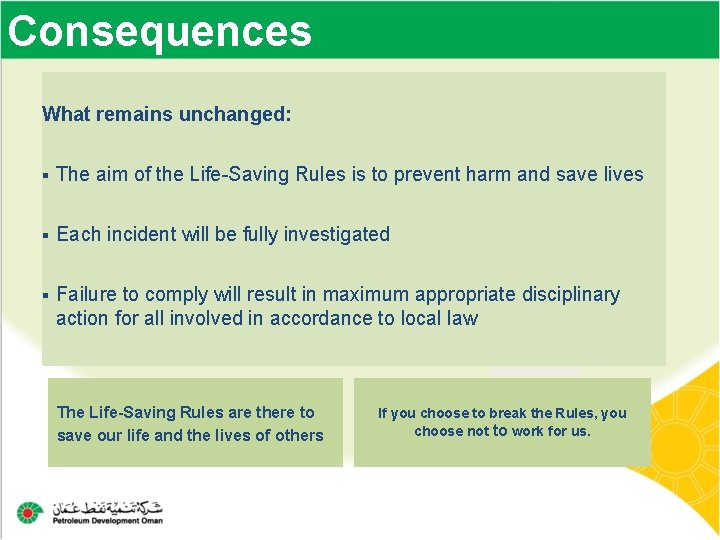
Consequences What remains unchanged: § The aim of the Life-Saving Rules is to prevent harm and save lives § Each incident will be fully investigated § Failure to comply will result in maximum appropriate disciplinary action for all involved in accordance to local law The Life-Saving Rules are there to save our life and the lives of others If you choose to break the Rules, you choose not to work for us.

Reporting When you see someone break a Life-Saving Rule: • Intervene • Reporting is not about blame. It’s about collecting information to help us understand why rules are being broken and what we need to do to make sure it doesn’t happen again.
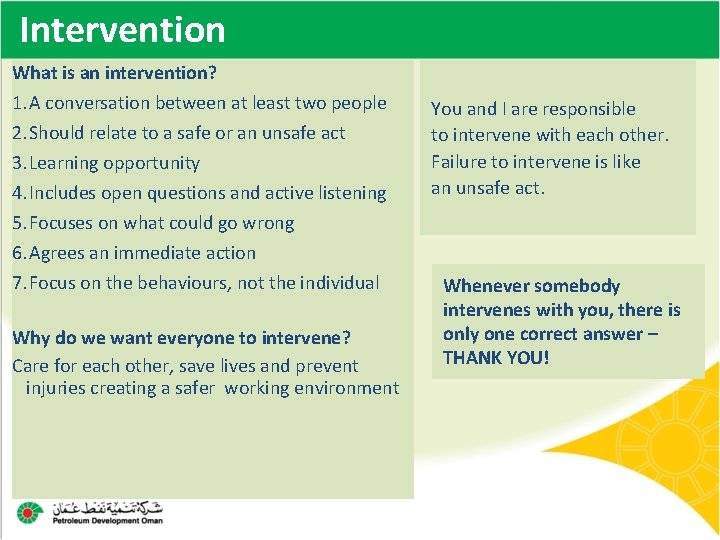
Intervention What is an intervention? 1. A conversation between at least two people 2. Should relate to a safe or an unsafe act 3. Learning opportunity 4. Includes open questions and active listening 5. Focuses on what could go wrong 6. Agrees an immediate action 7. Focus on the behaviours, not the individual Why do we want everyone to intervene? Care for each other, save lives and prevent injuries creating a safer working environment You and I are responsible to intervene with each other. Failure to intervene is like an unsafe act. Whenever somebody intervenes with you, there is only one correct answer – THANK YOU!
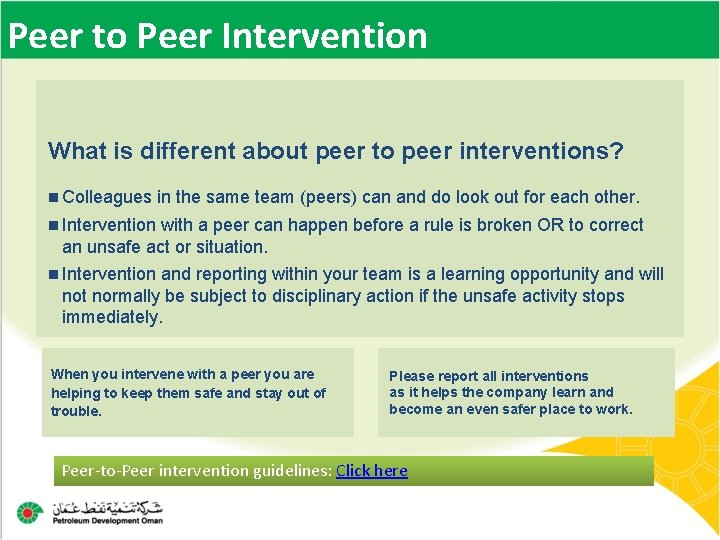
Peer to Peer Intervention What is different about peer to peer interventions? Colleagues in the same team (peers) can and do look out for each other. Intervention with a peer can happen before a rule is broken OR to correct an unsafe act or situation. Intervention and reporting within your team is a learning opportunity and will not normally be subject to disciplinary action if the unsafe activity stops immediately. When you intervene with a peer you are helping to keep them safe and stay out of trouble. Please report all interventions as it helps the company learn and become an even safer place to work. Peer-to-Peer intervention guidelines: Click here
Reporting incidents An incident is an unplanned or undesired event that can cause injury, asset damage and/or impact environment or reputation. Why should you report an incident? Incident investigations always provides Learning which when applied prohibit reoccurrence Types of incidents to report : § Life Saving Rule violations § Near Misses § Incidents with or without Injury ? § Asset Damage § Incidents with Environmental Impact
Close THANK YOU for your active participation and please remember: Follow the Life-Saving Rules and help others to comply! By intervening you might save someone’s life. By not complying you might lose your life! Any further queries refer to LSR-FAQs click here
- Slides: 20