
Redux Rapid Model Building Douglas Pearson Ph D
Redux: Rapid Model Building • • • Douglas Pearson, Ph. D. Three. Penny Software douglas. pearson@threepenny. net Professor John Laird University of Michigan laird@umich. edu Supported by the Office of Naval Research
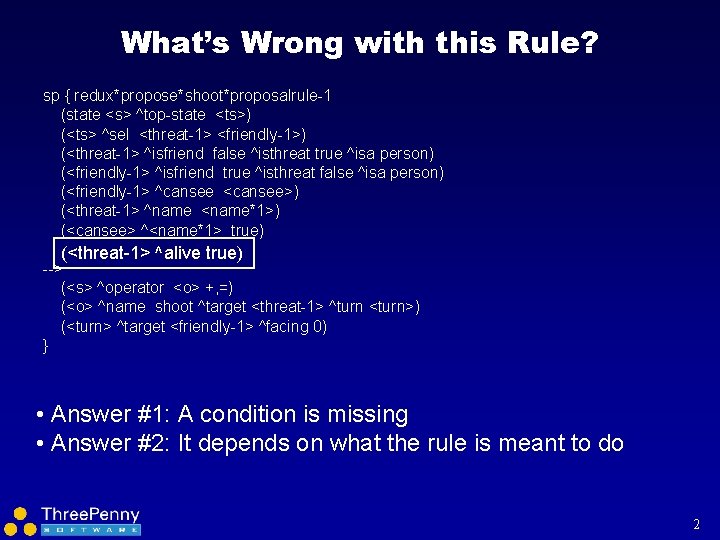
What’s Wrong with this Rule? sp { redux*propose*shoot*proposalrule-1 (state <s> ^top-state <ts>) (<ts> ^sel <threat-1> <friendly-1>) (<threat-1> ^isfriend false ^isthreat true ^isa person) (<friendly-1> ^isfriend true ^isthreat false ^isa person) (<friendly-1> ^cansee <cansee>) (<threat-1> ^name <name*1>) (<cansee> ^<name*1> true) (<threat-1> ^alive true) --> (<s> ^operator <o> +, =) (<o> ^name shoot ^target <threat-1> ^turn <turn>) (<turn> ^target <friendly-1> ^facing 0) } • Answer #1: A condition is missing • Answer #2: It depends on what the rule is meant to do 2
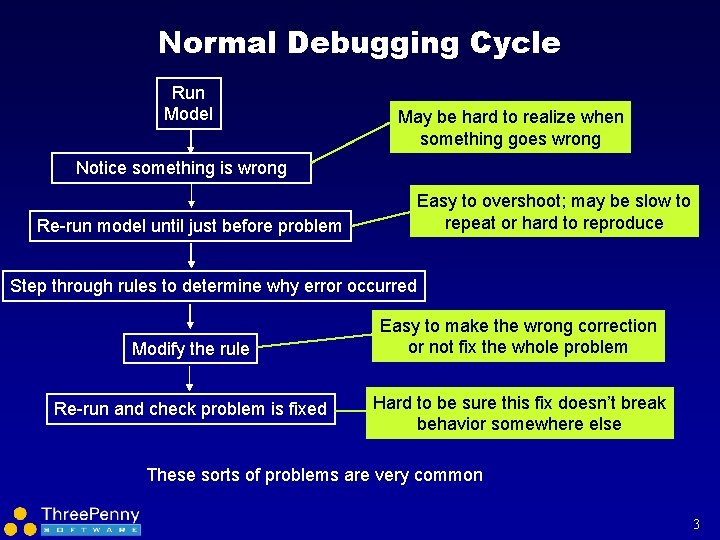
Normal Debugging Cycle Run Model May be hard to realize when something goes wrong Notice something is wrong Easy to overshoot; may be slow to repeat or hard to reproduce Re-run model until just before problem Step through rules to determine why error occurred Modify the rule Re-run and check problem is fixed Easy to make the wrong correction or not fix the whole problem Hard to be sure this fix doesn’t break behavior somewhere else These sorts of problems are very common 3
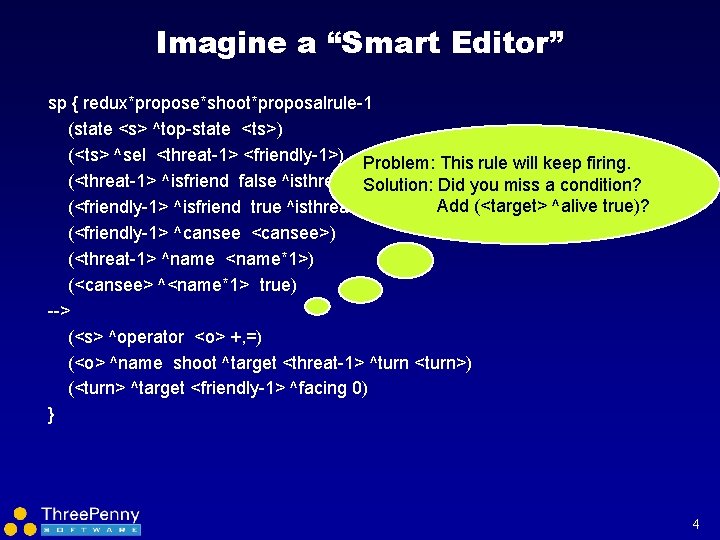
Imagine a “Smart Editor” sp { redux*propose*shoot*proposalrule-1 (state <s> ^top-state <ts>) (<ts> ^sel <threat-1> <friendly-1>) Problem: This rule will keep firing. (<threat-1> ^isfriend false ^isthreat true ^isa person) Solution: Did you miss a condition? (<target> ^alive true)? (<friendly-1> ^isfriend true ^isthreat false ^isa Add person) (<friendly-1> ^cansee <cansee>) (<threat-1> ^name <name*1>) (<cansee> ^<name*1> true) --> (<s> ^operator <o> +, =) (<o> ^name shoot ^target <threat-1> ^turn <turn>) (<turn> ^target <friendly-1> ^facing 0) } 4
Need to Specify What Should Happen • Formal specification / high level language? – Problems: • Tends to become as complex as underlying solution • Now debugging the specification (is this easier? ) – Can be done (assembler->C++) but rare to succeed • Specify through examples – Particular instances reduce complexity – But may not get full coverage (or examples conflict) 5
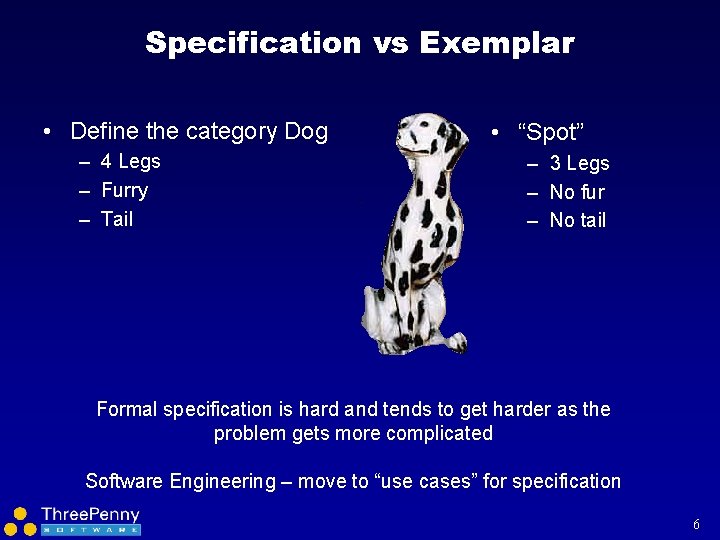
Specification vs Exemplar • Define the category Dog – 4 Legs – Furry – Tail • “Spot” – 3 Legs – No fur – No tail Formal specification is hard and tends to get harder as the problem gets more complicated Software Engineering – move to “use cases” for specification 6
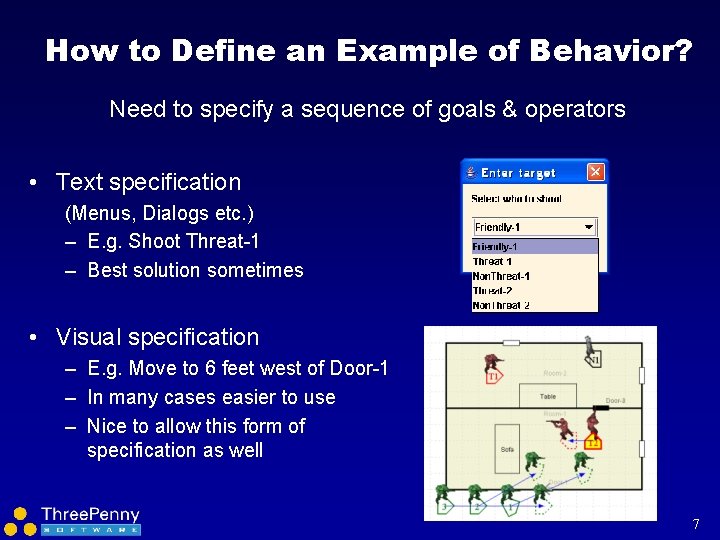
How to Define an Example of Behavior? Need to specify a sequence of goals & operators • Text specification (Menus, Dialogs etc. ) – E. g. Shoot Threat-1 – Best solution sometimes • Visual specification – E. g. Move to 6 feet west of Door-1 – In many cases easier to use – Nice to allow this form of specification as well 7
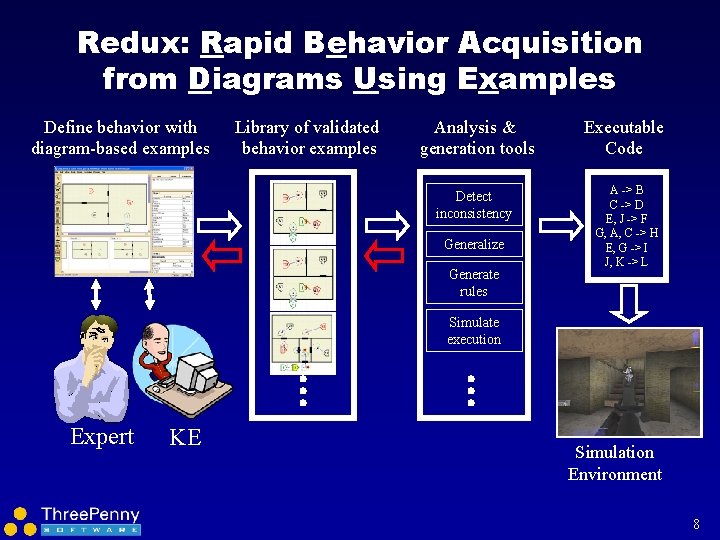
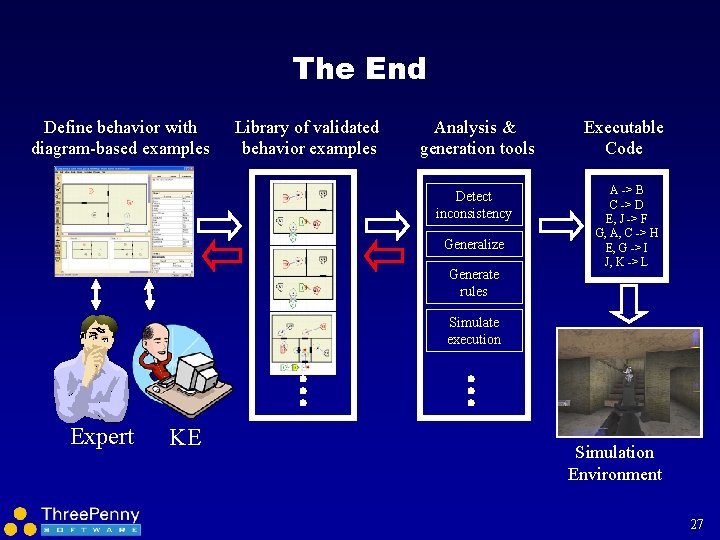
Redux: Rapid Behavior Acquisition from Diagrams Using Examples Define behavior with diagram-based examples Library of validated behavior examples Analysis & generation tools Executable Code Detect inconsistency A -> B C -> D E, J -> F G, A, C -> H E, G -> I J, K -> L Generalize Generate rules Simulate execution Expert KE Simulation Environment 8
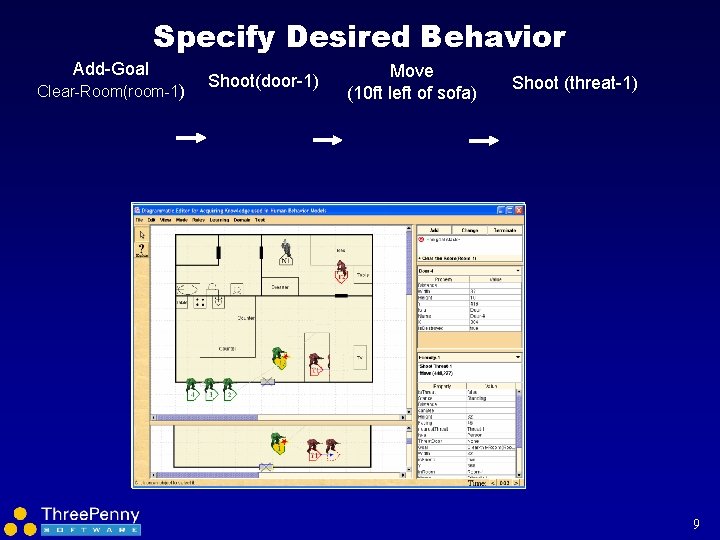
Specify Desired Behavior Add-Goal Clear-Room(room-1) Shoot(door-1) Move (10 ft left of sofa) Shoot (threat-1) 9
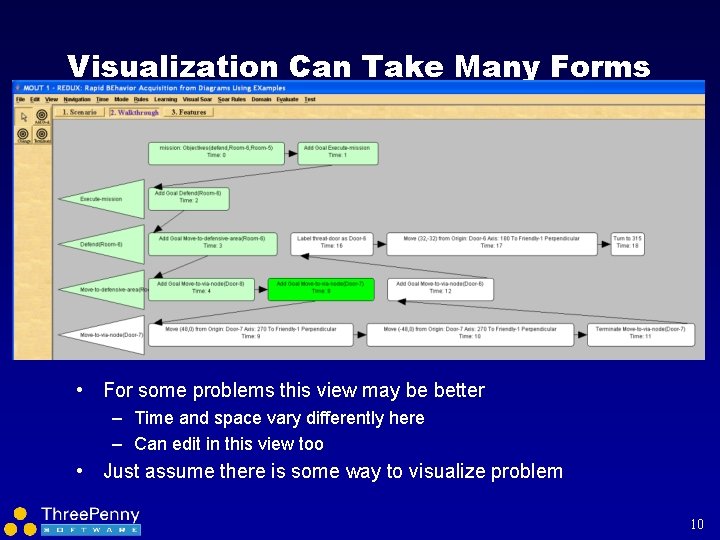
Visualization Can Take Many Forms • For some problems this view may be better – Time and space vary differently here – Can edit in this view too • Just assume there is some way to visualize problem 10
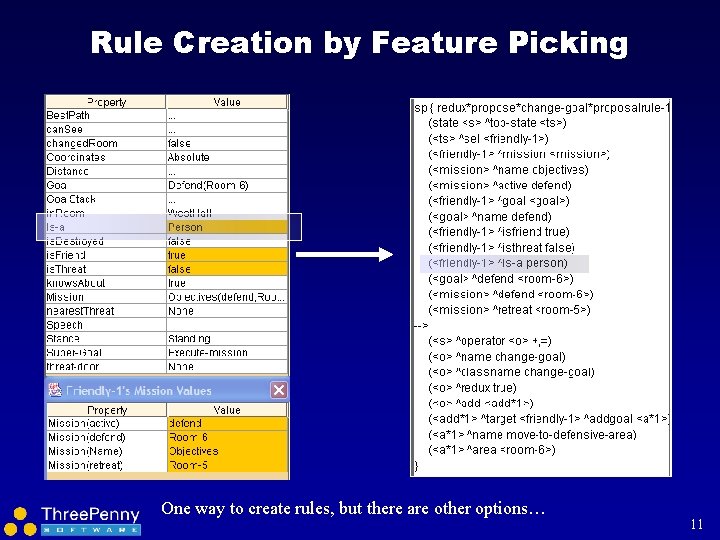
Rule Creation by Feature Picking One way to create rules, but there are other options… 11
Faster Rule Creation • Type rule directly • Select features manually from example • Select features automatically based on example – “Guess” based on situation (domain specific currently) – “Guess” based on ILP from examples (Tolga) • (Goals, State, Operator)->Yes or (Goals, State, Operator)->No • Learn to predict when to select the operator • In each case refine the rules manually – Better guesses just speed up rule creation – Few features/conditions -> general rule – More features/conditions-> specific rule 12
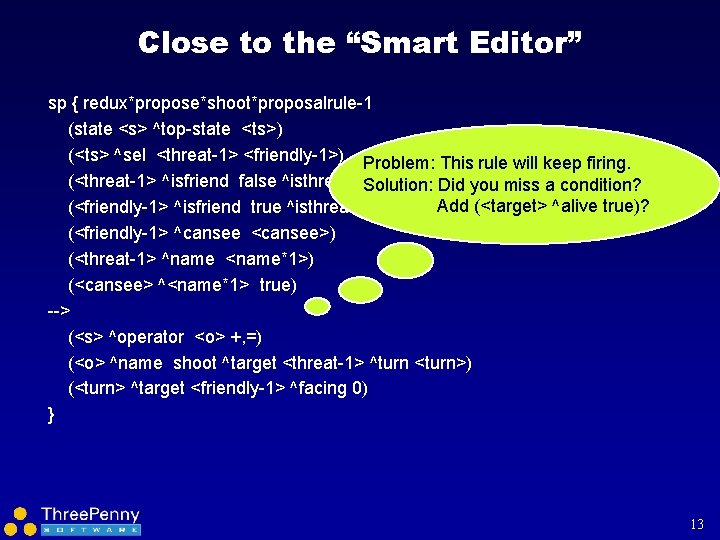
Close to the “Smart Editor” sp { redux*propose*shoot*proposalrule-1 (state <s> ^top-state <ts>) (<ts> ^sel <threat-1> <friendly-1>) Problem: This rule will keep firing. (<threat-1> ^isfriend false ^isthreat true ^isa person) Solution: Did you miss a condition? (<target> ^alive true)? (<friendly-1> ^isfriend true ^isthreat false ^isa Add person) (<friendly-1> ^cansee <cansee>) (<threat-1> ^name <name*1>) (<cansee> ^<name*1> true) --> (<s> ^operator <o> +, =) (<o> ^name shoot ^target <threat-1> ^turn <turn>) (<turn> ^target <friendly-1> ^facing 0) } 13
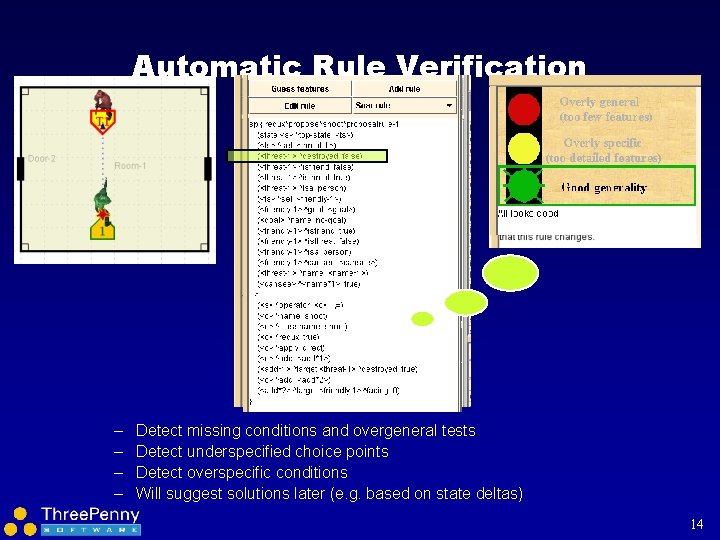
Automatic Rule Verification – – Detect missing conditions and overgeneral tests Detect underspecified choice points Detect overspecific conditions Will suggest solutions later (e. g. based on state deltas) 14
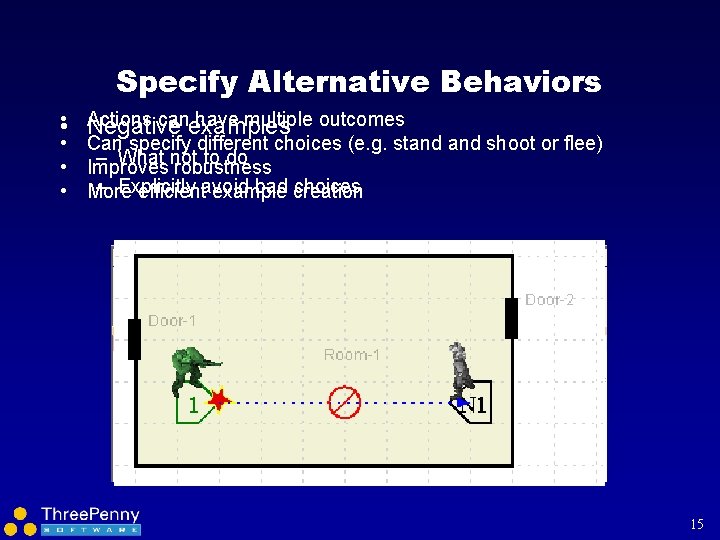
Specify Alternative Behaviors • • • Actions canexamples have multiple outcomes Negative Can specify different choices (e. g. stand shoot or flee) – What not to do Improves robustness – Explicitly bad creation choices More efficientavoid example 15
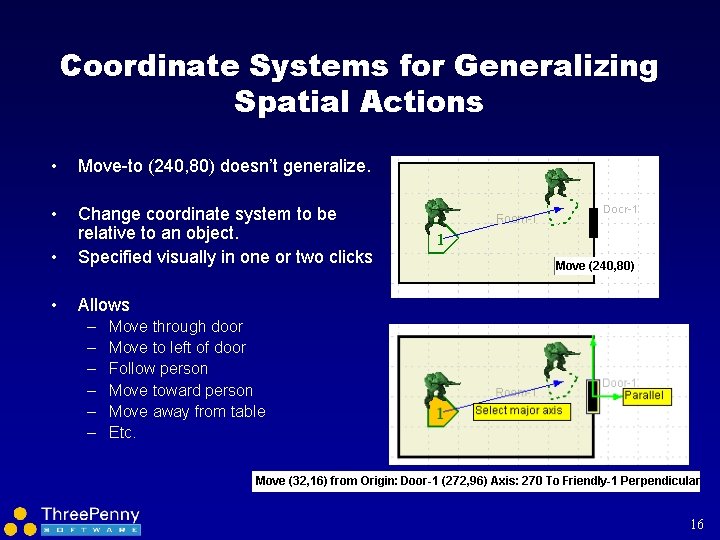
Coordinate Systems for Generalizing Spatial Actions • Move-to (240, 80) doesn’t generalize. • • Change coordinate system to be relative to an object. Specified visually in one or two clicks • Allows – – – Move through door Move to left of door Follow person Move toward person Move away from table Etc. 16
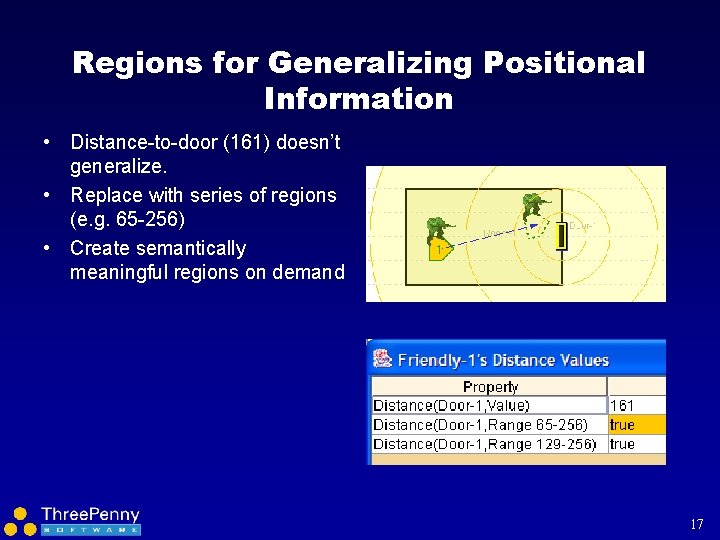
Regions for Generalizing Positional Information • Distance-to-door (161) doesn’t generalize. • Replace with series of regions (e. g. 65 -256) • Create semantically meaningful regions on demand 17
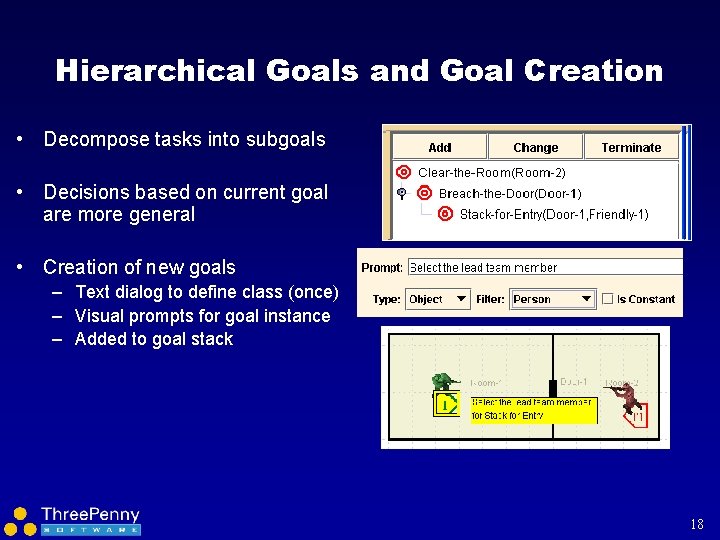
Hierarchical Goals and Goal Creation • Decompose tasks into subgoals • Decisions based on current goal are more general • Creation of new goals – Text dialog to define class (once) – Visual prompts for goal instance – Added to goal stack 18
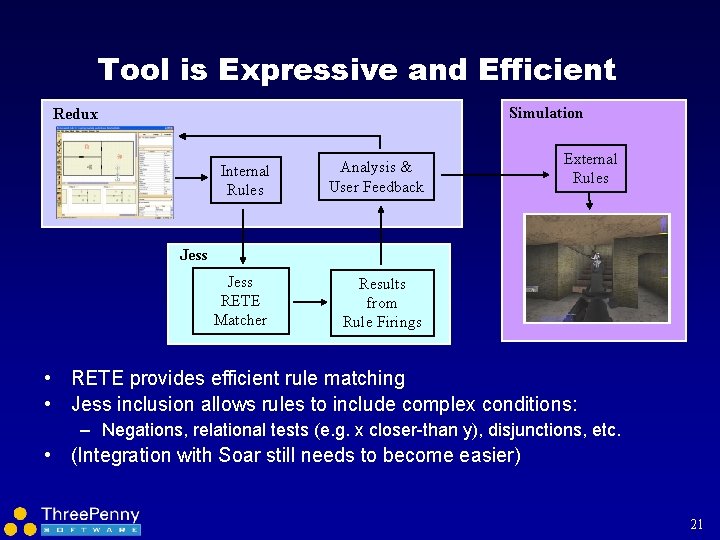
Tool is Expressive and Efficient Simulation Redux Internal Rules Analysis & User Feedback Jess RETE Matcher Results from Rule Firings External Rules Jess • RETE provides efficient rule matching • Jess inclusion allows rules to include complex conditions: – Negations, relational tests (e. g. x closer-than y), disjunctions, etc. • (Integration with Soar still needs to become easier) 21
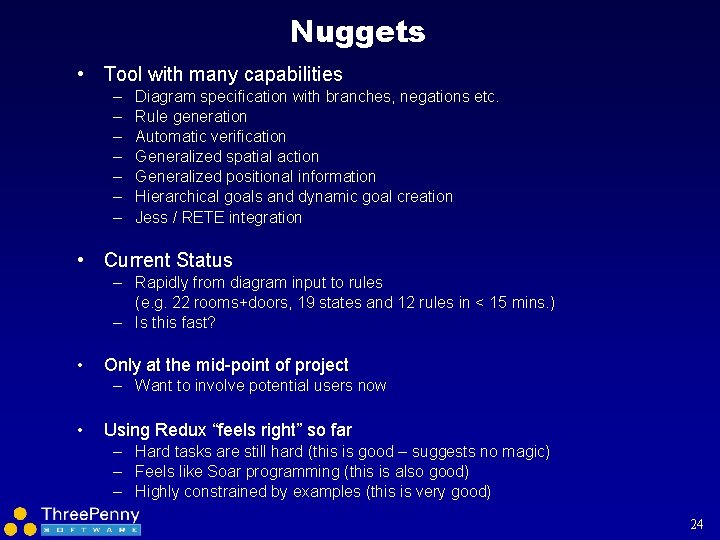
Nuggets • Tool with many capabilities – – – – Diagram specification with branches, negations etc. Rule generation Automatic verification Generalized spatial action Generalized positional information Hierarchical goals and dynamic goal creation Jess / RETE integration • Current Status – Rapidly from diagram input to rules (e. g. 22 rooms+doors, 19 states and 12 rules in < 15 mins. ) – Is this fast? • Only at the mid-point of project – Want to involve potential users now • Using Redux “feels right” so far – Hard tasks are still hard (this is good – suggests no magic) – Feels like Soar programming (this is also good) – Highly constrained by examples (this is very good) 24
Coal • Future Work – – • What do we really have here? – – – – • Extending to support a library of examples Extending the state representation (by the user) Extending to state elaboration and operator implementation rules Including learning component End-user programming tool (seems unlikely) End-user maintenance tool End-user specification tool Knowledge engineer tool Rapid prototyping tool Teaching tool Formal specification and verification tool Integrated specification, rule creation and environment tool (one JAR file) Larger questions – How expensive to tailor to a new domain / type of visualization ? – Will Redux rules really map well to Soar rules in real environment? – Are we focusing on the hard part of the task? 25
The End Define behavior with diagram-based examples Library of validated behavior examples Analysis & generation tools Executable Code Detect inconsistency A -> B C -> D E, J -> F G, A, C -> H E, G -> I J, K -> L Generalize Generate rules Simulate execution Expert KE Simulation Environment 27
- Slides: 22