
Redundancy Ratio An Invariant Property of the Consonant


- Slides: 20
Redundancy Ratio: An Invariant Property of the Consonant Inventories of the World’s Languages Animesh Mukherjee, Monojit Choudhury, Anupam Basu and Niloy Ganguly Department of Computer Science & Engg. Indian Institute of Technology, Kharagpur
Redundancy in Natural Systems Ø Reduce the risk of information loss – fault tolerance Ø Examples of redundancy: ØBiological systems – Codons, genes, proteins etc. ØLinguistic systems – Synonymous words ØHuman Brain – Perhaps the biggest example of neuronal redundancy
Redundancy in Sound Systems Ø Like any other natural system, human speech sound systems are expected to show redundancy in the information they encode Ø In this work we attempt to ØMathematically formulate this redundancy, and, ØUnravel the interesting patterns (if any) that results from this formulation
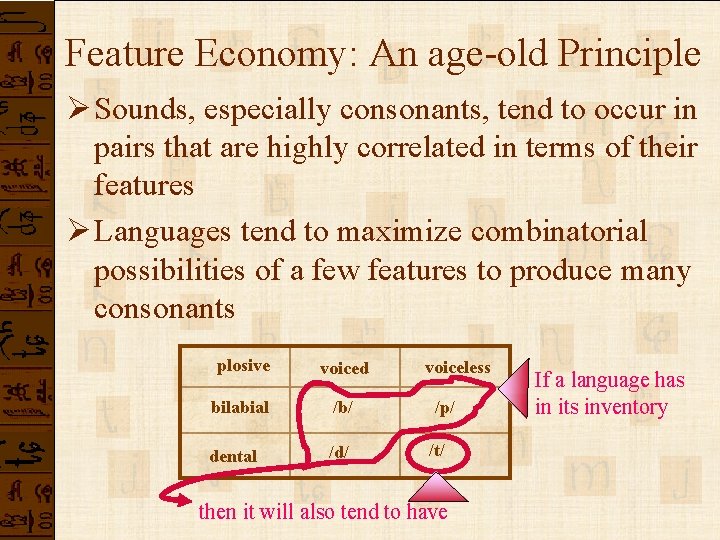
Feature Economy: An age-old Principle Ø Sounds, especially consonants, tend to occur in pairs that are highly correlated in terms of their features Ø Languages tend to maximize combinatorial possibilities of a few features to produce many consonants plosive voiced bilabial /b/ dental /d/ voiceless /p/ /t/ then it will also tend to have If a language has in its inventory
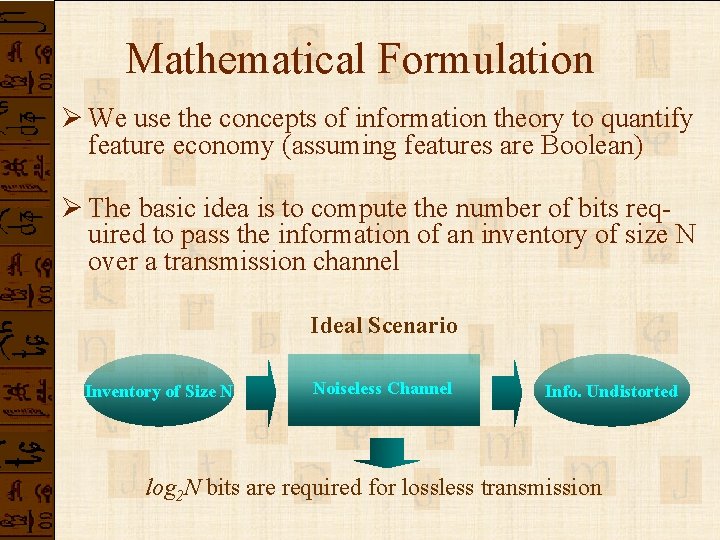
Mathematical Formulation Ø We use the concepts of information theory to quantify feature economy (assuming features are Boolean) Ø The basic idea is to compute the number of bits required to pass the information of an inventory of size N over a transmission channel Ideal Scenario Inventory of Size N Noiseless Channel Info. Undistorted log 2 N bits are required for lossless transmission
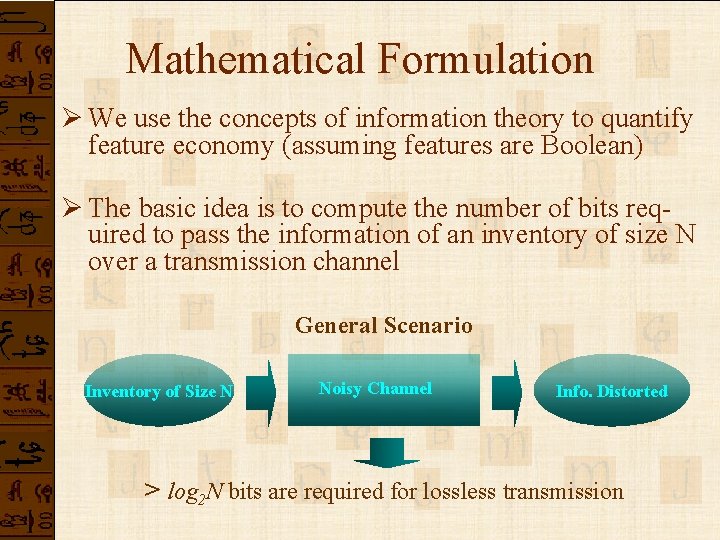
Mathematical Formulation Ø We use the concepts of information theory to quantify feature economy (assuming features are Boolean) Ø The basic idea is to compute the number of bits required to pass the information of an inventory of size N over a transmission channel General Scenario Inventory of Size N Noisy Channel Info. Distorted > log 2 N bits are required for lossless transmission
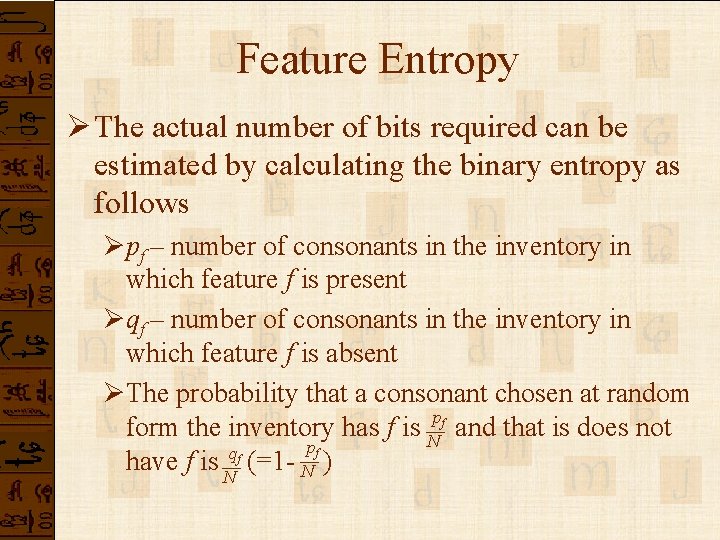
Feature Entropy Ø The actual number of bits required can be estimated by calculating the binary entropy as follows Øpf – number of consonants in the inventory in which feature f is present Øqf – number of consonants in the inventory in which feature f is absent ØThe probability that a consonant chosen at random form the inventory has f is Npf and that is does not pf qf have f is N (=1 - N )
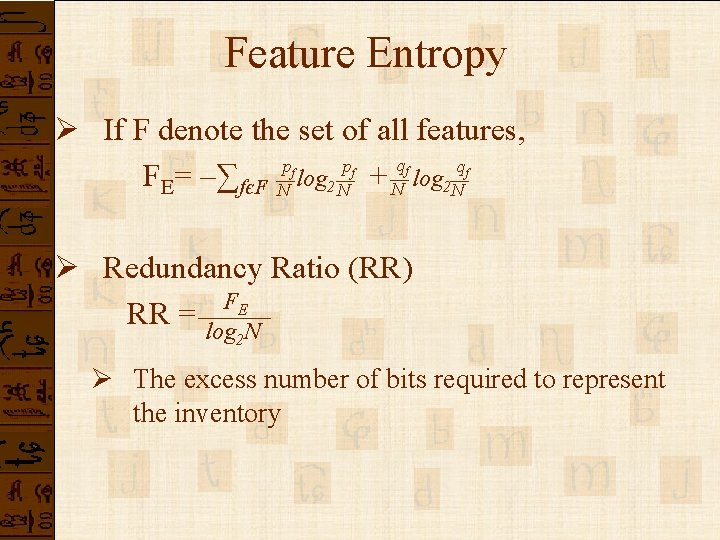
Feature Entropy Ø If F denote the set of all features, q p p FE= –∑fєF N log 2 N + N log 2 Nq f f Ø Redundancy Ratio (RR) RR = log. FEN 2 Ø The excess number of bits required to represent the inventory
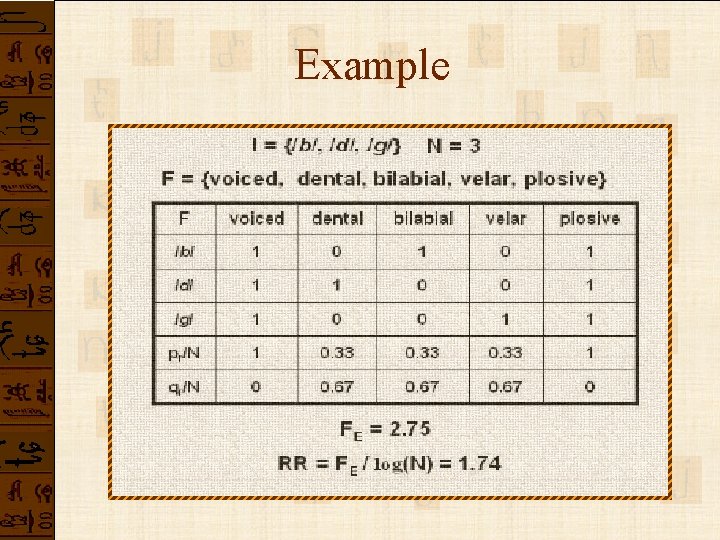
Example
Experimentation Ø Data Source ØUCLA Phonological Inventory Database ØSamples data uniformly from almost all linguistic families ØHosts phonological systems of 317 languages ØNumber of Consonants: 541 ØNumber of Vowels: 151
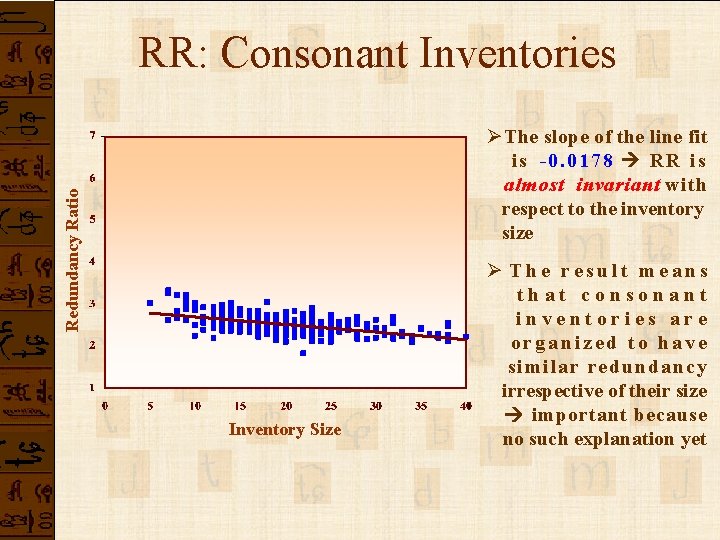
RR: Consonant Inventories Redundancy Ratio Ø The slope of the line fit is -0. 0178 R R i s almost invariant with respect to the inventory size Inventory Size Ø The result means that consonant inventories are organized to have similar redundancy irrespective of their size important because no such explanation yet
The Invariance is not “by chance” Ø The invariance in the distribution of RRs for consonant inventories did not emerge by chance Ø Can be validated by a standard test of hypothesis Ø Null Hypothesis: The invariance in the distribution of RRs observed across the real consonant inventories is also prevalent across the randomly generated inventories.
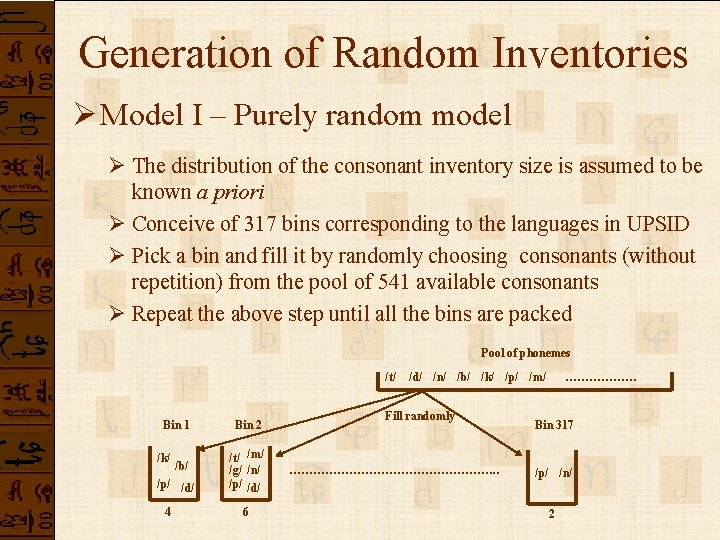
Generation of Random Inventories Ø Model I – Purely random model Ø The distribution of the consonant inventory size is assumed to be known a priori Ø Conceive of 317 bins corresponding to the languages in UPSID Ø Pick a bin and fill it by randomly choosing consonants (without repetition) from the pool of 541 available consonants Ø Repeat the above step until all the bins are packed Pool of phonemes /t/ Bin 1 /k/ /b/ /p/ /d/ 4 Bin 2 /t/ /m/ /g/ /n/ /p/ /d/ 6 ……………… /d/ /n/ /b/ /k/ /p/ /m/ Fill randomly ………………………. . Bin 317 /p/ /n/ 2
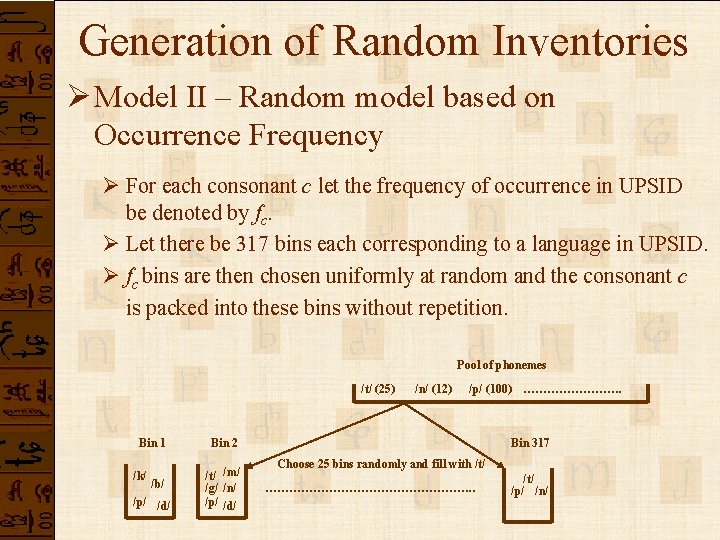
Generation of Random Inventories Ø Model II – Random model based on Occurrence Frequency Ø For each consonant c let the frequency of occurrence in UPSID be denoted by fc. Ø Let there be 317 bins each corresponding to a language in UPSID. Ø fc bins are then chosen uniformly at random and the consonant c is packed into these bins without repetition. Pool of phonemes /t/ (25) Bin 1 /k/ /b/ /p/ /d/ /n/ (12) /p/ (100) …………. Bin 2 /t/ /m/ /g/ /n/ /p/ /d/ Bin 317 Choose 25 bins randomly and fill with /t/ ………………………. . /t/ /p/ /n/
Results Ø Model I – t-test indicates that the null hypothesis can be rejected with (100 - 9. 29 e-15)% confidence
The Case of Vowel Inventories Ø The slope of the line fit is -0. 125 Ø For small inventories RR is not invariant while for Larger ones ( s i z e > 1 2) i t i s s o
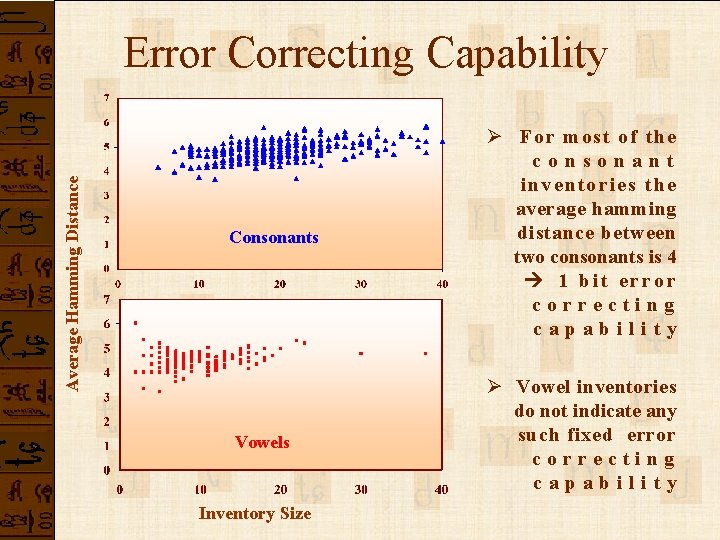
Average Hamming Distance Error Correcting Capability Consonants Vowels Inventory Size Ø For most of the consonant inventories the average hamming distance between two consonants is 4 1 bit error correcting capability Ø Vowel inventories do not indicate any such fixed error correcting capability
Conclusions Ø Redundancy ratio is almost an invariant property of the consonant inventories with respect to the inventory size, Ø This invariance is a direct consequence of the fixed error correcting capabilities of the consonant inventories, Ø Unlike the consonant inventories, the vowel inventories are not indicative (at least not all of them) of such an invariance.
Discussions Ø Cause of the origins of redundancy in a linguistic system ØFault tolerance: Redundancy acts as a failsafe mechanism against random distortion ØEvolutionary Cause: Redundancy allows a speaker to successfully communicate with speakers of neighboring dialects – “Linguistic junk” as pointed out by Lass (Lass, 1997)
Děkuji