
Redundancy And Information Leakage In FineGrained Access Control



- Slides: 55
Redundancy And Information Leakage In Fine-Grained Access Control By Govind Kabra, Ravishankar Ramamurthy, S. Sudarshan, SIGMOD 2006 PRESENTED BY SRIHARSA MOHAPATRA, Ph. D FIRST YEAR, CSE (10405004) DILEEP SINGH, M. TECH-II, CSE (09305083) UNDER GUIDANCE OF PROF S. SUDARSHAN 1
INTEGRATION TO OUR DAILY LIFE USE � 2
INTRODUCTION �Fine grained access control (at row level) to the database enhances usability of the database by allowing large number of users who have different privileges, authorities and responsibilities. �Implies control of access at the granularity of rows and to the specific columns in the rows. 3
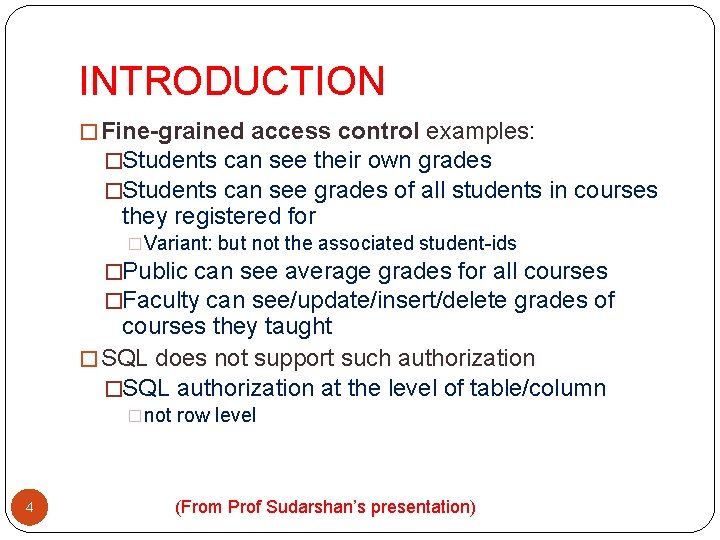
INTRODUCTION � Fine-grained access control examples: �Students can see their own grades �Students can see grades of all students in courses they registered for �Variant: but not the associated student-ids �Public can see average grades for all courses �Faculty can see/update/insert/delete grades of courses they taught � SQL does not support such authorization �SQL authorization at the level of table/column �not row level 4 (From Prof Sudarshan’s presentation)
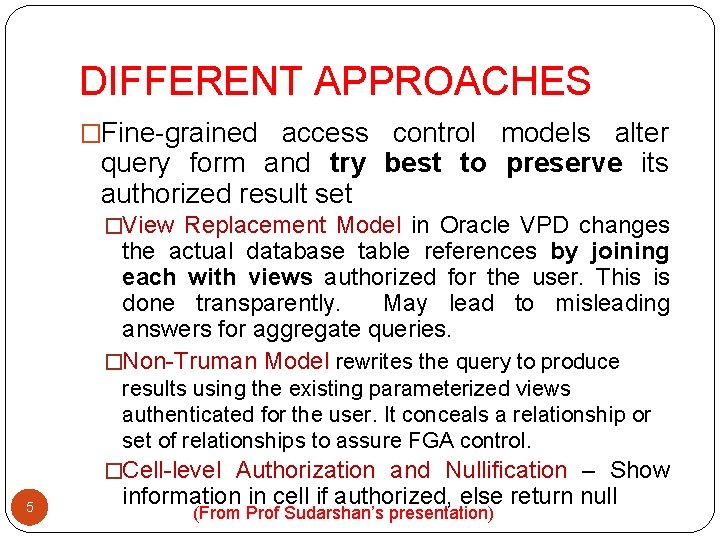
DIFFERENT APPROACHES �Fine-grained access control models alter query form and try best to preserve its authorized result set �View Replacement Model in Oracle VPD changes the actual database table references by joining each with views authorized for the user. This is done transparently. May lead to misleading answers for aggregate queries. �Non-Truman Model rewrites the query to produce results using the existing parameterized views authenticated for the user. It conceals a relationship or set of relationships to assure FGA control. �Cell-level Authorization and Nullification – Show 5 information in cell if authorized, else return null (From Prof Sudarshan’s presentation)
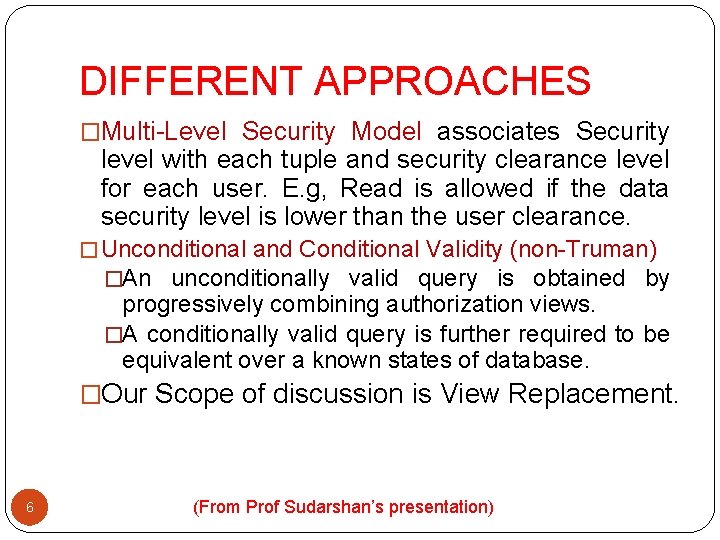
DIFFERENT APPROACHES �Multi-Level Security Model associates Security level with each tuple and security clearance level for each user. E. g, Read is allowed if the data security level is lower than the user clearance. � Unconditional and Conditional Validity (non-Truman) �An unconditionally valid query is obtained by progressively combining authorization views. �A conditionally valid query is further required to be equivalent over a known states of database. �Our Scope of discussion is View Replacement. 6 (From Prof Sudarshan’s presentation)
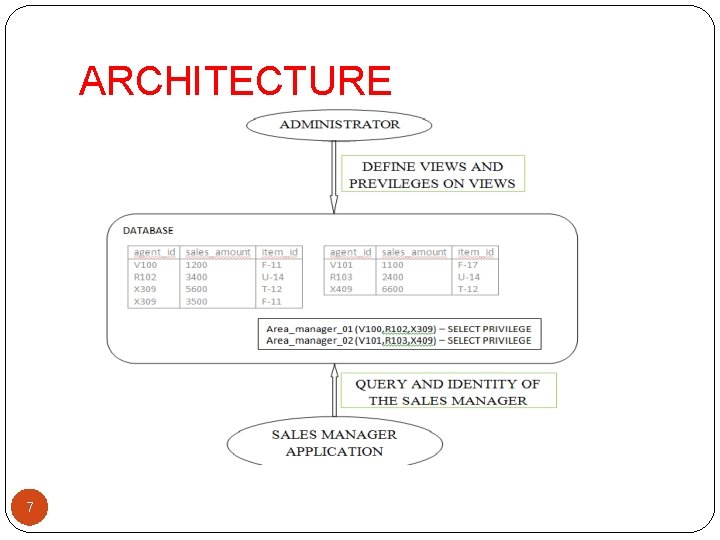
ARCHITECTURE 7
VIEW REPLACEMENT ARCHITECTURE �The database direct users are the applications created by the administrator. �These applications are interface between the large number of users and the database. �Each application user has unique authentication for the application and an unique user ID in the database. �The application generates the user ID specific to the user and passes it to the database �User id used by database during view replacement. 8
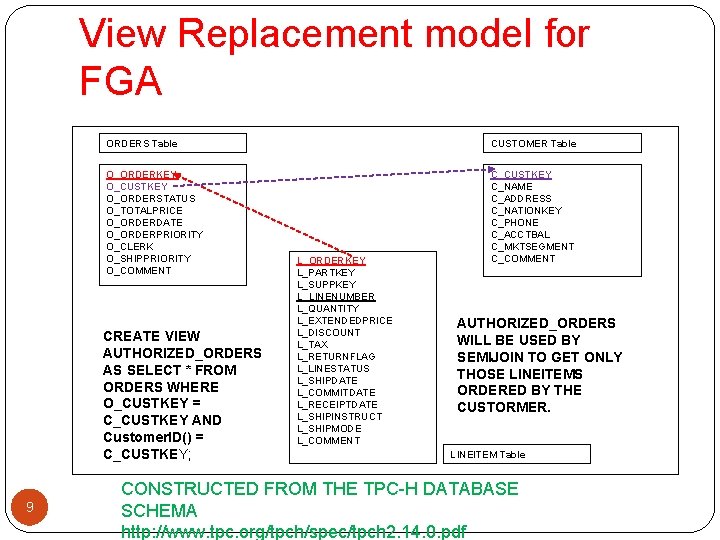
View Replacement model for FGA ORDERS Table CUSTOMER Table O_ORDERKEY O_CUSTKEY O_ORDERSTATUS O_TOTALPRICE O_ORDERDATE O_ORDERPRIORITY O_CLERK O_SHIPPRIORITY O_COMMENT C_CUSTKEY C_NAME C_ADDRESS C_NATIONKEY C_PHONE C_ACCTBAL C_MKTSEGMENT C_COMMENT CREATE VIEW AUTHORIZED_ORDERS AS SELECT * FROM ORDERS WHERE O_CUSTKEY = C_CUSTKEY AND Customer. ID() = C_CUSTKEY; 9 L_ORDERKEY L_PARTKEY L_SUPPKEY L_LINENUMBER L_QUANTITY L_EXTENDEDPRICE L_DISCOUNT L_TAX L_RETURNFLAG L_LINESTATUS L_SHIPDATE L_COMMITDATE L_RECEIPTDATE L_SHIPINSTRUCT L_SHIPMODE L_COMMENT AUTHORIZED_ORDERS WILL BE USED BY SEMIJOIN TO GET ONLY THOSE LINEITEMS ORDERED BY THE CUSTORMER. LINEITEM Table CONSTRUCTED FROM THE TPC-H DATABASE SCHEMA http: //www. tpc. org/tpch/spec/tpch 2. 14. 0. pdf
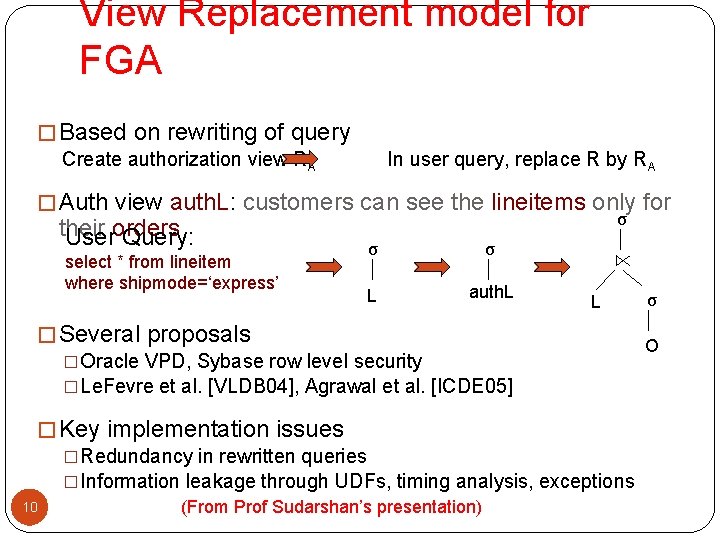
View Replacement model for FGA � Based on rewriting of query Create authorization view RA In user query, replace R by RA � Auth view auth. L: customers can see the lineitems only for their Userorders Query: select * from lineitem where shipmode=‘express’ σ σ σ L auth. L L � Several proposals �Oracle VPD, Sybase row level security �Le. Fevre et al. [VLDB 04], Agrawal et al. [ICDE 05] � Key implementation issues �Redundancy in rewritten queries �Information leakage through UDFs, timing analysis, exceptions 10 (From Prof Sudarshan’s presentation) σ O
REDUNDANCY AND INFORMATION LEAKAGE - AN OVERVIEW �The additional predicates in the translated query which shall act on the view may contain common join operations which are also present in other parts of the query �The query may leak information not accessible to the user �Exceptions and error messages �Behavior of UDF may give clue about information �The goal of the query evaluation is to �prevent information leakage by generating safe plans � Job 11 of the optimization phase. �Minimize execution time by removing redundant parts of query plan
REDUNDANCY CAUSE �The predicate and joins in the original query and the semi-join operation on the relation after query rewriting often overlap in the range of the selection of tuples. �Therefore some comparisons are performed multiple times. �This redundant tests must be removed for optimal speed of operations. 12
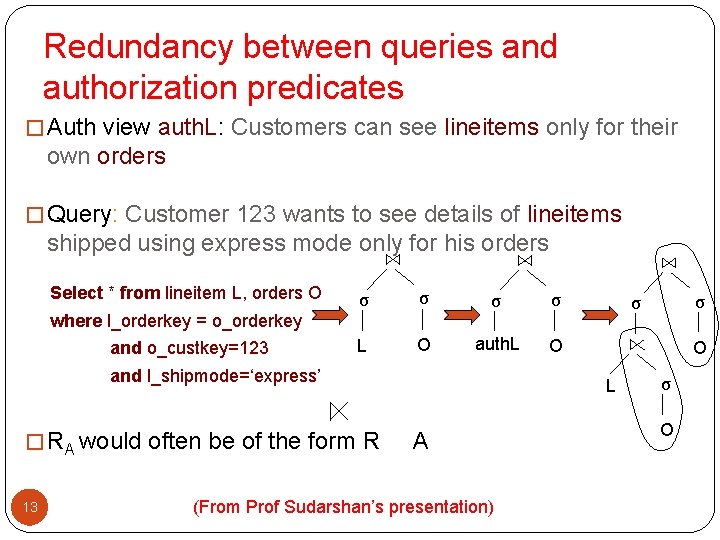
Redundancy between queries and authorization predicates � Auth view auth. L: Customers can see lineitems only for their own orders � Query: Customer 123 wants to see details of lineitems shipped using express mode only for his orders Select * from lineitem L, orders O σ σ L O auth. L O where l_orderkey = o_orderkey and o_custkey=123 and l_shipmode=‘express’ � RA would often be of the form R 13 O L A (From Prof Sudarshan’s presentation) σ σ σ O
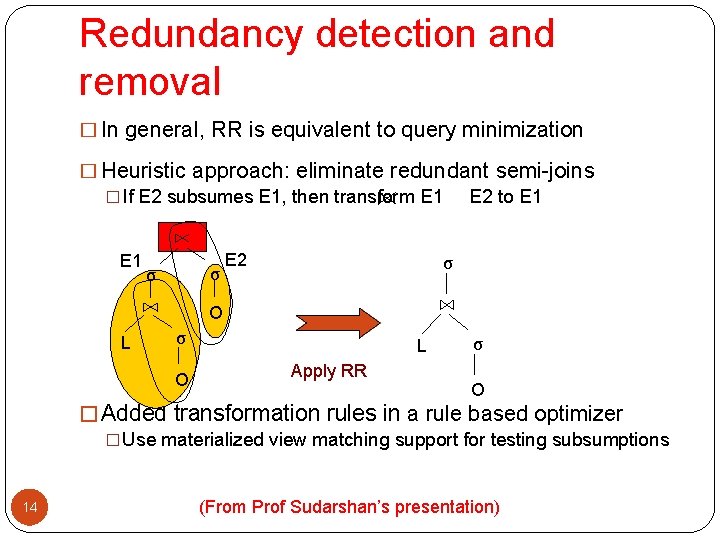
Redundancy detection and removal � In general, RR is equivalent to query minimization � Heuristic approach: eliminate redundant semi-joins � If E 2 subsumes E 1, then transform E 1 E 2 to E 1 σ σ E 2 σ O L Apply RR σ O � Added transformation rules in a rule based optimizer � Use materialized view matching support for testing subsumptions 14 (From Prof Sudarshan’s presentation)
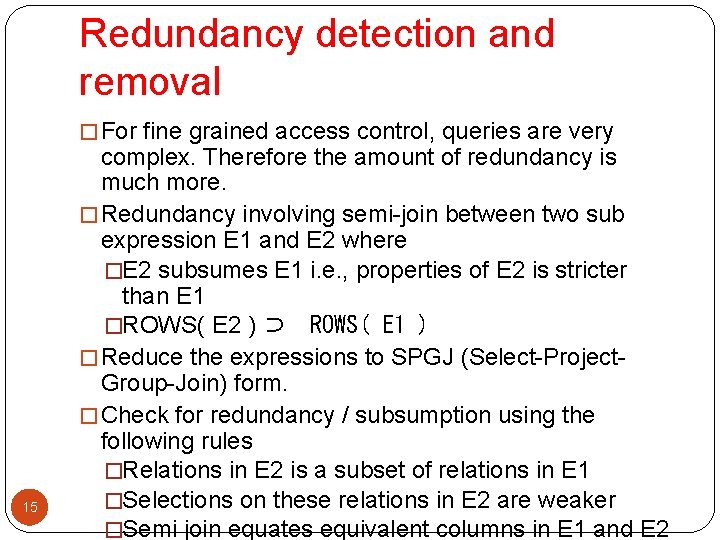
Redundancy detection and removal � For fine grained access control, queries are very 15 complex. Therefore the amount of redundancy is much more. � Redundancy involving semi-join between two sub expression E 1 and E 2 where �E 2 subsumes E 1 i. e. , properties of E 2 is stricter than E 1 �ROWS( E 2 ) ⊃ ROWS( E 1 ) � Reduce the expressions to SPGJ (Select-Project. Group-Join) form. � Check for redundancy / subsumption using the following rules �Relations in E 2 is a subset of relations in E 1 �Selections on these relations in E 2 are weaker �Semi join equates equivalent columns in E 1 and E 2
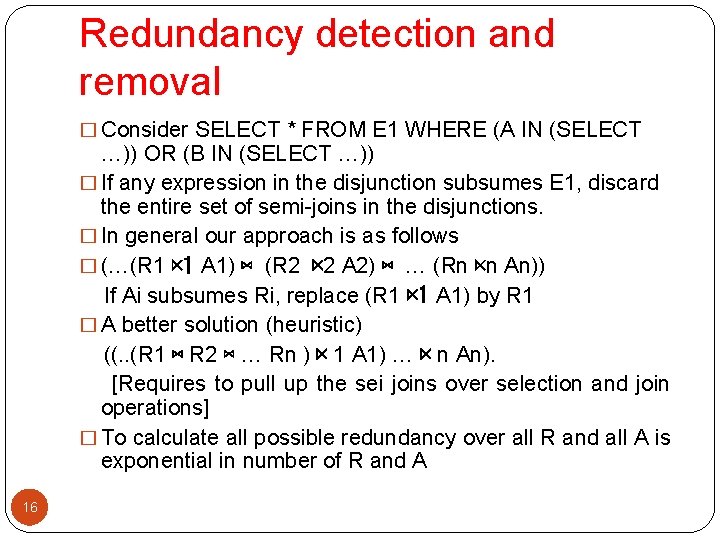
Redundancy detection and removal � Consider SELECT * FROM E 1 WHERE (A IN (SELECT …)) OR (B IN (SELECT …)) � If any expression in the disjunction subsumes E 1, discard the entire set of semi-joins in the disjunctions. � In general our approach is as follows � (…(R 1 ⋉1 A 1) ⋈ (R 2 ⋉2 A 2) ⋈ … (Rn ⋉n An)) If Ai subsumes Ri, replace (R 1 ⋉1 A 1) by R 1 � A better solution (heuristic) ((. . (R 1 ⋈ R 2 ⋈ … Rn ) ⋉ 1 A 1) … ⋉ n An). [Requires to pull up the sei joins over selection and join operations] � To calculate all possible redundancy over all R and all A is exponential in number of R and A 16
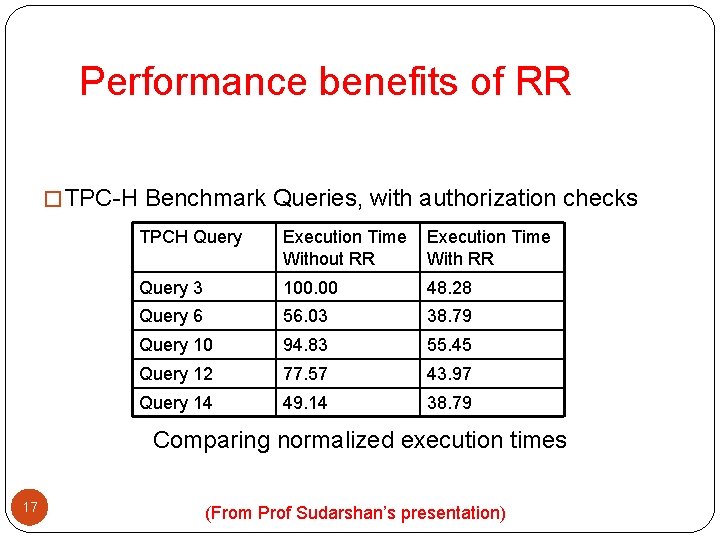
Performance benefits of RR � TPC-H Benchmark Queries, with authorization checks TPCH Query Execution Time Without RR Execution Time With RR Query 3 100. 00 48. 28 Query 6 56. 03 38. 79 Query 10 94. 83 55. 45 Query 12 77. 57 43. 97 Query 14 49. 14 38. 79 Comparing normalized execution times 17 (From Prof Sudarshan’s presentation)
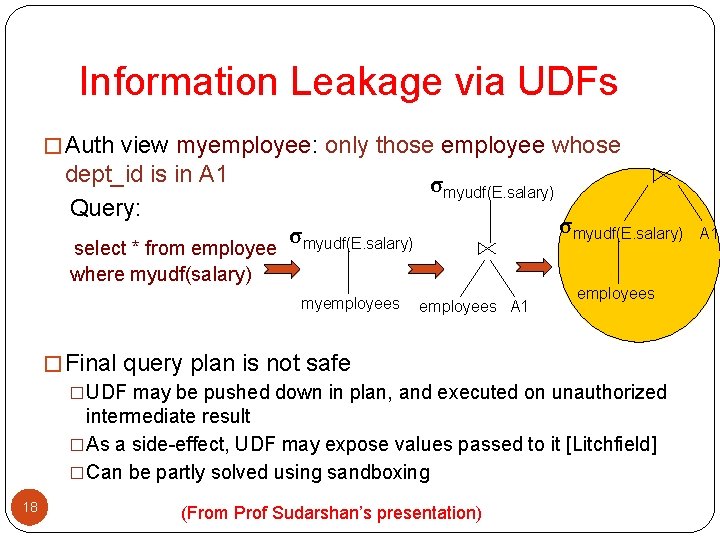
Information Leakage via UDFs � Auth view myemployee: only those employee whose dept_id is in A 1 Query: select * from employee where myudf(salary) σmyudf(E. salary) myemployees A 1 employees � Final query plan is not safe �UDF may be pushed down in plan, and executed on unauthorized intermediate result �As a side-effect, UDF may expose values passed to it [Litchfield] �Can be partly solved using sandboxing 18 (From Prof Sudarshan’s presentation) A 1
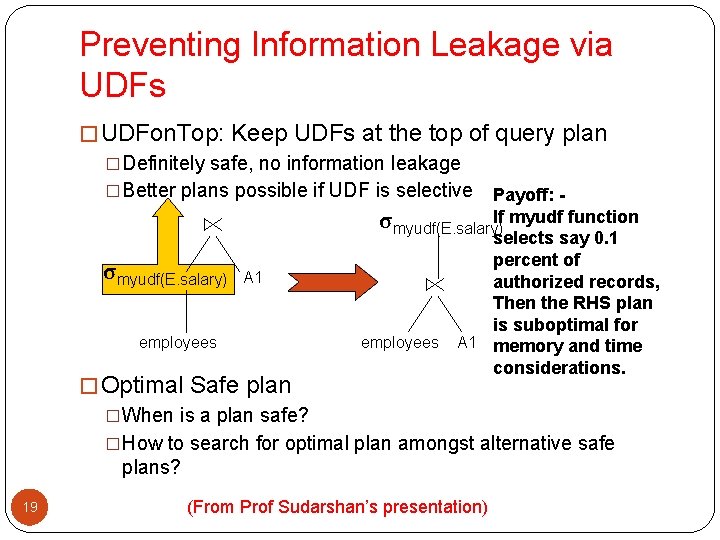
Preventing Information Leakage via UDFs � UDFon. Top: Keep UDFs at the top of query plan �Definitely safe, no information leakage �Better plans possible if UDF is selective Payoff: - σmyudf(E. salary)If myudf function σmyudf(E. salary) employees A 1 employees selects say 0. 1 percent of authorized records, Then the RHS plan is suboptimal for A 1 memory and time considerations. � Optimal Safe plan �When is a plan safe? �How to search for optimal plan amongst alternative safe plans? 19 (From Prof Sudarshan’s presentation)
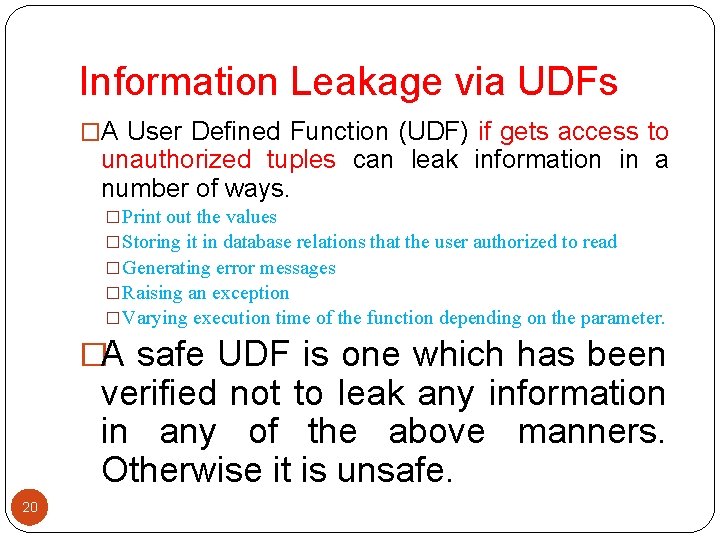
Information Leakage via UDFs �A User Defined Function (UDF) if gets access to unauthorized tuples can leak information in a number of ways. �Print out the values �Storing it in database relations that the user authorized to read �Generating error messages �Raising an exception �Varying execution time of the function depending on the parameter. �A safe UDF is one which has been verified not to leak any information in any of the above manners. Otherwise it is unsafe. 20
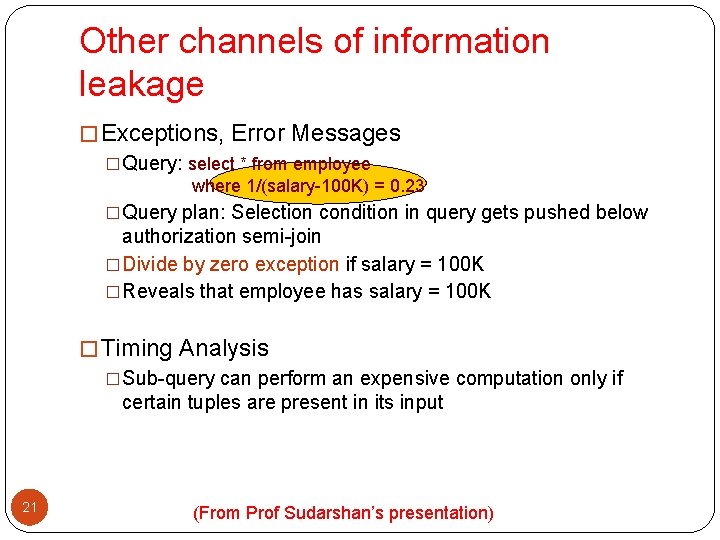
Other channels of information leakage � Exceptions, Error Messages �Query: select * from employee where 1/(salary-100 K) = 0. 23 �Query plan: Selection condition in query gets pushed below authorization semi-join �Divide by zero exception if salary = 100 K �Reveals that employee has salary = 100 K � Timing Analysis �Sub-query can perform an expensive computation only if certain tuples are present in its input 21 (From Prof Sudarshan’s presentation)
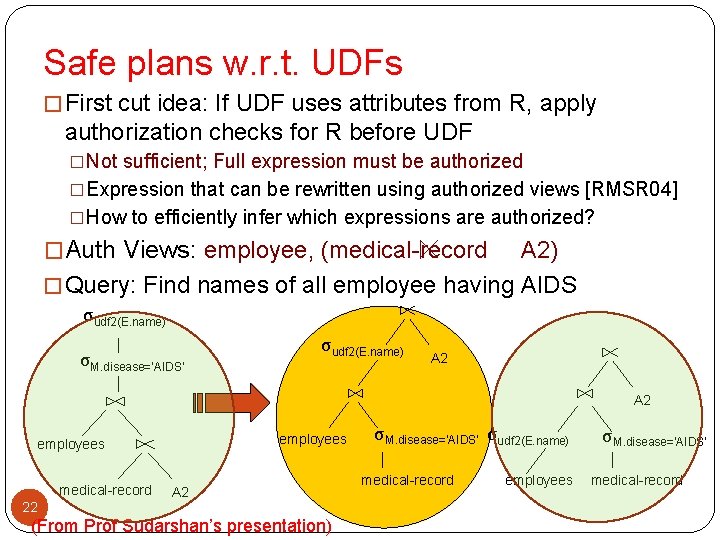
Safe plans w. r. t. UDFs � First cut idea: If UDF uses attributes from R, apply authorization checks for R before UDF �Not sufficient; Full expression must be authorized �Expression that can be rewritten using authorized views [RMSR 04] �How to efficiently infer which expressions are authorized? �Auth Views: employee, (medical-record A 2) � Query: Find names of all employee having AIDS σudf 2(E. name) σM. disease=‘AIDS’ σudf 2(E. name) A 2 employees medical-record 22 A 2 (From Prof Sudarshan’s presentation) σM. disease=‘AIDS’ σudf 2(E. name) medical-record employees σM. disease=‘AIDS’ medical-record
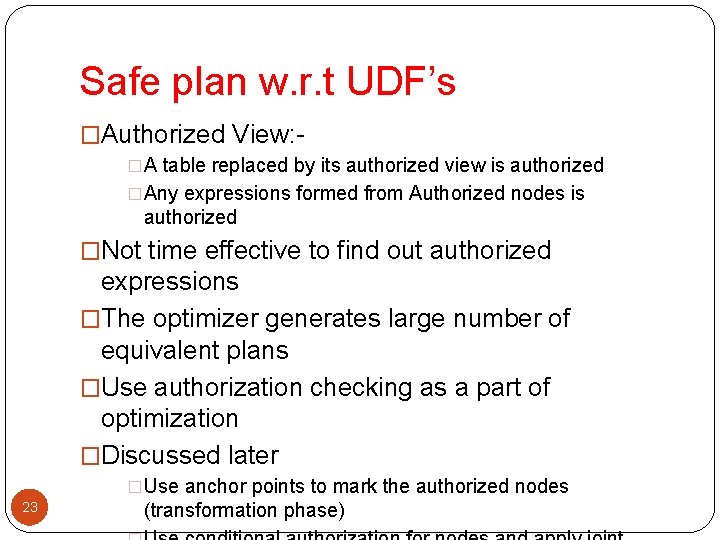
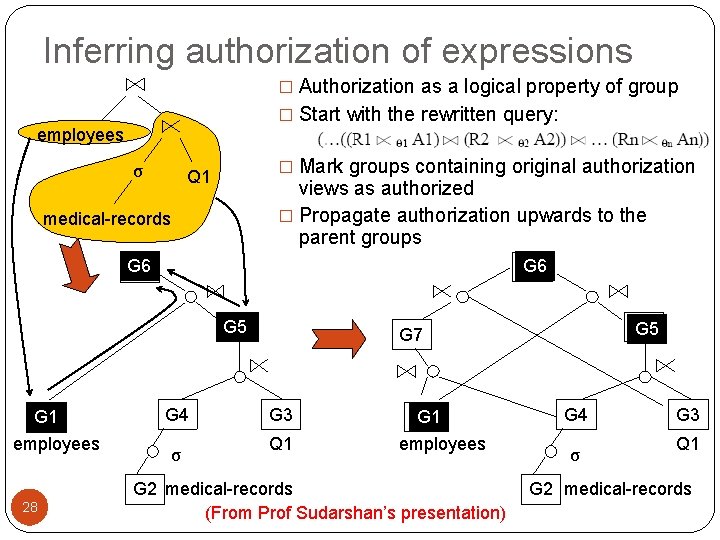
Safe plan w. r. t UDF’s �Authorized View: �A table replaced by its authorized view is authorized �Any expressions formed from Authorized nodes is authorized �Not time effective to find out authorized expressions �The optimizer generates large number of equivalent plans �Use authorization checking as a part of optimization �Discussed later �Use anchor points to mark the authorized nodes 23 (transformation phase)
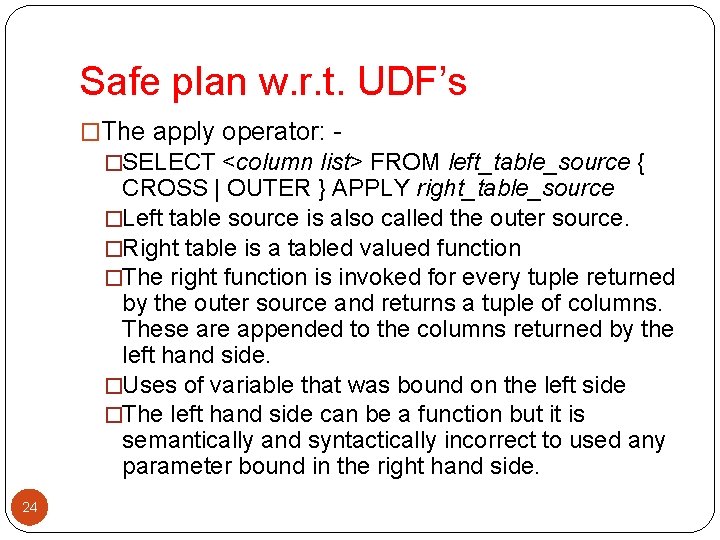
Safe plan w. r. t. UDF’s �The apply operator: �SELECT <column list> FROM left_table_source { CROSS | OUTER } APPLY right_table_source �Left table source is also called the outer source. �Right table is a tabled valued function �The right function is invoked for every tuple returned by the outer source and returns a tuple of columns. These are appended to the columns returned by the left hand side. �Uses of variable that was bound on the left side �The left hand side can be a function but it is semantically and syntactically incorrect to used any parameter bound in the right hand side. 24
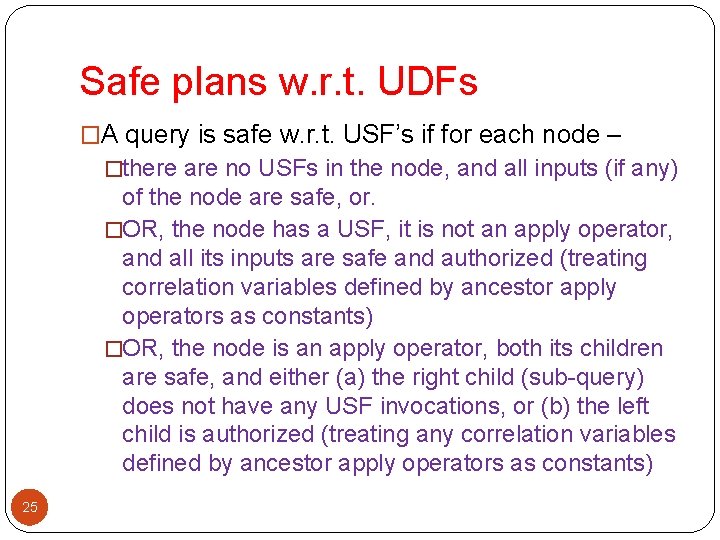
Safe plans w. r. t. UDFs �A query is safe w. r. t. USF’s if for each node – �there are no USFs in the node, and all inputs (if any) of the node are safe, or. �OR, the node has a USF, it is not an apply operator, and all its inputs are safe and authorized (treating correlation variables defined by ancestor apply operators as constants) �OR, the node is an apply operator, both its children are safe, and either (a) the right child (sub-query) does not have any USF invocations, or (b) the left child is authorized (treating any correlation variables defined by ancestor apply operators as constants) 25
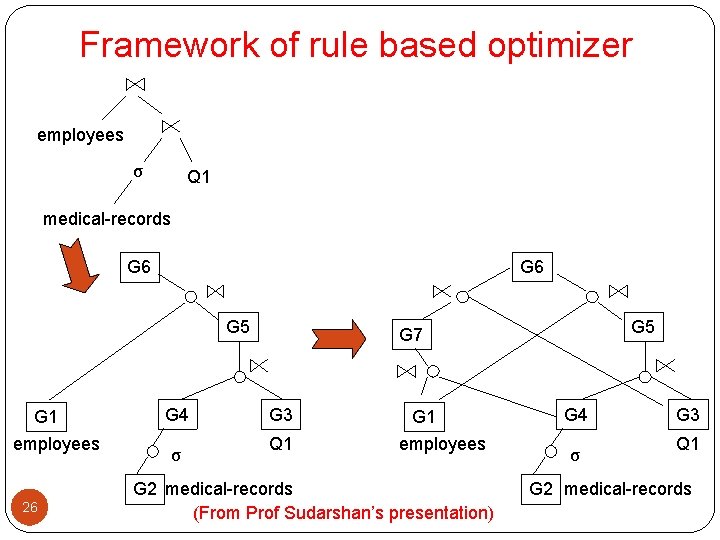
Framework of rule based optimizer employees σ Q 1 medical-records G 6 G 5 G 1 employees 26 G 4 σ G 5 G 7 G 3 Q 1 G 1 employees G 2 medical-records (From Prof Sudarshan’s presentation) G 4 σ G 3 Q 1 G 2 medical-records
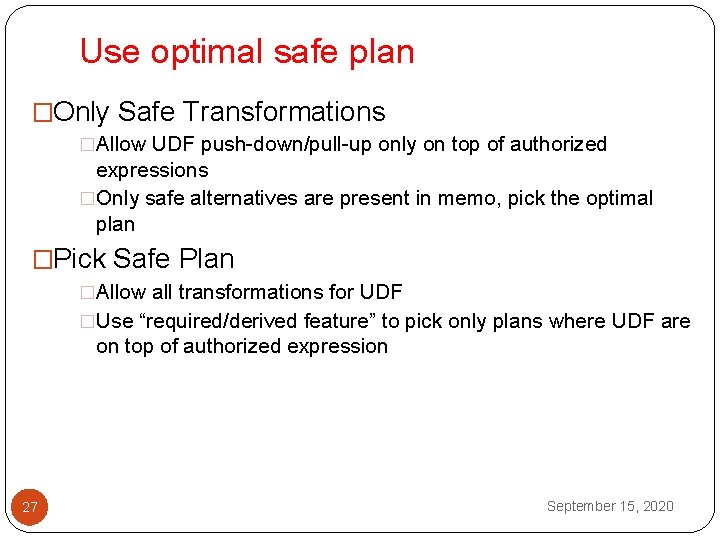
Use optimal safe plan �Only Safe Transformations �Allow UDF push-down/pull-up only on top of authorized expressions �Only safe alternatives are present in memo, pick the optimal plan �Pick Safe Plan �Allow all transformations for UDF �Use “required/derived feature” to pick only plans where UDF are on top of authorized expression 27 September 15, 2020
Inferring authorization of expressions � Authorization as a logical property of group � Start with the rewritten query: employees σ � Mark groups containing original authorization Q 1 views as authorized � Propagate authorization upwards to the parent groups medical-records G 6 G 6 G 5 G 1 employees 28 G 4 σ G 5 G 7 G 3 Q 1 G 1 employees G 2 medical-records (From Prof Sudarshan’s presentation) G 4 σ G 3 Q 1 G 2 medical-records
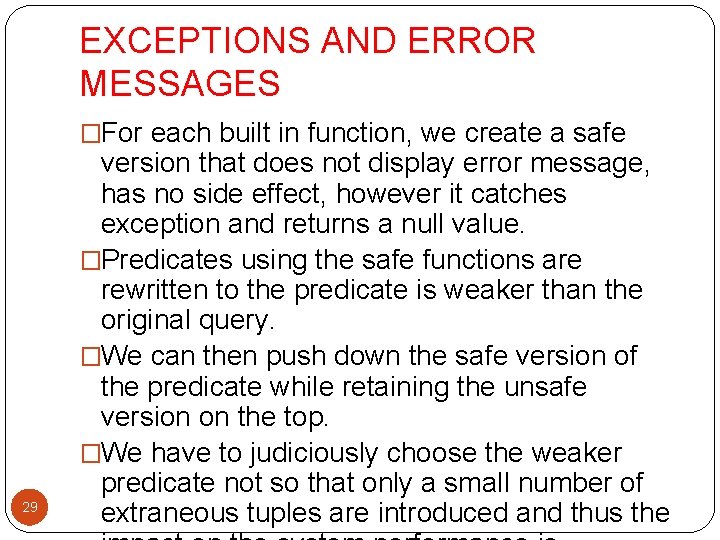
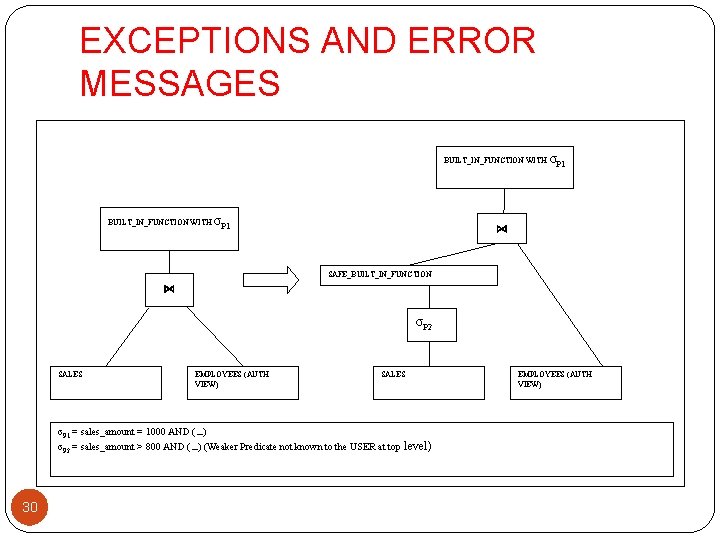
EXCEPTIONS AND ERROR MESSAGES �For each built in function, we create a safe 29 version that does not display error message, has no side effect, however it catches exception and returns a null value. �Predicates using the safe functions are rewritten to the predicate is weaker than the original query. �We can then push down the safe version of the predicate while retaining the unsafe version on the top. �We have to judiciously choose the weaker predicate not so that only a small number of extraneous tuples are introduced and thus the
EXCEPTIONS AND ERROR MESSAGES BUILT_IN_FUNCTION WITH σP 1 ⋈ SAFE_BUILT_IN_FUNCTION ⋈ σP 2 SALES EMPLOYEES (AUTH VIEW) SALES σP 1 = sales_amount = 1000 AND (…) σP 2 = sales_amount > 800 AND (…) (Weaker Predicate not known to the USER at top 30 level) EMPLOYEES (AUTH VIEW)
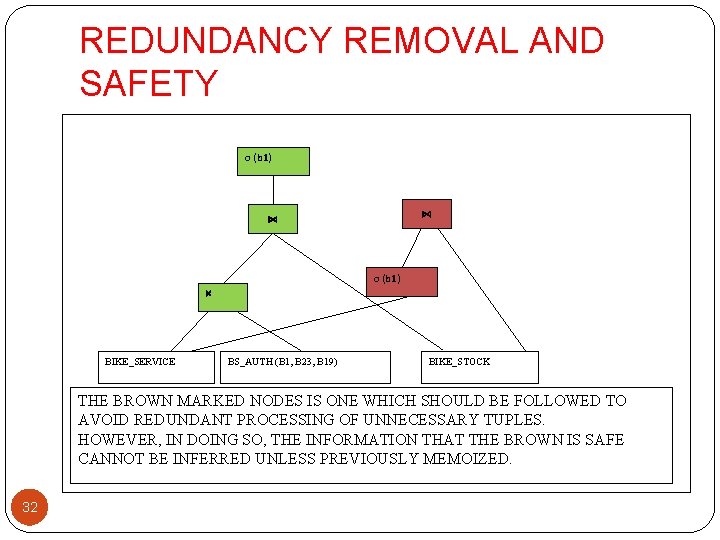
REDUNDANCY REMOVAL VS SAFETY �Consider a scheme in which a bike service center allows a service person for service of specific types of bikes. For example, SERV_PER_01 can serve bikes of type B 1, B 23 and B 19. �Further, service person who is authorized to serve a type of bike can query about the respective stock. 31
REDUNDANCY REMOVAL AND SAFETY σ (b 1) ⋈ ⋈ σ (b 1) ⋉ BIKE_SERVICE BS_AUTH (B 1, B 23, B 19) BIKE_STOCK THE BROWN MARKED NODES IS ONE WHICH SHOULD BE FOLLOWED TO AVOID REDUNDANT PROCESSING OF UNNECESSARY TUPLES. HOWEVER, IN DOING SO, THE INFORMATION THAT THE BROWN IS SAFE CANNOT BE INFERRED UNLESS PREVIOUSLY MEMOIZED. 32
INTEGRATING REDUNDANCY REMOVAL AND SAFETY �The approaches seem to be in conflict. �Redundancy removal requires to pull up the semi join operations above all the selections as possible. �On the other hand, the safety analysis requires the authorized views to mark expressions as authorized. The authorized view check involves semi join operations. �PLAN ONE: - During TRANSFORMATION Phase �In transformation phase authorization-anchor operations are introduced to prevent pulling up of Ri or Ai or insertion of any operation in the expression Ri ⋉θ 1 Ai. �The transformation phase first removes the authorization-anchor operations and marks as authorized the corresponding groups. 33
INTEGRATING REDUNDANCY REMOVAL AND SAFETY �As 34 groups have alternative with the authorization predicate in place, we can infer authorization of groups using validity propagation method. �The redundancy removal rules are substitutions and they allow partial pruning of the search space when redundancy is detected. �Redundancy of semi joins get tested multiple times and because of increased search space due late detection of redundant parts. �This may lead to potential cycles in memo structure.
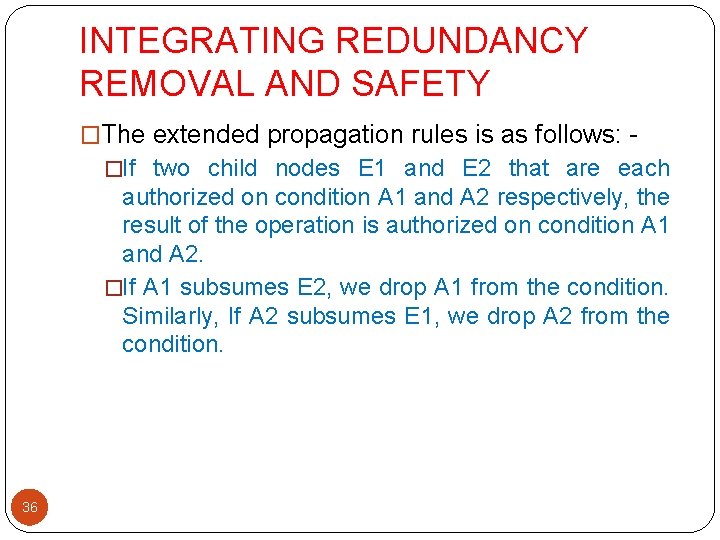
INTEGRATING REDUNDANCY REMOVAL AND SAFETY �PLAN TWO: - Conditioned Authorization �We mark a node authorized on some condition. This means given Ri ⋉θ 1 Ai we mark the node as authorized on ⋉θ 1 Ai and then can pull up Ai if required for simplification. �Before submitting to any USF, the tuples generated from this node, all such ⋉θ 1 Ai must have to be used to filter out unauthorized tuples. �Here there is a scope to optimize the expressions for Ai’s at the root node of the expression. 35
INTEGRATING REDUNDANCY REMOVAL AND SAFETY �The extended propagation rules is as follows: �If two child nodes E 1 and E 2 that are each authorized on condition A 1 and A 2 respectively, the result of the operation is authorized on condition A 1 and A 2. �If A 1 subsumes E 2, we drop A 1 from the condition. Similarly, If A 2 subsumes E 1, we drop A 2 from the condition. 36
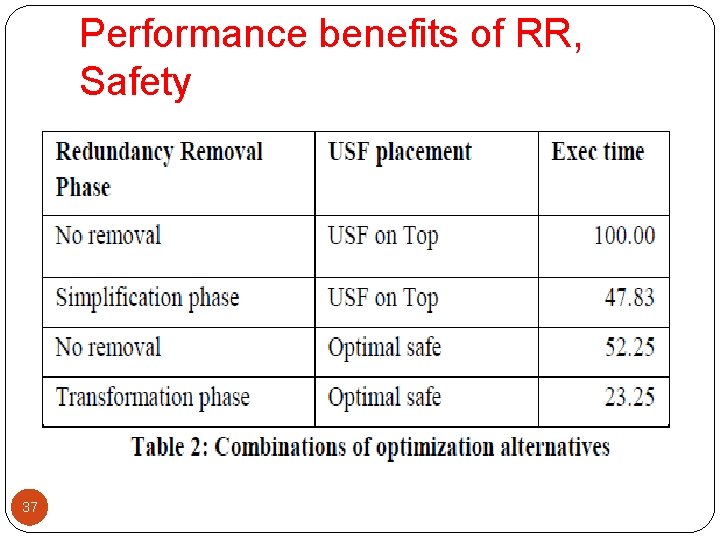
Performance benefits of RR, Safety 37
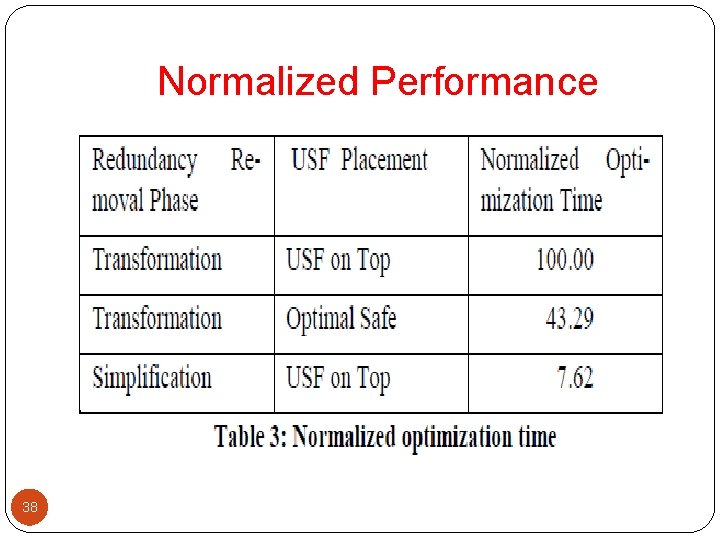
Normalized Performance 38
ASSURING DATA PRIVACY BY K- anonymity 39
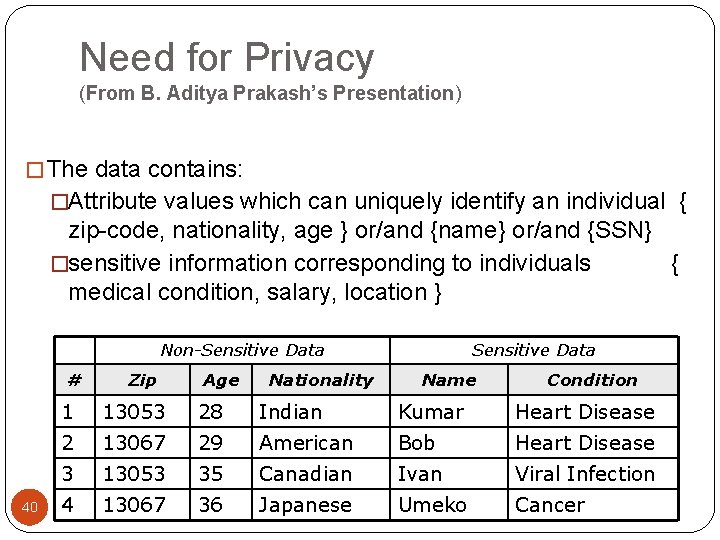
Need for Privacy (From B. Aditya Prakash’s Presentation) � The data contains: �Attribute values which can uniquely identify an individual { zip-code, nationality, age } or/and {name} or/and {SSN} �sensitive information corresponding to individuals { medical condition, salary, location } Non-Sensitive Data # 40 Zip Age Nationality Sensitive Data Name Condition 1 13053 28 Indian Kumar Heart Disease 2 13067 29 American Bob Heart Disease 3 13053 35 Canadian Ivan Viral Infection 4 13067 36 Japanese Umeko Cancer
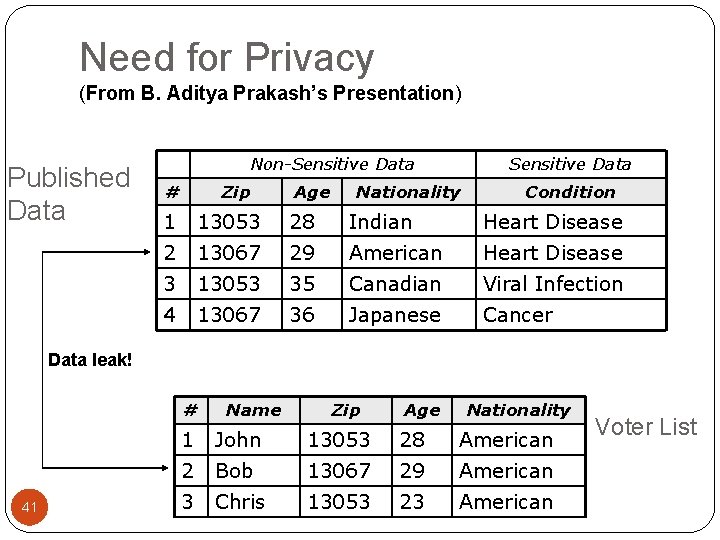
Need for Privacy (From B. Aditya Prakash’s Presentation) Published Data Non-Sensitive Data # Zip Age Sensitive Data Nationality Condition 1 13053 28 Indian Heart Disease 2 13067 29 American Heart Disease 3 13053 35 Canadian Viral Infection 4 13067 36 Japanese Cancer Data leak! # 41 Name Zip Age Nationality 1 John 13053 28 American 2 Bob 13067 29 American 3 Chris 13053 23 American Voter List
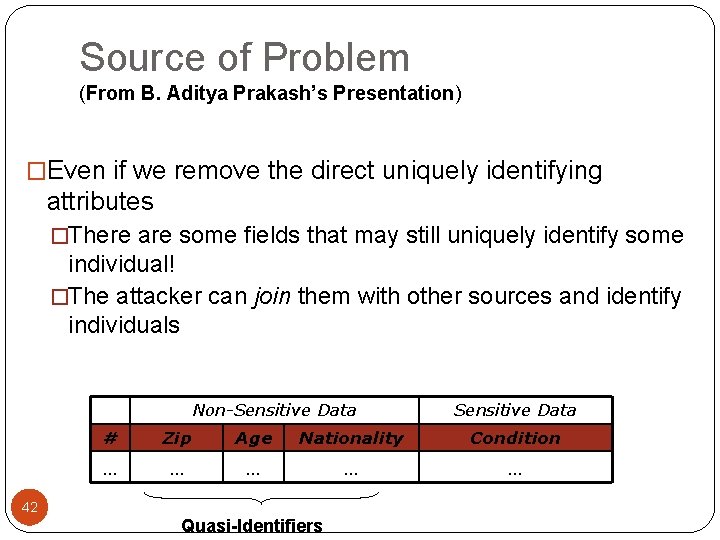
Source of Problem (From B. Aditya Prakash’s Presentation) �Even if we remove the direct uniquely identifying attributes �There are some fields that may still uniquely identify some individual! �The attacker can join them with other sources and identify individuals Non-Sensitive Data # Zip Age Nationality Condition … … … 42 Quasi-Identifiers
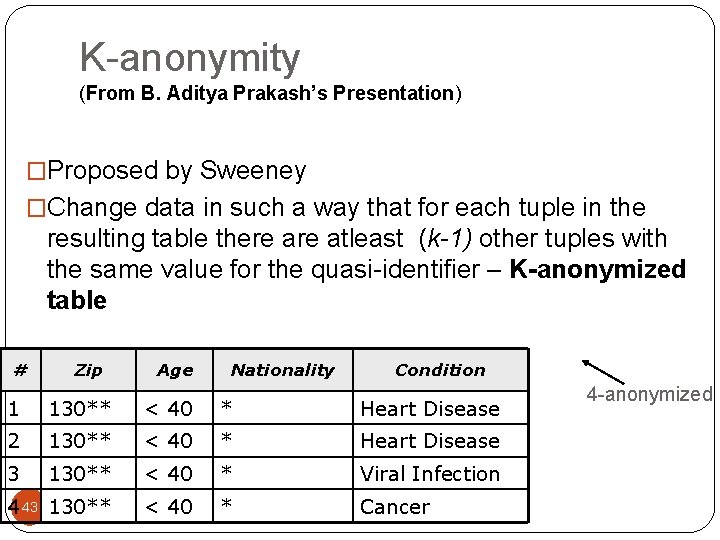
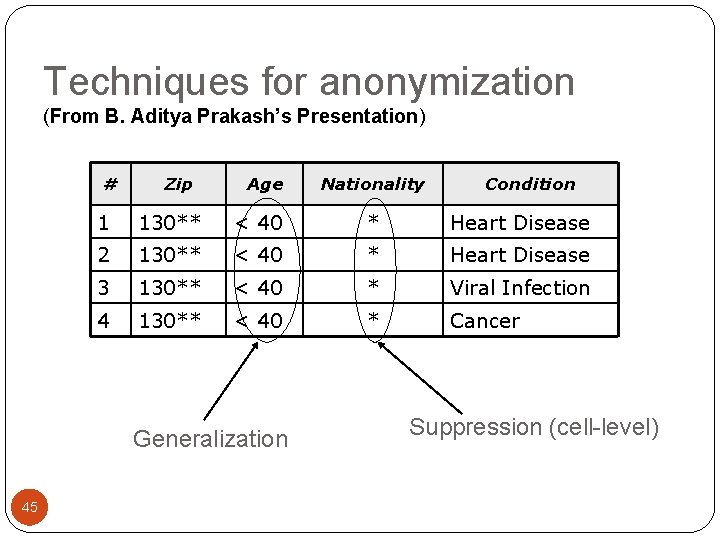
K-anonymity (From B. Aditya Prakash’s Presentation) �Proposed by Sweeney �Change data in such a way that for each tuple in the resulting table there atleast (k-1) other tuples with the same value for the quasi-identifier – K-anonymized table # Zip Age Nationality Condition 1 130** < 40 * Heart Disease 2 130** < 40 * Heart Disease 3 130** < 40 * Viral Infection 4 43 130** < 40 * Cancer 4 -anonymized
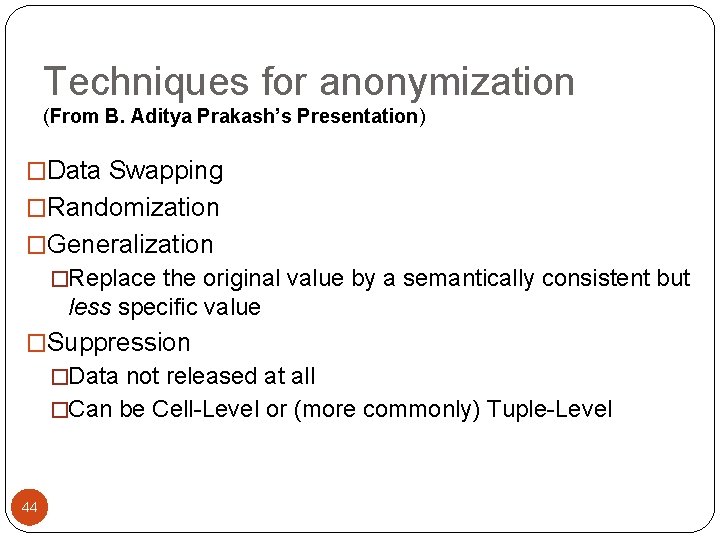
Techniques for anonymization (From B. Aditya Prakash’s Presentation) �Data Swapping �Randomization �Generalization �Replace the original value by a semantically consistent but less specific value �Suppression �Data not released at all �Can be Cell-Level or (more commonly) Tuple-Level 44
Techniques for anonymization (From B. Aditya Prakash’s Presentation) # Zip Age Condition 1 130** < 40 * Heart Disease 2 130** < 40 * Heart Disease 3 130** < 40 * Viral Infection 4 130** < 40 * Cancer Generalization 45 Nationality Suppression (cell-level)
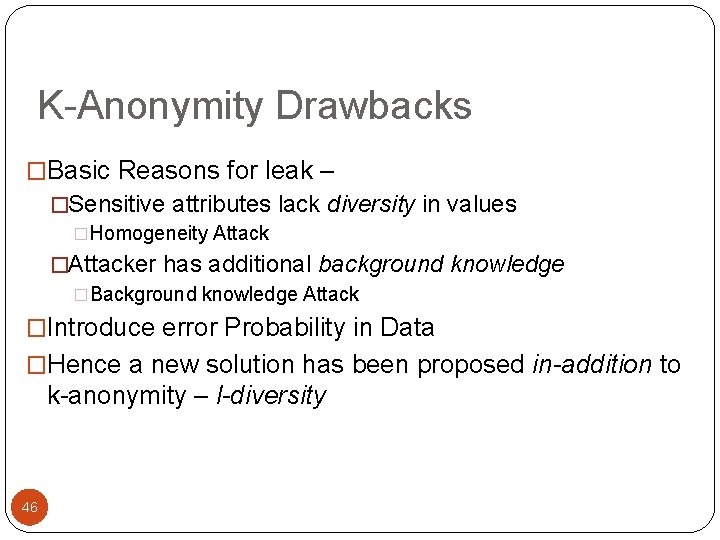
K-Anonymity Drawbacks �Basic Reasons for leak – �Sensitive attributes lack diversity in values �Homogeneity Attack �Attacker has additional background knowledge �Background knowledge Attack �Introduce error Probability in Data �Hence a new solution has been proposed in-addition to k-anonymity – l-diversity 46
THANK YOU 47
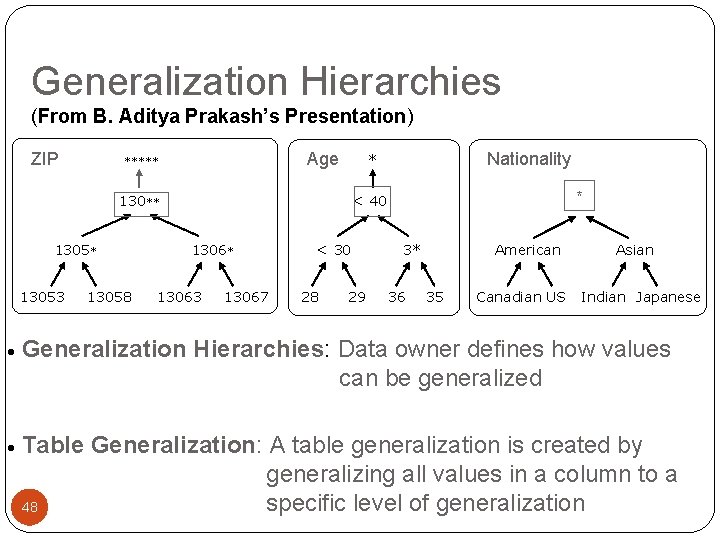
Generalization Hierarchies (From B. Aditya Prakash’s Presentation) ZIP Age 13053 13058 * < 40 1305 Nationality * 13063 13067 < 30 28 29 3* 36 American 35 Canadian US Asian Indian Japanese • Generalization Hierarchies: Data owner defines how values can be generalized • Table Generalization: A table generalization is created by generalizing all values in a column to a specific level of generalization 48
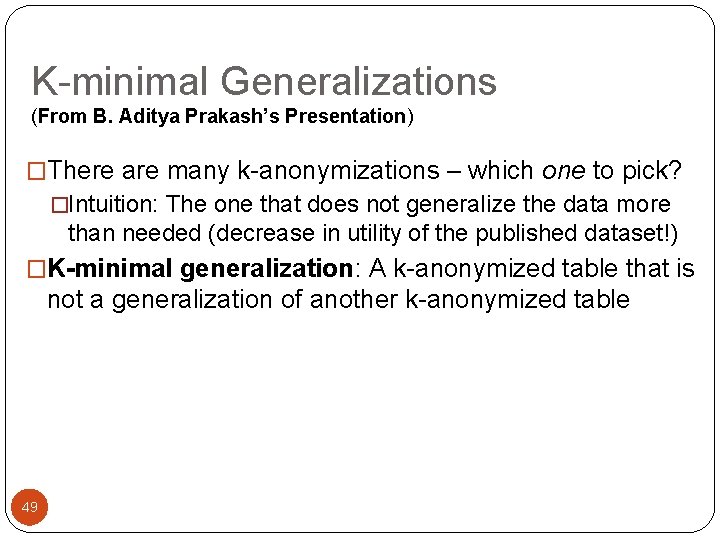
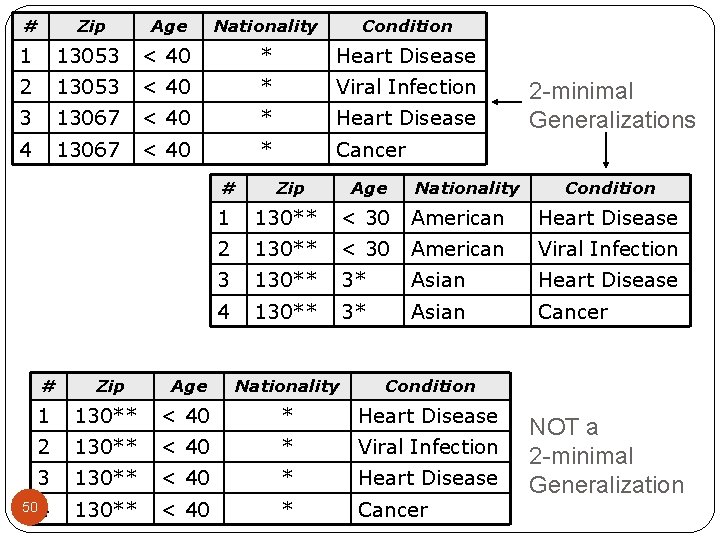
K-minimal Generalizations (From B. Aditya Prakash’s Presentation) �There are many k-anonymizations – which one to pick? �Intuition: The one that does not generalize the data more than needed (decrease in utility of the published dataset!) �K-minimal generalization: A k-anonymized table that is not a generalization of another k-anonymized table 49
# Zip Age Nationality Condition 1 13053 < 40 * Heart Disease 2 13053 < 40 * Viral Infection 3 13067 < 40 * Heart Disease 4 13067 < 40 * Cancer Nationality 2 -minimal Generalizations # Zip Age 1 130** < 30 American Heart Disease 2 130** < 30 American Viral Infection 3 130** 3* Asian Heart Disease 4 130** 3* Asian Cancer # Zip Age Nationality Condition 1 130** < 40 * Heart Disease 2 130** < 40 * Viral Infection 3 130** < 40 * Heart Disease 504 130** < 40 * Cancer Condition NOT a 2 -minimal Generalization
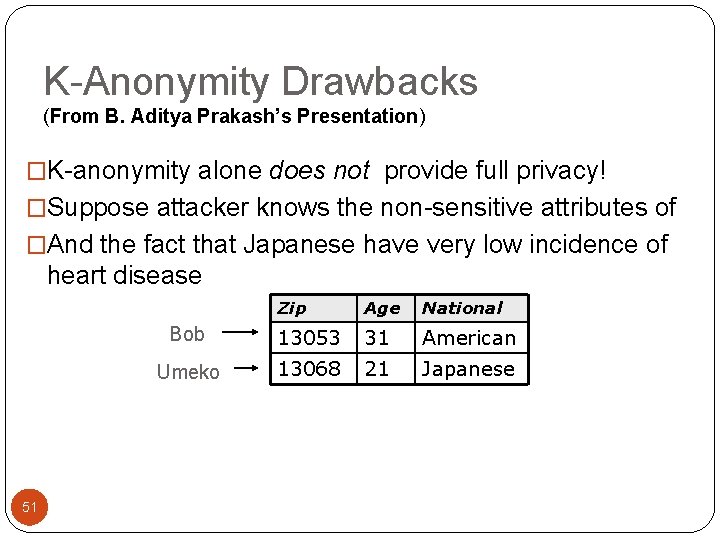
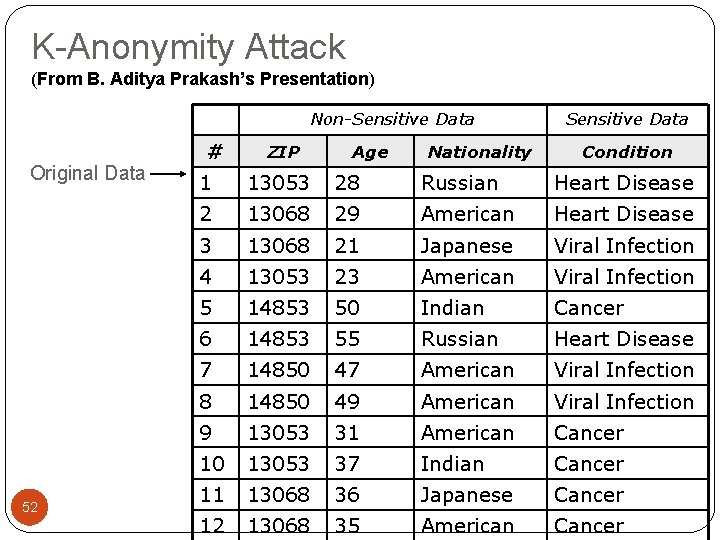
K-Anonymity Drawbacks (From B. Aditya Prakash’s Presentation) �K-anonymity alone does not provide full privacy! �Suppose attacker knows the non-sensitive attributes of �And the fact that Japanese have very low incidence of heart disease 51 Zip Age National Bob 13053 31 American Umeko 13068 21 Japanese
K-Anonymity Attack (From B. Aditya Prakash’s Presentation) Non-Sensitive Data Original Data 52 # ZIP Age Nationality Sensitive Data Condition 1 13053 28 Russian Heart Disease 2 13068 29 American Heart Disease 3 13068 21 Japanese Viral Infection 4 13053 23 American Viral Infection 5 14853 50 Indian Cancer 6 14853 55 Russian Heart Disease 7 14850 47 American Viral Infection 8 14850 49 American Viral Infection 9 13053 31 American Cancer 10 13053 37 Indian Cancer 11 13068 36 Japanese Cancer 12 13068 35 American Cancer
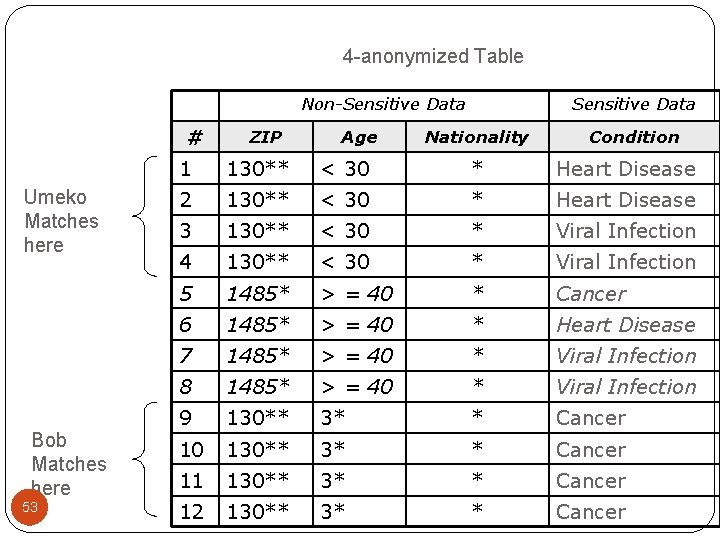
4 -anonymized Table Non-Sensitive Data # Umeko Matches here Bob Matches here 53 ZIP Age Sensitive Data Nationality Condition 1 130** < 30 * Heart Disease 2 130** < 30 * Heart Disease 3 130** < 30 * Viral Infection 4 130** < 30 * Viral Infection 5 1485* > = 40 * Cancer 6 1485* > = 40 * Heart Disease 7 1485* > = 40 * Viral Infection 8 1485* > = 40 * Viral Infection 9 130** 3* * Cancer 10 130** 3* * Cancer 11 130** 3* * Cancer 12 130** 3* * Cancer
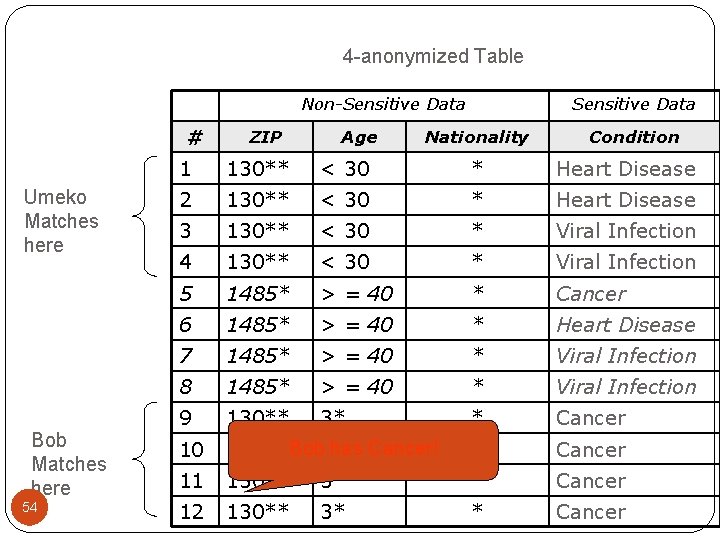
4 -anonymized Table Non-Sensitive Data # Umeko Matches here Bob Matches here 54 ZIP Age Sensitive Data Nationality Condition 1 130** < 30 * Heart Disease 2 130** < 30 * Heart Disease 3 130** < 30 * Viral Infection 4 130** < 30 * Viral Infection 5 1485* > = 40 * Cancer 6 1485* > = 40 * Heart Disease 7 1485* > = 40 * Viral Infection 8 1485* > = 40 * Viral Infection 9 * Cancer 10 130** 3* has Cancer! 130**Bob 3* * Cancer 11 130** 3* * Cancer 12 130** 3* * Cancer
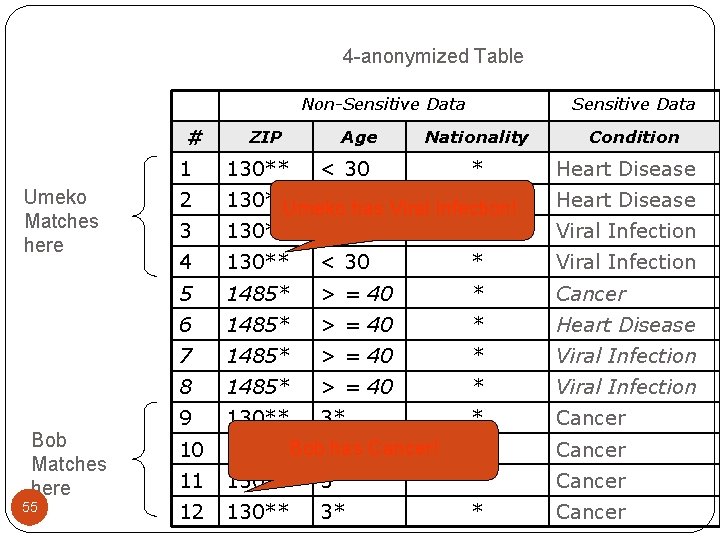
4 -anonymized Table Non-Sensitive Data # Umeko Matches here Bob Matches here 55 ZIP Age Sensitive Data Nationality < 30 * Condition 1 130** Heart Disease 2 Heart Disease 3 130**Umeko < 30 * has Viral Infection! 130** < 30 * 4 130** < 30 * Viral Infection 5 1485* > = 40 * Cancer 6 1485* > = 40 * Heart Disease 7 1485* > = 40 * Viral Infection 8 1485* > = 40 * Viral Infection 9 * Cancer 10 130** 3* has Cancer! 130**Bob 3* * Cancer 11 130** 3* * Cancer 12 130** 3* * Cancer Viral Infection