
Redundancy and Emergency Interconnectivity Study Water Transmission Grid

- Slides: 29
Redundancy and Emergency Interconnectivity Study Water Transmission Grid Study For the Coosa North Georgia Region April 22, 2015 Presented by: Michelle Vincent, Jacobs and Tanya Kinnard, Amec Foster Wheeler www. jacobs. com | worldwide
Introduction • Background • Redundancy and Emergency Interconnectivity Study – – – Service Areas Existing interconnections Emergency scenarios and reliability targets for focus area Additional interconnection projects and costs Next steps and recommendations • Water Transmission Grid Study – – – 2 Methods and priorities Conceptual grid development Potential sources Recommendations and costs Future Activities
Background • Studies were commissioned by the Coosa North Georgia Regional Water Planning Council (“Council”) to support Regional Water Plan implementation efforts • The Council: – Established by Georgia's State Water Plan in 2008 – Sets direction, goals, and policy for water planning in the region – Works closely with Georgia Environmental Protection Division to produce Regional Water Plans and support implementation – Meets semi-annually to quarterly • The North Georgia Water Partnership (“Partnership”) serves as the technical advisory body for the Council, in addition to implementing goals for water planning and service for the region. • The Partnership: – Formed in 2003 – Provides proactive regional water-based planning, technical assistance and education – Meets monthly and assists with implementation process 3
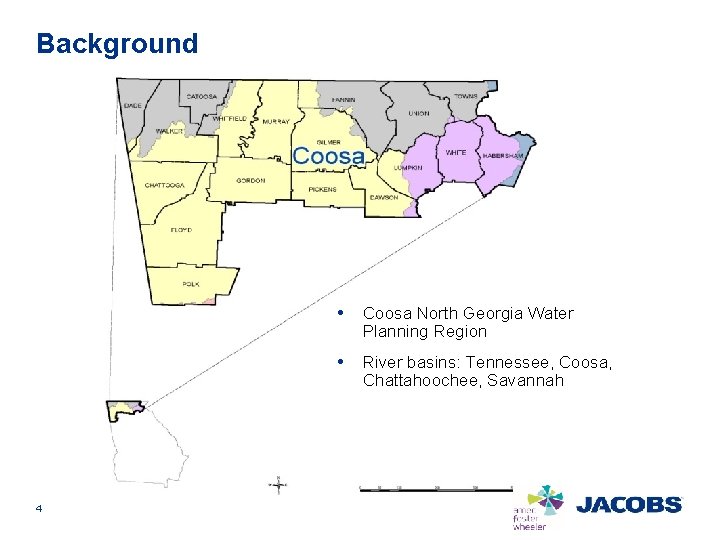
Background • Coosa North Georgia Water Planning Region • River basins: Tennessee, Coosa, Chattahoochee, Savannah 4
Redundancy and Emergency Interconnectivity Major tasks of Study: • Data collection • Determine Service Areas - entire region • Analyze and map existing interconnections – focus area • Evaluate emergency scenarios and reliability targets for focus area • Propose additional interconnection projects • Next steps and recommendations 5
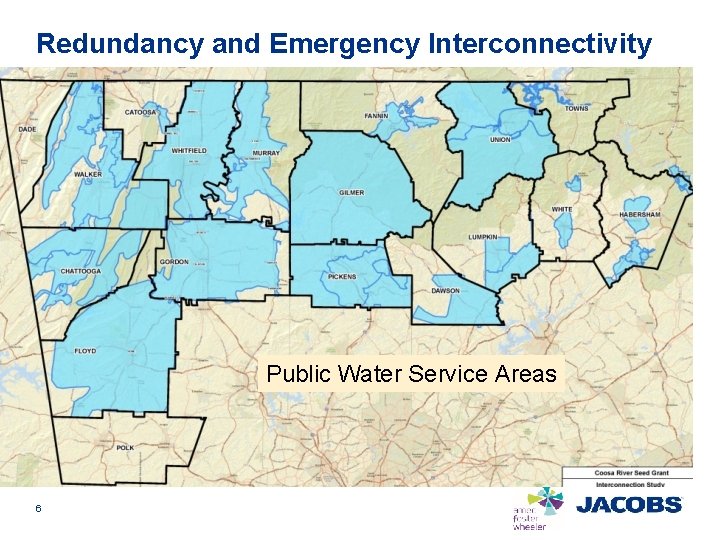
Redundancy and Emergency Interconnectivity Public Water Service Areas 6
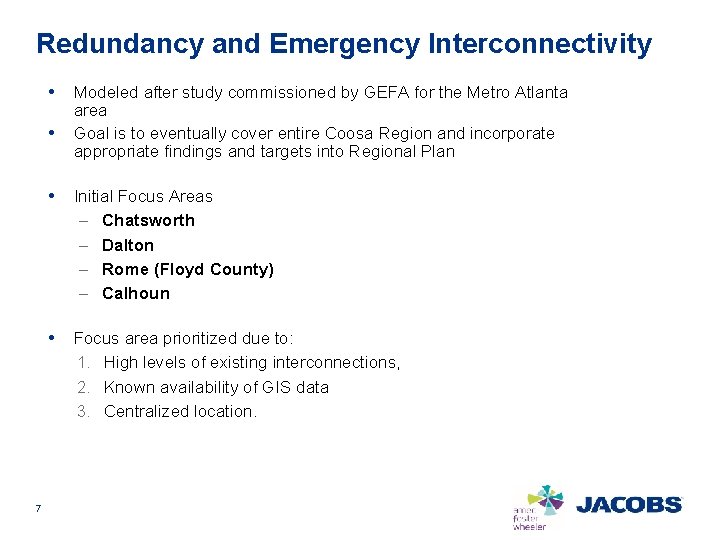
Redundancy and Emergency Interconnectivity • Modeled after study commissioned by GEFA for the Metro Atlanta • area Goal is to eventually cover entire Coosa Region and incorporate appropriate findings and targets into Regional Plan • Initial Focus Areas – – Chatsworth Dalton Rome (Floyd County) Calhoun • Focus area prioritized due to: 1. High levels of existing interconnections, 2. Known availability of GIS data 3. Centralized location. 7
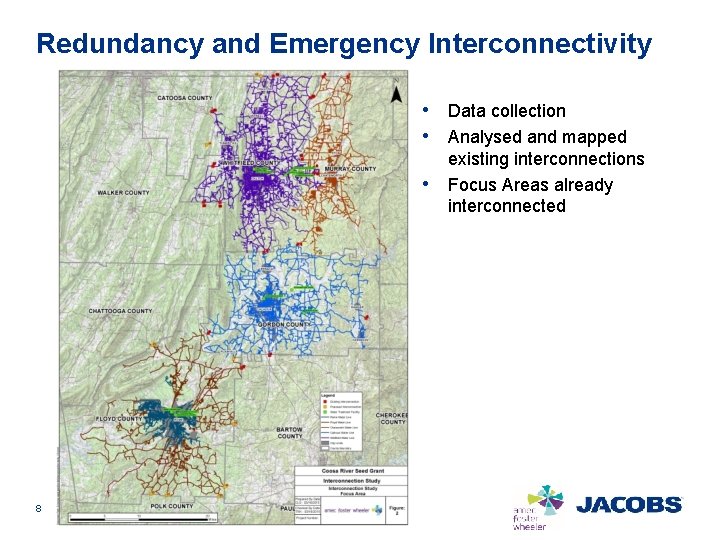
Redundancy and Emergency Interconnectivity • Data collection • Analysed and mapped • 8 existing interconnections Focus Areas already interconnected
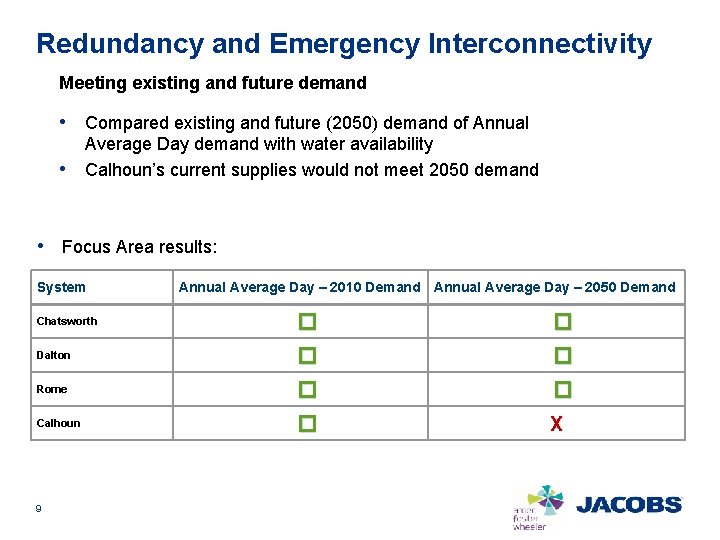
Redundancy and Emergency Interconnectivity Meeting existing and future demand • Compared existing and future (2050) demand of Annual • Average Day demand with water availability Calhoun’s current supplies would not meet 2050 demand • Focus Area results: System Annual Average Day – 2010 Demand Annual Average Day – 2050 Demand Chatsworth � � Dalton � � Rome � � Calhoun � X 9
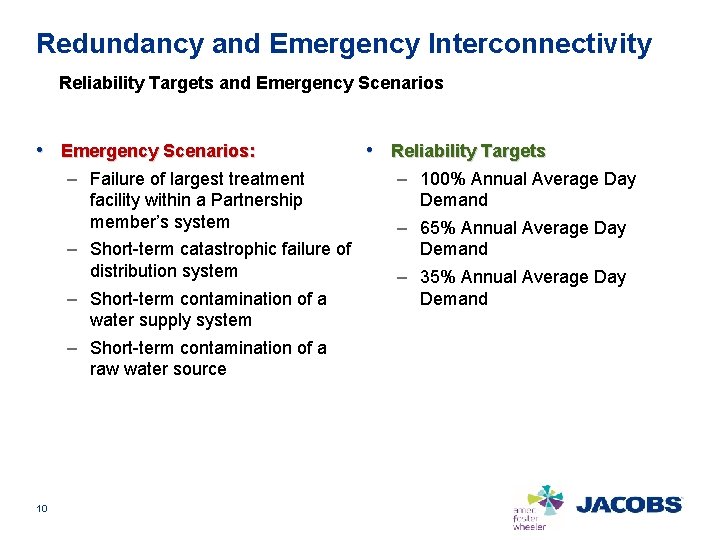
Redundancy and Emergency Interconnectivity Reliability Targets and Emergency Scenarios • Emergency Scenarios: – Failure of largest treatment facility within a Partnership member’s system – Short-term catastrophic failure of distribution system – Short-term contamination of a water supply system – Short-term contamination of a raw water source 10 • Reliability Targets – 100% Annual Average Day Demand – 65% Annual Average Day Demand – 35% Annual Average Day Demand
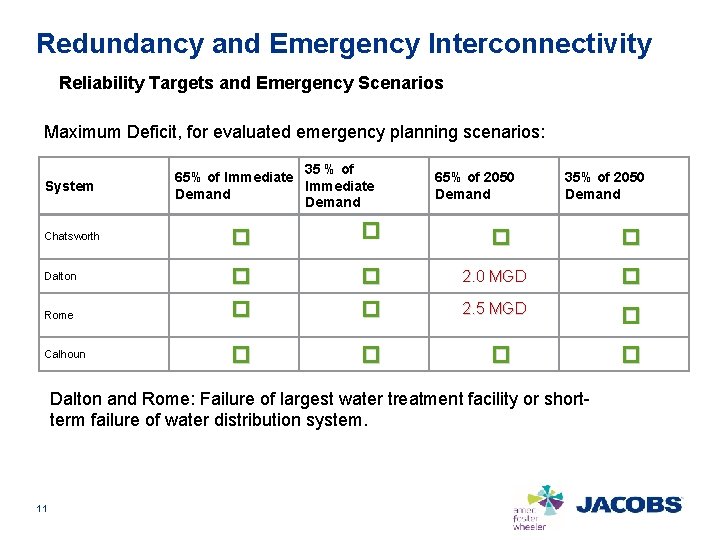
Redundancy and Emergency Interconnectivity Reliability Targets and Emergency Scenarios Maximum Deficit, for evaluated emergency planning scenarios: System 35 % of 65% of Immediate Demand 65% of 2050 Demand 35% of 2050 Demand � � Chatsworth � � Dalton � � 2. 0 MGD � Rome � � 2. 5 MGD � Calhoun � � � Dalton and Rome: Failure of largest water treatment facility or shortterm failure of water distribution system. 11 �
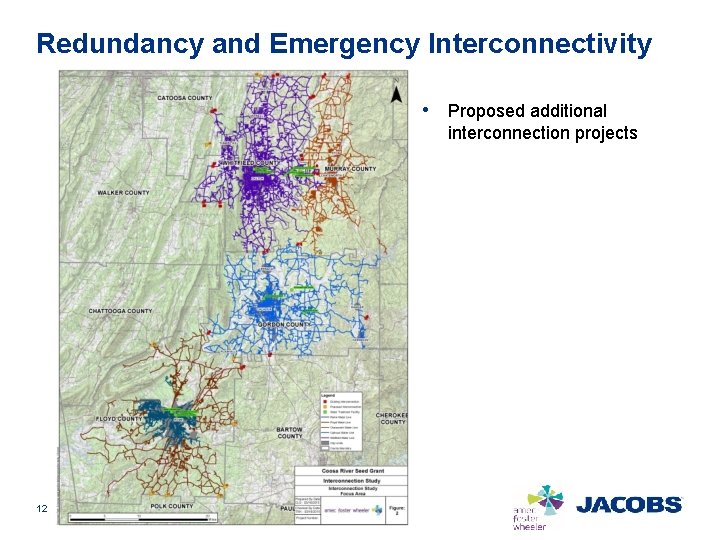
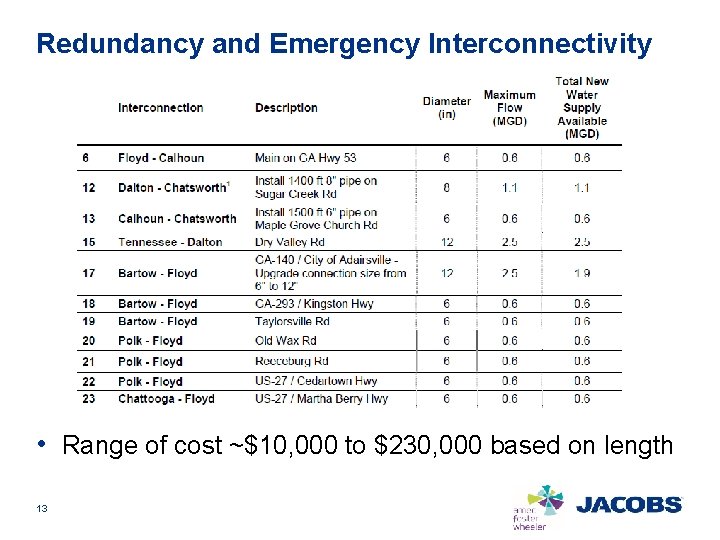
Redundancy and Emergency Interconnectivity • Proposed additional interconnection projects 12
Redundancy and Emergency Interconnectivity • Range of cost ~$10, 000 to $230, 000 based on length 13
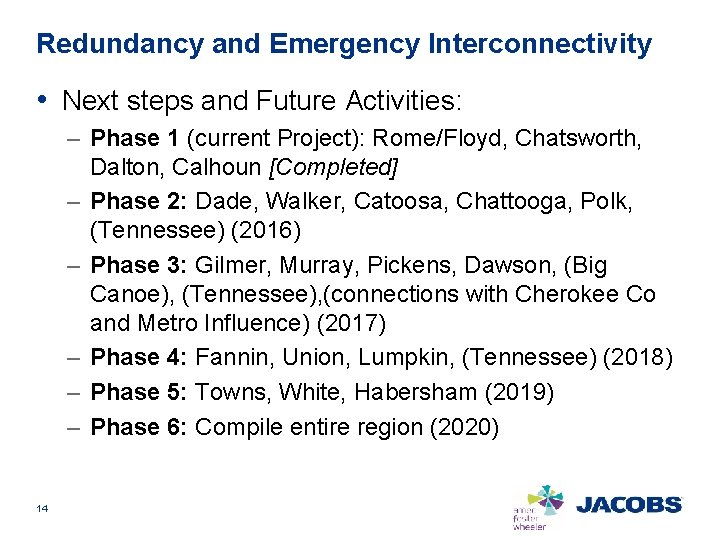
Redundancy and Emergency Interconnectivity • Next steps and Future Activities: – Phase 1 (current Project): Rome/Floyd, Chatsworth, Dalton, Calhoun [Completed] – Phase 2: Dade, Walker, Catoosa, Chattooga, Polk, (Tennessee) (2016) – Phase 3: Gilmer, Murray, Pickens, Dawson, (Big Canoe), (Tennessee), (connections with Cherokee Co and Metro Influence) (2017) – Phase 4: Fannin, Union, Lumpkin, (Tennessee) (2018) – Phase 5: Towns, White, Habersham (2019) – Phase 6: Compile entire region (2020) 14
Water Transmission Grid Study 15
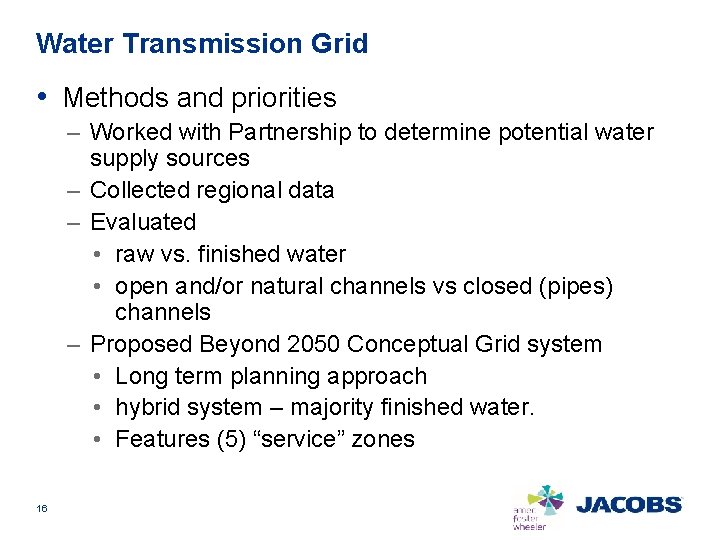
Water Transmission Grid • Methods and priorities – Worked with Partnership to determine potential water supply sources – Collected regional data – Evaluated • raw vs. finished water • open and/or natural channels vs closed (pipes) channels – Proposed Beyond 2050 Conceptual Grid system • Long term planning approach • hybrid system – majority finished water. • Features (5) “service” zones 16
Grid Concept Development 1. Envisioned as one continuous raw or finished pipeline available for anyone to tap 2. Refined to (4) service zones in GA and (1) service zone in TN 3. Reality of these endeavors is beyond 2050 as water supply projected needs are minimal through 2050 for the region 4. Planning for 3 rd generation 17
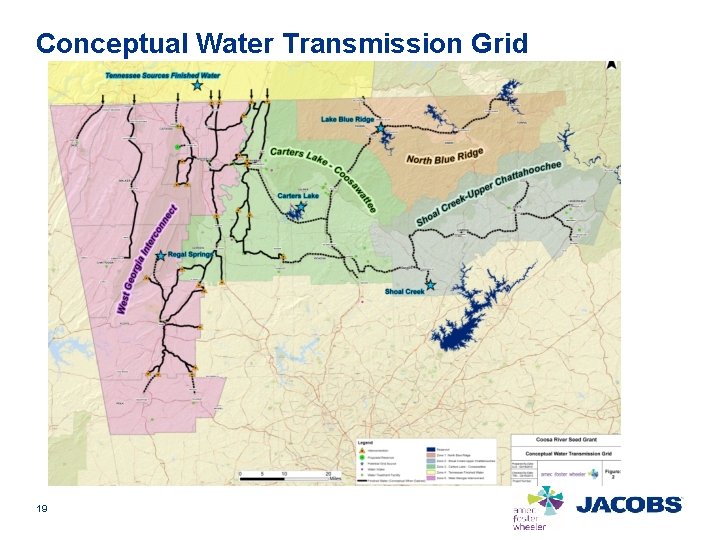
Conceptual Water Transmission Grid • • • 18 (Zone 1) - North Blue Ridge (Zone 2) -Shoal Creek-Upper Chattahoochee (Zone 3) - Carters Lake-Coosawattee (Zone 4) - Tennessee Finished Water (Zone 5) - West Georgia Interconnect
Conceptual Water Transmission Grid 19
Potential Water Supply Sources • Tennessee Water Systems • • • 20 Interconnections already exist (Tennessee American Water and Eastside Utility) Several GA municipalities and communities currently purchase water from TN Use of finished water avoids controversy
Potential Water Supply Sources • Rome/Dalton/Calhoun • • 21 Surplus water available now and near future As part of Redundancy and Emergency Interconnectivity Study this focus area is identified as an example for the region and possible the state • Highly interconnected already
Potential Water Supply Sources • Regal Springs • • • 22 A well and surface water spring system Benefits include requiring minimal treatment and conveniently located to west side of region
Potential Water Supply Sources • Lake Blue Ridge • • 23 Blue Ridge was chosen over Nottley or Chattuge due to proximity to future water needs Conceptual grid envisions future connection to other lakes in the area
Potential Water Supply Sources • Proposed Reservoir on Dry Creek • • 24 Identified in “Preliminary Water Supply Study Technical Memorandum” by Partnership in 2008 Projected yield ~ 12. 2 MGD Located between Catoosa and Whitfield counties One of highest rated potential reservoirs
Potential Water Supply Sources • Shoal Creek Reservoir • • • 25 Potential yield 100 MGD Proximity to southern and eastern Coosa region Eliminates moving water through difficult terrain
Recommendations and Costs Ø Ø Closed pipelines to transport water Break region into interconnected zones Move water through path of least resistance Costs for these types of project pipeline scenarios range from $17 M to $58 M per zone or on average at $11 M per pipeline length Ø Similar projects around the world range from $100 s of millions to $1 billion 26
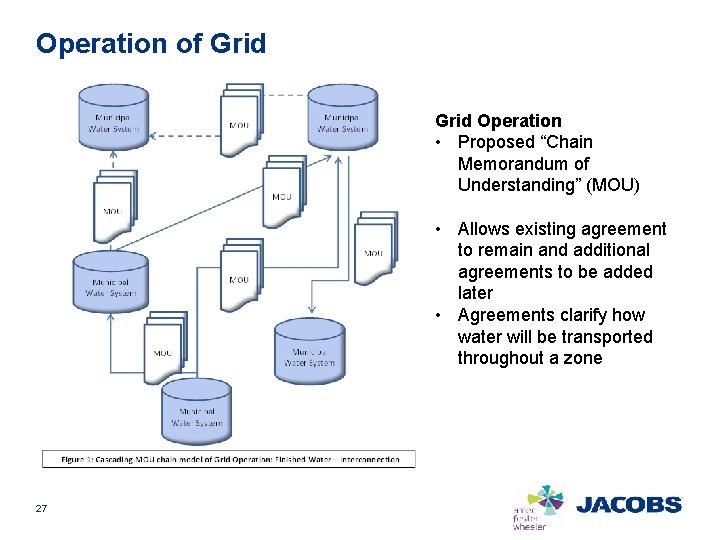
Operation of Grid Operation • Proposed “Chain Memorandum of Understanding” (MOU) • Allows existing agreement to remain and additional agreements to be added later • Agreements clarify how water will be transported throughout a zone 27
Water Transmission Grid Future Activities: • • Incorporate additional interconnection areas Collect additional data: utilities corridors. Identify future regional water supply projects Establish regional goals – Target emergency redundancy rates 35% and 65%? – Local and regional systems work to achieve goals. 28
Comments, Questions and Discussion Michelle Vincent, Jacobs and Tanya Kinnard, Amec Foster Wheeler 22 © Copyright October 2021 Jacobs www. jacobs. com | worldwide