
Reduction of an ER Schema to Tables n
Reduction of an E-R Schema to Tables n A database which conforms to an E-R diagram can be represented by a collection of tables. n Converting an E-R diagram to a table format is the basis for deriving a relational database design from an E-R diagram. n Primary keys allow entity sets and relationship sets to be expressed uniformly as tables which represent the contents of the database. n For each entity set and relationship set there is a unique table which is assigned the name of the corresponding entity set or relationship set. n Each table has a number of columns (in the case of entity sets, corresponding to attributes), which have unique names. Database System Concepts 2. 1 ©Silberschatz, Korth and Sudarshan
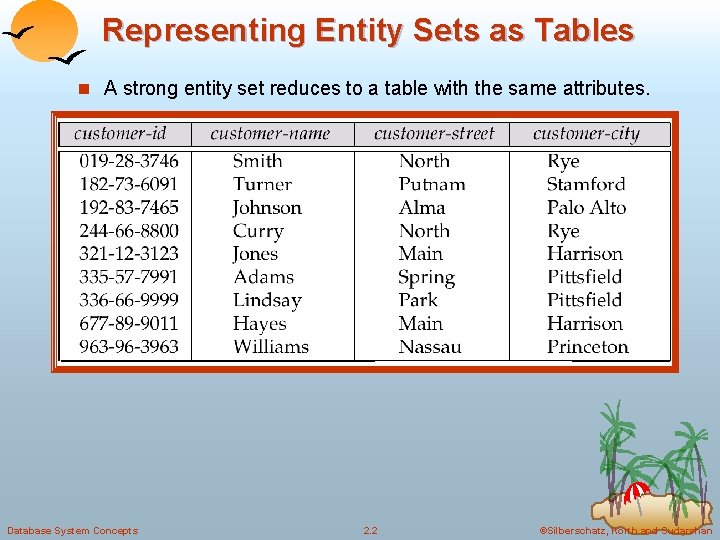
Representing Entity Sets as Tables n A strong entity set reduces to a table with the same attributes. Database System Concepts 2. 2 ©Silberschatz, Korth and Sudarshan
Composite and Multivalued Attributes n Composite attributes are flattened out by creating a separate attribute for each component attribute H E. g. given entity set customer with composite attribute name with component attributes first-name and last-name the table corresponding to the entity set has two attributes name. first-name and name. last-name n A multivalued attribute M of an entity E is represented by a separate table EM H Table EM has attributes corresponding to the primary key of E and an attribute corresponding to multivalued attribute M H E. g. Multivalued attribute dependent-names of employee is represented by a table employee-dependent-names( employee-id, dname) H Each value of the multivalued attribute maps to a separate row of the table EM 4 E. g. , an employee entity with primary key John and dependents Johnson and Johndotir maps to two rows: (John, Johnson) and (John, Johndotir) Database System Concepts 2. 3 ©Silberschatz, Korth and Sudarshan
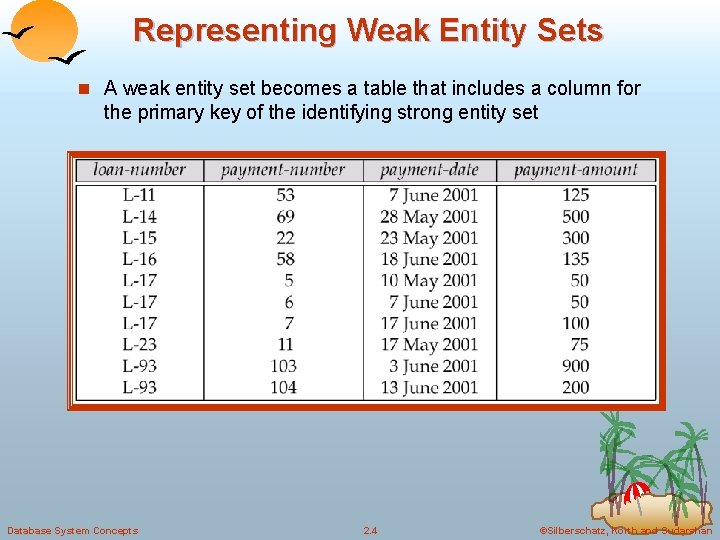
Representing Weak Entity Sets n A weak entity set becomes a table that includes a column for the primary key of the identifying strong entity set Database System Concepts 2. 4 ©Silberschatz, Korth and Sudarshan
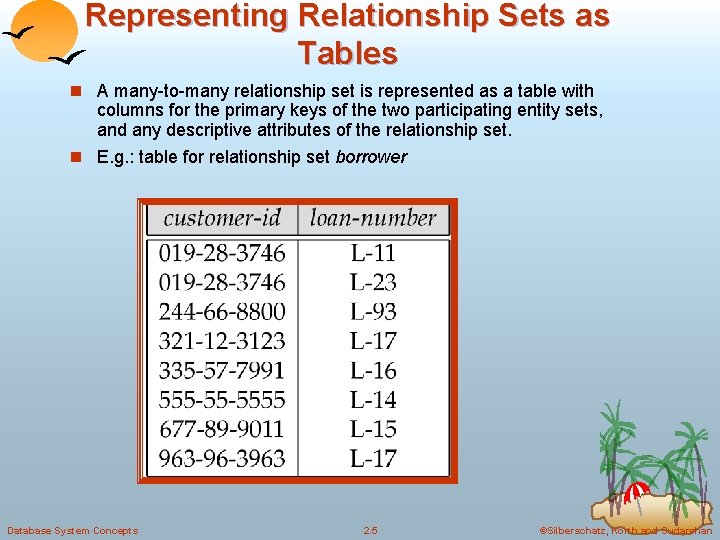
Representing Relationship Sets as Tables n A many-to-many relationship set is represented as a table with columns for the primary keys of the two participating entity sets, and any descriptive attributes of the relationship set. n E. g. : table for relationship set borrower Database System Concepts 2. 5 ©Silberschatz, Korth and Sudarshan
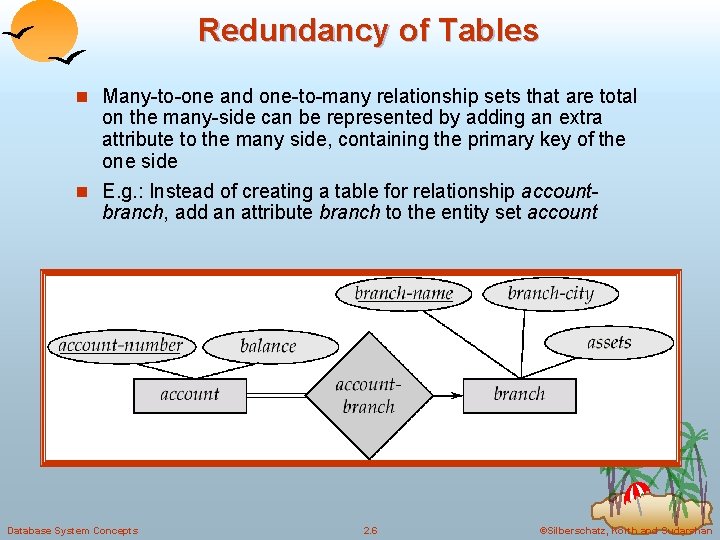
Redundancy of Tables n Many-to-one and one-to-many relationship sets that are total on the many-side can be represented by adding an extra attribute to the many side, containing the primary key of the one side n E. g. : Instead of creating a table for relationship accountbranch, add an attribute branch to the entity set account Database System Concepts 2. 6 ©Silberschatz, Korth and Sudarshan
Redundancy of Tables (Cont. ) n For one-to-one relationship sets, either side can be chosen to act as the “many” side H That is, extra attribute can be added to either of the tables corresponding to the two entity sets n If participation is partial on the many side, replacing a table by an extra attribute in the relation corresponding to the “many” side could result in null values n The table corresponding to a relationship set linking a weak entity set to its identifying strong entity set is redundant. H E. g. The payment table already contains the information that would appear in the loan-payment table (i. e. , the columns loan-number and payment-number). Database System Concepts 2. 7 ©Silberschatz, Korth and Sudarshan
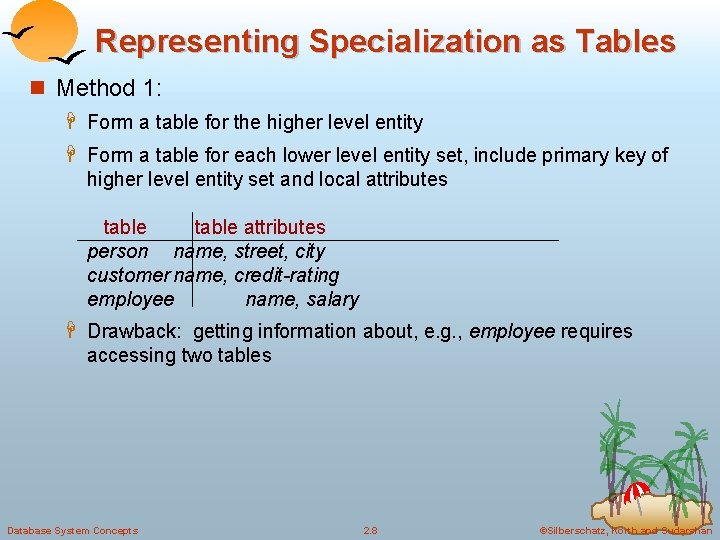
Representing Specialization as Tables n Method 1: H Form a table for the higher level entity H Form a table for each lower level entity set, include primary key of higher level entity set and local attributes table attributes person name, street, city customer name, credit-rating employee name, salary H Drawback: getting information about, e. g. , employee requires accessing two tables Database System Concepts 2. 8 ©Silberschatz, Korth and Sudarshan
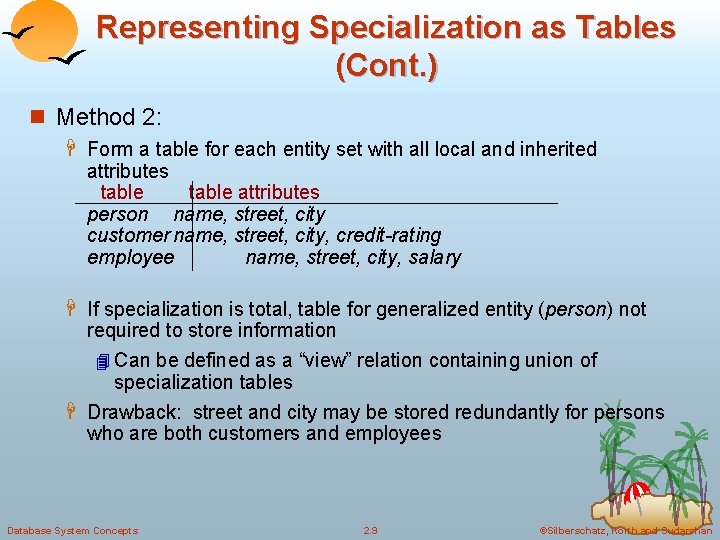
Representing Specialization as Tables (Cont. ) n Method 2: H Form a table for each entity set with all local and inherited attributes table attributes person name, street, city customer name, street, city, credit-rating employee name, street, city, salary H If specialization is total, table for generalized entity (person) not required to store information 4 Can be defined as a “view” relation containing union of specialization tables H Drawback: street and city may be stored redundantly for persons who are both customers and employees Database System Concepts 2. 9 ©Silberschatz, Korth and Sudarshan
Relations Corresponding to Aggregation n To represent aggregation, create a table containing n primary key of the aggregated relationship, n the primary key of the associated entity set n any descriptive attributes Database System Concepts 2. 10 ©Silberschatz, Korth and Sudarshan
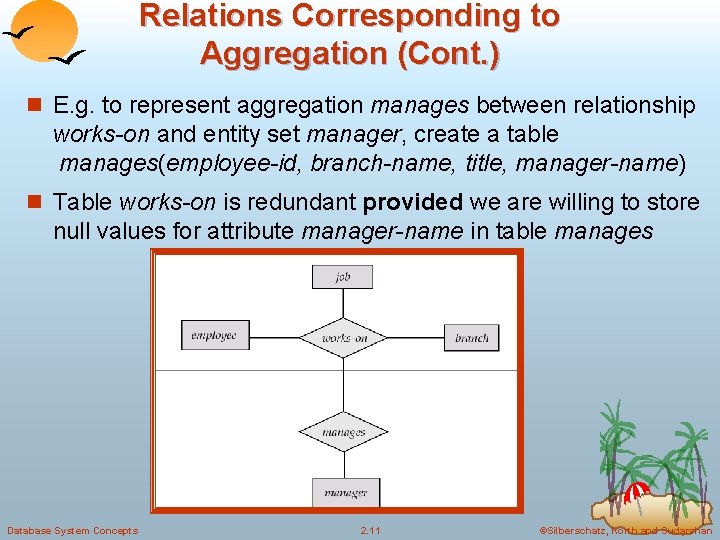
Relations Corresponding to Aggregation (Cont. ) n E. g. to represent aggregation manages between relationship works-on and entity set manager, create a table manages(employee-id, branch-name, title, manager-name) n Table works-on is redundant provided we are willing to store null values for attribute manager-name in table manages Database System Concepts 2. 11 ©Silberschatz, Korth and Sudarshan
End of Chapter 2
- Slides: 12