
Reducing Regional Disparities through Regional Integration Saman Kelegama

- Slides: 17
Reducing Regional Disparities through Regional Integration Saman Kelegama Institute of Policy Studies of Sri Lanka
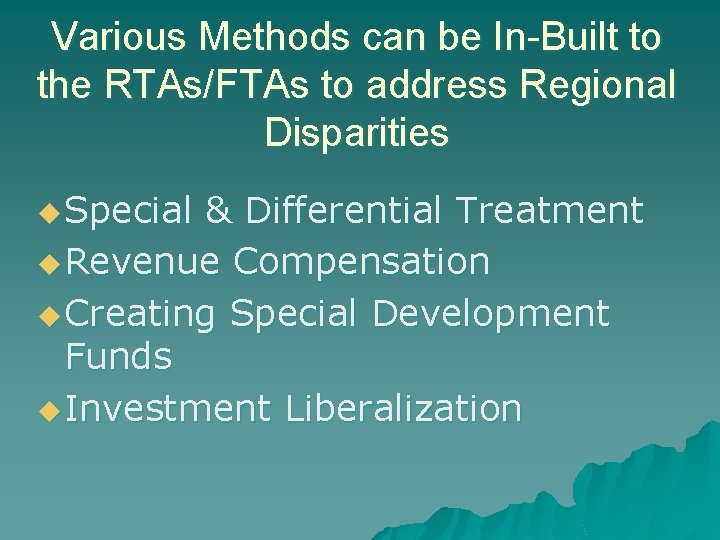
Various Methods can be In-Built to the RTAs/FTAs to address Regional Disparities u Special & Differential Treatment u Revenue Compensation u Creating Special Development Funds u Investment Liberalization
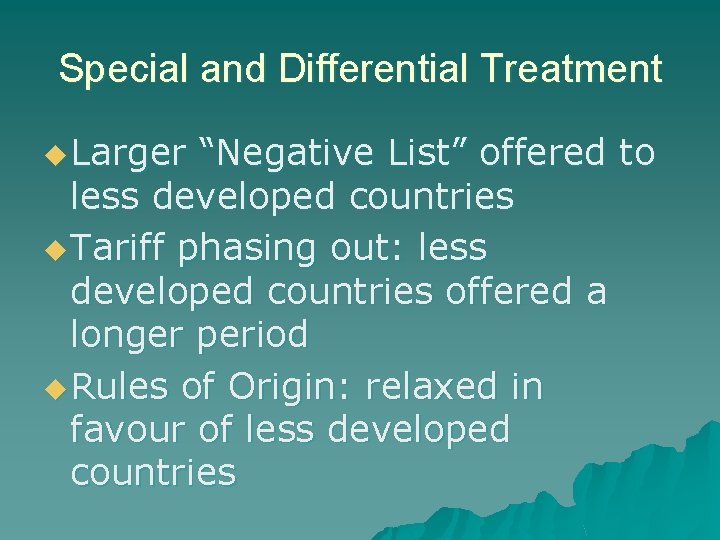
Special and Differential Treatment u Larger “Negative List” offered to less developed countries u Tariff phasing out: less developed countries offered a longer period u Rules of Origin: relaxed in favour of less developed countries
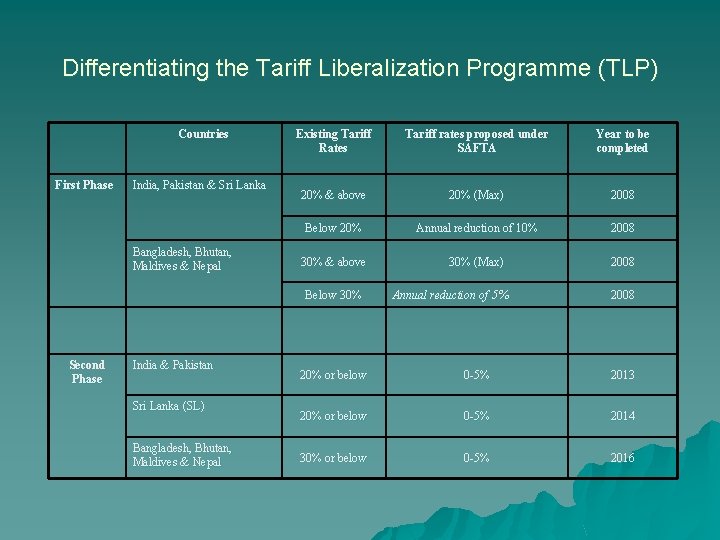
Differentiating the Tariff Liberalization Programme (TLP) Countries First Phase India, Pakistan & Sri Lanka Bangladesh, Bhutan, Maldives & Nepal Existing Tariff Rates Tariff rates proposed under SAFTA Year to be completed 20% & above 20% (Max) 2008 Below 20% Annual reduction of 10% 2008 30% & above 30% (Max) 2008 Annual reduction of 5% 2008 Below 30% Second Phase India & Pakistan Sri Lanka (SL) Bangladesh, Bhutan, Maldives & Nepal 20% or below 0 -5% 2013 20% or below 0 -5% 2014 30% or below 0 -5% 2016
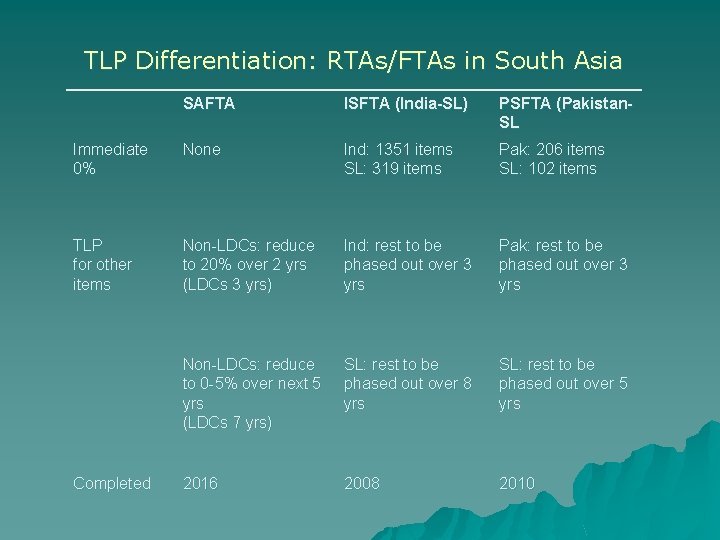
TLP Differentiation: RTAs/FTAs in South Asia SAFTA ISFTA (India-SL) PSFTA (Pakistan. SL Immediate 0% None Ind: 1351 items SL: 319 items Pak: 206 items SL: 102 items TLP for other items Non-LDCs: reduce to 20% over 2 yrs (LDCs 3 yrs) Ind: rest to be phased out over 3 yrs Pak: rest to be phased out over 3 yrs Non-LDCs: reduce to 0 -5% over next 5 yrs (LDCs 7 yrs) SL: rest to be phased out over 8 yrs SL: rest to be phased out over 5 yrs 2016 2008 2010 Completed
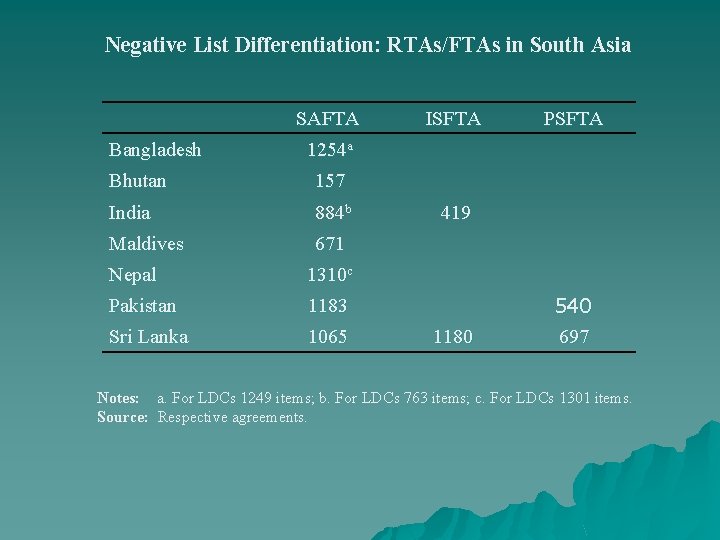
Negative List Differentiation: RTAs/FTAs in South Asia SAFTA Bangladesh ISFTA PSFTA 1254 a Bhutan 157 India 884 b Maldives 671 Nepal 1310 c Pakistan 1183 Sri Lanka 1065 419 1180 540 697 Notes: a. For LDCs 1249 items; b. For LDCs 763 items; c. For LDCs 1301 items. Source: Respective agreements.
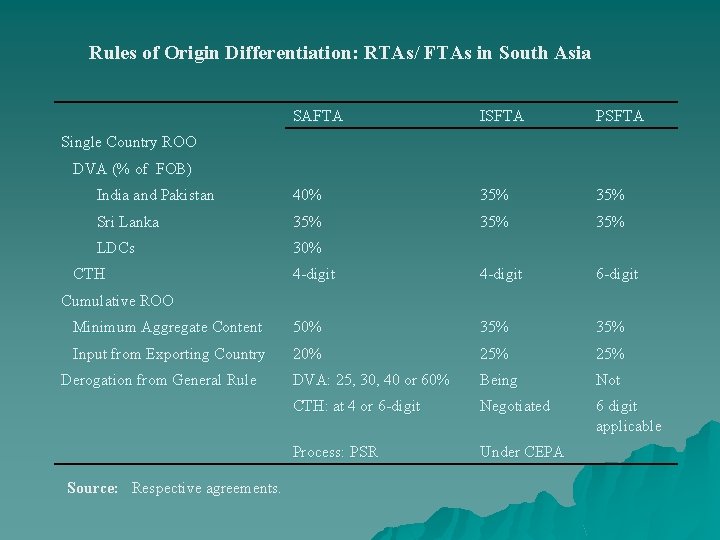
Rules of Origin Differentiation: RTAs/ FTAs in South Asia SAFTA ISFTA PSFTA India and Pakistan 40% 35% Sri Lanka 35% 35% LDCs 30% 4 -digit 6 -digit Minimum Aggregate Content 50% 35% Input from Exporting Country 20% 25% DVA: 25, 30, 40 or 60% Being Not CTH: at 4 or 6 -digit Negotiated 6 digit applicable Process: PSR Under CEPA Single Country ROO DVA (% of FOB) CTH Cumulative ROO Derogation from General Rule Source: Respective agreements.
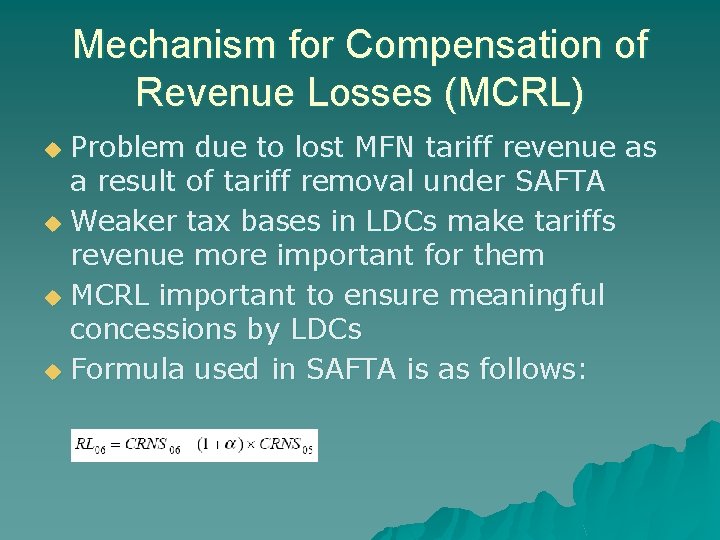
Mechanism for Compensation of Revenue Losses (MCRL) Problem due to lost MFN tariff revenue as a result of tariff removal under SAFTA u Weaker tax bases in LDCs make tariffs revenue more important for them u MCRL important to ensure meaningful concessions by LDCs u Formula used in SAFTA is as follows: u
Problems of MCRL The MCRL takes time to come into operation (SAFTA-4 years) u There is no inbuilt incentives for LDCs to devise alternative domestic mechanisms to raise revenue u No inbuilt incentives for non-LDCs to provide technical assistance for compensation u Unreliability of customs data could affect efficacy of MCRL u
Development Fund SAARC EPG Report (1998) recommended US $ 500 mn for establishing a South Asia Development Fund [SDF] (with major contribution from the more developed member countries, and possible outside sources) u SDF now established with major contributions from India. Funds could be utilized for supply-side development of LDCs u EU – Fund was available for Ireland, Portugal, etc. u GMS under ADB support for supply sector development of Southeast Asia u
Development Fund For those RTAs where there are ‘observers’, they can be invited to contribute to the Development Fund u In Comprehensive Economic Partnership Agreement’s there is an ‘Economic Cooperation’ window where the more developed country can assist through concessional credit lines to develop the supply side of the less developed partner u
Investment Liberalization u SAARC EPG report argues for creating a SAARC Investment Area u Intra-regional investments can assist in creating supply capabilities u Investment integration can facilitate industrial restructuring to assist in building supply capabilities in relatively smaller and lesser developed economies
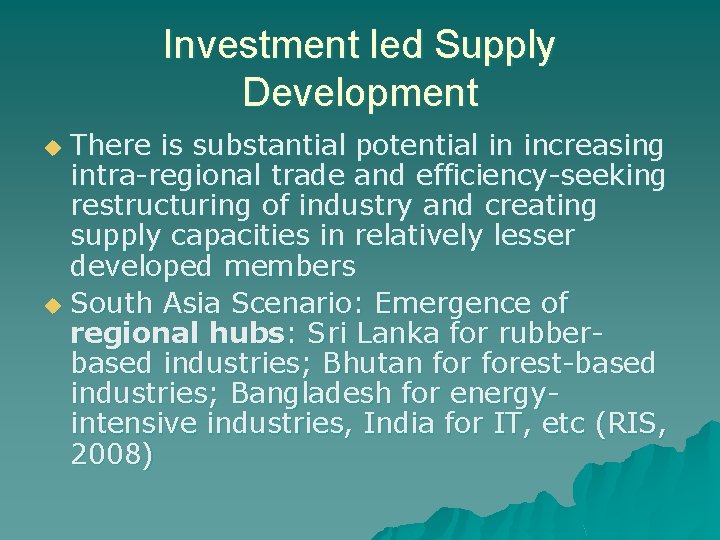
Investment led Supply Development There is substantial potential in increasing intra-regional trade and efficiency-seeking restructuring of industry and creating supply capacities in relatively lesser developed members u South Asia Scenario: Emergence of regional hubs: Sri Lanka for rubberbased industries; Bhutan forest-based industries; Bangladesh for energyintensive industries, India for IT, etc (RIS, 2008) u
Investment led Development u By facilitating development of supply capabilities in smaller and lesser developed countries in the regional groupings, the industrial restructuring leads to balanced regional development. u ASEAN Investment Area, ASEAN Industrial Cooperation, etc. , are partly based on this idea
Investment led Development Less developed countries (viz. Spain, Portugal, Greece, Ireland in EU) are the key beneficiaries of integration through industrial restructuring and building of supply capabilities u Sri Lanka has benefited from Indian investment in increasing export and supply base development u Faster growth and convergence of levels of development can be achieved u
Unilateral Offers/Voluntary Methods Larger/developed country can make unilateral offers in trade. In SAFTA, India offered duty free entry for SAARC LDC goods subject to a negative list with effect from 1. 1. 08 u BIMSTEC liberalization is based on the 3 + x formula, where those members that are reluctant to join at the beginning, can join when they are ready u
Thank You u www. ips. lk