
Reducing OS noise using offload driver on Intel


- Slides: 14
Reducing OS noise using offload driver on Intel® Xeon Phi™ Processor Grzegorz Andrejczuk grzegorz. andrejczuk@intel. com Intel Technology Poland IXPUG Annual Fall Conference 2017 1
Introduction Irregularities caused by events like timer interrupts are already recognized as a problem for highly parallel applications running on multi-core processors. Linux tickless kernel is becoming a standard option on HPC compute nodes, but it does not eliminate OS noise completely. IXPUG Annual Fall Conference 2017 2
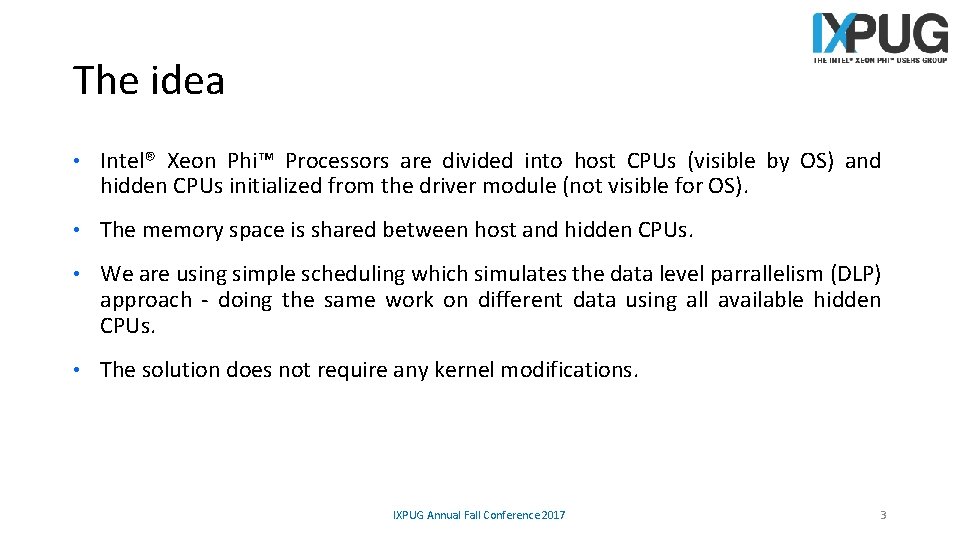
The idea • Intel® Xeon Phi™ Processors are divided into host CPUs (visible by OS) and hidden CPUs initialized from the driver module (not visible for OS). • The memory space is shared between host and hidden CPUs. • We are using simple scheduling which simulates the data level parrallelism (DLP) approach - doing the same work on different data using all available hidden CPUs. • The solution does not require any kernel modifications. IXPUG Annual Fall Conference 2017 3
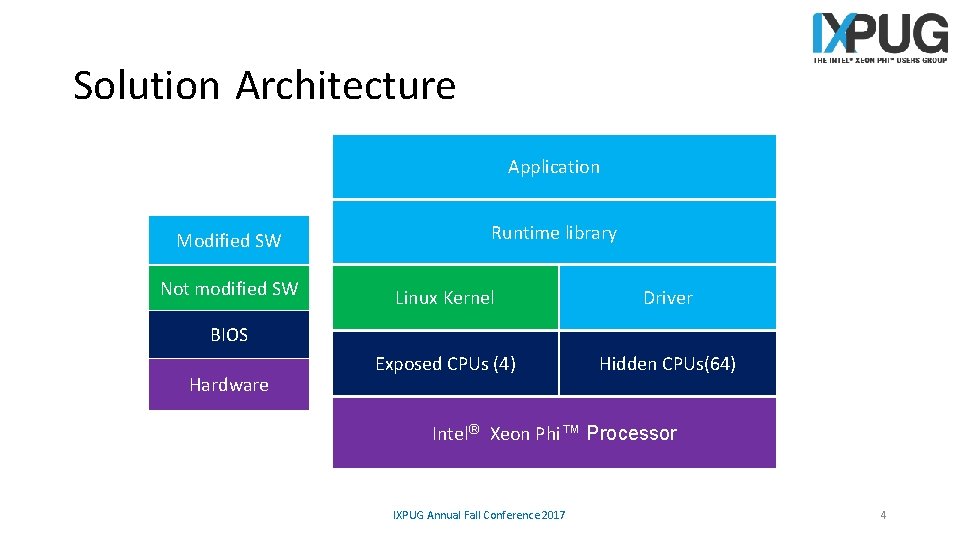
Solution Architecture Application Modified SW Not modified SW Runtime library Linux Kernel Driver Exposed CPUs (4) Hidden CPUs(64) BIOS Hardware Intel® Xeon Phi™ Processor IXPUG Annual Fall Conference 2017 4
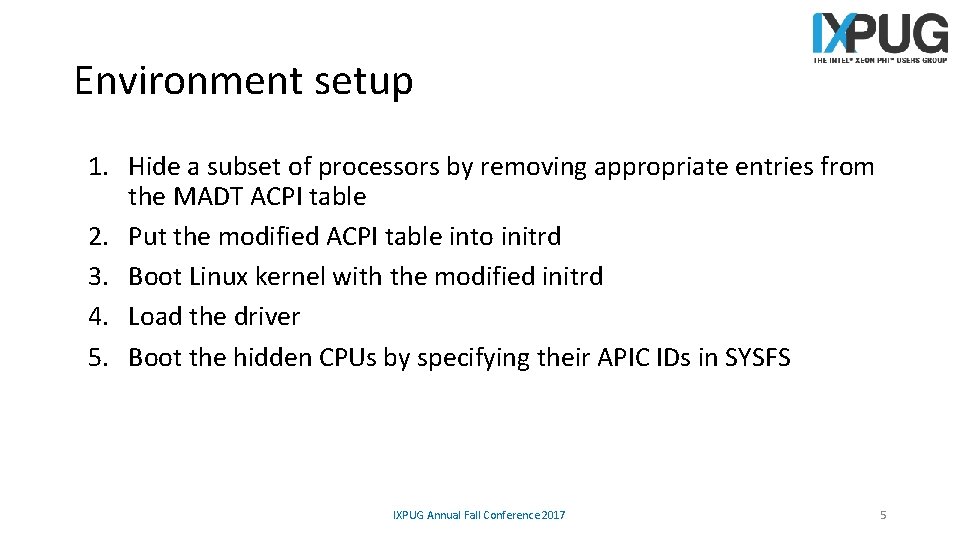
Environment setup 1. Hide a subset of processors by removing appropriate entries from the MADT ACPI table 2. Put the modified ACPI table into initrd 3. Boot Linux kernel with the modified initrd 4. Load the driver 5. Boot the hidden CPUs by specifying their APIC IDs in SYSFS IXPUG Annual Fall Conference 2017 5
Initialization control flow 1. Application initializes the runtime library. 2. The runtime library reserves the hidden CPUs and uses the driver to request to execute its code there. 3. The driver initializes the hidden CPUs and starts executing the “idle” loop. 4. The hidden CPUs wait for the work from Application. Work: • pointer to function • pointer to data IXPUG Annual Fall Conference 2017 Host Userspace Driver Userspace Host Kernelspace Driver Kernelspace 6
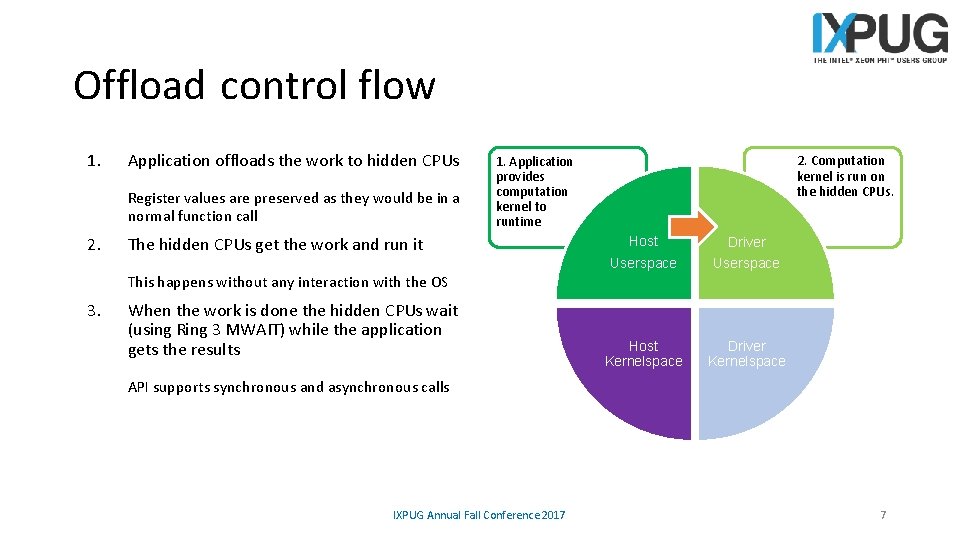
Offload control flow 1. Application offloads the work to hidden CPUs Register values are preserved as they would be in a normal function call 2. Computation kernel is run on the hidden CPUs. 1. Application provides computation kernel to runtime The hidden CPUs get the work and run it Host Userspace Driver Userspace Host Kernelspace Driver Kernelspace 7 This happens without any interaction with the OS 3. When the work is done the hidden CPUs wait (using Ring 3 MWAIT) while the application gets the results API supports synchronous and asynchronous calls IXPUG Annual Fall Conference 2017 7
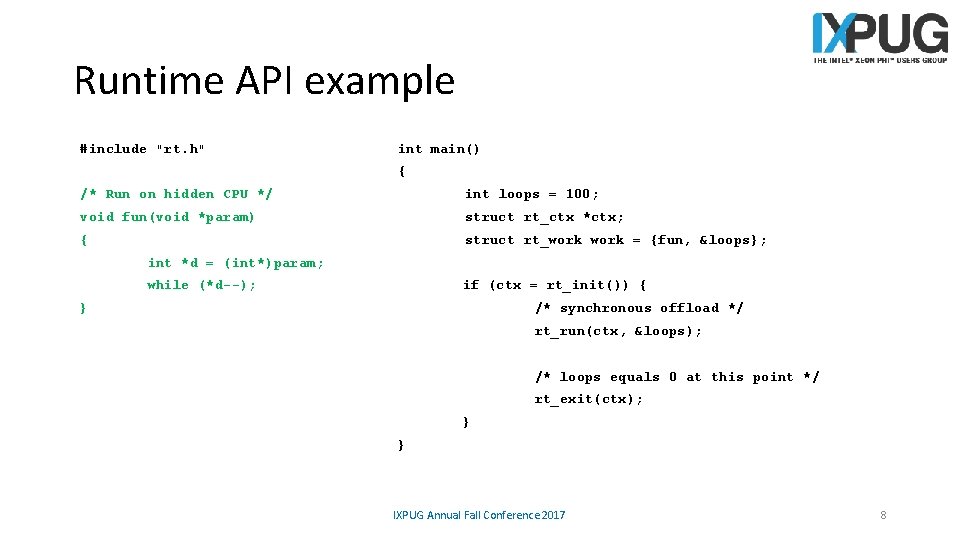
Runtime API example #include "rt. h" int main() { /* Run on hidden CPU */ int loops = 100; void fun(void *param) struct rt_ctx *ctx; { struct rt_work = {fun, &loops}; int *d = (int*)param; while (*d--); if (ctx = rt_init()) { } /* synchronous offload */ rt_run(ctx, &loops); /* loops equals 0 at this point */ rt_exit(ctx); } } IXPUG Annual Fall Conference 2017 8
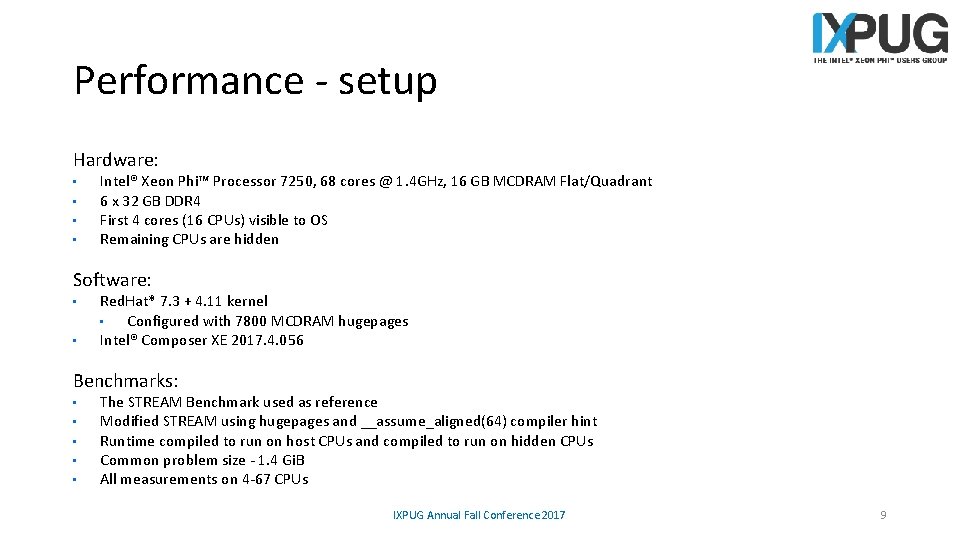
Performance - setup Hardware: • • Intel® Xeon Phi™ Processor 7250, 68 cores @ 1. 4 GHz, 16 GB MCDRAM Flat/Quadrant 6 x 32 GB DDR 4 First 4 cores (16 CPUs) visible to OS Remaining CPUs are hidden Software: • • Red. Hat* 7. 3 + 4. 11 kernel • Configured with 7800 MCDRAM hugepages Intel® Composer XE 2017. 4. 056 Benchmarks: • • • The STREAM Benchmark used as reference Modified STREAM using hugepages and __assume_aligned(64) compiler hint Runtime compiled to run on host CPUs and compiled to run on hidden CPUs Common problem size - 1. 4 Gi. B All measurements on 4 -67 CPUs IXPUG Annual Fall Conference 2017 9
Performance - STREAM Reference experiment : • STREAM Benchmark using Open. MP • nohz_full=1 -271 Experiment 1: • STREAM using Open. MP • nohz_full=1 -271 isolcpus=1 -271 Experiment 2: • Modified STREAM using Open. MP • nohz_full=1 -271 isolcpus=1 -271 Experiment 3: • Modified STREAM using runtime compiled to run on host • nohz_full=1 -271 isolcpus=1 -271 Experiment 4: • Modified STREAM using runtime compiled to use hidden CPUs • nohz_full=1 -271 isolcpus=1 -271 Measurement Result [%] Reference 100 Experiment 1 100 Experiment 2 106 Experiment 3 107 Experiment 4 107. 5 IXPUG Annual Fall Conference 2017 10
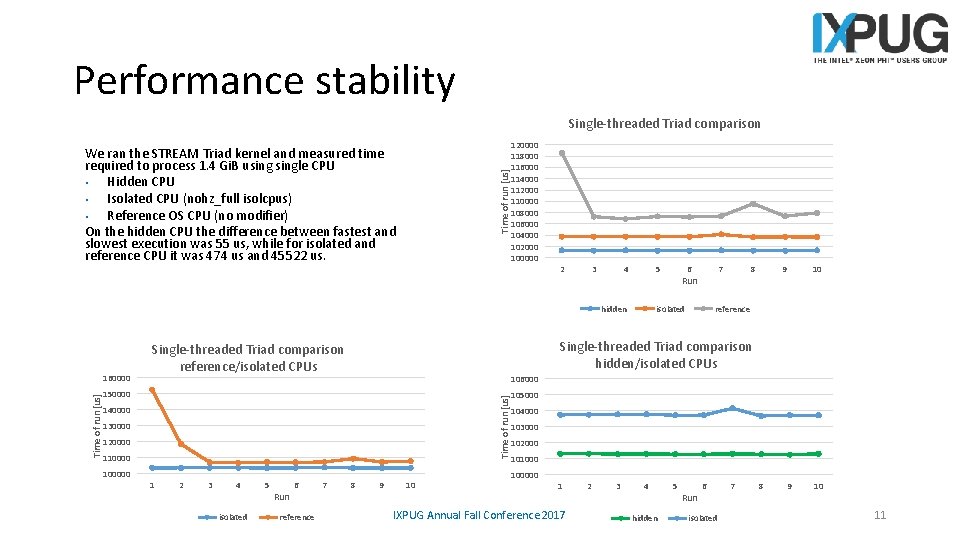
Performance stability Single-threaded Triad comparison 120000 118000 116000 114000 112000 110000 108000 106000 104000 102000 100000 Time of run [us] We ran the STREAM Triad kernel and measured time required to process 1. 4 Gi. B usingle CPU • Hidden CPU • Isolated CPU (nohz_full isolcpus) • Reference OS CPU (no modifier) On the hidden CPU the difference between fastest and slowest execution was 55 us, while for isolated and reference CPU it was 474 us and 45522 us. 2 3 4 5 hidden 160000 7 isolated 8 9 10 reference Single-threaded Triad comparison hidden/isolated CPUs Single-threaded Triad comparison reference/isolated CPUs 106000 150000 Time of run [us] 105000 140000 104000 130000 103000 120000 102000 1100000 6 Run 101000 1 2 3 4 isolated 5 Run 6 reference 7 8 9 10 100000 1 IXPUG Annual Fall Conference 2017 2 3 4 hidden 5 Run 6 isolated 7 8 9 10 11
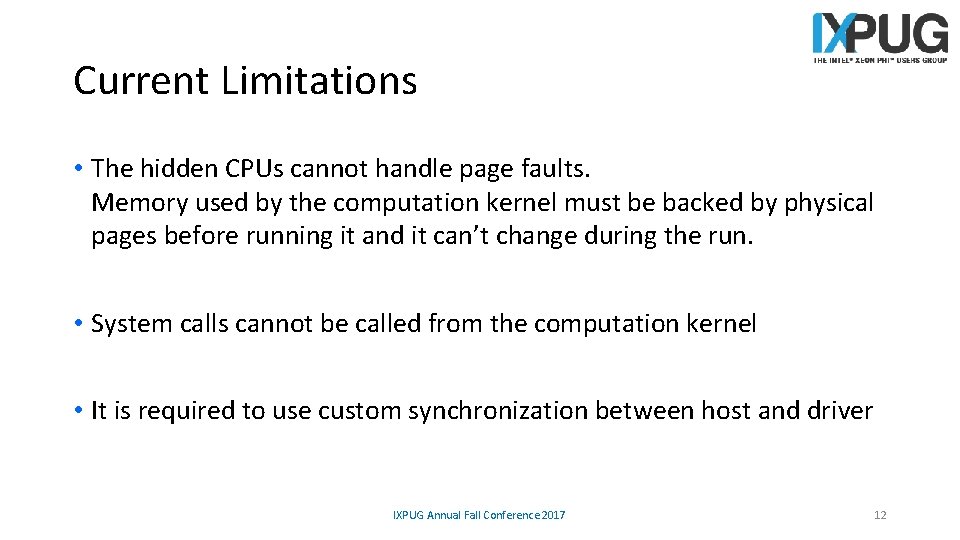
Current Limitations • The hidden CPUs cannot handle page faults. Memory used by the computation kernel must be backed by physical pages before running it and it can’t change during the run. • System calls cannot be called from the computation kernel • It is required to use custom synchronization between host and driver IXPUG Annual Fall Conference 2017 12
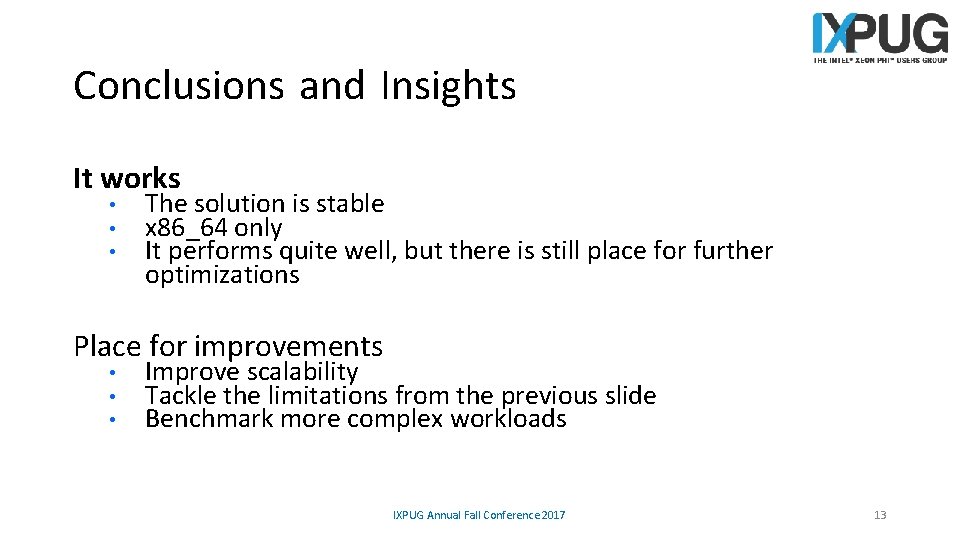
Conclusions and Insights It works • • • The solution is stable x 86_64 only It performs quite well, but there is still place for further optimizations Place for improvements • • • Improve scalability Tackle the limitations from the previous slide Benchmark more complex workloads IXPUG Annual Fall Conference 2017 13
Thank you The Team: • Łukasz Odzioba lukasz. odzioba@intel. com • Łukasz Daniluk lukasz. daniluk@intel. com • Paweł Karczewski pawel. karczewski@intel. com • Jarosław Kogut jaroslaw. kogut@intel. com • Krzysztor Góreczny krzysztof. goreczny@intel. com IXPUG Annual Fall Conference 2017 14