
Reducing Insulin Administration Errors The Independent Double Check
Reducing Insulin Administration Errors: The Independent Double Check Warren Prokopiw, BSc, BSP, M Eng Cynthia Turner, BPharm Michele Babich BSc(Pharm), MHSA
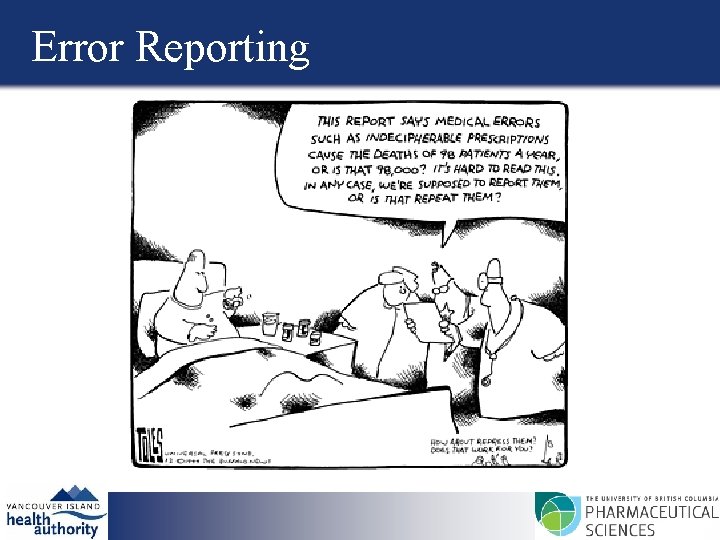
Background • Accreditation Canada – verification processes for high risk activities 1 • Institute for Safe Medication Practices – independent double check for high alert medications 2 • BC Patient Safety and Learning System – Voluntary reporting system for trend analysis – Known to under-report actual rates 3

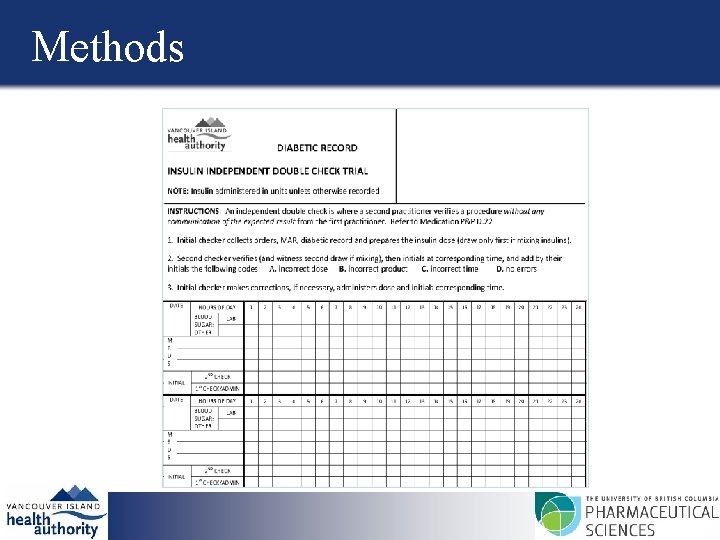
Background • Independent Double Checks (IDCs)4 – Second practitioner verifies a procedure – No communication of expected result from first practitioner • Removes bias • Maximize catching errors
Objectives • Primary – To determine which medication has the highest administration events within VIHA – To quantify the change in events occurring after implementation of independent double checks • Secondary – To investigate if simplifying event documentation increases the rate of voluntary reporting
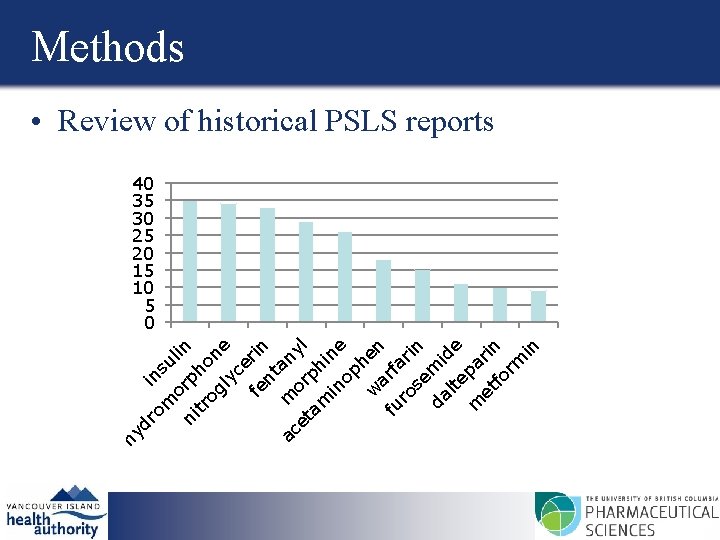
om ins u or lin ni p tr ho og n ly e ce fe rin nt ac m an et or yl am ph in ine op h w en a fu rfa ro r se in da mi lte de m pa et rin fo rm in dr hy Methods • Review of historical PSLS reports 40 35 30 25 20 15 10 5 0
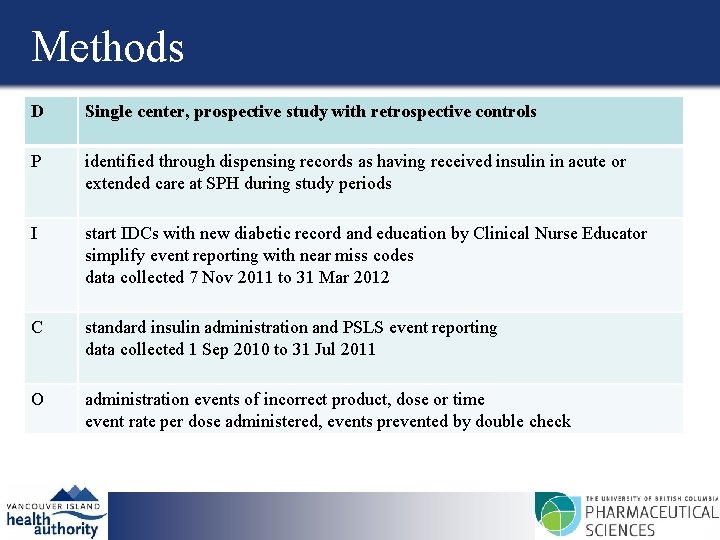
Methods D Single center, prospective study with retrospective controls P identified through dispensing records as having received insulin in acute or extended care at SPH during study periods I start IDCs with new diabetic record and education by Clinical Nurse Educator simplify event reporting with near miss codes data collected 7 Nov 2011 to 31 Mar 2012 C standard insulin administration and PSLS event reporting data collected 1 Sep 2010 to 31 Jul 2011 O administration events of incorrect product, dose or time event rate per dose administered, events prevented by double check
Methods
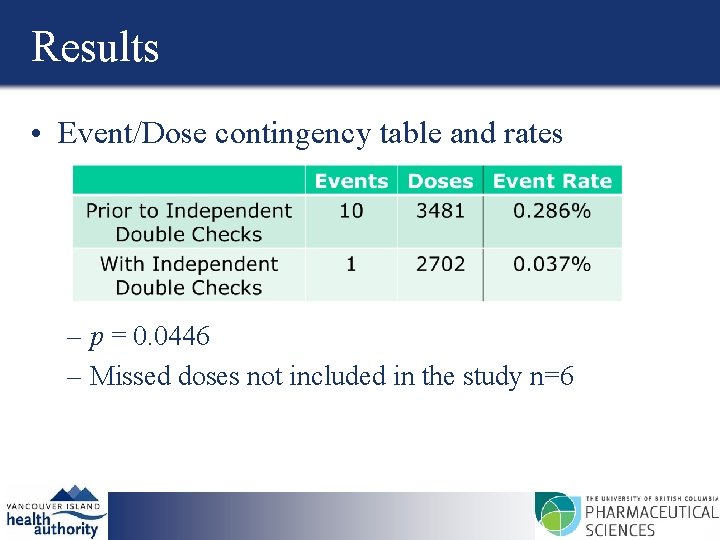
Results • Event/Dose contingency table and rates – p = 0. 0446 – Missed doses not included in the study n=6
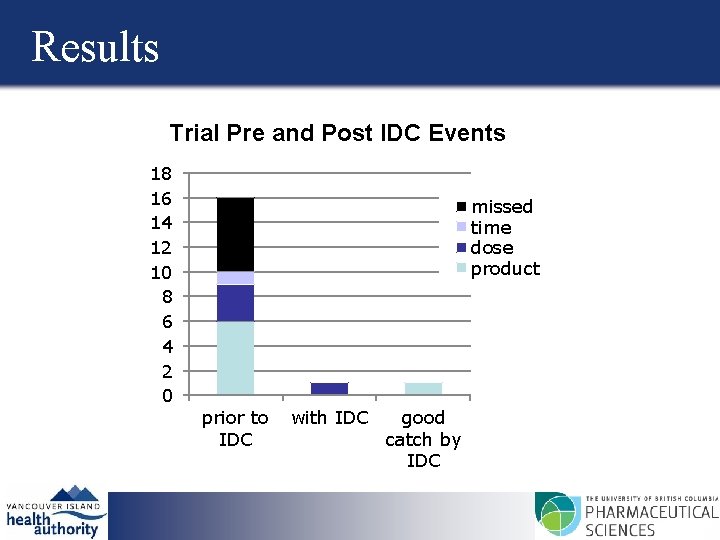
Results Trial Pre and Post IDC Events 18 16 14 12 10 8 6 4 2 0 missed time dose product prior to IDC with IDC good catch by IDC
Conclusions • Institution of independent double checks significantly reduced the number of insulin events per dose administered compared to pre-implementation • A good catch demonstrated IDCs work • Simplification of event documentation did not increase the rate of voluntary reporting • In the future, we plan to expand independent double checks for insulin administration throughout VIHA
Error Reporting
References 1. Accreditation Canada ROP Handbook 2011; 28 2. ISMP Canada Safety Bulletin 2005; 5(1) 3. Classen D Qual Saf Health Care 2005; 14 221– 226. 4. VIHA Medication P&P D. 22
Thank you!
- Slides: 13