
Reducing Emissions from Deforestation and Forest Degradation Forest
- Slides: 30
Reducing Emissions from Deforestation and Forest Degradation Forest Carbon Partnership Facility Procedures for Readiness Plan Review and Approval Participants Committee Meeting (FCPF PC 2) Gamboa, Panama, March 11 -13, 2009
Outline § Overview § R-Plan review and approval procedures § Schedule for review § Model for R-Plan review § Roster of Experts § TAP 2 objectives § R-Plan template § R-Plan review criteria § Conclusion
§ Mimics the R-PIN review process of TAP #1 § Uses a cycle of draft, comment, and revision § Submission of R-Plan 9 weeks before PC meeting § Establishes Technical Advisory Panel #2: Overview § Review of R-Plans § Technical Assistance § Roster of Experts § Internal Bank review § Web posting of revised R-Plan prior to PC meeting: available to public § 3 R-Plan submissions to PC allowed
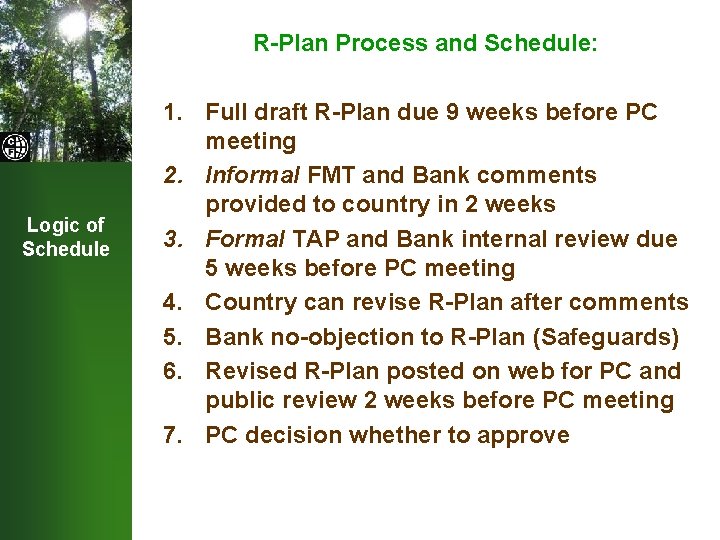
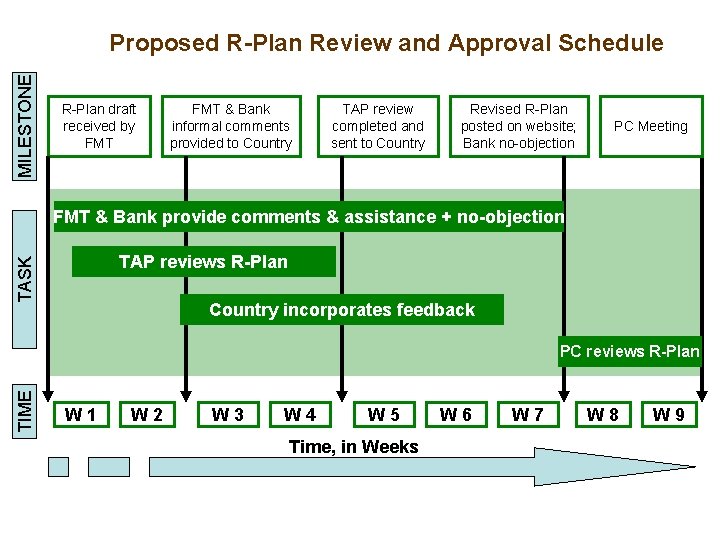
R-Plan Process and Schedule: Logic of Schedule 1. Full draft R-Plan due 9 weeks before PC meeting 2. Informal FMT and Bank comments provided to country in 2 weeks 3. Formal TAP and Bank internal review due 5 weeks before PC meeting 4. Country can revise R-Plan after comments 5. Bank no-objection to R-Plan (Safeguards) 6. Revised R-Plan posted on web for PC and public review 2 weeks before PC meeting 7. PC decision whether to approve
MILESTONE Proposed R-Plan Review and Approval Schedule R-Plan draft received by FMT & Bank informal comments provided to Country TAP review completed and sent to Country Revised R-Plan posted on website; Bank no-objection PC Meeting FMT & Bank provide comments & assistance + no-objection TASK TAP reviews R-Plan Country incorporates feedback TIME PC reviews R-Plan W 1 W 2 W 3 W 4 W 5 Time, in Weeks W 6 W 7 W 8 W 9
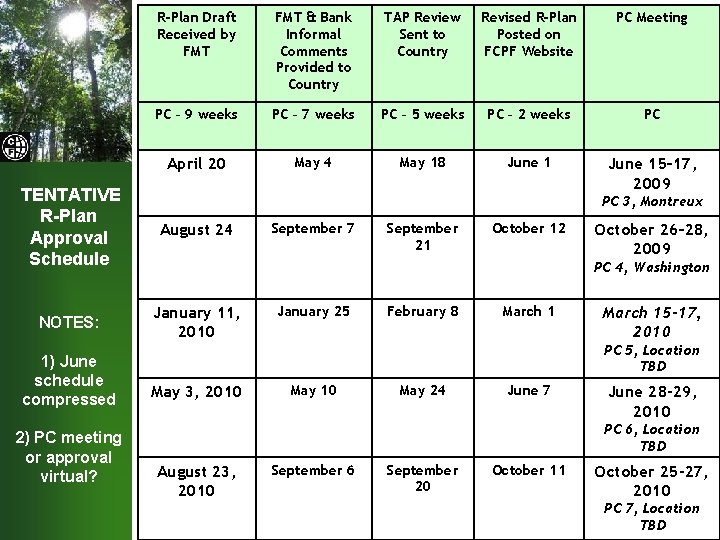
R-Plan Draft Received by FMT & Bank Informal Comments Provided to Country TAP Review Sent to Country Revised R-Plan Posted on FCPF Website PC Meeting PC – 9 weeks PC – 7 weeks PC – 5 weeks PC – 2 weeks PC April 20 May 4 May 18 June 15– 17, 2009 TENTATIVE R-Plan Approval Schedule August 24 NOTES: January 11, 2010 1) June schedule compressed 2) PC meeting or approval virtual? PC 3, Montreux September 7 September 21 October 12 October 26– 28, 2009 PC 4, Washington January 25 February 8 March 15 -17, 2010 PC 5, Location TBD May 3, 2010 May 24 June 7 June 28 -29, 2010 PC 6, Location TBD August 23, 2010 September 6 September 20 October 11 October 25 -27, 2010 PC 7, Location TBD
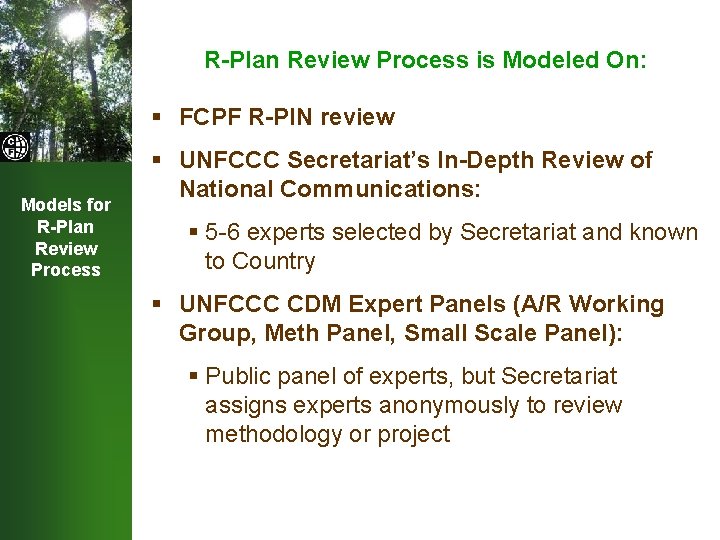
R-Plan Review Process is Modeled On: § FCPF R-PIN review Models for R-Plan Review Process § UNFCCC Secretariat’s In-Depth Review of National Communications: § 5 -6 experts selected by Secretariat and known to Country § UNFCCC CDM Expert Panels (A/R Working Group, Meth Panel, Small Scale Panel): § Public panel of experts, but Secretariat assigns experts anonymously to review methodology or project
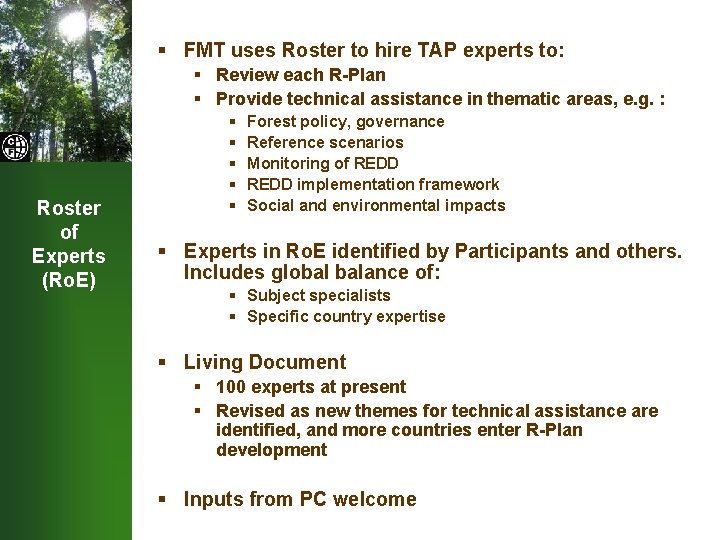
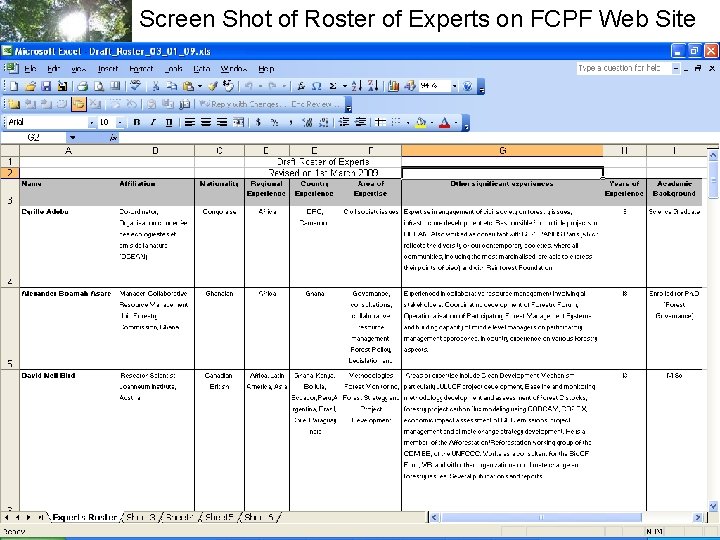
Roster of Experts § FMT uses Roster to hire TAP experts to: § Review each R-Plan § Provide technical assistance in thematic areas, e. g. : Roster of Experts (Ro. E) § § § Forest policy, governance Reference scenarios Monitoring of REDD implementation framework Social and environmental impacts § Experts in Ro. E identified by Participants and others. Includes global balance of: § Subject specialists § Specific country expertise § Living Document § 100 experts at present § Revised as new themes for technical assistance are identified, and more countries enter R-Plan development § Inputs from PC welcome
Screen Shot of Roster of Experts on FCPF Web Site
Review of R-Plans § 4 - 6 (<10) individual experts selected by FMT from Ro. E to constitute ‘TAP Country R-Plan Review Team’ TAP 2: Objective 1 § Cross-disciplinary expertise § 1 expert with FCPF R-PIN review experience (lead reviewer) + 1 expert with country experience (public) § Other experts from Ro. E (anonymous) § Review methods: desk review, country conference calls, meetings, occasional country visit § Avoid expert conflicts of interest § Final TAP Country R-Plan Review Team synthesis made public (as for R-PINs)
Technical Assistance and Expertise TAP 2: Objective 2 § Experts selected by FMT from Ro. E to provide technical expertise in a range of REDD issues § REDD methods development (e. g. , how to set reference case) § Limited assistance in response to country request (e. g. , how to set up national GHG registry) § Participation in expert processes, workshops, meetings on REDD
FMT Management of the TAP § § FMT Role § § Manages contracting, work, and quality of products Encourages consistency across R-Plan review teams and products Facilitate knowledge management to Participants and policy process FMT consults with FCPF Bureau on major decisions or commitments of resources Remuneration: standard Bank practices Contract period: § § March 15, 2009, to June 30, 2009 Extension possible to June 30, 2010
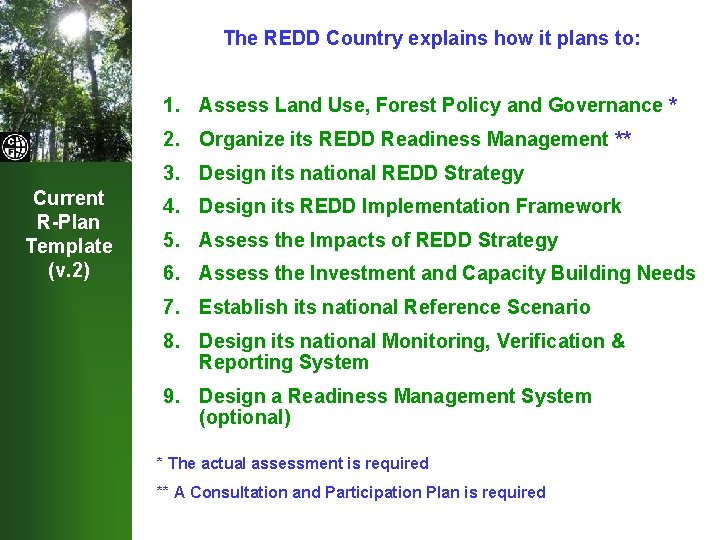
The REDD Country explains how it plans to: 1. Assess Land Use, Forest Policy and Governance * 2. Organize its REDD Readiness Management ** 3. Design its national REDD Strategy Current R-Plan Template (v. 2) 4. Design its REDD Implementation Framework 5. Assess the Impacts of REDD Strategy 6. Assess the Investment and Capacity Building Needs 7. Establish its national Reference Scenario 8. Design its national Monitoring, Verification & Reporting System 9. Design a Readiness Management System (optional) * The actual assessment is required ** A Consultation and Participation Plan is required
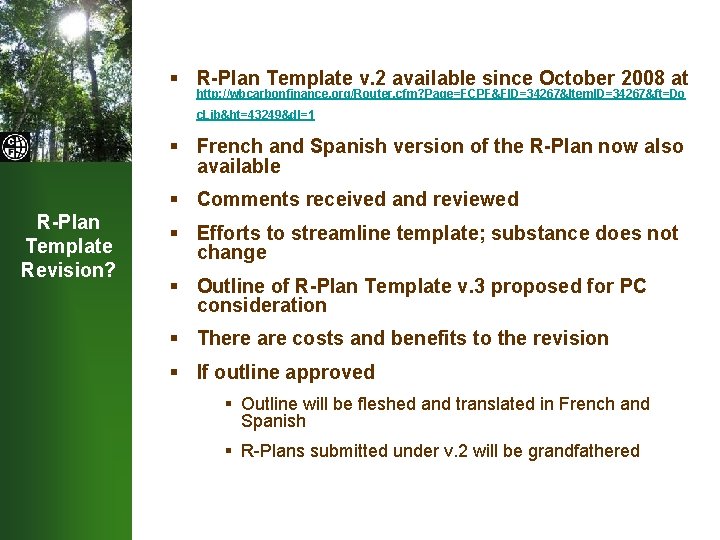
§ R-Plan Template v. 2 available since October 2008 at http: //wbcarbonfinance. org/Router. cfm? Page=FCPF&FID=34267&Item. ID=34267&ft=Do c. Lib&ht=43249&dl=1 § French and Spanish version of the R-Plan now also available § Comments received and reviewed R-Plan Template Revision? § Efforts to streamline template; substance does not change § Outline of R-Plan Template v. 3 proposed for PC consideration § There are costs and benefits to the revision § If outline approved § Outline will be fleshed and translated in French and Spanish § R-Plans submitted under v. 2 will be grandfathered
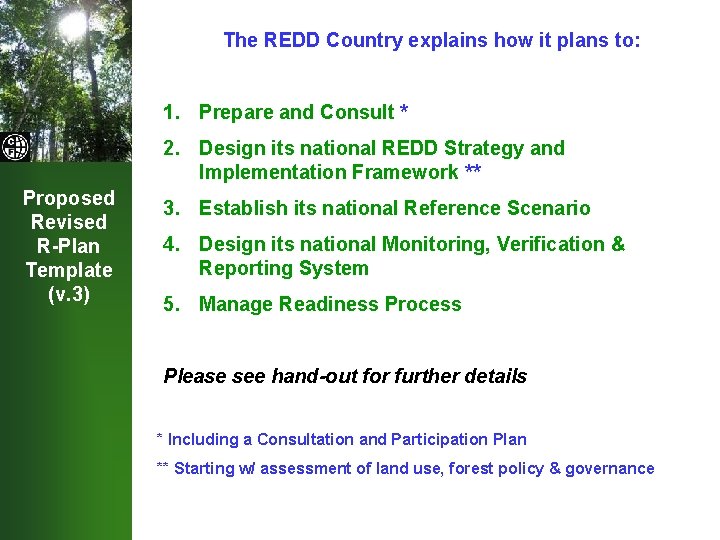
The REDD Country explains how it plans to: 1. Prepare and Consult * 2. Design its national REDD Strategy and Implementation Framework ** Proposed Revised R-Plan Template (v. 3) 3. Establish its national Reference Scenario 4. Design its national Monitoring, Verification & Reporting System 5. Manage Readiness Process Please see hand-out for further details * Including a Consultation and Participation Plan ** Starting w/ assessment of land use, forest policy & governance
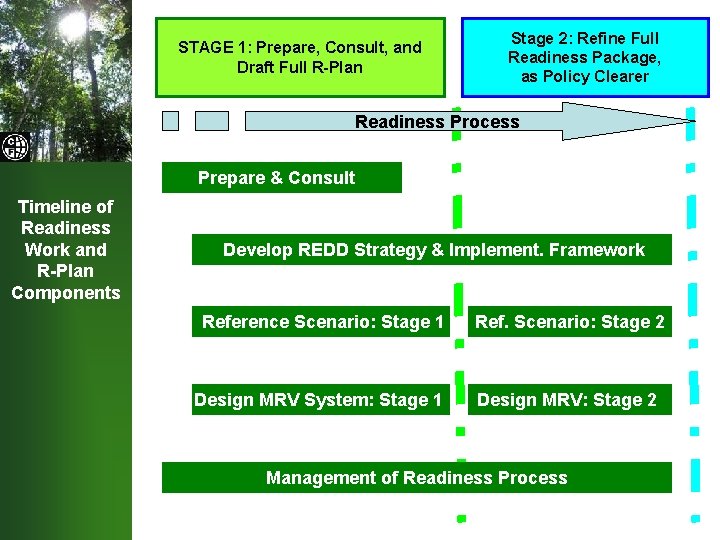
STAGE 1: Prepare, Consult, and Draft Full R-Plan Stage 2: Refine Full Readiness Package, as Policy Clearer Readiness Process Prepare & Consult Timeline of Readiness Work and R-Plan Components Develop REDD Strategy & Implement. Framework Reference Scenario: Stage 1 Ref. Scenario: Stage 2 Design MRV System: Stage 1 Design MRV: Stage 2 Management of Readiness Process
R-Plan Review: 6 Cross-Cutting Criteria for review of entire R-Plan Cross. Cutting Criteria (1) § Criterion (i): Ownership, transparency, and dissemination of the R-Plan by the government and relevant stakeholders § Criterion (ii): Coherence between the proposed activities in R-Plan (including early ideas on REDD Strategy) and existing national and sectoral strategies § Criterion (iii): Completeness of information and data provided
§ Criterion (iv): Clear responsibilities for the execution of REDD activities to be financed Cross. Cutting Criteria (2) § Criterion (v): Feasibility of proposed activities to achieve Readiness to reduce deforestation and forest degradation, and their likelihood of success in achieving Readiness (once fully funded and implemented) § Criterion (vi): Variety of approaches
§ Criterion (i): Ownership, transparency, and dissemination of the R-Plan by the government and relevant stakeholders Cross-Cutting Criteria and Standards to Be Met (1) Inclusiveness of reasonable consultation and participation by major stakeholders: § Consultation process for R-Plan development thus far, and the Consultation and Participation Plan included in the R-Plan (which looks forward in time) § Cross-cutting nature of national working group on REDD (including major stakeholders and key government agencies) § Process for developing REDD strategy
§ Criterion (ii): Coherence between the proposed activities in R-Plan (including early ideas on REDD Strategy) and existing national and sectoral strategies Cross-Cutting Criteria and Standards to Be Met (2) R-Plan makes clear reference to country sector strategies and identifies major potential synergies or inconsistencies with REDD plans and process
§ Criterion (iii): Completeness of information and data provided Cross-Cutting Criteria and Standards to Be Met (3) § The R-Plan reviews key information and studies available, and performs gap analysis of information or studies needed. § To. R or plans provided for all components, + implementation budget and schedule
§ Criterion (iv): Clear responsibilities for the execution of REDD activities to be financed Cross-Cutting Criteria and Standards to Be Met (4) A clear, inclusive, and functioning national REDD working group process and set of institutional arrangements for executing the R-Plan studies and activities is presented
§ Criterion (v): Feasibility of proposed activities to achieve Readiness to reduce deforestation and forest degradation, and their likelihood of success in achieving Readiness (once fully funded and implemented) Cross-Cutting Criteria and Standards to Be Met (5) Includes adequate description of early design of MRV system, including rural livelihoods, and conservation of biodiversity (full MRV design may occur at a later stage, informed by the needs of the policy process)
§ Criterion (vi): Variety of approaches (defined as approaches that can contribute to the learning objective of the FCPF): Cross-Cutting Criteria and Standards to Be Met (6) § Approaches to tackle deforestation and forest degradation § Innovative and/or advanced concepts of MRV § Benefit sharing § Regional leadership in addressing REDD § Approaches that are inclusive and combine with livelihood enhancements, incl. on the role of forest-dependent indigenous peoples and other forest dwellers, focus on land rights, etc.
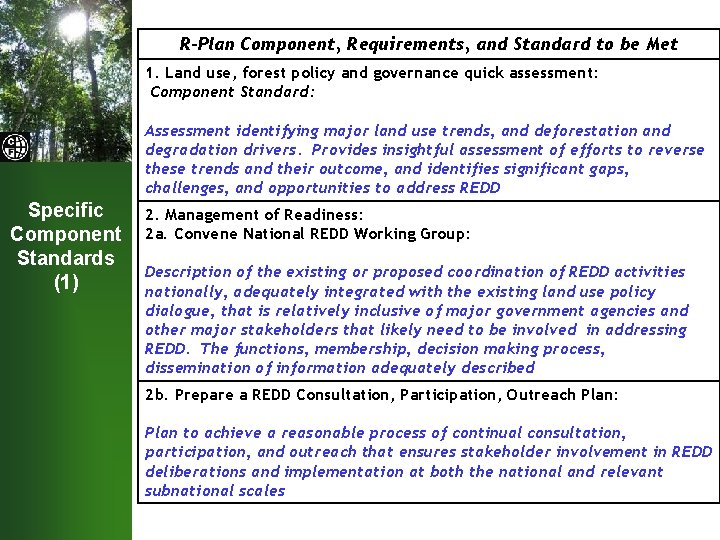
R-Plan Component, Requirements, and Standard to be Met 1. Land use, forest policy and governance quick assessment: Component Standard: Assessment identifying major land use trends, and deforestation and degradation drivers. Provides insightful assessment of efforts to reverse these trends and their outcome, and identifies significant gaps, challenges, and opportunities to address REDD Specific Component Standards (1) 2. Management of Readiness: 2 a. Convene National REDD Working Group: Description of the existing or proposed coordination of REDD activities nationally, adequately integrated with the existing land use policy dialogue, that is relatively inclusive of major government agencies and other major stakeholders that likely need to be involved in addressing REDD. The functions, membership, decision making process, dissemination of information adequately described 2 b. Prepare a REDD Consultation, Participation, Outreach Plan: Plan to achieve a reasonable process of continual consultation, participation, and outreach that ensures stakeholder involvement in REDD deliberations and implementation at both the national and relevant subnational scales
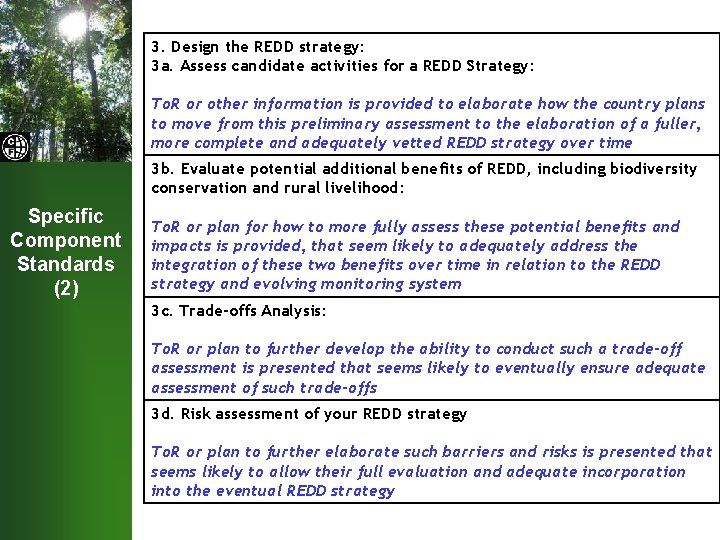
3. Design the REDD strategy: 3 a. Assess candidate activities for a REDD Strategy: To. R or other information is provided to elaborate how the country plans to move from this preliminary assessment to the elaboration of a fuller, more complete and adequately vetted REDD strategy over time 3 b. Evaluate potential additional benefits of REDD, including biodiversity conservation and rural livelihood: Specific Component Standards (2) To. R or plan for how to more fully assess these potential benefits and impacts is provided, that seem likely to adequately address the integration of these two benefits over time in relation to the REDD strategy and evolving monitoring system 3 c. Trade-offs Analysis: To. R or plan to further develop the ability to conduct such a trade-off assessment is presented that seems likely to eventually ensure adequate assessment of such trade-offs 3 d. Risk assessment of your REDD strategy To. R or plan to further elaborate such barriers and risks is presented that seems likely to allow their full evaluation and adequate incorporation into the eventual REDD strategy
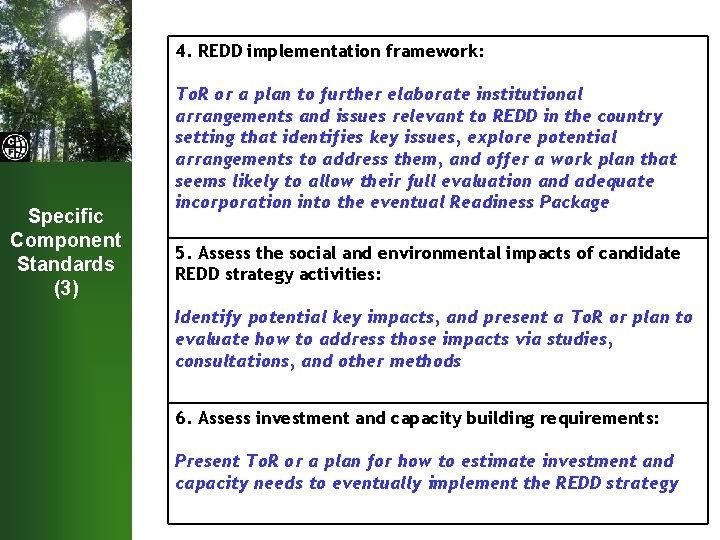
4. REDD implementation framework: Specific Component Standards (3) To. R or a plan to further elaborate institutional arrangements and issues relevant to REDD in the country setting that identifies key issues, explore potential arrangements to address them, and offer a work plan that seems likely to allow their full evaluation and adequate incorporation into the eventual Readiness Package 5. Assess the social and environmental impacts of candidate REDD strategy activities: Identify potential key impacts, and present a To. R or plan to evaluate how to address those impacts via studies, consultations, and other methods 6. Assess investment and capacity building requirements: Present To. R or a plan for how to estimate investment and capacity needs to eventually implement the REDD strategy
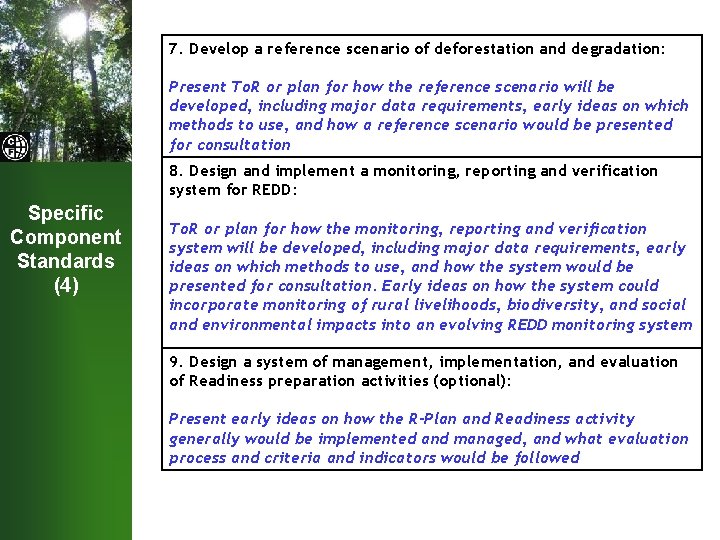
7. Develop a reference scenario of deforestation and degradation: Present To. R or plan for how the reference scenario will be developed, including major data requirements, early ideas on which methods to use, and how a reference scenario would be presented for consultation 8. Design and implement a monitoring, reporting and verification system for REDD: Specific Component Standards (4) To. R or plan for how the monitoring, reporting and verification system will be developed, including major data requirements, early ideas on which methods to use, and how the system would be presented for consultation. Early ideas on how the system could incorporate monitoring of rural livelihoods, biodiversity, and social and environmental impacts into an evolving REDD monitoring system 9. Design a system of management, implementation, and evaluation of Readiness preparation activities (optional): Present early ideas on how the R-Plan and Readiness activity generally would be implemented and managed, and what evaluation process and criteria and indicators would be followed
Conclusion Include in PC Resolutions: § No-objection to proposed TAP 2 Terms of Reference for R-Plan review and technical assistance § No-objection to proposed Roster of Experts § No objection to proposed R-Plan approval process Other Decisions: § Need to revise R-Plan template?
From FCPF Charter: Annex: FMT’s Roles in R-Plans § Assist REDD Country Participant to prepare and implement R-Plan (at Country’s request) § Propose members and To. R for TAPs § Coordinate with relevant international bodies § Ensure compliance with World Bank Operational Policies and Procedures § Encourage knowledge sharing