
Reducing Childhood Obesity case studies from local national
Reducing Childhood Obesity case studies from local, national and international projects Michael Baber Director, Health Action Campaign

Obesity: Why prevention is better than cure • Only 2% of obese men and 3% of obese women in the UK are likely to get back to a healthy weight over a 9 year period • Obese parents are more likely to have obese children • Obese parents are less likely to recognise their children are obese

Understanding the causes of Obesity Too much of the wrong kinds of food and drink • • • Supersizing (2 litre Coke bottles, 1978 i. e. 10 times the original size) Ready meals (the microwave 1984) Fast Food, Takeaways & Home Delivery in the UK (£ 30 billion p. a. ) Soft drinks in the UK (£ 10 billion p. a. ) Food & Drink advertising in the UK (£ 1 billion p. a. ) Less breastfeeding/more use of formula milk and sweet baby foods
Preventing childhood obesity: one-off initiatives Small scale, Short term, Ad hoc interventions Usually don’t have positive outcomes – but a few exceptions. Healthy Beginnings Trial (Sydney: 2007 -2010) Regular home visits by specially trained community nurses (antenatal – 24 months) Lower BMI vs control group, though obesity returned when intervention stopped. Infant, Feeding, Activity and Nutrition Trial (In. Fant) (Melbourne: 2008 -2010) Dieticians worked with established first time parents groups. Positive action taken by parents, although varied according to their age and education.
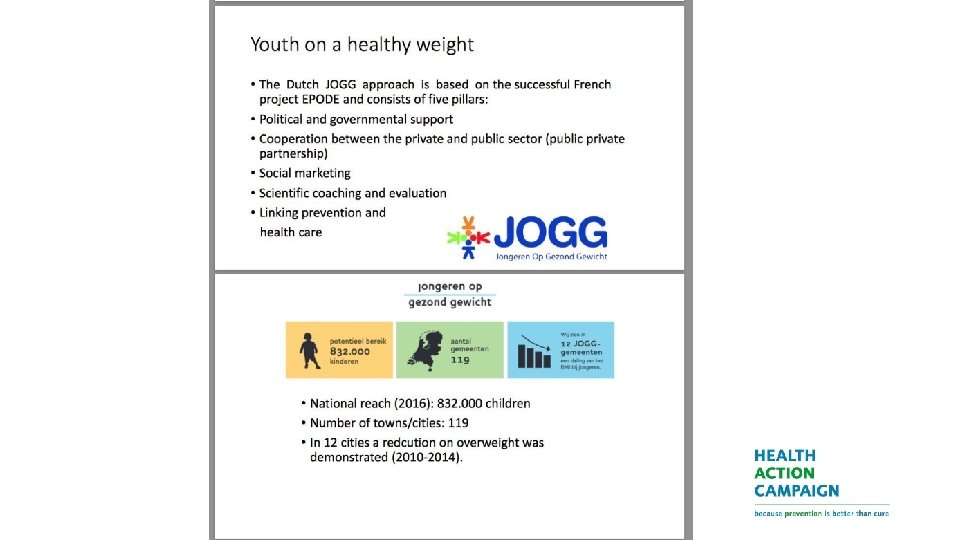
Four ‘Whole Systems’ interventions • Romp & Chomp • EPODE (Ensemble Prevenons l’Obesite Des Enfants) • JOGG (Jongeren op Gezond Gewicht) • TCOCT (The Children’s Obesity Clinic Treatment Protocol)
Romp & Chomp Geelong, Australia 2004– 2008 What was it? • Healthy eating and active play with a target group of 12, 000 children • Community-wide, multi-setting, multi-strategy – which reduced obesity What helped? • Capacity building and Sustainable partnerships • Specialist advice and Integration into formal training of childcare workers What challenges were identified? • Limited funding and High staff turnover • More parent engagement needed and Lack of high level leadership
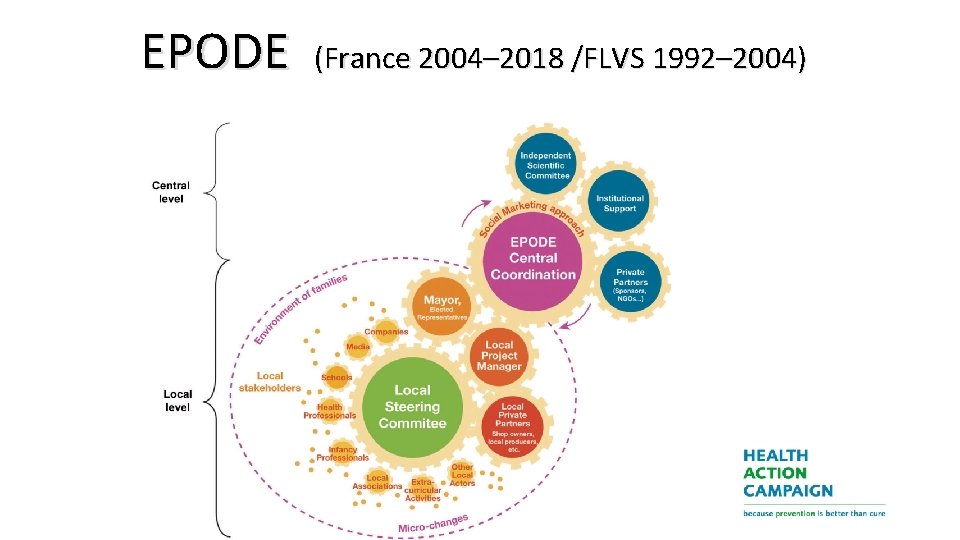
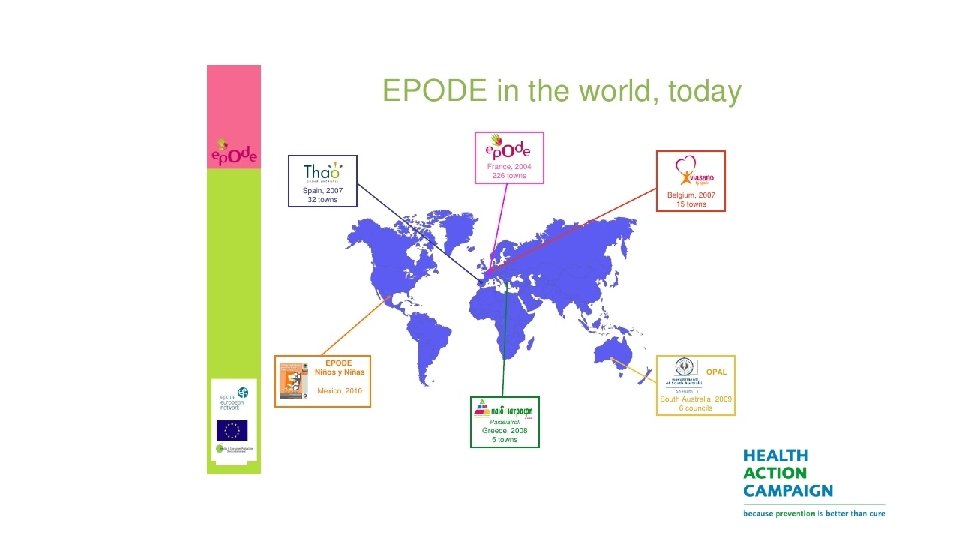
EPODE (France 2004– 2018 /FLVS 1992– 2004)
The Children’s Obesity Clinic Treatment (Holbaek, Denmark 2008 -2018) Treats obesity as a chronic disease Children with weight problems referred to hospital Seen by a paediatrician and a dietitian Plus a paediatric nurse, a psychologist or a social worker if needed Teach parents how to control their children’s environment e. g. no 2 nd helpings for 20 mins, no TV before 5 pm, pocket money in a bank account • Successfully replicated elsewhere in Denmark • • •
A whole systems approach in the UK To identify how local authorities can make greater in-roads into tackling obesity by taking a more ‘whole systems’ approach Local Government Association Public Health England Leeds Becket University Association of Directors of Public Health
Voluntary, Statutory or Third Way? • Voluntary e. g. Responsibility Deal, 2016 Childhood Obesity Plan and LGA/PHE Whole Systems pilots • Statutory e. g. Soft Drinks levy, Calorie labelling and proposed 9 pm watershed for HFSS advertising • Third Way e. g. Elected Mayors + health remit + Tackling Obesity Fund - to reduce childhood obesity across 40% of England
Social Marketing - Generation Z The healthiest generation? Smoke less, drink less alcohol, exercise more and eat more healthily (ONS/NHS) ‘Whole systems’ social marketing campaign to reduce sugar consumption • Health experts AND celebrity chefs • Extensive media AND social media coverage Student Health Behaviour Change study (Perspect Public Health 2018) 68. 2% of 18 -21 year olds were trying to avoid sugary drinks 72. 4% healthy weight, 12. 8% underweight and 14. 8% overweight
Social Marketing – to the Food & Drinks Industry What are your target audience’s needs, wants and concerns? Profits, Customer response, Feasibility and Affordability How to recognise and meet those concerns a) Customer lifetime value – health conscious consumers spend more, live longer b) Consumer research feedback – demand for healthier food continues to grow c) Reformulation is a core skill, specialist help available, R&D corporation tax relief + new options e. g. Soda-Lo and flavour delivery particles Potential for Diversification e. g. Coca Cola launching 3 new drinks below the sugar tax threshold in 2018 e. g. Pepsi. Co now owns Quaker Oats and has just acquired Health Warrior
Conclusions • Prevention is better than cure, so first prevent childhood obesity • Big problems need big solutions, so every available lever needs to be used – including the potential of Elected Mayors • Whole systems approaches currently work best • Generation Z – a positive trend to build on? • Use Social Marketing to change Food & Drink industry behaviour, not just the behaviour of individual consumers
References 1. Fildes A, Charlton J, Rudisill C et al. Probability of an obese person attaining normal body weight: cohort study using electronic health records. American Journal of Public Health September 2015. http: //ajph. aphapublications. org/doi/pdf/10. 2105/AJPH. 2015. 302773 2. Wen LM, Baur LA, Simpson JM. Sustainability of effects of an early childhood obesity prevention trial over time: A further 3 -year follow-up of the healthy beginnings trial. JAMA Pediatr. 2015 Jun; 169: 543 -51 3. Cameron AJ, Ball K, Hesketh KD. Variation in outcomes of the Melbourne infant, feeding, activity and nutrition trial (In. FANT) program according to maternal education and age. Prev Med. 2014; 58: 58 -63. 4. Keita AD, Risica PM, Drenner KL. Feasibility and acceptability of an early childhood obesity prevention intervention: Results from healthy homes, healthy families pilot study. J Obesity 2014 http: //www. hindawi. com/journals/jobe/2014/378501/ 5. De Silva-Sanigorski A, Bell AC, Kremer P Reducing obesity in early childhood: results from Romp & Chomp, an Australian community-wide intervention program The American Journal of Clinical Nutrition, Volume 91, Issue 4, 1 April 2010, Pages 831– 840, https: //doi. org/10. 3945/ajcn. 2009. 28826 6. Romon M, Lommez A, Tafflet M et al. Downward trends in the prevalence of childhood overweight in the setting of 12 year school and community based programmes Public Health Nutrition 2008 (NB This study focused on a precursor to EPODE, which EPODE then developed further). 7. Borys J-M, Valdeyron L, Levy E et al. EPODE – A Model for Reducing the Incidence of Obesity and Weight-related Comorbidities. Eur Endocrinol. 2013 Aug; 9(2): 116– 120. 8. JOGG Jongeren op Gezond Gewicht- JOGG (Young people at a Healthy Weight) Marieke Hendriksen National JOGG Project Bureau 2017 9. Holm JC, Gamborg M, Bille DS et al. Chronic care treatment of obese children and adolescents Int J Pediatr Obes. 2011 Aug; 6(3 -4): 188 -96 10. Most SW, Højgaard B, Teilmann G Adoption of the children’s obesity clinic’s treatment (TCOCT) protocol into another Danish pediatric obesity treatment clinic BMC Pediatrics 2015 15: 13 11. Haas J, Baber M, Byrom N et al. Changes in student physical health behaviour: an opportunity to turn the concept of a Healthy University into a reality Perspectives in Public Health November 2018
- Slides: 16