
Reducing Cafeteria Waste Kathi Mirza Mass DEP Municipal
- Slides: 14
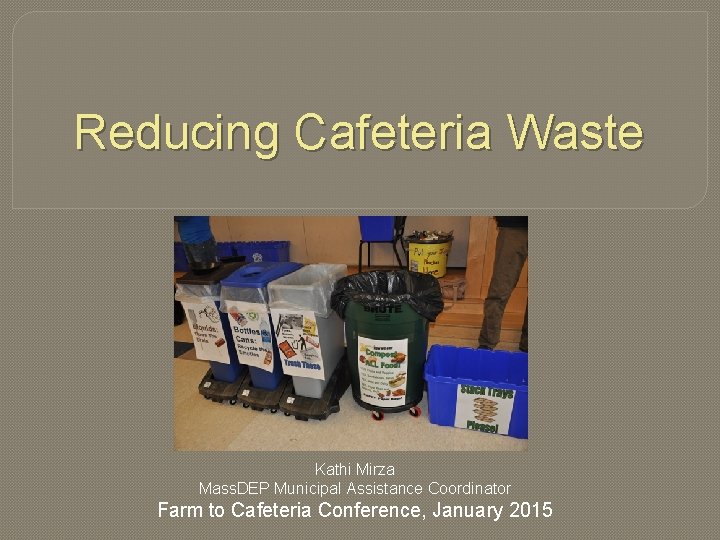
Reducing Cafeteria Waste Kathi Mirza Mass. DEP Municipal Assistance Coordinator Farm to Cafeteria Conference, January 2015
Let’s Close the Loop �Conference focused on bringing healthy, locally-produced, high-quality products into our schools. �What comes in must go out… in some form �Take time to look at all items managed in the cafeteria to develop best practices in waste reduction, recycling, and composting.
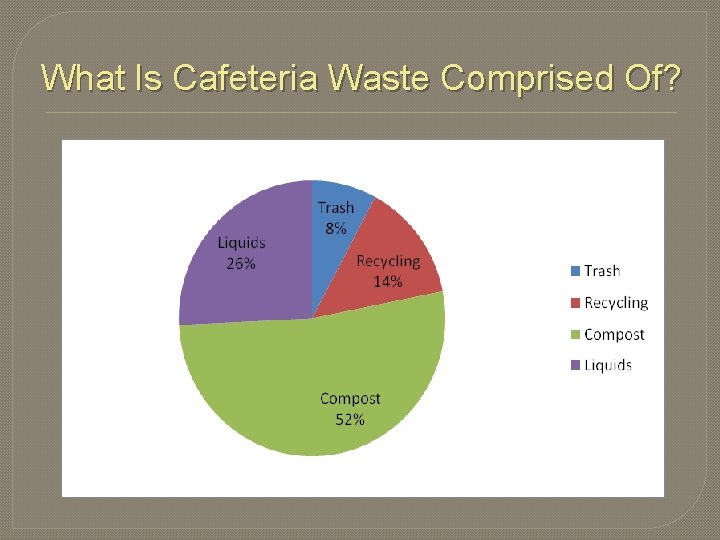
What Is Cafeteria Waste Comprised Of?
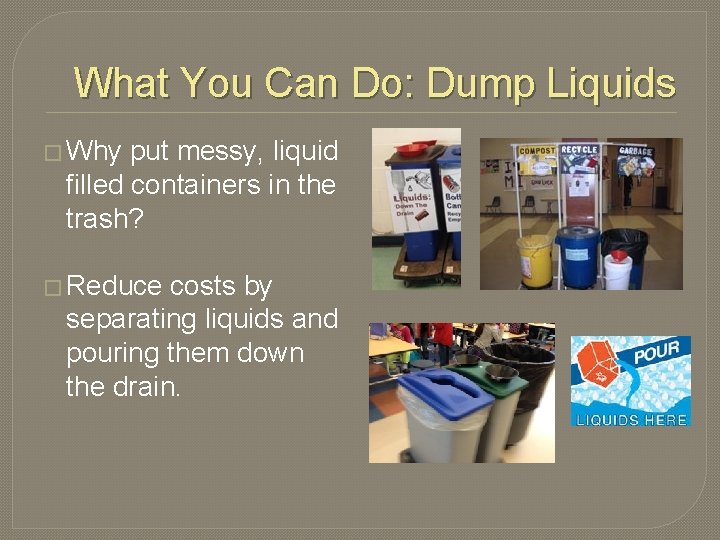
What You Can Do: Dump Liquids � Why put messy, liquid filled containers in the trash? � Reduce costs by separating liquids and pouring them down the drain.
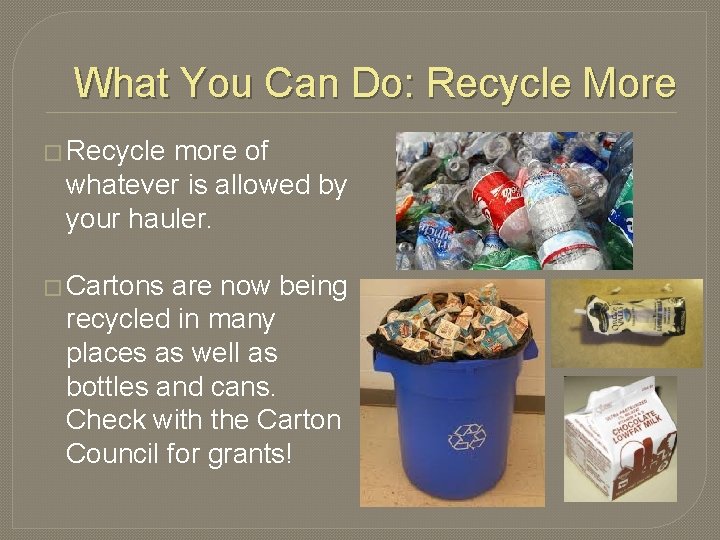
What You Can Do: Recycle More � Recycle more of whatever is allowed by your hauler. � Cartons are now being recycled in many places as well as bottles and cans. Check with the Carton Council for grants!
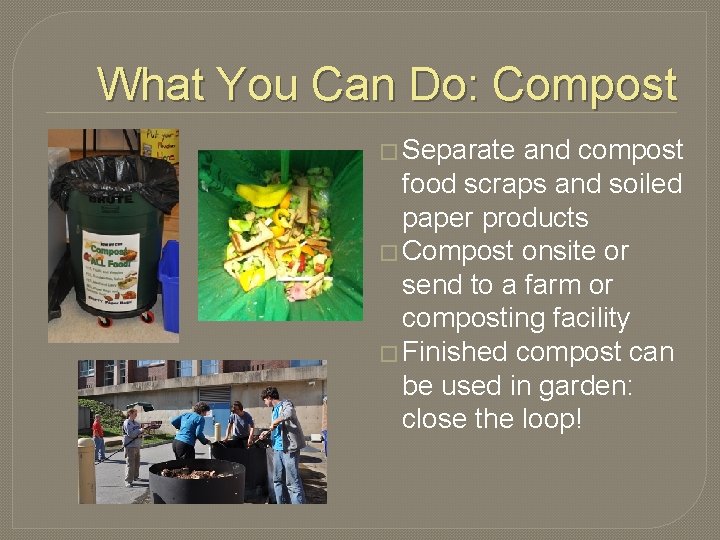
What You Can Do: Compost � Separate and compost food scraps and soiled paper products � Compost onsite or send to a farm or composting facility � Finished compost can be used in garden: close the loop!
What You Can Do: Reconsider Cafeteria Trays Dishware options for school foodservice operations include: 1. Washable foodservice ware & dish machines 2. Compostable foodservice ware 3. Disposable foodservice ware (foam) Key considerations: 1. Cost 2. Environmentally friendly 3. Healthy choice for serving both hot and cold food to students
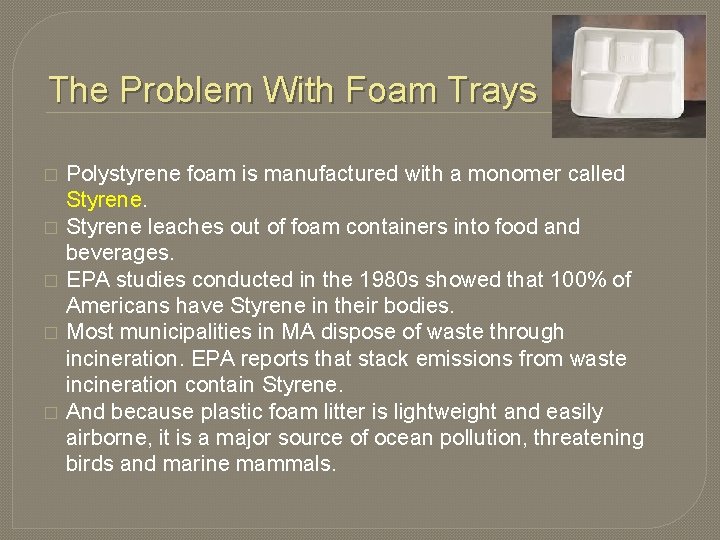
The Problem With Foam Trays � � � Polystyrene foam is manufactured with a monomer called Styrene leaches out of foam containers into food and beverages. EPA studies conducted in the 1980 s showed that 100% of Americans have Styrene in their bodies. Most municipalities in MA dispose of waste through incineration. EPA reports that stack emissions from waste incineration contain Styrene. And because plastic foam litter is lightweight and easily airborne, it is a major source of ocean pollution, threatening birds and marine mammals.
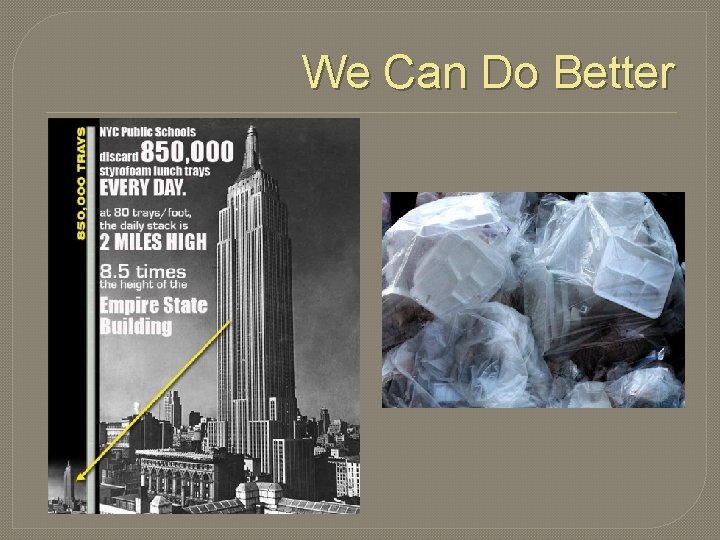
We Can Do Better
State Survey of School FSDs � MA Survey to > 400 School Foodservice Directors in Fall 2014 (with help from DESE) � 48 districts responded by Dec 2014 � Expect more responses in 2015.
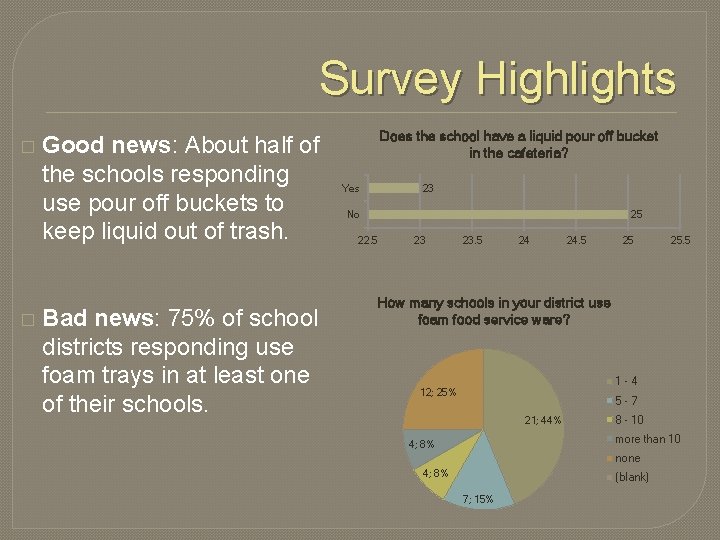
Survey Highlights � � Good news: About half of the schools responding use pour off buckets to keep liquid out of trash. Bad news: 75% of school districts responding use foam trays in at least one of their schools. Does the school have a liquid pour off bucket in the cafeteria? Yes 23 No 25 22. 5 23 23. 5 24 24. 5 25 25. 5 How many schools in your district use foam food service ware? 1 -4 12; 25% 5 -7 21; 44% 8 - 10 more than 10 4; 8% none 4; 8% (blank) 7; 15%
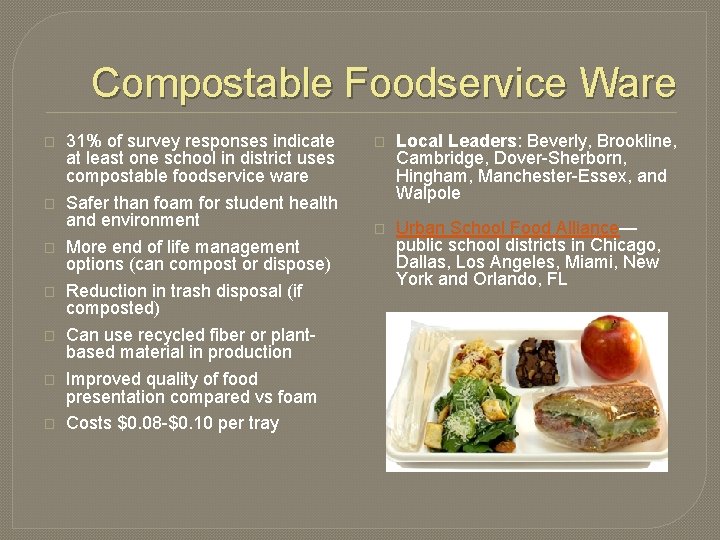
Compostable Foodservice Ware � � � � 31% of survey responses indicate at least one school in district uses compostable foodservice ware Safer than foam for student health and environment More end of life management options (can compost or dispose) Reduction in trash disposal (if composted) Can use recycled fiber or plantbased material in production Improved quality of food presentation compared vs foam Costs $0. 08 -$0. 10 per tray � Local Leaders: Beverly, Brookline, Cambridge, Dover-Sherborn, Hingham, Manchester-Essex, and Walpole � Urban School Food Alliance— public school districts in Chicago, Dallas, Los Angeles, Miami, New York and Orlando, FL
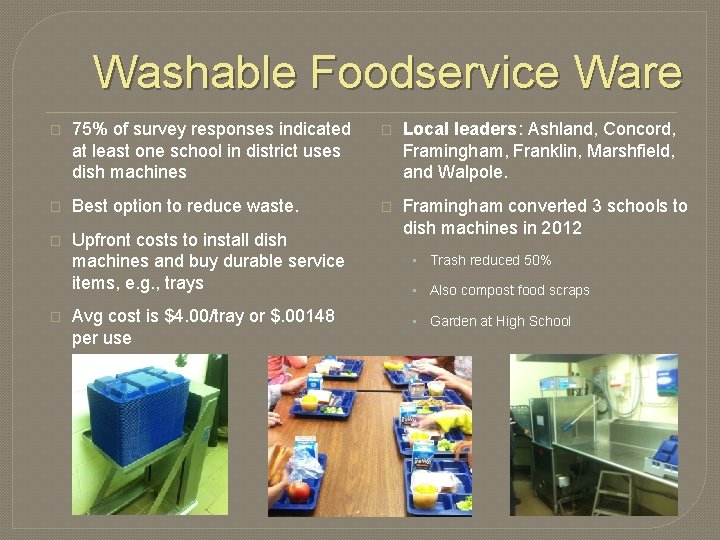
Washable Foodservice Ware � 75% of survey responses indicated at least one school in district uses dish machines � Local leaders: Ashland, Concord, Framingham, Franklin, Marshfield, and Walpole. � Best option to reduce waste. � � Upfront costs to install dish machines and buy durable service items, e. g. , trays Framingham converted 3 schools to dish machines in 2012 � Avg cost is $4. 00/tray or $. 00148 per use • Trash reduced 50% • Also compost food scraps • Garden at High School
Help is Available � Mass. DEP Green Team www. The. Green. Team. org � Recycling Works MA www. Recycling. Works. MA. com � Mass. DEP Regional Municipal Assistance Coordinators: • • Western Mass: Arlene Miller- Arlenem 773@aol. com Central Mass: Irene Congdon- Irene_congdon 1@yahoo. com Southeast 1: Janine Delaney - JDelaney. MAC@comcast. net Southeast 2: Kathi Mirza - KMirza@taunton-ma. gov Northeast 2: Sharon Byrne Kishida- SKishida@beverlyma. gov Northeast 3: Carolyn Dann- CDann@bedfordma. gov Barnstable County: Dave Quinn- DQuinn@barnstablecounty. org Boston area: Brooke Nash- Brooke. Nash@state. ma. us