
Reducing and Enlarging Formulas Yewande Dayo Student Pharmacist
- Slides: 11
Reducing and Enlarging Formulas Yewande Dayo Student Pharmacist
Objectives � Perform calculations to reduce and enlarge formulas for pharmaceutical preparations stated in metric quantities � Perform calculations to reduce and enlarge formulas for pharmaceutical preparations stated in proportional parts
Reducing and Enlarging Formulas � Official USP-NF formulas are generally based on preparing 1000 m. L or 1000 g of product. � Some formulas are based on the preparation of a dosage unit (e. g. 1 capsule) or other quantity (e. g. 100 m. L). � Industrial formulas may be scaled up to quantities of ingredients necessary to make hundreds of thousands of dosage units in a production batch. � Thus, quite frequently, Pharmacists have to reduce or enlarge formulas in their course of practice � This may be calculating the quantities of each ingredient required for a smaller or greater quantity while maintaining the correct proportion of one ingredient to the other.
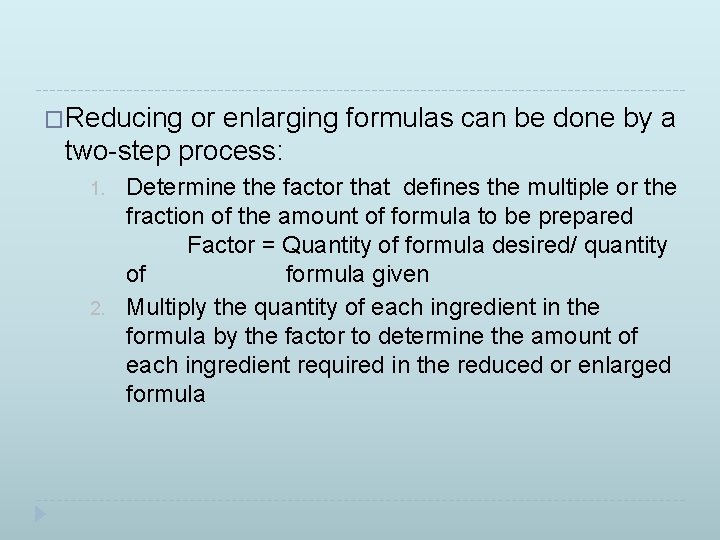
�Reducing or enlarging formulas can be done by a two-step process: 1. 2. Determine the factor that defines the multiple or the fraction of the amount of formula to be prepared Factor = Quantity of formula desired/ quantity of formula given Multiply the quantity of each ingredient in the formula by the factor to determine the amount of each ingredient required in the reduced or enlarged formula
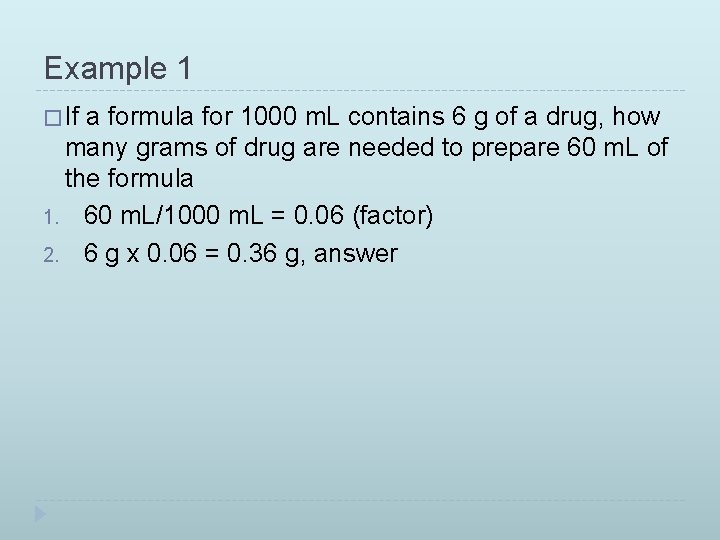
Example 1 � If a formula for 1000 m. L contains 6 g of a drug, how many grams of drug are needed to prepare 60 m. L of the formula 1. 60 m. L/1000 m. L = 0. 06 (factor) 2. 6 g x 0. 06 = 0. 36 g, answer
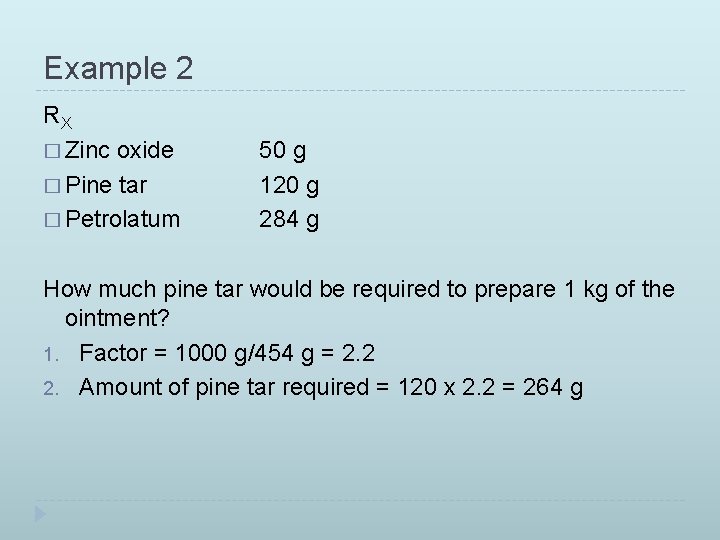
Example 2 RX � Zinc oxide � Pine tar � Petrolatum 50 g 120 g 284 g How much pine tar would be required to prepare 1 kg of the ointment? 1. Factor = 1000 g/454 g = 2. 2 2. Amount of pine tar required = 120 x 2. 2 = 264 g
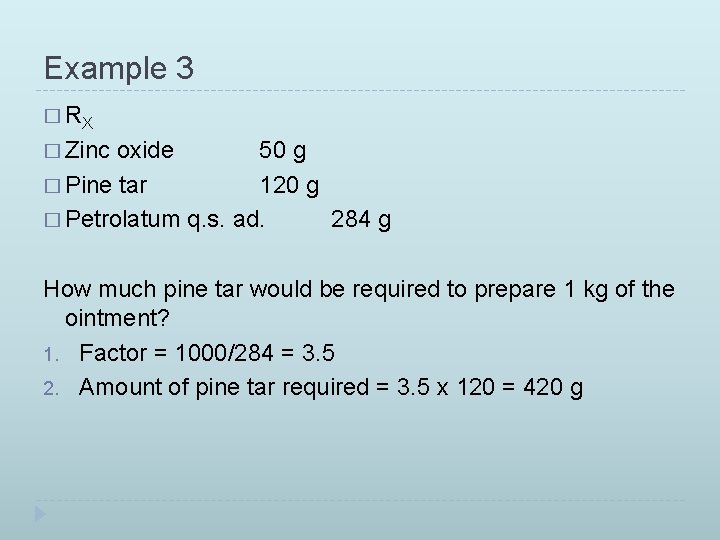
Example 3 � RX � Zinc oxide 50 g � Pine tar 120 g � Petrolatum q. s. ad. 284 g How much pine tar would be required to prepare 1 kg of the ointment? 1. Factor = 1000/284 = 3. 5 2. Amount of pine tar required = 3. 5 x 120 = 420 g
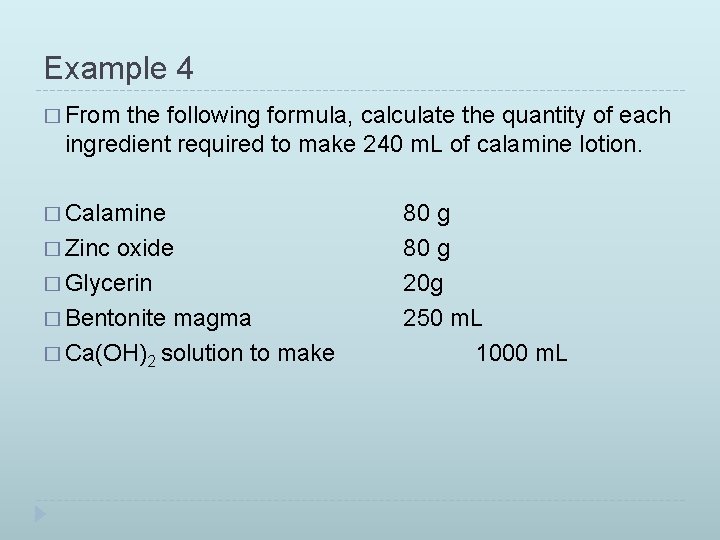
Example 4 � From the following formula, calculate the quantity of each ingredient required to make 240 m. L of calamine lotion. � Calamine � Zinc oxide � Glycerin � Bentonite magma � Ca(OH)2 solution to make 80 g 20 g 250 m. L 1000 m. L
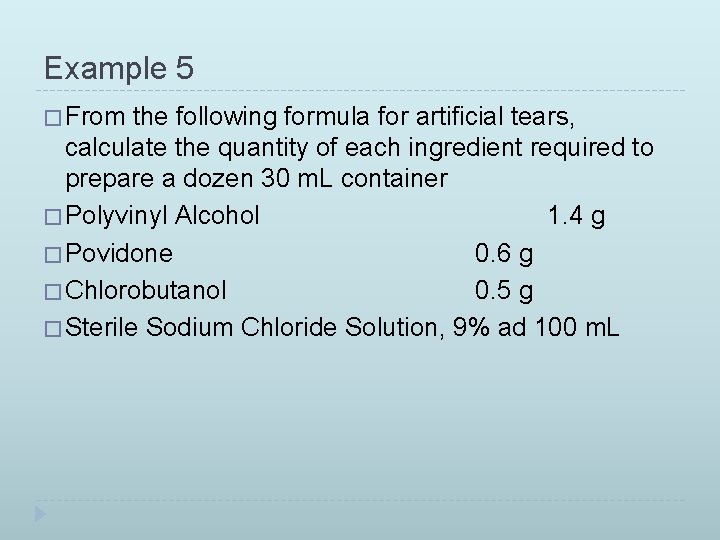
Example 5 � From the following formula for artificial tears, calculate the quantity of each ingredient required to prepare a dozen 30 m. L container � Polyvinyl Alcohol 1. 4 g � Povidone 0. 6 g � Chlorobutanol 0. 5 g � Sterile Sodium Chloride Solution, 9% ad 100 m. L
Formulas That Specify Proportional Parts � Rarely, a pharmacist may encounter an old formula with ingredients in “parts” rather than measures of weight and volume � The “parts” indicate a relative proportion of each ingredient in weight or volume
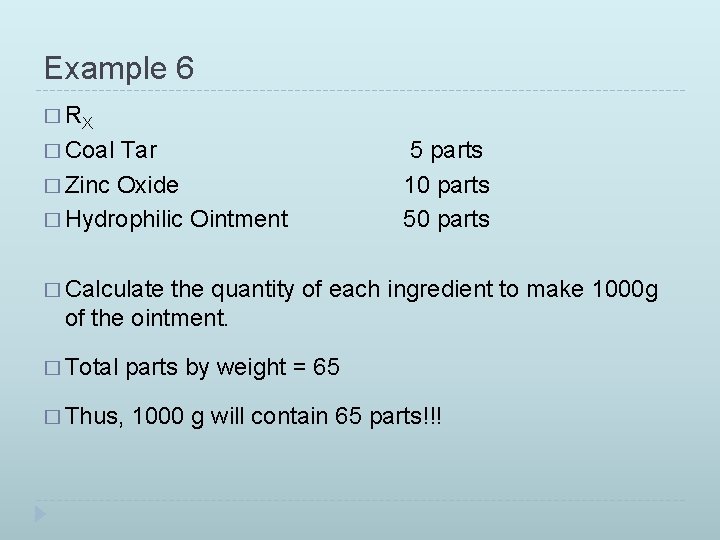
Example 6 � RX � Coal Tar � Zinc Oxide � Hydrophilic Ointment 5 parts 10 parts 50 parts � Calculate the quantity of each ingredient to make 1000 g of the ointment. � Total parts by weight = 65 � Thus, 1000 g will contain 65 parts!!!