
REDUCEFMR A ShamControlled Randomized Trial of Transcatheter Indirect

- Slides: 16
REDUCE-FMR: A Sham-Controlled Randomized Trial of Transcatheter Indirect Mitral Annuloplasty in Heart Failure Patients with Functional Mitral Regurgitation Horst Sievert, MD Cardio. Vascular Center Frankfurt - CVC, Frankfurt, Germany On behalf of the REDUCE-FMR Investigators
Financial Disclosures Horst Sievert, MD Companies: 4 tech Cardio, Abbott, Ablative Solutions, Ancora Heart, Bavaria Medizin Technologie Gmb. H, Bioventrix, Boston Scientific, Carag, Cardiac Dimensions, Celonova, Cibiem, CGuard, Comed B. V. , Contego, CVRx, Edwards, Endologix, Hemoteq, Inspire. MD, Lifetech, Maquet Getinge Group, Medtronic, Mitralign, Nuomao Medtech, Occlutech, pfm Medical, Recor, Renal Guard, Rox Medical, Terumo, Vascular Dynamics, Vivasure Medical, Venus, Veryan Relationships: Consulting fees, travel expenses and study honoraria
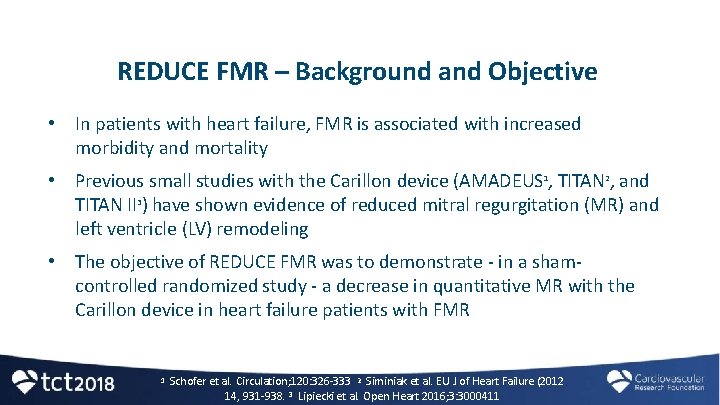
REDUCE FMR – Background and Objective • In patients with heart failure, FMR is associated with increased morbidity and mortality • Previous small studies with the Carillon device (AMADEUS 1, TITAN 2, and TITAN II 3) have shown evidence of reduced mitral regurgitation (MR) and left ventricle (LV) remodeling • The objective of REDUCE FMR was to demonstrate - in a shamcontrolled randomized study - a decrease in quantitative MR with the Carillon device in heart failure patients with FMR 1 Schofer et al. Circulation; 120: 326 -333 2 Siminiak et al. EU J of Heart Failure (2012 14, 931 -938. 3 Lipiecki et al. Open Heart 2016; 3: 3000411
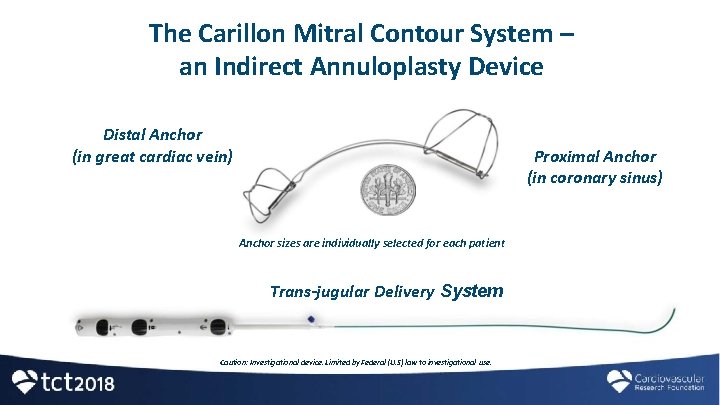
The Carillon Mitral Contour System – an Indirect Annuloplasty Device Distal Anchor (in great cardiac vein) Proximal Anchor (in coronary sinus) Anchor sizes are individually selected for each patient Trans-jugular Delivery System Caution: Investigational device. Limited by Federal (U. S) law to investigational use.
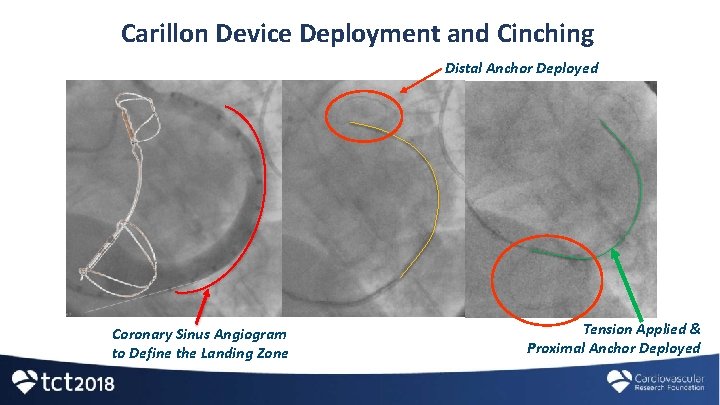
Carillon Device Deployment and Cinching Distal Anchor Deployed Coronary Sinus Angiogram to Define the Landing Zone Tension Applied & Proximal Anchor Deployed
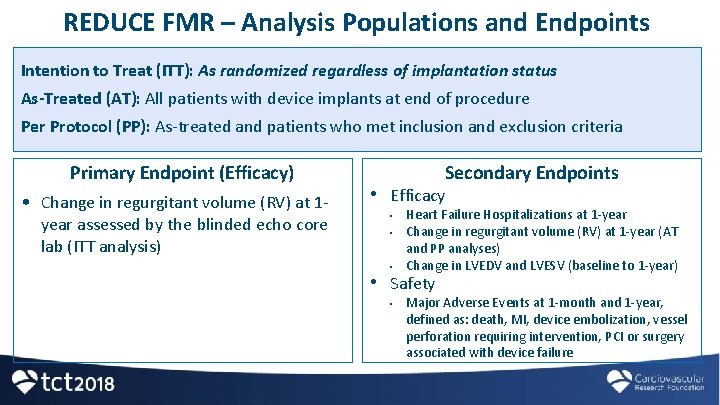
REDUCE FMR – Analysis Populations and Endpoints Intention to Treat (ITT): As randomized regardless of implantation status As-Treated (AT): All patients with device implants at end of procedure Per Protocol (PP): As-treated and patients who met inclusion and exclusion criteria Primary Endpoint (Efficacy) • Change in regurgitant volume (RV) at 1 year assessed by the blinded echo core lab (ITT analysis) Secondary Endpoints • Efficacy • • • Heart Failure Hospitalizations at 1 -year Change in regurgitant volume (RV) at 1 -year (AT and PP analyses) Change in LVEDV and LVESV (baseline to 1 -year) • Safety • Major Adverse Events at 1 -month and 1 -year, defined as: death, MI, device embolization, vessel perforation requiring intervention, PCI or surgery associated with device failure
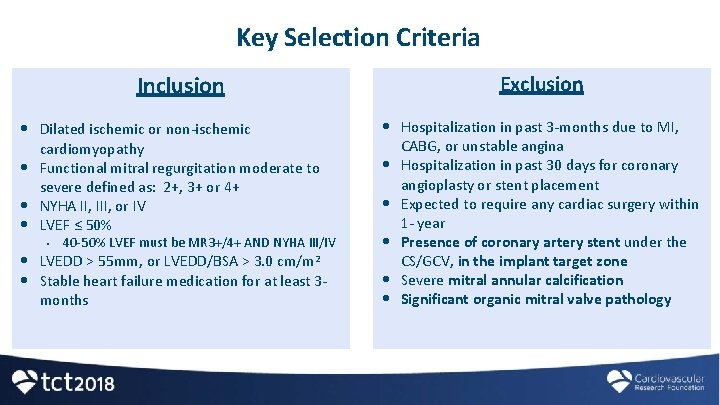
Key Selection Criteria Inclusion • Dilated ischemic or non-ischemic cardiomyopathy • Functional mitral regurgitation moderate to severe defined as: 2+, 3+ or 4+ • NYHA II, III, or IV • LVEF ≤ 50% • 40 -50% LVEF must be MR 3+/4+ AND NYHA III/IV • LVEDD > 55 mm, or LVEDD/BSA > 3. 0 cm/m 2 • Stable heart failure medication for at least 3 months Exclusion • Hospitalization in past 3 -months due to MI, • • • CABG, or unstable angina Hospitalization in past 30 days for coronary angioplasty or stent placement Expected to require any cardiac surgery within 1 - year Presence of coronary artery stent under the CS/GCV, in the implant target zone Severe mitral annular calcification Significant organic mitral valve pathology
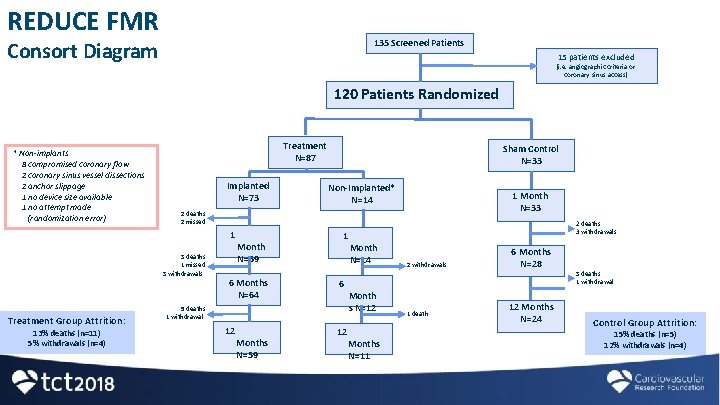
REDUCE FMR 135 Screened Patients Consort Diagram 15 patients excluded (i. e. angiographic criteria or coronary sinus access) 120 Patients Randomized * Non-implants 8 compromised coronary flow 2 coronary sinus vessel dissections 2 anchor slippage 1 no device size available 1 no attempt made (randomization error) Treatment N=87 Implanted N=73 3 deaths 1 missed 3 withdrawals 13% deaths (n=11) 5% withdrawals (n=4) Non-Implanted* N=14 1 Month N=33 2 deaths 2 missed 1 Treatment Group Attrition: Sham Control N=33 Month N=69 6 Months N=64 1 6 5 deaths 1 withdrawal 12 Months N=59 12 2 deaths 3 withdrawals Month N=14 Month s N=12 Months N=11 2 withdrawals 1 death 6 Months N=28 12 Months N=24 3 deaths 1 withdrawal Control Group Attrition: 15% deaths (n=5) 12% withdrawals (n=4)
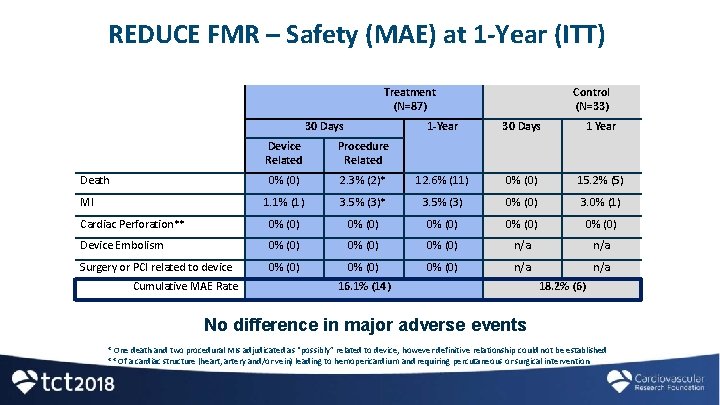
REDUCE FMR – Safety (MAE) at 1 -Year (ITT) Treatment (N=87) 30 Days Control (N=33) 1 -Year 30 Days 1 Year Device Related Procedure Related 0% (0) 2. 3% (2)* 12. 6% (11) 0% (0) 15. 2% (5) 1. 1% (1) 3. 5% (3)* 3. 5% (3) 0% (0) 3. 0% (1) Cardiac Perforation** 0% (0) 0% (0) Device Embolism 0% (0) n/a Surgery or PCI related to device 0% (0) n/a Death MI Cumulative MAE Rate 16. 1% (14) 18. 2% (6) No difference in major adverse events • • * One death and two procedural MIs adjudicated as “possibly” related to device, however definitive relationship could not be established ** Of a cardiac structure (heart, artery and/or vein) leading to hemopericardium and requiring percutaneous or surgical intervention
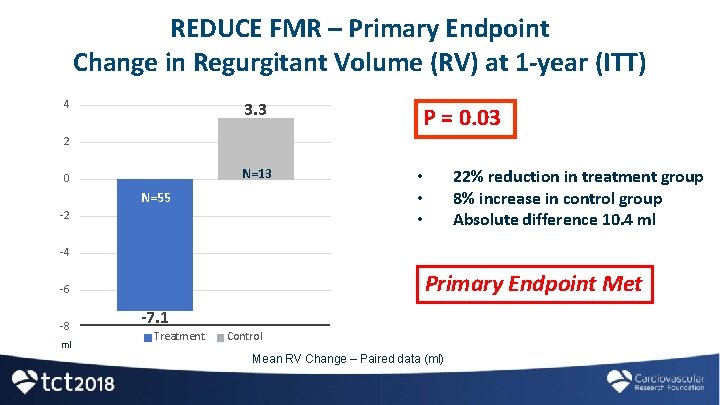
REDUCE FMR – Primary Endpoint Change in Regurgitant Volume (RV) at 1 -year (ITT) 4 3. 3 P = 0. 03 2 N=13 0 N=55 -2 22% reduction in treatment group 8% increase in control group Absolute difference 10. 4 ml • • • -4 Primary Endpoint Met -6 -8 ml -7. 1 Treatment Control Mean RV Change – Paired data (ml)
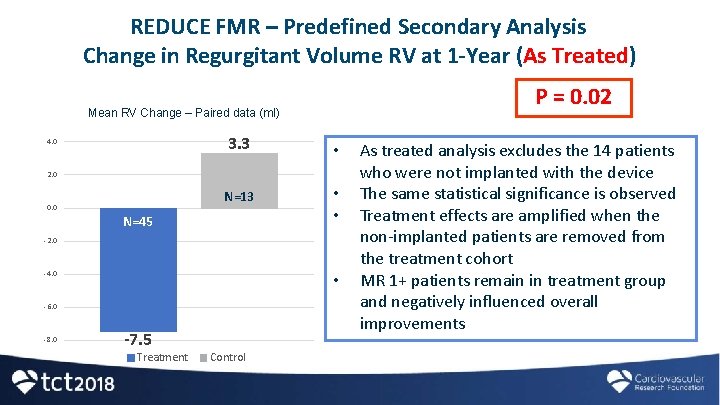
REDUCE FMR – Predefined Secondary Analysis Change in Regurgitant Volume RV at 1 -Year (As Treated) P = 0. 02 Mean RV Change – Paired data (ml) 3. 3 4. 0 • 2. 0 N=13 0. 0 N=45 • • -2. 0 -4. 0 • -6. 0 -8. 0 -7. 5 Treatment Control As treated analysis excludes the 14 patients who were not implanted with the device The same statistical significance is observed Treatment effects are amplified when the non-implanted patients are removed from the treatment cohort MR 1+ patients remain in treatment group and negatively influenced overall improvements
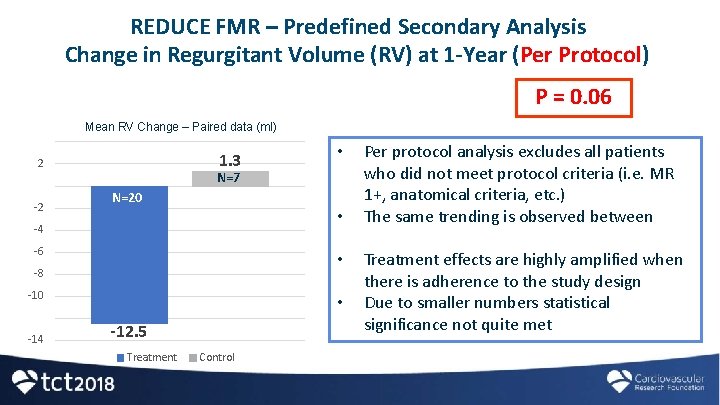
REDUCE FMR – Predefined Secondary Analysis Change in Regurgitant Volume (RV) at 1 -Year (Per Protocol) P = 0. 06 Mean RV Change – Paired data (ml) 1. 3 2 -2 N=7 N=20 • -4 -6 • -8 -10 -14 • • -12. 5 Treatment Control Per protocol analysis excludes all patients who did not meet protocol criteria (i. e. MR 1+, anatomical criteria, etc. ) The same trending is observed between Treatment effects are highly amplified when there is adherence to the study design Due to smaller numbers statistical significance not quite met
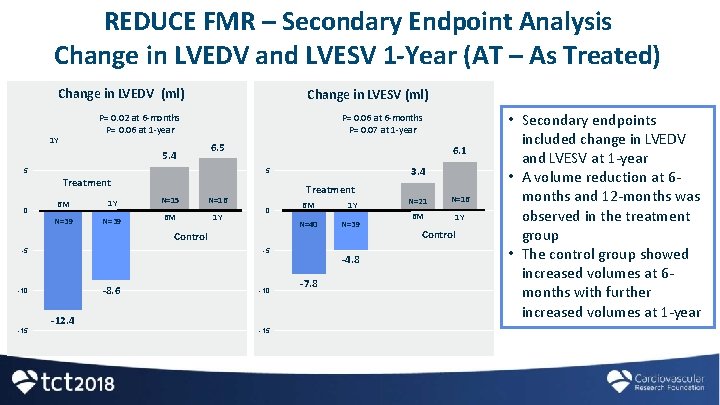
REDUCE FMR – Secondary Endpoint Analysis Change in LVEDV and LVESV 1 -Year (AT – As Treated) Change in LVEDV (ml) Change in LVESV (ml) P= 0. 06 at 6 -months P= 0. 07 at 1 -year P= 0. 02 at 6 -months P= 0. 06 at 1 -year 1 Y 5. 4 6. 5 6. 1 Treatment 0 3. 4 5 5 6 M 1 Y N=15 N=39 6 M Treatment N=16 1 Y 0 6 M 1 Y N=40 N=39 Control -5 -5 -8. 6 -10 -15 -12. 4 -10 -15 -4. 8 -7. 8 N=21 N=16 6 M 1 Y Control • Secondary endpoints included change in LVEDV and LVESV at 1 -year • A volume reduction at 6 months and 12 -months was observed in the treatment group • The control group showed increased volumes at 6 months with further increased volumes at 1 -year
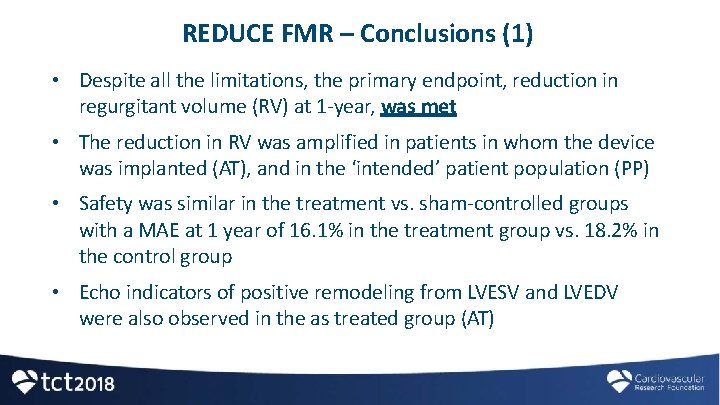
REDUCE FMR – Conclusions (1) • Despite all the limitations, the primary endpoint, reduction in regurgitant volume (RV) at 1 -year, was met • The reduction in RV was amplified in patients in whom the device was implanted (AT), and in the ‘intended’ patient population (PP) • Safety was similar in the treatment vs. sham-controlled groups with a MAE at 1 year of 16. 1% in the treatment group vs. 18. 2% in the control group • Echo indicators of positive remodeling from LVESV and LVEDV were also observed in the as treated group (AT)
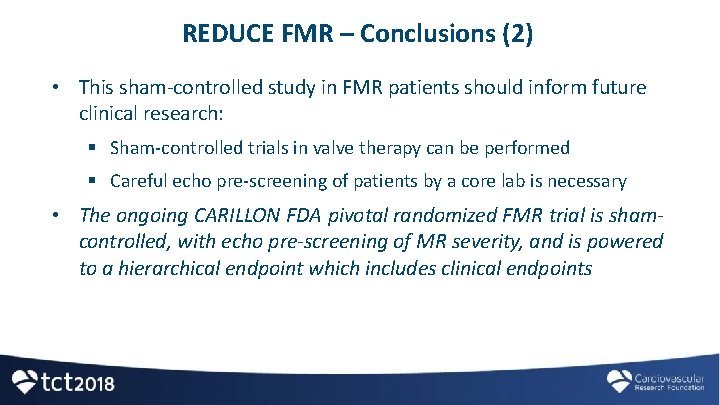
REDUCE FMR – Conclusions (2) • This sham-controlled study in FMR patients should inform future clinical research: Sham-controlled trials in valve therapy can be performed Careful echo pre-screening of patients by a core lab is necessary • The ongoing CARILLON FDA pivotal randomized FMR trial is shamcontrolled, with echo pre-screening of MR severity, and is powered to a hierarchical endpoint which includes clinical endpoints
REDUCE-FMR: A Sham-Controlled Randomized Trial of Transcatheter Indirect Mitral Annuloplasty in Heart Failure Patients with Functional Mitral Regurgitation Horst Sievert, MD Cardio. Vascular Center Frankfurt - CVC Frankfurt, Germany On behalf of the REDUCE-FMR Investigators