
Reduced Instruction Set Computers Chapter 13 William Stallings
![Weighted Relative Dynamic Frequency of HLL Operations [PATT 82 a] Dynamic Occurrence Machine-Instruction Weighted](https://slidetodoc.com/presentation_image/448dec9d9fb7c0827e3a586c78b43711/image-10.jpg "Weighted Relative Dynamic Frequency of HLL Operations [PATT 82 a] Dynamic Occurrence Machine-Instruction Weighted")


- Slides: 38
Reduced Instruction Set Computers Chapter 13 William Stallings Computer Organization and Architecture 7 th Edition
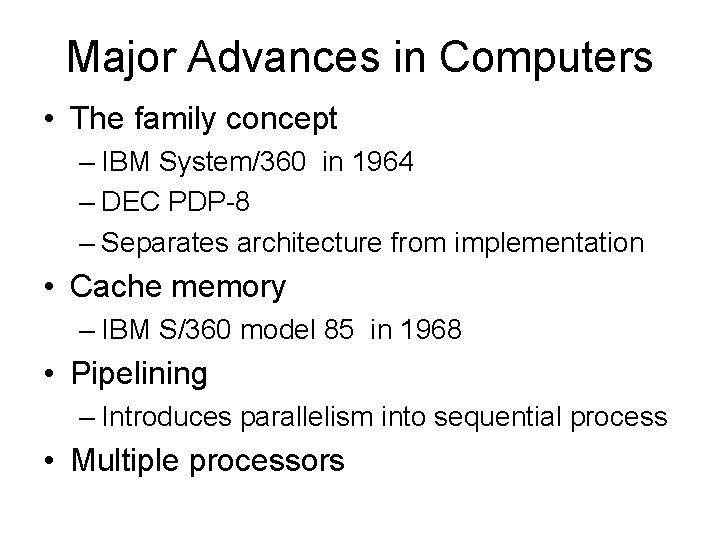
Major Advances in Computers • The family concept – IBM System/360 in 1964 – DEC PDP-8 – Separates architecture from implementation • Cache memory – IBM S/360 model 85 in 1968 • Pipelining – Introduces parallelism into sequential process • Multiple processors
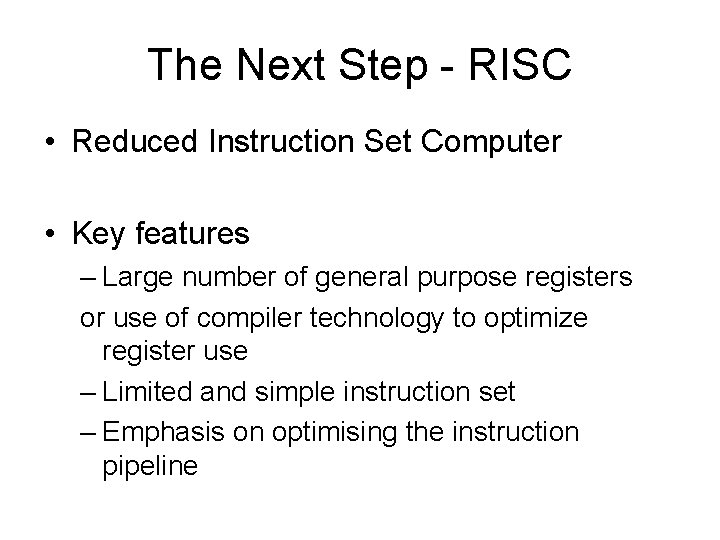
The Next Step - RISC • Reduced Instruction Set Computer • Key features – Large number of general purpose registers or use of compiler technology to optimize register use – Limited and simple instruction set – Emphasis on optimising the instruction pipeline
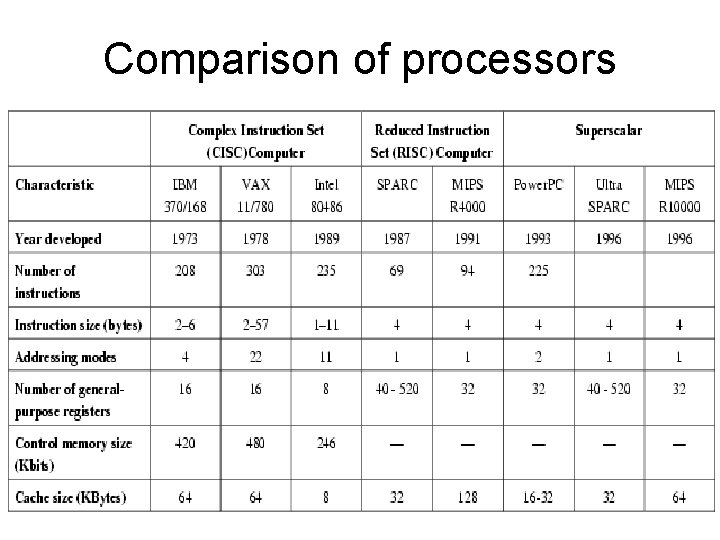
Comparison of processors
Driving force for CISC • Increasingly complex high level languages (HLL) – structured and object-oriented programming • Semantic gap: implementation of complex instructions • Leads to: – Large instruction sets – More addressing modes – Hardware implementations of HLL statements, e. g. CASE (switch) on VAX
Intention of CISC • Ease compiler writing (narrowing the semantic gap) • Improve execution efficiency – Complex operations in microcode (the programming language of the control unit) • Support more complex HLLs
Execution Characteristics • Operations performed (types of instructions) • Operands used (memory organization, addressing modes) • Execution sequencing (pipeline organization)
Dynamic Program Behaviour • Studies have been done based on programs written in HLLs • Dynamic studies are measured during the execution of the program • Operations, Operands, Procedure calls
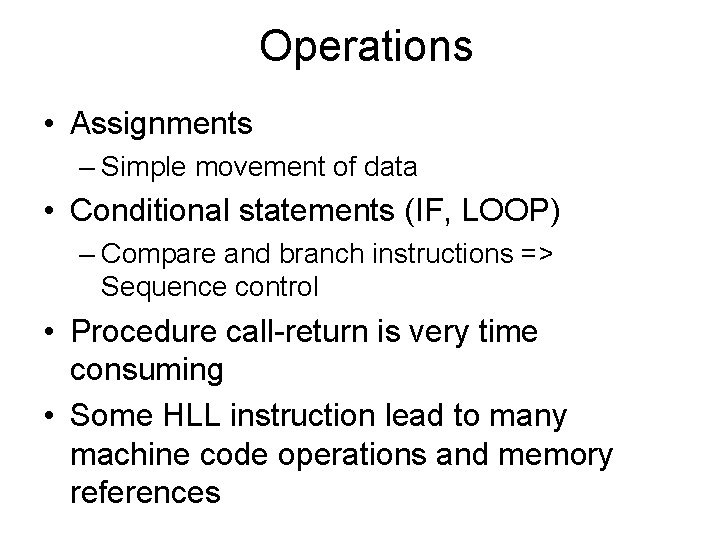
Operations • Assignments – Simple movement of data • Conditional statements (IF, LOOP) – Compare and branch instructions => Sequence control • Procedure call-return is very time consuming • Some HLL instruction lead to many machine code operations and memory references
Weighted Relative Dynamic Frequency of HLL Operations [PATT 82 a] Dynamic Occurrence Machine-Instruction Weighted Memory-Reference Weighted Pascal C ASSIGN 45% 38% 13% 14% 15% LOOP 5% 3% 42% 33% 26% CALL 15% 12% 31% 33% 44% 45% IF 29% 43% 11% 21% 7% 13% GOTO — 3% — — OTHER 6% 1% 3% 1% 2% 1%
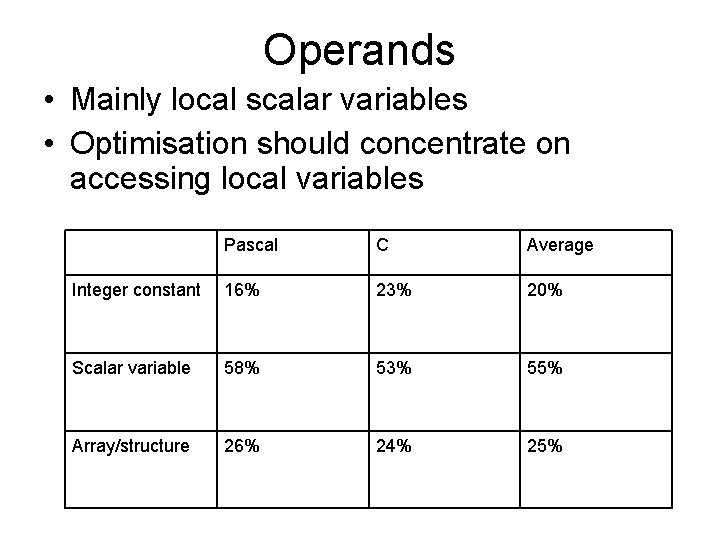
Operands • Mainly local scalar variables • Optimisation should concentrate on accessing local variables Pascal C Average Integer constant 16% 23% 20% Scalar variable 58% 53% 55% Array/structure 26% 24% 25%
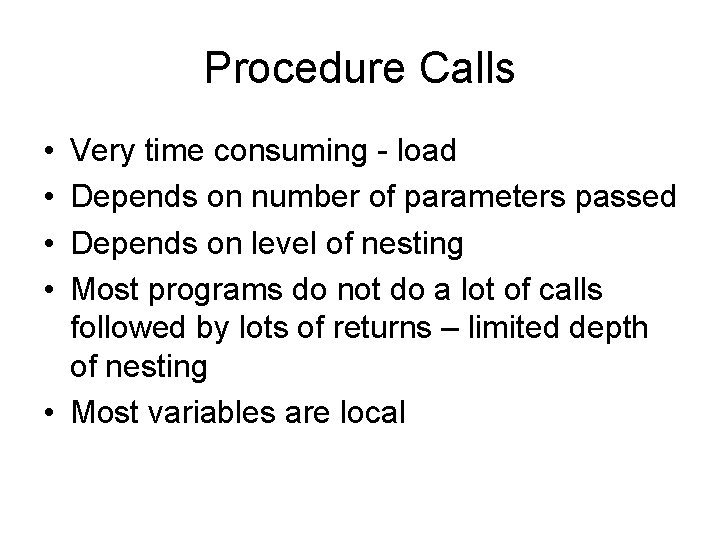
Procedure Calls • • Very time consuming - load Depends on number of parameters passed Depends on level of nesting Most programs do not do a lot of calls followed by lots of returns – limited depth of nesting • Most variables are local
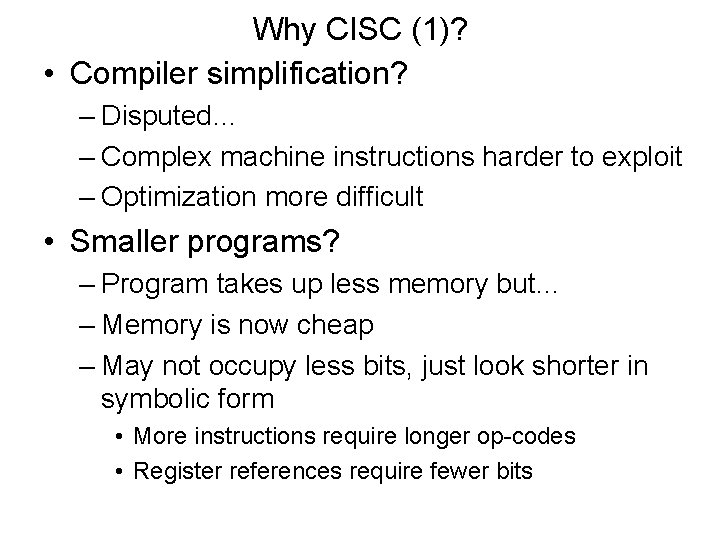
Why CISC (1)? • Compiler simplification? – Disputed… – Complex machine instructions harder to exploit – Optimization more difficult • Smaller programs? – Program takes up less memory but… – Memory is now cheap – May not occupy less bits, just look shorter in symbolic form • More instructions require longer op-codes • Register references require fewer bits
Why CISC (2)? • Faster programs? – Bias towards use of simpler instructions – More complex control unit – Thus even simple instructions take longer to execute • It is far from clear that CISC is the appropriate solution
Implications - RISC Best support is given by optimising most used and most time consuming features Large number of registers • • • Careful design of pipelines • • • Operand referencing (assignments, locality) Conditional branches and procedures Simplified (reduced) instruction set - for optimization of pipelining and efficient use of registers
RISC v CISC • Not clear cut • Many designs borrow from both design strategies: e. g. Power. PC and Pentium II • No pair of RISC and CISC that are directly comparable • No definitive set of test programs • Difficult to separate hardware effects from compiler effects • Most comparisons done on “toy” rather than production machines
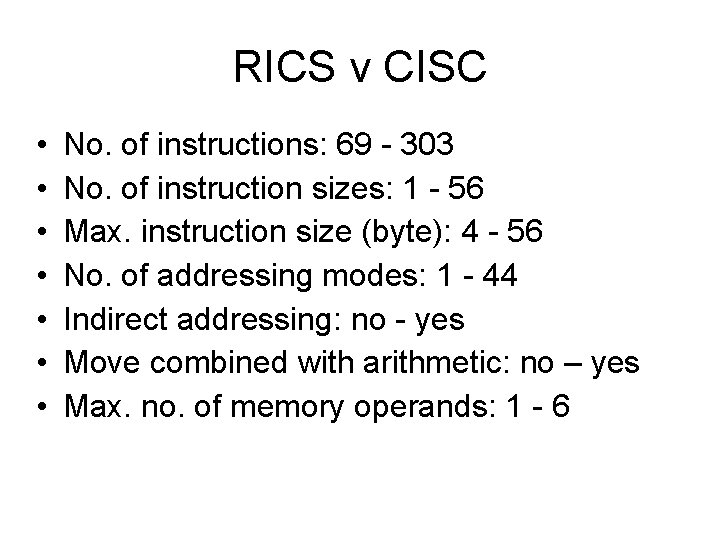
RICS v CISC • • No. of instructions: 69 - 303 No. of instruction sizes: 1 - 56 Max. instruction size (byte): 4 - 56 No. of addressing modes: 1 - 44 Indirect addressing: no - yes Move combined with arithmetic: no – yes Max. no. of memory operands: 1 - 6
Large Register File • Software solution – Require compiler to allocate registers – Allocation is based on most used variables in a given time – Requires sophisticated program analysis • Hardware solution – Have more registers – Thus more variables will be in registers
Registers for Local Variables • Store local scalar variables in registers Reduces memory access and simplifies addressing • Every procedure (function) call changes locality – Parameters must be passed down – Results must be returned – Variables from calling programs must be restored
Register Windows • Only few parameters passed between procedures • Limited depth of procedure calls • Use multiple small sets of registers • Call switches to a different set of registers • Return switches back to a previously used set of registers
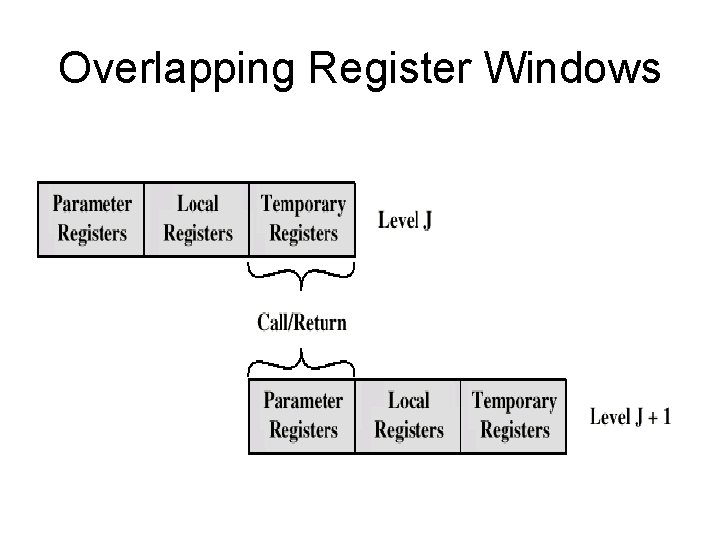
Register Windows cont. • Three areas within a register set 1. Parameter registers 2. Local registers 3. Temporary registers • Temporary registers from one set overlap with parameter registers from the next – This allows parameter passing without moving data
Overlapping Register Windows
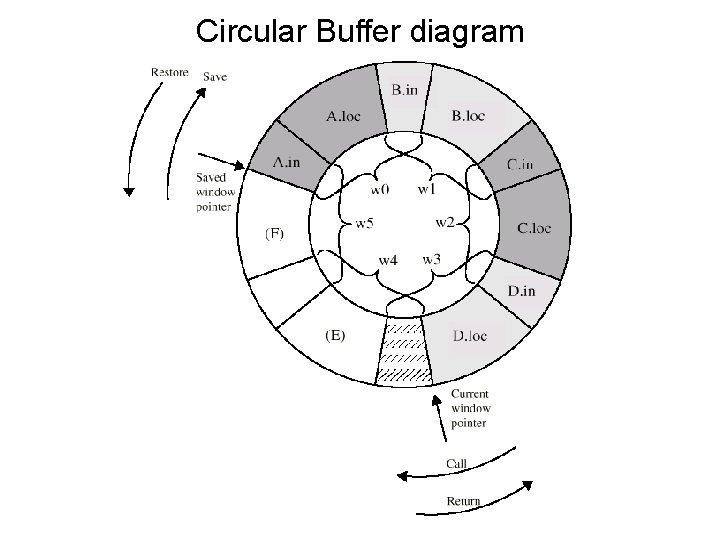
Circular Buffer diagram
Operations of Circular Buffer • When a call is made, a current window pointer is moved to show the currently active register window • If all windows are in use and a new procedure is called: an interrupt is generated and the oldest window (the one furthest back in the call nesting) is saved to memory
Operations of Circular Buffer (cont. ) • At a return a window may have to be restored from main memory • A saved window pointer indicates where the next saved window should be restored
Global Variables • Allocated by the compiler to memory – Inefficient for frequently accessed variables • Have a set of registers dedicated for storing global variables
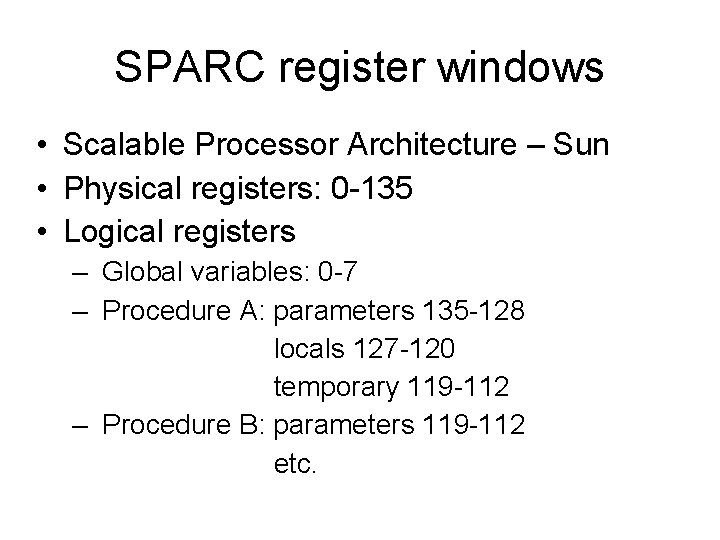
SPARC register windows • Scalable Processor Architecture – Sun • Physical registers: 0 -135 • Logical registers – Global variables: 0 -7 – Procedure A: parameters 135 -128 locals 127 -120 temporary 119 -112 – Procedure B: parameters 119 -112 etc.
• • Compiler Based Register Optimization Assume small number of registers (16 -32) Optimizing use is up to compiler HLL programs usually have no explicit references to registers Assign symbolic or virtual register to each candidate variable Map (unlimited) symbolic registers to real registers Symbolic registers that do not overlap can share real registers If you run out of real registers some variables use memory
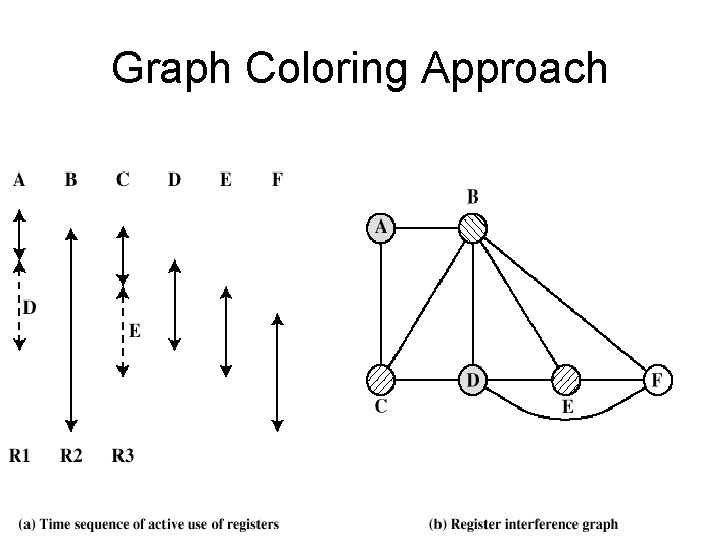
• • Graph Coloring Given a graph of nodes and edges Assign a color to each node Adjacent nodes have different colors Use minimum number of colors Nodes are symbolic registers Two registers that are live in the same program fragment are joined by an edge Try to color the graph with n colors, where n is the number of real registers Nodes that can not be colored are placed in memory
Graph Coloring Approach
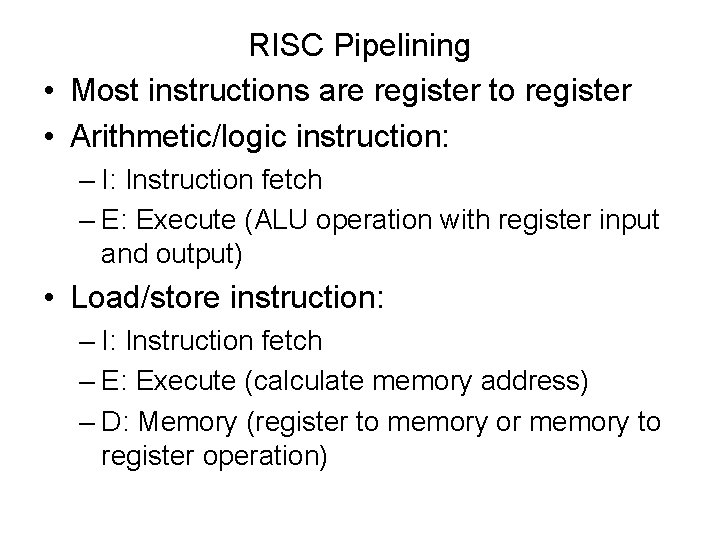
RISC Pipelining • Most instructions are register to register • Arithmetic/logic instruction: – I: Instruction fetch – E: Execute (ALU operation with register input and output) • Load/store instruction: – I: Instruction fetch – E: Execute (calculate memory address) – D: Memory (register to memory or memory to register operation)
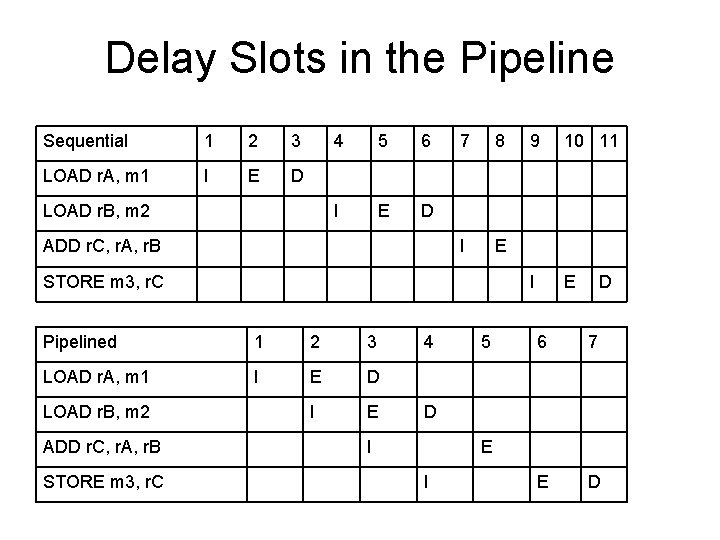
Delay Slots in the Pipeline Sequential 1 2 3 LOAD r. A, m 1 I E D LOAD r. B, m 2 4 5 6 I E D ADD r. C, r. A, r. B 7 8 I E STORE m 3, r. C Pipelined 1 2 3 LOAD r. A, m 1 I E D I E LOAD r. B, m 2 ADD r. C, r. A, r. B STORE m 3, r. C 4 5 9 10 11 I E D 6 7 E D D I E I
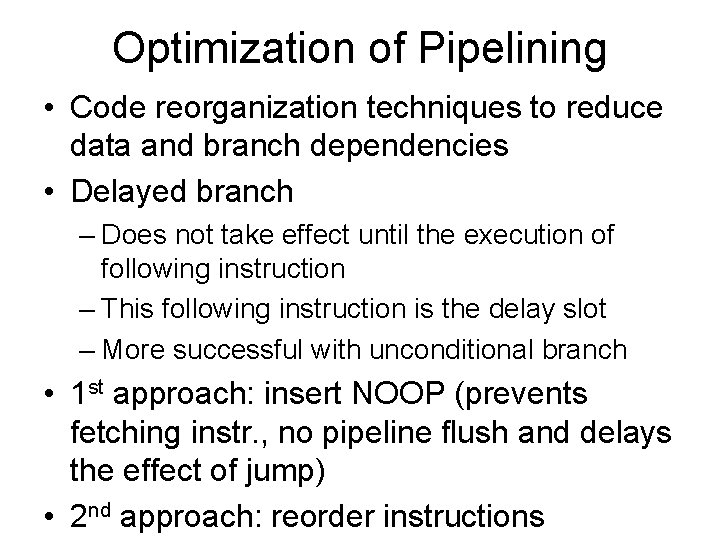
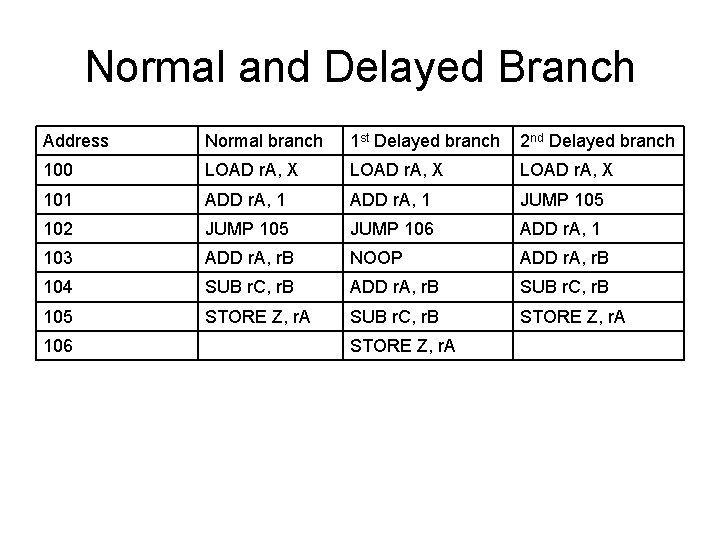
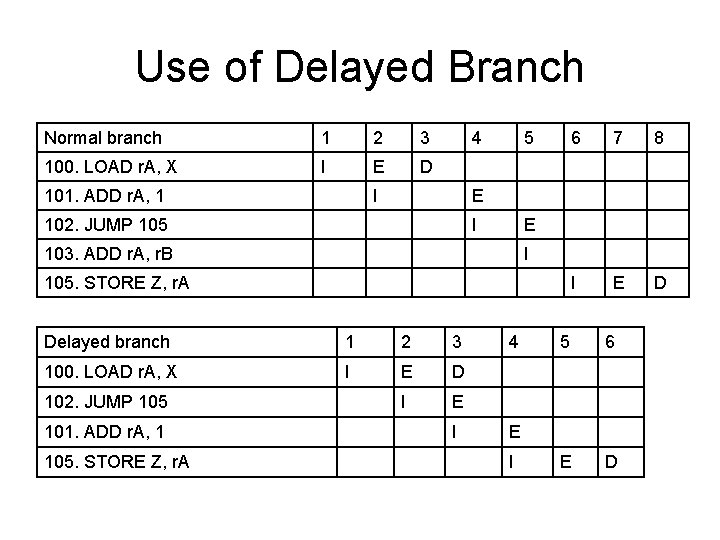
Optimization of Pipelining • Code reorganization techniques to reduce data and branch dependencies • Delayed branch – Does not take effect until the execution of following instruction – This following instruction is the delay slot – More successful with unconditional branch • 1 st approach: insert NOOP (prevents fetching instr. , no pipeline flush and delays the effect of jump) • 2 nd approach: reorder instructions
Normal and Delayed Branch Address Normal branch 1 st Delayed branch 2 nd Delayed branch 100 LOAD r. A, X 101 ADD r. A, 1 JUMP 105 102 JUMP 105 JUMP 106 ADD r. A, 1 103 ADD r. A, r. B NOOP ADD r. A, r. B 104 SUB r. C, r. B ADD r. A, r. B SUB r. C, r. B 105 STORE Z, r. A SUB r. C, r. B STORE Z, r. A 106 STORE Z, r. A
Use of Delayed Branch Normal branch 1 2 3 100. LOAD r. A, X I E D 101. ADD r. A, 1 4 I 5 I I E D I 105. STORE Z, r. A Delayed branch 1 2 3 100. LOAD r. A, X I E D I E 105. STORE Z, r. A 8 E 103. ADD r. A, r. B 101. ADD r. A, 1 7 E 102. JUMP 105 6 I 4 5 6 E D E I
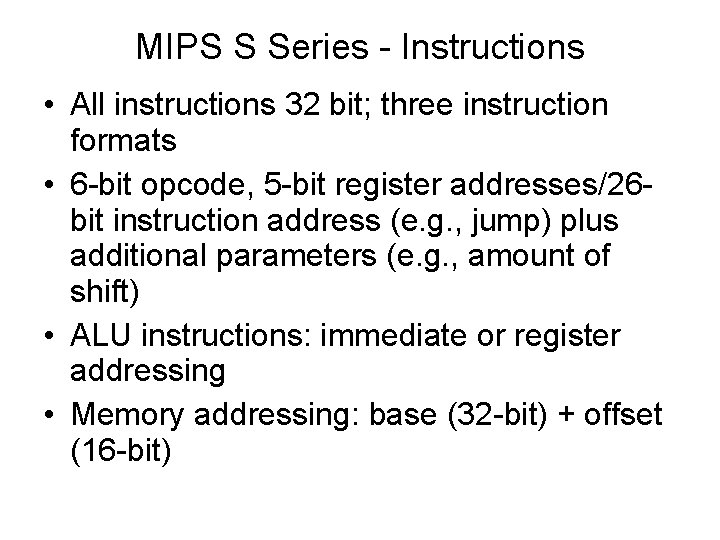
MIPS S Series - Instructions • All instructions 32 bit; three instruction formats • 6 -bit opcode, 5 -bit register addresses/26 bit instruction address (e. g. , jump) plus additional parameters (e. g. , amount of shift) • ALU instructions: immediate or register addressing • Memory addressing: base (32 -bit) + offset (16 -bit)
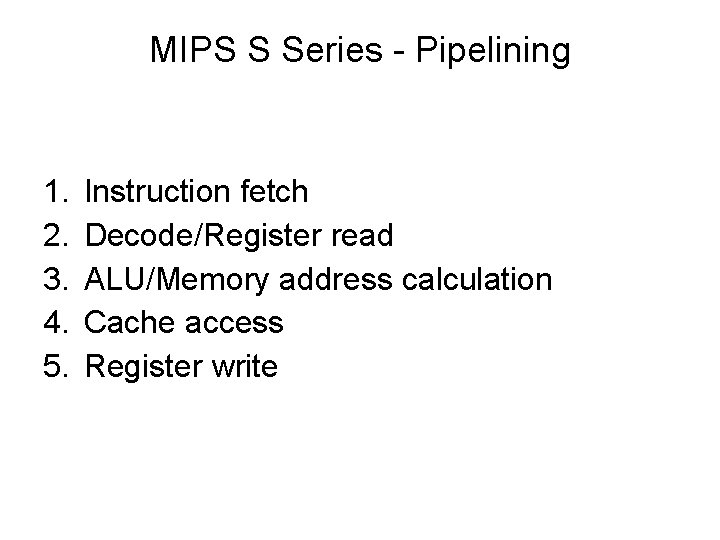
MIPS S Series - Pipelining 1. 2. 3. 4. 5. Instruction fetch Decode/Register read ALU/Memory address calculation Cache access Register write
MIPS – R 4000 pipeline 1. Instruction Fetch 1: address generated 2. IF 2: instruction fetched from cache 3. Register file: instruction decoded and operands fetched from registers 4. Instruction execute: ALU or virt. address calculation or branch conditions checked 5. Data cache 1: virt. add. sent to cache 6. DC 2: cache access 7. Tag check: checks on cache tags 8. Write back: result written into register