
Reduced Instruction Set Computer RISC Focuses on reducing
![Example: While C Loop to MIPS • While loop in C: while (save[i]==k) i](https://slidetodoc.com/presentation_image_h2/15624533f0331908cd1d180c6949ca12/image-17.jpg "Example: While C Loop to MIPS • While loop in C: while (save[i]==k) i")
- Slides: 27
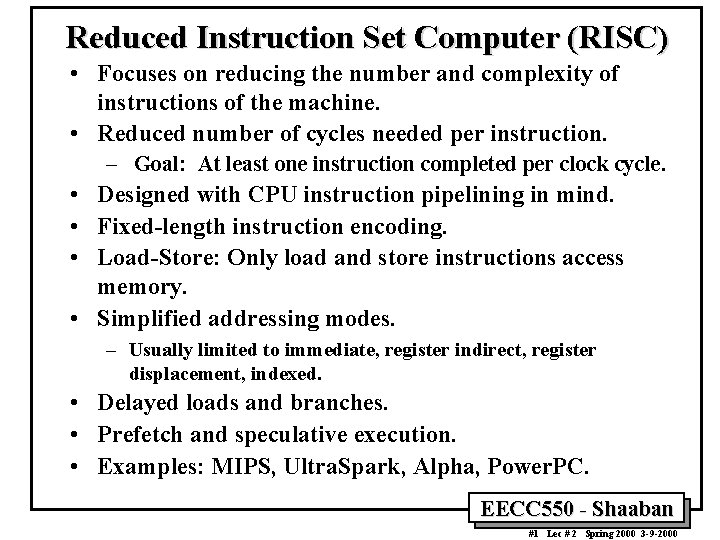
Reduced Instruction Set Computer (RISC) • Focuses on reducing the number and complexity of instructions of the machine. • Reduced number of cycles needed per instruction. – Goal: At least one instruction completed per clock cycle. • Designed with CPU instruction pipelining in mind. • Fixed-length instruction encoding. • Load-Store: Only load and store instructions access memory. • Simplified addressing modes. – Usually limited to immediate, register indirect, register displacement, indexed. • Delayed loads and branches. • Prefetch and speculative execution. • Examples: MIPS, Ultra. Spark, Alpha, Power. PC. EECC 550 - Shaaban #1 Lec # 2 Spring 2000 3 -9 -2000
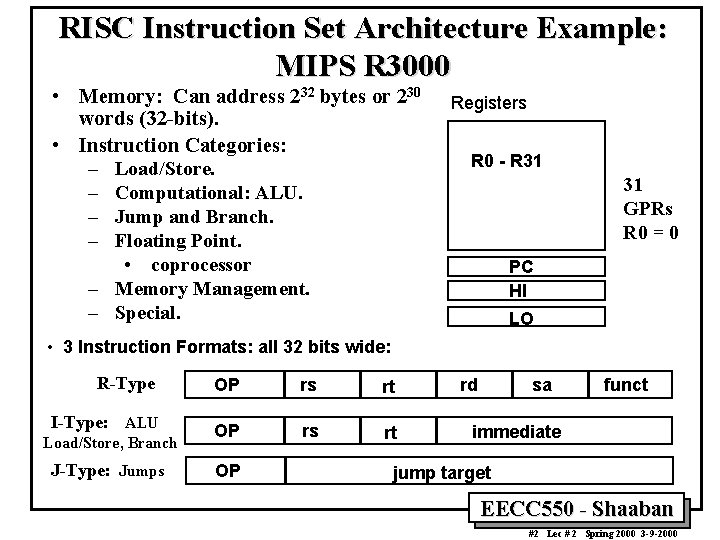
RISC Instruction Set Architecture Example: MIPS R 3000 • Memory: Can address 232 bytes or 230 words (32 -bits). • Instruction Categories: – Load/Store. – Computational: ALU. – Jump and Branch. – Floating Point. • coprocessor – Memory Management. – Special. Registers R 0 - R 31 31 GPRs R 0 = 0 PC HI LO • 3 Instruction Formats: all 32 bits wide: R-Type OP rs rt I-Type: ALU OP rs rt Load/Store, Branch J-Type: Jumps OP rd sa funct immediate jump target EECC 550 - Shaaban #2 Lec # 2 Spring 2000 3 -9 -2000
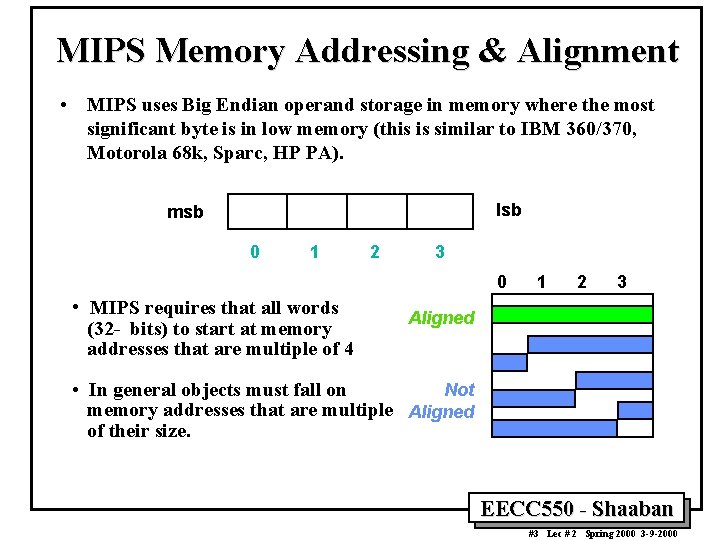
MIPS Memory Addressing & Alignment • MIPS uses Big Endian operand storage in memory where the most significant byte is in low memory (this is similar to IBM 360/370, Motorola 68 k, Sparc, HP PA). lsb msb 0 1 2 3 0 • MIPS requires that all words (32 - bits) to start at memory addresses that are multiple of 4 1 2 3 Aligned • In general objects must fall on Not memory addresses that are multiple Aligned of their size. EECC 550 - Shaaban #3 Lec # 2 Spring 2000 3 -9 -2000
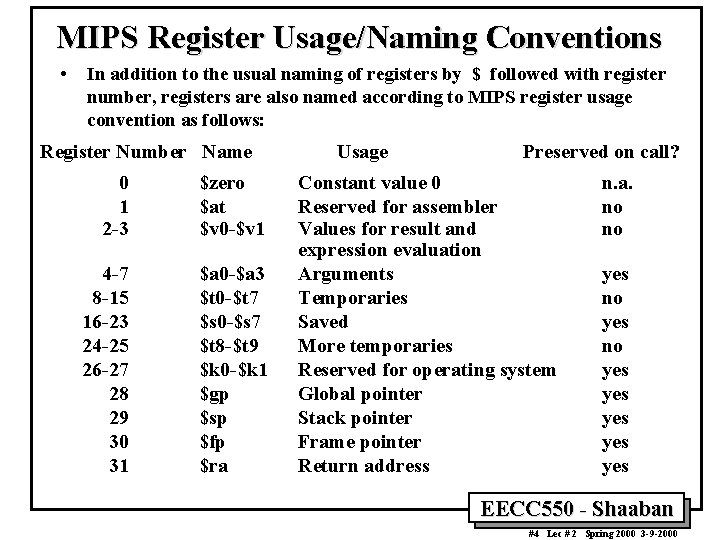
MIPS Register Usage/Naming Conventions • In addition to the usual naming of registers by $ followed with register number, registers are also named according to MIPS register usage convention as follows: Register Number Name 0 1 2 -3 $zero $at $v 0 -$v 1 4 -7 8 -15 16 -23 24 -25 26 -27 28 29 30 31 $a 0 -$a 3 $t 0 -$t 7 $s 0 -$s 7 $t 8 -$t 9 $k 0 -$k 1 $gp $sp $fp $ra Usage Preserved on call? Constant value 0 Reserved for assembler Values for result and expression evaluation Arguments Temporaries Saved More temporaries Reserved for operating system Global pointer Stack pointer Frame pointer Return address n. a. no no yes yes yes EECC 550 - Shaaban #4 Lec # 2 Spring 2000 3 -9 -2000
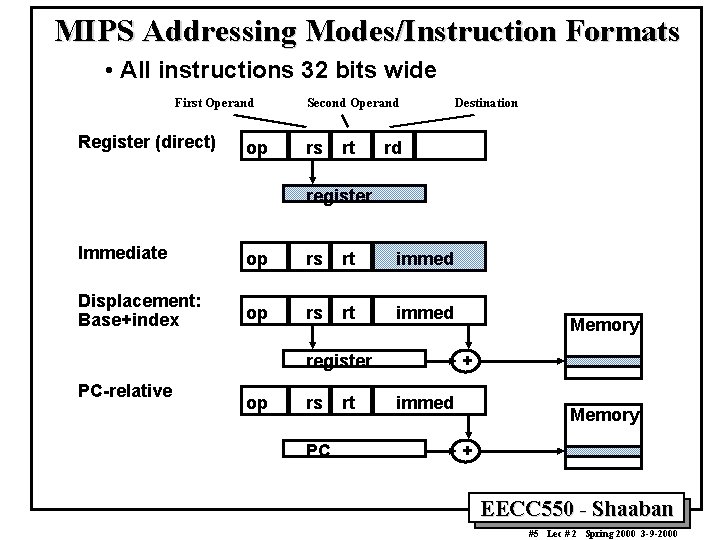
MIPS Addressing Modes/Instruction Formats • All instructions 32 bits wide First Operand Register (direct) op Second Operand rs rt Destination rd register Immediate op rs rt immed Displacement: Base+index op rs rt immed register PC-relative op rs PC rt Memory + immed Memory + EECC 550 - Shaaban #5 Lec # 2 Spring 2000 3 -9 -2000
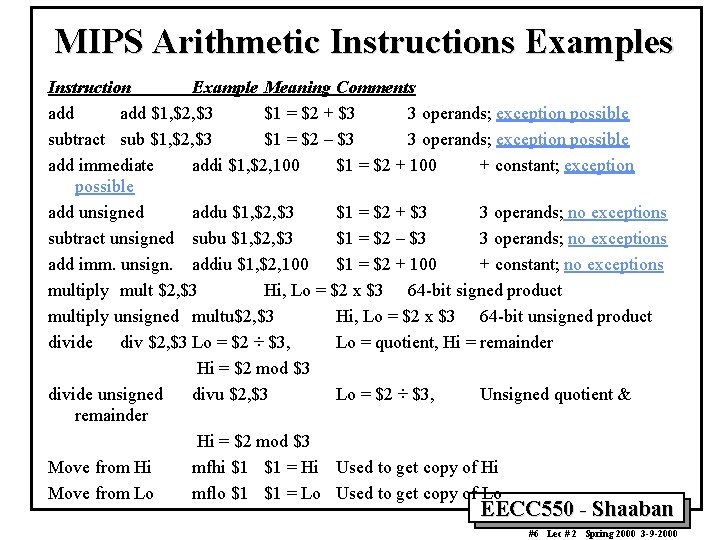
MIPS Arithmetic Instructions Examples Instruction Example Meaning Comments add $1, $2, $3 $1 = $2 + $3 3 operands; exception possible subtract sub $1, $2, $3 $1 = $2 – $3 3 operands; exception possible add immediate addi $1, $2, 100 $1 = $2 + 100 + constant; exception possible add unsigned addu $1, $2, $3 $1 = $2 + $3 3 operands; no exceptions subtract unsigned subu $1, $2, $3 $1 = $2 – $3 3 operands; no exceptions add imm. unsign. addiu $1, $2, 100 $1 = $2 + 100 + constant; no exceptions multiply mult $2, $3 Hi, Lo = $2 x $3 64 -bit signed product multiply unsigned multu$2, $3 Hi, Lo = $2 x $3 64 -bit unsigned product divide div $2, $3 Lo = $2 ÷ $3, Lo = quotient, Hi = remainder Hi = $2 mod $3 divide unsigned divu $2, $3 Lo = $2 ÷ $3, Unsigned quotient & remainder Hi = $2 mod $3 Move from Hi mfhi $1 $1 = Hi Used to get copy of Hi Move from Lo mflo $1 $1 = Lo Used to get copy of Lo EECC 550 - Shaaban #6 Lec # 2 Spring 2000 3 -9 -2000
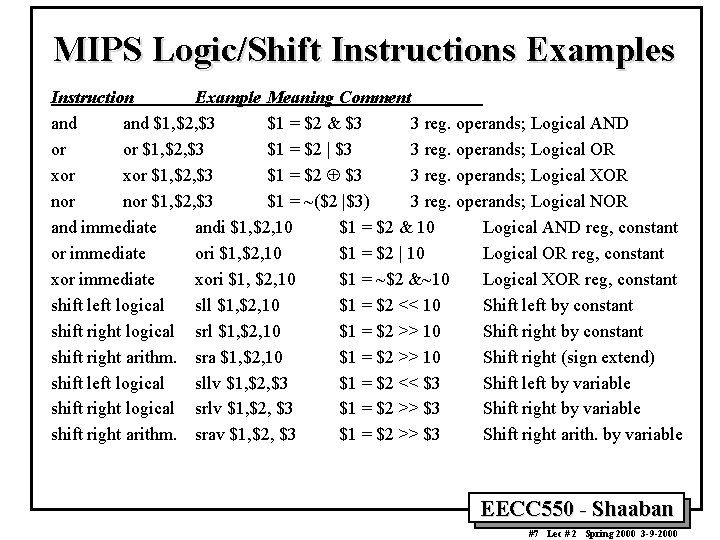
MIPS Logic/Shift Instructions Examples Instruction Example Meaning Comment and $1, $2, $3 $1 = $2 & $3 3 reg. operands; Logical AND or or $1, $2, $3 $1 = $2 | $3 3 reg. operands; Logical OR xor $1, $2, $3 $1 = $2 $3 3 reg. operands; Logical XOR nor $1, $2, $3 $1 = ~($2 |$3) 3 reg. operands; Logical NOR and immediate andi $1, $2, 10 $1 = $2 & 10 Logical AND reg, constant or immediate ori $1, $2, 10 $1 = $2 | 10 Logical OR reg, constant xor immediate xori $1, $2, 10 $1 = ~$2 &~10 Logical XOR reg, constant shift left logical sll $1, $2, 10 $1 = $2 << 10 Shift left by constant shift right logical srl $1, $2, 10 $1 = $2 >> 10 Shift right by constant shift right arithm. sra $1, $2, 10 $1 = $2 >> 10 Shift right (sign extend) shift left logical sllv $1, $2, $3 $1 = $2 << $3 Shift left by variable shift right logical srlv $1, $2, $3 $1 = $2 >> $3 Shift right by variable shift right arithm. srav $1, $2, $3 $1 = $2 >> $3 Shift right arith. by variable EECC 550 - Shaaban #7 Lec # 2 Spring 2000 3 -9 -2000
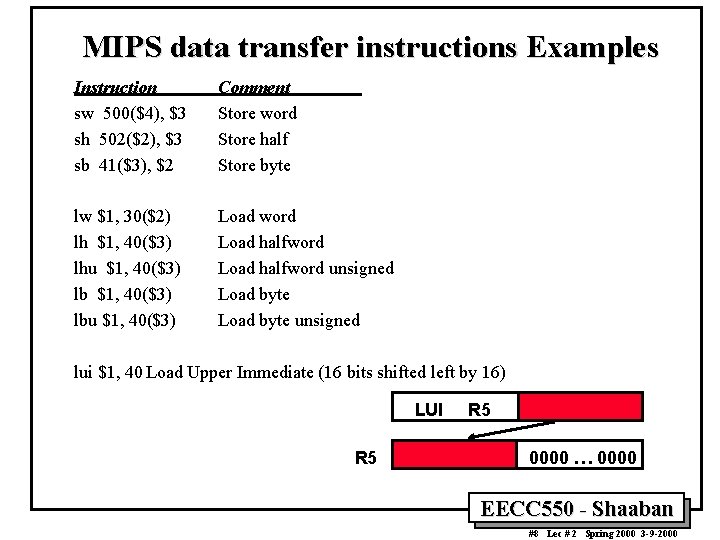
MIPS data transfer instructions Examples Instruction sw 500($4), $3 sh 502($2), $3 sb 41($3), $2 Comment Store word Store half Store byte lw $1, 30($2) lh $1, 40($3) lhu $1, 40($3) lbu $1, 40($3) Load word Load halfword unsigned Load byte unsigned lui $1, 40 Load Upper Immediate (16 bits shifted left by 16) LUI R 5 0000 … 0000 EECC 550 - Shaaban #8 Lec # 2 Spring 2000 3 -9 -2000
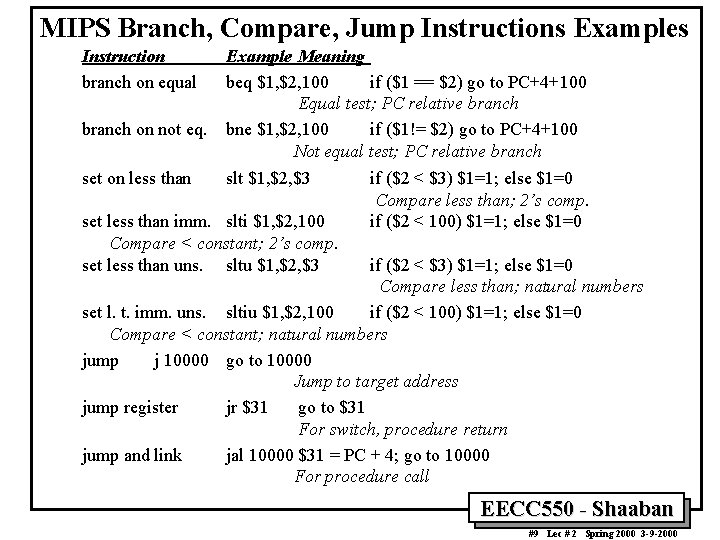
MIPS Branch, Compare, Jump Instructions Examples Instruction branch on equal branch on not eq. set on less than Example Meaning beq $1, $2, 100 if ($1 == $2) go to PC+4+100 Equal test; PC relative branch bne $1, $2, 100 if ($1!= $2) go to PC+4+100 Not equal test; PC relative branch slt $1, $2, $3 set less than imm. slti $1, $2, 100 Compare < constant; 2’s comp. set less than uns. sltu $1, $2, $3 if ($2 < $3) $1=1; else $1=0 Compare less than; 2’s comp. if ($2 < 100) $1=1; else $1=0 if ($2 < $3) $1=1; else $1=0 Compare less than; natural numbers set l. t. imm. uns. sltiu $1, $2, 100 if ($2 < 100) $1=1; else $1=0 Compare < constant; natural numbers jump j 10000 go to 10000 Jump to target address jump register jr $31 go to $31 For switch, procedure return jump and link jal 10000 $31 = PC + 4; go to 10000 For procedure call EECC 550 - Shaaban #9 Lec # 2 Spring 2000 3 -9 -2000
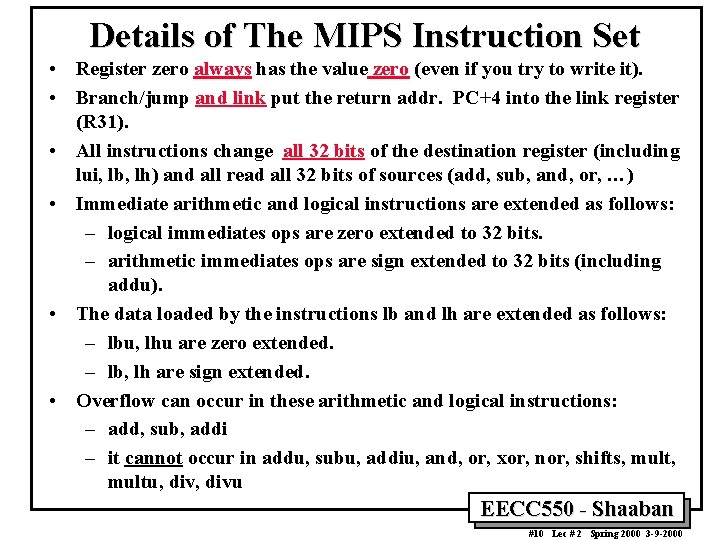
Details of The MIPS Instruction Set • Register zero always has the value zero (even if you try to write it). • Branch/jump and link put the return addr. PC+4 into the link register (R 31). • All instructions change all 32 bits of the destination register (including lui, lb, lh) and all read all 32 bits of sources (add, sub, and, or, …) • Immediate arithmetic and logical instructions are extended as follows: – logical immediates ops are zero extended to 32 bits. – arithmetic immediates ops are sign extended to 32 bits (including addu). • The data loaded by the instructions lb and lh are extended as follows: – lbu, lhu are zero extended. – lb, lh are sign extended. • Overflow can occur in these arithmetic and logical instructions: – add, sub, addi – it cannot occur in addu, subu, addiu, and, or, xor, nor, shifts, multu, divu EECC 550 - Shaaban #10 Lec # 2 Spring 2000 3 -9 -2000
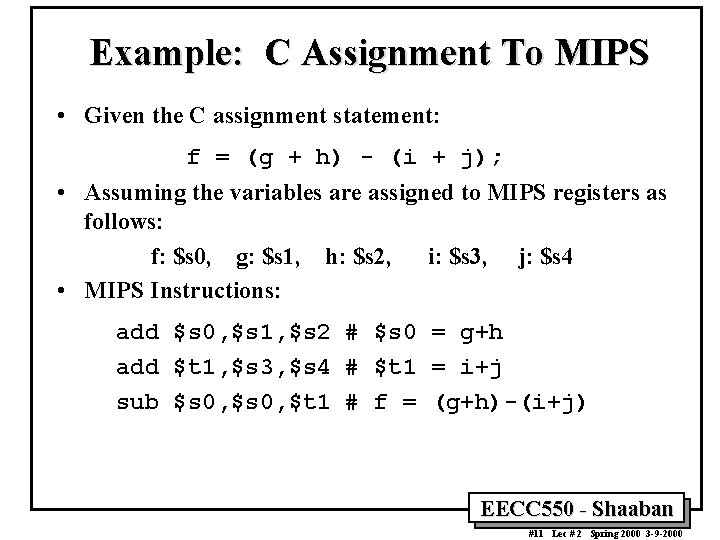
Example: C Assignment To MIPS • Given the C assignment statement: f = (g + h) - (i + j); • Assuming the variables are assigned to MIPS registers as follows: f: $s 0, g: $s 1, h: $s 2, i: $s 3, j: $s 4 • MIPS Instructions: add $s 0, $s 1, $s 2 # $s 0 = g+h add $t 1, $s 3, $s 4 # $t 1 = i+j sub $s 0, $t 1 # f = (g+h)-(i+j) EECC 550 - Shaaban #11 Lec # 2 Spring 2000 3 -9 -2000
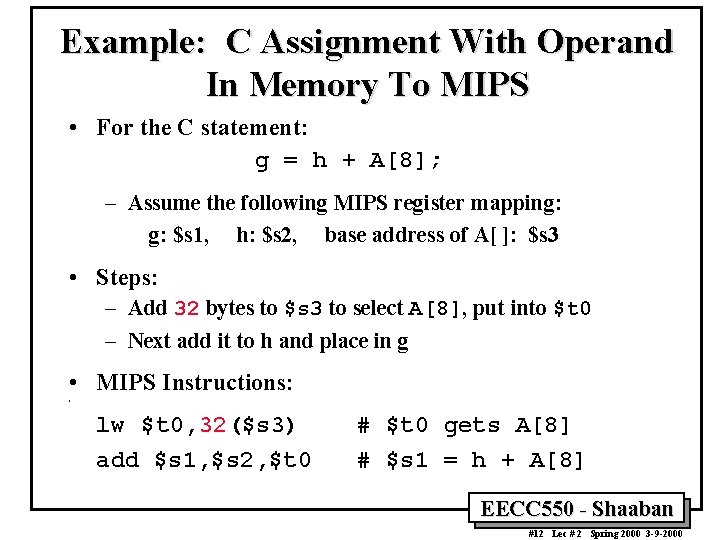
Example: C Assignment With Operand In Memory To MIPS • For the C statement: g = h + A[8]; – Assume the following MIPS register mapping: g: $s 1, h: $s 2, base address of A[ ]: $s 3 • Steps: – Add 32 bytes to $s 3 to select A[8], put into $t 0 – Next add it to h and place in g • MIPS Instructions: • lw $t 0, 32($s 3) add $s 1, $s 2, $t 0 # $t 0 gets A[8] # $s 1 = h + A[8] EECC 550 - Shaaban #12 Lec # 2 Spring 2000 3 -9 -2000
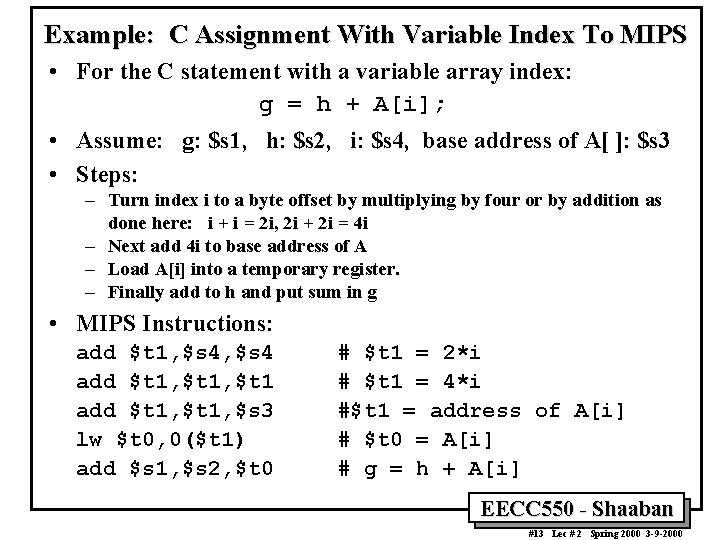
Example: C Assignment With Variable Index To MIPS • For the C statement with a variable array index: g = h + A[i]; • Assume: g: $s 1, h: $s 2, i: $s 4, base address of A[ ]: $s 3 • Steps: – Turn index i to a byte offset by multiplying by four or by addition as done here: i + i = 2 i, 2 i + 2 i = 4 i – Next add 4 i to base address of A – Load A[i] into a temporary register. – Finally add to h and put sum in g • MIPS Instructions: add $t 1, $s 4 add $t 1, $t 1 add $t 1, $s 3 lw $t 0, 0($t 1) add $s 1, $s 2, $t 0 # $t 1 = 2*i # $t 1 = 4*i #$t 1 = address of A[i] # $t 0 = A[i] # g = h + A[i] EECC 550 - Shaaban #13 Lec # 2 Spring 2000 3 -9 -2000
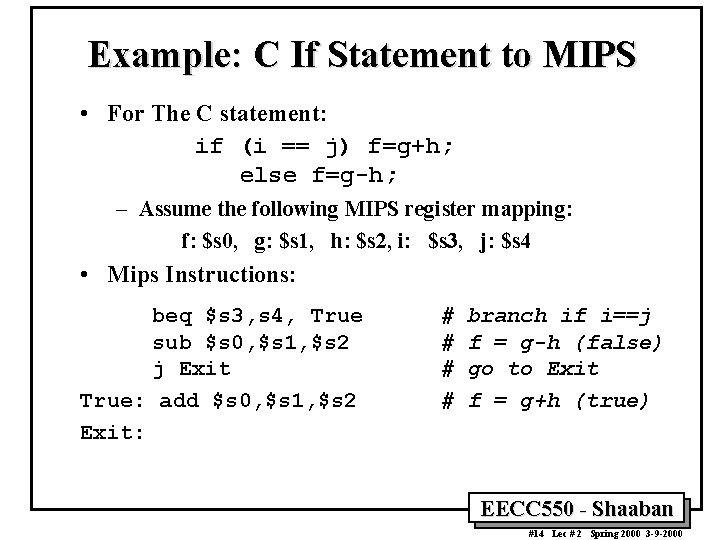
Example: C If Statement to MIPS • For The C statement: if (i == j) f=g+h; else f=g-h; – Assume the following MIPS register mapping: f: $s 0, g: $s 1, h: $s 2, i: $s 3, j: $s 4 • Mips Instructions: beq $s 3, s 4, True sub $s 0, $s 1, $s 2 j Exit True: add $s 0, $s 1, $s 2 Exit: # # branch if i==j f = g-h (false) go to Exit f = g+h (true) EECC 550 - Shaaban #14 Lec # 2 Spring 2000 3 -9 -2000
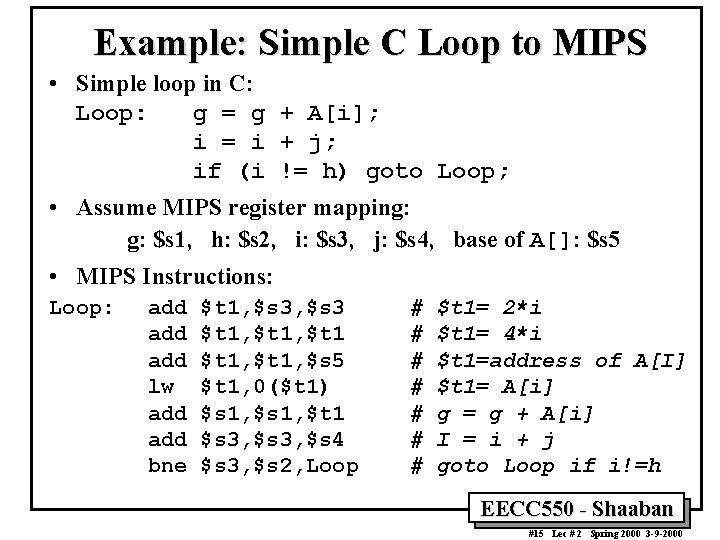
Example: Simple C Loop to MIPS • Simple loop in C: Loop: g = g + A[i]; i = i + j; if (i != h) goto Loop; • Assume MIPS register mapping: g: $s 1, h: $s 2, i: $s 3, j: $s 4, base of A[]: $s 5 • MIPS Instructions: Loop: add add lw add bne $t 1, $s 3 $t 1, $t 1, $s 5 $t 1, 0($t 1) $s 1, $t 1 $s 3, $s 4 $s 3, $s 2, Loop # # # # $t 1= 2*i $t 1= 4*i $t 1=address of A[I] $t 1= A[i] g = g + A[i] I = i + j goto Loop if i!=h EECC 550 - Shaaban #15 Lec # 2 Spring 2000 3 -9 -2000
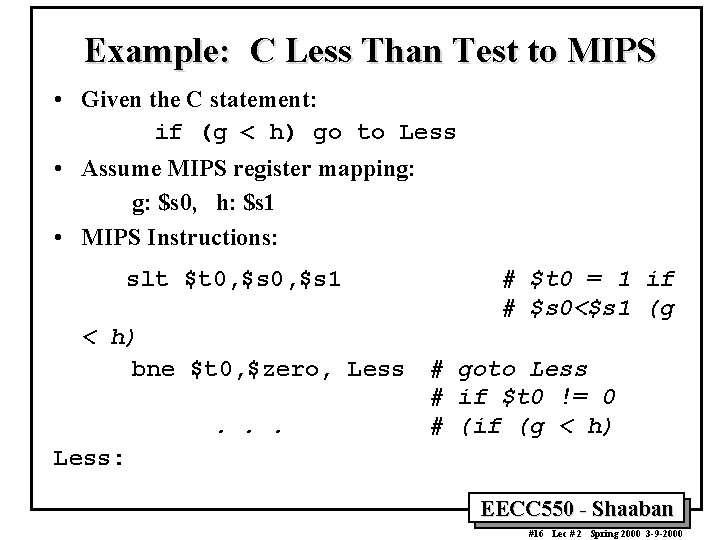
Example: C Less Than Test to MIPS • Given the C statement: if (g < h) go to Less • Assume MIPS register mapping: g: $s 0, h: $s 1 • MIPS Instructions: slt $t 0, $s 1 # $t 0 = 1 if # $s 0<$s 1 (g < h) bne $t 0, $zero, Less # goto Less # if $t 0 != 0. . . # (if (g < h) Less: EECC 550 - Shaaban #16 Lec # 2 Spring 2000 3 -9 -2000
Example: While C Loop to MIPS • While loop in C: while (save[i]==k) i = i + j; • Assume MIPS register mapping: i: $s 3, j: $s 4, k: $s 5, base of save[ ]: $s 6 • MIPS Instructions: Loop: add add lw bne $t 1, $s 3 $t 1, $t 1, $s 6 $t 1, 0($t 1) $t 1, $s 5, Exit add $s 3, $s 4 j Loop Exit: # # # # $t 1 = 2*i $t 1 = 4*i $t 1 = Address $t 1 = save[i] goto Exit if save[i]!=k i = i + j goto Loop EECC 550 - Shaaban #17 Lec # 2 Spring 2000 3 -9 -2000
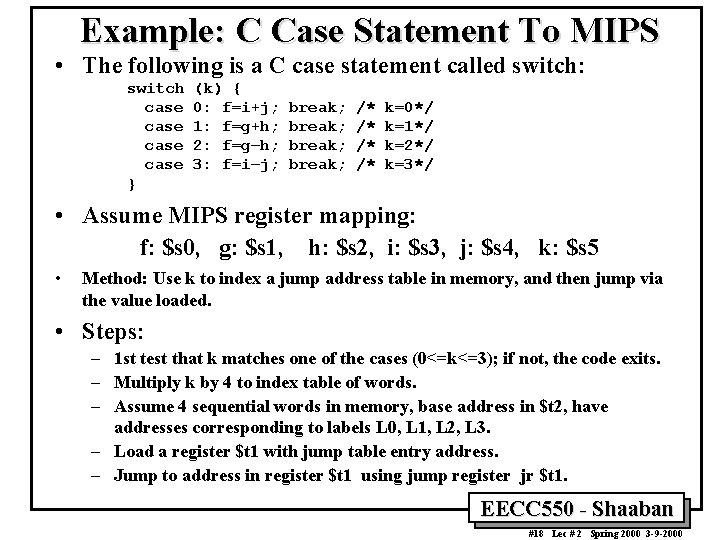
Example: C Case Statement To MIPS • The following is a C case statement called switch: switch case } (k) { 0: f=i+j; 1: f=g+h; 2: f=g–h; 3: f=i–j; break; /* /* k=0*/ k=1*/ k=2*/ k=3*/ • Assume MIPS register mapping: f: $s 0, g: $s 1, h: $s 2, i: $s 3, j: $s 4, k: $s 5 • Method: Use k to index a jump address table in memory, and then jump via the value loaded. • Steps: – 1 st test that k matches one of the cases (0<=k<=3); if not, the code exits. – Multiply k by 4 to index table of words. – Assume 4 sequential words in memory, base address in $t 2, have addresses corresponding to labels L 0, L 1, L 2, L 3. – Load a register $t 1 with jump table entry address. – Jump to address in register $t 1 using jump register jr $t 1. EECC 550 - Shaaban #18 Lec # 2 Spring 2000 3 -9 -2000
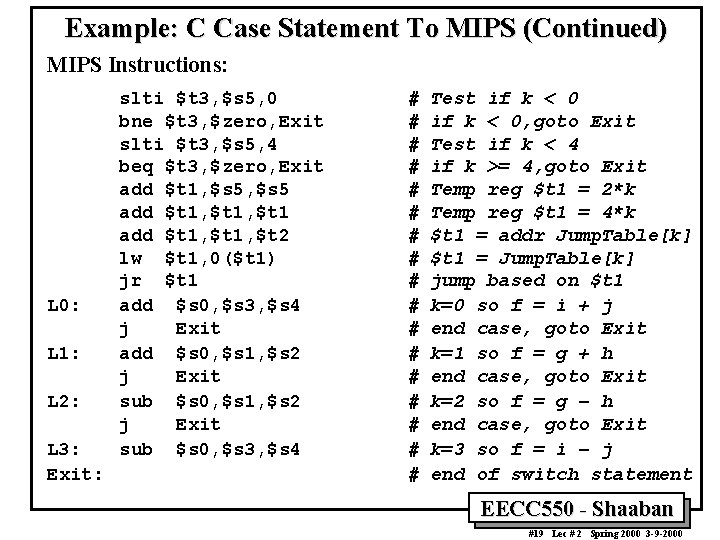
Example: C Case Statement To MIPS (Continued) MIPS Instructions: L 0: L 1: L 2: L 3: Exit: slti $t 3, $s 5, 0 bne $t 3, $zero, Exit slti $t 3, $s 5, 4 beq $t 3, $zero, Exit add $t 1, $s 5 add $t 1, $t 1 add $t 1, $t 2 lw $t 1, 0($t 1) jr $t 1 add $s 0, $s 3, $s 4 j Exit add $s 0, $s 1, $s 2 j Exit sub $s 0, $s 3, $s 4 # # # # # Test if k < 0, goto Exit Test if k < 4 if k >= 4, goto Exit Temp reg $t 1 = 2*k Temp reg $t 1 = 4*k $t 1 = addr Jump. Table[k] $t 1 = Jump. Table[k] jump based on $t 1 k=0 so f = i + j end case, goto Exit k=1 so f = g + h end case, goto Exit k=2 so f = g – h end case, goto Exit k=3 so f = i – j end of switch statement EECC 550 - Shaaban #19 Lec # 2 Spring 2000 3 -9 -2000
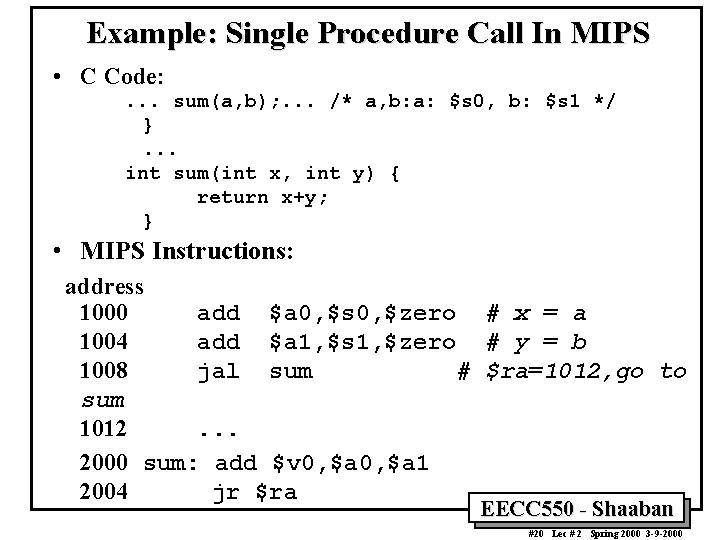
Example: Single Procedure Call In MIPS • C Code: . . . sum(a, b); . . . /* a, b: a: $s 0, b: $s 1 */ }. . . int sum(int x, int y) { return x+y; } • MIPS Instructions: address 1000 add $a 0, $s 0, $zero # x = a 1004 add $a 1, $s 1, $zero # y = b 1008 jal sum # $ra=1012, go to sum 1012. . . 2000 sum: add $v 0, $a 1 2004 jr $ra EECC 550 - Shaaban #20 Lec # 2 Spring 2000 3 -9 -2000
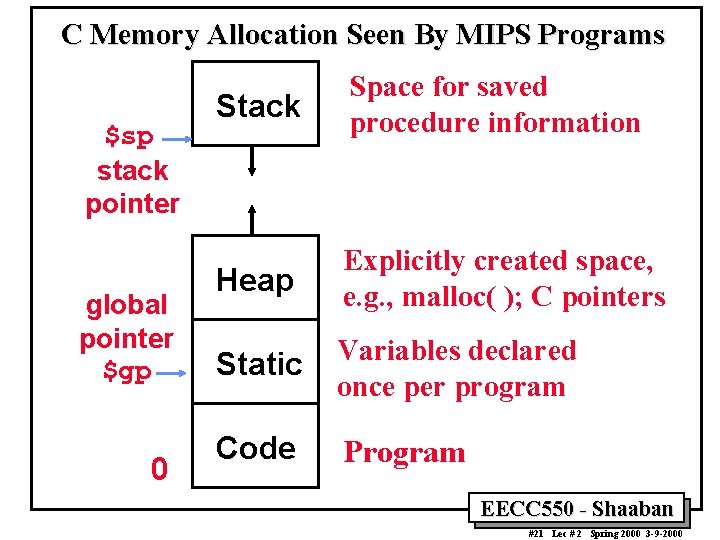
C Memory Allocation Seen By MIPS Programs $sp stack pointer global pointer $gp 0 Stack Space for saved procedure information Heap Explicitly created space, e. g. , malloc( ); C pointers Static Variables declared once per program Code Program EECC 550 - Shaaban #21 Lec # 2 Spring 2000 3 -9 -2000
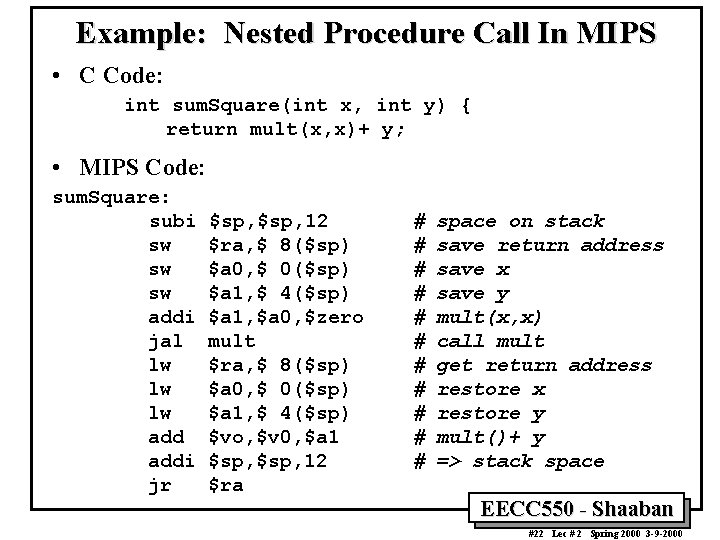
Example: Nested Procedure Call In MIPS • C Code: int sum. Square(int x, int y) { return mult(x, x)+ y; • MIPS Code: sum. Square: subi sw sw sw addi jal lw lw lw addi jr $sp, 12 $ra, $ 8($sp) $a 0, $ 0($sp) $a 1, $ 4($sp) $a 1, $a 0, $zero mult $ra, $ 8($sp) $a 0, $ 0($sp) $a 1, $ 4($sp) $vo, $v 0, $a 1 $sp, 12 $ra # # # space on stack save return address save x save y mult(x, x) call mult get return address restore x restore y mult()+ y => stack space EECC 550 - Shaaban #22 Lec # 2 Spring 2000 3 -9 -2000
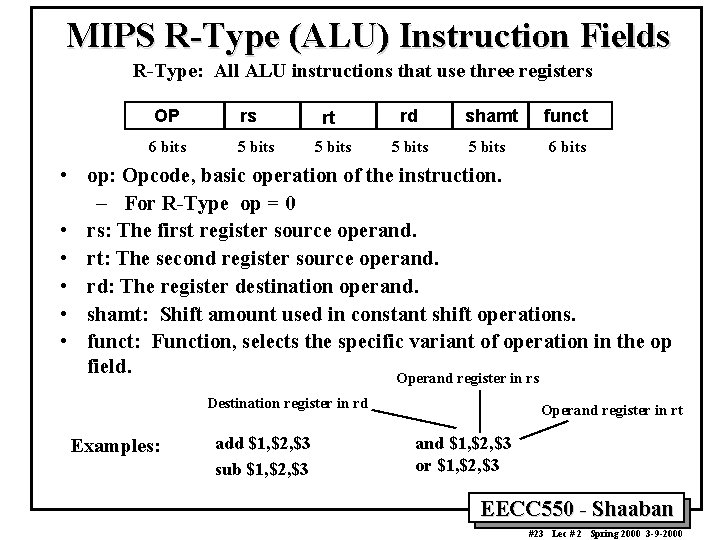
MIPS R-Type (ALU) Instruction Fields R-Type: All ALU instructions that use three registers OP 6 bits rs 5 bits rt rd shamt funct 5 bits 6 bits • op: Opcode, basic operation of the instruction. – For R-Type op = 0 • rs: The first register source operand. • rt: The second register source operand. • rd: The register destination operand. • shamt: Shift amount used in constant shift operations. • funct: Function, selects the specific variant of operation in the op field. Operand register in rs Destination register in rd Examples: add $1, $2, $3 sub $1, $2, $3 Operand register in rt and $1, $2, $3 or $1, $2, $3 EECC 550 - Shaaban #23 Lec # 2 Spring 2000 3 -9 -2000
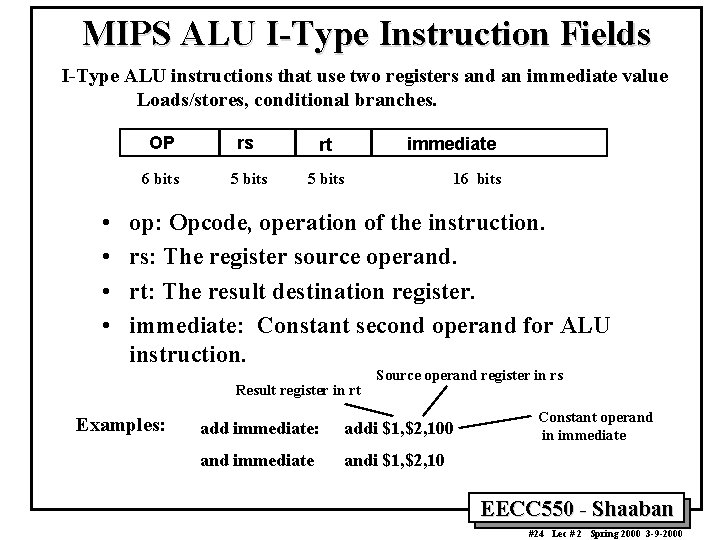
MIPS ALU I-Type Instruction Fields I-Type ALU instructions that use two registers and an immediate value Loads/stores, conditional branches. • • OP rs rt 6 bits 5 bits immediate 16 bits op: Opcode, operation of the instruction. rs: The register source operand. rt: The result destination register. immediate: Constant second operand for ALU instruction. Result register in rt Examples: Source operand register in rs add immediate: addi $1, $2, 100 and immediate andi $1, $2, 10 Constant operand in immediate EECC 550 - Shaaban #24 Lec # 2 Spring 2000 3 -9 -2000
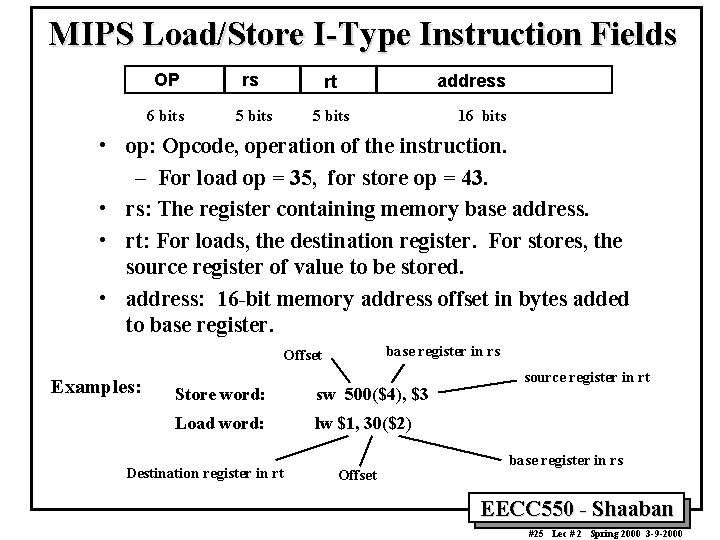
MIPS Load/Store I-Type Instruction Fields OP rs rt 6 bits 5 bits address 16 bits • op: Opcode, operation of the instruction. – For load op = 35, for store op = 43. • rs: The register containing memory base address. • rt: For loads, the destination register. For stores, the source register of value to be stored. • address: 16 -bit memory address offset in bytes added to base register in rs Offset Examples: Store word: sw 500($4), $3 Load word: lw $1, 30($2) Destination register in rt Offset source register in rt base register in rs EECC 550 - Shaaban #25 Lec # 2 Spring 2000 3 -9 -2000
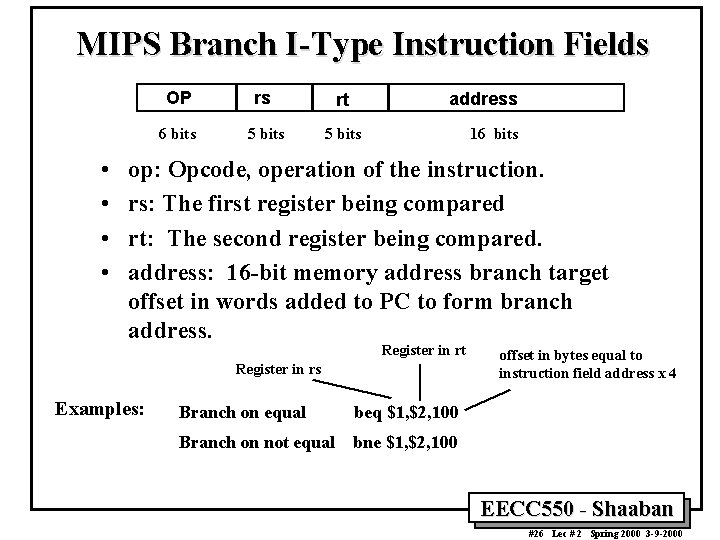
MIPS Branch I-Type Instruction Fields • • OP rs rt 6 bits 5 bits address 16 bits op: Opcode, operation of the instruction. rs: The first register being compared rt: The second register being compared. address: 16 -bit memory address branch target offset in words added to PC to form branch address. Register in rt Register in rs Examples: Branch on equal beq $1, $2, 100 Branch on not equal bne $1, $2, 100 offset in bytes equal to instruction field address x 4 EECC 550 - Shaaban #26 Lec # 2 Spring 2000 3 -9 -2000
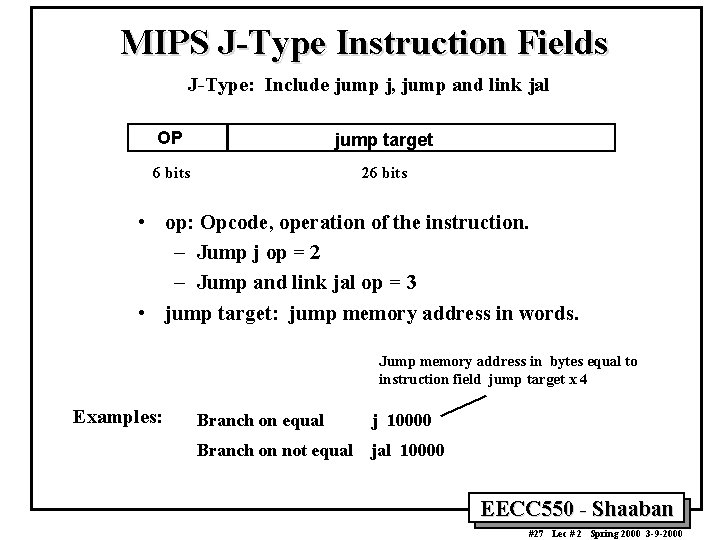
MIPS J-Type Instruction Fields J-Type: Include jump j, jump and link jal OP jump target 6 bits 26 bits • op: Opcode, operation of the instruction. – Jump j op = 2 – Jump and link jal op = 3 • jump target: jump memory address in words. Jump memory address in bytes equal to instruction field jump target x 4 Examples: Branch on equal j 10000 Branch on not equal jal 10000 EECC 550 - Shaaban #27 Lec # 2 Spring 2000 3 -9 -2000