
REDUAL PCI dual antithrombotic therapy with dabigatran after
RE-DUAL PCI: dual antithrombotic therapy with dabigatran after percutaneous coronary intervention in patients with atrial fibrillation Christopher P. Cannon Deepak L Bhatt, Jonas Oldgren, Gregory YH Lip, Stephen G Ellis, Takeshi Kimura, Michael Maeng, Bela Merkely, Uwe Zeymer, Savion Gropper, Matias Nordaby, Eva Kleine, Ruth Harper, Jenny Manassie, James L Januzzi, Jurrien M ten Berg, Philippe Gabriel Steg and Stefan H Hohnloser On behalf of the steering committee and RE-DUAL PCI investigators
Declaration of interest -Research contracts (Amgen Arisaph, Boehringer - ngelhe·m (B ), Bristolyers Squ·bb (BMS), Daiichi Sankyo, Janssen, Merck, and Takeda: ) - Consu lting/Royalties /Owner / Stockholder of a healthcare company (Alnylam, Amgen, Arisaph Astra Zen- , eca BI, BMS Eisai, Glaxo. Smith. K line, Ko a Lipirnedix Merck, Pfizer egeneron Sanofi and Takeda. )
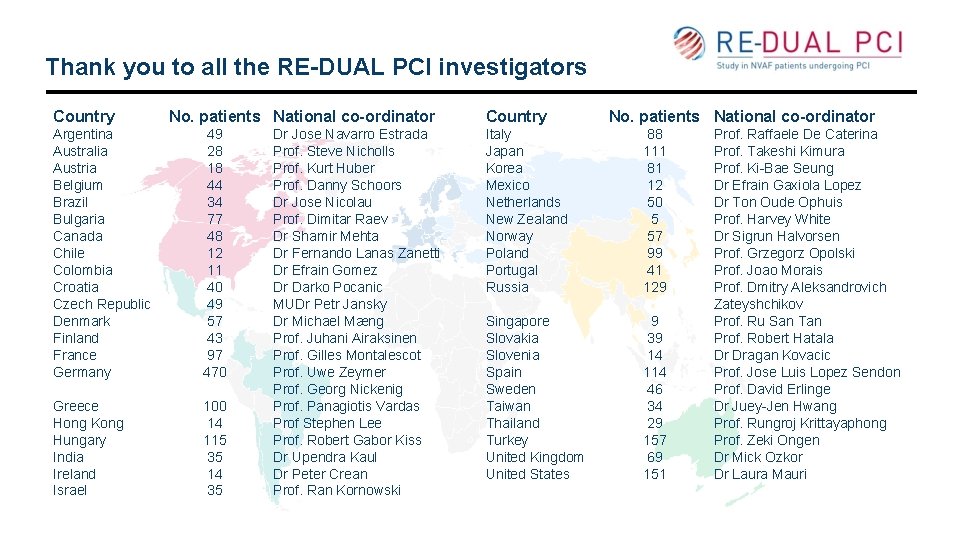
Thank you to all the RE-DUAL PCI investigators Country No. patients National co-ordinator Argentina Australia Austria Belgium Brazil Bulgaria Canada Chile Colombia Croatia Czech Republic Denmark Finland France Germany 49 28 18 44 34 77 48 12 11 40 49 57 43 97 470 Greece Hong Kong Hungary India Ireland Israel 100 14 115 35 14 35 Dr Jose Navarro Estrada Prof. Steve Nicholls Prof. Kurt Huber Prof. Danny Schoors Dr Jose Nicolau Prof. Dimitar Raev Dr Shamir Mehta Dr Fernando Lanas Zanetti Dr Efrain Gomez Dr Darko Pocanic MUDr Petr Jansky Dr Michael Mæng Prof. Juhani Airaksinen Prof. Gilles Montalescot Prof. Uwe Zeymer Prof. Georg Nickenig Prof. Panagiotis Vardas Prof Stephen Lee Prof. Robert Gabor Kiss Dr Upendra Kaul Dr Peter Crean Prof. Ran Kornowski Country No. patients National co-ordinator Italy Japan Korea Mexico Netherlands New Zealand Norway Poland Portugal Russia 88 111 81 12 50 5 57 99 41 129 Singapore Slovakia Slovenia Spain Sweden Taiwan Thailand Turkey United Kingdom United States 9 39 14 114 46 34 29 157 69 151 Prof. Raffaele De Caterina Prof. Takeshi Kimura Prof. Ki-Bae Seung Dr Efrain Gaxiola Lopez Dr Ton Oude Ophuis Prof. Harvey White Dr Sigrun Halvorsen Prof. Grzegorz Opolski Prof. Joao Morais Prof. Dmitry Aleksandrovich Zateyshchikov Prof. Ru San Tan Prof. Robert Hatala Dr Dragan Kovacic Prof. Jose Luis Lopez Sendon Prof. David Erlinge Dr Juey-Jen Hwang Prof. Rungroj Krittayaphong Prof. Zeki Ongen Dr Mick Ozkor Dr Laura Mauri
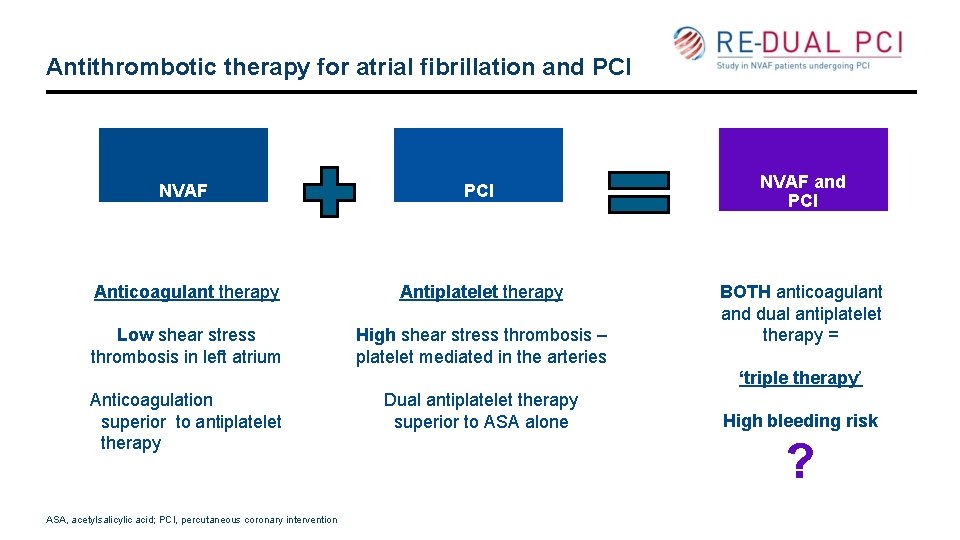
Antithrombotic therapy for atrial fibrillation and PCI NVAF and PCI Anticoagulant therapy Antiplatelet therapy Low shear stress thrombosis in left atrium High shear stress thrombosis – platelet mediated in the arteries BOTH anticoagulant and dual antiplatelet therapy = ‘triple therapy’ Anticoagulation superior to antiplatelet therapy ASA, acetylsalicylic acid; PCI, percutaneous coronary intervention Dual antiplatelet therapy superior to ASA alone High bleeding risk ?
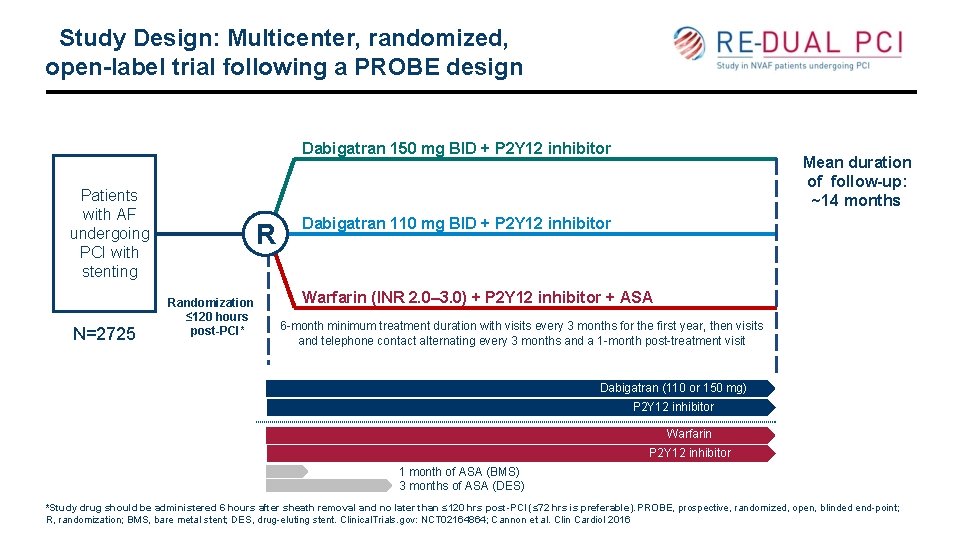
Study Design: Multicenter, randomized, open-label trial following a PROBE design Dabigatran 150 mg BID + P 2 Y 12 inhibitor Patients with AF undergoing PCI with stenting N=2725 R Randomization ≤ 120 hours post-PCI* Mean duration of follow-up: ~14 months Dabigatran 110 mg BID + P 2 Y 12 inhibitor Warfarin (INR 2. 0– 3. 0) + P 2 Y 12 inhibitor + ASA 6 -month minimum treatment duration with visits every 3 months for the first year, then visits and telephone contact alternating every 3 months and a 1 -month post-treatment visit Dabigatran (110 or 150 mg) P 2 Y 12 inhibitor Warfarin P 2 Y 12 inhibitor 1 month of ASA (BMS) 3 months of ASA (DES) *Study drug should be administered 6 hours after sheath removal and no later than ≤ 120 hrs post-PCI (≤ 72 hrs is preferable). PROBE, prospective, randomized, open, blinded end-point; R, randomization; BMS, bare metal stent; DES, drug-eluting stent. Clinical. Trials. gov: NCT 02164864; Cannon et al. Clin Cardiol 2016
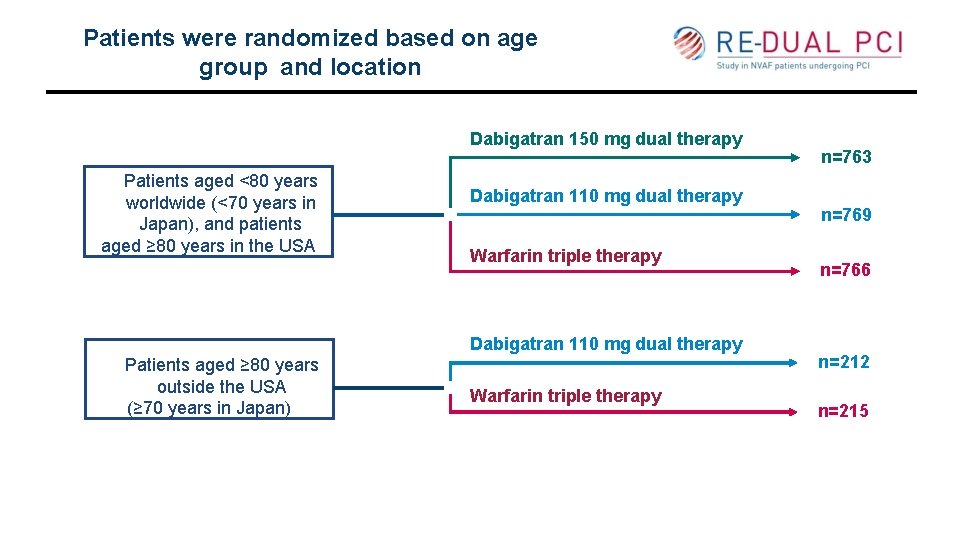
Patients were randomized based on age group and location Dabigatran 150 mg dual therapy Patients aged <80 years worldwide (<70 years in Japan), and patients aged ≥ 80 years in the USA Dabigatran 110 mg dual therapy Warfarin triple therapy Dabigatran 110 mg dual therapy Patients aged ≥ 80 years outside the USA (≥ 70 years in Japan) Warfarin triple therapy n=763 n=769 n=766 n=212 n=215
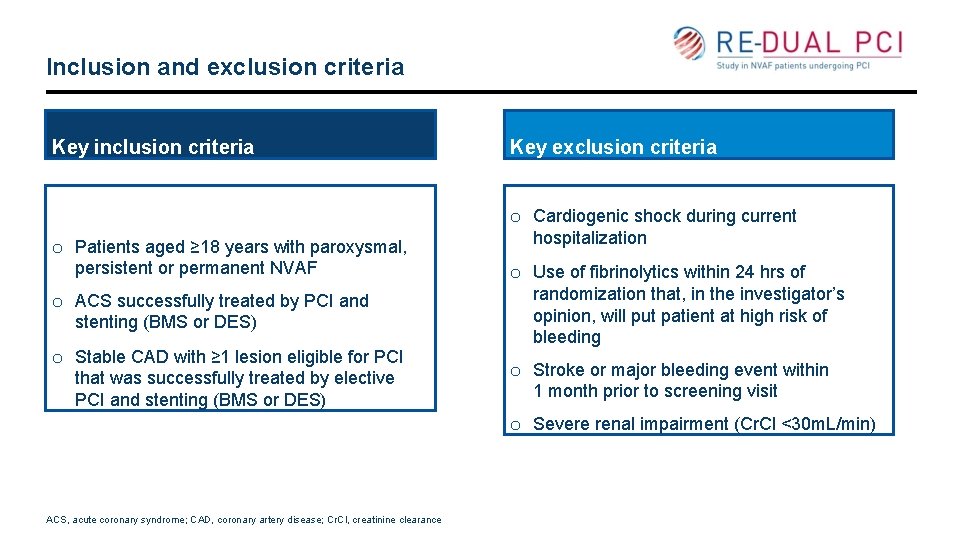
Inclusion and exclusion criteria Key inclusion criteria Key exclusion criteria o Cardiogenic shock during current o Patients aged ≥ 18 years with paroxysmal, persistent or permanent NVAF o ACS successfully treated by PCI and stenting (BMS or DES) o Stable CAD with ≥ 1 lesion eligible for PCI that was successfully treated by elective PCI and stenting (BMS or DES) hospitalization o Use of fibrinolytics within 24 hrs of randomization that, in the investigator’s opinion, will put patient at high risk of bleeding o Stroke or major bleeding event within 1 month prior to screening visit o Severe renal impairment (Cr. Cl <30 m. L/min) ACS, acute coronary syndrome; CAD, coronary artery disease; Cr. Cl, creatinine clearance
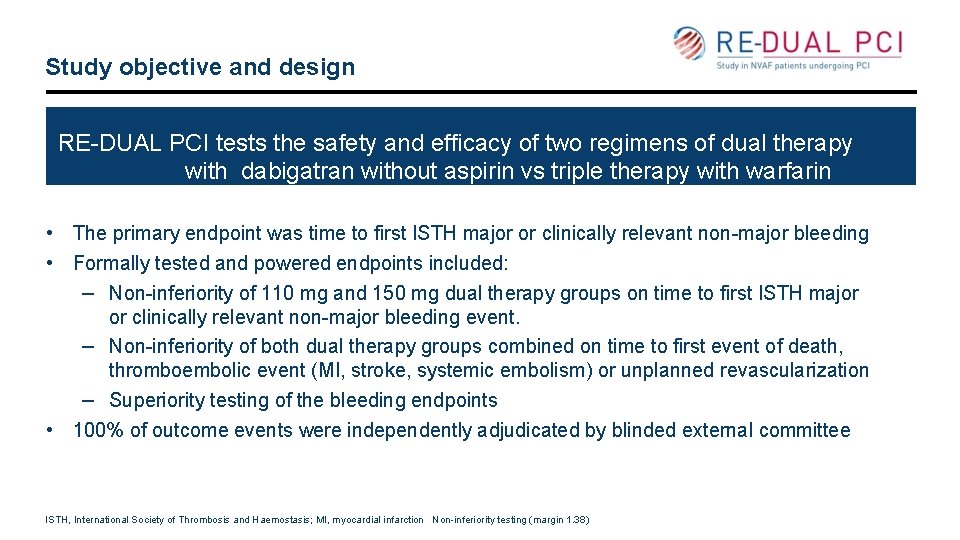
Study objective and design RE-DUAL PCI tests the safety and efficacy of two regimens of dual therapy with dabigatran without aspirin vs triple therapy with warfarin • The primary endpoint was time to first ISTH major or clinically relevant non-major bleeding • Formally tested and powered endpoints included: – Non-inferiority of 110 mg and 150 mg dual therapy groups on time to first ISTH major or clinically relevant non-major bleeding event. – Non-inferiority of both dual therapy groups combined on time to first event of death, thromboembolic event (MI, stroke, systemic embolism) or unplanned revascularization – Superiority testing of the bleeding endpoints • 100% of outcome events were independently adjudicated by blinded external committee ISTH, International Society of Thrombosis and Haemostasis; MI, myocardial infarction Non-inferiority testing (margin 1. 38)
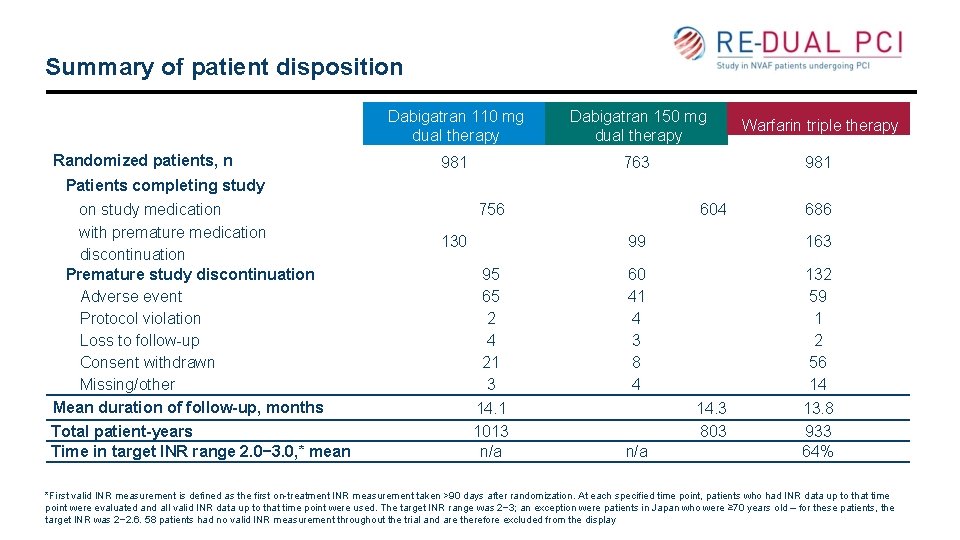
Summary of patient disposition Randomized patients, n Dabigatran 110 mg dual therapy Dabigatran 150 mg dual therapy Warfarin triple therapy 981 763 981 Patients completing study on study medication with premature medication discontinuation Premature study discontinuation Adverse event Protocol violation Loss to follow-up Consent withdrawn Missing/other Mean duration of follow-up, months Total patient-years Time in target INR range 2. 0− 3. 0, * mean 756 130 95 65 2 4 21 3 14. 1 1013 n/a 604 686 99 163 60 41 4 3 8 4 132 59 1 2 56 14 13. 8 933 64% 14. 3 803 n/a *First valid INR measurement is defined as the first on-treatment INR measurement taken >90 days after randomization. At each specified time point, patients who had INR data up to that time point were evaluated and all valid INR data up to that time point were used. The target INR range was 2− 3; an exception were patients in Japan who were ≥ 70 years old – for these patients, the target INR was 2− 2. 6. 58 patients had no valid INR measurement throughout the trial and are therefore excluded from the display
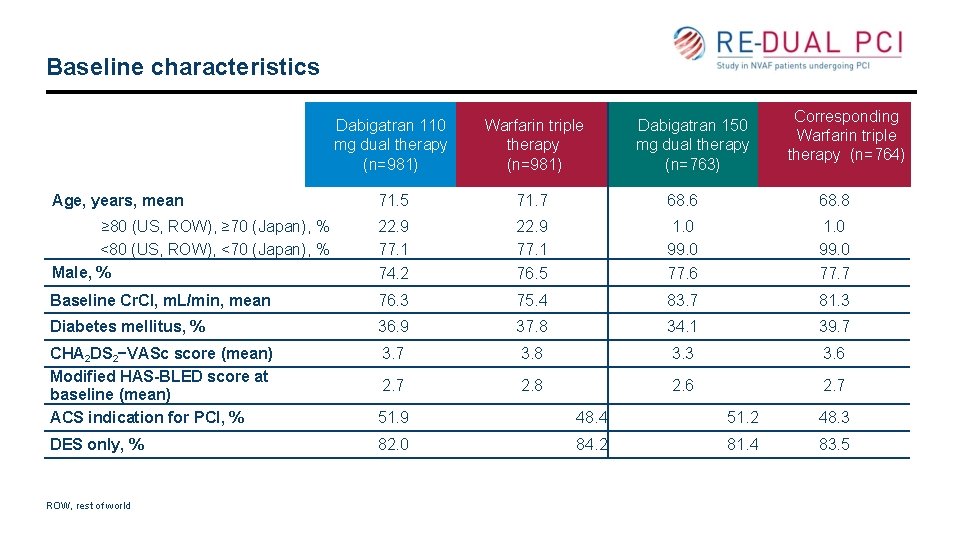
Baseline characteristics Warfarin triple therapy (n=981) Age, years, mean 71. 5 71. 7 68. 6 68. 8 ≥ 80 (US, ROW), ≥ 70 (Japan), % <80 (US, ROW), <70 (Japan), % Male, % 22. 9 77. 1 1. 0 99. 0 74. 2 76. 5 77. 6 77. 7 Baseline Cr. Cl, m. L/min, mean 76. 3 75. 4 83. 7 81. 3 Diabetes mellitus, % 36. 9 37. 8 34. 1 39. 7 CHA 2 DS 2−VASc score (mean) Modified HAS-BLED score at baseline (mean) ACS indication for PCI, % 3. 7 3. 8 3. 3 3. 6 2. 7 2. 8 2. 6 2. 7 51. 9 48. 4 51. 2 48. 3 DES only, % 82. 0 84. 2 81. 4 83. 5 ROW, rest of world Dabigatran 150 mg dual therapy (n=763) Corresponding Warfarin triple therapy (n=764) Dabigatran 110 mg dual therapy (n=981)
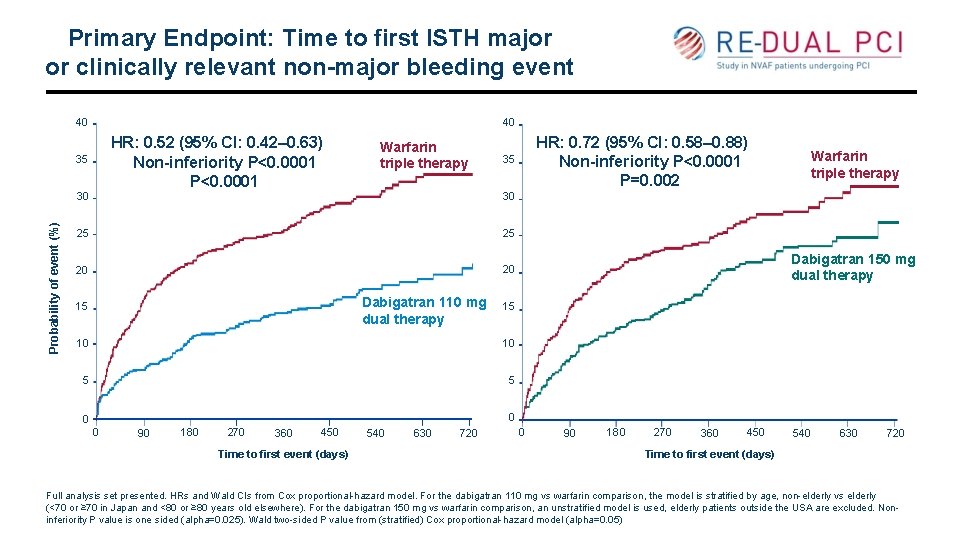
Primary Endpoint: Time to first ISTH major or clinically relevant non-major bleeding event 40 40 HR: 0. 52 (95% CI: 0. 42– 0. 63) Non-inferiority P<0. 0001 35 Probability of event (%) 30 Warfarin triple therapy 35 30 25 25 20 20 Dabigatran 110 mg dual therapy 15 10 5 5 0 0 90 180 270 360 450 Time to first event (days) 540 630 720 Warfarin triple therapy Dabigatran 150 mg dual therapy 15 10 0 HR: 0. 72 (95% CI: 0. 58– 0. 88) Non-inferiority P<0. 0001 P=0. 002 0 90 180 270 360 450 540 630 720 Time to first event (days) Full analysis set presented. HRs and Wald CIs from Cox proportional-hazard model. For the dabigatran 110 mg vs warfarin comparison, the model is stratified by age, non-elderly vs elderly (<70 or ≥ 70 in Japan and <80 or ≥ 80 years old elsewhere). For the dabigatran 150 mg vs warfarin comparison, an unstratified model is used, elderly patients outside the USA are excluded. Noninferiority P value is one sided (alpha=0. 025). Wald two-sided P value from (stratified) Cox proportional-hazard model (alpha=0. 05)
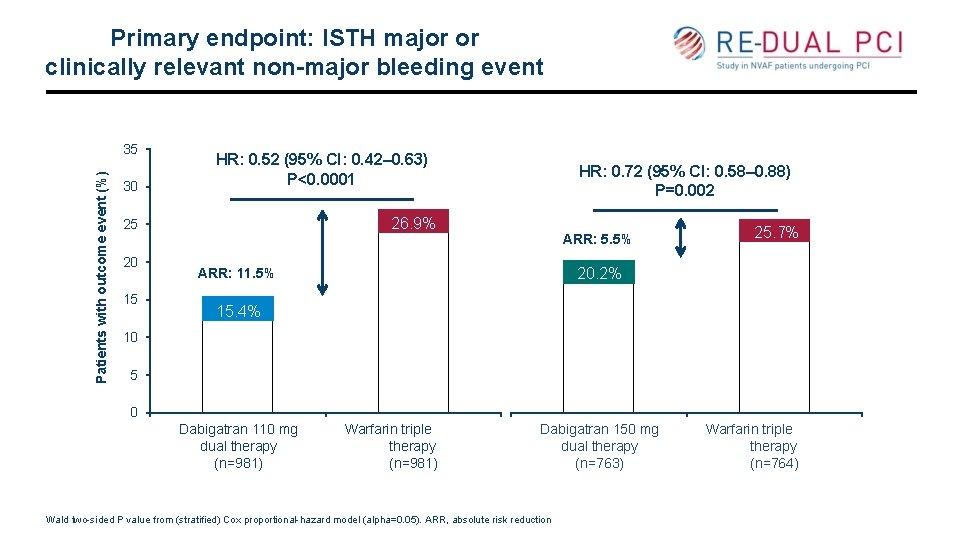
Primary endpoint: ISTH major or clinically relevant non-major bleeding event Patients with outcome event (%) 35 30 HR: 0. 52 (95% CI: 0. 42– 0. 63) P<0. 0001 26. 9% 25 20 15 HR: 0. 72 (95% CI: 0. 58– 0. 88) P=0. 002 ARR: 5. 5% 25. 7% 20. 2% ARR: 11. 5% 15. 4% 10 5 0 Dabigatran 110 mg dual therapy (n=981) Warfarin triple therapy (n=981) Dabigatran 150 mg dual therapy (n=763) Wald two-sided P value from (stratified) Cox proportional-hazard model (alpha=0. 05). ARR, absolute risk reduction Warfarin triple therapy (n=764)
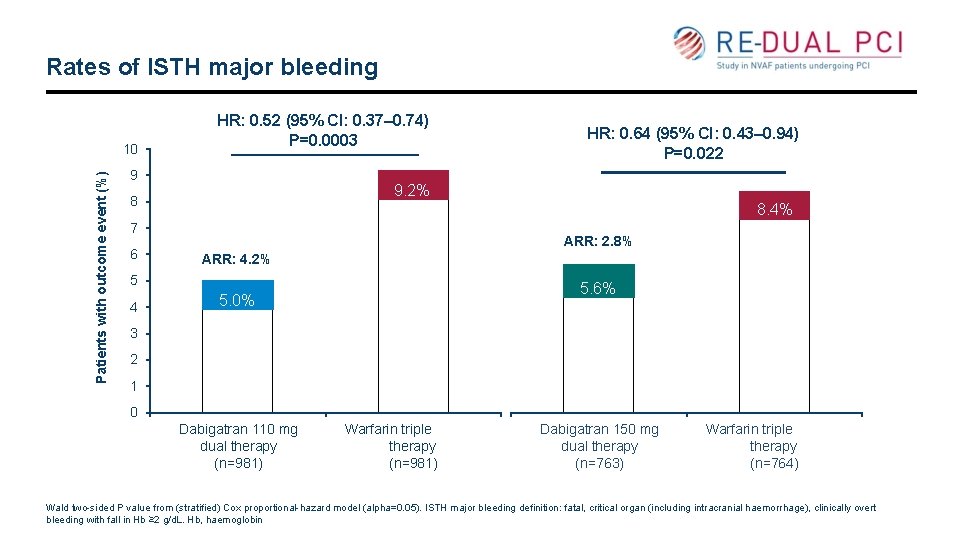
Rates of ISTH major bleeding Patients with outcome event (%) 10 HR: 0. 52 (95% CI: 0. 37– 0. 74) P=0. 0003 9 9. 2% 8 8. 4% 7 6 ARR: 2. 8% ARR: 4. 2% 5 4 HR: 0. 64 (95% CI: 0. 43– 0. 94) P=0. 022 5. 6% 5. 0% 3 2 1 0 Dabigatran 110 mg dual therapy (n=981) Warfarin triple therapy (n=981) Dabigatran 150 mg dual therapy (n=763) Warfarin triple therapy (n=764) Wald two-sided P value from (stratified) Cox proportional-hazard model (alpha=0. 05). ISTH major bleeding definition: fatal, critical organ (including intracranial haemorrhage), clinically overt bleeding with fall in Hb ≥ 2 g/d. L. Hb, haemoglobin
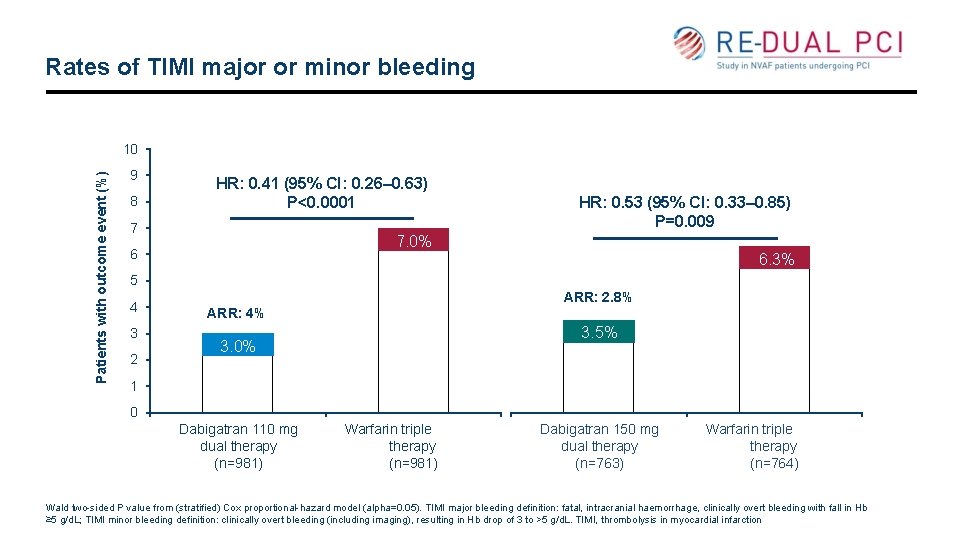
Rates of TIMI major or minor bleeding Patients with outcome event (%) 10 9 8 HR: 0. 41 (95% CI: 0. 26– 0. 63) P<0. 0001 7 HR: 0. 53 (95% CI: 0. 33– 0. 85) P=0. 009 7. 0% 6 6. 3% 5 4 3 2 ARR: 2. 8% ARR: 4% 3. 5% 3. 0% 1 0 Dabigatran 110 mg dual therapy (n=981) Warfarin triple therapy (n=981) Dabigatran 150 mg dual therapy (n=763) Warfarin triple therapy (n=764) Wald two-sided P value from (stratified) Cox proportional-hazard model (alpha=0. 05). TIMI major bleeding definition: fatal, intracranial haemorrhage, clinically overt bleeding with fall in Hb ≥ 5 g/d. L; TIMI minor bleeding definition: clinically overt bleeding (including imaging), resulting in Hb drop of 3 to >5 g/d. L. TIMI, thrombolysis in myocardial infarction
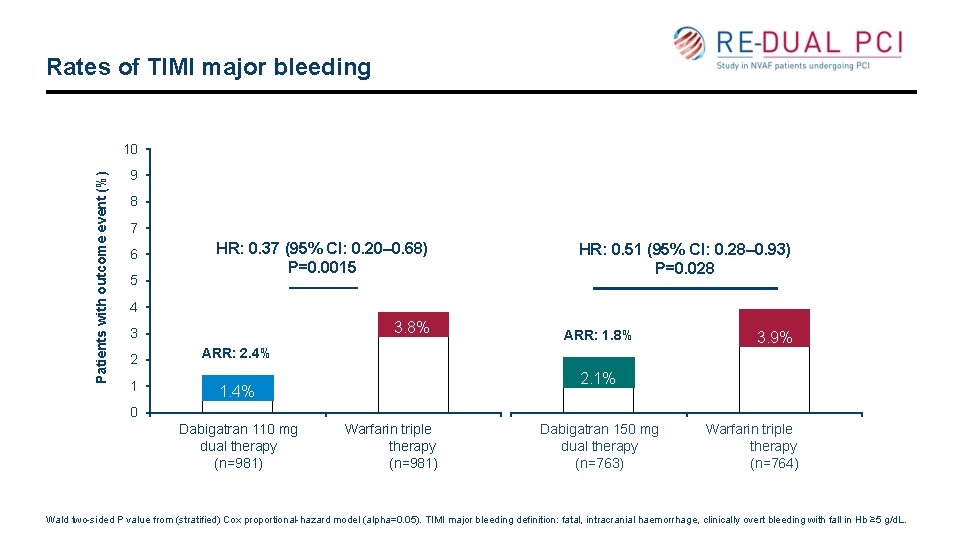
Rates of TIMI major bleeding Patients with outcome event (%) 10 9 8 7 6 5 HR: 0. 37 (95% CI: 0. 20– 0. 68) P=0. 0015 HR: 0. 51 (95% CI: 0. 28– 0. 93) P=0. 028 4 3. 8% 3 2 1 ARR: 1. 8% ARR: 2. 4% 3. 9% 2. 1% 1. 4% 0 Dabigatran 110 mg dual therapy (n=981) Warfarin triple therapy (n=981) Dabigatran 150 mg dual therapy (n=763) Warfarin triple therapy (n=764) Wald two-sided P value from (stratified) Cox proportional-hazard model (alpha=0. 05). TIMI major bleeding definition: fatal, intracranial haemorrhage, clinically overt bleeding with fall in Hb ≥ 5 g/d. L.
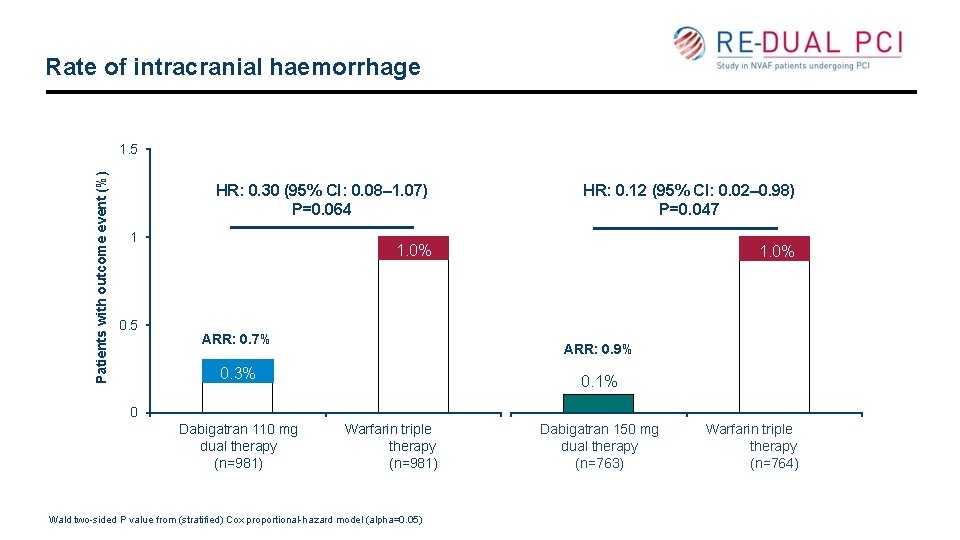
Rate of intracranial haemorrhage Patients with outcome event (%) 1. 5 HR: 0. 30 (95% CI: 0. 08– 1. 07) P=0. 064 HR: 0. 12 (95% CI: 0. 02– 0. 98) P=0. 047 1. 0% 1 0. 5 ARR: 0. 7% ARR: 0. 9% 0. 3% 0. 1% 0 Dabigatran 110 mg dual therapy (n=981) Warfarin triple therapy (n=981) Wald two-sided P value from (stratified) Cox proportional-hazard model (alpha=0. 05) Dabigatran 150 mg dual therapy (n=763) Warfarin triple therapy (n=764)
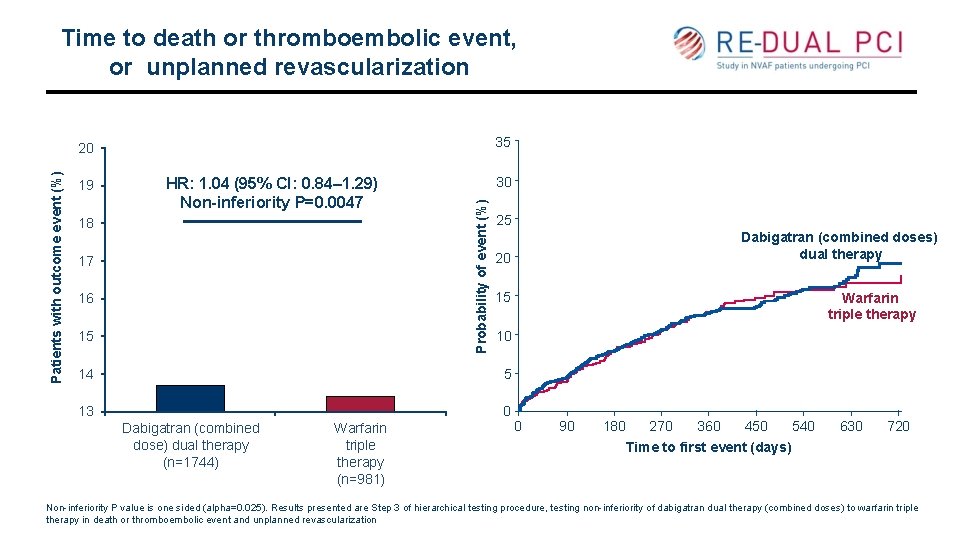
Time to death or thromboembolic event, or unplanned revascularization 35 19 HR: 1. 04 (95% CI: 0. 84– 1. 29) Non-inferiority P=0. 0047 18 17 16 15 30 Probability of event (%) Patients with outcome event (%) 20 25 20 15 5 13 0 Warfarin triple therapy (n=981) Warfarin triple therapy 10 14 Dabigatran (combined dose) dual therapy (n=1744) Dabigatran (combined doses) dual therapy 0 90 180 270 450 540 360 Time to first event (days) 630 720 Non-inferiority P value is one sided (alpha=0. 025). Results presented are Step 3 of hierarchical testing procedure, testing non-inferiority of dabigatran dual therapy (combined doses) to warfarin triple therapy in death or thromboembolic event and unplanned revascularization
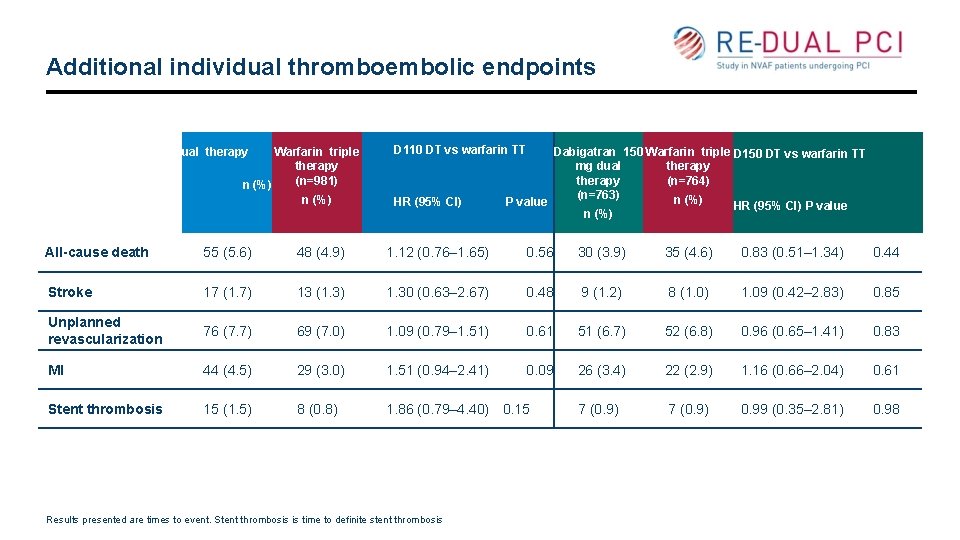
Additional individual thromboembolic endpoints Dabigatran 110 mg dual therapy (n=981) Warfarin triple therapy (n=981) n (%) D 110 DT vs warfarin TT HR (95% CI) Dabigatran 150 Warfarin triple D 150 DT vs warfarin TT mg dual therapy (n=764) (n=763) n (%) P value HR (95% CI) P value n (%) All-cause death 55 (5. 6) 48 (4. 9) 1. 12 (0. 76– 1. 65) 0. 56 30 (3. 9) 35 (4. 6) 0. 83 (0. 51– 1. 34) 0. 44 Stroke 17 (1. 7) 13 (1. 3) 1. 30 (0. 63– 2. 67) 0. 48 9 (1. 2) 8 (1. 0) 1. 09 (0. 42– 2. 83) 0. 85 Unplanned revascularization 76 (7. 7) 69 (7. 0) 1. 09 (0. 79– 1. 51) 0. 61 51 (6. 7) 52 (6. 8) 0. 96 (0. 65– 1. 41) 0. 83 MI 44 (4. 5) 29 (3. 0) 1. 51 (0. 94– 2. 41) 0. 09 26 (3. 4) 22 (2. 9) 1. 16 (0. 66– 2. 04) 0. 61 Stent thrombosis 15 (1. 5) 8 (0. 8) 1. 86 (0. 79– 4. 40) 0. 15 7 (0. 9) 0. 99 (0. 35– 2. 81) 0. 98 Results presented are times to event. Stent thrombosis is time to definite stent thrombosis
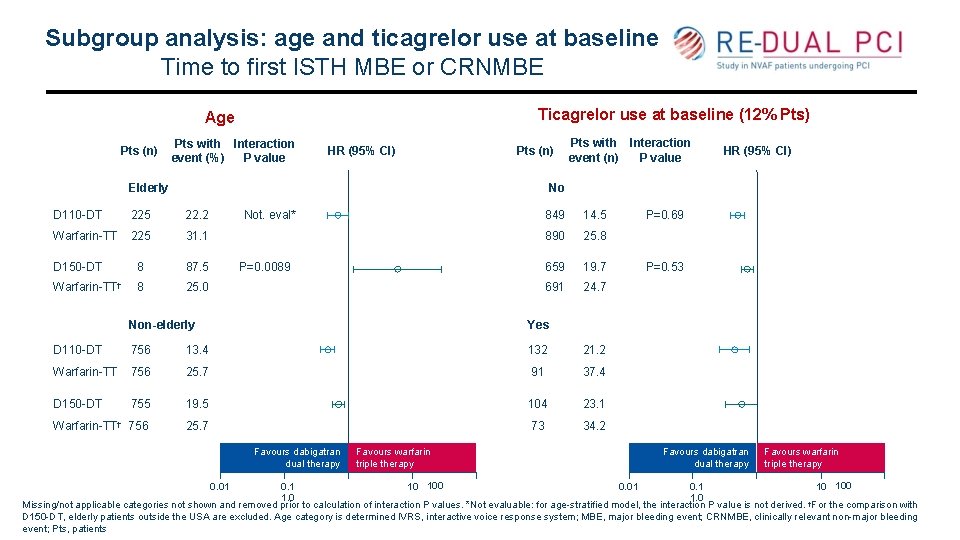
Subgroup analysis: age and ticagrelor use at baseline Time to first ISTH MBE or CRNMBE Ticagrelor use at baseline (12% Pts) Age Pts (n) Pts with Interaction event (%) P value HR (95% CI) Pts (n) Elderly Pts with Interaction event (n) P value HR (95% CI) No D 110 -DT 225 22. 2 Warfarin-TT 225 31. 1 D 150 -DT 8 87. 5 Warfarin-TT† 8 25. 0 Not. eval* P=0. 0089 849 14. 5 890 25. 8 659 19. 7 691 24. 7 Non-elderly Yes D 110 -DT 756 13. 4 132 21. 2 Warfarin-TT 756 25. 7 91 37. 4 D 150 -DT 755 19. 5 104 23. 1 Warfarin-TT† 756 25. 7 73 34. 2 Favours dabigatran dual therapy Favours warfarin triple therapy P=0. 69 P=0. 53 Favours dabigatran dual therapy Favours warfarin triple therapy 0. 1 10 100 0. 01 1. 0 Missing/not applicable categories not shown and removed prior to calculation of interaction P values. *Not evaluable: for age-stratified model, the interaction P value is not derived. †For the comparison with D 150 -DT, elderly patients outside the USA are excluded. Age category is determined IVRS, interactive voice response system; MBE, major bleeding event; CRNMBE, clinically relevant non-major bleeding event; Pts, patients 0. 01
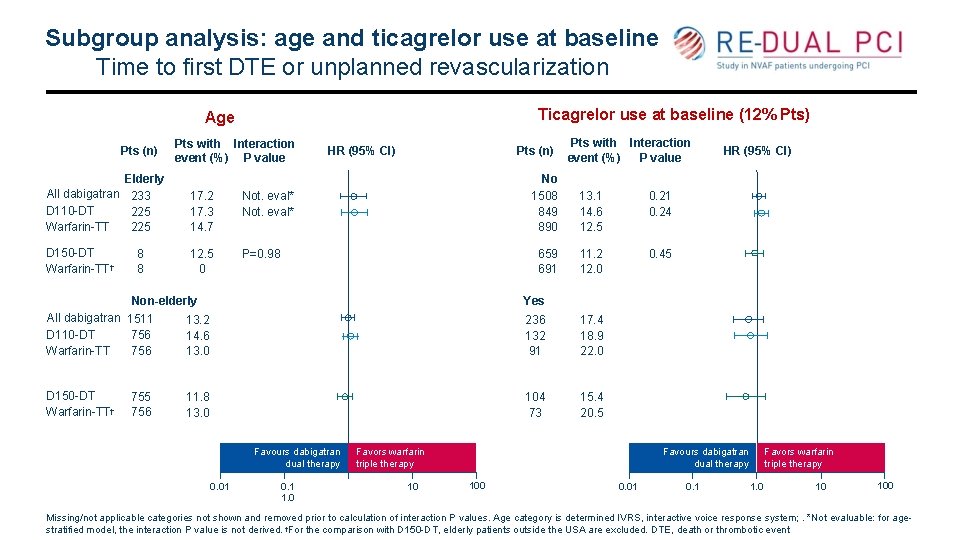
Subgroup analysis: age and ticagrelor use at baseline Time to first DTE or unplanned revascularization Ticagrelor use at baseline (12% Pts) Age Pts (n) Pts with Interaction event (%) P value Elderly All dabigatran 233 D 110 -DT 225 Warfarin-TT 225 17. 2 17. 3 14. 7 Not. eval* D 150 -DT Warfarin-TT† 12. 5 0 P=0. 98 8 8 Pts (n) HR (95% CI) Pts with Interaction event (%) P value No 1508 849 890 13. 1 14. 6 12. 5 0. 21 0. 24 659 691 11. 2 12. 0 0. 45 Yes Non-elderly All dabigatran 1511 D 110 -DT 756 Warfarin-TT 756 13. 2 14. 6 13. 0 236 132 91 17. 4 18. 9 22. 0 D 150 -DT Warfarin-TT† 11. 8 13. 0 104 73 15. 4 20. 5 756 HR (95% CI) Favours dabigatran dual therapy 0. 01 0. 1 1. 0 Favors warfarin triple therapy 10 Favors warfarin triple therapy Favours dabigatran dual therapy 100 0. 01 0. 1 1. 0 10 100 Missing/not applicable categories not shown and removed prior to calculation of interaction P values. Age category is determined IVRS, interactive voice response system; . *Not evaluable: for agestratified model, the interaction P value is not derived. †For the comparison with D 150 -DT, elderly patients outside the USA are excluded. DTE, death or thrombotic event
Conclusions In patients with AF who have undergone PCI: Dual therapy with dabigatran and a P 2 Y 12 antagonist significantly reduced the risk of bleeding versus warfarin triple therapy, with non-inferiority for overall thromboembolic events Absolute risk reductions with dabigatran dual therapy were 11. 5% and 5. 5% in ISTH major or clinically relevant non-major bleeding at the 110 mg and 150 mg doses, respectively, compared with warfarin triple therapy These dabigatran dual therapy regimens, using doses approved worldwide for stroke prevention, offer clinicians two additional options for managing Afib patients post-PCI
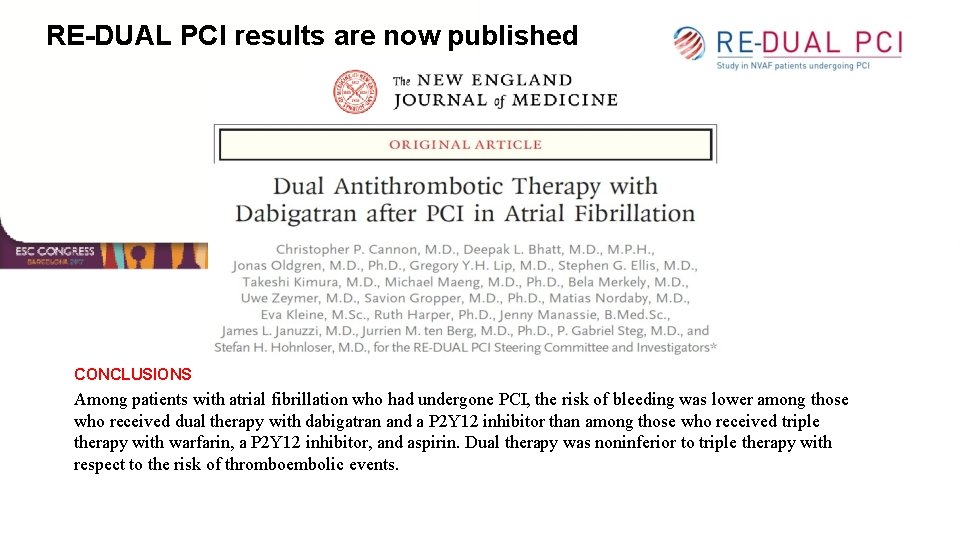
RE-DUAL PCI results are now published CONCLUSIONS Among patients with atrial fibrillation who had undergone PCI, the risk of bleeding was lower among those who received dual therapy with dabigatran and a P 2 Y 12 inhibitor than among those who received triple therapy with warfarin, a P 2 Y 12 inhibitor, and aspirin. Dual therapy was noninferior to triple therapy with respect to the risk of thromboembolic events.
- Slides: 22