
Redrafting editing and proofreading to improve marks Noone


- Slides: 29
Re-drafting, editing and proofreading to improve marks…
No-one said this was going to be easy! Now that you have struggled with drafting your research paper, you may better understand the rigour involved in getting it right. If you have finished your draft, now is the time to re-draft and polish. I don’t want to be commenting on errors that can be corrected NOW when I am perusing your submitted draft.
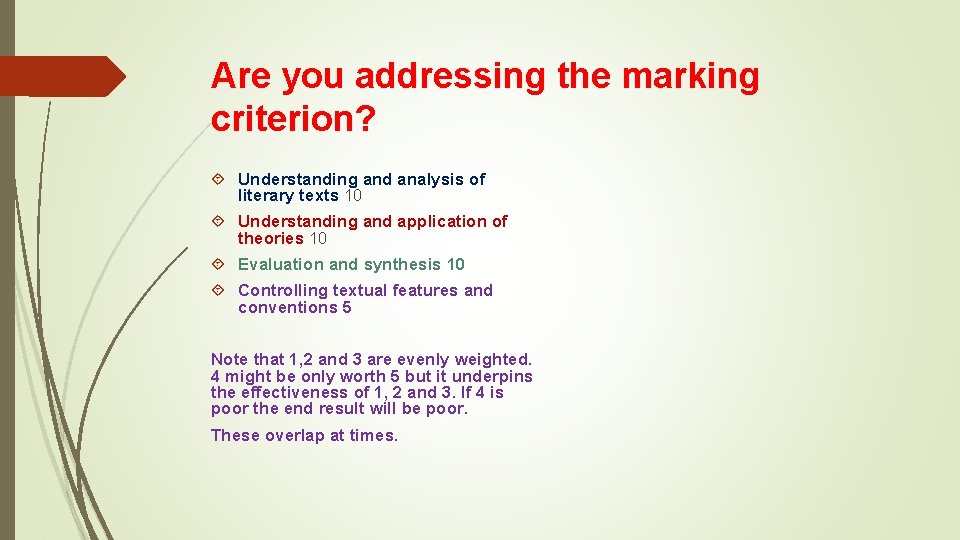
Are you addressing the marking criterion? Understanding and analysis of literary texts 10 Understanding and application of theories 10 Evaluation and synthesis 10 Controlling textual features and conventions 5 Note that 1, 2 and 3 are evenly weighted. 4 might be only worth 5 but it underpins the effectiveness of 1, 2 and 3. If 4 is poor the end result will be poor. These overlap at times.
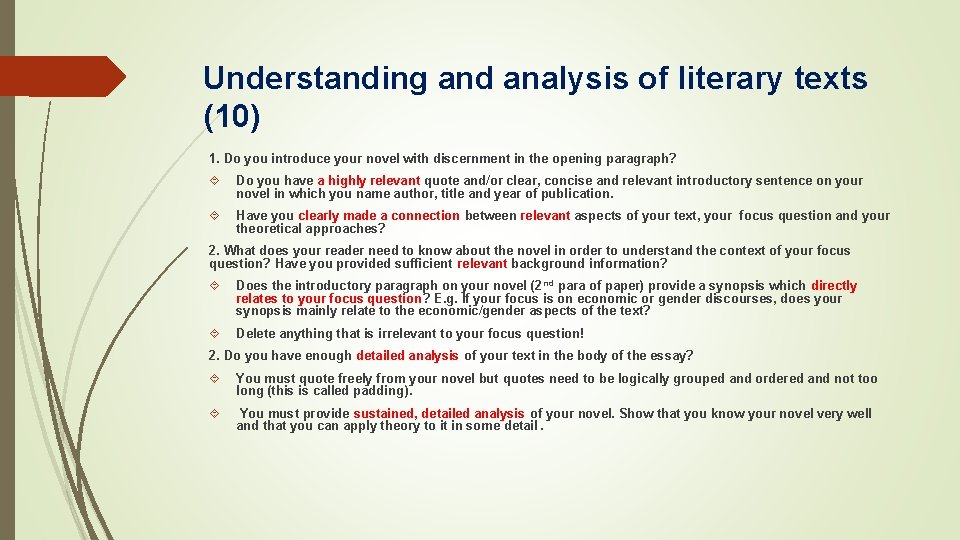
Understanding and analysis of literary texts (10) 1. Do you introduce your novel with discernment in the opening paragraph? Do you have a highly relevant quote and/or clear, concise and relevant introductory sentence on your novel in which you name author, title and year of publication. Have you clearly made a connection between relevant aspects of your text, your focus question and your theoretical approaches? 2. What does your reader need to know about the novel in order to understand the context of your focus question? Have you provided sufficient relevant background information? Does the introductory paragraph on your novel (2 nd para of paper) provide a synopsis which directly relates to your focus question? E. g. If your focus is on economic or gender discourses, does your synopsis mainly relate to the economic/gender aspects of the text? Delete anything that is irrelevant to your focus question! 2. Do you have enough detailed analysis of your text in the body of the essay? You must quote freely from your novel but quotes need to be logically grouped and ordered and not too long (this is called padding). You must provide sustained, detailed analysis of your novel. Show that you know your novel very well and that you can apply theory to it in some detail.
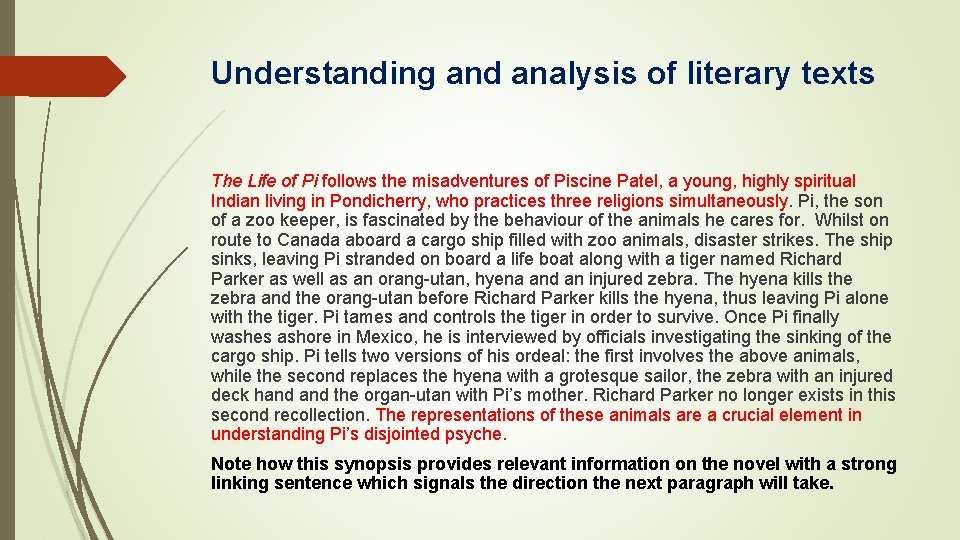
Understanding and analysis of literary texts The Life of Pi follows the misadventures of Piscine Patel, a young, highly spiritual Indian living in Pondicherry, who practices three religions simultaneously. Pi, the son of a zoo keeper, is fascinated by the behaviour of the animals he cares for. Whilst on route to Canada aboard a cargo ship filled with zoo animals, disaster strikes. The ship sinks, leaving Pi stranded on board a life boat along with a tiger named Richard Parker as well as an orang-utan, hyena and an injured zebra. The hyena kills the zebra and the orang-utan before Richard Parker kills the hyena, thus leaving Pi alone with the tiger. Pi tames and controls the tiger in order to survive. Once Pi finally washes ashore in Mexico, he is interviewed by officials investigating the sinking of the cargo ship. Pi tells two versions of his ordeal: the first involves the above animals, while the second replaces the hyena with a grotesque sailor, the zebra with an injured deck hand the organ-utan with Pi’s mother. Richard Parker no longer exists in this second recollection. The representations of these animals are a crucial element in understanding Pi’s disjointed psyche. Note how this synopsis provides relevant information on the novel with a strong linking sentence which signals the direction the next paragraph will take.
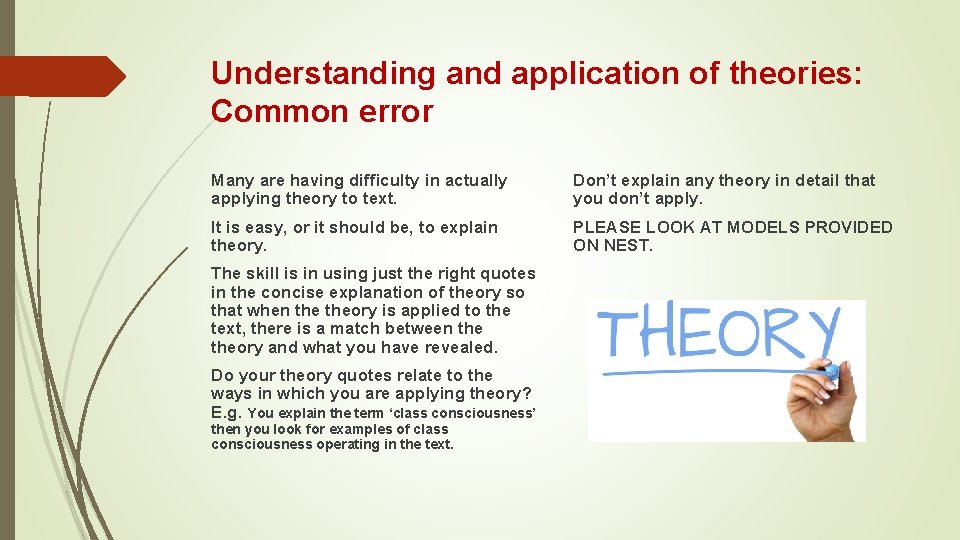
Understanding and application of theories: Common error Many are having difficulty in actually applying theory to text. Don’t explain any theory in detail that you don’t apply. It is easy, or it should be, to explain theory. PLEASE LOOK AT MODELS PROVIDED ON NEST. The skill is in using just the right quotes in the concise explanation of theory so that when theory is applied to the text, there is a match between theory and what you have revealed. Do your theory quotes relate to the ways in which you are applying theory? E. g. You explain the term ‘class consciousness’ then you look for examples of class consciousness operating in the text.
Understanding and application of theories (10) Have you been able to clearly explain theories and related concepts which are relevant to your focus question? Avoid sections in your essay which explain theory in too much detail but which do not apply that theory to your text. You must show that you both understand theory and how to apply it. Do not try to explain complex theory in your own words. USE QUOTES! Have you been able to show connections between different theories and concepts? Have you commented on the ways in which one theorist is indebted to the foundation work of another, later theorist? Have you situated theory in a context or school of thought? E. g. second wave feminism, French feminism, poststructuralist, psychoanalytical feminism Do you know the difference between a theory and a concept? E. g. Marxist theory and the concept ‘class consciousness’, feminist theory and the concept ‘phallocentrism’, Freudian theory and the concept of ‘condensation’. Have you considered applying questions that theorists ask to the text? Theorists apply theory through the use of strategies (analysing binaries), terms and concepts and through asking questions. Have you been able to apply theory coherently to relevant aspects of your text? Consider these examples:
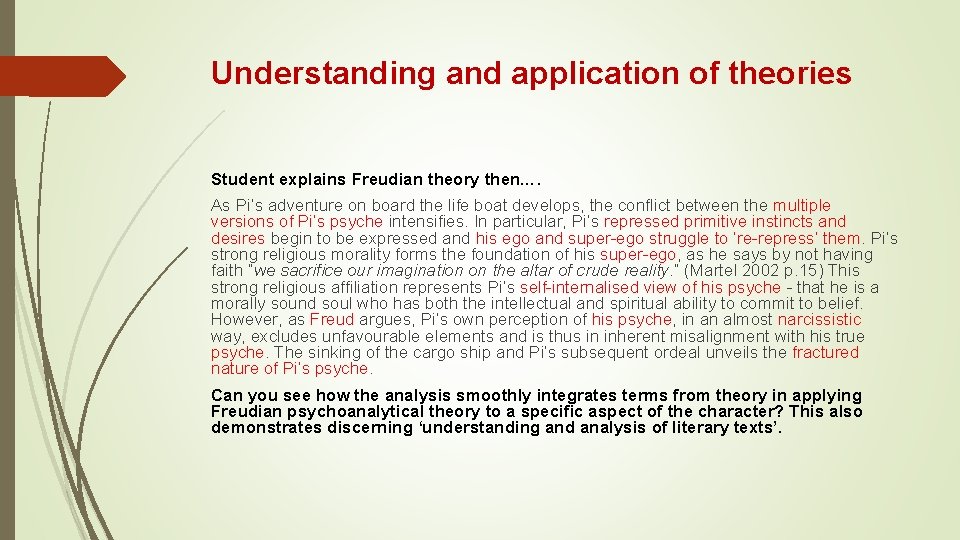
Understanding and application of theories Student explains Freudian theory then…. As Pi’s adventure on board the life boat develops, the conflict between the multiple versions of Pi’s psyche intensifies. In particular, Pi’s repressed primitive instincts and desires begin to be expressed and his ego and super-ego struggle to ‘re-repress’ them. Pi’s strong religious morality forms the foundation of his super-ego, as he says by not having faith “we sacrifice our imagination on the altar of crude reality. ” (Martel 2002 p. 15) This strong religious affiliation represents Pi’s self-internalised view of his psyche - that he is a morally sound soul who has both the intellectual and spiritual ability to commit to belief. However, as Freud argues, Pi’s own perception of his psyche, in an almost narcissistic way, excludes unfavourable elements and is thus in inherent misalignment with his true psyche. The sinking of the cargo ship and Pi’s subsequent ordeal unveils the fractured nature of Pi’s psyche. Can you see how the analysis smoothly integrates terms from theory in applying Freudian psychoanalytical theory to a specific aspect of the character? This also demonstrates discerning ‘understanding and analysis of literary texts’.
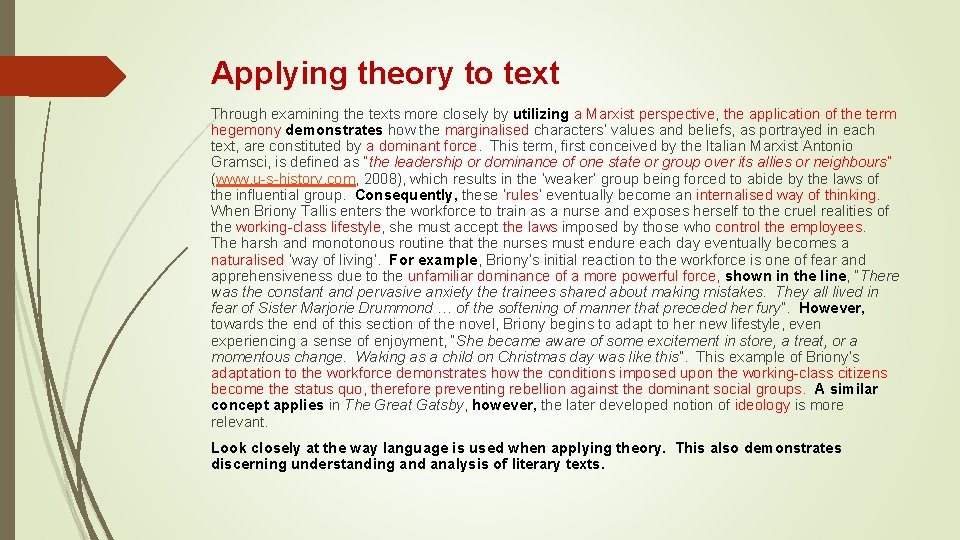
Applying theory to text Through examining the texts more closely by utilizing a Marxist perspective, the application of the term hegemony demonstrates how the marginalised characters’ values and beliefs, as portrayed in each text, are constituted by a dominant force. This term, first conceived by the Italian Marxist Antonio Gramsci, is defined as “the leadership or dominance of one state or group over its allies or neighbours” (www. u-s-history. com, 2008), which results in the ‘weaker’ group being forced to abide by the laws of the influential group. Consequently, these ‘rules’ eventually become an internalised way of thinking. When Briony Tallis enters the workforce to train as a nurse and exposes herself to the cruel realities of the working-class lifestyle, she must accept the laws imposed by those who control the employees. The harsh and monotonous routine that the nurses must endure each day eventually becomes a naturalised ‘way of living’. For example, Briony’s initial reaction to the workforce is one of fear and apprehensiveness due to the unfamiliar dominance of a more powerful force, shown in the line, “There was the constant and pervasive anxiety the trainees shared about making mistakes. They all lived in fear of Sister Marjorie Drummond … of the softening of manner that preceded her fury”. However, towards the end of this section of the novel, Briony begins to adapt to her new lifestyle, even experiencing a sense of enjoyment, “She became aware of some excitement in store, a treat, or a momentous change. Waking as a child on Christmas day was like this”. This example of Briony’s adaptation to the workforce demonstrates how the conditions imposed upon the working-class citizens become the status quo, therefore preventing rebellion against the dominant social groups. A similar concept applies in The Great Gatsby, however, the later developed notion of ideology is more relevant. Look closely at the way language is used when applying theory. This also demonstrates discerning understanding and analysis of literary texts.
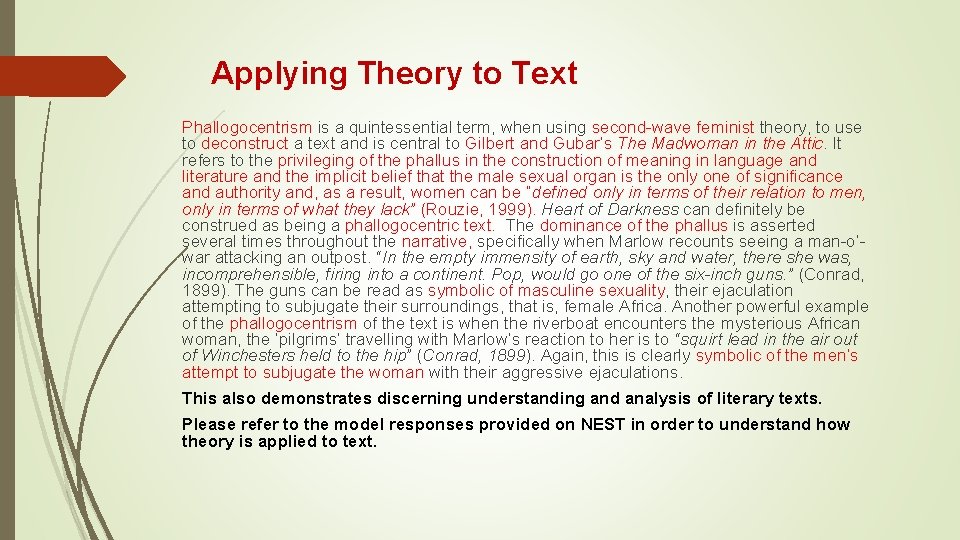
Applying Theory to Text Phallogocentrism is a quintessential term, when using second-wave feminist theory, to use to deconstruct a text and is central to Gilbert and Gubar’s The Madwoman in the Attic. It refers to the privileging of the phallus in the construction of meaning in language and literature and the implicit belief that the male sexual organ is the only one of significance and authority and, as a result, women can be “defined only in terms of their relation to men, only in terms of what they lack” (Rouzie, 1999). Heart of Darkness can definitely be construed as being a phallogocentric text. The dominance of the phallus is asserted several times throughout the narrative, specifically when Marlow recounts seeing a man-o’war attacking an outpost. “In the empty immensity of earth, sky and water, there she was, incomprehensible, firing into a continent. Pop, would go one of the six-inch guns. ” (Conrad, 1899). The guns can be read as symbolic of masculine sexuality, their ejaculation attempting to subjugate their surroundings, that is, female Africa. Another powerful example of the phallogocentrism of the text is when the riverboat encounters the mysterious African woman, the ‘pilgrims’ travelling with Marlow’s reaction to her is to “squirt lead in the air out of Winchesters held to the hip” (Conrad, 1899). Again, this is clearly symbolic of the men’s attempt to subjugate the woman with their aggressive ejaculations. This also demonstrates discerning understanding and analysis of literary texts. Please refer to the model responses provided on NEST in order to understand how theory is applied to text.
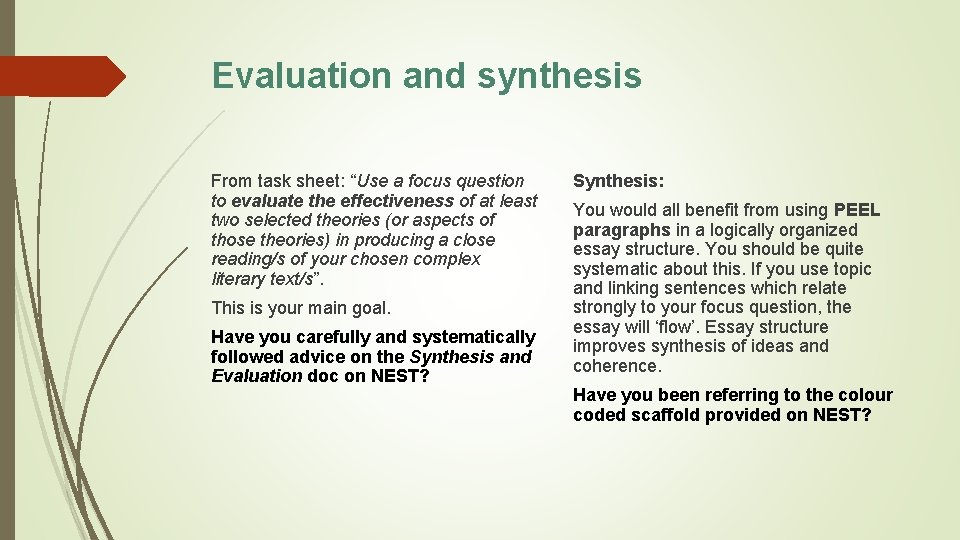
Evaluation and synthesis From task sheet: “Use a focus question to evaluate the effectiveness of at least two selected theories (or aspects of those theories) in producing a close reading/s of your chosen complex literary text/s”. This is your main goal. Have you carefully and systematically followed advice on the Synthesis and Evaluation doc on NEST? Synthesis: You would all benefit from using PEEL paragraphs in a logically organized essay structure. You should be quite systematic about this. If you use topic and linking sentences which relate strongly to your focus question, the essay will ‘flow’. Essay structure improves synthesis of ideas and coherence. Have you been referring to the colour coded scaffold provided on NEST?
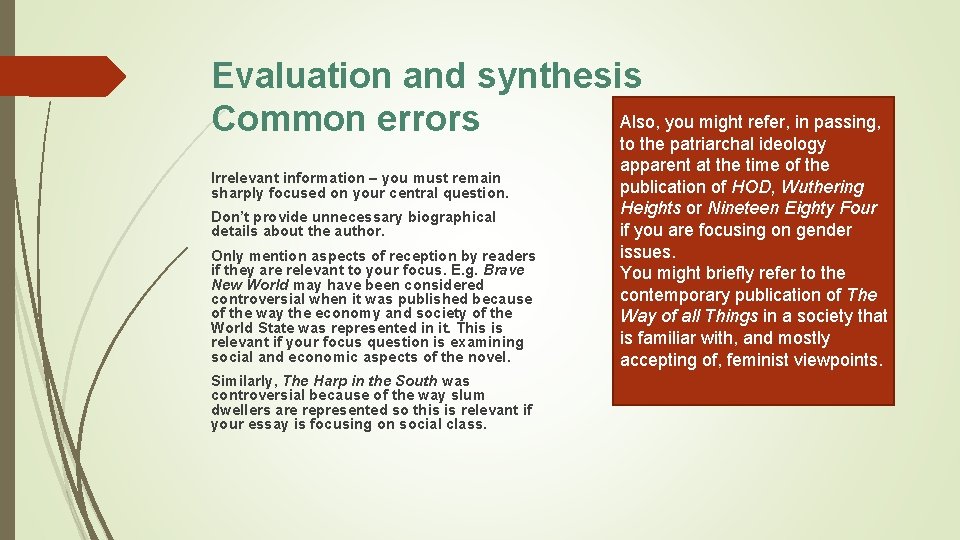
Evaluation and synthesis Also, you might refer, in passing, Common errors Irrelevant information – you must remain sharply focused on your central question. Don’t provide unnecessary biographical details about the author. Only mention aspects of reception by readers if they are relevant to your focus. E. g. Brave New World may have been considered controversial when it was published because of the way the economy and society of the World State was represented in it. This is relevant if your focus question is examining social and economic aspects of the novel. Similarly, The Harp in the South was controversial because of the way slum dwellers are represented so this is relevant if your essay is focusing on social class. to the patriarchal ideology apparent at the time of the publication of HOD, Wuthering Heights or Nineteen Eighty Four if you are focusing on gender issues. You might briefly refer to the contemporary publication of The Way of all Things in a society that is familiar with, and mostly accepting of, feminist viewpoints.
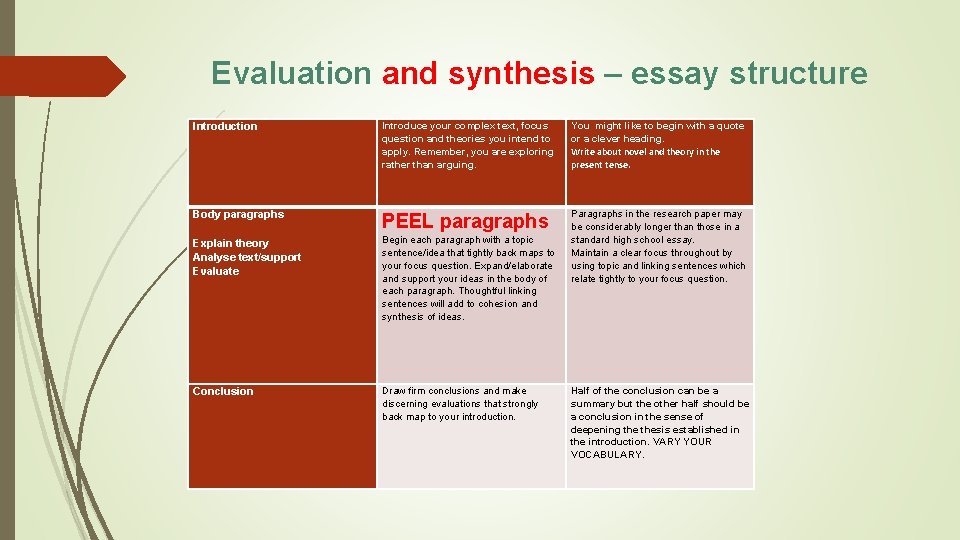
Evaluation and synthesis – essay structure Introduction Introduce your complex text, focus question and theories you intend to apply. Remember, you are exploring rather than arguing. You might like to begin with a quote or a clever heading. Write about novel and theory in the present tense. Body paragraphs PEEL paragraphs Explain theory Analyse text/support Evaluate Begin each paragraph with a topic sentence/idea that tightly back maps to your focus question. Expand/elaborate and support your ideas in the body of each paragraph. Thoughtful linking sentences will add to cohesion and synthesis of ideas. Paragraphs in the research paper may be considerably longer than those in a standard high school essay. Maintain a clear focus throughout by using topic and linking sentences which relate tightly to your focus question. Conclusion Draw firm conclusions and make discerning evaluations that strongly back map to your introduction. Half of the conclusion can be a summary but the other half should be a conclusion in the sense of deepening thesis established in the introduction. VARY YOUR VOCABULARY.
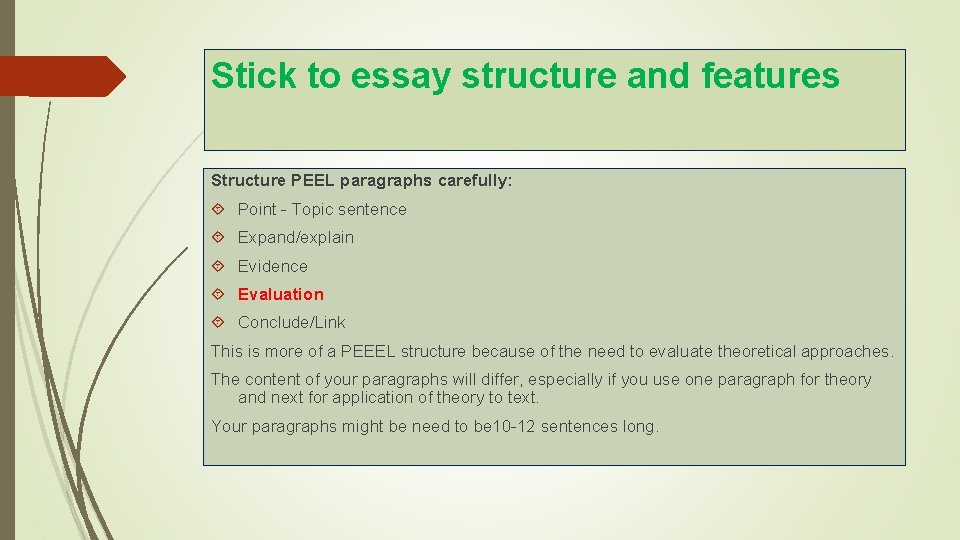
Stick to essay structure and features Structure PEEL paragraphs carefully: Point - Topic sentence Expand/explain Evidence Evaluation Conclude/Link This is more of a PEEEL structure because of the need to evaluate theoretical approaches. The content of your paragraphs will differ, especially if you use one paragraph for theory and next for application of theory to text. Your paragraphs might be need to be 10 -12 sentences long.
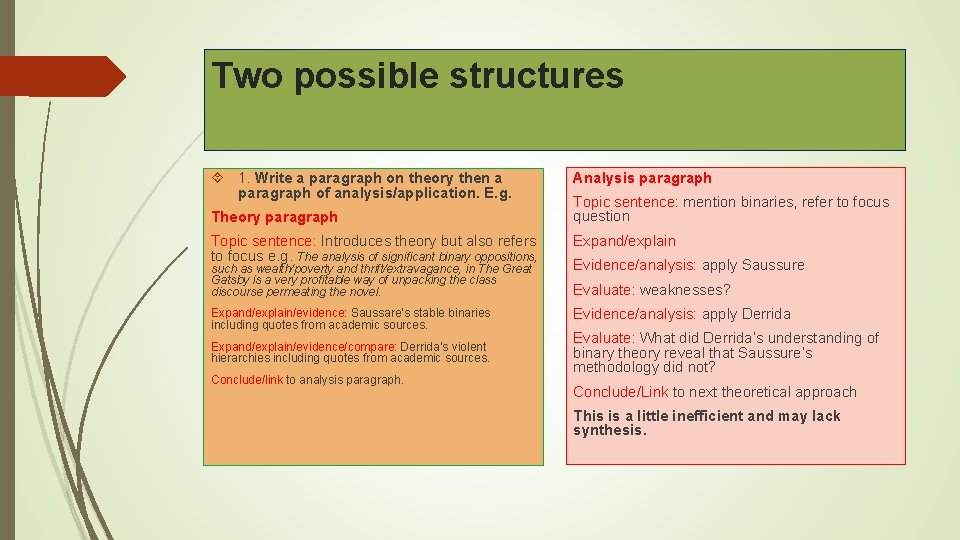
Two possible structures 1. Write a paragraph on theory then a paragraph of analysis/application. E. g. Theory paragraph Topic sentence: Introduces theory but also refers to focus e. g. The analysis of significant binary oppositions, Analysis paragraph Topic sentence: mention binaries, refer to focus question Expand/explain such as wealth/poverty and thrift/extravagance, in The Great Gatsby is a very profitable way of unpacking the class discourse permeating the novel. Evidence/analysis: apply Saussure Expand/explain/evidence: Saussare’s stable binaries including quotes from academic sources. Evidence/analysis: apply Derrida Expand/explain/evidence/compare: Derrida’s violent hierarchies including quotes from academic sources. Conclude/link to analysis paragraph. Evaluate: weaknesses? Evaluate: What did Derrida’s understanding of binary theory reveal that Saussure’s methodology did not? Conclude/Link to next theoretical approach This is a little inefficient and may lack synthesis.
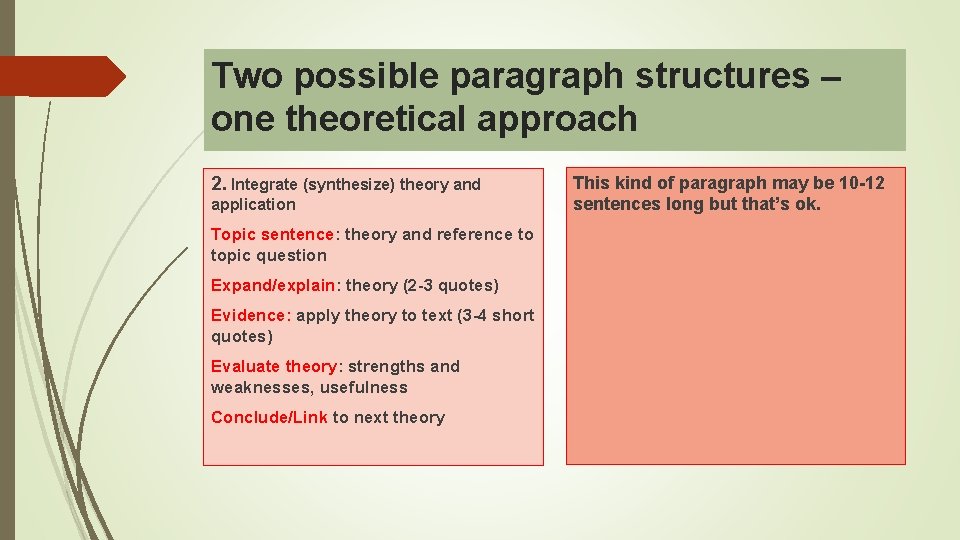
Two possible paragraph structures – one theoretical approach 2. Integrate (synthesize) theory and application Topic sentence: theory and reference to topic question Expand/explain: theory (2 -3 quotes) Evidence: apply theory to text (3 -4 short quotes) Evaluate theory: strengths and weaknesses, usefulness Conclude/Link to next theory This kind of paragraph may be 10 -12 sentences long but that’s ok.
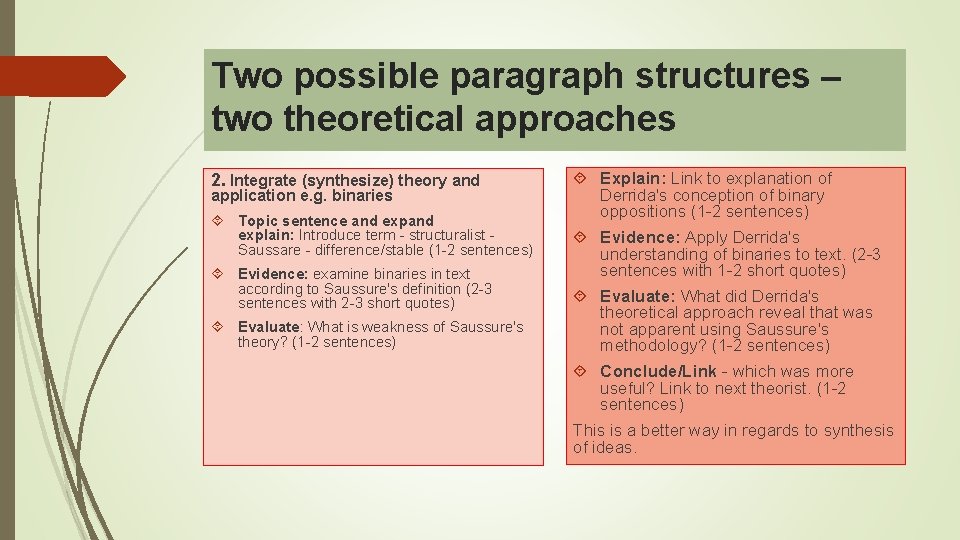
Two possible paragraph structures – two theoretical approaches 2. Integrate (synthesize) theory and application e. g. binaries Topic sentence and explain: Introduce term - structuralist Saussare - difference/stable (1 -2 sentences) Evidence: examine binaries in text according to Saussure's definition (2 -3 sentences with 2 -3 short quotes) Evaluate: What is weakness of Saussure's theory? (1 -2 sentences) Explain: Link to explanation of Derrida's conception of binary oppositions (1 -2 sentences) Evidence: Apply Derrida's understanding of binaries to text. (2 -3 sentences with 1 -2 short quotes) Evaluate: What did Derrida's theoretical approach reveal that was not apparent using Saussure's methodology? (1 -2 sentences) Conclude/Link - which was more useful? Link to next theorist. (1 -2 sentences) This is a better way in regards to synthesis of ideas.
Essay structure –keeping your eye on your focus question ARE ALL YOUR SENTENCES ON THE SAME TEAM? Imagine your essay is like a football team who wants to win the game. What happens when a player takes their eyes off the ball? What happens if a player walks off the field and tries to play in the dressing room? What happens if a player starts running toward the wrong try line? The game would be a shambles. Your essay will be a shambles if you don’t keep your eye on the metaphorical ball and the main game! No irrelevancies allowed! Everything you write needs to tightly back map to your focus question.
Evaluation and synthesis How can you evaluate the usefulness, strengths and weaknesses of a theory? You can see what is revealed when you apply theory. Do you understand something more clearly or in more detail/depth when theory is applied? What new insights did you gain? You can read up on your theories in order to compare and contrast them. How did X theorist adapt Y’s theory? What new elements did he/she add? Understanding this will allow you to evaluate what theory X reveals that theory Y did not reveal. This is VIP. Ask Professor Google to take you to sites that evaluate theory using key words like critique, weaknesses, strengths etc. Here you might find evaluations of theory from literary critics that you can quote from or paraphrase. Use the “Synthesis and Evaluation” doc for further tips. This is weighted just as heavily as criterion 1 and 2. i. e. 10 marks each.
Controlling textual features and conventions COMMON ERRORS 1. Lack of clarity (clearly expressing ideas) and concision (using elevated/specialist language precisely, not using ‘word vomit’, expressing an idea in fewer, more precise words) – use PEEL paragraphs, proofread. 2. Faulty sentence structures – proofread/have someone else proofread. 3. Vocabulary errors – use words you understand but do use specialist vocabulary (e. g. representation, discourse, ideology); delete unnecessary adjectives; avoid repetition; search for synonyms in order to vary vocabulary. Look at model responses. How do they use language? 4. Repetitious phrasing … repetition of key words and phrases is generally okay, and works as a cohesive tool for synthesising your work, but if you keep using the same words or phrases to denote analysis, to link between ideas, or to start sentences, then you need to fix this when you edit.
To Do DO use present tense when referring to the novel or to what the application of particular theories will achieve. E. g. Instead of “The novel was both written and set in a time…. . ” write “The novel is both written and set in a time…. ” Instead of “The character was represented…” write “The character is represented”… Instead of “Harry was angry with Vic because”…”Harry is angry with Vic because. . ” Not “Fitzgerald portrayed Gatsby as…” but “Fitzgerald portrays Gatsby as…” Instead of “This theory can be (or will be) used to expose the ideologies…. ” write “the application of this theory/concept exposes. . ” i. e. the present tense. Write as if you have proven the usefulness (or not) of theoretical approaches – you are about to lay out your proof. This may mean that you revise and refine your introduction after you have completed the body of your essay.
Your Focus Question Have you made your focus question shorter and snappier? E. g. Does Joseph Conrad’s Heart of Darkness (date) depict Africa and its people in a socially-progressive manner given the colonialist milieu in which it was written? To what extent does Gabriel Garcia Marquez’ One Hundred Years of Solitude (date) perpetuate the myth of traditional Latin American machismo? How does Pi balance his instincts and conscience in the face of adversity in Yan Martel’s Life of Pi (date)? What explanation is there for the abhorrent relationship that the character Aunt Judith conducts with her son Seth in Stella Gibbons’ Cold Comfort Farm (date)? Try writing your question in this way. You can introduce theories and their usefulness in subsequent sentences.
Controlling textual features and conventions The comma Use a comma to separate a series of three items. e. g. I take my diary, workbook and two pens to class every lesson. Use a comma after an introductory cohesive tie. e. g. However, Therefore, For instance, In conclusion, Use a comma for names or information added into a sentence. E. g. My brother, Harry, is twelve. His teacher, who is tall, likes to play basketball.
Semicolon use See http: //theoatmeal. com/comics/semicolon Basically, semi-colons are used to: 1. Separate pieces of information that are different, yet related. E. g. Six students began the tournament (independent clause); the challenges were arduous (independent clause). 2. Separate lists of items that are complicated. E. g. The task will involve: reading a novel; understanding literary terms; editing drafts and writing a review. How would you correct this sentence? (Is the clause after the semi-colon independent? ) Whilst misogyny is not immediately obvious within the text, with females seldom named or mentioned, the novella contains depictions of female that are highly derogatory; with Conrad’s divisive modus operandi provoking continual debate amongst individuals since its publication in 1899.
How do you know when a sentence ends? There is a complete thought. The next set of words also expresses a complete thought. There is a distinct pause before next set of words if read aloud. Also, pay attention to sentence construction and syntax. Are you using dependent clauses, in which there is no subject, as sentences? Are you writing overcomplicated sentences, where the subject/purpose of the sentence gets lost amidst the word vomit? Remember that it is okay to use simple sentences. Who can identify a major fault with this sentence? In addition, the concept of Judith Butler’s performativity can be applied to the text, who draws from the founding works of Freud. In addition, Judith Butler, drawing on the work of Sigmund Freud, developed the term ‘performativity’ which may be profitably applied to the text.
In-text referencing In Senior School, it is expected students are using in-text citations in their work. You must include an in-text citation every time you quote, paraphrase or summarise somebody else's words or ideas - that includes images, information from the internet and other sources. You must cite the author and year for each reference you cite, every time you cite that reference. The general format for an in-text citation is (Author surname, Year, p. ). Please see the school referencing policy and https: //www. citewrite. qut. edu. au/cite/qutcite. jsp#apa-general-intext This site has a fuller explanation of in-text referencing. You must get this right! Do not write book and article names in sentences in the body of your research paper……. Freud suggests, “Blah blah. ” (Freud, 1910, p. 10) The full reference then goes in your bibliography which is alphabetized.
Tips 1. Thoroughly edit your own work before submission of drafts. 2. Read the work aloud (in your head). Does it sound OK? 3. Cover everything but the line you are proofreading with a blank piece of paper. Read slowly.
Tips Use your finger to point to each word and punctuation mark one at a time. Proofread for spelling first then proofread for punctuation then for grammar. DON’T just skim read! Have a peer proofread your draft! Have a trusted adult proofread your draft for spelling, grammar, vocabulary, syntax and sentence errors. Please don’t submit a rough draft! I don’t want to be wading through proofreading errors; I want to be concentrating on the intellectual content of the draft.
Keep up the good work!