
REDOX Reduction and Oxidation L E O t
- Slides: 24
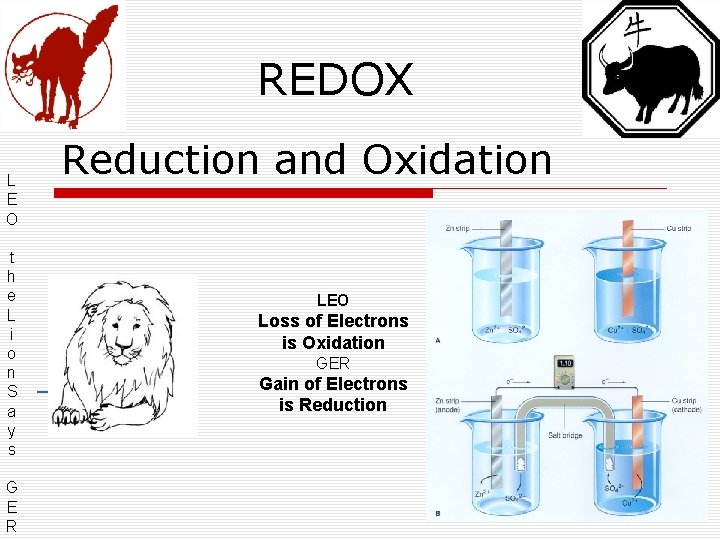
REDOX Reduction and Oxidation L E O t h e L i o n S a y s G E R LEO Loss of Electrons is Oxidation GER Gain of Electrons is Reduction 1
LEO GER vs. OIL RIG o CRASH COURSE: https: //www. youtube. com/watch? v=l. Q 6 FBA 1 HM 3 s o LEO GER n Loss of Electrons=Oxidation n Gain of Electrons= Reduction o OIL RIG n Oxidation is Loss n Reduction is Gain 2
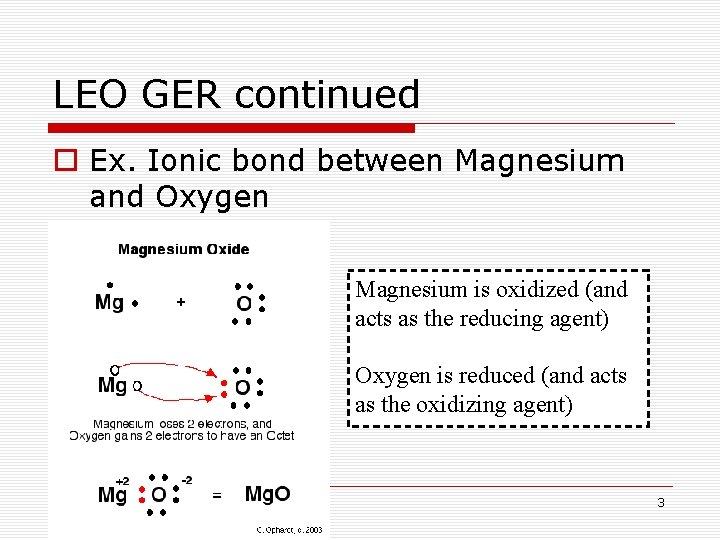
LEO GER continued o Ex. Ionic bond between Magnesium and Oxygen Magnesium is oxidized (and acts as the reducing agent) Oxygen is reduced (and acts as the oxidizing agent) 3
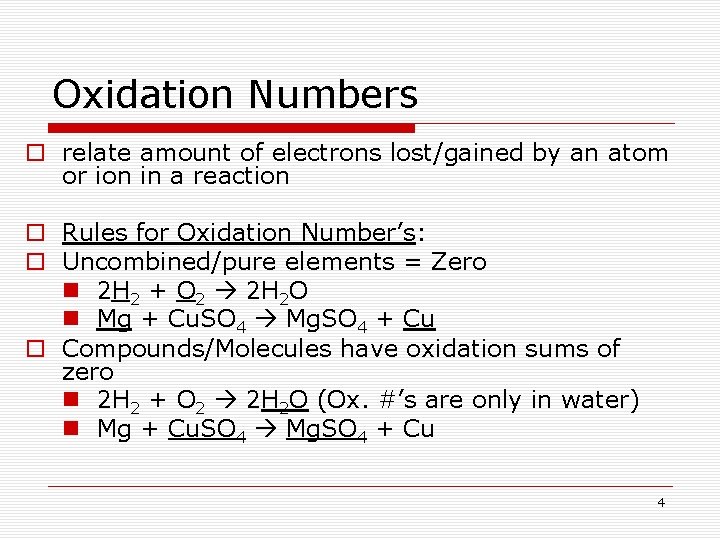
Oxidation Numbers o relate amount of electrons lost/gained by an atom or ion in a reaction o Rules for Oxidation Number’s: o Uncombined/pure elements = Zero n 2 H 2 + O 2 2 H 2 O n Mg + Cu. SO 4 Mg. SO 4 + Cu o Compounds/Molecules have oxidation sums of zero n 2 H 2 + O 2 2 H 2 O (Ox. #’s are only in water) n Mg + Cu. SO 4 Mg. SO 4 + Cu 4
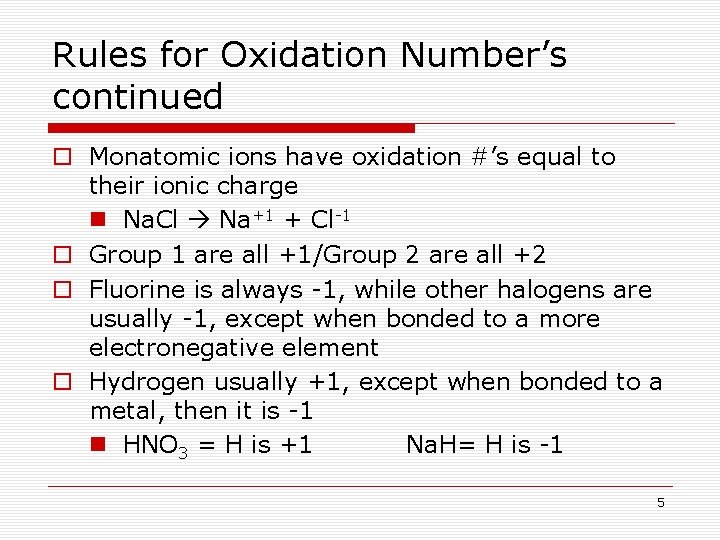
Rules for Oxidation Number’s continued o Monatomic ions have oxidation #’s equal to their ionic charge n Na. Cl Na+1 + Cl-1 o Group 1 are all +1/Group 2 are all +2 o Fluorine is always -1, while other halogens are usually -1, except when bonded to a more electronegative element o Hydrogen usually +1, except when bonded to a metal, then it is -1 n HNO 3 = H is +1 Na. H= H is -1 5
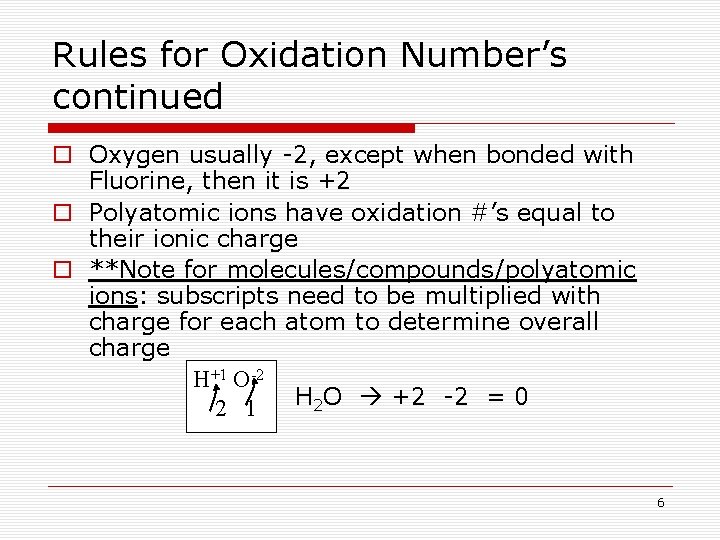
Rules for Oxidation Number’s continued o Oxygen usually -2, except when bonded with Fluorine, then it is +2 o Polyatomic ions have oxidation #’s equal to their ionic charge o **Note for molecules/compounds/polyatomic ions: subscripts need to be multiplied with charge for each atom to determine overall charge H+1 O-2 H 2 O +2 -2 = 0 2 1 6
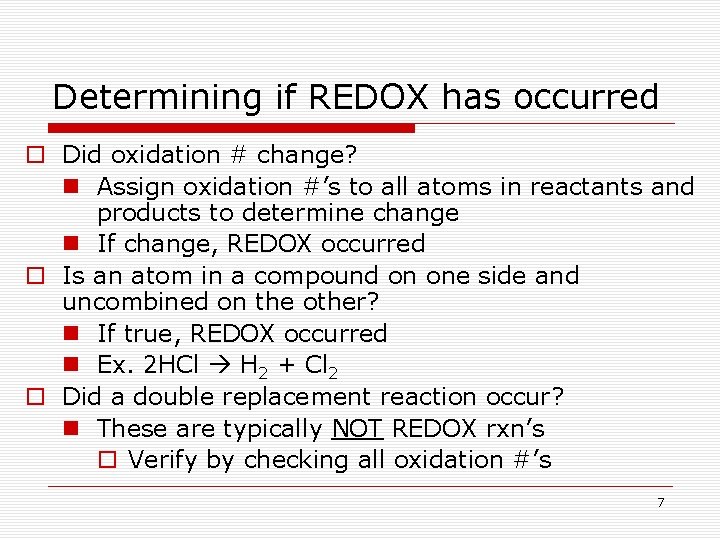
Determining if REDOX has occurred o Did oxidation # change? n Assign oxidation #’s to all atoms in reactants and products to determine change n If change, REDOX occurred o Is an atom in a compound on one side and uncombined on the other? n If true, REDOX occurred n Ex. 2 HCl H 2 + Cl 2 o Did a double replacement reaction occur? n These are typically NOT REDOX rxn’s o Verify by checking all oxidation #’s 7
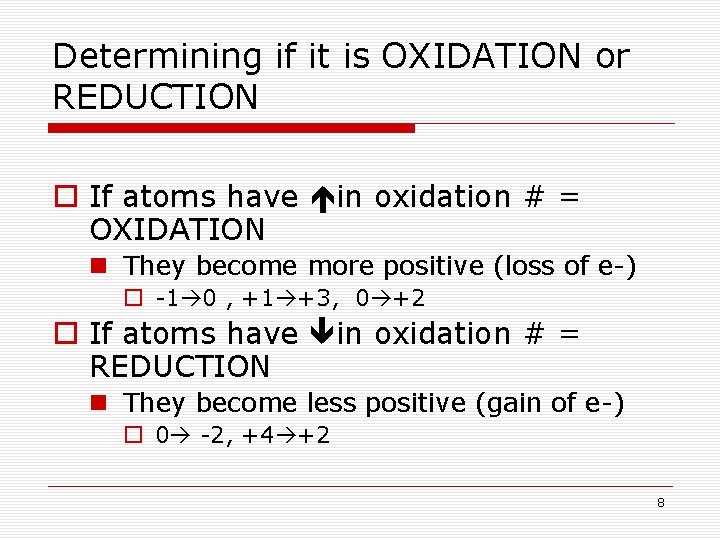
Determining if it is OXIDATION or REDUCTION o If atoms have in oxidation # = OXIDATION n They become more positive (loss of e-) o -1 0 , +1 +3, 0 +2 o If atoms have in oxidation # = REDUCTION n They become less positive (gain of e-) o 0 -2, +4 +2 8
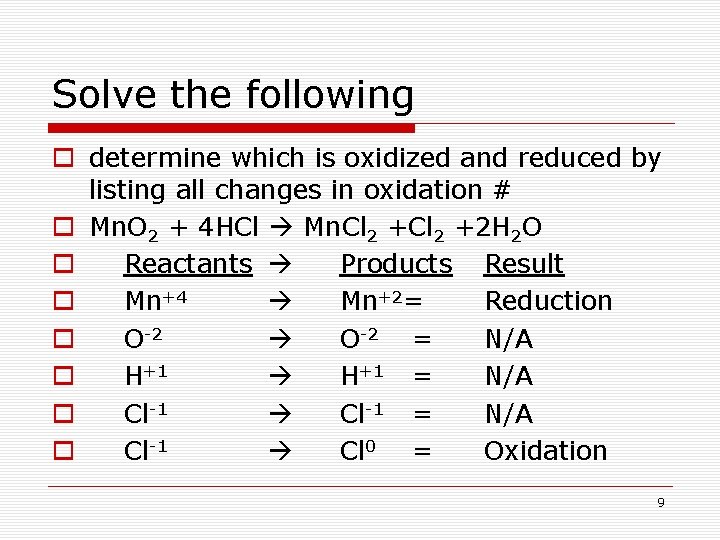
Solve the following o determine which is oxidized and reduced by listing all changes in oxidation # o Mn. O 2 + 4 HCl Mn. Cl 2 +2 H 2 O o Reactants Products Result o Mn+4 Mn+2= Reduction o O-2 = N/A o H+1 = N/A o Cl-1 Cl 0 = Oxidation 9
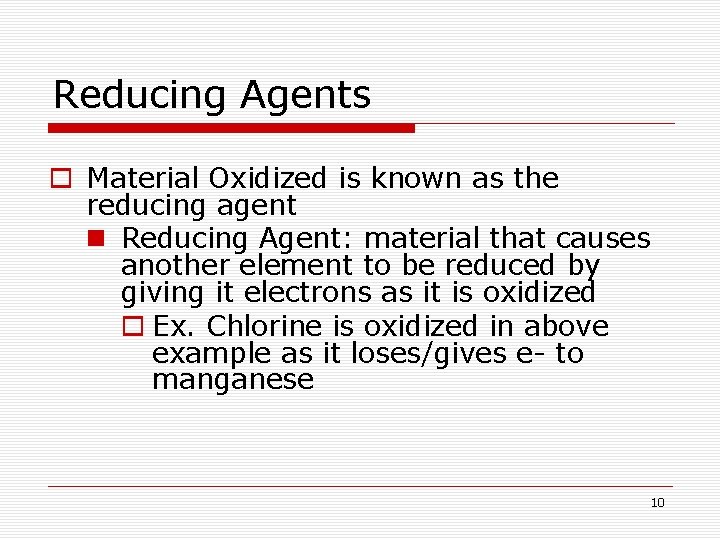
Reducing Agents o Material Oxidized is known as the reducing agent n Reducing Agent: material that causes another element to be reduced by giving it electrons as it is oxidized o Ex. Chlorine is oxidized in above example as it loses/gives e- to manganese 10
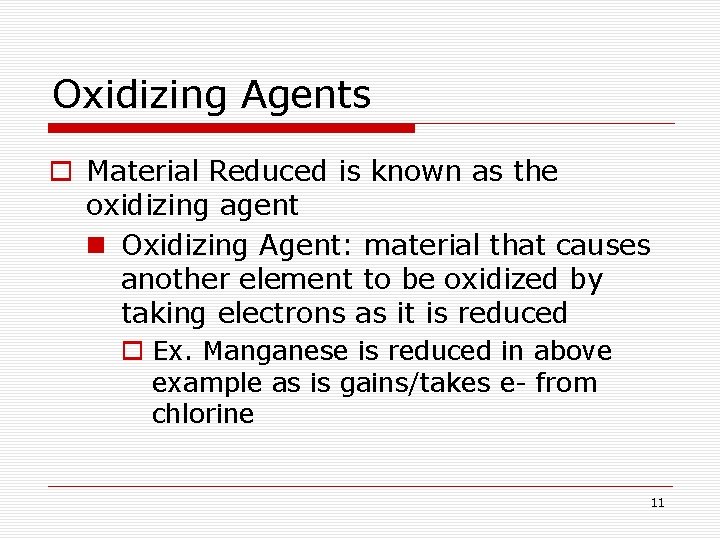
Oxidizing Agents o Material Reduced is known as the oxidizing agent n Oxidizing Agent: material that causes another element to be oxidized by taking electrons as it is reduced o Ex. Manganese is reduced in above example as is gains/takes e- from chlorine 11
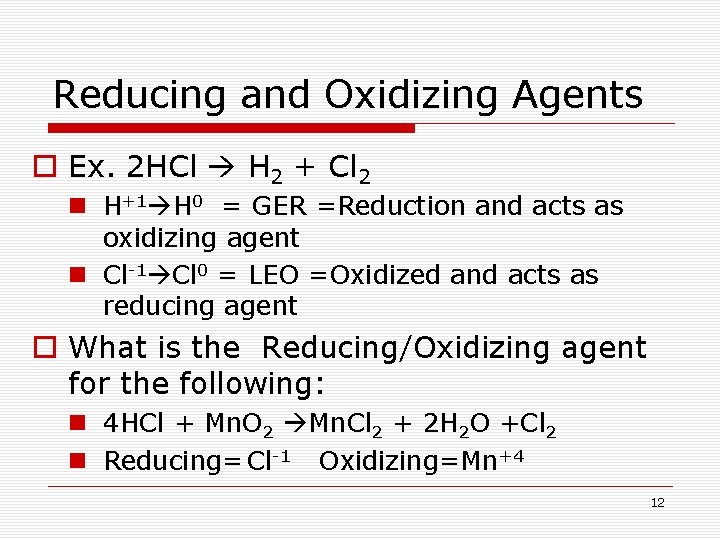
Reducing and Oxidizing Agents o Ex. 2 HCl H 2 + Cl 2 n H+1 H 0 = GER =Reduction and acts as oxidizing agent n Cl-1 Cl 0 = LEO =Oxidized and acts as reducing agent o What is the Reducing/Oxidizing agent for the following: n 4 HCl + Mn. O 2 Mn. Cl 2 + 2 H 2 O +Cl 2 n Reducing= Cl-1 Oxidizing=Mn+4 12
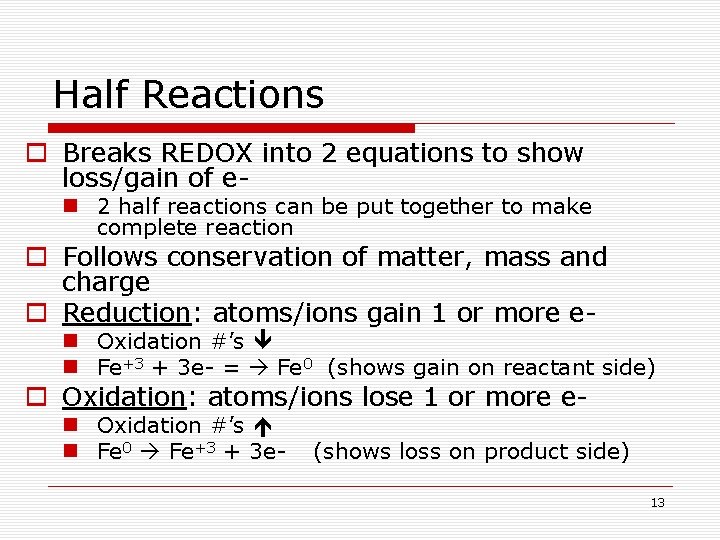
Half Reactions o Breaks REDOX into 2 equations to show loss/gain of e- n 2 half reactions can be put together to make complete reaction o Follows conservation of matter, mass and charge o Reduction: atoms/ions gain 1 or more e- n Oxidation #’s n Fe+3 + 3 e- = Fe 0 (shows gain on reactant side) o Oxidation: atoms/ions lose 1 or more en Oxidation #’s n Fe 0 Fe+3 + 3 e- (shows loss on product side) 13
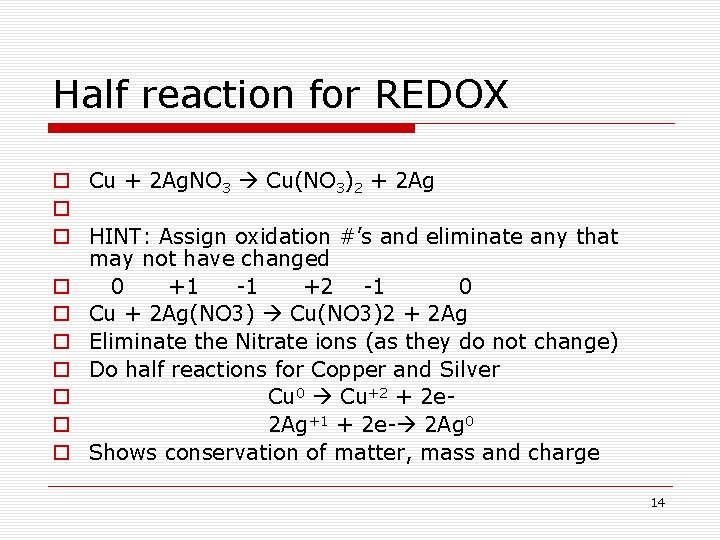
Half reaction for REDOX o Cu + 2 Ag. NO 3 Cu(NO 3)2 + 2 Ag o o HINT: Assign oxidation #’s and eliminate any that may not have changed o 0 +1 -1 +2 -1 0 o Cu + 2 Ag(NO 3) Cu(NO 3)2 + 2 Ag o Eliminate the Nitrate ions (as they do not change) o Do half reactions for Copper and Silver o Cu 0 Cu+2 + 2 eo 2 Ag+1 + 2 e- 2 Ag 0 o Shows conservation of matter, mass and charge 14
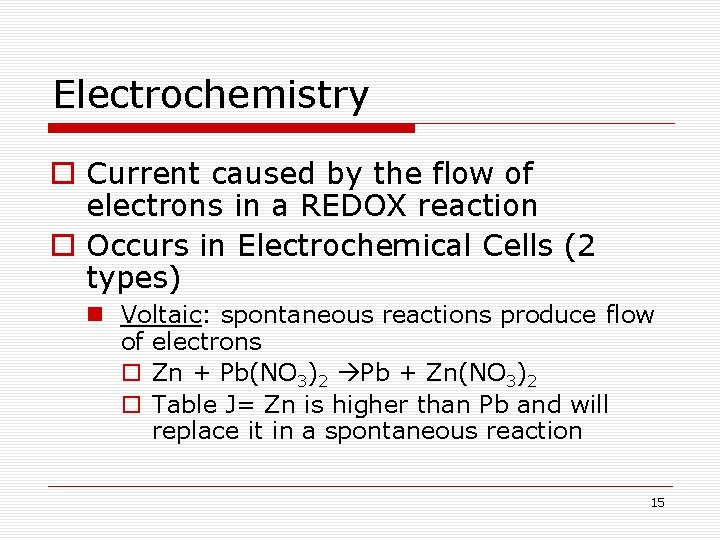
Electrochemistry o Current caused by the flow of electrons in a REDOX reaction o Occurs in Electrochemical Cells (2 types) n Voltaic: spontaneous reactions produce flow of electrons o Zn + Pb(NO 3)2 Pb + Zn(NO 3)2 o Table J= Zn is higher than Pb and will replace it in a spontaneous reaction 15
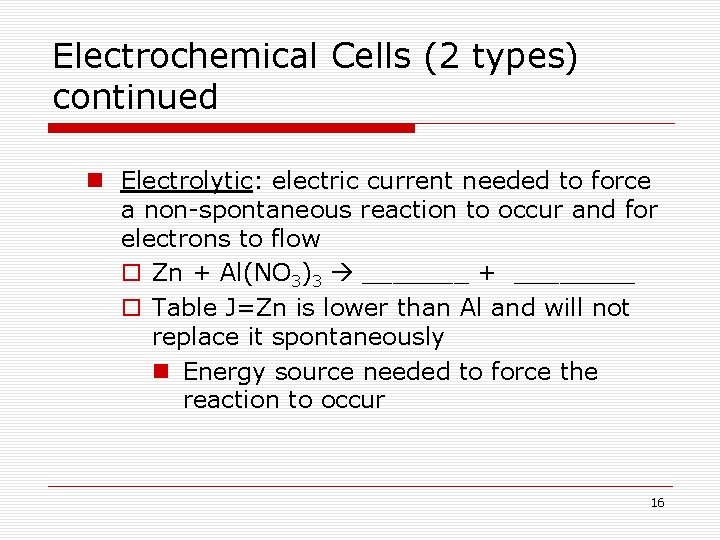
Electrochemical Cells (2 types) continued n Electrolytic: electric current needed to force a non-spontaneous reaction to occur and for electrons to flow o Zn + Al(NO 3)3 _______ + ____ o Table J=Zn is lower than Al and will not replace it spontaneously n Energy source needed to force the reaction to occur 16
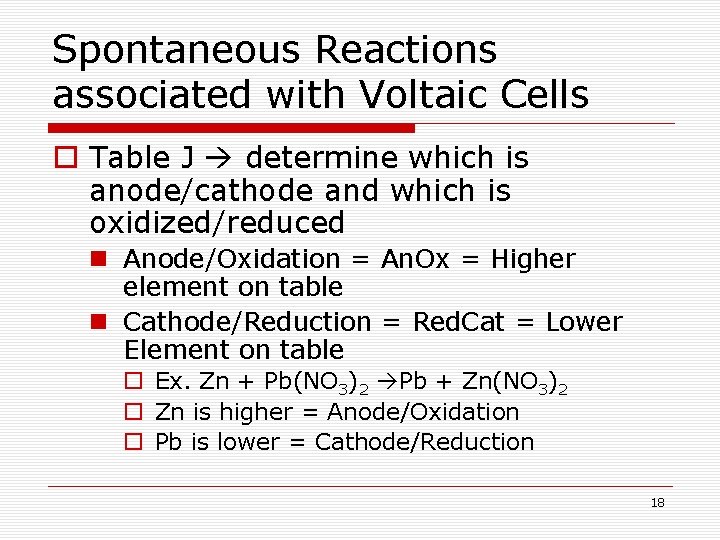
Anode vs. Cathode o Cells contain 2 surfaces (electrodes) that conduct electricity n Anode where Oxidation occurs (An. Ox) n Cathode Where Reduction occurs (Red. Cat) 17
Spontaneous Reactions associated with Voltaic Cells o Table J determine which is anode/cathode and which is oxidized/reduced n Anode/Oxidation = An. Ox = Higher element on table n Cathode/Reduction = Red. Cat = Lower Element on table o Ex. Zn + Pb(NO 3)2 Pb + Zn(NO 3)2 o Zn is higher = Anode/Oxidation o Pb is lower = Cathode/Reduction 18
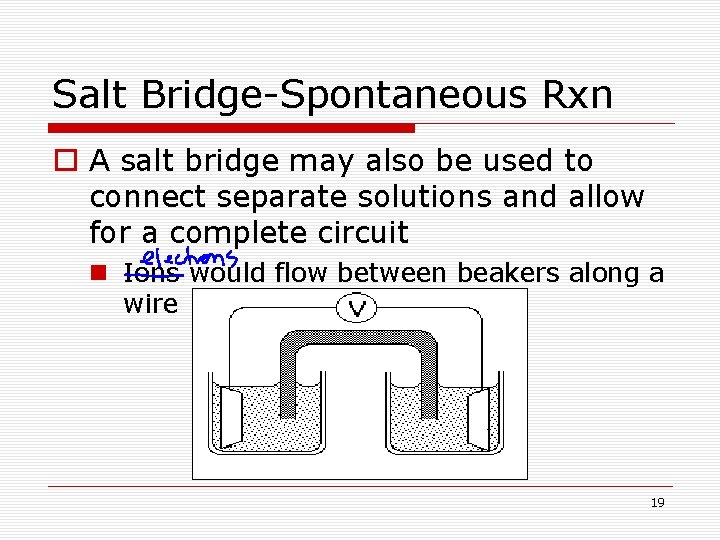
Salt Bridge-Spontaneous Rxn o A salt bridge may also be used to connect separate solutions and allow for a complete circuit n Ions would flow between beakers along a wire 19
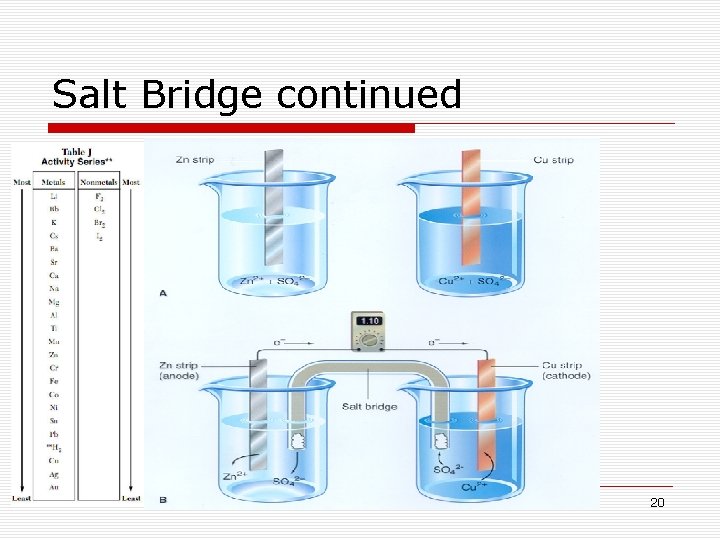
Salt Bridge continued 20
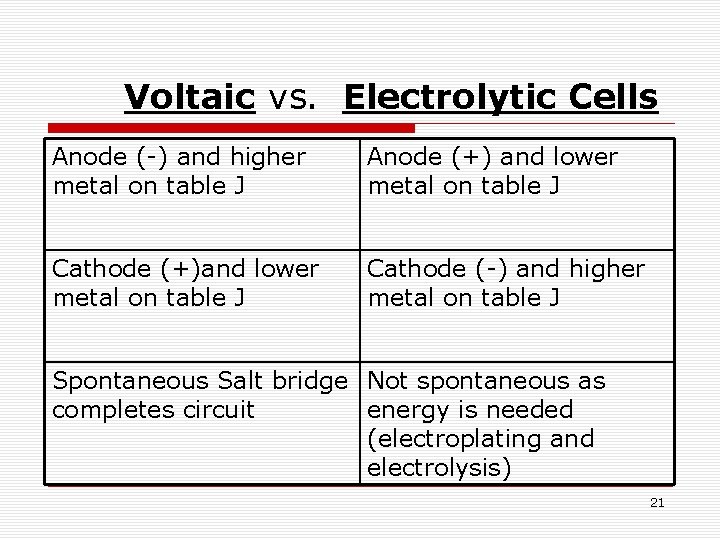
Voltaic vs. Electrolytic Cells Anode (-) and higher metal on table J Anode (+) and lower metal on table J Cathode (+)and lower metal on table J Cathode (-) and higher metal on table J Spontaneous Salt bridge Not spontaneous as completes circuit energy is needed (electroplating and electrolysis) 21
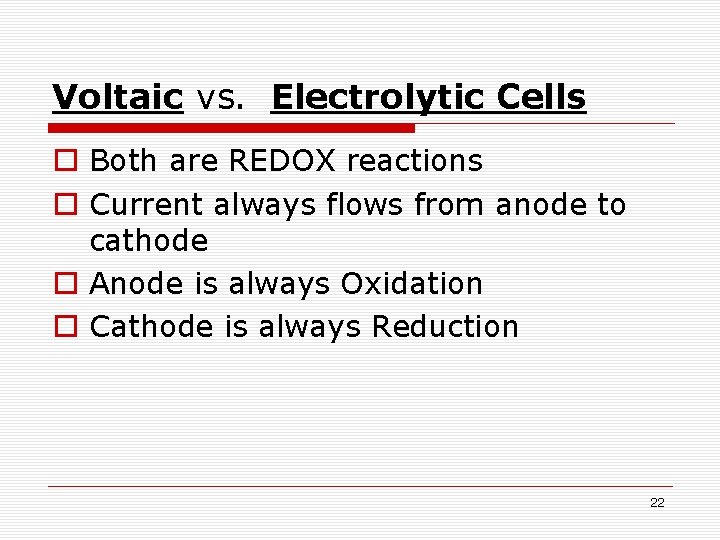
Voltaic vs. Electrolytic Cells o Both are REDOX reactions o Current always flows from anode to cathode o Anode is always Oxidation o Cathode is always Reduction 22
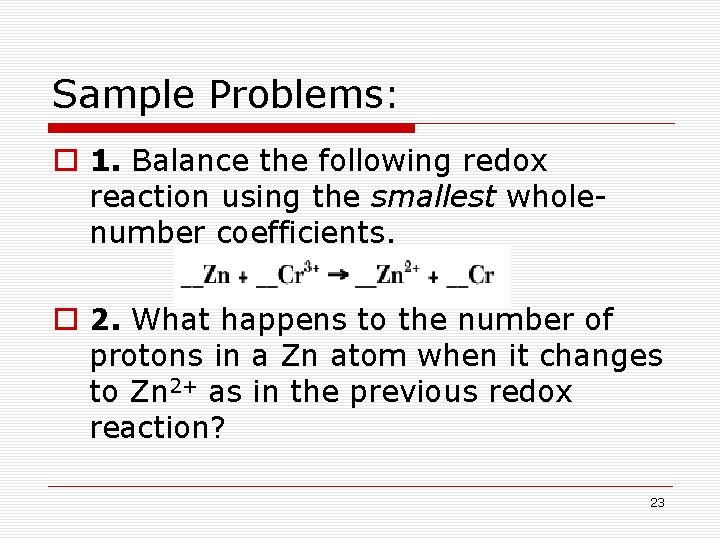
Sample Problems: o 1. Balance the following redox reaction using the smallest wholenumber coefficients. o 2. What happens to the number of protons in a Zn atom when it changes to Zn 2+ as in the previous redox reaction? 23
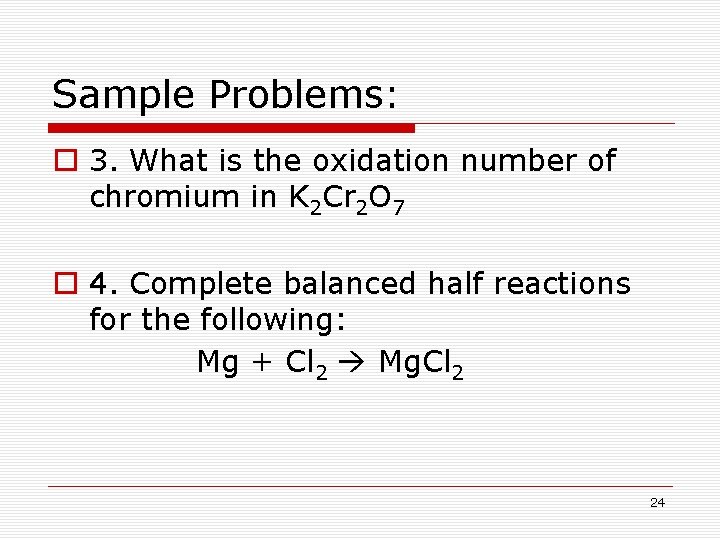
Sample Problems: o 3. What is the oxidation number of chromium in K 2 Cr 2 O 7 o 4. Complete balanced half reactions for the following: Mg + Cl 2 Mg. Cl 2 24