
REDOX REACTIONS REDUCTION Previously What happened to oxygen
- Slides: 17
REDOX REACTIONS
REDUCTION • Previously: What happened to oxygen when it reacted – During reactions oxygen would take on electrons • Now: When any element gains electrons
OXIDATION • Previous: What happened to an element when it reacted with oxygen – During reaction, oxygen would take the electrons from elements • Now: When any element loses electrons
REDOX • Reduction and oxidation NEVER happen by themselves – When an element is oxidized, there is another element that is reduced – When an element is reduced, there is an another element that is oxidized • LEO the Lion says GER – Lose an electron oxidized – Gain an electrons reduced
OXIDATION NUMBERS • Oxidation numbers can be assigned using the periodic table if the compound is an ionic compound. • Covalent compounds are made of two nonmetals, which from the periodic table are always expected to be negative. – Since covalent compounds are neutral, it is not possible for every element to retain its negative oxidation number. – Only the more electronegative element stays negative; least electronegative element changes to positive • Oxidation number is different from formal charge. • Using oxidation number gives us another way to account for electrons in chemical changes.
RULES FOR DETERMINING OXIDATION NUMBERS 1. 2. 3. 4. 5. 6. The oxidation number of any uncombined element is zero The oxidation number of a monatomic ion equals its charge Oxygen’s oxidation number is -2, except in peroxides (H 2 O 2) where it is -1 or when it bonds with fluorine where it will be +2 The oxidation number of hydrogen is +1 except when it bonds with metals to from metal hydrides, where it is -1 or in the polyatomic ion NH 4 where it is also -1 The sum of the oxidation numbers for a compound must equal zero The sum of the oxidation numbers in the formula of a polyatomic ion is equal to its charge.
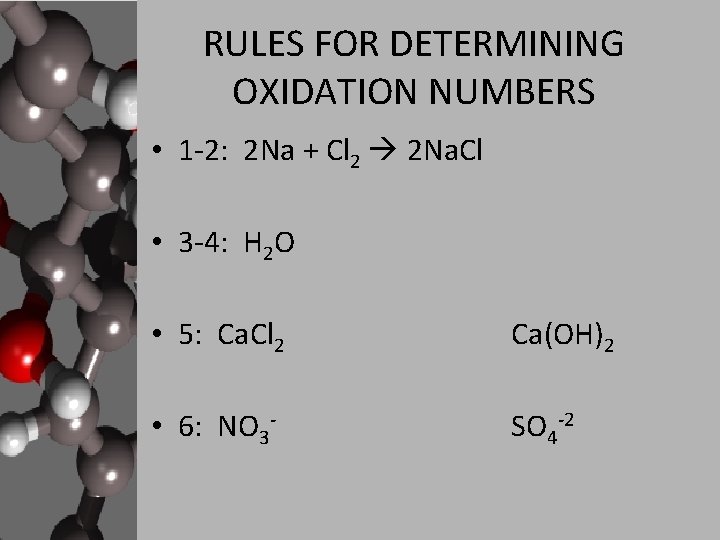
RULES FOR DETERMINING OXIDATION NUMBERS • 1 -2: 2 Na + Cl 2 2 Na. Cl • 3 -4: H 2 O • 5: Ca. Cl 2 Ca(OH)2 • 6: NO 3 - SO 4 -2
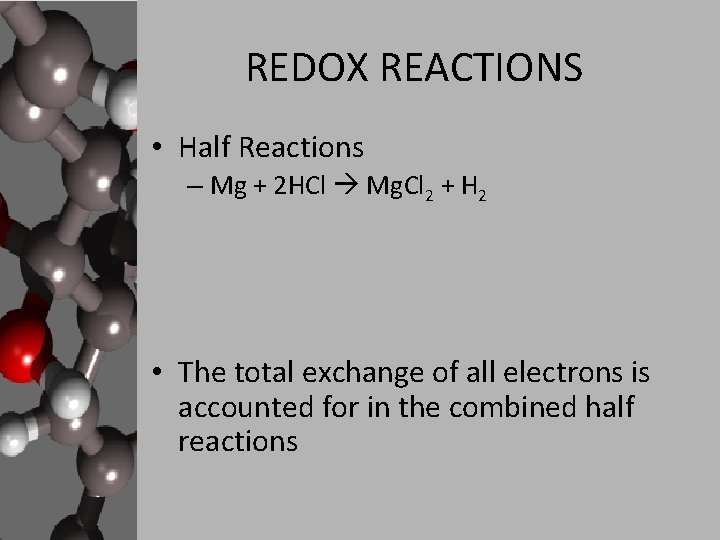
REDOX REACTIONS • Any reaction where the oxidation number of an element is different on the two sides of the chemical equation is a redox equation • Mg + 2 HCl Mg. Cl 2 + H 2 • Oxidation = loss of electrons • Reduction = gaining electrons • You will represent redox reactions using half reactions
REDOX REACTIONS • Half Reactions – Mg + 2 HCl Mg. Cl 2 + H 2 • The total exchange of all electrons is accounted for in the combined half reactions
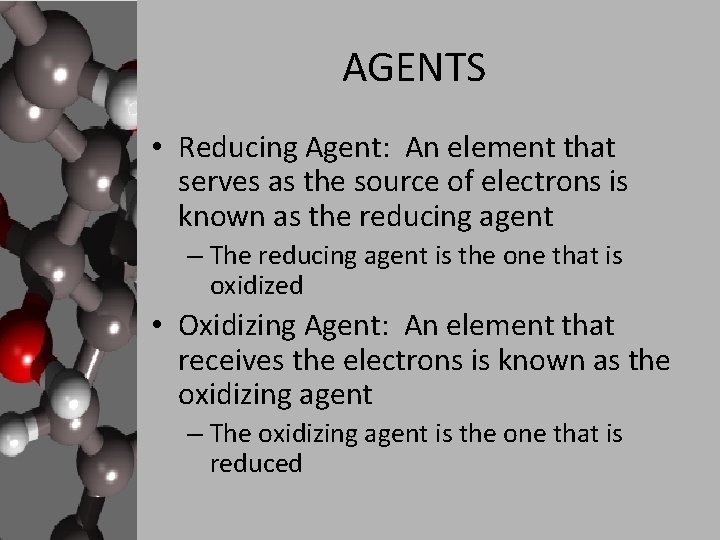
AGENTS • Reducing Agent: An element that serves as the source of electrons is known as the reducing agent – The reducing agent is the one that is oxidized • Oxidizing Agent: An element that receives the electrons is known as the oxidizing agent – The oxidizing agent is the one that is reduced
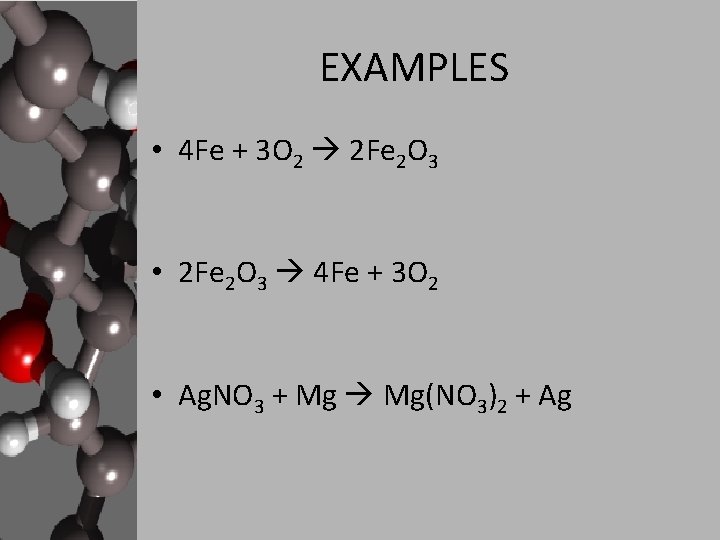
EXAMPLES • 4 Fe + 3 O 2 2 Fe 2 O 3 • 2 Fe 2 O 3 4 Fe + 3 O 2 • Ag. NO 3 + Mg Mg(NO 3)2 + Ag
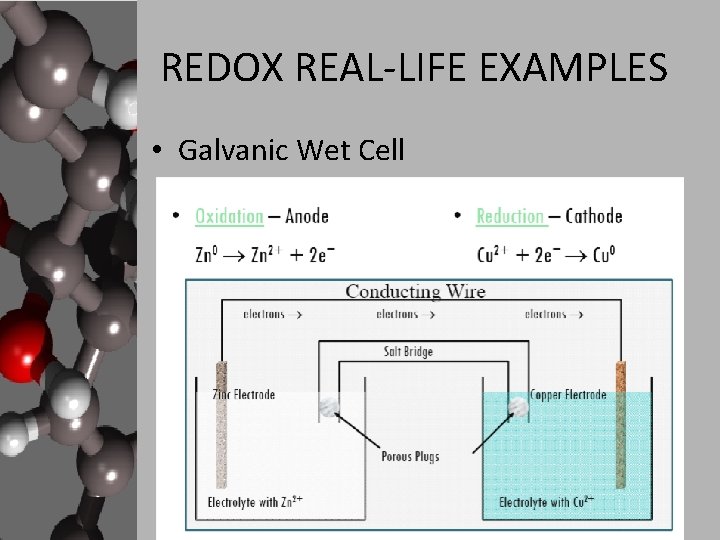
REDOX REAL-LIFE EXAMPLES • Galvanic Wet Cell
REDOX REAL-LIFE EXAMPLES • How does this work – If you bathe two different strips in a conductive solution, and connect them externally with a wire – Reactions between the electrodes and the solution furnish the circuit with charges continually. – The process that produces the electrical energy continues and becomes useful. – Spontaneously conversion of chemical energy to electrical energy. – The Copper (Cu) atoms attract electrons more than do the Zinc (Zn) atoms. – Zinc is more active and yields its electrons more easily.
REDOX REAL-LIFE EXAMPLES
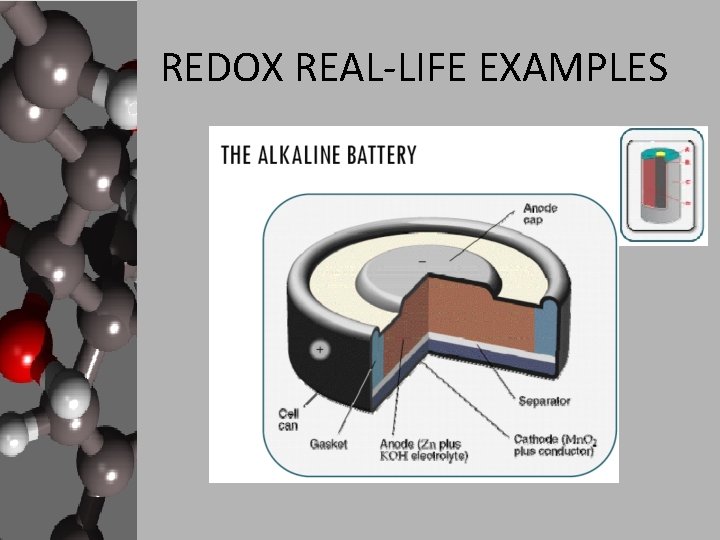
REDOX REAL-LIFE EXAMPLES • AN ALKALINE BATTERY – Anode: Zn cap: • Zn(s) → Zn 2+(aq) + 2 e- – Cathode: Mn. O 2, NH 4 Cl and carbon paste: 2 NH 4 +(aq) + 2 Mn. O 2(s) + 2 e- → Mn 2 O 3(s) + 2 NH 3(aq) + 2 H 2 O(l) – Graphite rod in the center - inert cathode. – Alkaline battery, NH 4 Cl is replaced with KOH. – Anode: Zn powder mixed in a gel:
REDOX REAL-LIFE EXAMPLES
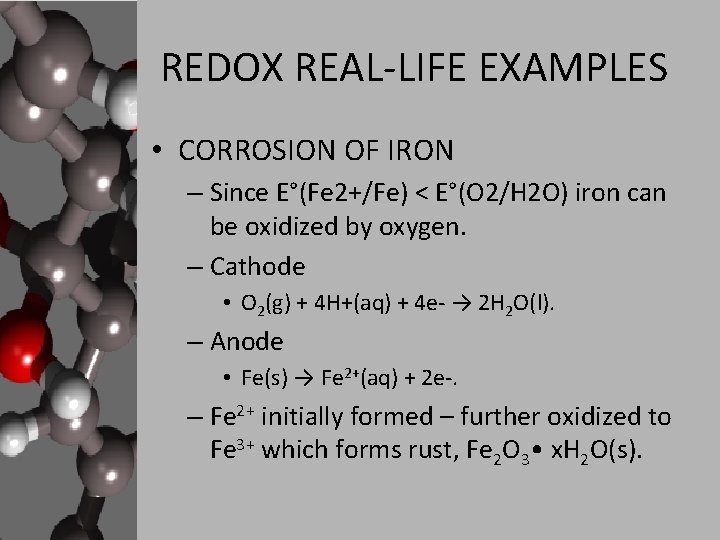
REDOX REAL-LIFE EXAMPLES • CORROSION OF IRON – Since E°(Fe 2+/Fe) < E°(O 2/H 2 O) iron can be oxidized by oxygen. – Cathode • O 2(g) + 4 H+(aq) + 4 e- → 2 H 2 O(l). – Anode • Fe(s) → Fe 2+(aq) + 2 e-. – Fe 2+ initially formed – further oxidized to Fe 3+ which forms rust, Fe 2 O 3 • x. H 2 O(s).