
Redox Reactions NugentRegents Chem Oxidation Numbers n n
Redox Reactions Nugent-Regents Chem
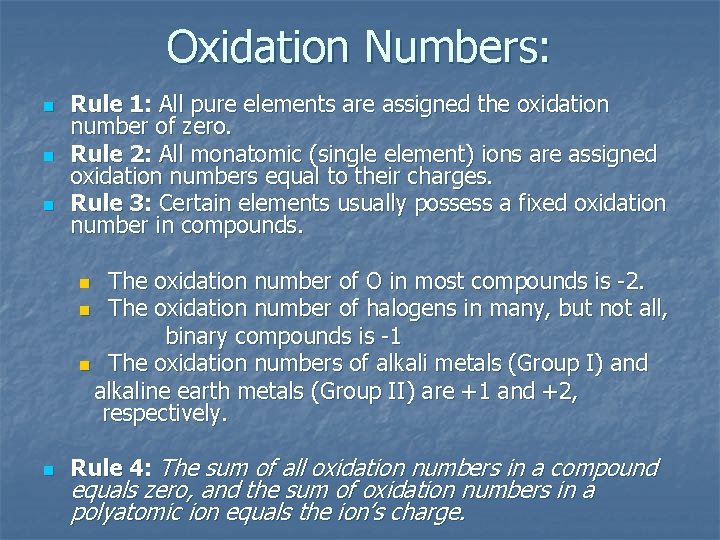
Oxidation Numbers: n n n Rule 1: All pure elements are assigned the oxidation number of zero. Rule 2: All monatomic (single element) ions are assigned oxidation numbers equal to their charges. Rule 3: Certain elements usually possess a fixed oxidation number in compounds. The oxidation number of O in most compounds is -2. n The oxidation number of halogens in many, but not all, binary compounds is -1 n The oxidation numbers of alkali metals (Group I) and alkaline earth metals (Group II) are +1 and +2, respectively. n n Rule 4: The sum of all oxidation numbers in a compound equals zero, and the sum of oxidation numbers in a polyatomic ion equals the ion’s charge.
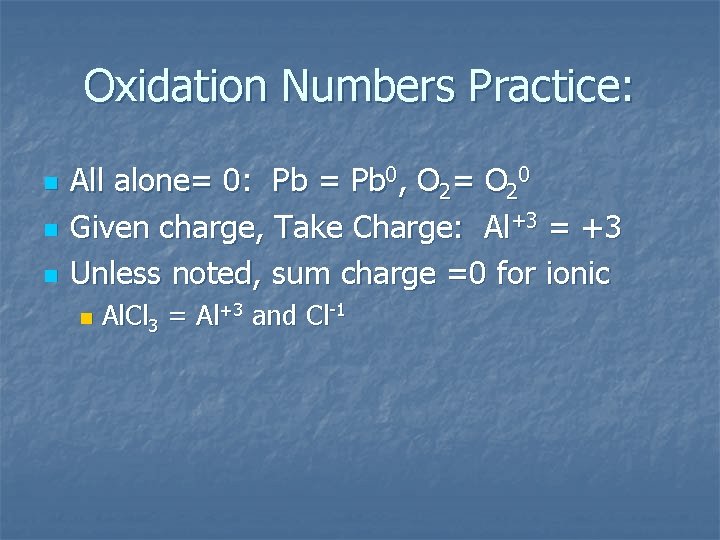
Oxidation Numbers Practice: n n n All alone= 0: Pb = Pb 0, O 2= O 20 Given charge, Take Charge: Al+3 = +3 Unless noted, sum charge =0 for ionic n Al. Cl 3 = Al+3 and Cl-1
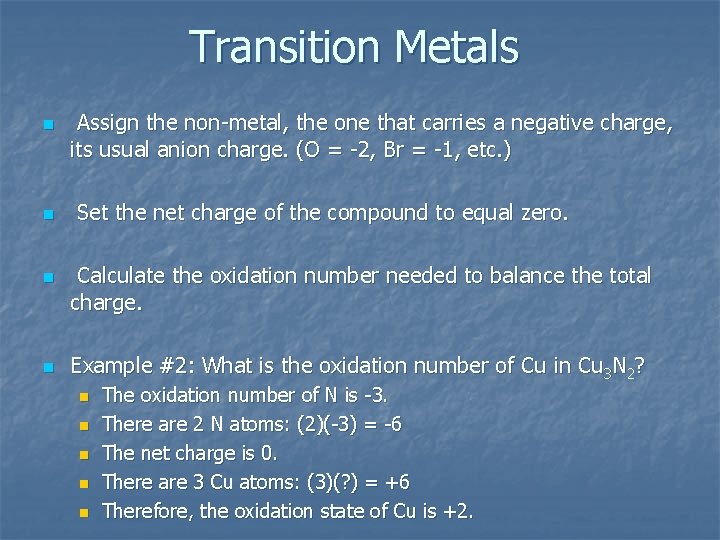
Transition Metals n n Assign the non-metal, the one that carries a negative charge, its usual anion charge. (O = -2, Br = -1, etc. ) Set the net charge of the compound to equal zero. Calculate the oxidation number needed to balance the total charge. Example #2: What is the oxidation number of Cu in Cu 3 N 2? n n n The oxidation number of N is -3. There are 2 N atoms: (2)(-3) = -6 The net charge is 0. There are 3 Cu atoms: (3)(? ) = +6 Therefore, the oxidation state of Cu is +2.
Redox n n n Redox Reactions: Transfer of electrons Reduction: Gain of Electrons Oxidation: Loss of Electrons LEO the Lion says GER n OIL RIG n n Law of Conservation of Mass and Charge!
Redox Animations n Zno + Cu+2 n Mgo + Cu+2
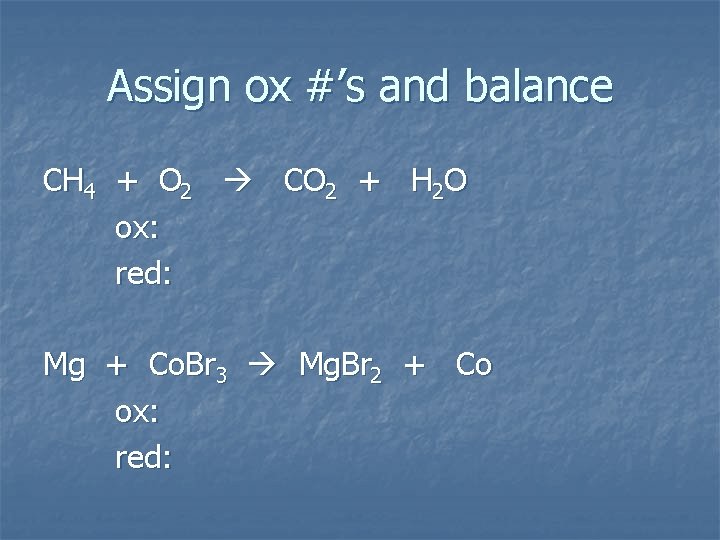
Assign ox #’s and balance CH 4 + O 2 CO 2 + H 2 O ox: red: Mg + Co. Br 3 Mg. Br 2 + Co ox: red:

Self Check n n n Quiz 1 Self Check 2 Self Check 3
- Slides: 8