
Redox Reactions 2015 Pearson Education Inc OxidationReduction Reactions
- Slides: 17
Redox Reactions © 2015 Pearson Education, Inc.
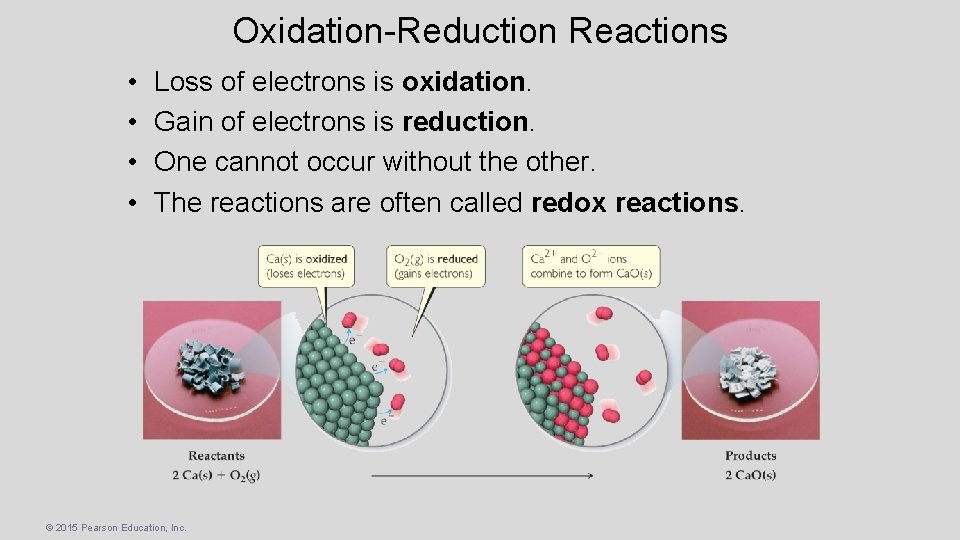
Oxidation-Reduction Reactions • • Loss of electrons is oxidation. Gain of electrons is reduction. One cannot occur without the other. The reactions are often called redox reactions. © 2015 Pearson Education, Inc.
Oxidation Numbers To determine if an oxidation–reduction reaction has occurred, we assign an oxidation number to each element in a neutral compound or charged entity. 1. Elements in their elemental form have an oxidation number of zero. 2. The oxidation number of a monatomic ion is the same as its charge. (Na is +1, Br is -1, etc) © 2015 Pearson Education, Inc.
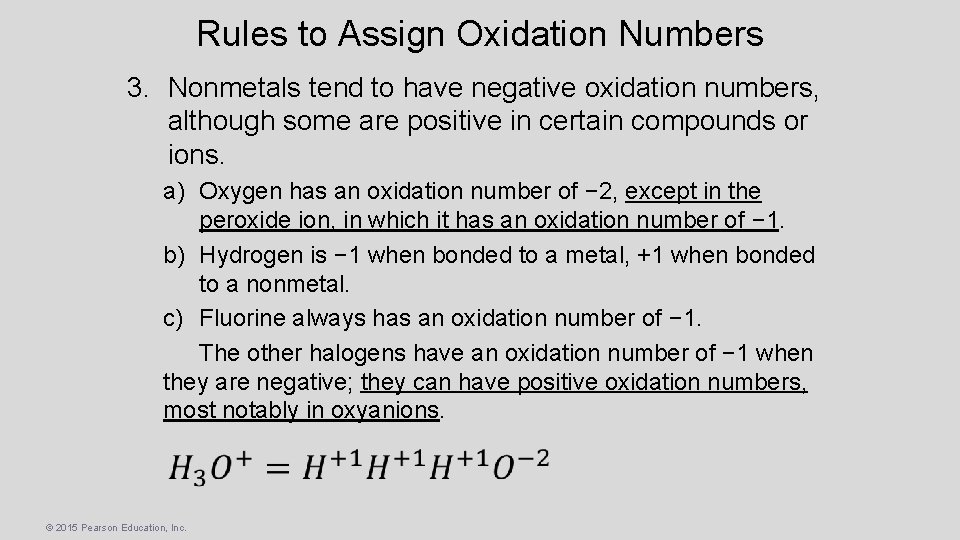
Rules to Assign Oxidation Numbers 3. Nonmetals tend to have negative oxidation numbers, although some are positive in certain compounds or ions. a) Oxygen has an oxidation number of − 2, except in the peroxide ion, in which it has an oxidation number of − 1. b) Hydrogen is − 1 when bonded to a metal, +1 when bonded to a nonmetal. c) Fluorine always has an oxidation number of − 1. The other halogens have an oxidation number of − 1 when they are negative; they can have positive oxidation numbers, most notably in oxyanions. © 2015 Pearson Education, Inc.
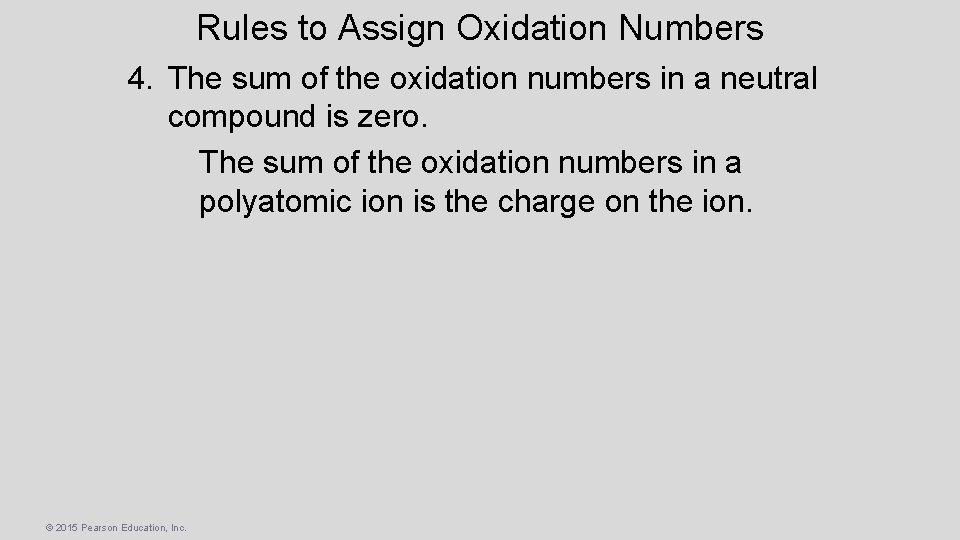
Rules to Assign Oxidation Numbers 4. The sum of the oxidation numbers in a neutral compound is zero. The sum of the oxidation numbers in a polyatomic ion is the charge on the ion. © 2015 Pearson Education, Inc.
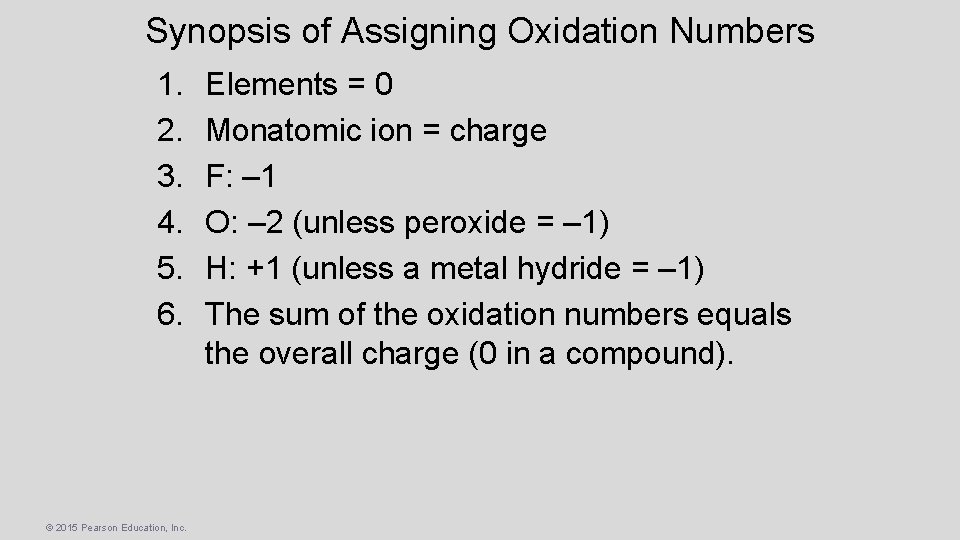
Synopsis of Assigning Oxidation Numbers 1. 2. 3. 4. 5. 6. © 2015 Pearson Education, Inc. Elements = 0 Monatomic ion = charge F: – 1 O: – 2 (unless peroxide = – 1) H: +1 (unless a metal hydride = – 1) The sum of the oxidation numbers equals the overall charge (0 in a compound).
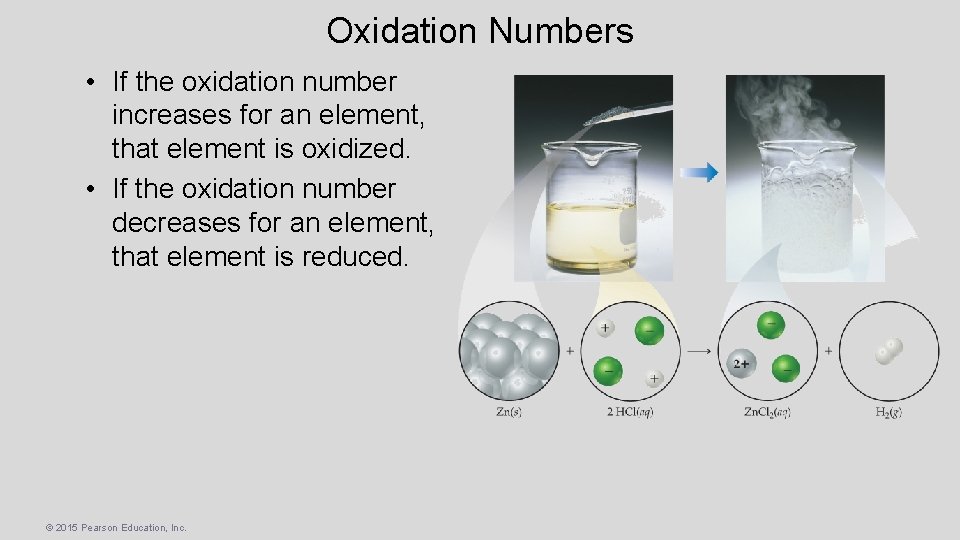
Oxidation Numbers • If the oxidation number increases for an element, that element is oxidized. • If the oxidation number decreases for an element, that element is reduced. © 2015 Pearson Education, Inc.
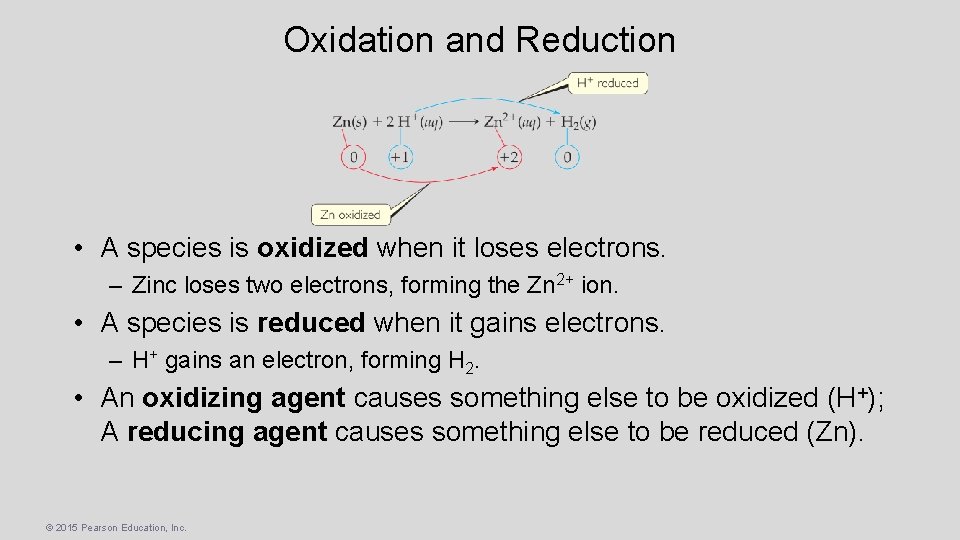
Oxidation and Reduction • A species is oxidized when it loses electrons. – Zinc loses two electrons, forming the Zn 2+ ion. • A species is reduced when it gains electrons. – H+ gains an electron, forming H 2. • An oxidizing agent causes something else to be oxidized (H+); A reducing agent causes something else to be reduced (Zn). © 2015 Pearson Education, Inc.
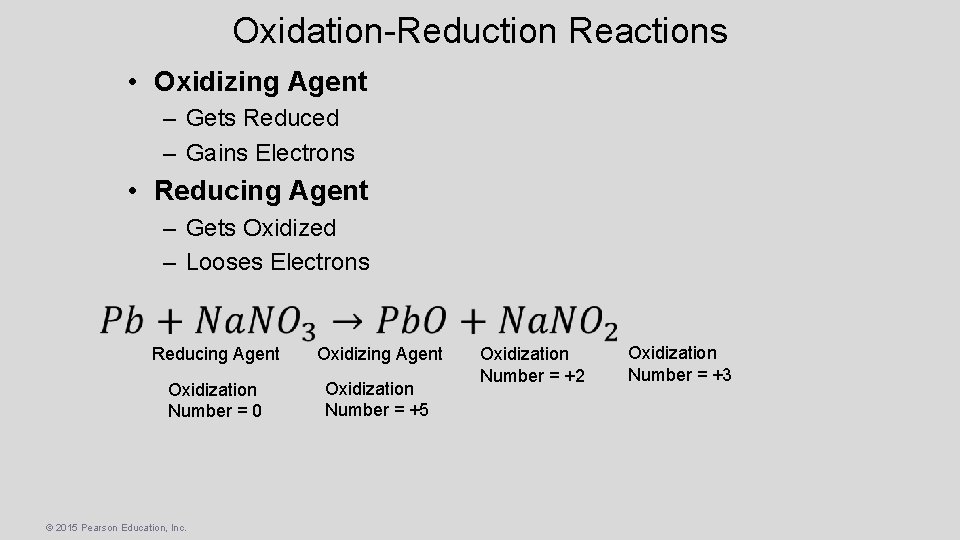
Oxidation-Reduction Reactions • Oxidizing Agent – Gets Reduced – Gains Electrons • Reducing Agent – Gets Oxidized – Looses Electrons Reducing Agent Oxidization Number = 0 Oxidization Number = +5 © 2015 Pearson Education, Inc. Oxidization Number = +2 Oxidization Number = +3
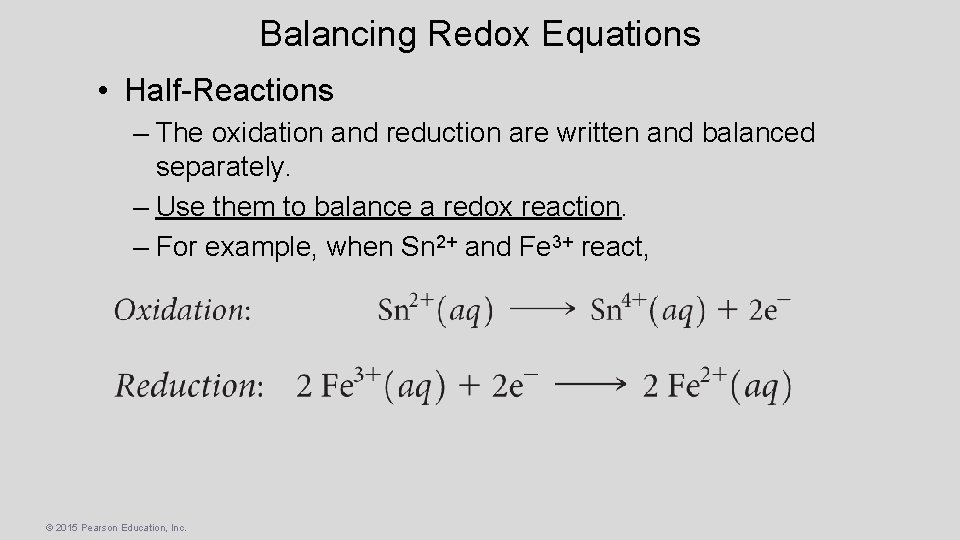
Balancing Redox Equations • Half-Reactions – The oxidation and reduction are written and balanced separately. – Use them to balance a redox reaction. – For example, when Sn 2+ and Fe 3+ react, © 2015 Pearson Education, Inc.
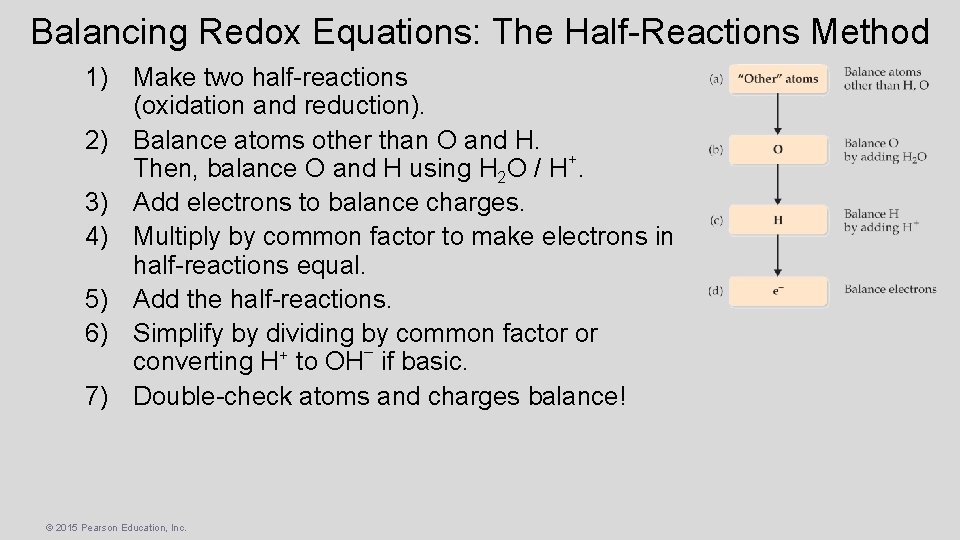
Balancing Redox Equations: The Half-Reactions Method 1) Make two half-reactions (oxidation and reduction). 2) Balance atoms other than O and H. Then, balance O and H using H 2 O / H+. 3) Add electrons to balance charges. 4) Multiply by common factor to make electrons in half-reactions equal. 5) Add the half-reactions. 6) Simplify by dividing by common factor or converting H+ to OH– if basic. 7) Double-check atoms and charges balance! © 2015 Pearson Education, Inc.
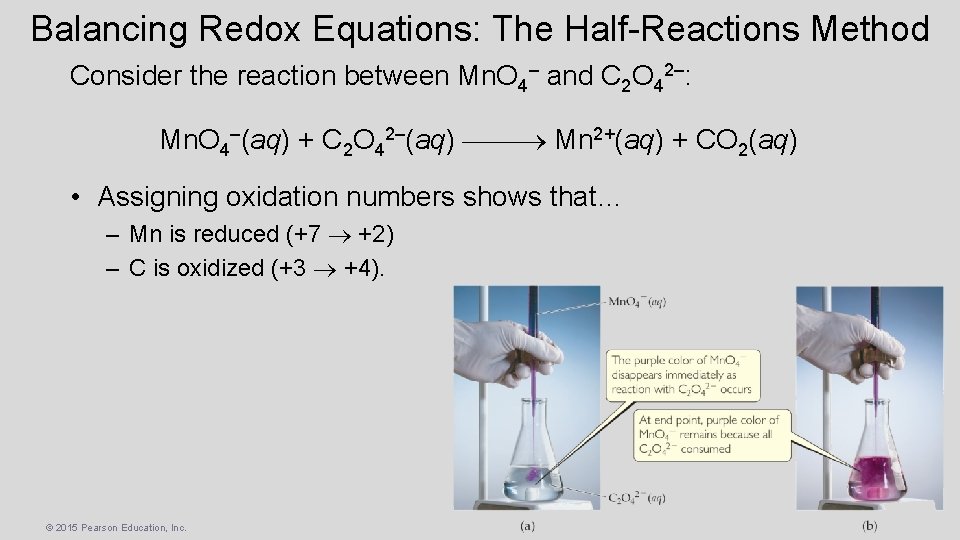
Balancing Redox Equations: The Half-Reactions Method Consider the reaction between Mn. O 4– and C 2 O 42–: Mn. O 4–(aq) + C 2 O 42–(aq) Mn 2+(aq) + CO 2(aq) • Assigning oxidation numbers shows that… – Mn is reduced (+7 +2) – C is oxidized (+3 +4). © 2015 Pearson Education, Inc.
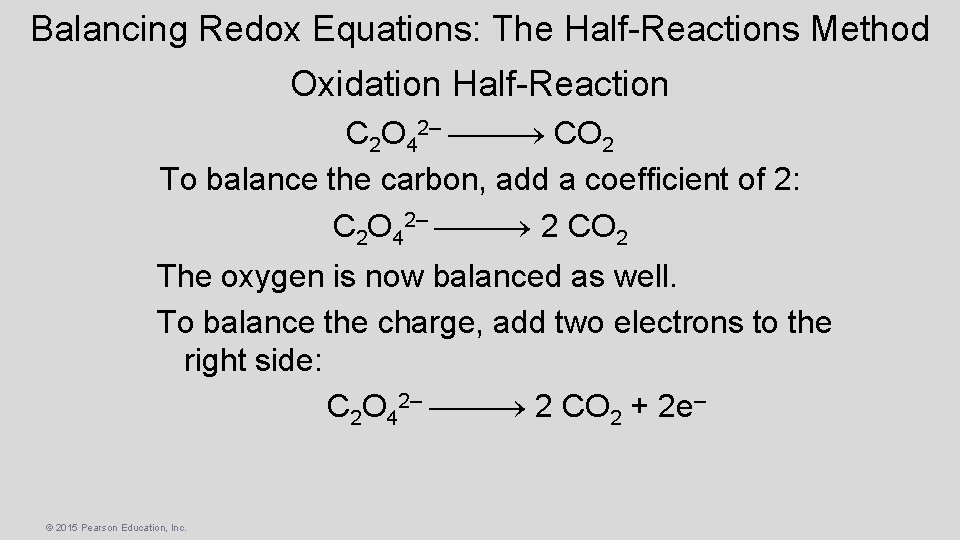
Balancing Redox Equations: The Half-Reactions Method Oxidation Half-Reaction C 2 O 42– CO 2 To balance the carbon, add a coefficient of 2: C 2 O 42– 2 CO 2 The oxygen is now balanced as well. To balance the charge, add two electrons to the right side: C 2 O 42– 2 CO 2 + 2 e– © 2015 Pearson Education, Inc.
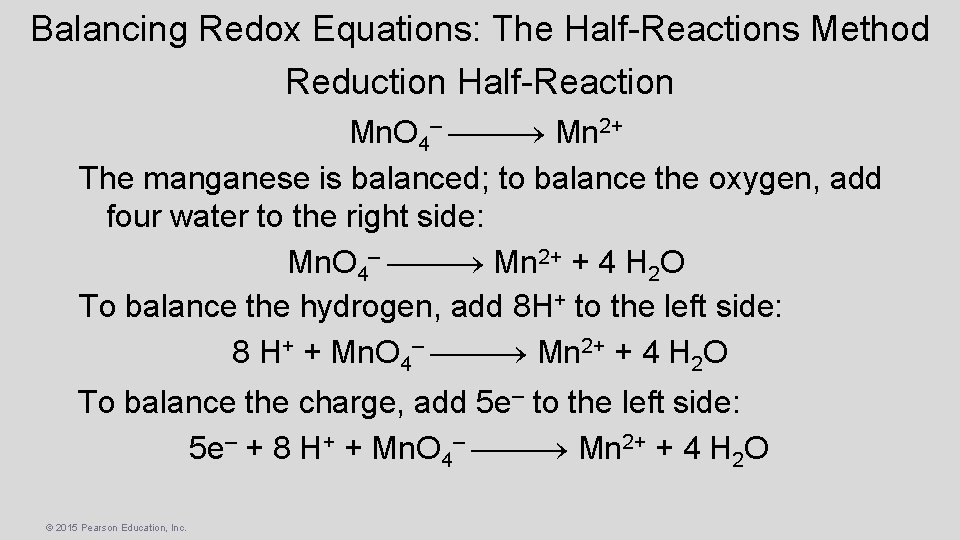
Balancing Redox Equations: The Half-Reactions Method Reduction Half-Reaction Mn. O 4– Mn 2+ The manganese is balanced; to balance the oxygen, add four water to the right side: Mn. O 4– Mn 2+ + 4 H 2 O To balance the hydrogen, add 8 H+ to the left side: 8 H+ + Mn. O 4– Mn 2+ + 4 H 2 O To balance the charge, add 5 e– to the left side: 5 e– + 8 H+ + Mn. O 4– Mn 2+ + 4 H 2 O © 2015 Pearson Education, Inc.
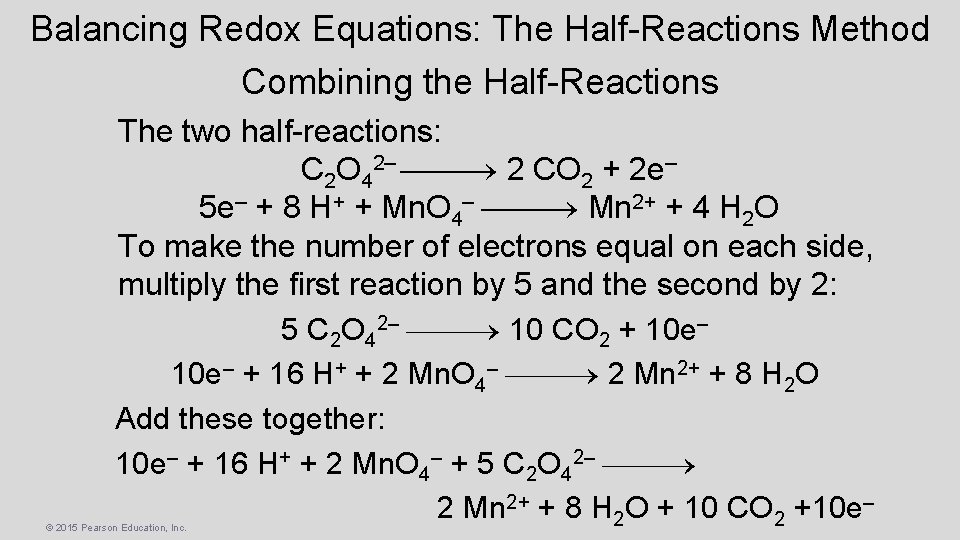
Balancing Redox Equations: The Half-Reactions Method Combining the Half-Reactions The two half-reactions: C 2 O 42– 2 CO 2 + 2 e– 5 e– + 8 H+ + Mn. O 4– Mn 2+ + 4 H 2 O To make the number of electrons equal on each side, multiply the first reaction by 5 and the second by 2: 5 C 2 O 42– 10 CO 2 + 10 e– + 16 H+ + 2 Mn. O 4– 2 Mn 2+ + 8 H 2 O Add these together: 10 e– + 16 H+ + 2 Mn. O 4– + 5 C 2 O 42– 2 Mn 2+ + 8 H 2 O + 10 CO 2 +10 e– © 2015 Pearson Education, Inc.
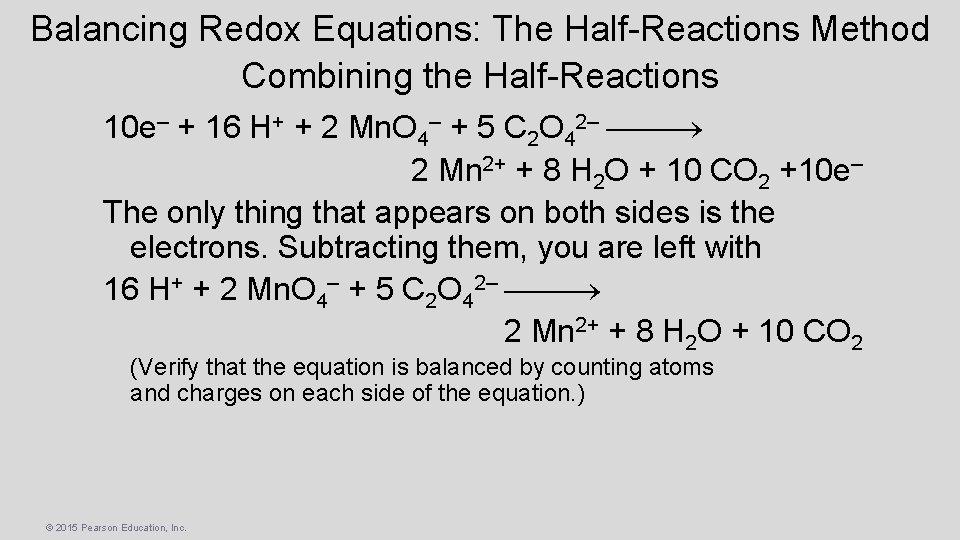
Balancing Redox Equations: The Half-Reactions Method Combining the Half-Reactions 10 e– + 16 H+ + 2 Mn. O 4– + 5 C 2 O 42– 2 Mn 2+ + 8 H 2 O + 10 CO 2 +10 e– The only thing that appears on both sides is the electrons. Subtracting them, you are left with 16 H+ + 2 Mn. O 4– + 5 C 2 O 42– 2 Mn 2+ + 8 H 2 O + 10 CO 2 (Verify that the equation is balanced by counting atoms and charges on each side of the equation. ) © 2015 Pearson Education, Inc.
Balancing Equations for Reactions Occurring in Basic Solution • A reaction that occurs in basic solution can be balanced as if it occurred in acid. • Once the equation is balanced, add OH– to each side to “neutralize” the H+ in the equation and create water in its place. • If this produces water on both sides, subtract water from each side so it appears on only one side of the equation. © 2015 Pearson Education, Inc.