
REDOX A guide for A level students KNOCKHARDY

- Slides: 55
REDOX A guide for A level students KNOCKHARDY PUBLISHING 2008 SPECIFICATIONS
KNOCKHARDY PUBLISHING REDOX INTRODUCTION This Powerpoint show is one of several produced to help students understand selected topics at AS and A 2 level Chemistry. It is based on the requirements of the AQA and OCR specifications but is suitable for other examination boards. Individual students may use the material at home for revision purposes or it may be used for classroom teaching if an interactive white board is available. Accompanying notes on this, and the full range of AS and A 2 topics, are available from the KNOCKHARDY SCIENCE WEBSITE at. . . www. knockhardy. org. uk/sci. htm Navigation is achieved by. . . either or clicking on the grey arrows at the foot of each page using the left and right arrow keys on the keyboard
REDOX CONTENTS • Definitions of oxidation and reduction • Calculating oxidation state • Use of H, O and F in calculating oxidation state • Naming compounds • Redox reactions • Balancing ionic half equations • Combining half equations to form a redox equation • Revision check list
REDOX Before you start it would be helpful to… • Recall the layout of the periodic table • Be able to balance simple equations
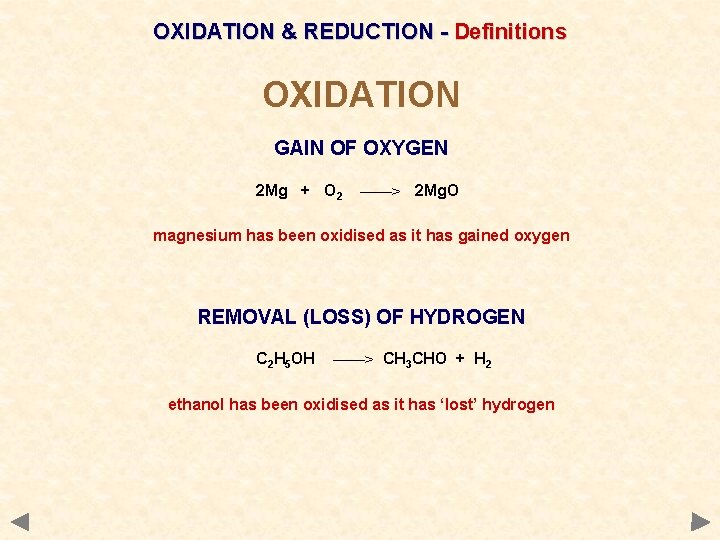
OXIDATION & REDUCTION - Definitions OXIDATION GAIN OF OXYGEN 2 Mg + O 2 ——> 2 Mg. O magnesium has been oxidised as it has gained oxygen REMOVAL (LOSS) OF HYDROGEN C 2 H 5 OH ——> CH 3 CHO + H 2 ethanol has been oxidised as it has ‘lost’ hydrogen
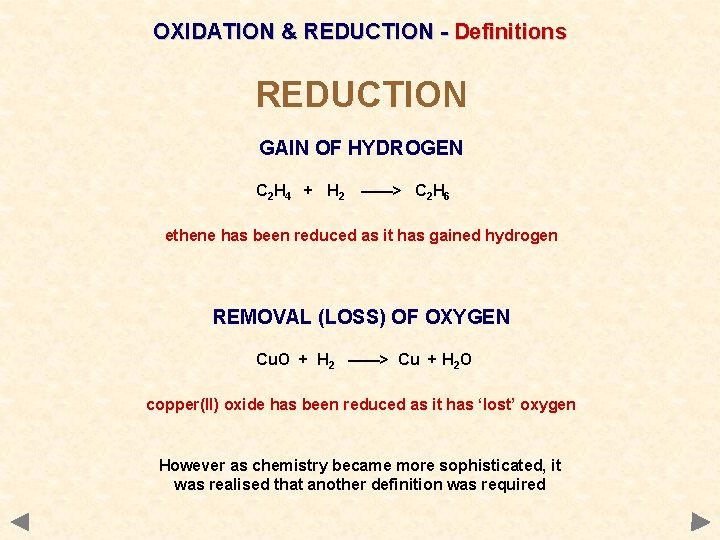
OXIDATION & REDUCTION - Definitions REDUCTION GAIN OF HYDROGEN C 2 H 4 + H 2 ——> C 2 H 6 ethene has been reduced as it has gained hydrogen REMOVAL (LOSS) OF OXYGEN Cu. O + H 2 ——> Cu + H 2 O copper(II) oxide has been reduced as it has ‘lost’ oxygen However as chemistry became more sophisticated, it was realised that another definition was required
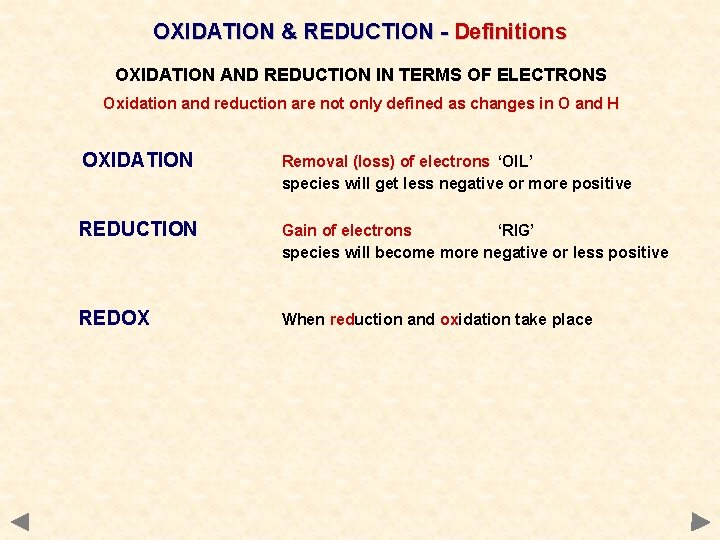
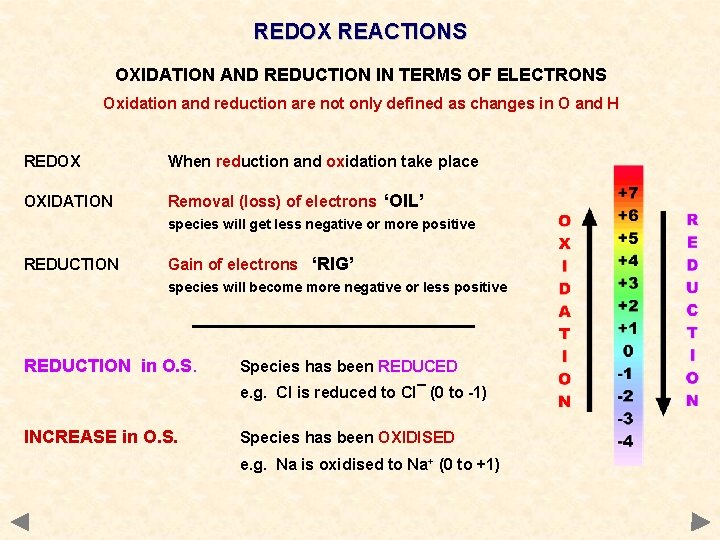
OXIDATION & REDUCTION - Definitions OXIDATION AND REDUCTION IN TERMS OF ELECTRONS Oxidation and reduction are not only defined as changes in O and H. . . OXIDATION Removal (loss) of electrons ‘OIL’ species will get less negative or more positive REDUCTION Gain of electrons ‘RIG’ species will become more negative or less positive REDOX When reduction and oxidation take place
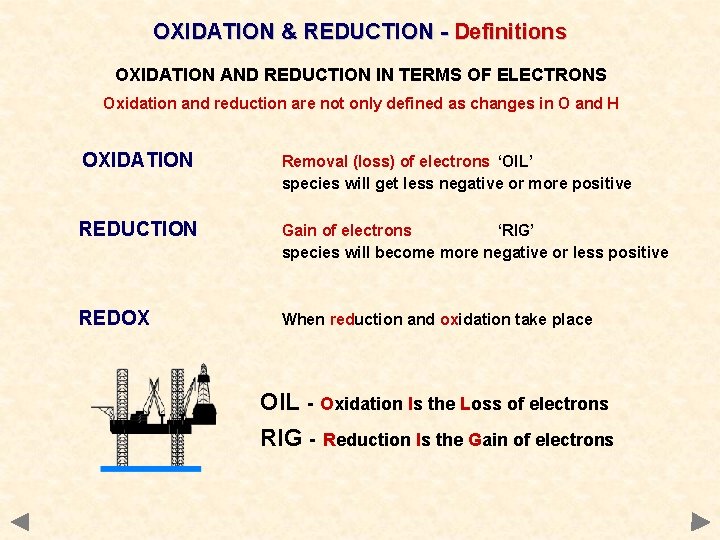
OXIDATION & REDUCTION - Definitions OXIDATION AND REDUCTION IN TERMS OF ELECTRONS Oxidation and reduction are not only defined as changes in O and H. . . OXIDATION Removal (loss) of electrons ‘OIL’ species will get less negative or more positive REDUCTION Gain of electrons ‘RIG’ species will become more negative or less positive REDOX When reduction and oxidation take place OIL - Oxidation Is the Loss of electrons RIG - Reduction Is the Gain of electrons
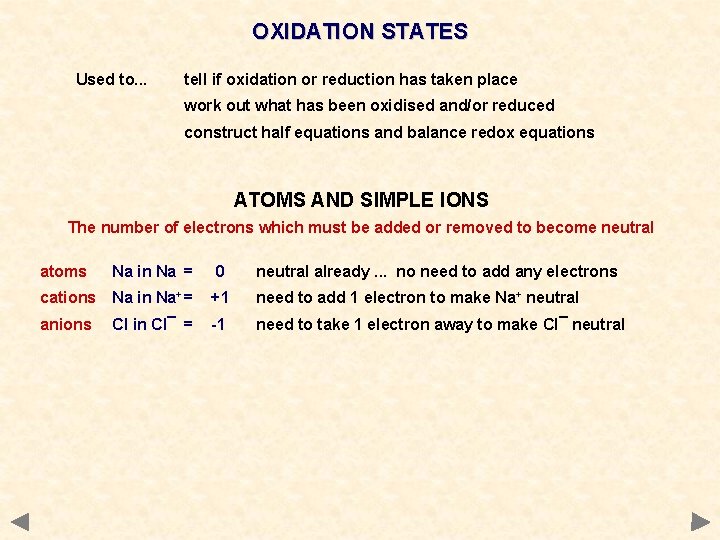
OXIDATION STATES Used to. . . tell if oxidation or reduction has taken place work out what has been oxidised and/or reduced construct half equations and balance redox equations ATOMS AND SIMPLE IONS The number of electrons which must be added or removed to become neutral atoms Na in Na = 0 neutral already. . . no need to add any electrons cations Na in Na+ = +1 need to add 1 electron to make Na+ neutral anions Cl in Cl¯ = -1 need to take 1 electron away to make Cl¯ neutral
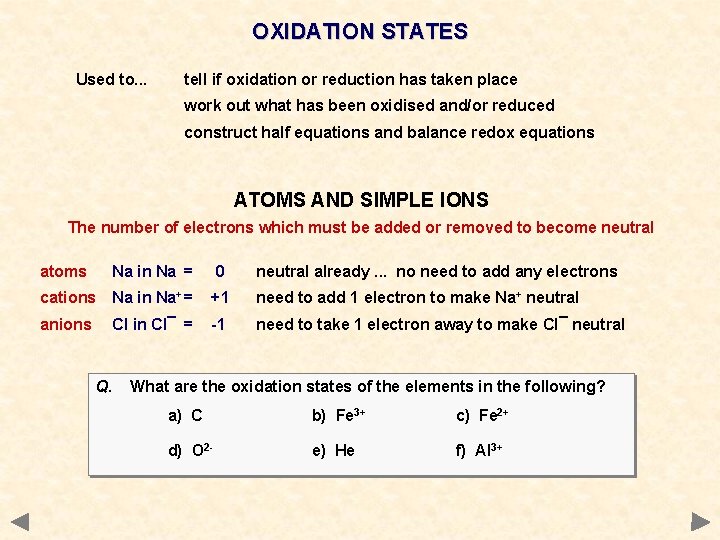
OXIDATION STATES Used to. . . tell if oxidation or reduction has taken place work out what has been oxidised and/or reduced construct half equations and balance redox equations ATOMS AND SIMPLE IONS The number of electrons which must be added or removed to become neutral atoms Na in Na = 0 neutral already. . . no need to add any electrons cations Na in Na+ = +1 need to add 1 electron to make Na+ neutral anions Cl in Cl¯ = -1 need to take 1 electron away to make Cl¯ neutral Q. What are the oxidation states of the elements in the following? a) C b) Fe 3+ c) Fe 2+ d) O 2 - e) He f) Al 3+
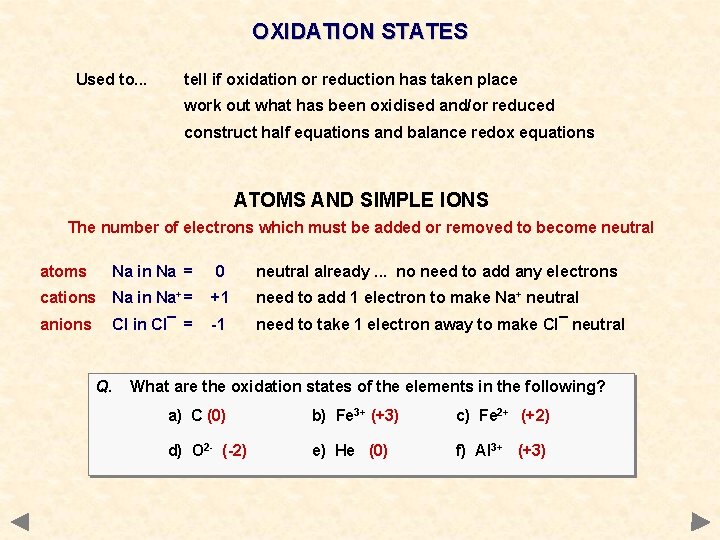
OXIDATION STATES Used to. . . tell if oxidation or reduction has taken place work out what has been oxidised and/or reduced construct half equations and balance redox equations ATOMS AND SIMPLE IONS The number of electrons which must be added or removed to become neutral atoms Na in Na = 0 neutral already. . . no need to add any electrons cations Na in Na+ = +1 need to add 1 electron to make Na+ neutral anions Cl in Cl¯ = -1 need to take 1 electron away to make Cl¯ neutral Q. What are the oxidation states of the elements in the following? a) C (0) b) Fe 3+ (+3) c) Fe 2+ (+2) d) O 2 - (-2) e) He (0) f) Al 3+ (+3)
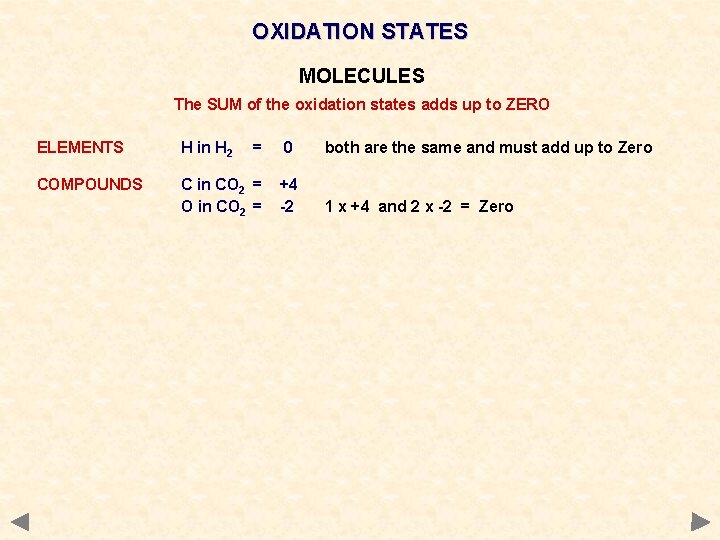
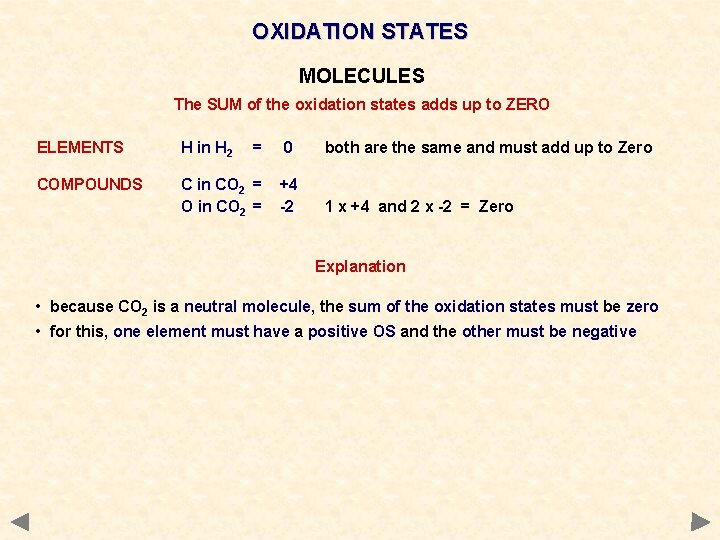
OXIDATION STATES MOLECULES The SUM of the oxidation states adds up to ZERO ELEMENTS H in H 2 = COMPOUNDS C in CO 2 = O in CO 2 = 0 both are the same and must add up to Zero +4 -2 1 x +4 and 2 x -2 = Zero
OXIDATION STATES MOLECULES The SUM of the oxidation states adds up to ZERO ELEMENTS H in H 2 = COMPOUNDS C in CO 2 = O in CO 2 = 0 both are the same and must add up to Zero +4 -2 1 x +4 and 2 x -2 = Zero Explanation • because CO 2 is a neutral molecule, the sum of the oxidation states must be zero • for this, one element must have a positive OS and the other must be negative
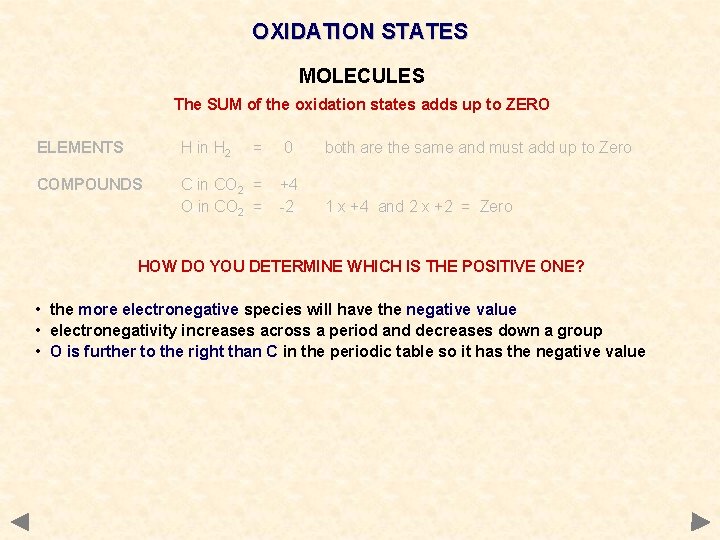
OXIDATION STATES MOLECULES The SUM of the oxidation states adds up to ZERO ELEMENTS H in H 2 = COMPOUNDS C in CO 2 = O in CO 2 = 0 both are the same and must add up to Zero +4 -2 1 x +4 and 2 x +2 = Zero HOW DO YOU DETERMINE WHICH IS THE POSITIVE ONE? • the more electronegative species will have the negative value • electronegativity increases across a period and decreases down a group • O is further to the right than C in the periodic table so it has the negative value
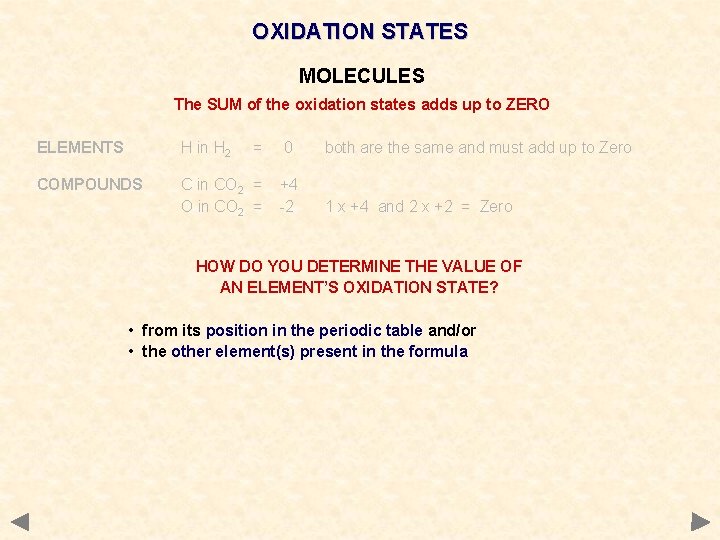
OXIDATION STATES MOLECULES The SUM of the oxidation states adds up to ZERO ELEMENTS H in H 2 = COMPOUNDS C in CO 2 = O in CO 2 = 0 both are the same and must add up to Zero +4 -2 1 x +4 and 2 x +2 = Zero HOW DO YOU DETERMINE THE VALUE OF AN ELEMENT’S OXIDATION STATE? • from its position in the periodic table and/or • the other element(s) present in the formula
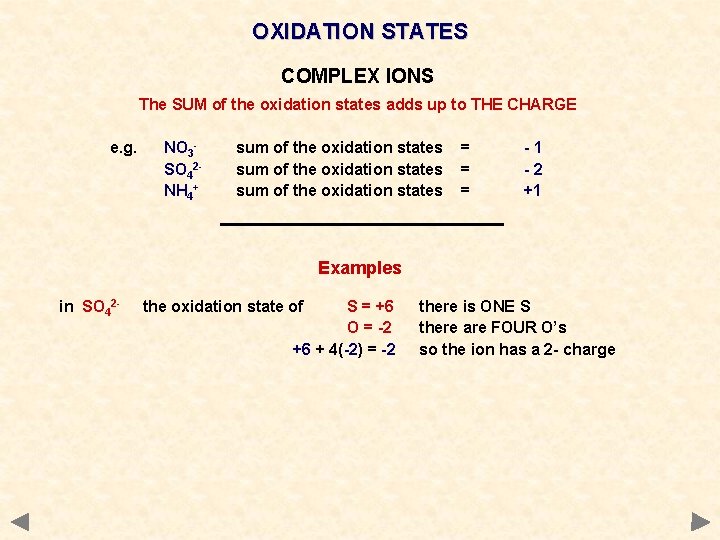
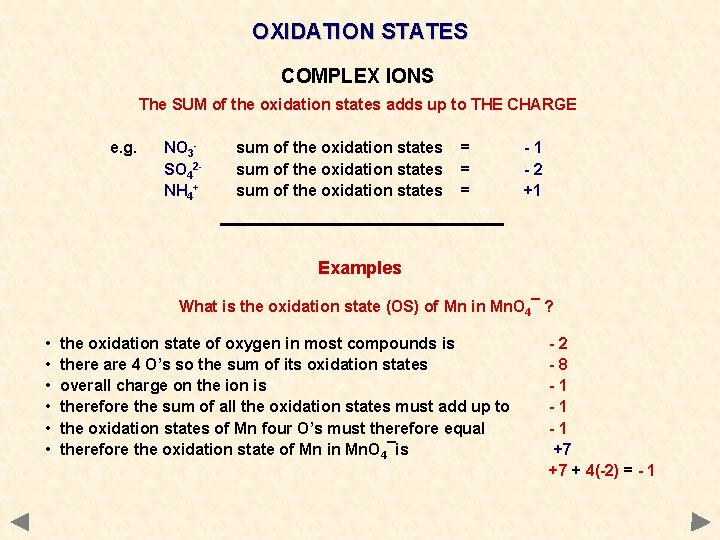
OXIDATION STATES COMPLEX IONS The SUM of the oxidation states adds up to THE CHARGE e. g. NO 3 SO 42 NH 4+ sum of the oxidation states = = = -1 -2 +1 Examples in SO 42 - the oxidation state of S = +6 O = -2 +6 + 4(-2) = -2 there is ONE S there are FOUR O’s so the ion has a 2 - charge
OXIDATION STATES COMPLEX IONS The SUM of the oxidation states adds up to THE CHARGE e. g. NO 3 SO 42 NH 4+ sum of the oxidation states = = = -1 -2 +1 Examples What is the oxidation state (OS) of Mn in Mn. O 4¯ ? • • • the oxidation state of oxygen in most compounds is there are 4 O’s so the sum of its oxidation states overall charge on the ion is therefore the sum of all the oxidation states must add up to the oxidation states of Mn four O’s must therefore equal therefore the oxidation state of Mn in Mn. O 4¯is -2 -8 -1 -1 -1 +7 +7 + 4(-2) = - 1
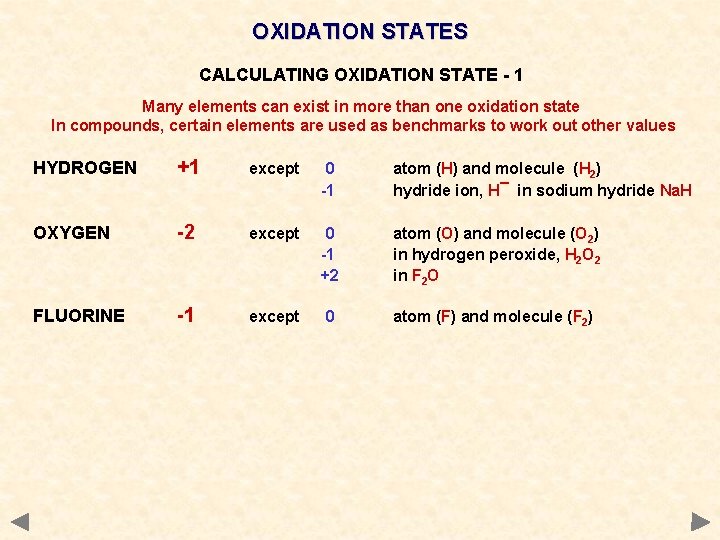
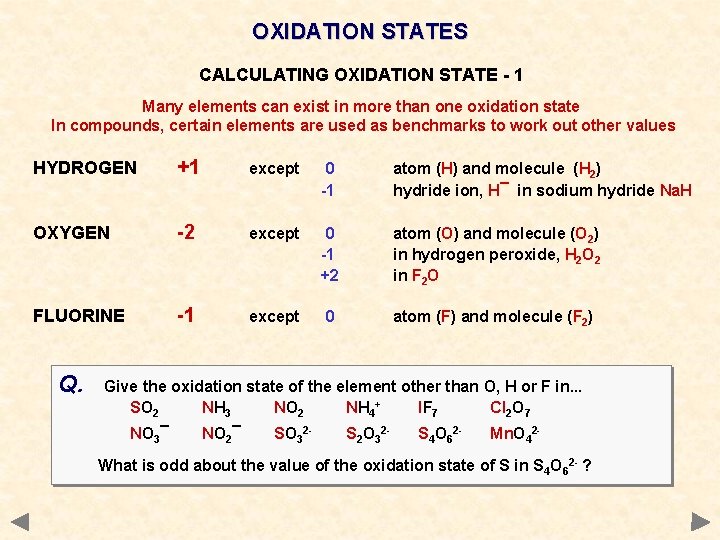
OXIDATION STATES CALCULATING OXIDATION STATE - 1 Many elements can exist in more than one oxidation state In compounds, certain elements are used as benchmarks to work out other values HYDROGEN +1 except 0 -1 atom (H) and molecule (H 2) hydride ion, H¯ in sodium hydride Na. H OXYGEN -2 except 0 -1 +2 atom (O) and molecule (O 2) in hydrogen peroxide, H 2 O 2 in F 2 O FLUORINE -1 except 0 atom (F) and molecule (F 2)
OXIDATION STATES CALCULATING OXIDATION STATE - 1 Many elements can exist in more than one oxidation state In compounds, certain elements are used as benchmarks to work out other values HYDROGEN +1 except 0 -1 atom (H) and molecule (H 2) hydride ion, H¯ in sodium hydride Na. H OXYGEN -2 except 0 -1 +2 atom (O) and molecule (O 2) in hydrogen peroxide, H 2 O 2 in F 2 O FLUORINE -1 except 0 atom (F) and molecule (F 2) Q. Give the oxidation state of the element other than O, H or F in. . . SO 2 NH 3 NO 2 NH 4+ IF 7 Cl 2 O 7 NO 3¯ NO 2¯ SO 32 - S 2 O 32 - S 4 O 62 - Mn. O 42 - What is odd about the value of the oxidation state of S in S 4 O 62 - ?
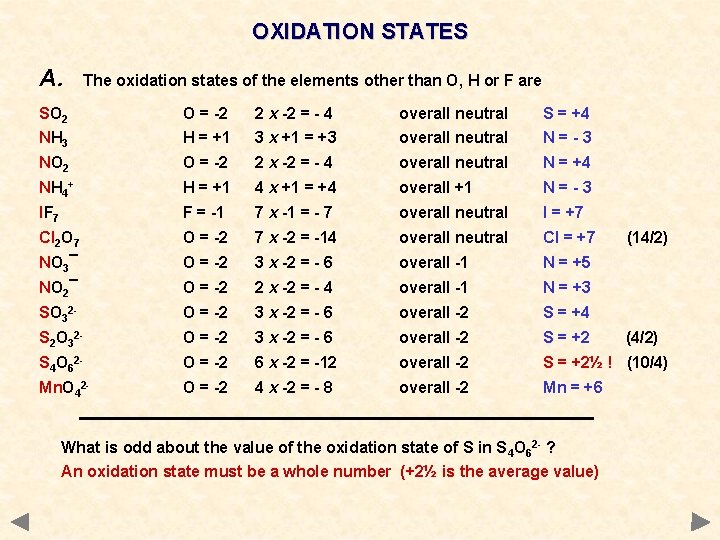
OXIDATION STATES A. The oxidation states of the elements other than O, H or F are SO 2 NH 3 O = -2 H = +1 2 x -2 = - 4 3 x +1 = +3 overall neutral S = +4 N=-3 NO 2 O = -2 2 x -2 = - 4 overall neutral N = +4 NH 4+ H = +1 4 x +1 = +4 overall +1 N=-3 IF 7 F = -1 7 x -1 = - 7 overall neutral I = +7 Cl 2 O 7 O = -2 7 x -2 = -14 overall neutral Cl = +7 NO 3¯ O = -2 3 x -2 = - 6 overall -1 N = +5 NO 2¯ O = -2 2 x -2 = - 4 overall -1 N = +3 SO 32 - O = -2 3 x -2 = - 6 overall -2 S = +4 S 2 O 32 - O = -2 3 x -2 = - 6 overall -2 S = +2 S 4 O 62 - O = -2 6 x -2 = -12 overall -2 S = +2½ ! (10/4) Mn. O 42 - O = -2 4 x -2 = - 8 overall -2 Mn = +6 What is odd about the value of the oxidation state of S in S 4 O 62 - ? An oxidation state must be a whole number (+2½ is the average value) (14/2) (4/2)
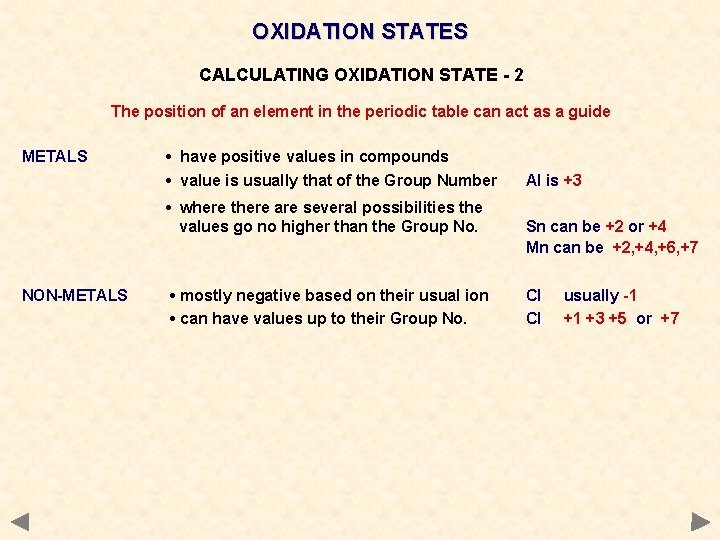
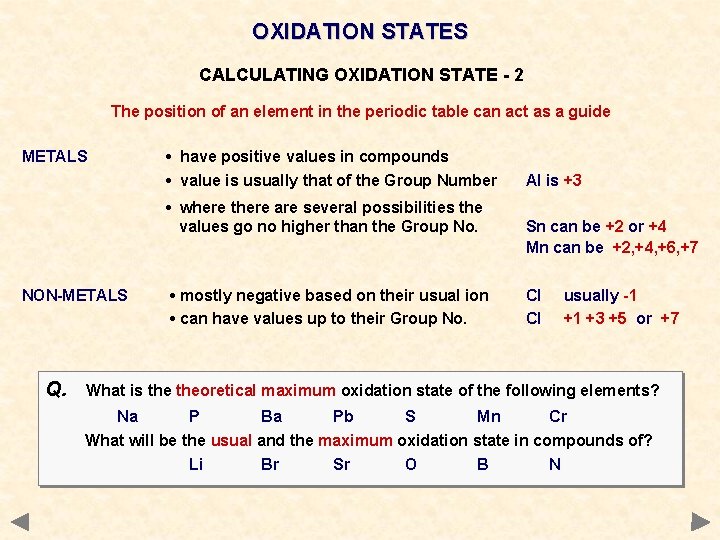
OXIDATION STATES CALCULATING OXIDATION STATE - 2 The position of an element in the periodic table can act as a guide METALS • have positive values in compounds • value is usually that of the Group Number • where there are several possibilities the values go no higher than the Group No. NON-METALS • mostly negative based on their usual ion • can have values up to their Group No. Al is +3 Sn can be +2 or +4 Mn can be +2, +4, +6, +7 Cl Cl usually -1 +1 +3 +5 or +7
OXIDATION STATES CALCULATING OXIDATION STATE - 2 The position of an element in the periodic table can act as a guide METALS • have positive values in compounds • value is usually that of the Group Number • where there are several possibilities the values go no higher than the Group No. NON-METALS Q. • mostly negative based on their usual ion • can have values up to their Group No. Al is +3 Sn can be +2 or +4 Mn can be +2, +4, +6, +7 Cl Cl usually -1 +1 +3 +5 or +7 What is theoretical maximum oxidation state of the following elements? Na P Ba Pb S Mn Cr What will be the usual and the maximum oxidation state in compounds of? Li Br Sr O B N +1
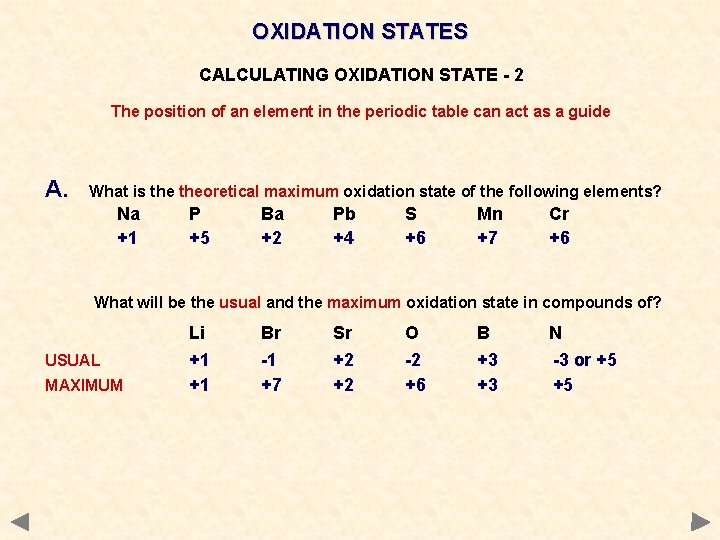
OXIDATION STATES CALCULATING OXIDATION STATE - 2 The position of an element in the periodic table can act as a guide A. What is theoretical maximum oxidation state of the following elements? Na +1 P +5 Ba +2 Pb +4 S +6 Mn +7 Cr +6 What will be the usual and the maximum oxidation state in compounds of? USUAL MAXIMUM Li +1 +1 Br -1 +7 Sr +2 +2 O -2 +6 B +3 +3 N -3 or +5 +5
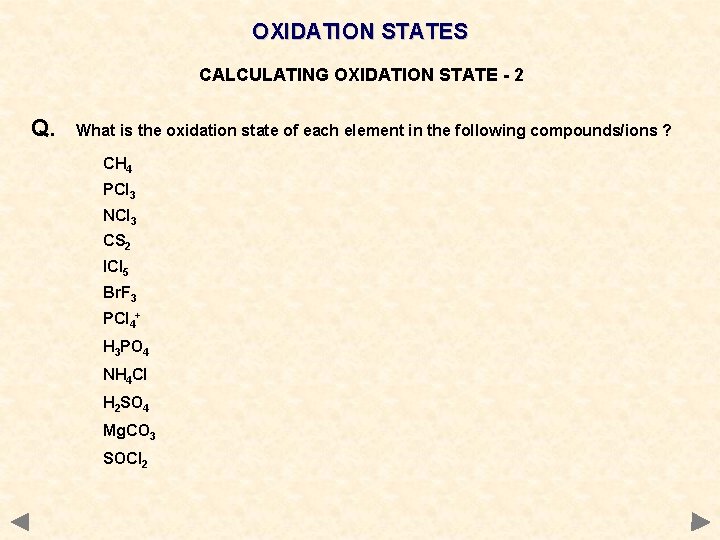
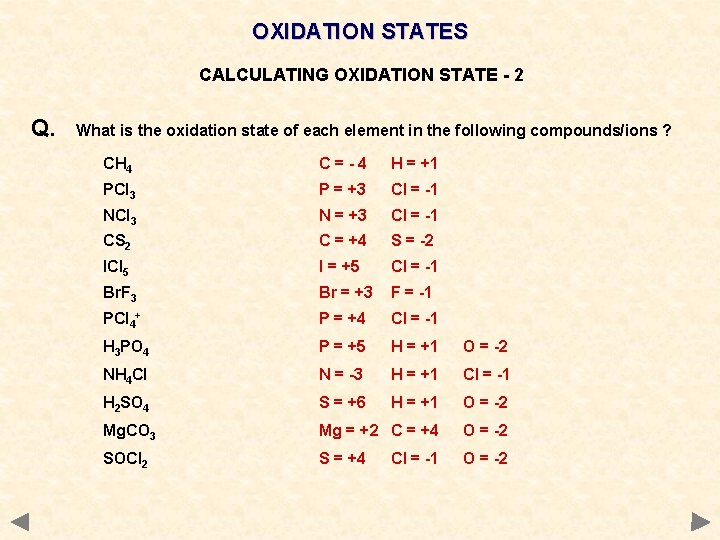
OXIDATION STATES CALCULATING OXIDATION STATE - 2 Q. What is the oxidation state of each element in the following compounds/ions ? CH 4 PCl 3 NCl 3 CS 2 ICl 5 Br. F 3 PCl 4+ H 3 PO 4 NH 4 Cl H 2 SO 4 Mg. CO 3 SOCl 2
OXIDATION STATES CALCULATING OXIDATION STATE - 2 Q. What is the oxidation state of each element in the following compounds/ions ? CH 4 C=-4 H = +1 PCl 3 P = +3 Cl = -1 NCl 3 N = +3 Cl = -1 CS 2 C = +4 S = -2 ICl 5 I = +5 Cl = -1 Br. F 3 Br = +3 F = -1 PCl 4+ P = +4 Cl = -1 H 3 PO 4 P = +5 H = +1 O = -2 NH 4 Cl N = -3 H = +1 Cl = -1 H 2 SO 4 S = +6 H = +1 O = -2 Mg. CO 3 Mg = +2 C = +4 O = -2 SOCl 2 S = +4 O = -2 Cl = -1
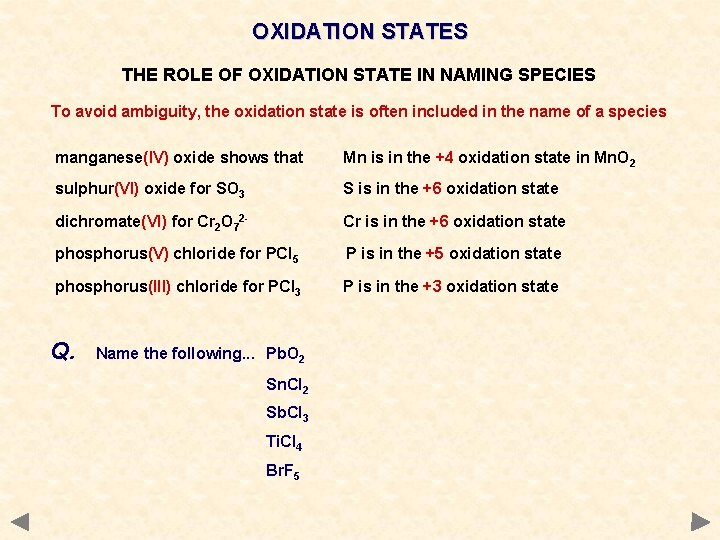
OXIDATION STATES THE ROLE OF OXIDATION STATE IN NAMING SPECIES To avoid ambiguity, the oxidation state is often included in the name of a species manganese(IV) oxide shows that Mn is in the +4 oxidation state in Mn. O 2 sulphur(VI) oxide for SO 3 S is in the +6 oxidation state dichromate(VI) for Cr 2 O 72 - Cr is in the +6 oxidation state phosphorus(V) chloride for PCl 5 P is in the +5 oxidation state phosphorus(III) chloride for PCl 3 P is in the +3 oxidation state Q. Name the following. . . Pb. O 2 Sn. Cl 2 Sb. Cl 3 Ti. Cl 4 Br. F 5
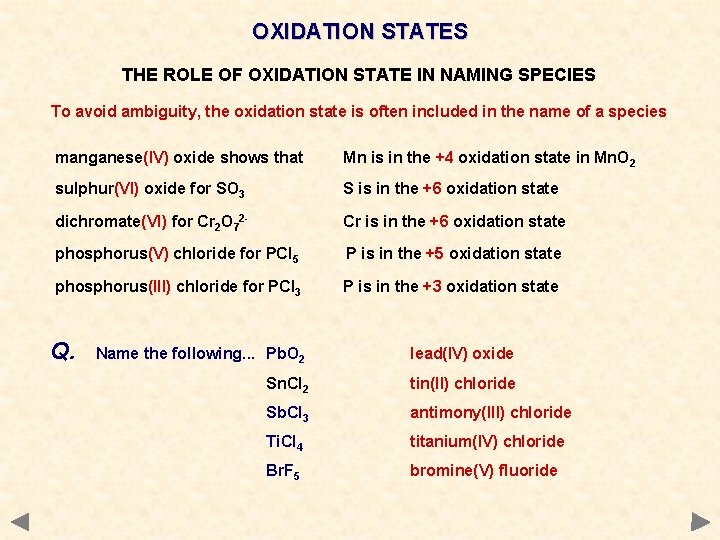
OXIDATION STATES THE ROLE OF OXIDATION STATE IN NAMING SPECIES To avoid ambiguity, the oxidation state is often included in the name of a species manganese(IV) oxide shows that Mn is in the +4 oxidation state in Mn. O 2 sulphur(VI) oxide for SO 3 S is in the +6 oxidation state dichromate(VI) for Cr 2 O 72 - Cr is in the +6 oxidation state phosphorus(V) chloride for PCl 5 P is in the +5 oxidation state phosphorus(III) chloride for PCl 3 P is in the +3 oxidation state Q. Name the following. . . Pb. O 2 lead(IV) oxide Sn. Cl 2 tin(II) chloride Sb. Cl 3 antimony(III) chloride Ti. Cl 4 titanium(IV) chloride Br. F 5 bromine(V) fluoride
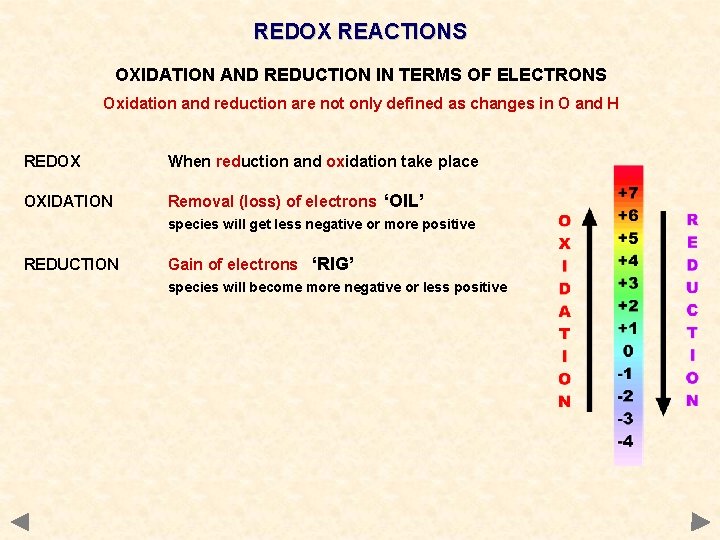
REDOX REACTIONS OXIDATION AND REDUCTION IN TERMS OF ELECTRONS Oxidation and reduction are not only defined as changes in O and H REDOX When reduction and oxidation take place OXIDATION Removal (loss) of electrons ‘OIL’ species will get less negative or more positive REDUCTION Gain of electrons ‘RIG’ species will become more negative or less positive
REDOX REACTIONS OXIDATION AND REDUCTION IN TERMS OF ELECTRONS Oxidation and reduction are not only defined as changes in O and H REDOX When reduction and oxidation take place OXIDATION Removal (loss) of electrons ‘OIL’ species will get less negative or more positive REDUCTION Gain of electrons ‘RIG’ species will become more negative or less positive REDUCTION in O. S. Species has been REDUCED e. g. Cl is reduced to Cl¯ (0 to -1) INCREASE in O. S. Species has been OXIDISED e. g. Na is oxidised to Na+ (0 to +1)
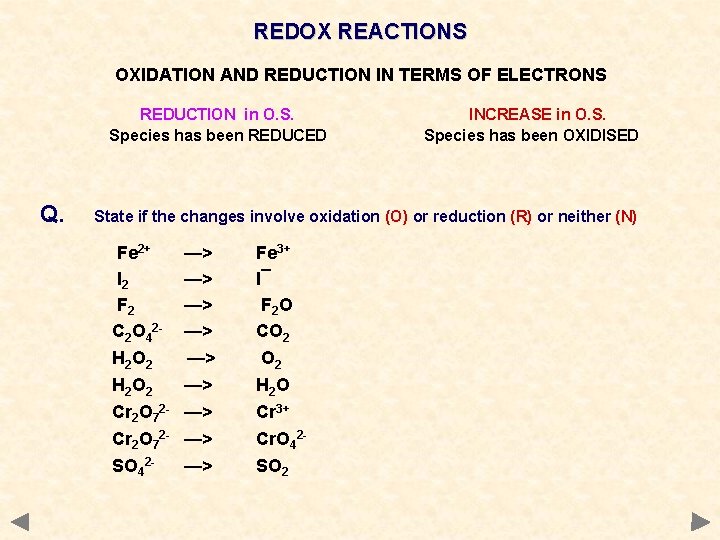
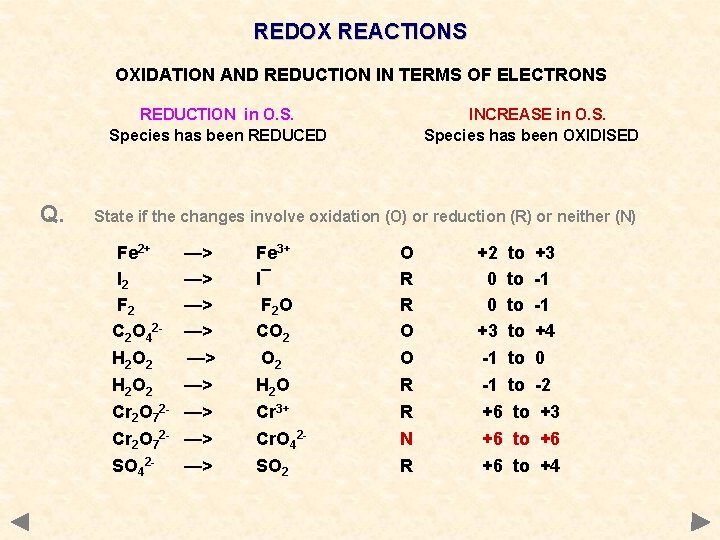
REDOX REACTIONS OXIDATION AND REDUCTION IN TERMS OF ELECTRONS REDUCTION in O. S. Species has been REDUCED Q. INCREASE in O. S. Species has been OXIDISED State if the changes involve oxidation (O) or reduction (R) or neither (N) Fe 2+ I 2 F 2 C 2 O 42 H 2 O 2 Cr 2 O 72 SO 42 - —> —> —> Fe 3+ I¯ F 2 O CO 2 H 2 O Cr 3+ Cr. O 42 SO 2
REDOX REACTIONS OXIDATION AND REDUCTION IN TERMS OF ELECTRONS REDUCTION in O. S. Species has been REDUCED Q. INCREASE in O. S. Species has been OXIDISED State if the changes involve oxidation (O) or reduction (R) or neither (N) Fe 2+ I 2 F 2 C 2 O 42 H 2 O 2 Cr 2 O 72 SO 42 - —> —> —> Fe 3+ I¯ F 2 O CO 2 H 2 O Cr 3+ Cr. O 42 SO 2 O R R O O R R N R +2 to +3 0 to -1 +3 to +4 -1 to 0 -1 to -2 +6 to +3 +6 to +6 +6 to +4
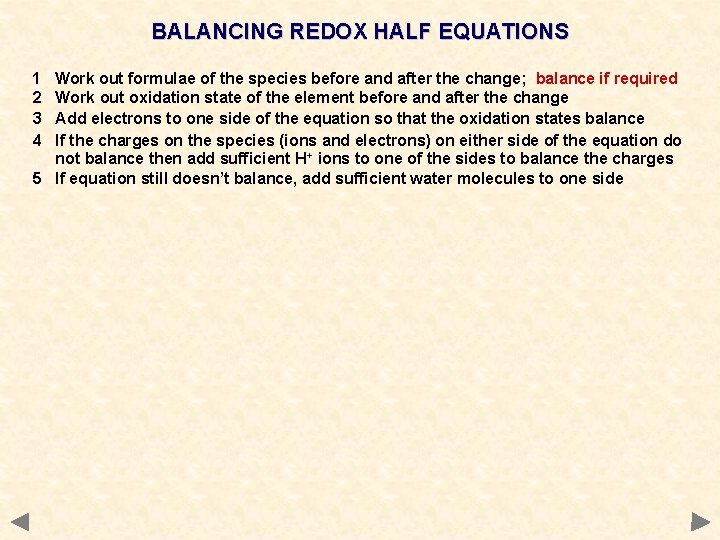
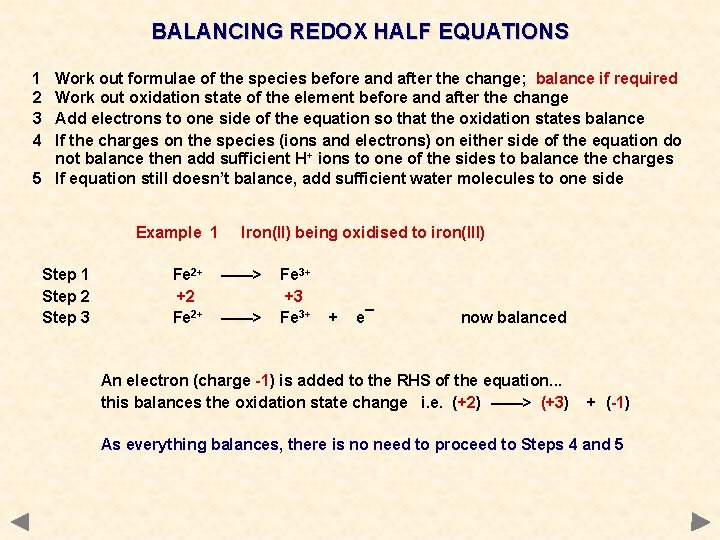
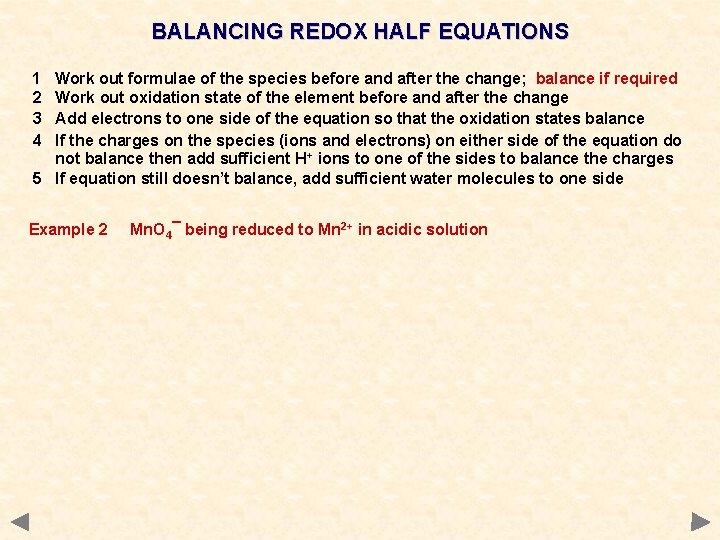
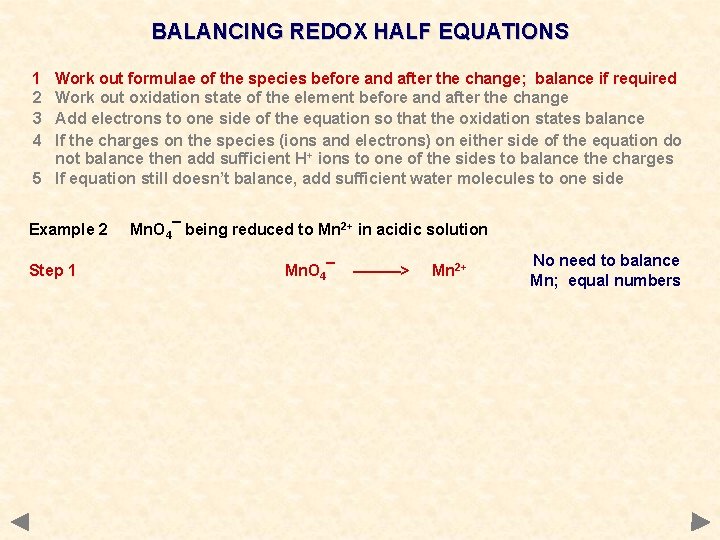
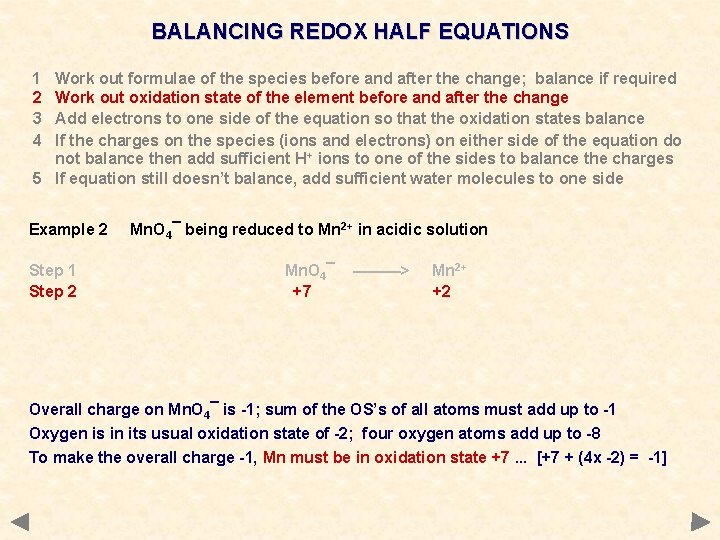
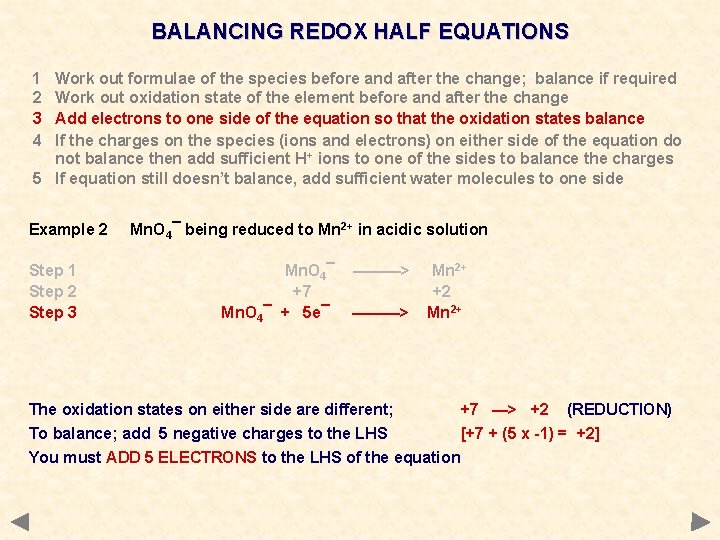
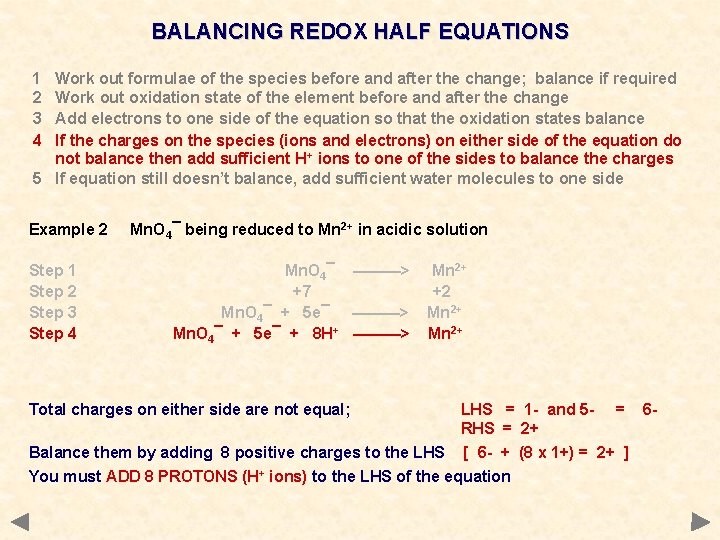
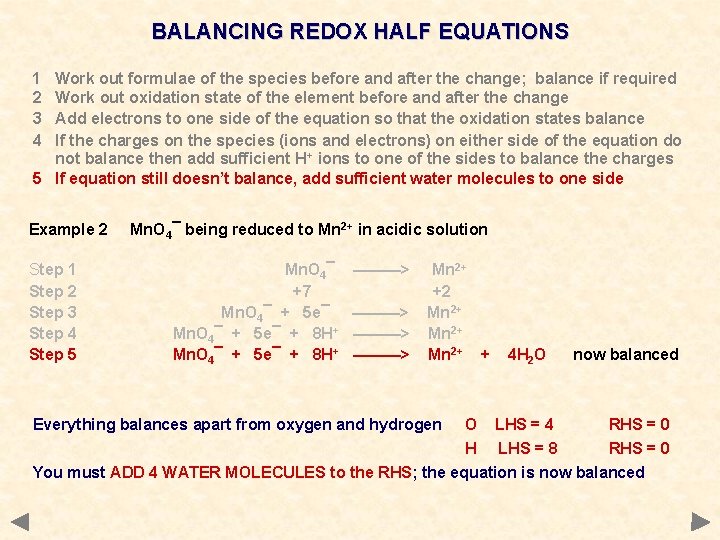
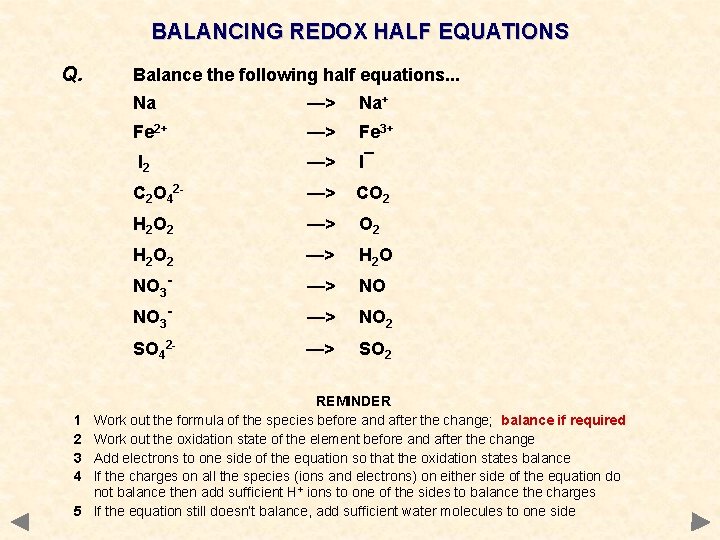
BALANCING REDOX HALF EQUATIONS 1 2 3 4 Work out formulae of the species before and after the change; balance if required Work out oxidation state of the element before and after the change Add electrons to one side of the equation so that the oxidation states balance If the charges on the species (ions and electrons) on either side of the equation do not balance then add sufficient H+ ions to one of the sides to balance the charges 5 If equation still doesn’t balance, add sufficient water molecules to one side
BALANCING REDOX HALF EQUATIONS 1 2 3 4 Work out formulae of the species before and after the change; balance if required Work out oxidation state of the element before and after the change Add electrons to one side of the equation so that the oxidation states balance If the charges on the species (ions and electrons) on either side of the equation do not balance then add sufficient H+ ions to one of the sides to balance the charges 5 If equation still doesn’t balance, add sufficient water molecules to one side Example 1 Step 2 Step 3 Fe 2+ +2 Fe 2+ Iron(II) being oxidised to iron(III) ——> Fe 3+ +3 Fe 3+ + e¯ now balanced An electron (charge -1) is added to the RHS of the equation. . . this balances the oxidation state change i. e. (+2) ——> (+3) + (-1) As everything balances, there is no need to proceed to Steps 4 and 5
BALANCING REDOX HALF EQUATIONS 1 2 3 4 Work out formulae of the species before and after the change; balance if required Work out oxidation state of the element before and after the change Add electrons to one side of the equation so that the oxidation states balance If the charges on the species (ions and electrons) on either side of the equation do not balance then add sufficient H+ ions to one of the sides to balance the charges 5 If equation still doesn’t balance, add sufficient water molecules to one side Example 2 Mn. O 4¯ being reduced to Mn 2+ in acidic solution
BALANCING REDOX HALF EQUATIONS 1 2 3 4 Work out formulae of the species before and after the change; balance if required Work out oxidation state of the element before and after the change Add electrons to one side of the equation so that the oxidation states balance If the charges on the species (ions and electrons) on either side of the equation do not balance then add sufficient H+ ions to one of the sides to balance the charges 5 If equation still doesn’t balance, add sufficient water molecules to one side Example 2 Step 1 Mn. O 4¯ being reduced to Mn 2+ in acidic solution Mn. O 4¯ ———> Mn 2+ No need to balance Mn; equal numbers
BALANCING REDOX HALF EQUATIONS 1 2 3 4 Work out formulae of the species before and after the change; balance if required Work out oxidation state of the element before and after the change Add electrons to one side of the equation so that the oxidation states balance If the charges on the species (ions and electrons) on either side of the equation do not balance then add sufficient H+ ions to one of the sides to balance the charges 5 If equation still doesn’t balance, add sufficient water molecules to one side Example 2 Step 1 Step 2 Mn. O 4¯ being reduced to Mn 2+ in acidic solution Mn. O 4¯ +7 ———> Mn 2+ +2 Overall charge on Mn. O 4¯ is -1; sum of the OS’s of all atoms must add up to -1 Oxygen is in its usual oxidation state of -2; four oxygen atoms add up to -8 To make the overall charge -1, Mn must be in oxidation state +7. . . [+7 + (4 x -2) = -1]
BALANCING REDOX HALF EQUATIONS 1 2 3 4 Work out formulae of the species before and after the change; balance if required Work out oxidation state of the element before and after the change Add electrons to one side of the equation so that the oxidation states balance If the charges on the species (ions and electrons) on either side of the equation do not balance then add sufficient H+ ions to one of the sides to balance the charges 5 If equation still doesn’t balance, add sufficient water molecules to one side Example 2 Step 1 Step 2 Step 3 Mn. O 4¯ being reduced to Mn 2+ in acidic solution Mn. O 4¯ +7 Mn. O 4¯ + 5 e¯ ———> Mn 2+ +2 Mn 2+ The oxidation states on either side are different; +7 —> +2 (REDUCTION) To balance; add 5 negative charges to the LHS [+7 + (5 x -1) = +2] You must ADD 5 ELECTRONS to the LHS of the equation
BALANCING REDOX HALF EQUATIONS 1 2 3 4 Work out formulae of the species before and after the change; balance if required Work out oxidation state of the element before and after the change Add electrons to one side of the equation so that the oxidation states balance If the charges on the species (ions and electrons) on either side of the equation do not balance then add sufficient H+ ions to one of the sides to balance the charges 5 If equation still doesn’t balance, add sufficient water molecules to one side Example 2 Step 1 Step 2 Step 3 Step 4 Mn. O 4¯ being reduced to Mn 2+ in acidic solution Mn. O 4¯ ———> +7 Mn. O 4¯ + 5 e¯ ———> Mn. O 4¯ + 5 e¯ + 8 H+ ———> Mn 2+ +2 Mn 2+ Total charges on either side are not equal; LHS = 1 - and 5 RHS = 2+ Balance them by adding 8 positive charges to the LHS [ 6 - + (8 x 1+) = 2+ ] You must ADD 8 PROTONS (H+ ions) to the LHS of the equation = 6 -
BALANCING REDOX HALF EQUATIONS 1 2 3 4 Work out formulae of the species before and after the change; balance if required Work out oxidation state of the element before and after the change Add electrons to one side of the equation so that the oxidation states balance If the charges on the species (ions and electrons) on either side of the equation do not balance then add sufficient H+ ions to one of the sides to balance the charges 5 If equation still doesn’t balance, add sufficient water molecules to one side Example 2 Step 1 Step 2 Step 3 Step 4 Step 5 Mn. O 4¯ being reduced to Mn 2+ in acidic solution Mn. O 4¯ +7 Mn. O 4¯ + 5 e¯ + 8 H+ ———> Mn 2+ +2 Mn 2+ + Everything balances apart from oxygen and hydrogen 4 H 2 O now balanced O LHS = 4 RHS = 0 H LHS = 8 RHS = 0 You must ADD 4 WATER MOLECULES to the RHS; the equation is now balanced
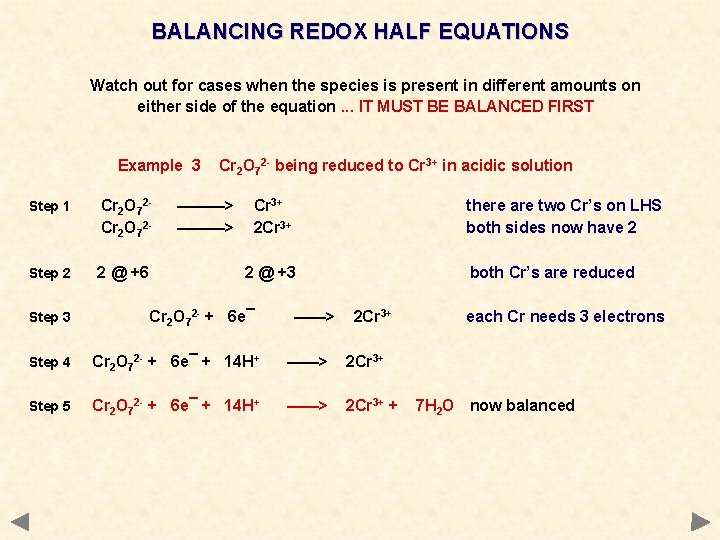
BALANCING REDOX HALF EQUATIONS Watch out for cases when the species is present in different amounts on either side of the equation. . . IT MUST BE BALANCED FIRST Example 3 Step 1 Cr 2 O 72 - Step 2 2 @ +6 Step 3 Cr 2 O 72 - being reduced to Cr 3+ in acidic solution ———> Cr 3+ 2 Cr 3+ there are two Cr’s on LHS both sides now have 2 2 @ +3 Cr 2 O 72 - + 6 e¯ ——> both Cr’s are reduced 2 Cr 3+ Step 4 Cr 2 O 72 - + 6 e¯ + 14 H+ ——> 2 Cr 3+ Step 5 Cr 2 O 72 - + 6 e¯ + 14 H+ ——> 2 Cr 3+ + each Cr needs 3 electrons 7 H 2 O now balanced
BALANCING REDOX HALF EQUATIONS Q. 1 2 3 4 5 Balance the following half equations. . . Na —> Na+ Fe 2+ —> Fe 3+ I 2 —> I¯ C 2 O 42 - —> CO 2 H 2 O 2 —> H 2 O NO 3 - —> NO 2 SO 42 - —> SO 2 REMINDER Work out the formula of the species before and after the change; balance if required Work out the oxidation state of the element before and after the change Add electrons to one side of the equation so that the oxidation states balance If the charges on all the species (ions and electrons) on either side of the equation do not balance then add sufficient H+ ions to one of the sides to balance the charges If the equation still doesn’t balance, add sufficient water molecules to one side
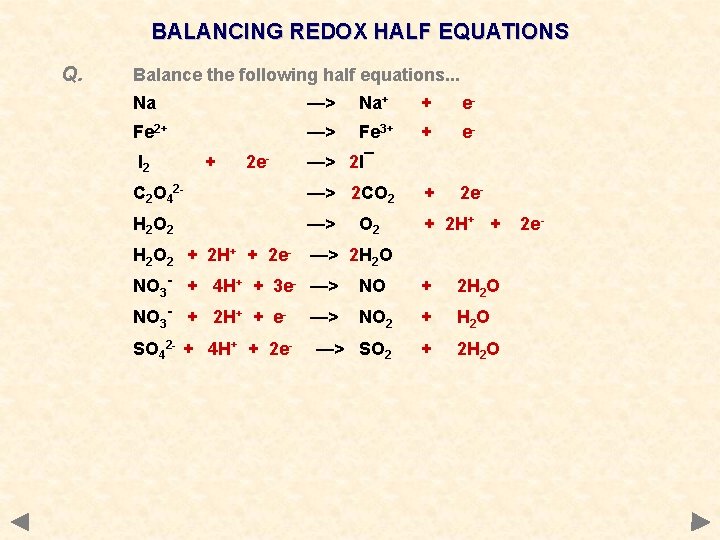
BALANCING REDOX HALF EQUATIONS Q. Balance the following half equations. . . Na —> Na+ + e- Fe 2+ —> Fe 3+ + e 2 e- I 2 + 2 e- —> 2 I¯ C 2 O 42 - —> 2 CO 2 + H 2 O 2 —> + 2 H+ + H 2 O 2 + 2 H+ + 2 e- —> 2 H 2 O O 2 NO 3 - + 4 H+ + 3 e- —> NO + 2 H 2 O NO 3 - + 2 H+ + e- NO 2 + H 2 O —> SO 2 + 2 H 2 O SO 42 - + 4 H+ + 2 e- —> 2 e-
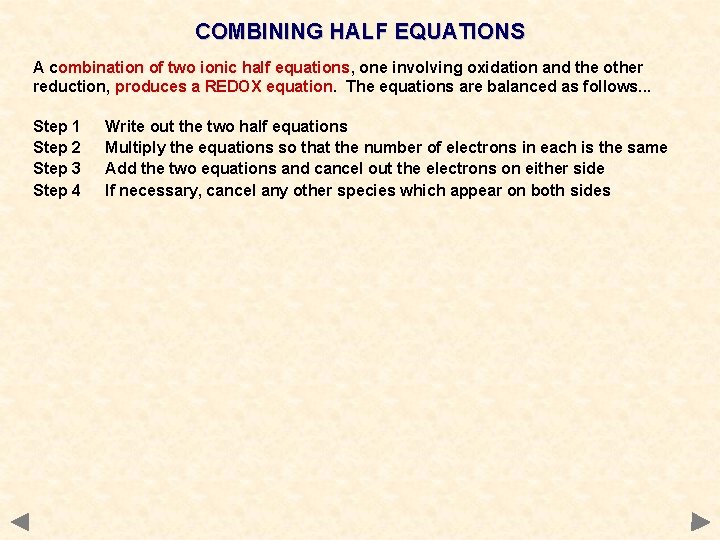
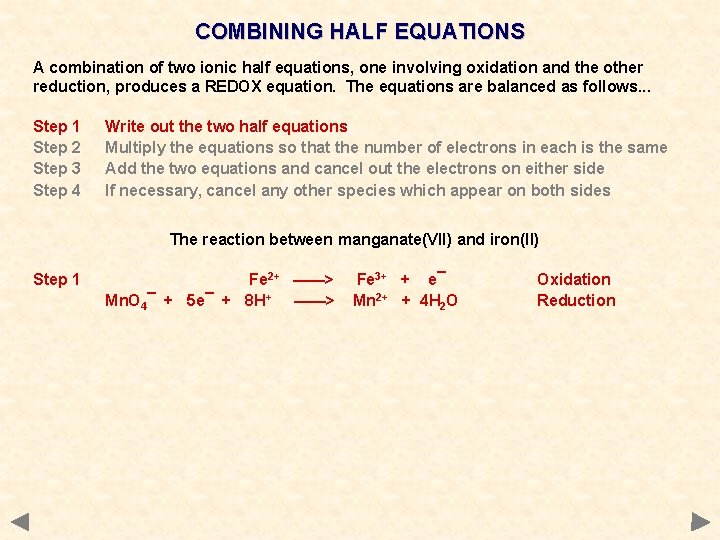
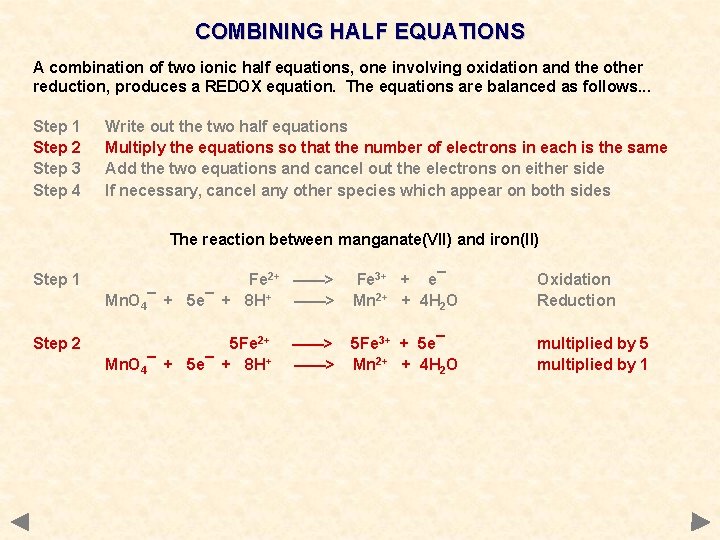
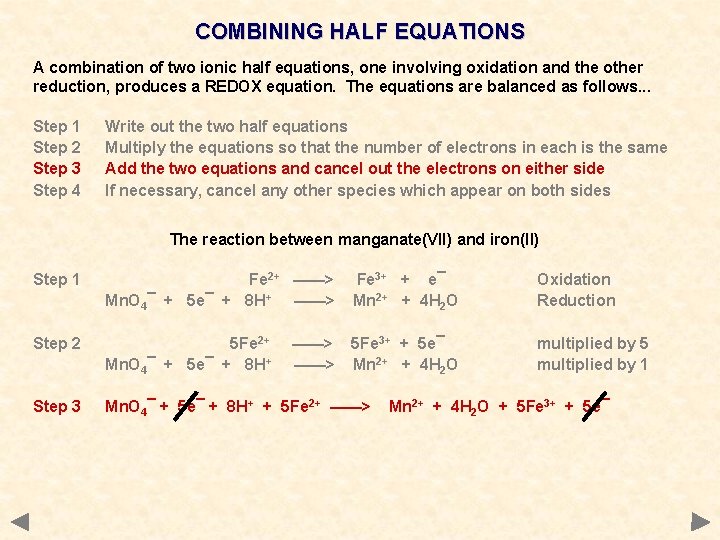
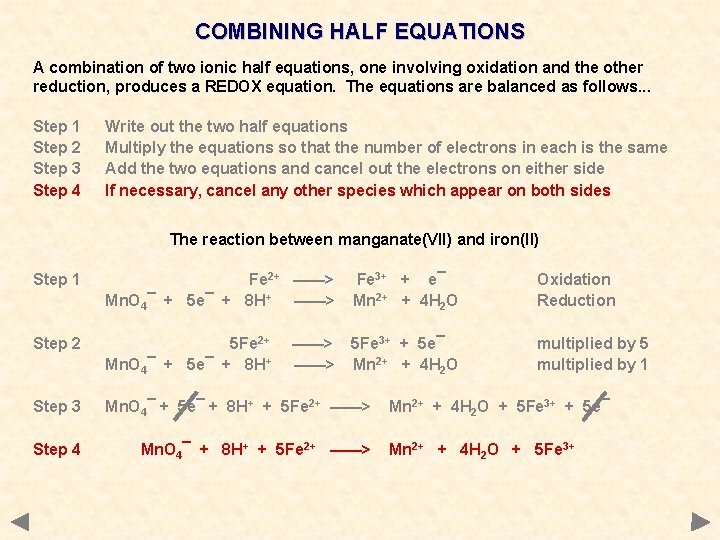
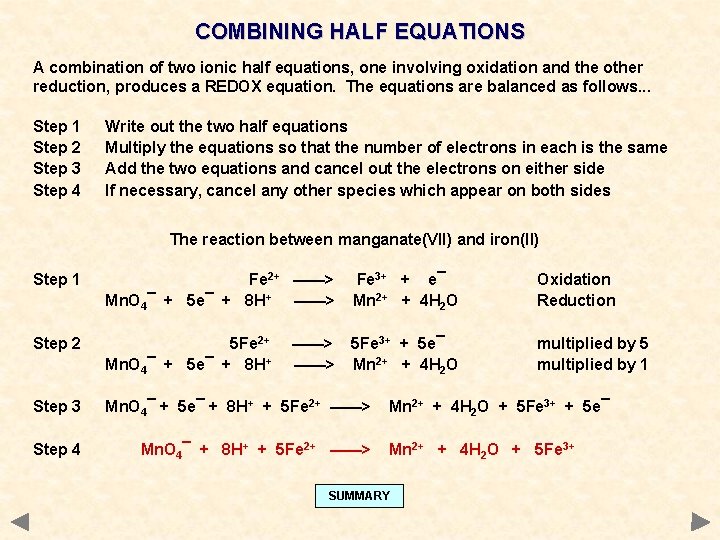
COMBINING HALF EQUATIONS A combination of two ionic half equations, one involving oxidation and the other reduction, produces a REDOX equation. The equations are balanced as follows. . . Step 1 Step 2 Step 3 Step 4 Write out the two half equations Multiply the equations so that the number of electrons in each is the same Add the two equations and cancel out the electrons on either side If necessary, cancel any other species which appear on both sides
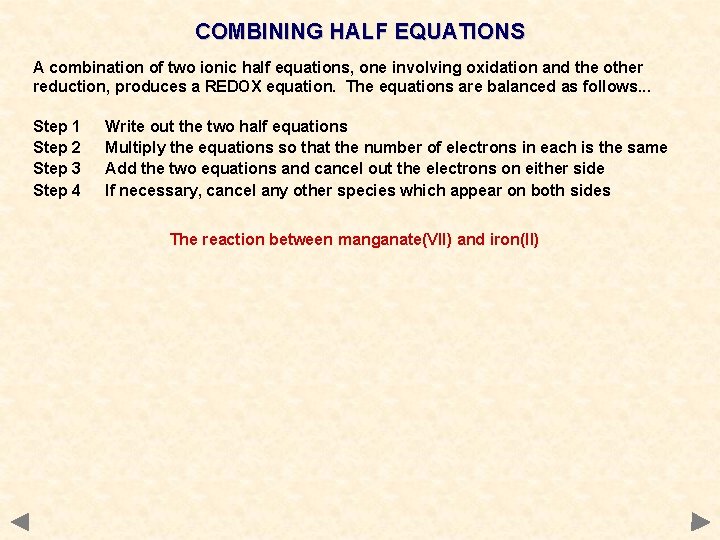
COMBINING HALF EQUATIONS A combination of two ionic half equations, one involving oxidation and the other reduction, produces a REDOX equation. The equations are balanced as follows. . . Step 1 Step 2 Step 3 Step 4 Write out the two half equations Multiply the equations so that the number of electrons in each is the same Add the two equations and cancel out the electrons on either side If necessary, cancel any other species which appear on both sides The reaction between manganate(VII) and iron(II)
COMBINING HALF EQUATIONS A combination of two ionic half equations, one involving oxidation and the other reduction, produces a REDOX equation. The equations are balanced as follows. . . Step 1 Step 2 Step 3 Step 4 Write out the two half equations Multiply the equations so that the number of electrons in each is the same Add the two equations and cancel out the electrons on either side If necessary, cancel any other species which appear on both sides The reaction between manganate(VII) and iron(II) Step 1 Fe 2+ ——> Mn. O 4¯ + 5 e¯ + 8 H+ ——> Fe 3+ + e¯ Mn 2+ + 4 H 2 O Oxidation Reduction
COMBINING HALF EQUATIONS A combination of two ionic half equations, one involving oxidation and the other reduction, produces a REDOX equation. The equations are balanced as follows. . . Step 1 Step 2 Step 3 Step 4 Write out the two half equations Multiply the equations so that the number of electrons in each is the same Add the two equations and cancel out the electrons on either side If necessary, cancel any other species which appear on both sides The reaction between manganate(VII) and iron(II) Step 1 Fe 2+ ——> Mn. O 4¯ + 5 e¯ + 8 H+ ——> Fe 3+ + e¯ Mn 2+ + 4 H 2 O Oxidation Reduction Step 2 5 Fe 2+ Mn. O 4¯ + 5 e¯ + 8 H+ 5 Fe 3+ + 5 e¯ Mn 2+ + 4 H 2 O multiplied by 5 multiplied by 1 ——>
COMBINING HALF EQUATIONS A combination of two ionic half equations, one involving oxidation and the other reduction, produces a REDOX equation. The equations are balanced as follows. . . Step 1 Step 2 Step 3 Step 4 Write out the two half equations Multiply the equations so that the number of electrons in each is the same Add the two equations and cancel out the electrons on either side If necessary, cancel any other species which appear on both sides The reaction between manganate(VII) and iron(II) Step 1 Fe 2+ ——> Mn. O 4¯ + 5 e¯ + 8 H+ ——> Fe 3+ + e¯ Mn 2+ + 4 H 2 O Oxidation Reduction Step 2 5 Fe 2+ Mn. O 4¯ + 5 e¯ + 8 H+ 5 Fe 3+ + 5 e¯ Mn 2+ + 4 H 2 O multiplied by 5 multiplied by 1 Step 3 Mn. O 4¯ + 5 e¯ + 8 H+ + 5 Fe 2+ ——> ——> Mn 2+ + 4 H 2 O + 5 Fe 3+ + 5 e¯
COMBINING HALF EQUATIONS A combination of two ionic half equations, one involving oxidation and the other reduction, produces a REDOX equation. The equations are balanced as follows. . . Step 1 Step 2 Step 3 Step 4 Write out the two half equations Multiply the equations so that the number of electrons in each is the same Add the two equations and cancel out the electrons on either side If necessary, cancel any other species which appear on both sides The reaction between manganate(VII) and iron(II) Step 1 Fe 2+ ——> Mn. O 4¯ + 5 e¯ + 8 H+ ——> Fe 3+ + e¯ Mn 2+ + 4 H 2 O Oxidation Reduction Step 2 5 Fe 2+ Mn. O 4¯ + 5 e¯ + 8 H+ 5 Fe 3+ + 5 e¯ Mn 2+ + 4 H 2 O multiplied by 5 multiplied by 1 Step 3 Mn. O 4¯ + 5 e¯ + 8 H+ + 5 Fe 2+ ——> Step 4 Mn. O 4¯ + 8 H+ + 5 Fe 2+ ——> ——> Mn 2+ + 4 H 2 O + 5 Fe 3+ + 5 e¯ Mn 2+ + 4 H 2 O + 5 Fe 3+
COMBINING HALF EQUATIONS A combination of two ionic half equations, one involving oxidation and the other reduction, produces a REDOX equation. The equations are balanced as follows. . . Step 1 Step 2 Step 3 Step 4 Write out the two half equations Multiply the equations so that the number of electrons in each is the same Add the two equations and cancel out the electrons on either side If necessary, cancel any other species which appear on both sides The reaction between manganate(VII) and iron(II) Step 1 Fe 2+ ——> Mn. O 4¯ + 5 e¯ + 8 H+ ——> Fe 3+ + e¯ Mn 2+ + 4 H 2 O Oxidation Reduction Step 2 5 Fe 2+ Mn. O 4¯ + 5 e¯ + 8 H+ 5 Fe 3+ + 5 e¯ Mn 2+ + 4 H 2 O multiplied by 5 multiplied by 1 Step 3 Mn. O 4¯ + 5 e¯ + 8 H+ + 5 Fe 2+ ——> Step 4 Mn. O 4¯ + 8 H+ + 5 Fe 2+ ——> ——> Mn 2+ + 4 H 2 O + 5 Fe 3+ + 5 e¯ Mn 2+ + 4 H 2 O + 5 Fe 3+ SUMMARY
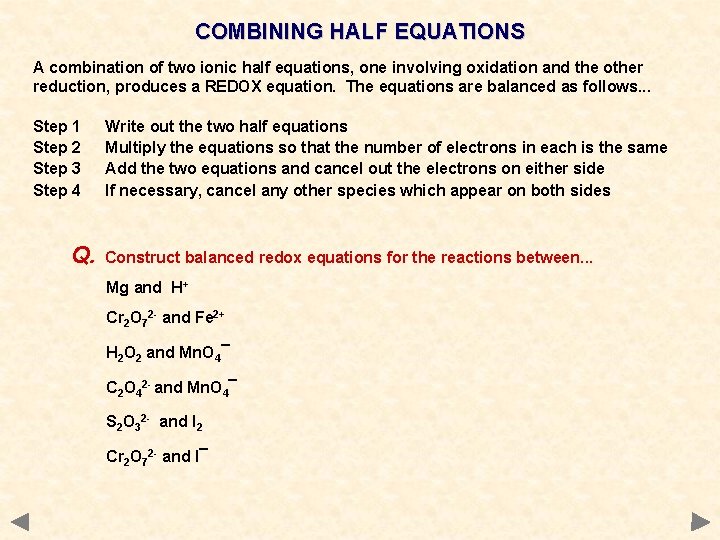
COMBINING HALF EQUATIONS A combination of two ionic half equations, one involving oxidation and the other reduction, produces a REDOX equation. The equations are balanced as follows. . . Step 1 Step 2 Step 3 Step 4 Q. Write out the two half equations Multiply the equations so that the number of electrons in each is the same Add the two equations and cancel out the electrons on either side If necessary, cancel any other species which appear on both sides Construct balanced redox equations for the reactions between. . . Mg and H+ Cr 2 O 72 - and Fe 2+ H 2 O 2 and Mn. O 4¯ C 2 O 42 - and Mn. O 4¯ S 2 O 32 - and I 2 Cr 2 O 72 - and I¯
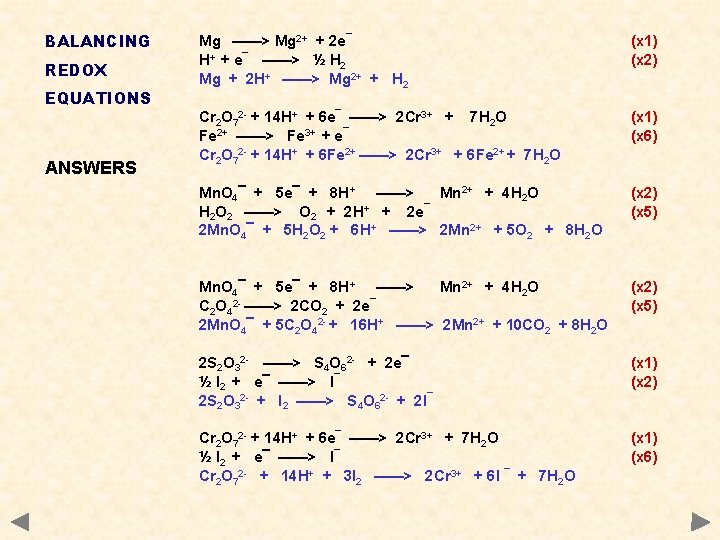
BALANCING REDOX EQUATIONS ANSWERS Mg ——> Mg 2+ + 2 e¯ H+ + e¯ ——> ½ H 2 Mg + 2 H+ ——> Mg 2+ + H 2 (x 1) (x 2) Cr 2 O 72 - + 14 H+ + 6 e¯ ——> 2 Cr 3+ + 7 H 2 O Fe 2+ ——> Fe 3+ + e¯ Cr 2 O 72 - + 14 H+ + 6 Fe 2+ ——> 2 Cr 3+ + 6 Fe 2+ + 7 H 2 O (x 1) (x 6) Mn. O 4¯ + 5 e¯ + 8 H+ ——> Mn 2+ + 4 H 2 O 2 ——> O 2 + 2 H+ + 2 e¯ 2 Mn. O 4¯ + 5 H 2 O 2 + 6 H+ ——> 2 Mn 2+ + 5 O 2 + 8 H 2 O (x 2) (x 5) Mn. O 4¯ + 5 e¯ + 8 H+ ——> Mn 2+ + 4 H 2 O C 2 O 42 - ——> 2 CO 2 + 2 e¯ 2 Mn. O 4¯ + 5 C 2 O 42 - + 16 H+ ——> 2 Mn 2+ + 10 CO 2 + 8 H 2 O (x 2) (x 5) 2 S 2 O 32 - ——> S 4 O 62 - + 2 e¯ ½ I 2 + e¯ ——> I¯ 2 S 2 O 32 - + I 2 ——> S 4 O 62 - + 2 I¯ (x 1) (x 2) Cr 2 O 72 - + 14 H+ + 6 e¯ ——> 2 Cr 3+ + 7 H 2 O ½ I 2 + e¯ ——> I¯ Cr 2 O 72 - + 14 H+ + 3 I 2 ——> 2 Cr 3+ + 6 I ¯ + 7 H 2 O (x 1) (x 6)
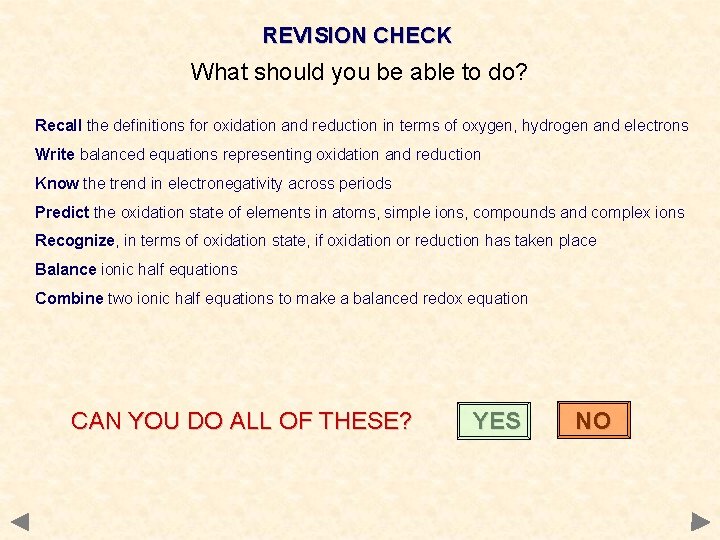
REVISION CHECK What should you be able to do? Recall the definitions for oxidation and reduction in terms of oxygen, hydrogen and electrons Write balanced equations representing oxidation and reduction Know the trend in electronegativity across periods Predict the oxidation state of elements in atoms, simple ions, compounds and complex ions Recognize, in terms of oxidation state, if oxidation or reduction has taken place Balance ionic half equations Combine two ionic half equations to make a balanced redox equation CAN YOU DO ALL OF THESE? YES NO
You need to go over the relevant topic(s) again Click on the button to return to the menu
WELL DONE! Try some past paper questions
REDOX THE END © 2008 JONATHAN HOPTON & KNOCKHARDY PUBLISHING