
Redlining Minnesota America HISTORY AND EFFECTS OF REDLINING

- Slides: 12
Redlining: Minnesota & America HISTORY AND EFFECTS OF REDLINING POLICIES
Segregation - Defined
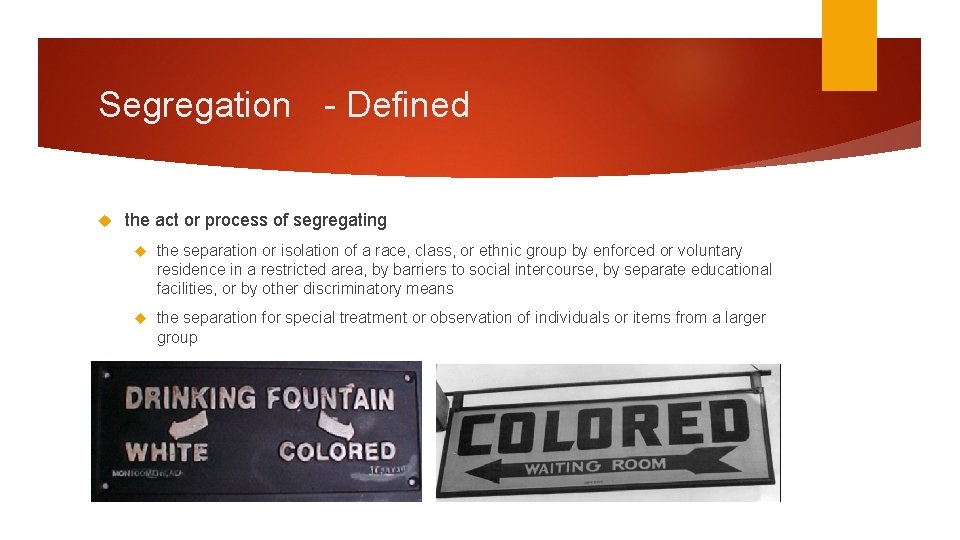
Segregation - Defined the act or process of segregating the separation or isolation of a race, class, or ethnic group by enforced or voluntary residence in a restricted area, by barriers to social intercourse, by separate educational facilities, or by other discriminatory means the separation for special treatment or observation of individuals or items from a larger group
Redlining - Defined
Redlining - Defined To withhold home-loan funds or insurance from neighborhoods considered poor economic risks To discriminate against in housing or insurance The literal drawing of red lines around minority-dominated neighborhoods by the FHA to prevent African-American and other minorities from owning homes. This practice is responsible for much of the residential segregation we experience in our urban neighborhoods today
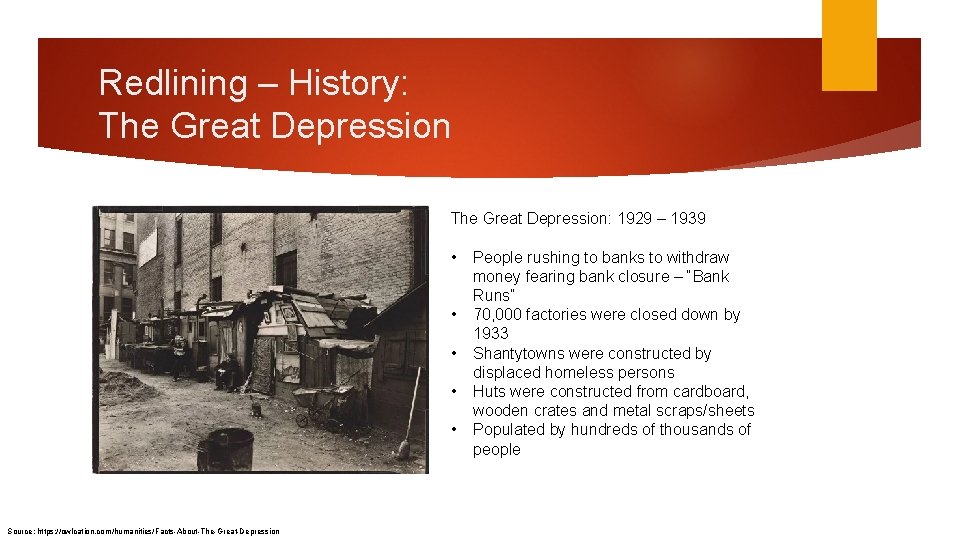
Redlining – History: The Great Depression: 1929 – 1939 • • • Source: https: //owlcation. com/humanities/Facts-About-The-Great-Depression People rushing to banks to withdraw money fearing bank closure – “Bank Runs” 70, 000 factories were closed down by 1933 Shantytowns were constructed by displaced homeless persons Huts were constructed from cardboard, wooden crates and metal scraps/sheets Populated by hundreds of thousands of people
Redlining - History Housing Shortage in 1933: FDR believed home ownership was the greatest thing Americans could do to ensure lasting economic security – Created Agencies to oversee housing reform: Home Owners’ Loan Corporation (HOLC) in 1933 to prevent foreclosures and Federal Housing Administration (FHA) in 1934 to standardize quality construction and insure loans for home building Federal Government created program to increase available housing in “suburbs” – Urban Renewal became theme Specifically for white, middle-class, and lower-middle-class families African-Americans and other people of color were left out of the new suburban communities — and pushed instead into urban housing projects. Anywhere African-Americans lived, or lived nearby, were colored to indicate to appraisers that these neighborhoods were too risky to insure mortgages. Source: https: //www. npr. org/2017/05/03/526655831/a-forgotten-history-of-how-the-u-s-government-segregated-america https: //study. com/academy/lesson/redlining-racism-in-housing-policies-during-the-new-deal-era. html
Redlining - History Federal Housing Administration – Created in 1934 Refused to insure mortgages in and near African-American neighborhoods “Incompatible racial groups should not be permitted to live in the same communities. ” Subsidizing builders who were mass-producing entire subdivisions for whites Builders would receive government assistance to build these suburban subdivisions with the agreement that none of the homes could be sold to African Americans Idea was if African-Americans were to buy homes in all-white neighborhoods, or even close to them, it would devalue the white property Was “banned” with Civil Rights Act of 1968 – however banks in the Twin Cities have been consistently lending more readily and on fairer terms to white borrowers, and to borrowers for loans on properties in predominantly white neighborhoods. Source: https: //www. npr. org/2017/05/03/526655831/a-forgotten-history-of-how-the-u-s-government-segregated-america https: //www. tcdailyplanet. net/redlining-hurting-twin-cities/ https: //www. npr. org/2017/05/03/526655831/a-forgotten-history-of-how-the-u-s-government-segregated-america
Redlining – Effects "Neighborhoods where black people lived were rated "D" and were usually considered ineligible for FHA backing. Black people were viewed as a contagion. Redlining went beyond FHA-backed loans and spread to the entire mortgage industry, which was already rife with racism, excluding black people from most legitimate means of obtaining a mortgage. “ “Without access to FHA-insured mortgages, black families who sought homeownership were forced to turn to predatory and abusive lenders. ” – Ta-Nehisi Coates The Atlantic Source: https: //www. mprnews. org/story/2016/10/20/npr-interactive-redlining-map-history-discrimination
Redlining – Effects Modern Segregated Metropolitan Areas Think of how this effects you in Minnesota and/or St. Paul… What does your neighborhood look like? What do your classrooms and school look like? Do you think all schools look like this? Families are less likely to experience upward mobility when they’re living in segregated neighborhoods where opportunity is absent Growing wealth gaps – Generational wealth builds for the privileged Majority of neighborhoods marked “hazardous” by the federal Home Owners’ Loan Corp. from 1935 to 1939 are today much more likely than other areas to comprise lower-income, minority residents. 91 percent of areas classified as “best” in the 1930 s remain middle-to-upper-income today, and 85 percent of them are still predominantly white. https: //www. npr. org/2017/05/03/526655831/a-forgotten-history-of-how-the-u-s-government-segregated-america https: //www. washingtonpost. com/news/wonk/wp/2018/03/28/redlining-was-banned-50 -years-ago-its-still-hurting-minorities-today/? noredirect=on&utm_term=. d 79884282 e 4 a
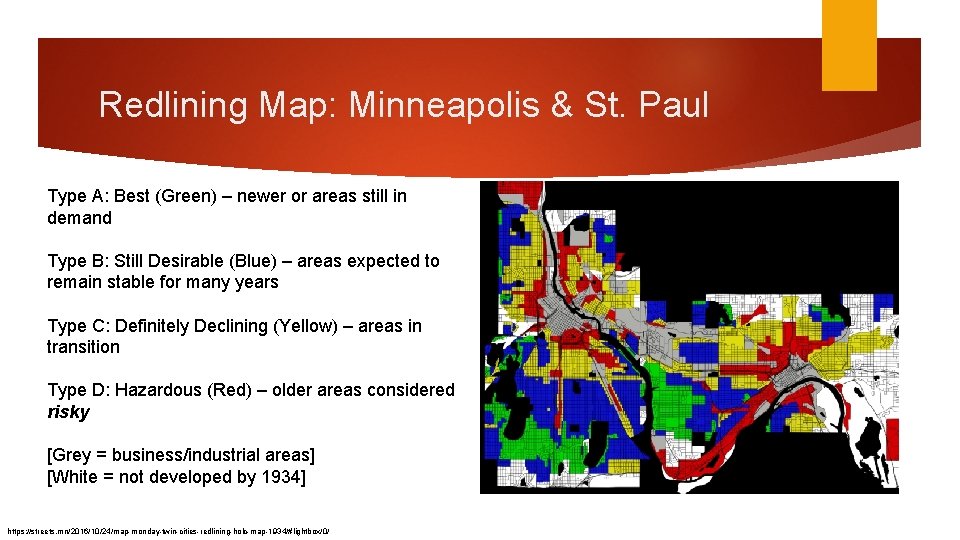
Redlining Map: Minneapolis & St. Paul Type A: Best (Green) – newer or areas still in demand Type B: Still Desirable (Blue) – areas expected to remain stable for many years Type C: Definitely Declining (Yellow) – areas in transition Type D: Hazardous (Red) – older areas considered risky [Grey = business/industrial areas] [White = not developed by 1934] https: //streets. mn/2016/10/24/map-monday-twin-cities-redlining-holc-map-1934/#lightbox/0/
Redlining Example – Saint Paul, MN Rondo Neighborhood 1950 s – 85% of St. Paul’s Black population lived south of University Ave, just west of Downtown. This meant the neighborhood was a “Red” neighborhood. I-94 was intentionally built right through the Rondo neighborhood. Was originally planned to go through the University Ave, but the neighborhood was primarily inhabited by University of Minnesota Professors and students, and residents protested. Instead, the developers moved to the Rondo neighborhood, whose residents were either unable to protest or their protests went unheard Thousands of Rondo residents were displaced into the segregated and discriminatory housing market of the Twin Cities Minnesota Stories: Remember Rondo Forced Out - The Rondo Neighborhood Source: http: //www. rubiconline. com/redlining-leaves-indelible-mark-on-twin-cities/