
Redheaded Flea Beetles Phenology Indicators A Lianmarie Colon
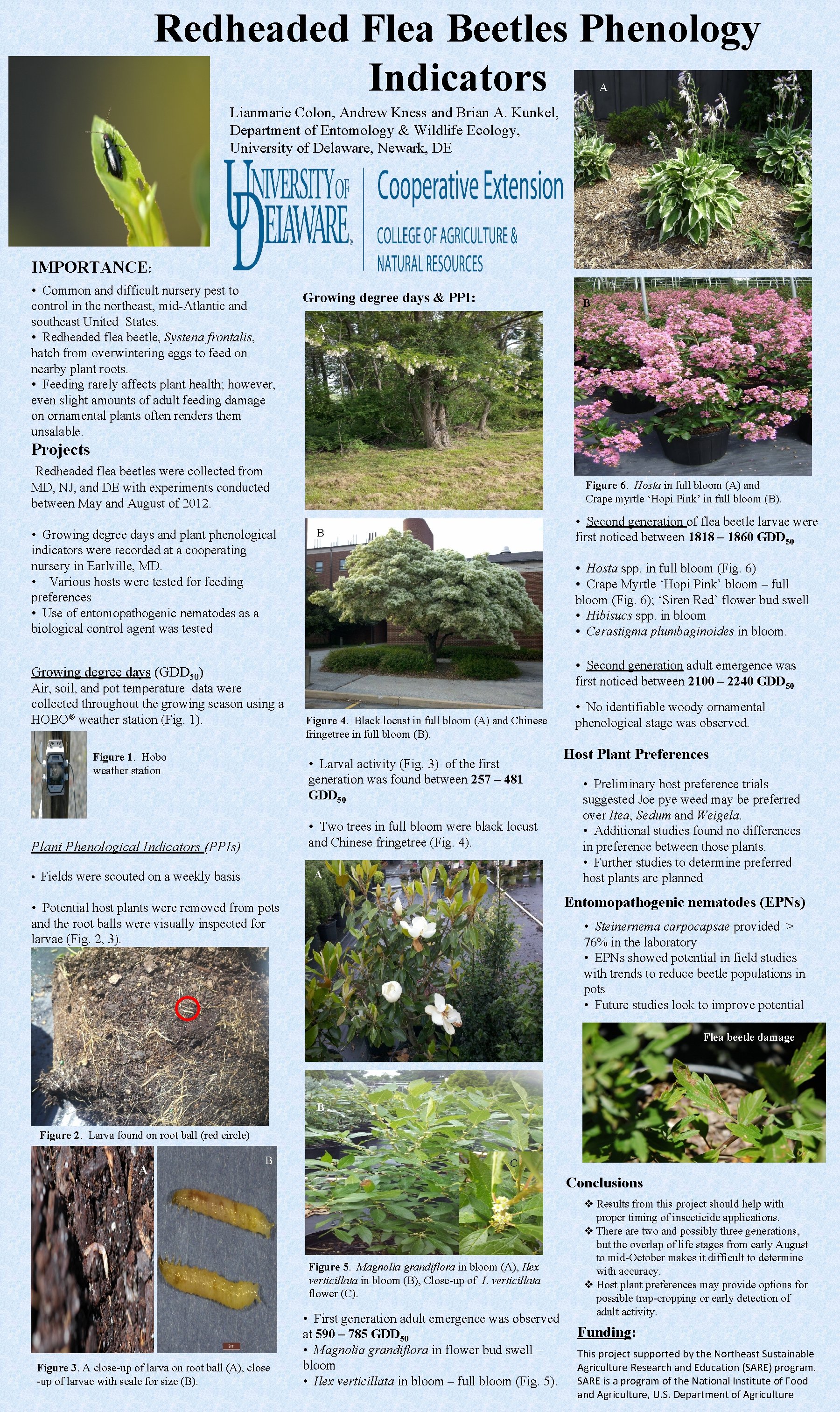
Redheaded Flea Beetles Phenology Indicators A Lianmarie Colon, Andrew Kness and Brian A. Kunkel, Department of Entomology & Wildlife Ecology, University of Delaware, Newark, DE IMPORTANCE: • Common and difficult nursery pest to control in the northeast, mid-Atlantic and southeast United States. • Redheaded flea beetle, Systena frontalis, hatch from overwintering eggs to feed on nearby plant roots. • Feeding rarely affects plant health; however, even slight amounts of adult feeding damage on ornamental plants often renders them unsalable. Growing degree days & PPI: B A Projects Redheaded flea beetles were collected from MD, NJ, and DE with experiments conducted between May and August of 2012. • Growing degree days and plant phenological indicators were recorded at a cooperating nursery in Earlville, MD. • Various hosts were tested for feeding preferences • Use of entomopathogenic nematodes as a biological control agent was tested Figure 6. Hosta in full bloom (A) and Crape myrtle ‘Hopi Pink’ in full bloom (B). • Second generation of flea beetle larvae were first noticed between 1818 – 1860 GDD 50 B • Hosta spp. in full bloom (Fig. 6) • Crape Myrtle ‘Hopi Pink’ bloom – full bloom (Fig. 6); ‘Siren Red’ flower bud swell • Hibisucs spp. in bloom • Cerastigma plumbaginoides in bloom. • Second generation adult emergence was first noticed between 2100 – 2240 GDD 50 Growing degree days (GDD 50) Air, soil, and pot temperature data were collected throughout the growing season using a HOBO® weather station (Fig. 1). Figure 1. Hobo weather station Figure 4. Black locust in full bloom (A) and Chinese fringetree in full bloom (B). • Larval activity (Fig. 3) of the first generation was found between 257 – 481 GDD 50 • Two trees in full bloom were black locust and Chinese fringetree (Fig. 4). Plant Phenological Indicators (PPIs) A • Fields were scouted on a weekly basis • No identifiable woody ornamental phenological stage was observed. Host Plant Preferences • Preliminary host preference trials suggested Joe pye weed may be preferred over Itea, Sedum and Weigela. • Additional studies found no differences in preference between those plants. • Further studies to determine preferred host plants are planned Entomopathogenic nematodes (EPNs) • Potential host plants were removed from pots and the root balls were visually inspected for larvae (Fig. 2, 3). • Steinernema carpocapsae provided > 76% in the laboratory • EPNs showed potential in field studies with trends to reduce beetle populations in pots • Future studies look to improve potential Flea beetle damage B Figure 2. Larva found on root ball (red circle) A B C Conclusions Figure 5. Magnolia grandiflora in bloom (A), Ilex verticillata in bloom (B), Close-up of I. verticillata flower (C). Figure 3. A close-up of larva on root ball (A), close -up of larvae with scale for size (B). • First generation adult emergence was observed at 590 – 785 GDD 50 • Magnolia grandiflora in flower bud swell – bloom • Ilex verticillata in bloom – full bloom (Fig. 5). v Results from this project should help with proper timing of insecticide applications. v There are two and possibly three generations, but the overlap of life stages from early August to mid-October makes it difficult to determine with accuracy. v Host plant preferences may provide options for possible trap-cropping or early detection of adult activity. Funding: This project supported by the Northeast Sustainable Agriculture Research and Education (SARE) program. SARE is a program of the National Institute of Food and Agriculture, U. S. Department of Agriculture
- Slides: 1