
RedBlack Trees v 6 8 3 4 2162022
Red-Black Trees v 6 8 3 4 2/16/2022 Red-Black Trees z 1
Outline and Reading From (2, 4) trees to red-black trees (§ 3. 3. 3) Red-black tree (§ 3. 3. 3) n n n Definition Height Insertion w restructuring w recoloring n Deletion w restructuring w recoloring w adjustment 2/16/2022 Red-Black Trees 2
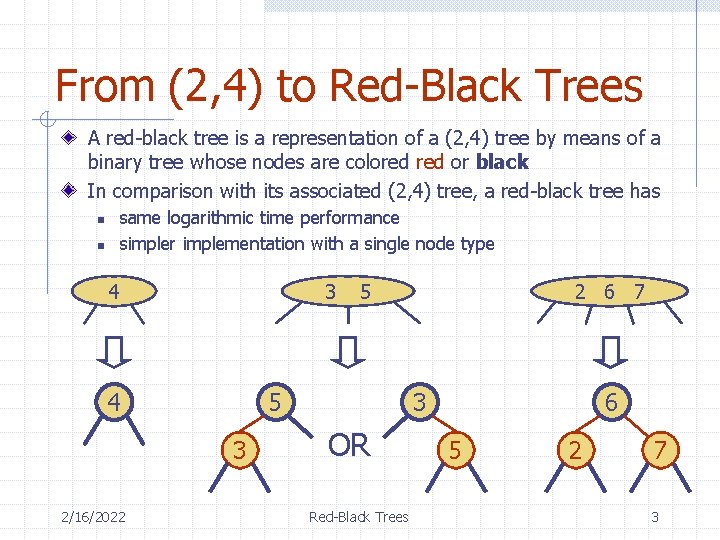
From (2, 4) to Red-Black Trees A red-black tree is a representation of a (2, 4) tree by means of a binary tree whose nodes are colored or black In comparison with its associated (2, 4) tree, a red-black tree has same logarithmic time performance simpler implementation with a single node type n n 4 3 4 5 3 2/16/2022 5 2 6 7 3 OR Red-Black Trees 6 5 2 7 3
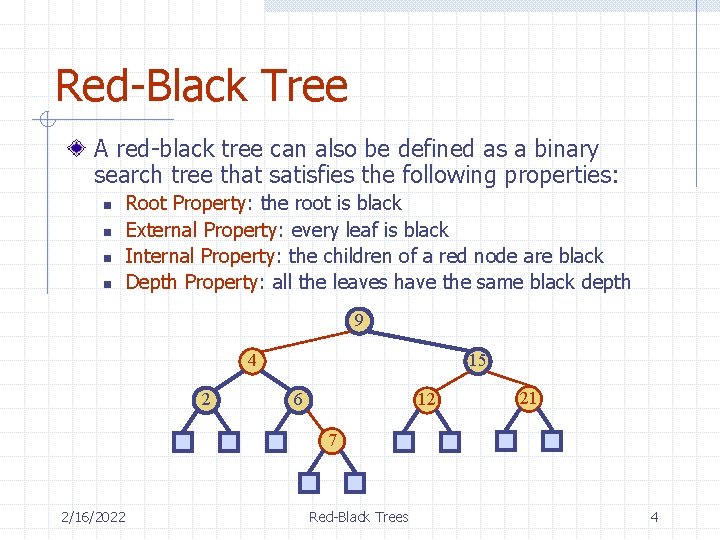
Red-Black Tree A red-black tree can also be defined as a binary search tree that satisfies the following properties: n n Root Property: the root is black External Property: every leaf is black Internal Property: the children of a red node are black Depth Property: all the leaves have the same black depth 9 4 2 15 6 12 21 7 2/16/2022 Red-Black Trees 4

Height of a Red-Black Tree Theorem: A red-black tree storing n items has height O(log n) Proof: n The height of a red-black tree is at most twice the height of its associated (2, 4) tree, which is O(log n) The search algorithm for a binary search tree is the same as that for a binary search tree By the above theorem, searching in a red-black tree takes O(log n) time 2/16/2022 Red-Black Trees 5

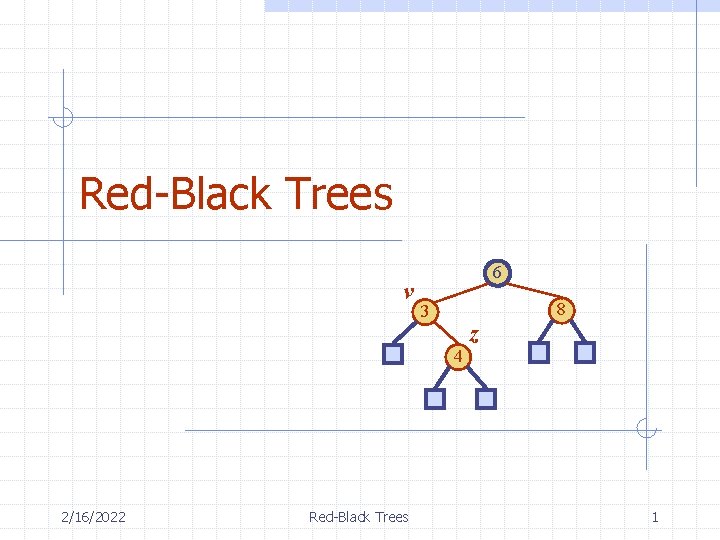
Insertion To perform operation insert. Item(k, o), we execute the insertion algorithm for binary search trees and color red the newly inserted node z unless it is the root n n n We preserve the root, external, and depth properties If the parent v of z is black, we also preserve the internal property and we are done Else (v is red ) we have a double red (i. e. , a violation of the internal property), which requires a reorganization of the tree Example where the insertion of 4 causes a double red: v 2/16/2022 6 3 v 8 z 6 8 3 4 Red-Black Trees z 6
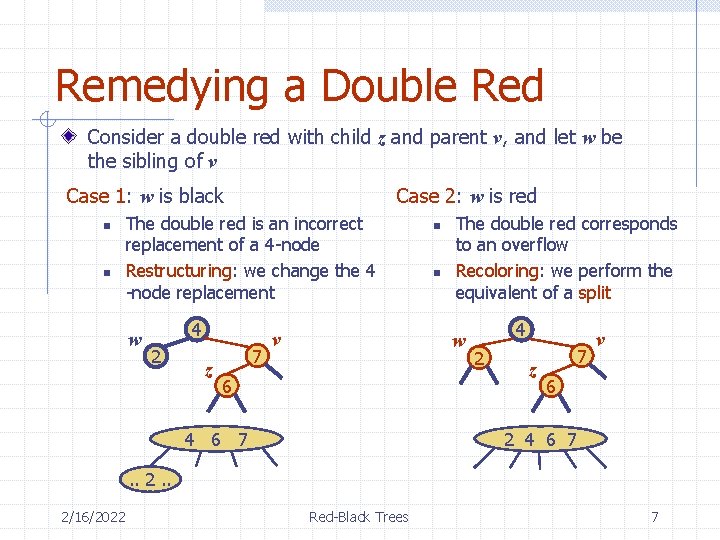
Remedying a Double Red Consider a double red with child z and parent v, and let w be the sibling of v Case 1: w is black n n Case 2: w is red The double red is an incorrect replacement of a 4 -node Restructuring: we change the 4 -node replacement w 4 2 z 7 v n n The double red corresponds to an overflow Recoloring: we perform the equivalent of a split w 6 4 6 7 4 2 z 7 v 6 2 4 6 7 . . 2/16/2022 Red-Black Trees 7
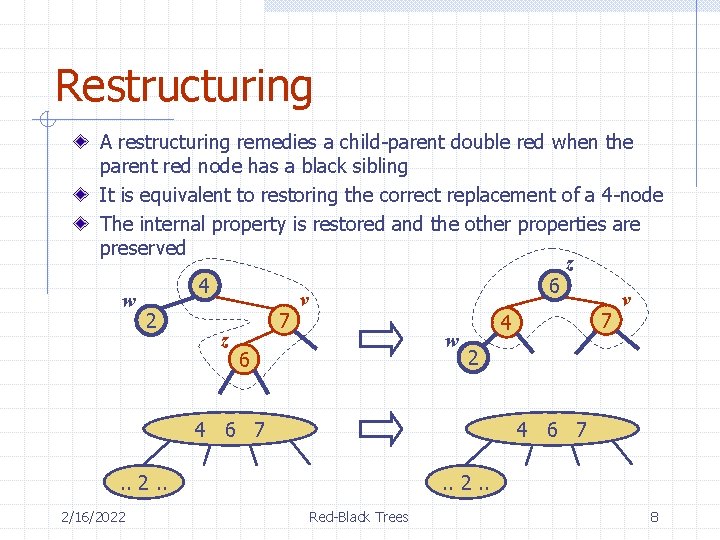
Restructuring A restructuring remedies a child-parent double red when the parent red node has a black sibling It is equivalent to restoring the correct replacement of a 4 -node The internal property is restored and the other properties are preserved z 6 4 v v w 7 7 2 4 z w 2 6 4 6 7 . . 2/16/2022 . . 2. . Red-Black Trees 8
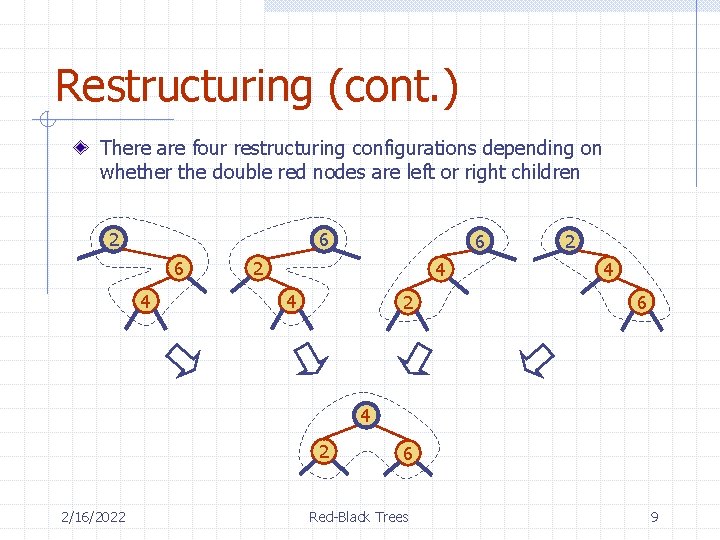
Restructuring (cont. ) There are four restructuring configurations depending on whether the double red nodes are left or right children 6 2 6 4 6 2 4 4 2 2 4 6 4 2 2/16/2022 6 Red-Black Trees 9
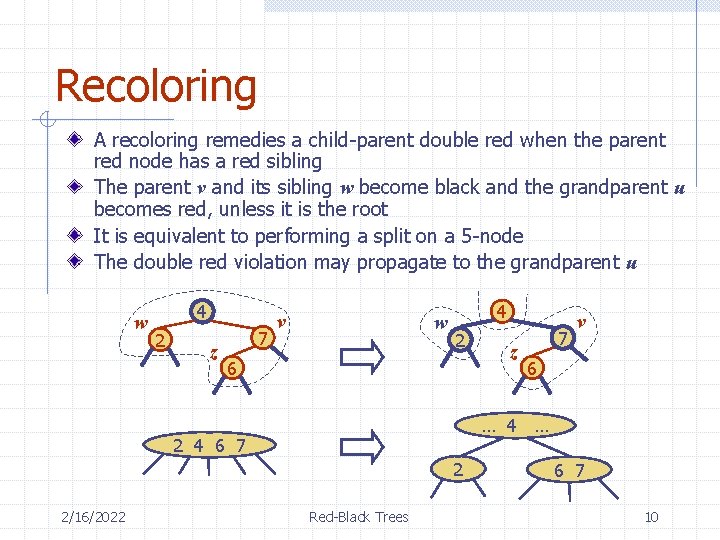
Recoloring A recoloring remedies a child-parent double red when the parent red node has a red sibling The parent v and its sibling w become black and the grandparent u becomes red, unless it is the root It is equivalent to performing a split on a 5 -node The double red violation may propagate to the grandparent u w 4 2 z 7 v w 4 2 6 7 6 … 4 … 2 4 6 7 2 2/16/2022 z v Red-Black Trees 6 7 10
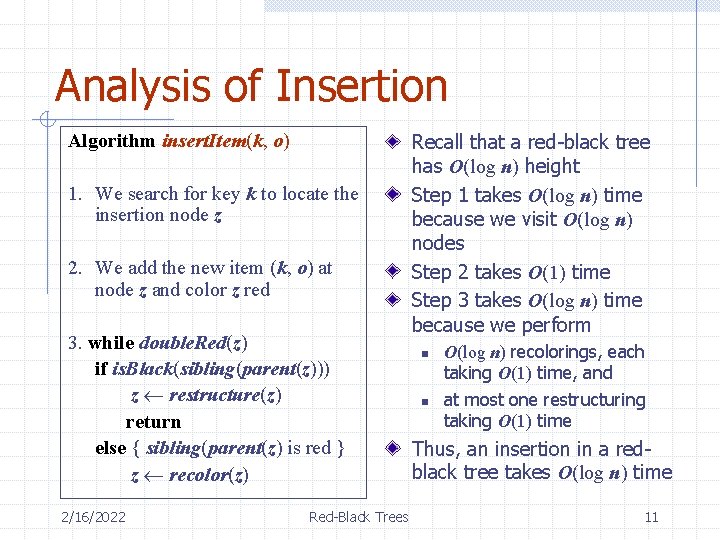
Analysis of Insertion Algorithm insert. Item(k, o) 1. We search for key k to locate the insertion node z 2. We add the new item (k, o) at node z and color z red 3. while double. Red(z) if is. Black(sibling(parent(z))) z restructure(z) return else { sibling(parent(z) is red } z recolor(z) 2/16/2022 Red-Black Trees Recall that a red-black tree has O(log n) height Step 1 takes O(log n) time because we visit O(log n) nodes Step 2 takes O(1) time Step 3 takes O(log n) time because we perform n n O(log n) recolorings, each taking O(1) time, and at most one restructuring taking O(1) time Thus, an insertion in a redblack tree takes O(log n) time 11
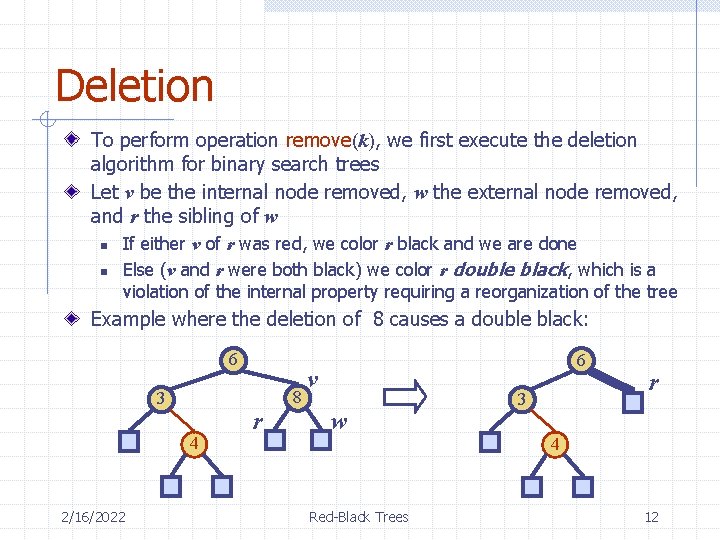
Deletion To perform operation remove(k), we first execute the deletion algorithm for binary search trees Let v be the internal node removed, w the external node removed, and r the sibling of w n n If either v of r was red, we color r black and we are done Else (v and r were both black) we color r double black, which is a violation of the internal property requiring a reorganization of the tree Example where the deletion of 8 causes a double black: 6 8 3 4 2/16/2022 r 6 v w Red-Black Trees 3 r 4 12
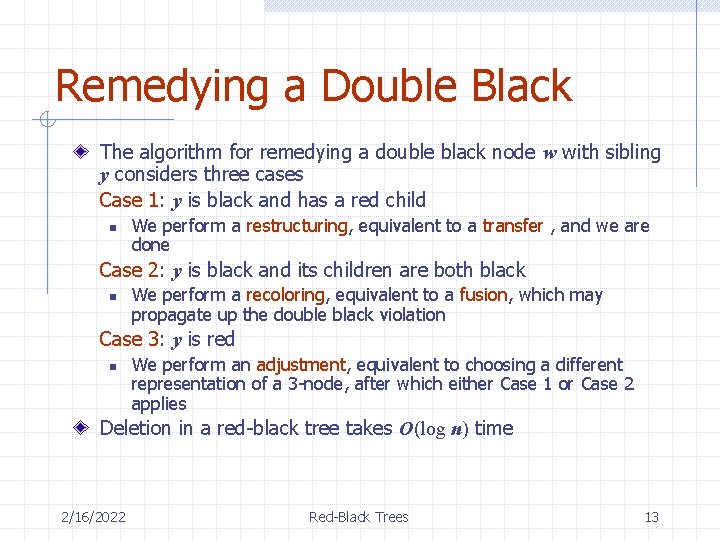
Remedying a Double Black The algorithm for remedying a double black node w with sibling y considers three cases Case 1: y is black and has a red child n We perform a restructuring, equivalent to a transfer , and we are done Case 2: y is black and its children are both black n We perform a recoloring, equivalent to a fusion, which may propagate up the double black violation Case 3: y is red n We perform an adjustment, equivalent to choosing a different representation of a 3 -node, after which either Case 1 or Case 2 applies Deletion in a red-black tree takes O(log n) time 2/16/2022 Red-Black Trees 13
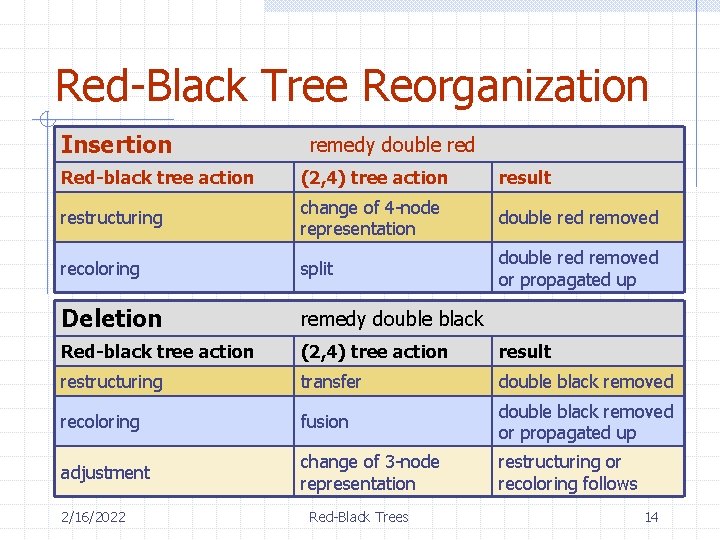
Red-Black Tree Reorganization Insertion remedy double red Red-black tree action (2, 4) tree action result restructuring change of 4 -node representation double red removed recoloring split double red removed or propagated up Deletion remedy double black Red-black tree action (2, 4) tree action result restructuring transfer double black removed recoloring fusion double black removed or propagated up adjustment change of 3 -node representation restructuring or recoloring follows 2/16/2022 Red-Black Trees 14
- Slides: 14