
Red Lily Health Board Story 1998 2019 The

Red Lily Health Board Story 1998 -2019
The Red Lily story is about threat, survival, re-emergence and growth. The story of the regeneration of the land after the removal of feral buffalo from Western Arnhem Land was the inspiration behind the name of the Red Lily Health Board. • The story of this emerging community controlled heath service draws a strong parallel with the re -emergence of the red lily, a native plant once common in Western Arnhem Land. Almost wiped out by the trampling hooves of buffalo—an animal introduced in the early 1800 s by British settlers—the red lily began to regenerate in the 1980 s (following a Northern Territory Government policy to remove the beasts from the region). • Like the blooming of its namesake, the Red Lily Health Board Aboriginal Corporation is also slowly but surely rejuvenating the region, by improving health and empowering its local people. • For many years it has been a dream of a dedicated group of people to set up a regional health service that was not only culturally sensitive to the needs of the community but also controlled by the community. • This means holding clinics and informal gatherings in communities. Red Lily is making it easy for people to participate and to feel confident about having their say. The community has the power.
The Red Lily story is about threat, survival, re-emergence and growth. • Red Lily covers a vast remote region, from Croker Island in the north to Kakadu National Park in the south and it serves a distinct and diverse group of traditional people. • As the Red Lily rule book says, ‘Our vision acknowledges the distinct and diverse identity of our people and their communities’. • At the heart of Red Lily is a deep commitment to improving the health of Bininj/Arrakpi people. It is achieving this through encouraging local engagement in decision making, promoting community interaction, and respecting cultural diversity.
The Red Lily story is about threat, survival, re-emergence and growth. • With the first services transferring across to Red Lily in April 2019, this marks a significant step for the local communities toward Red Lily Health Board’s mission to address the issues regarding the poor health of Aboriginal people of the West Arnhem region. • These services go to Red Lily Health Board commencing management of primary prevention health programs including promoting health and wellness for the Aboriginal people of the West Arnhem region. • Red Lily Health Board Chair, Reuben Cooper acknowledges the hard work of all involved, particularly the Red Lily Board Directors over the last few years, who have put in long hours and hard work to further the cause of community controlled health services. • The Red Lily Health Board also acknowledges the assistance provided over many years by elders and community members in the West Arnhem region as well as Top End Health Service, NT Health, AMSANT, NT PHN and the Commonwealth Department of Health. • The Red Lily Public Health team will continue to be based out of the Jabiru Health Centre and work in partnership with the broader health team to ensure health services are provided as close to where people live as possible.
Red Lily Health Service Logo
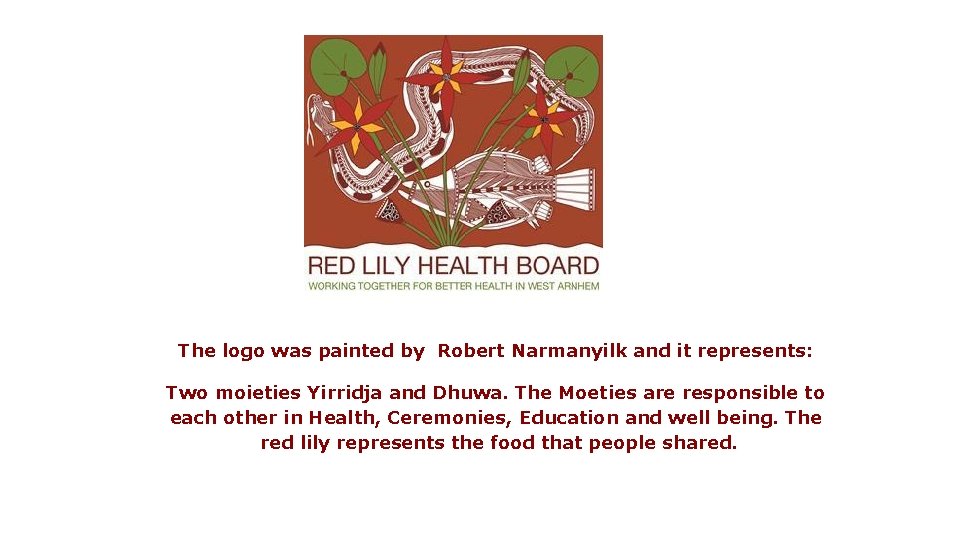
The logo was painted by Robert Narmanyilk and it represents: Two moieties Yirridja and Dhuwa. The Moeties are responsible to each other in Health, Ceremonies, Education and well being. The red lily represents the food that people shared.
History of Red Lily Health Service
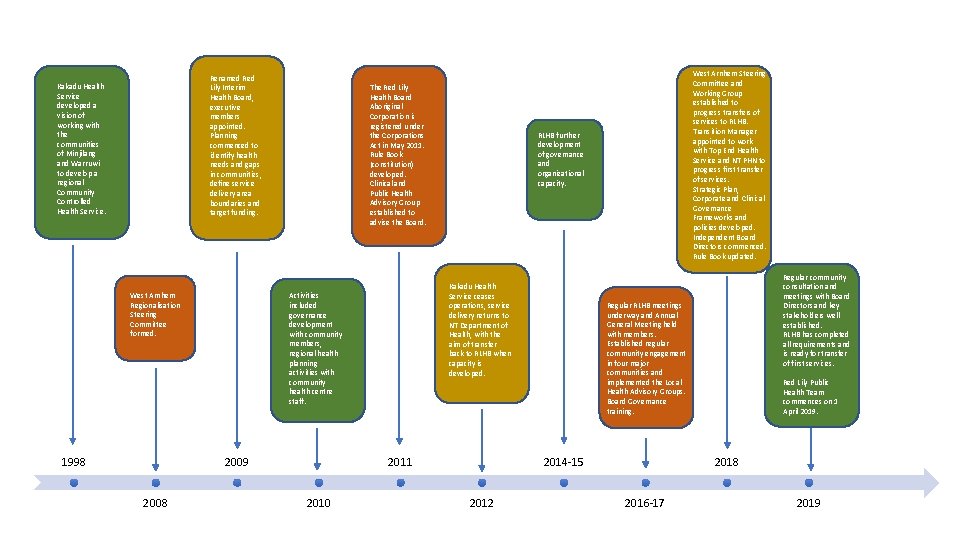
Renamed Red Lily Interim Health Board, executive members appointed. Planning commenced to identify health needs and gaps in communities, define service delivery area boundaries and target funding. Kakadu Health Service developed a vision of working with the communities of Minjilang and Warruwi to develop a regional Community Controlled Health Service. West Arnhem Regionalisation Steering Committee formed. 1998 The Red Lily Health Board Aboriginal Corporation is registered under the Corporations Act in May 2011. Rule Book (constitution) developed. Clinical and Public Health Advisory Group established to advise the Board. 2009 2008 RLHB further development of governance and organizational capacity. Kakadu Health Service ceases operations, service delivery returns to NT Department of Health, with the aim of transfer back to RLHB when capacity is developed. Activities included governance development with community members, regional health planning activities with community health centre staff. 2011 2010 West Arnhem Steering Committee and Working Group established to progress transfers of services to RLHB. Transition Manager appointed to work with Top End Health Service and NT PHN to progress first transfer of services. Strategic Plan, Corporate and Clinical Governance Frameworks and policies developed. Independent Board Directors commenced. Rule Book updated. Regular RLHB meetings underway and Annual General Meeting held with members. Established regular community engagement in four major communities and implemented the Local Health Advisory Groups. Board Governance training. 2014 -15 2012 Regular community consultation and meetings with Board Directors and key stakeholders well established. RLHB has completed all requirements and is ready for transfer of first services. Red Lily Public Health Team commences on 1 April 2019. 2018 2016 -17 2019
Red Lily Health Board Strategic Plan 2019 -2021
Red Lily Health Board Strategic Plan 2019 -2021 Organisation Description: Red Lily Health Service Board is an Aboriginal Corporation Incorporated under the Corporations (Aboriginal and Torres Strait Islander) Act 2006. Provision of primary health care services in the West Arnhem Region Mission To address the issues regarding the poor health of Aboriginal people of the West Arnhem region. Vision Aboriginal people of the West Arnhem region have access to services that support good health and allow them to actively participate in their communities Values Honesty, Trust, Respect, Confidentiality
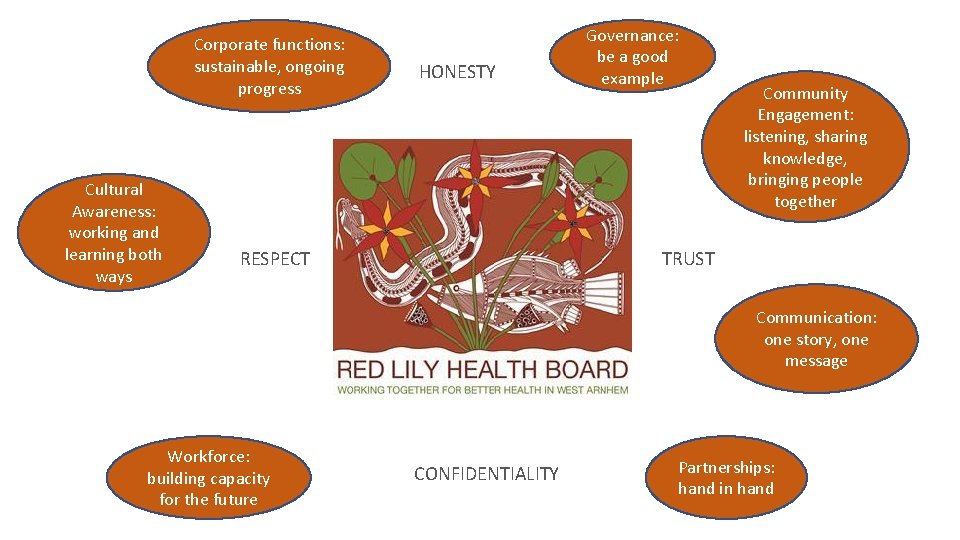
Corporate functions: sustainable, ongoing progress Cultural Awareness: working and learning both ways HONESTY RESPECT Governance: be a good example Community Engagement: listening, sharing knowledge, bringing people together TRUST Communication: one story, one message Workforce: building capacity for the future CONFIDENTIALITY Partnerships: hand in hand
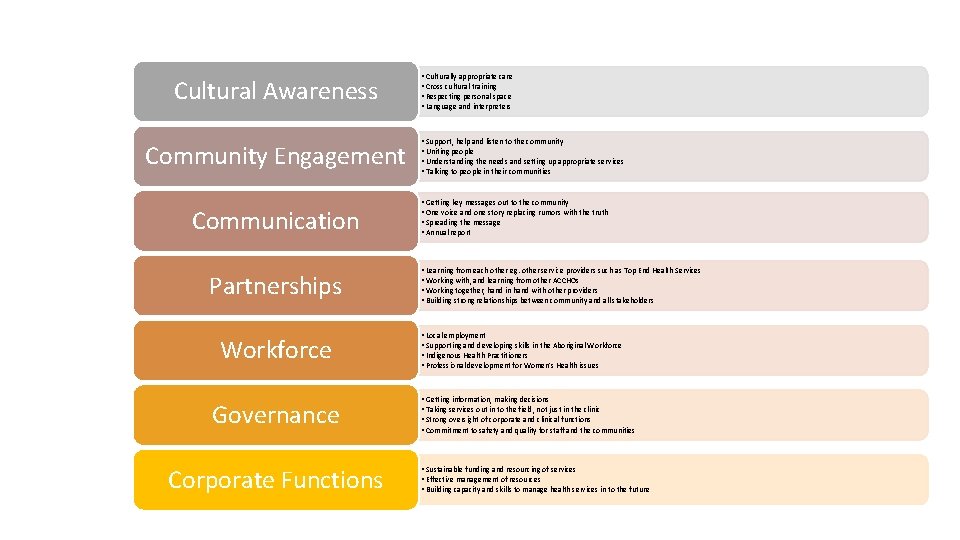
Cultural Awareness Community Engagement Communication Partnerships Workforce Governance Corporate Functions • Culturally appropriate care • Cross cultural training • Respecting personal space • Language and interpreters • Support, help and listen to the community • Uniting people • Understanding the needs and setting up appropriate services • Talking to people in their communities • Getting key messages out to the community • One voice and one story replacing rumors with the truth • Spreading the message • Annual report • Learning from each other eg. other service providers such as Top End Health Services • Working with, and learning from other ACCHOs • Working together, hand in hand with other providers • Building strong relationships between community and all stakeholders • Local employment • Supporting and developing skills in the Aboriginal Workforce • Indigenous Health Practitioners • Professional development for Women's Health issues • Getting information, making decisions • Taking services out in to the field, not just in the clinic • Strong oversight of corporate and clinical functions • Commitment to safety and quality for staff and the communities • Sustainable funding and resourcing of services • Effective management of resources • Building capacity and skills to manage health services in to the future
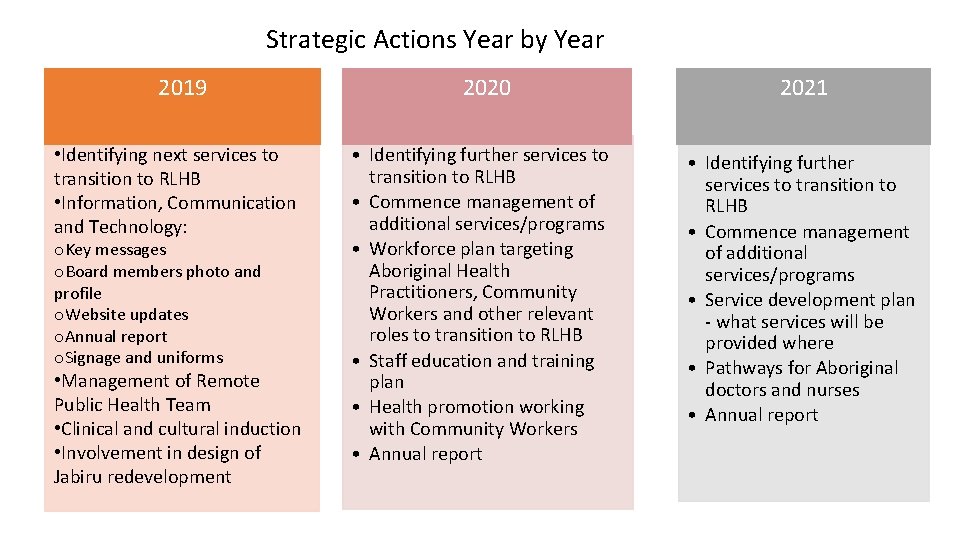
Strategic Actions Year by Year 2019 • Identifying next services to transition to RLHB • Information, Communication and Technology: o. Key messages o. Board members photo and profile o. Website updates o. Annual report o. Signage and uniforms • Management of Remote Public Health Team • Clinical and cultural induction • Involvement in design of Jabiru redevelopment 2020 2021 2020 • Identifying further services to transition to RLHB • Commence management of additional services/programs • Workforce plan targeting Aboriginal Health Practitioners, Community Workers and other relevant roles to transition to RLHB • Staff education and training plan • Health promotion working with Community Workers • Annual report 2021 • Identifying further services to transition to RLHB • Commence management of additional services/programs • Service development plan - what services will be provided where • Pathways for Aboriginal doctors and nurses • Annual report
- Slides: 13