
RED LIGHT YELLOW LIGHT An exercise in identifying
- Slides: 8
RED LIGHT, YELLOW LIGHT An exercise in identifying poor arguments
WHAT IS THE MOTIVATION? • • Part of Routines for Digging Deeper into Ideas Expand on the idea of thinking dispositions How do you know when to start thinking critically? How do you find opportunities to apply critical thinking? • Train identification of common issues Sweeping generalizations Blatant self-interest Oversimplified conclusions • Handle things is a way that is not dismissive
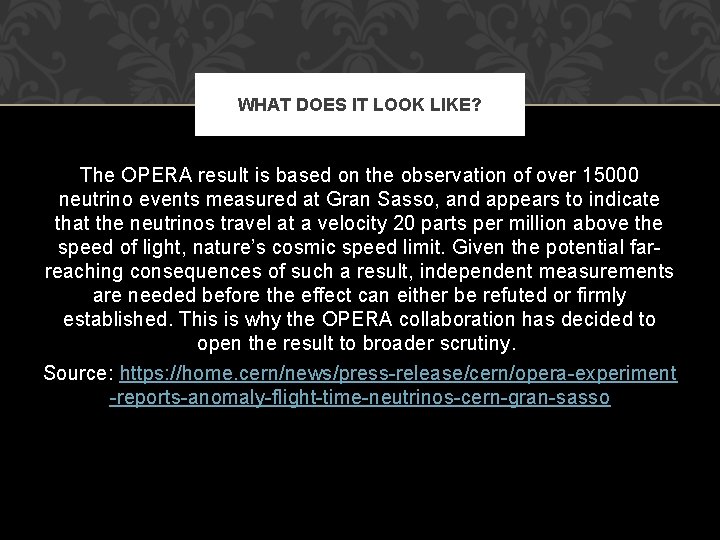
WHAT DOES IT LOOK LIKE? The OPERA result is based on the observation of over 15000 neutrino events measured at Gran Sasso, and appears to indicate that the neutrinos travel at a velocity 20 parts per million above the speed of light, nature’s cosmic speed limit. Given the potential farreaching consequences of such a result, independent measurements are needed before the effect can either be refuted or firmly established. This is why the OPERA collaboration has decided to open the result to broader scrutiny. Source: https: //home. cern/news/press-release/cern/opera-experiment -reports-anomaly-flight-time-neutrinos-cern-gran-sasso
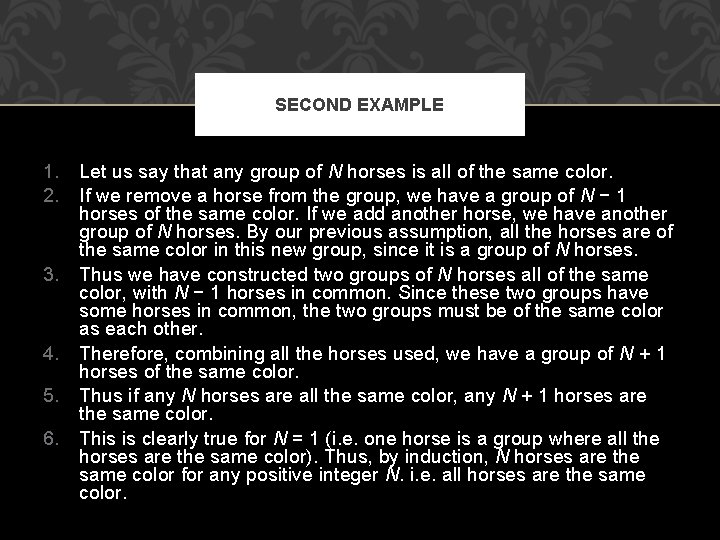
SECOND EXAMPLE 1. Let us say that any group of N horses is all of the same color. 2. If we remove a horse from the group, we have a group of N − 1 horses of the same color. If we add another horse, we have another group of N horses. By our previous assumption, all the horses are of the same color in this new group, since it is a group of N horses. 3. Thus we have constructed two groups of N horses all of the same color, with N − 1 horses in common. Since these two groups have some horses in common, the two groups must be of the same color as each other. 4. Therefore, combining all the horses used, we have a group of N + 1 horses of the same color. 5. Thus if any N horses are all the same color, any N + 1 horses are the same color. 6. This is clearly true for N = 1 (i. e. one horse is a group where all the horses are the same color). Thus, by induction, N horses are the same color for any positive integer N. i. e. all horses are the same color.
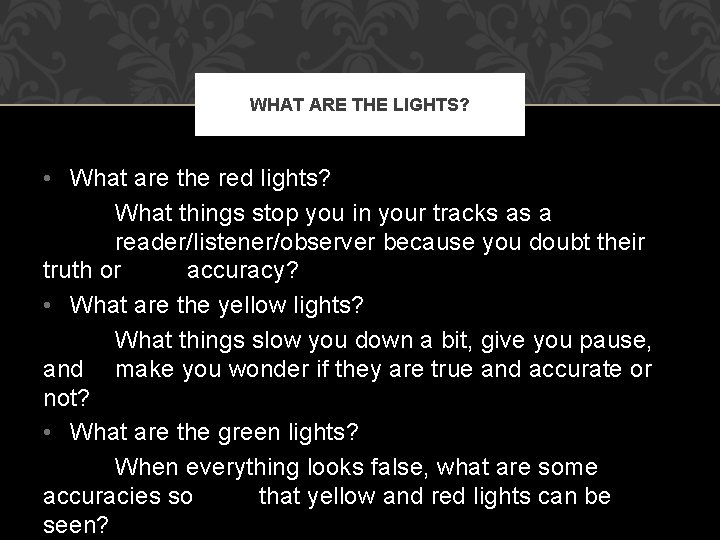
WHAT ARE THE LIGHTS? • What are the red lights? What things stop you in your tracks as a reader/listener/observer because you doubt their truth or accuracy? • What are the yellow lights? What things slow you down a bit, give you pause, and make you wonder if they are true and accurate or not? • What are the green lights? When everything looks false, what are some accuracies so that yellow and red lights can be seen?
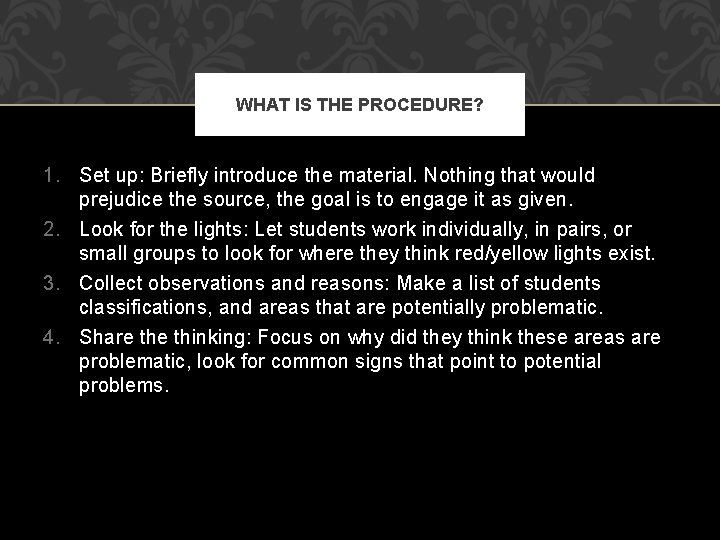
WHAT IS THE PROCEDURE? 1. Set up: Briefly introduce the material. Nothing that would prejudice the source, the goal is to engage it as given. 2. Look for the lights: Let students work individually, in pairs, or small groups to look for where they think red/yellow lights exist. 3. Collect observations and reasons: Make a list of students classifications, and areas that are potentially problematic. 4. Share thinking: Focus on why did they think these areas are problematic, look for common signs that point to potential problems.
DO IT Look at handout
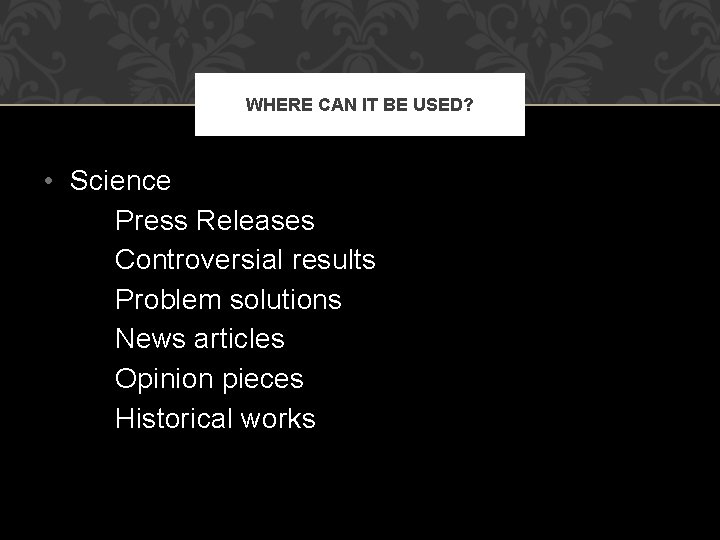
WHERE CAN IT BE USED? • Science Press Releases Controversial results Problem solutions News articles Opinion pieces Historical works