
Red Hawk Project United American Indian Involvement Inc
- Slides: 24
Red Hawk Project United American Indian Involvement, Inc. Assessing the Suicide Related Service Needs of the American Indian and Alaska Native Community of Los Angeles County Presented by Monique Smith, Psy. D. Maham Chaudhry
Suicide: Incidence and Demographics l According to Indian Health Service, from 1996 to 1998, the adjusted suicide rate for AI/AN for the California area was 15. 2 per 100, 000, with a total of 53 deaths (IHS, 2000 -2001). l Suicide rates for AI/AN range from 1. 5 to over 3 times the national average (IHS, 2000 -2001). l Nationally, Indian youth suicide is 2. 5 times greater than the rate for all youth (IHS, 2000 -2001).
Suicide: Incidence and Demographics l Nationally, suicide is the fourth leading cause of death for youth ages 10 -14, third for ages 15 -24 and is the second leading cause of death for both age groups (Champagne & Long, 2003). l For AI/AN youth, 22% of females and 12% of males reported having attempted suicide at some time (Blum, et al. , 1996) l Suicide is particularly common among young AI/AN males ages 15 -24, accounting for 64% of all suicides by AI/AN. This rate is 2 to 3 times higher than the general U. S. rate (Mock, et al. , 1996).
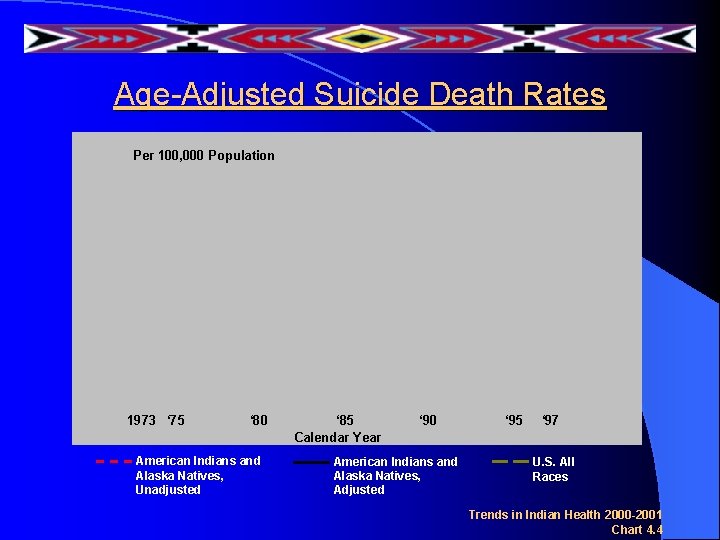
Age-Adjusted Suicide Death Rates Per 100, 000 Population 1973 ‘ 75 ‘ 80 American Indians and Alaska Natives, Unadjusted ‘ 85 Calendar Year ‘ 90 American Indians and Alaska Natives, Adjusted ‘ 95 ‘ 97 U. S. All Races Trends in Indian Health 2000 -2001 Chart 4. 4
Depression & Suicide Among AI/AN Depression is the 2 nd leading cause of disability in industrialized countries Depression associated with: l l 2 x increased risk of death overall 26 x increased risk of suicide Impaired social functioning
Red Hawk Project Goals and Objectives Project Goals The Red Hawk Project will target American Indian and Alaska Native (AI/AN) children and youth (ages 10 -24) in Los Angeles County. The overall goal of the project is to strengthen and develop culturally and linguistically appropriate youth suicide prevention and early intervention services for the American Indian community.
Red Hawk Project Goals and Objectives Project Objectives The Red Hawk Project will 1) evaluate the existing service delivery systems available to American Indian children and families in Los Angeles County, to describe services, identify access barriers, and assess the cultural appropriate of services. 2) collaborate with other agencies, providers and organizations to share information and resources by promoting awareness that suicide is preventable.
Red Hawk Project Goals and Objectives 3) develop a culturally appropriate youth suicide prevention curriculum. 4) implement the public health approach to suicide prevention as outline in the Institute of Medicine report, Reducing Suicide: A National Imperative.
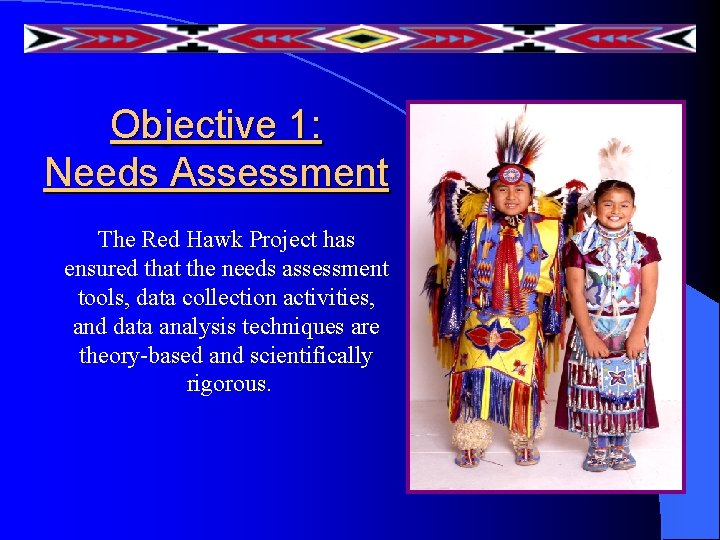
Objective 1: Needs Assessment The Red Hawk Project has ensured that the needs assessment tools, data collection activities, and data analysis techniques are theory-based and scientifically rigorous.
Methods Mixed Method Approach: Small Group Discussions Focus Group Discussions Key Informant Interviews Service System Assessment Surveys Data Analysis Techniques: Manual Transcriptions SPSS Analysis
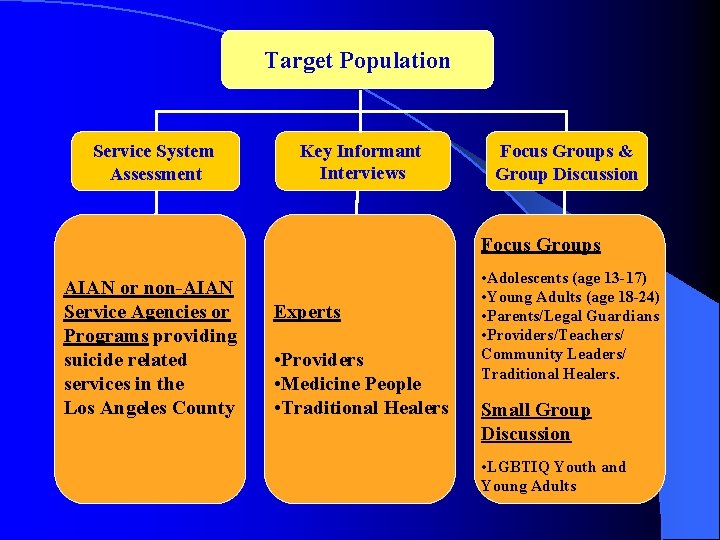
Target Population Service System Assessment Key Informant Interviews Focus Groups & Group Discussion Focus Groups AIAN or non-AIAN Service Agencies or Programs providing suicide related services in the Los Angeles County Experts • Providers • Medicine People • Traditional Healers • Adolescents (age 13 -17) • Young Adults (age 18 -24) • Parents/Legal Guardians • Providers/Teachers/ Community Leaders/ Traditional Healers. Small Group Discussion • LGBTIQ Youth and Young Adults
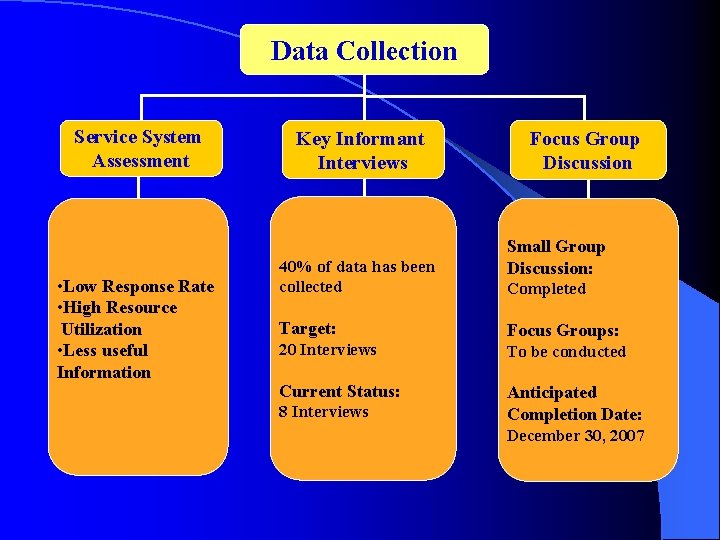
Data Collection Service System Assessment • Low Response Rate • High Resource Utilization • Less useful Information Key Informant Interviews 40% of data has been collected Target: 20 Interviews Current Status: 8 Interviews Focus Group Discussion Small Group Discussion: Completed Focus Groups: To be conducted Anticipated Completion Date: December 30, 2007
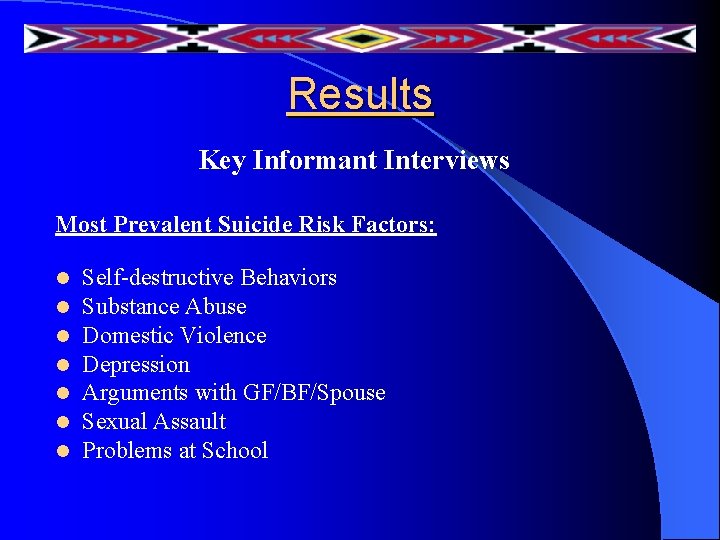
Results Key Informant Interviews Most Prevalent Suicide Risk Factors: l l l l Self-destructive Behaviors Substance Abuse Domestic Violence Depression Arguments with GF/BF/Spouse Sexual Assault Problems at School
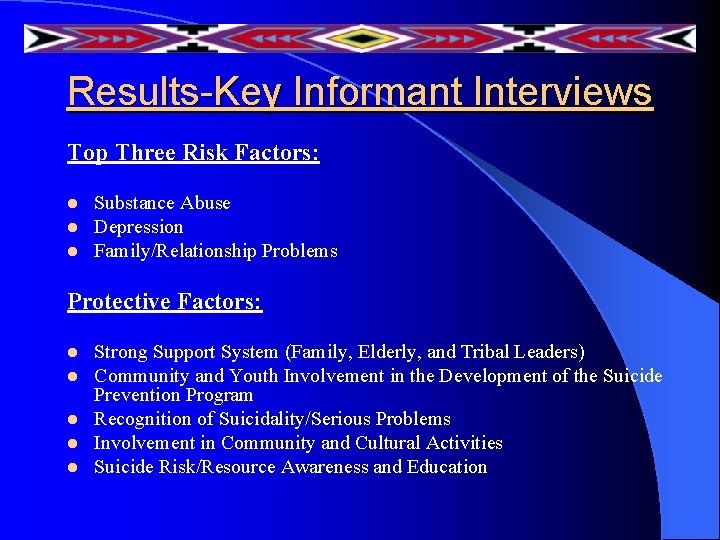
Results-Key Informant Interviews Top Three Risk Factors: l l l Substance Abuse Depression Family/Relationship Problems Protective Factors: Strong Support System (Family, Elderly, and Tribal Leaders) Community and Youth Involvement in the Development of the Suicide Prevention Program l Recognition of Suicidality/Serious Problems l Involvement in Community and Cultural Activities l Suicide Risk/Resource Awareness and Education l l
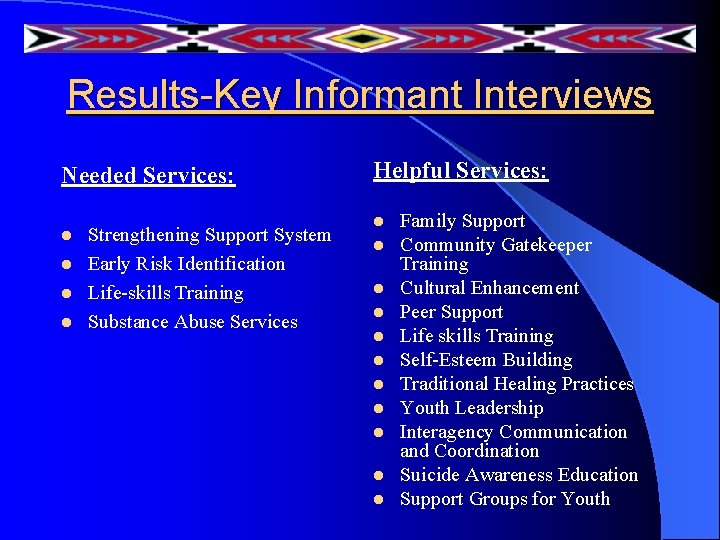
Results-Key Informant Interviews Needed Services: Strengthening Support System l Early Risk Identification l Life-skills Training l Substance Abuse Services l Helpful Services: l l l Family Support Community Gatekeeper Training Cultural Enhancement Peer Support Life skills Training Self-Esteem Building Traditional Healing Practices Youth Leadership Interagency Communication and Coordination Suicide Awareness Education Support Groups for Youth
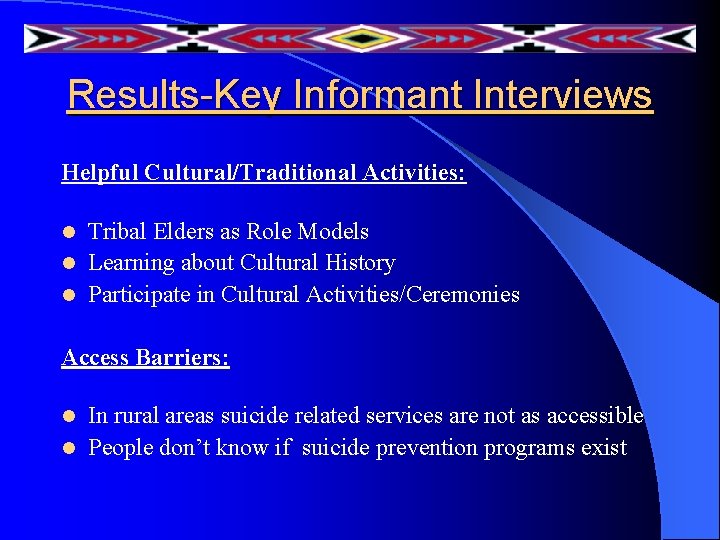
Results-Key Informant Interviews Helpful Cultural/Traditional Activities: Tribal Elders as Role Models l Learning about Cultural History l Participate in Cultural Activities/Ceremonies l Access Barriers: In rural areas suicide related services are not as accessible l People don’t know if suicide prevention programs exist l
Results Small Group Discussion with AIAN LGBTIQ youth and young adults Problems experienced by AIAN LGBTIQ youth and young adults that may act as contributing factors for suicide: l l l l Not being Accepted/Scrutinized Isolation Negative Peer Pressure Substance Abuse Run Away Youth Lack of Job Skills Lack of School Education Dysfunctional Families
Results-Small Group Discussion Signs of Suicide: l l l Depression Resentfulness Substance Abuse Hurting Animals Vandalism Neglected by Family/Peers
Results-Small Group Discussion Protective Factors: l l l l Family Support/Acceptance as LGBTIQ Native Spirituality Role Models/Mentors for Youth Good Upbringing/Parenting Assessment of Early Substance Use Healthy Environment/Relationships Open Communication with Family and Friends
Results-Small Group Discussion Needed Suicide Prevention Activities/Services: l l l Substance Abuse Rehabilitation Programs Introduction of Community Volunteer Work Support Groups/Empowerment Groups Peer Support Journal Writing – both positive and negative experiences Team Building Activities-outdoor activities Spiritual/Cultural Activities Self-encouragement through Recognition Mental Health/Substance Abuse Counseling Suicide Hotline Mentorship Program Sensitivity towards Native LGBTIQ
Limitations l Delayed approval by the Institutional Review Board l Limited Staff and Multiple Staff Roles l Service System Assessment Surveys – low response rate and high costs l Phone interviews with Key Informants – Limited availability – Issues with transcriptions
Red Hawk Project Implementation l The Red Hawk project will provide early intervention and assessment services to American Indian youth ages 10 -24 who are at risk for mental or emotional disorders that may lead to suicide attempts. l The Red Hawk project will serve 100 -150 AI/AN youth and their families per year (relating to suicide prevention). l The project will include skill building support groups, parenting support training, case management, and referral sources for crisis intervention and treatment. l We will develop a curriculum that is culturally relevant, feasible, salient, and effective.
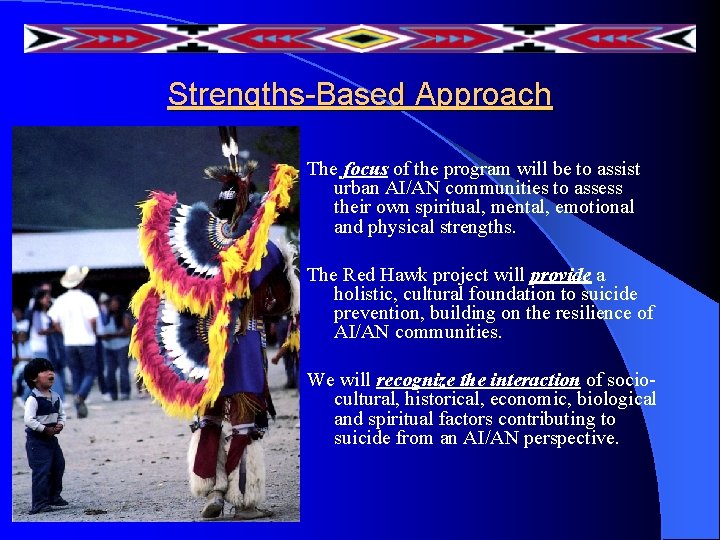
Strengths-Based Approach The focus of the program will be to assist urban AI/AN communities to assess their own spiritual, mental, emotional and physical strengths. The Red Hawk project will provide a holistic, cultural foundation to suicide prevention, building on the resilience of AI/AN communities. We will recognize the interaction of sociocultural, historical, economic, biological and spiritual factors contributing to suicide from an AI/AN perspective.
Thank You