
RED EYE UVEITIS Brig Mazhar Ishaq Advisor in


RED EYE- UVEITIS Brig Mazhar Ishaq Advisor in Ophthalmology, Comdt Armed Forces Institute Of Ophthalmology, Rwp

ANATOMICAL CLASSIFICATION n ANTERIOR UVEITIS n n n IRITIS IRIDOCYCLITIS INTERMEDIATE UVEITIS POSTERIOR UVEITIS PANUVEITIS

POSTERIOR UVEITIS n Involves the fundus posterior to the vitreous base - Retinitis - Choroiditis - Vasculitis

SARCOIDOSIS n Presentation - Acute - Insidious § Ocular features - AAU - CAU - Intermediate - Candlewax drippings’ - Multifocal choroiditis - Retinal granulomas

TUBERCULOSIS n Anterior segment involvement n Tuberculous uveitis - Anterior uveitis, - Choroiditis - Periphlebitis

TOXOPLASMOSIS n Presentation - Unilateral sudden onset of floaters § Signs - Spill-over’ anterior uveitis - Satellite lesion - Multiple foci are uncommon - Severe vitritis (‘headlight in the fog’)

TOXOPLASMOSIS

BEHCET SYNDROME n Recurrent oro-genital ulceration n Ocular features n AAU - cold abscess n Retinitis n Retinal vasculitis n Vitritis,

BEHCET SYNDROME
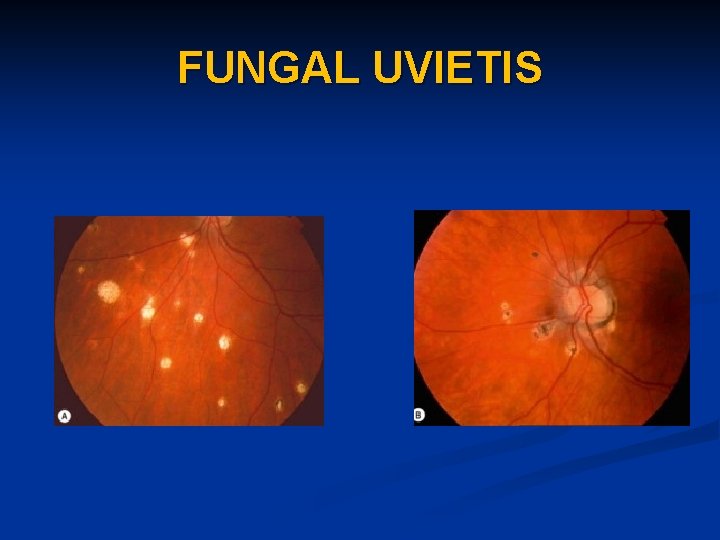
FUNGAL UVIETIS
INVESTIGATIONS Indications n Recurrent granulomatous anterior uveitis n Bilateral disease n Systemic manifestations with out a specific diagnosis n Confirmation of suspective ocular picture such as HLA-A 29 testing in birdshort chorioretinopathy

NOT NECESSARY n Single attack of mild unilateral acute anterior uveitis n A specific uveitis entity n When a systemic diagnosis compatible with the uveitis is already apparent
INVESTIGATIONS n Obtain a history, attempting to define the etiology. n Complete ocular examination, including an IOP check and a dilated fundus examination.
SKIN TESTS 1. Tuberculin skin test (montoux & Heaf) n Intradermal inj of purified protein n Positive Induration of 5 -14 mm with in 48 hours Negative n n Excludes TB May occure in advanced disease

PATHERGY TEST n Increased dermal sensitivity to needle trauma n Behcet syndrome n Rarely positive in absence of systemic activity n Pustule formation

SEROLOGY SYPHILIS 1. Non-treponemal tests RPR or VDRL n Primary infection n Monitor disease activity n Response to therapy

2. Immunofluorescent antibody test 3. Haemagglutination test

Enzyme-linked Immunosorbent Assay (ELISA) (ELISA n Antibodies in aqueous (more specific) n Other conditions (cat-scratch fever & toxocariasis Antinuclear Antibody (ANA) n In children with JIA who are at high risk of developing ant uveitis

ENZYME ASSAY 1. Angiotensin converting enzyme (ACE) n Nonspecific test Granulomatous disease like - Sarcoidosis (elevated in 80% & in acute) - TB - Leprosy n 2. Lysozyme n Good sensitivity but less speceficity for sarcoidosis
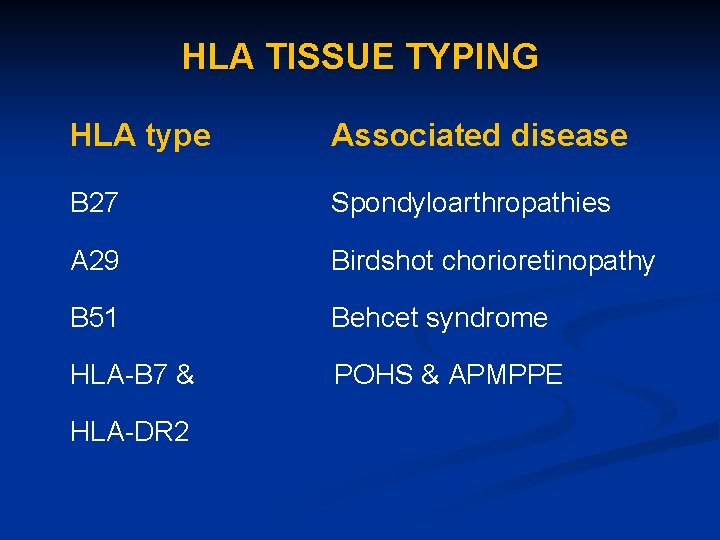
HLA TISSUE TYPING HLA type Associated disease B 27 Spondyloarthropathies A 29 Birdshot chorioretinopathy B 51 Behcet syndrome HLA-B 7 & POHS & APMPPE HLA-DR 2

IMAGING 1. Fluorescein angiography (FA) n n Retinal vasculitis CMO 2. Indocyanine angiography (ICG) n Better for choroidal disease

3. Ultrasonography (US) n It is useful in opaque media especially in excluding a RD or intraocular mass 4. Optical coherence tomography(OCT) n Detecting CMO Identify vitreoretinal traction as a mechanism of CMO n

BIOPSY Histopathology still remains the gold-standard 1. conjunctiva And Lacrimal gland - Sarcoidosis 2. Aqueous samples - For (polymerase chain reaction) PCR - Viral retinitis (occasionally) 3. Vitreous biopsy - Infectious endophthalmitis

RADIOLOGY 1. Chest X-rays - To exclude TB and Sarcoidosis 2. Sacro-illiac joint X-Rays - Diagnosis of spondyloarthropathy 3. CT & MRI - Sarcoidosis - Multiple sclerosis - Primary intraocular lymphoma
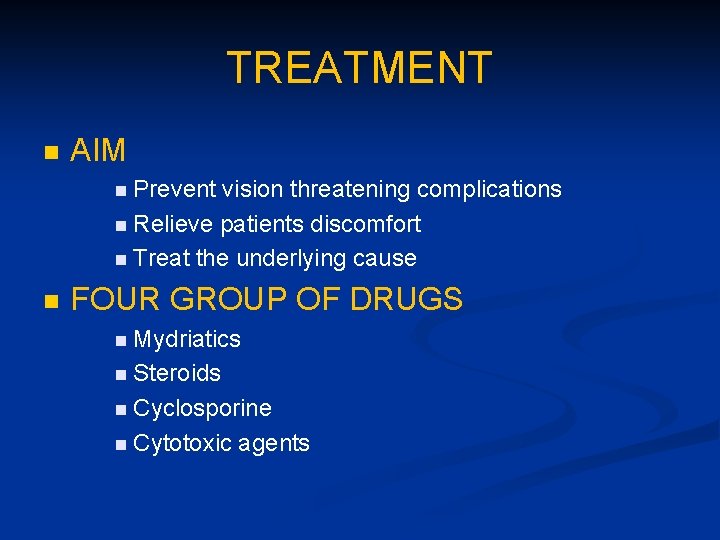
TREATMENT n AIM n Prevent vision threatening complications n Relieve patients discomfort n Treat the underlying cause n FOUR GROUP OF DRUGS n Mydriatics n Steroids n Cyclosporine n Cytotoxic agents

TREATMENT n Mydriatics n To give comfort n To prevent formation of posterior synechia n To break down synechia n Drugs (atropine, homatropine, scopolamine, tropicamide)

TREATMENT n Steroids (mainstay of treatment) n Topical n administration Complications (glaucoma, posterior sub capsular cataract, corneal complications, systemic side effects) n Periocular injections n Severe acute anterior uveitis n Adjuvant to topical/systemic n Poor compliance n Pre op

TREATMENT n n Systemic therapy Preparations n n n Prednisolone 5 mg Indications Rules n n n Start with large dose then reduce Initial dose 1 -1. 5 mg/kg BW Before breakfast Taper off Less than 2 weeks abrupt stop

TREATMENT n Side effects n Short term n Long term

TREATMENT n Cyclosporin n Steroid sparing agent n Complications n are hypertension and nephrotoxicity Cytotoxic drugs n Potentially blinding bilateral reversible uveitis n Intolerable side effects from systemic steroids therapy.

THANK YOU
- Slides: 32