
Red Cabbage Indicator Glossary Pigment a material that
Red Cabbage Indicator
Glossary Pigment – a material that changes the colour of the reflected light as a result of wavelength selective absorption p. H – a measure of the acidity or basicity of an aqueous solution Alkaline / basic – these terms are often used interchangeably but actually have different definitions. An alkali is a compound that forms hydroxide ions in water while a basic compound reacts with an acid to form a salt and water. Therefore, all alkalis are basic, but not all bases are alkalis

Homemade indicator Equipment - Beaker of water Filter and filter paper or sieve Bottle Piece of Red Cabbage Knife (or blender) The best indicator is dark purple… not too watery! Method 1. Rip cabbage into small bits 2. Grind cabbage with the mortar and pestle 3. Add a little water 4. Filter the red cabbage solution into the bottle 5. Try to collect a quarter / half a bottle of solution 10 Minutes

Red Cabbage Indicator

- Red Cabbage Indicator –Risk Assessment Sharp knife is used for shredding the cabbage. Hot water used Chemicals used (wear safety glasses) Some household cleaning products that may not be suitable for the students. It is recommend that these experiments be performed by the teacher as a demonstration. Students should not ingest any of the experiment; good lab practice starts young! Bleach will cause extensive burns and eye damage; minimise exposure. Drain and cream cleaner may cause skin irritation and eye damage; minimise exposure. First Aid – wash the affected area with water. If bleach, drain cleaner or cream cleaner are ingested, DO NOT induce vomiting; rinse mouth with water and seek medical assistance.
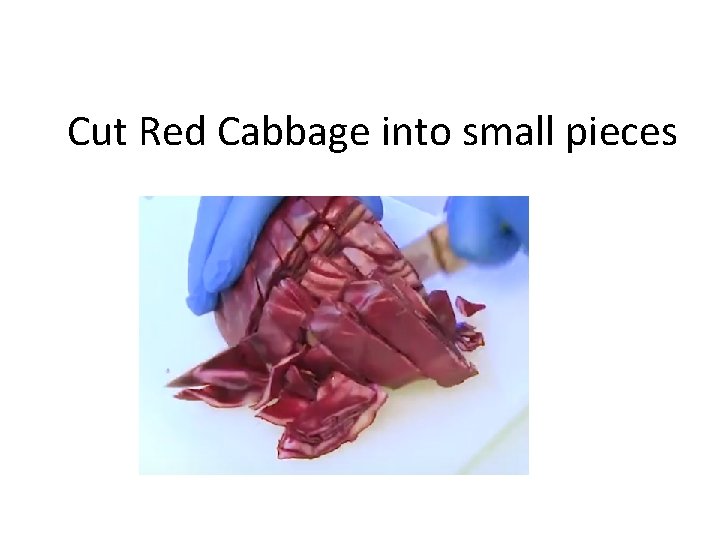
Cut Red Cabbage into small pieces

Put the shredded cabbage into a beaker and add water to cover the shredded cabbage.
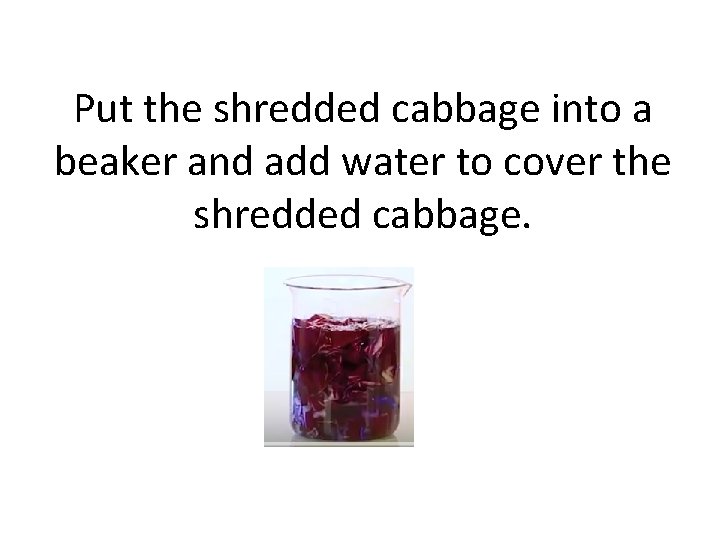
Put the shredded cabbage into a beaker and add water to cover the shredded cabbage.
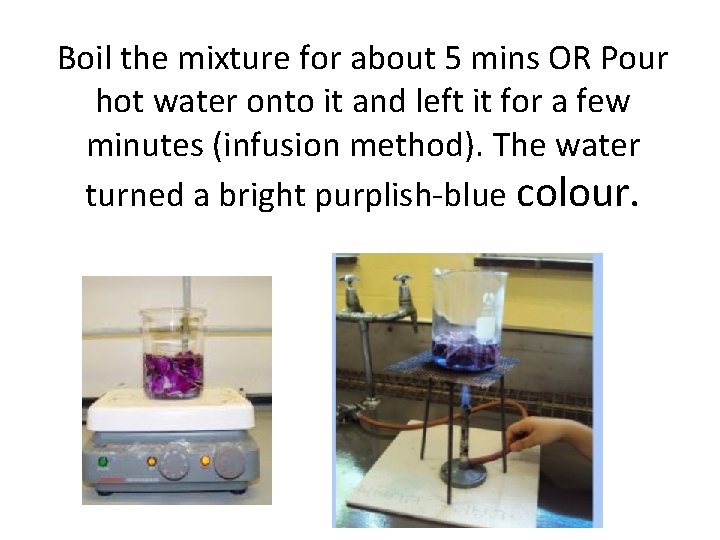
Boil the mixture for about 5 mins OR Pour hot water onto it and left it for a few minutes (infusion method). The water turned a bright purplish-blue colour.
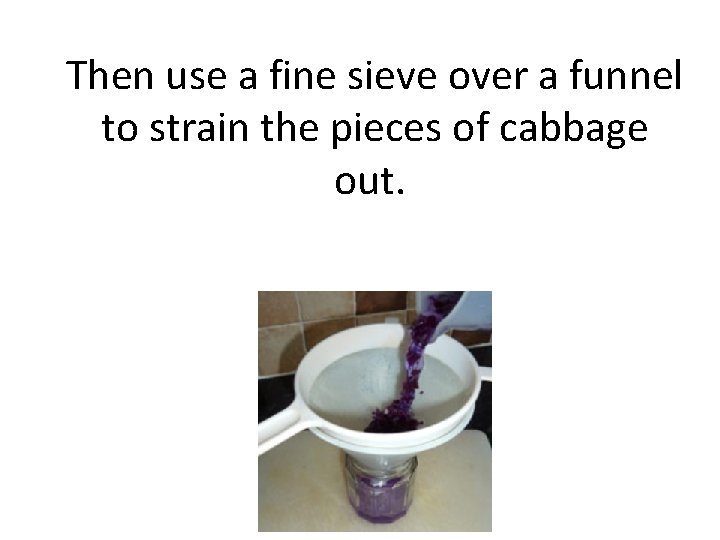
Then use a fine sieve over a funnel to strain the pieces of cabbage out.
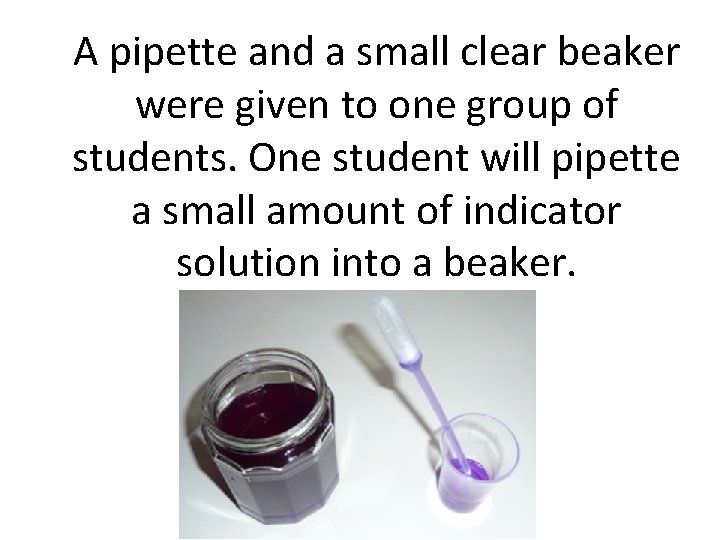
A pipette and a small clear beaker were given to one group of students. One student will pipette a small amount of indicator solution into a beaker.
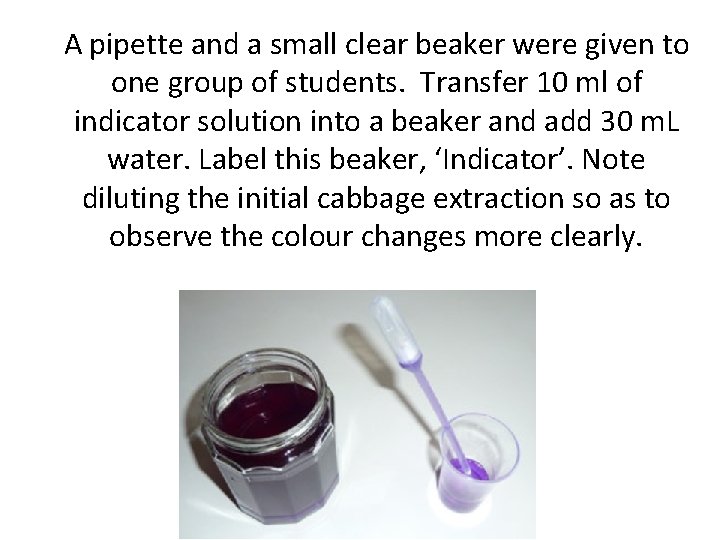
A pipette and a small clear beaker were given to one group of students. Transfer 10 ml of indicator solution into a beaker and add 30 m. L water. Label this beaker, ‘Indicator’. Note diluting the initial cabbage extraction so as to observe the colour changes more clearly.
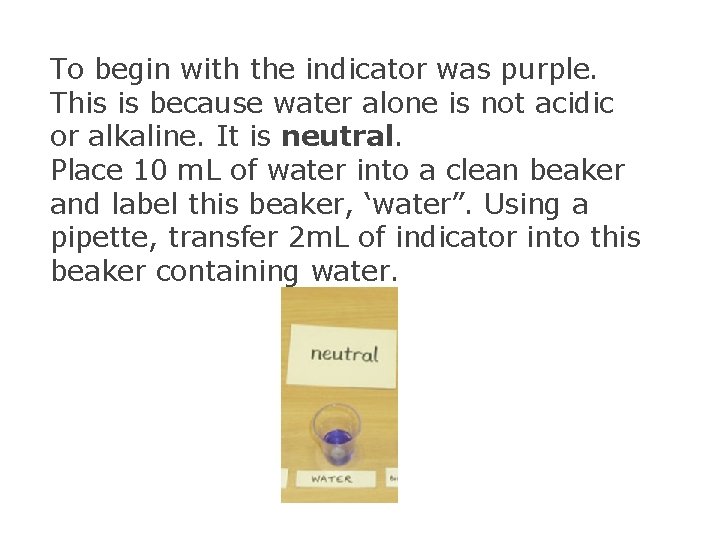
To begin with the indicator was purple. This is because water alone is not acidic or alkaline. It is neutral. Place 10 m. L of water into a clean beaker and label this beaker, ‘water”. Using a pipette, transfer 2 m. L of indicator into this beaker containing water.
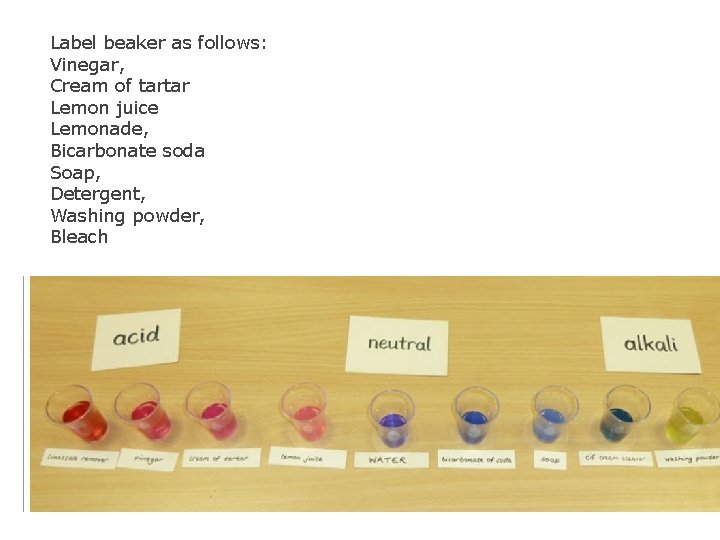
Label beaker as follows: Vinegar, Cream of tartar Lemon juice Lemonade, Bicarbonate soda Soap, Detergent, Washing powder, Bleach
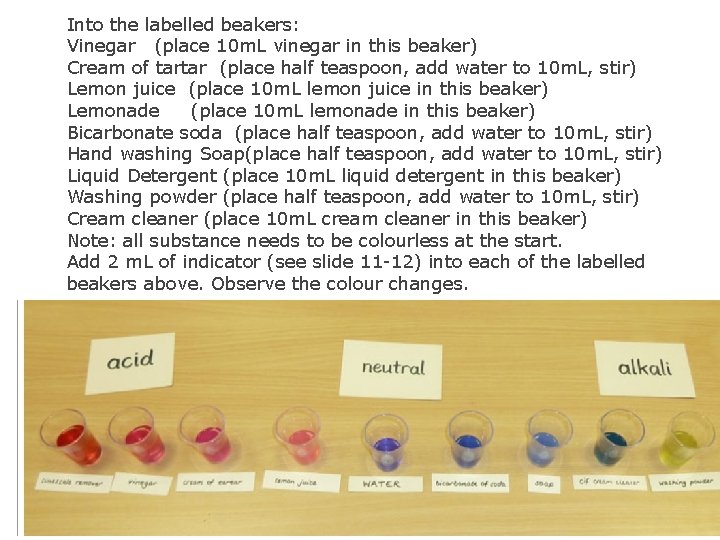
Into the labelled beakers: Vinegar (place 10 m. L vinegar in this beaker) Cream of tartar (place half teaspoon, add water to 10 m. L, stir) Lemon juice (place 10 m. L lemon juice in this beaker) Lemonade (place 10 m. L lemonade in this beaker) Bicarbonate soda (place half teaspoon, add water to 10 m. L, stir) Hand washing Soap(place half teaspoon, add water to 10 m. L, stir) Liquid Detergent (place 10 m. L liquid detergent in this beaker) Washing powder (place half teaspoon, add water to 10 m. L, stir) Cream cleaner (place 10 m. L cream cleaner in this beaker) Note: all substance needs to be colourless at the start. Add 2 m. L of indicator (see slide 11 -12) into each of the labelled beakers above. Observe the colour changes.
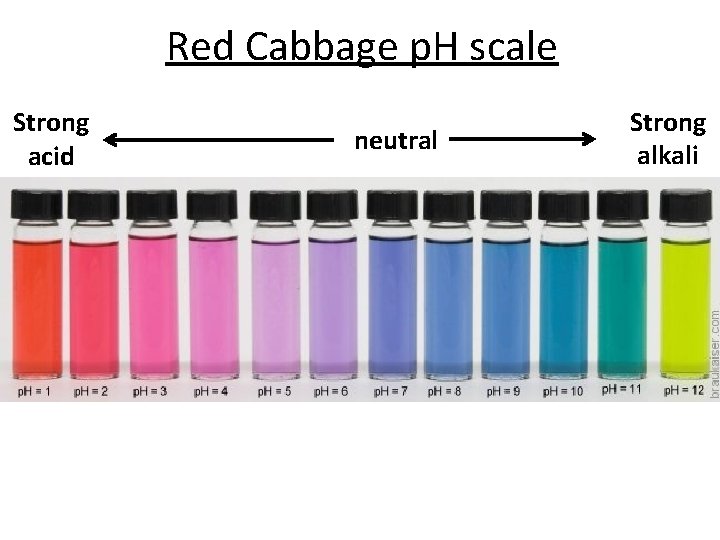
Red Cabbage p. H scale Strong acid neutral Strong alkali
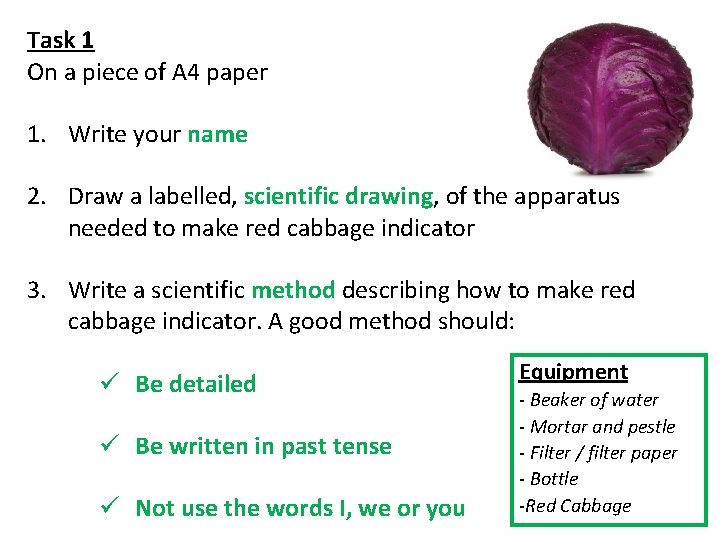
Task 1 On a piece of A 4 paper 1. Write your name 2. Draw a labelled, scientific drawing, of the apparatus needed to make red cabbage indicator 3. Write a scientific method describing how to make red cabbage indicator. A good method should: ü Be detailed ü Be written in past tense ü Not use the words I, we or you Equipment - Beaker of water - Mortar and pestle - Filter / filter paper - Bottle -Red Cabbage

p. H Poster Information Task q A ‘Universal Indicator’ p. H scale q Instructions of how to make ‘Red Cabbage Indicator’ q A ‘Red Cabbage Indicator’ p. H scale q Examples of acids, alkalis and neutral substances Design Task q Colourful q Easy to read
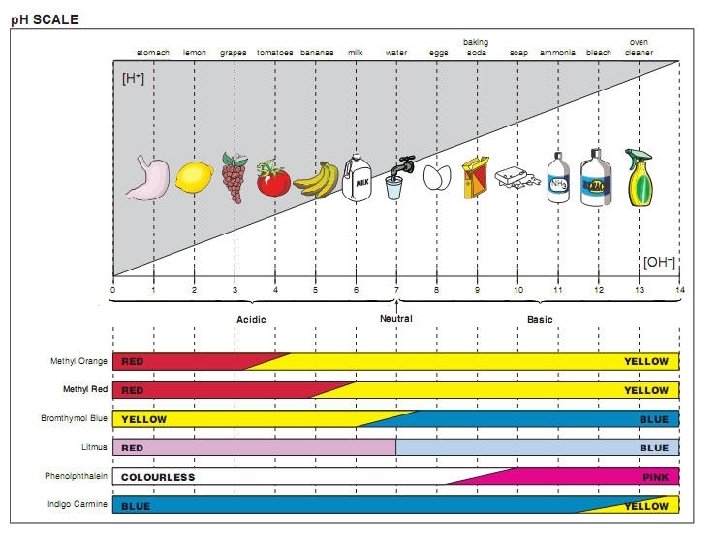
Suggested Questions for Students Is there a pattern between the products application and its p. H? – you will notice that the majority of the cleaning products (e. g. bleach, drain cleaner, toothpaste) are bases with a p. H above 7. This is because cleaning products require basic conditions to work efficiently. You will also notice that the food stuffs are acidic with a p. H below 7. This is because acids tend to have a sharp, bitter taste. Are p. H indicators always useful? – there are numerous uses for p. H indicators in everyday life. Examples are measuring the p. H of swimming pool and are used in the food and chemical industry. However, p. H indicators have the disadvantage that they have to be added to the sample in order to work. This could complicate further investigation of the sample as the indicator is in the sample solution. Is this process reversible? – this reaction should be reversible. If vinegar is added to a sample of toothpaste, then the colour should turn from blue to red via the initial purple. Likewise, addition of a basic compound to an acidic sample.
Suggested Improvements / Student Challenge Dipped strips of filter paper (or normal A 4 paper) in the red cabbage indicator and allow to dry. These strips of paper can also be used to test household substances. Use Ribena or beetroot – this experiment can also be done using Ribena or beetroot. However, Ribena does not change colour in the presence of acids. Essence from red rose can also be used as an indicator. Make a specific p. H – students could be challenged to make a solution of a specific p. H or colour using a selection of products. For example, starting from vinegar, what needs to be added to finish with a blue colour? Clean up and Waste Disposal The specific waste disposal protocols for this experiment will depend upon the choice of liquids used. Cabbage indicator solutions can be disposed of in the sink. Spillages can be cleaned with water and paper towel.
- Slides: 21