
Red Book framework hazard identification exposure assessment point
“Red Book” framework, hazard identification, exposure assessment, point estimates of risk In the International Perspectives on Quantitative Microbial Risk Assessment (ENVE 865 Special. Topics) At Drexel University, Philadelphia, PA, USA Arun Kumar, Ph. D. Department of Civil Engineering, IIT Delhi (arunku@civil. iitd. ac. in) Date: December 16 th, 2013 1
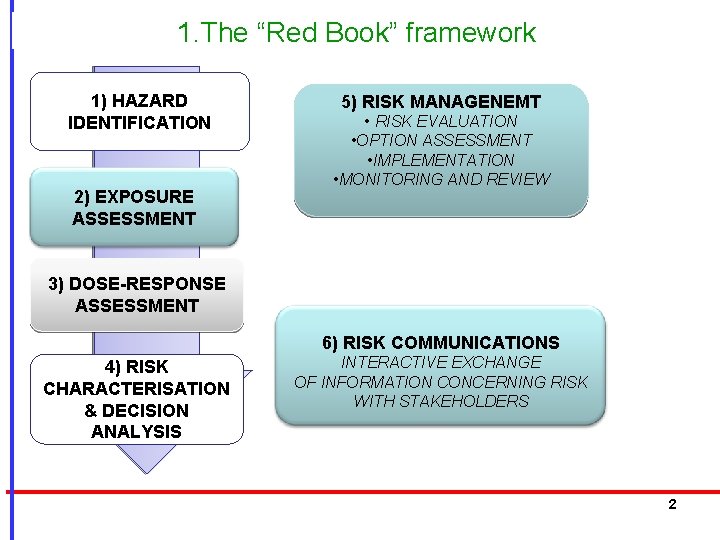
1. The “Red Book” framework 1) HAZARD IDENTIFICATION 2) EXPOSURE ASSESSMENT 5) RISK MANAGENEMT • RISK EVALUATION • OPTION ASSESSMENT • IMPLEMENTATION • MONITORING AND REVIEW 3) DOSE-RESPONSE ASSESSMENT 6) RISK COMMUNICATIONS 4) RISK CHARACTERISATION & DECISION ANALYSIS INTERACTIVE EXCHANGE OF INFORMATION CONCERNING RISK WITH STAKEHOLDERS 2
1. Hazard Identification 1. 2. 3. Hazard? Types and categories? How to find out and what information to look for? ROTAVIRUS 10 January 2022 arunku@civil. iitd. ac. in 3
2. Exposure Assessment 1. 2. 3. Exposure pathways? Exposure routes? Exposure parameters (types, sources of information and uncertainty) 10 January 2022 arunku@civil. iitd. ac. in 4
v. Exposure route Ingestion; inhalation; dermal contact (examples? ) v. Exposure parameters Exposure concentration, exposure frequency and duration, exposed subpopulation type 10 January 2022 5
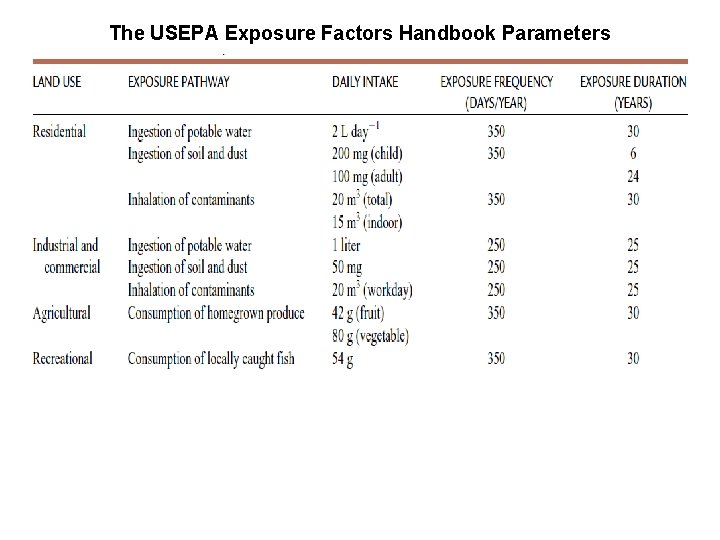
The USEPA Exposure Factors Handbook Parameters

DOSE-RESPONSE ASSESSMENT The choice of model is critical so that risks are not greatly overestimated or underestimated. A modified exponential (beta-Poisson distribution) or a logprobit (simple lognormal, or exponential, distribution) model may be used to describe the probability of infection in human subjects for many enteric microorganisms (Haas, 1983).
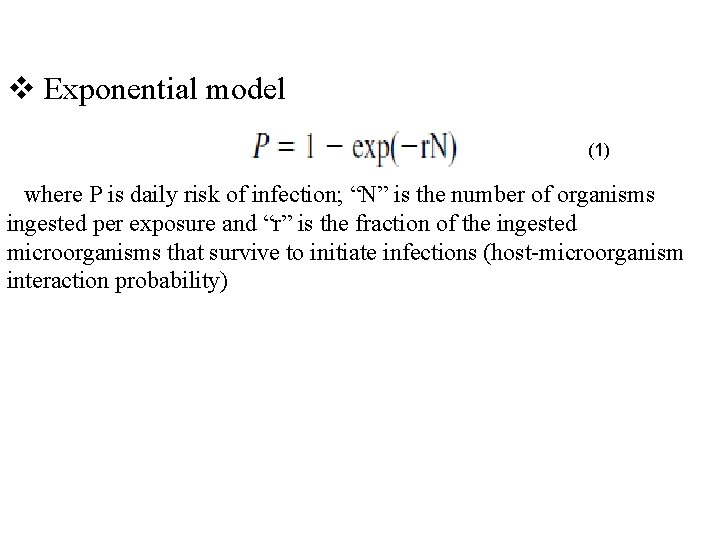
v Exponential model (1) where P is daily risk of infection; “N” is the number of organisms ingested per exposure and “r” is the fraction of the ingested microorganisms that survive to initiate infections (host-microorganism interaction probability)
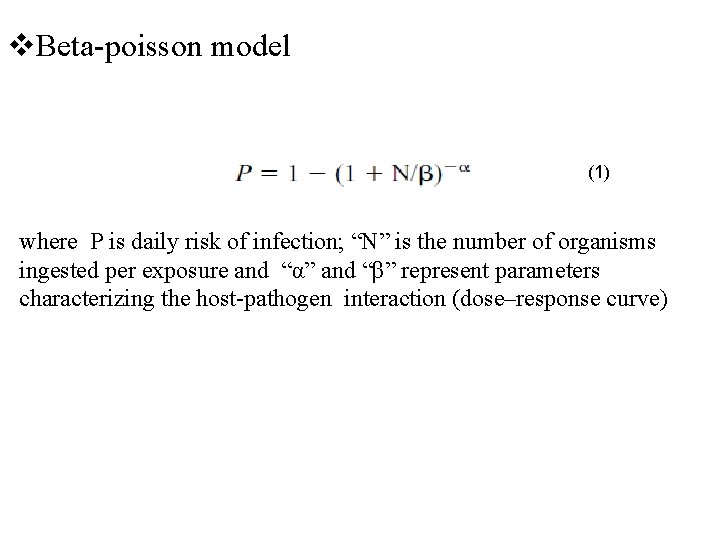
v. Beta-poisson model (1) where P is daily risk of infection; “N” is the number of organisms ingested per exposure and “α” and “β” represent parameters characterizing the host-pathogen interaction (dose–response curve)
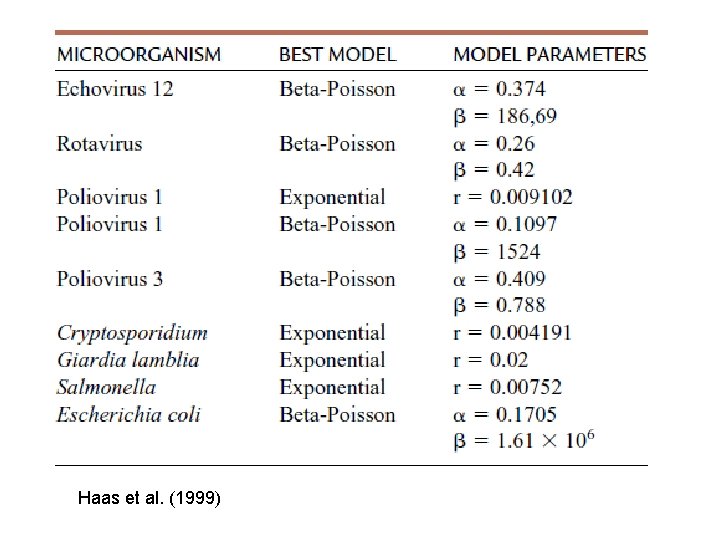
Haas et al. (1999)
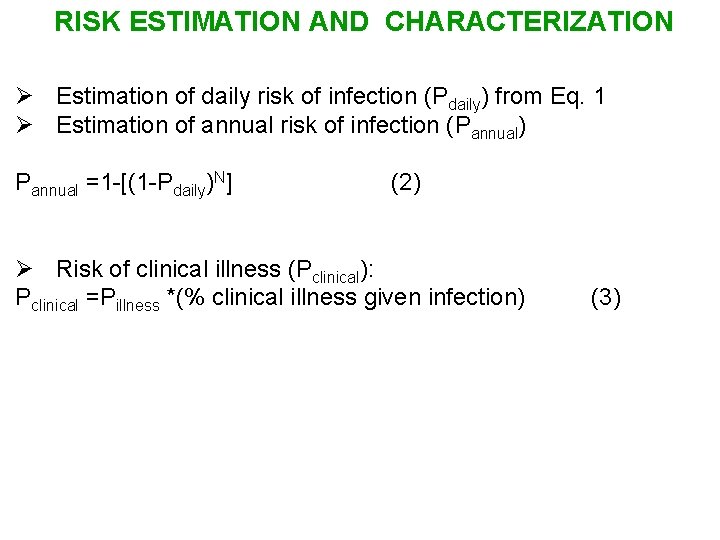
RISK ESTIMATION AND CHARACTERIZATION Ø Estimation of daily risk of infection (Pdaily) from Eq. 1 Ø Estimation of annual risk of infection (Pannual) Pannual =1 -[(1 -Pdaily)N] (2) Ø Risk of clinical illness (Pclinical): Pclinical =Pillness *(% clinical illness given infection) (3)
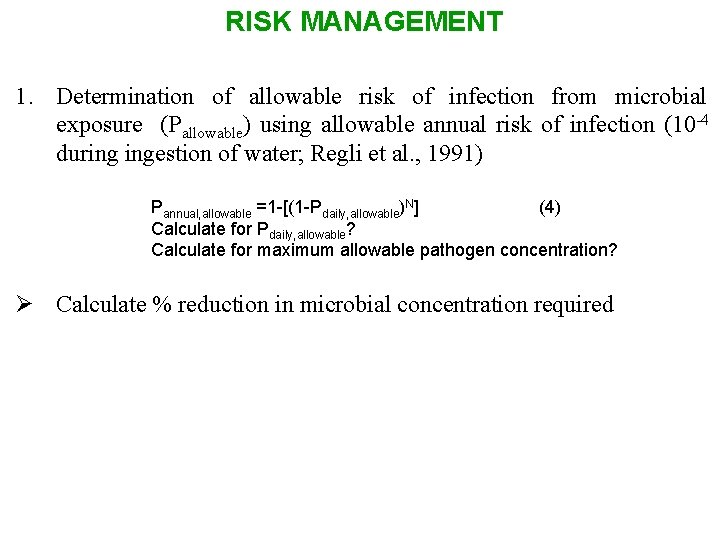
RISK MANAGEMENT 1. Determination of allowable risk of infection from microbial exposure (Pallowable) using allowable annual risk of infection (10 -4 during ingestion of water; Regli et al. , 1991) Pannual, allowable =1 -[(1 -Pdaily, allowable)N] (4) Calculate for Pdaily, allowable? Calculate for maximum allowable pathogen concentration? Ø Calculate % reduction in microbial concentration required
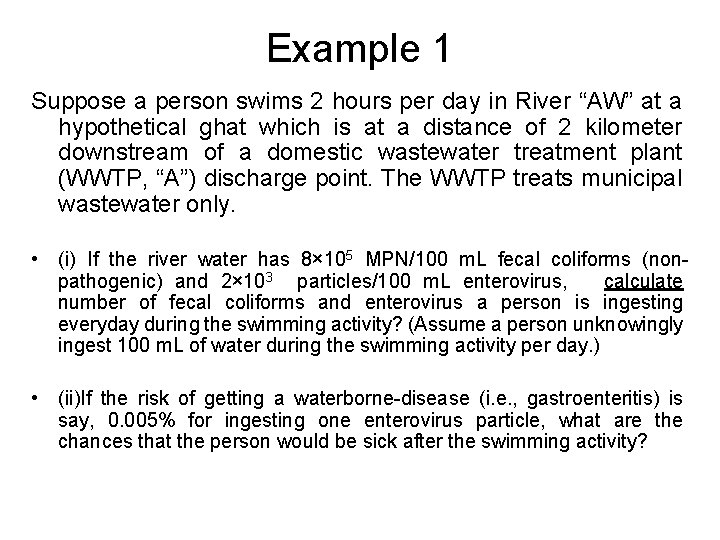
Example 1 Suppose a person swims 2 hours per day in River “AW” at a hypothetical ghat which is at a distance of 2 kilometer downstream of a domestic wastewater treatment plant (WWTP, “A”) discharge point. The WWTP treats municipal wastewater only. • (i) If the river water has 8× 10⁵ MPN/100 m. L fecal coliforms (nonpathogenic) and 2× 10³ particles/100 m. L enterovirus, calculate number of fecal coliforms and enterovirus a person is ingesting everyday during the swimming activity? (Assume a person unknowingly ingest 100 m. L of water during the swimming activity per day. ) • (ii)If the risk of getting a waterborne-disease (i. e. , gastroenteritis) is say, 0. 005% for ingesting one enterovirus particle, what are the chances that the person would be sick after the swimming activity?
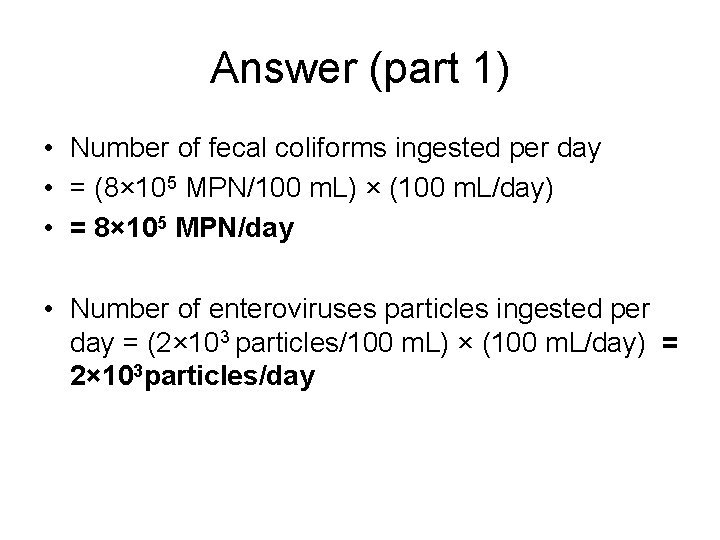
Answer (part 1) • Number of fecal coliforms ingested per day • = (8× 10⁵ MPN/100 m. L) × (100 m. L/day) • = 8× 10⁵ MPN/day • Number of enteroviruses particles ingested per day = (2× 10³ particles/100 m. L) × (100 m. L/day) = 2× 10³ particles/day
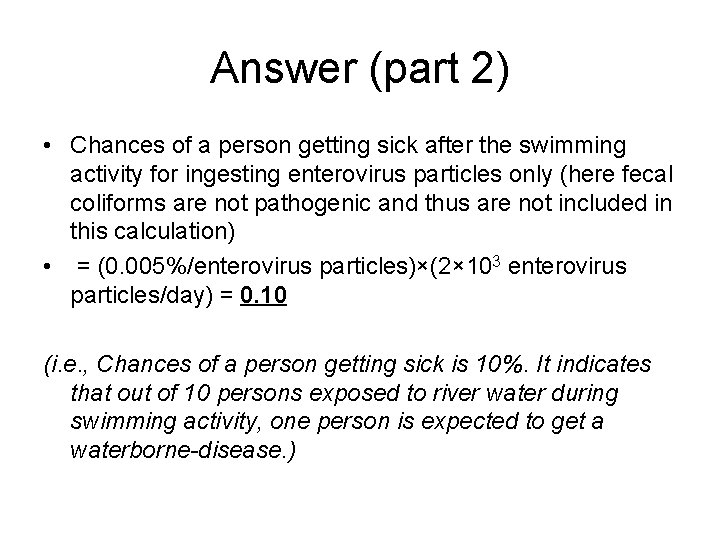
Answer (part 2) • Chances of a person getting sick after the swimming activity for ingesting enterovirus particles only (here fecal coliforms are not pathogenic and thus are not included in this calculation) • = (0. 005%/enterovirus particles)×(2× 10³ enterovirus particles/day) = 0. 10 (i. e. , Chances of a person getting sick is 10%. It indicates that out of 10 persons exposed to river water during swimming activity, one person is expected to get a waterborne-disease. )
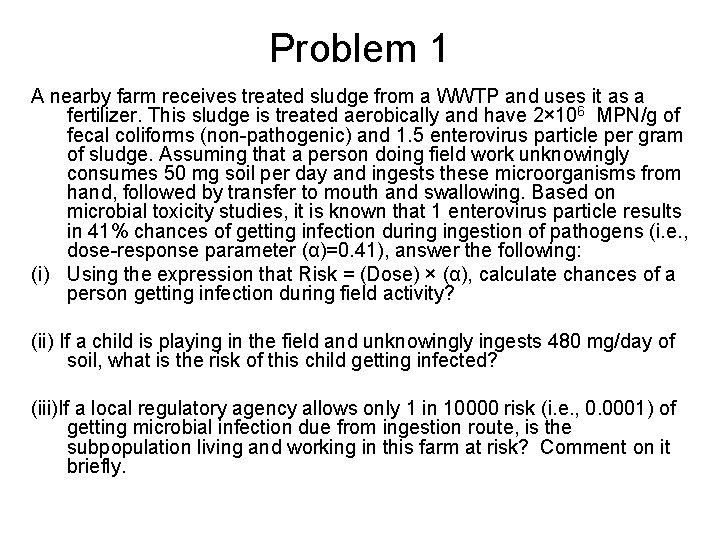
Problem 1 A nearby farm receives treated sludge from a WWTP and uses it as a fertilizer. This sludge is treated aerobically and have 2× 10⁶ MPN/g of fecal coliforms (non-pathogenic) and 1. 5 enterovirus particle per gram of sludge. Assuming that a person doing field work unknowingly consumes 50 mg soil per day and ingests these microorganisms from hand, followed by transfer to mouth and swallowing. Based on microbial toxicity studies, it is known that 1 enterovirus particle results in 41% chances of getting infection during ingestion of pathogens (i. e. , dose-response parameter (α)=0. 41), answer the following: (i) Using the expression that Risk = (Dose) × (α), calculate chances of a person getting infection during field activity? (ii) If a child is playing in the field and unknowingly ingests 480 mg/day of soil, what is the risk of this child getting infected? (iii)If a local regulatory agency allows only 1 in 10000 risk (i. e. , 0. 0001) of getting microbial infection due from ingestion route, is the subpopulation living and working in this farm at risk? Comment on it briefly.
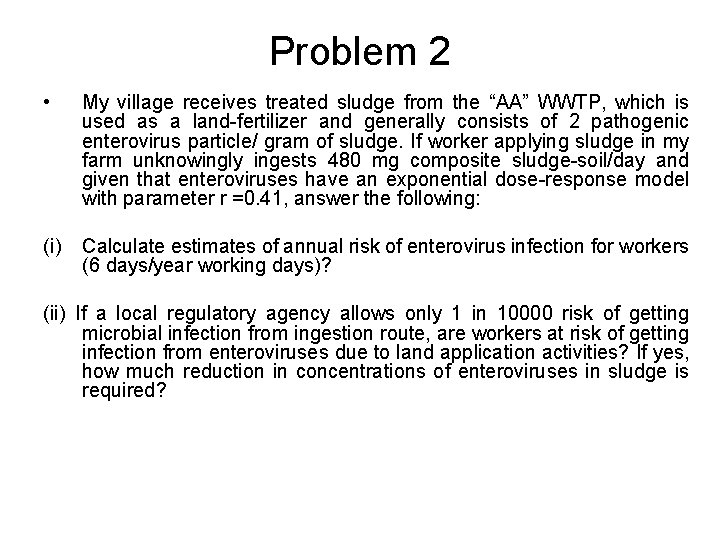
Problem 2 • My village receives treated sludge from the “AA” WWTP, which is used as a land-fertilizer and generally consists of 2 pathogenic enterovirus particle/ gram of sludge. If worker applying sludge in my farm unknowingly ingests 480 mg composite sludge-soil/day and given that enteroviruses have an exponential dose-response model with parameter r =0. 41, answer the following: (i) Calculate estimates of annual risk of enterovirus infection for workers (6 days/year working days)? (ii) If a local regulatory agency allows only 1 in 10000 risk of getting microbial infection from ingestion route, are workers at risk of getting infection from enteroviruses due to land application activities? If yes, how much reduction in concentrations of enteroviruses in sludge is required?
References • Gerba, C. P. (2000) Risk assessment. In: Environmental Microbiology (Gerba, C. P. , Maier, R. M. and Pepper, I. L. , Eds. ), pp. 557– 571. Academic Press, London. • Haas, C. N. , Rose, J. B. , & Gerba, C. P. (1999). Quantitative microbial risk assessment, John Wiley & Sons, Inc. New York, NY. • Regli, S. , Rose, J. B. , Haas, C. N. , & Gerba, C. P. (1991). Modeling the risk from giardia and viruses in drinking water. Journal of American Water Works Association, 83, 76 -84. • Mara, D. D. , Sleigh, P. A. , Blumenthal, U. J. , Carr, R. M. , (2007). “Health risks in wastewater irrigation: Comparing estimates from quantitative microbial risk analysis and epidemiological studies”. Journal of water and Health, 05. 1. 10 January 2022 arunku@civil. iitd. ac. in 18

Please contact: Dr. Arun Kumar (arunku@civil. iitd. ac. in) 19
- Slides: 19