
Red Black Trees Colored Nodes Definition Binary search
Red Black Trees Colored Nodes Definition • Binary search tree. • Each node is colored or black. • Root and all external nodes are black. • No root-to-external-node path has two consecutive red nodes. • All root-to-external-node paths have the same number of black nodes
Red Black Trees Colored Edges Definition • Binary search tree. • Child pointers are colored or black. • Pointer to an external node is black. • No root to external node path has two consecutive red pointers. • Every root to external node path has the same number of black pointers.
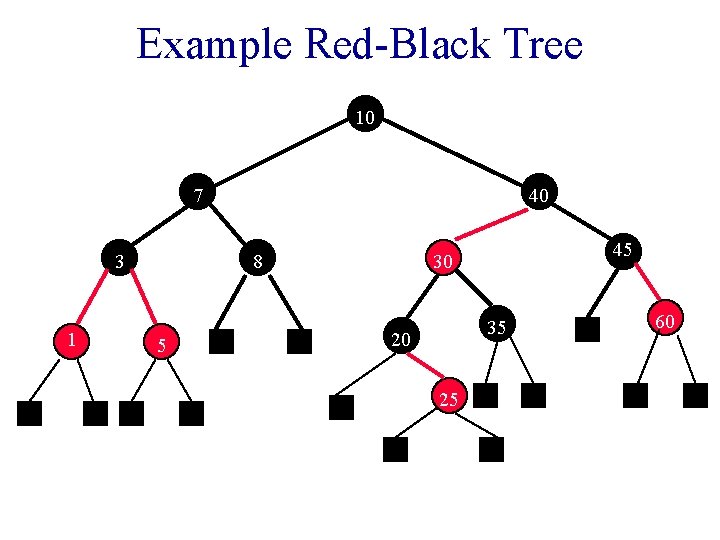
Example Red-Black Tree 10 7 3 1 40 8 5 45 30 35 20 25 60
Properties • The height of a red black tree that has n (internal) nodes is between log 2(n+1) and 2 log 2(n+1).
Properties • Start with a red black tree whose height is h; collapse all red nodes into their parent black nodes to get a tree whose node-degrees are between 2 and 4, height is >= h/2, and all external nodes are at the same level.
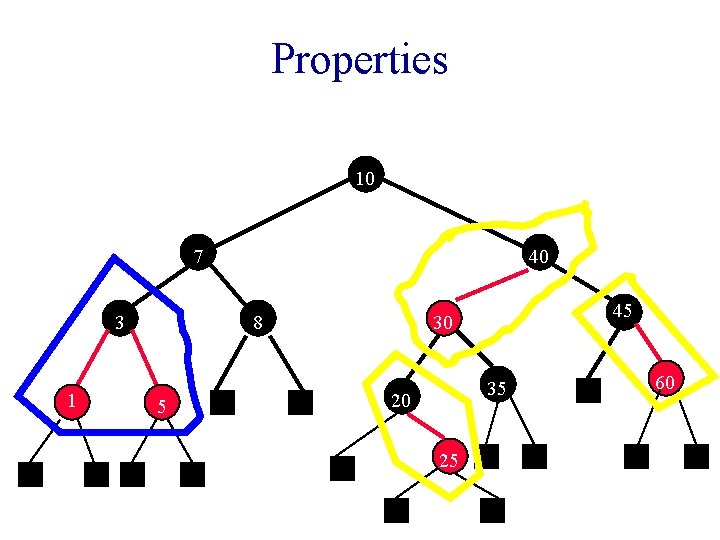
Properties 10 7 3 1 40 8 5 45 30 35 20 25 60
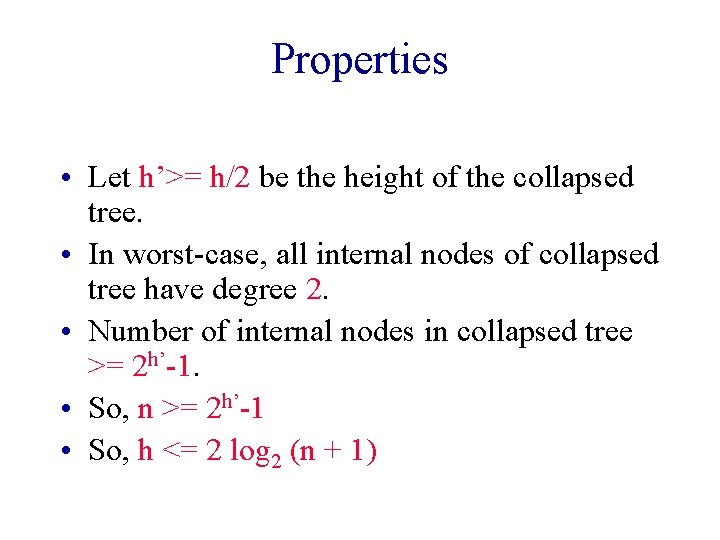
Properties • Let h’>= h/2 be the height of the collapsed tree. • In worst-case, all internal nodes of collapsed tree have degree 2. • Number of internal nodes in collapsed tree >= 2 h’-1. • So, n >= 2 h’-1 • So, h <= 2 log 2 (n + 1)
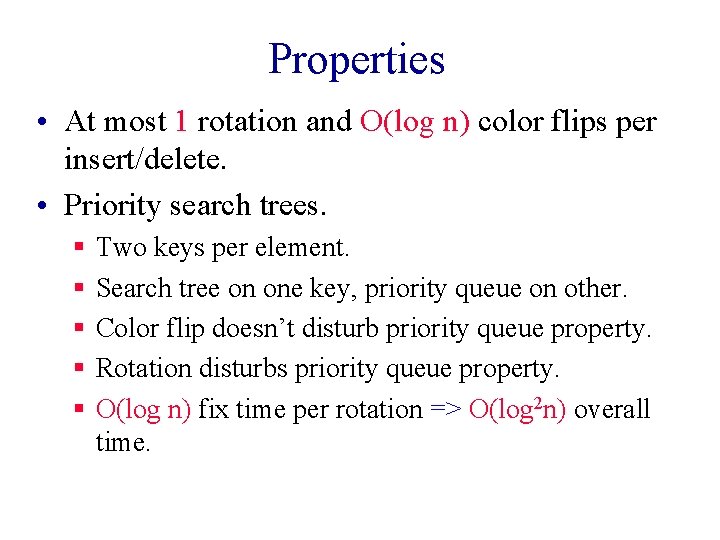
Properties • At most 1 rotation and O(log n) color flips per insert/delete. • Priority search trees. § § § Two keys per element. Search tree on one key, priority queue on other. Color flip doesn’t disturb priority queue property. Rotation disturbs priority queue property. O(log n) fix time per rotation => O(log 2 n) overall time.
Properties • O(1) amortized complexity to restructure following an insert/delete. • C++ STL implementation • java. util. Tree. Map => red black tree
Insert • New pair is placed in a new node, which is inserted into the red-black tree. • New node color options. § Black node => one root-to-external-node path has an extra black node (black pointer). • Hard to remedy. § Red node => one root-to-external-node path may have two consecutive red nodes (pointers). • May be remedied by color flips and/or a rotation.
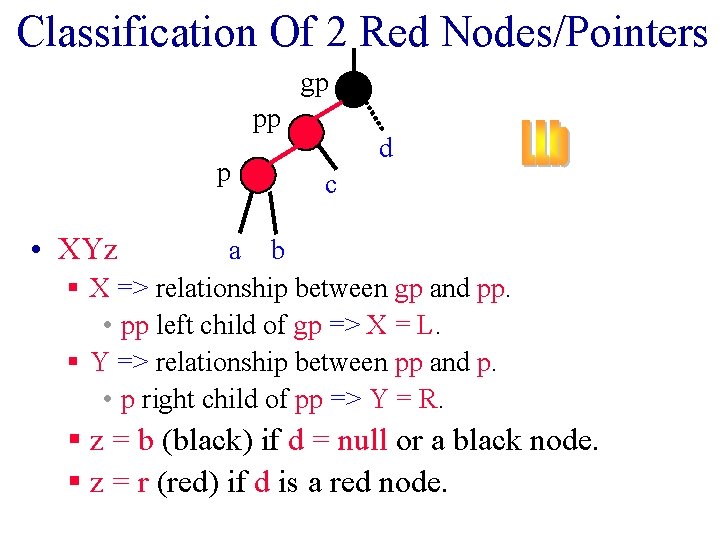
Classification Of 2 Red Nodes/Pointers gp pp p d c • XYz a b § X => relationship between gp and pp. • pp left child of gp => X = L. § Y => relationship between pp and p. • p right child of pp => Y = R. § z = b (black) if d = null or a black node. § z = r (red) if d is a red node.
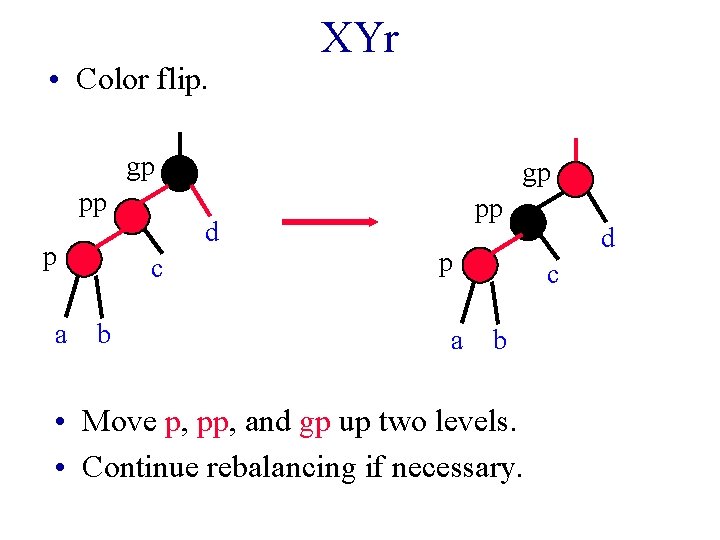
• Color flip. XYr gp pp p a d c b • Move p, pp, and gp up two levels. • Continue rebalancing if necessary.
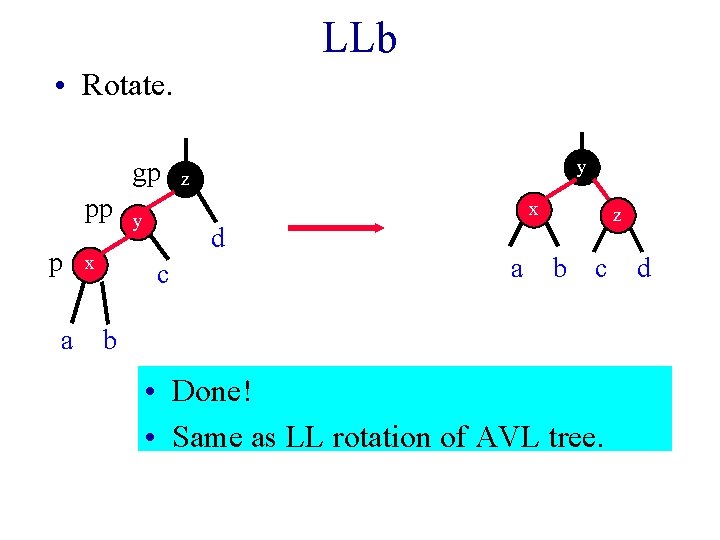
LLb • Rotate. gp pp p a x y z x y d c a z b c b • Done! • Same as LL rotation of AVL tree. d
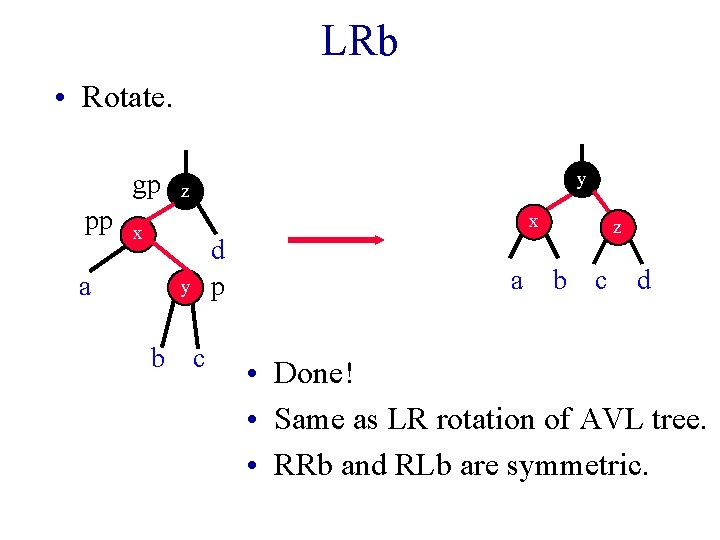
LRb • Rotate. gp pp y z x x a d p y b c a z b c d • Done! • Same as LR rotation of AVL tree. • RRb and RLb are symmetric.
Delete • Delete as for unbalanced binary search tree. • If red node deleted, no rebalancing needed. • If black node deleted, a subtree becomes one black pointer (node) deficient.
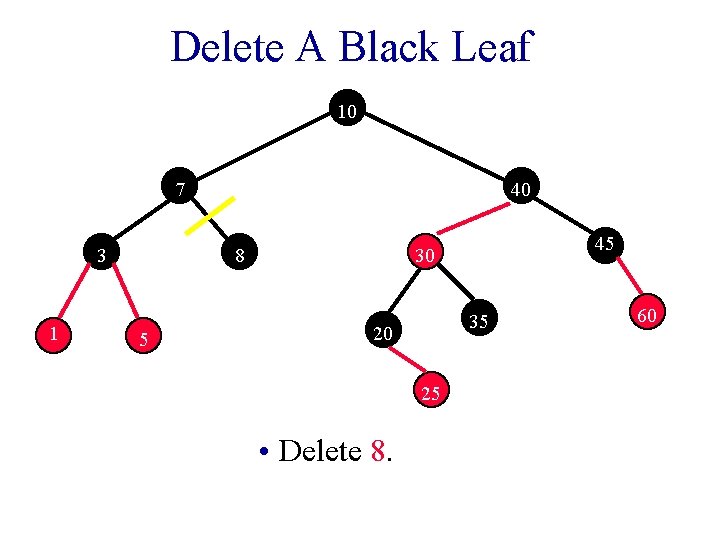
Delete A Black Leaf 10 7 3 1 40 8 5 45 30 35 20 25 • Delete 8. 60
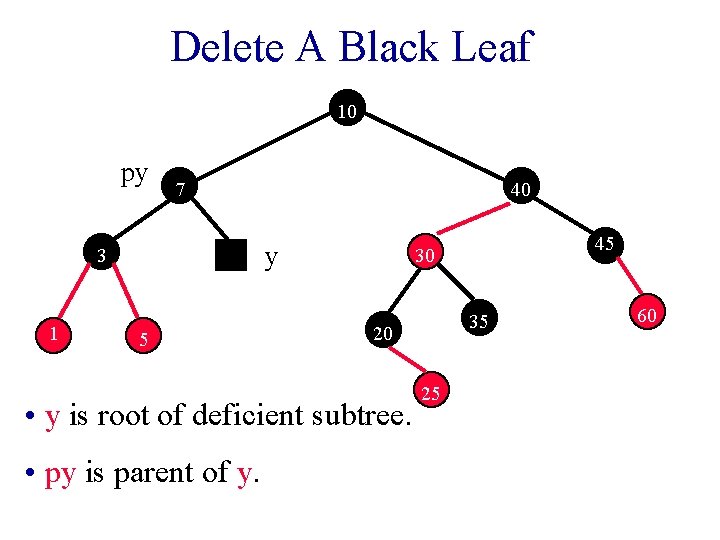
Delete A Black Leaf 10 py 7 y 3 1 40 5 35 20 • y is root of deficient subtree. • py is parent of y. 45 30 25 60
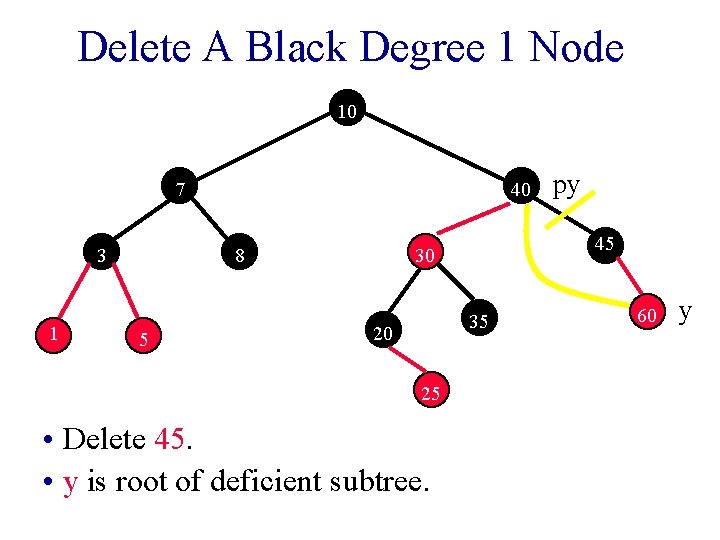
Delete A Black Degree 1 Node 10 7 3 1 40 8 5 45 30 35 20 25 • Delete 45. • y is root of deficient subtree. py 60 y
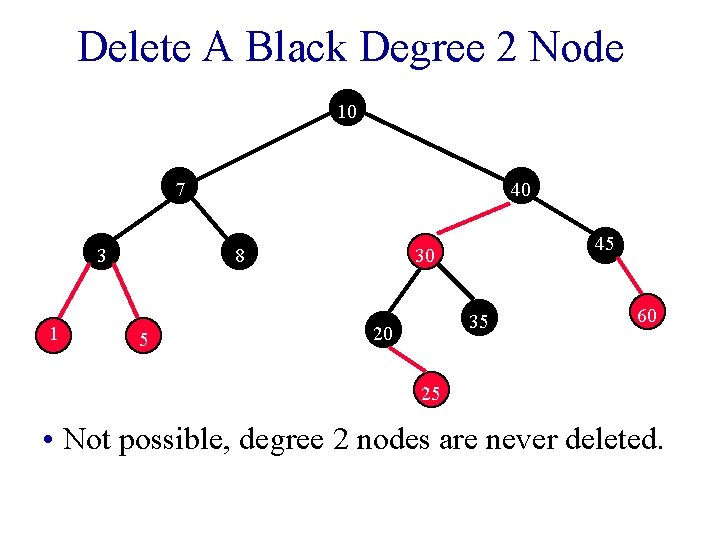
Delete A Black Degree 2 Node 10 7 3 1 40 8 5 45 30 35 20 60 25 • Not possible, degree 2 nodes are never deleted.
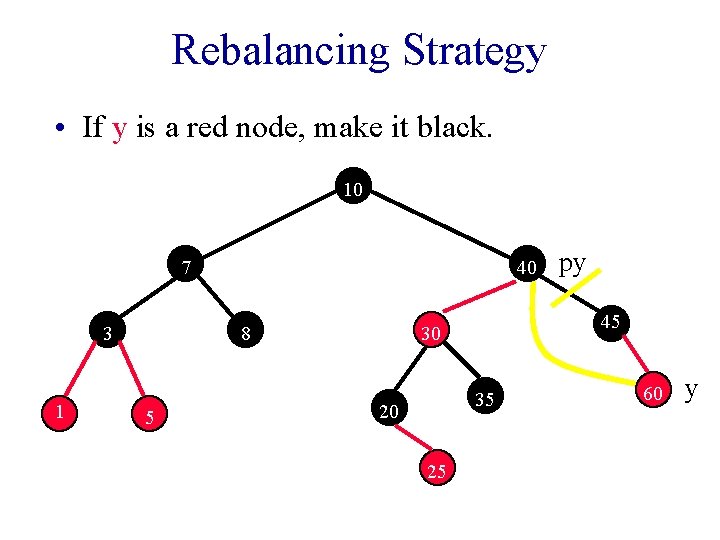
Rebalancing Strategy • If y is a red node, make it black. 10 7 3 1 40 8 5 45 30 35 20 25 py 60 y
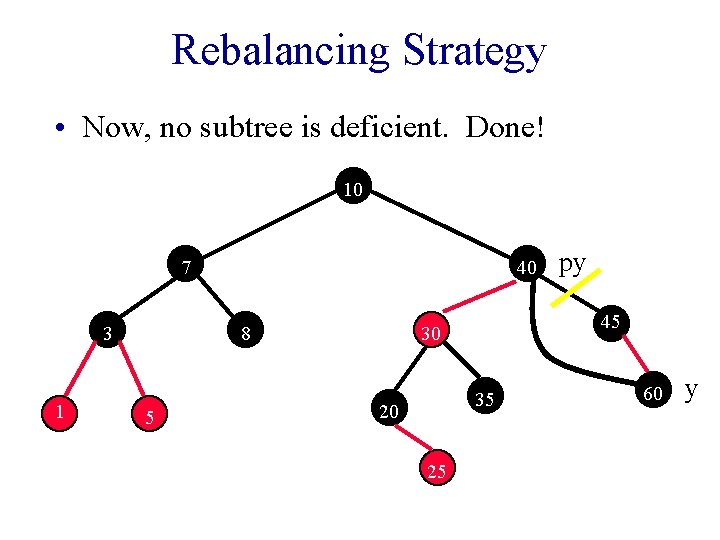
Rebalancing Strategy • Now, no subtree is deficient. Done! 10 7 3 1 40 8 5 45 30 35 20 25 py 60 y
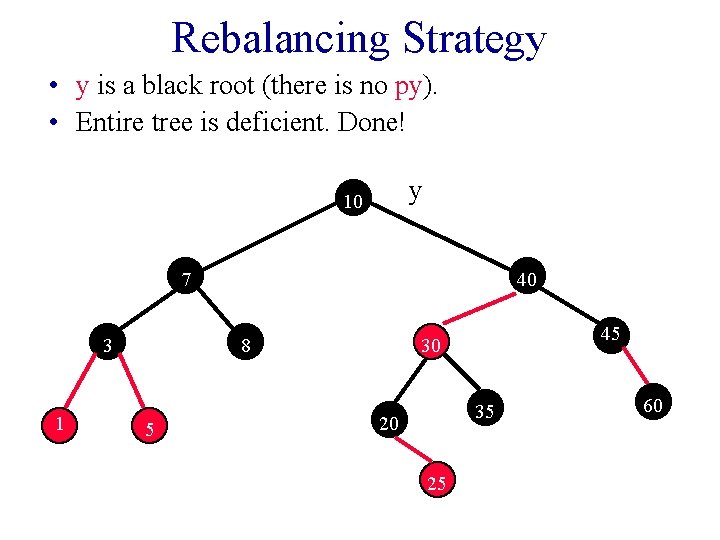
Rebalancing Strategy • y is a black root (there is no py). • Entire tree is deficient. Done! y 10 7 3 1 40 8 5 45 30 35 20 25 60
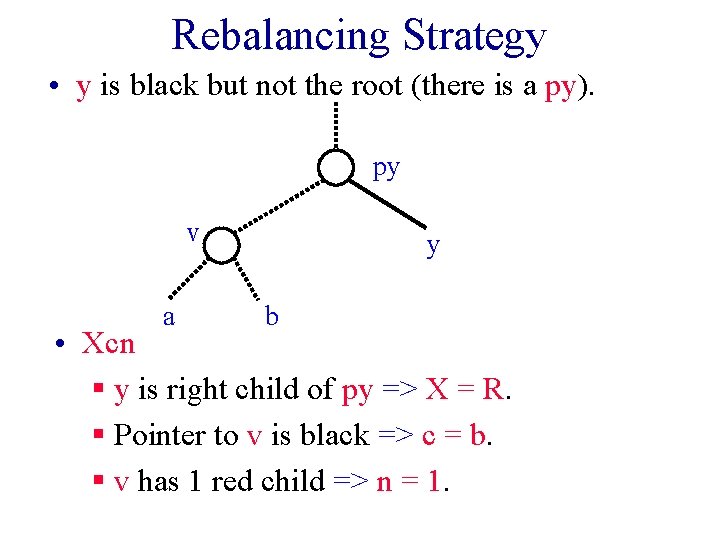
Rebalancing Strategy • y is black but not the root (there is a py). py v a y b • Xcn § y is right child of py => X = R. § Pointer to v is black => c = b. § v has 1 red child => n = 1.
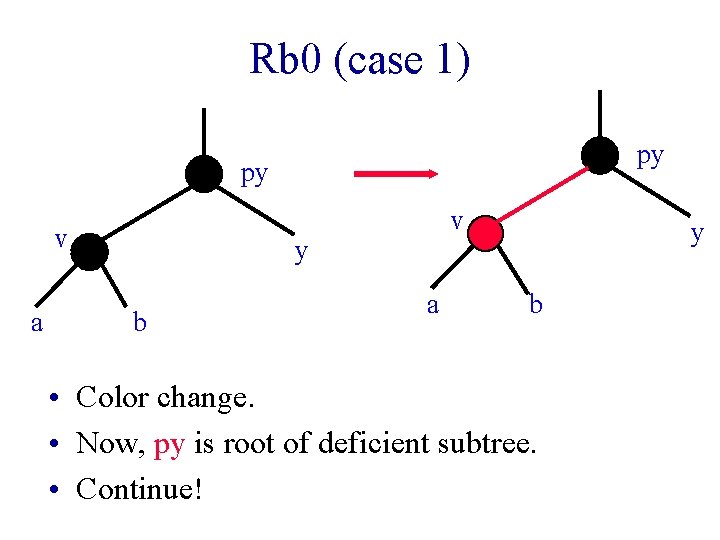
Rb 0 (case 1) py py v a v y b a y b • Color change. • Now, py is root of deficient subtree. • Continue!
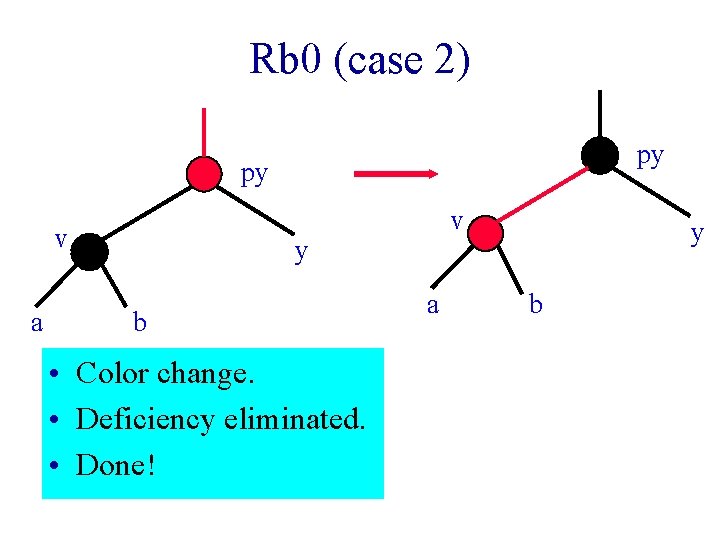
Rb 0 (case 2) py py v a v y b • Color change. • Deficiency eliminated. • Done! a y b
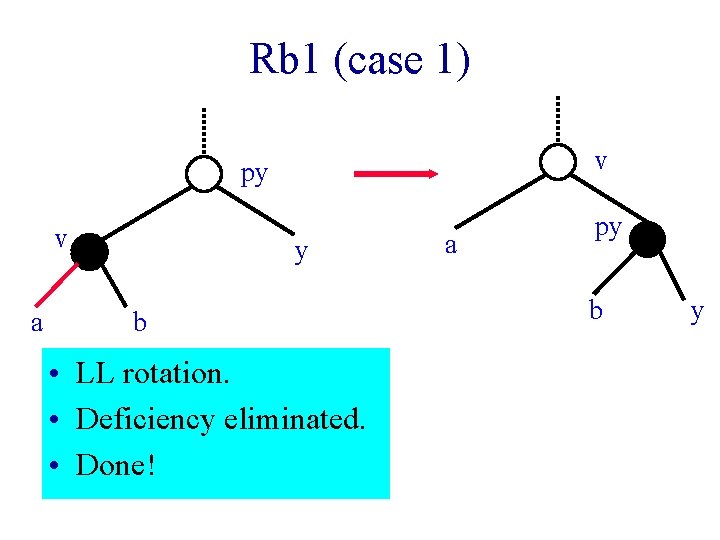
Rb 1 (case 1) v py v a y b • LL rotation. • Deficiency eliminated. • Done! a py b y
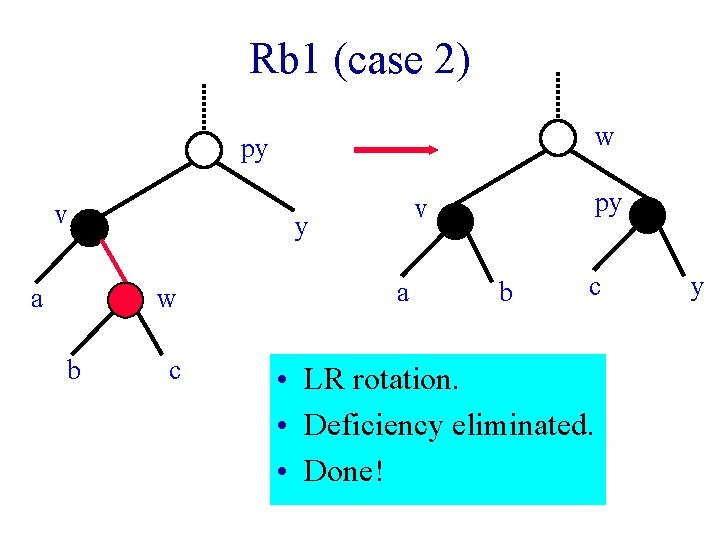
Rb 1 (case 2) w py v y w a b c py v a b c • LR rotation. • Deficiency eliminated. • Done! y
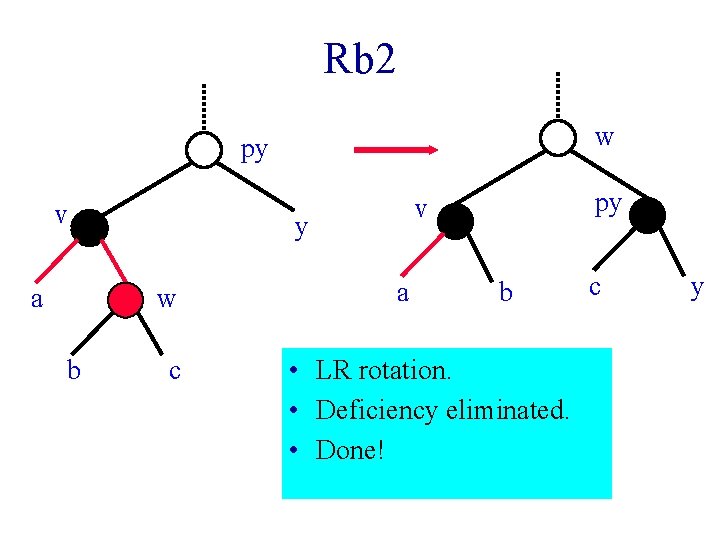
Rb 2 w py v y w a b c py v a b • LR rotation. • Deficiency eliminated. • Done! c y
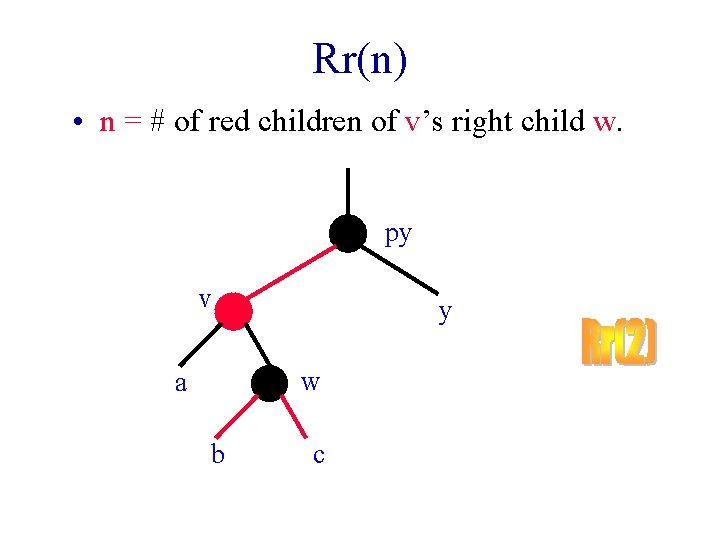
Rr(n) • n = # of red children of v’s right child w. py v y w a b c
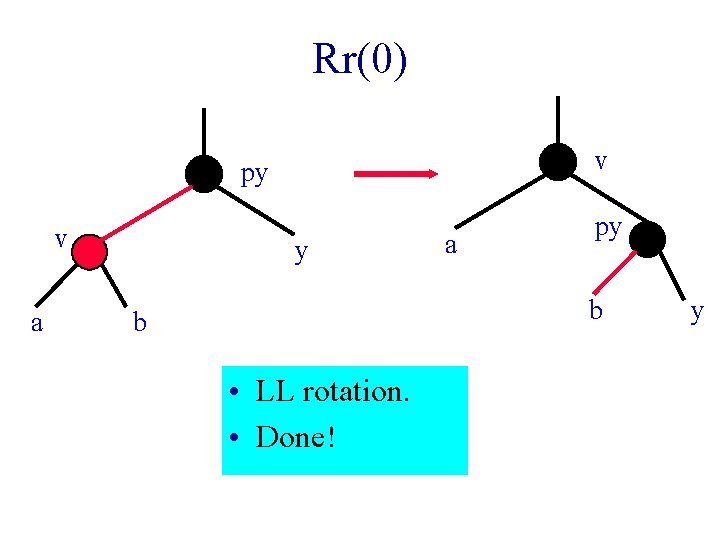
Rr(0) v py v a y a py b b • LL rotation. • Done! y
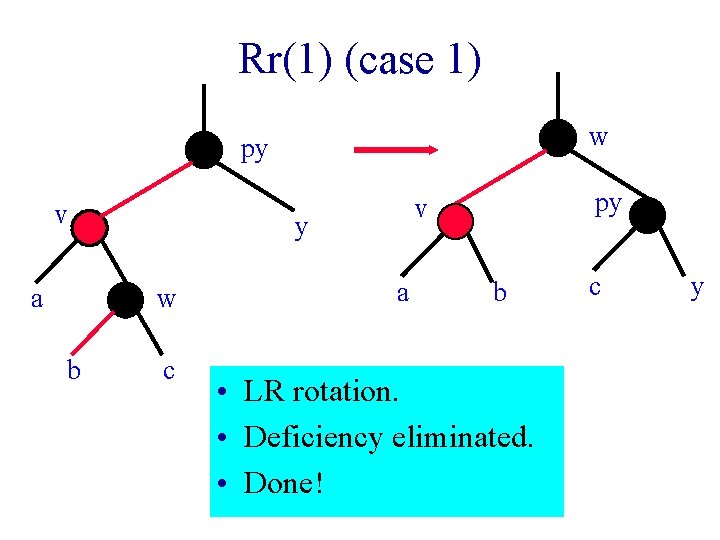
Rr(1) (case 1) w py v y w a b c py v a b • LR rotation. • Deficiency eliminated. • Done! c y
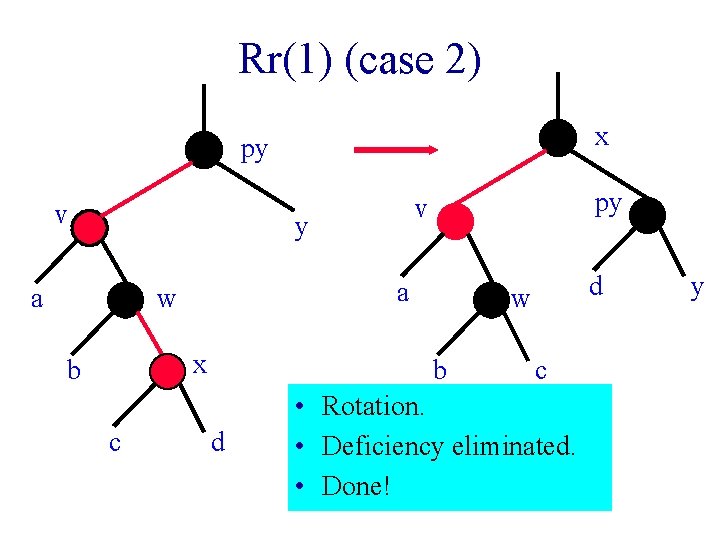
Rr(1) (case 2) x py v y a w a x b c py v b d d w c • Rotation. • Deficiency eliminated. • Done! y
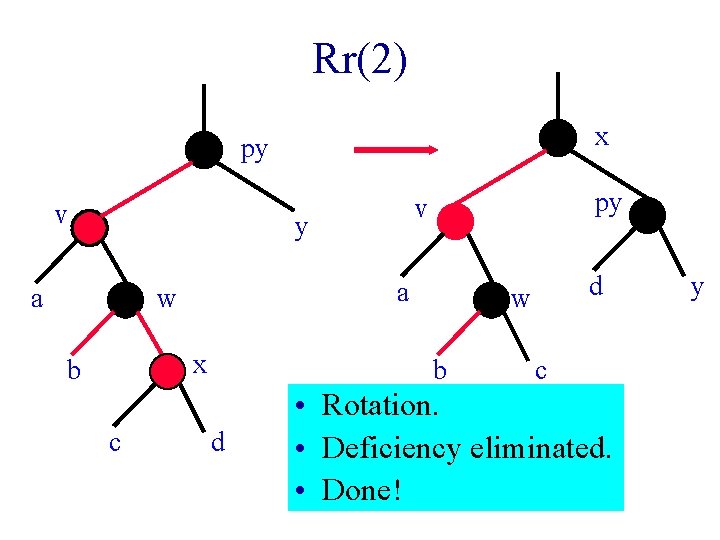
Rr(2) x py v y a w a x b c py v b d d w c • Rotation. • Deficiency eliminated. • Done! y
- Slides: 33